
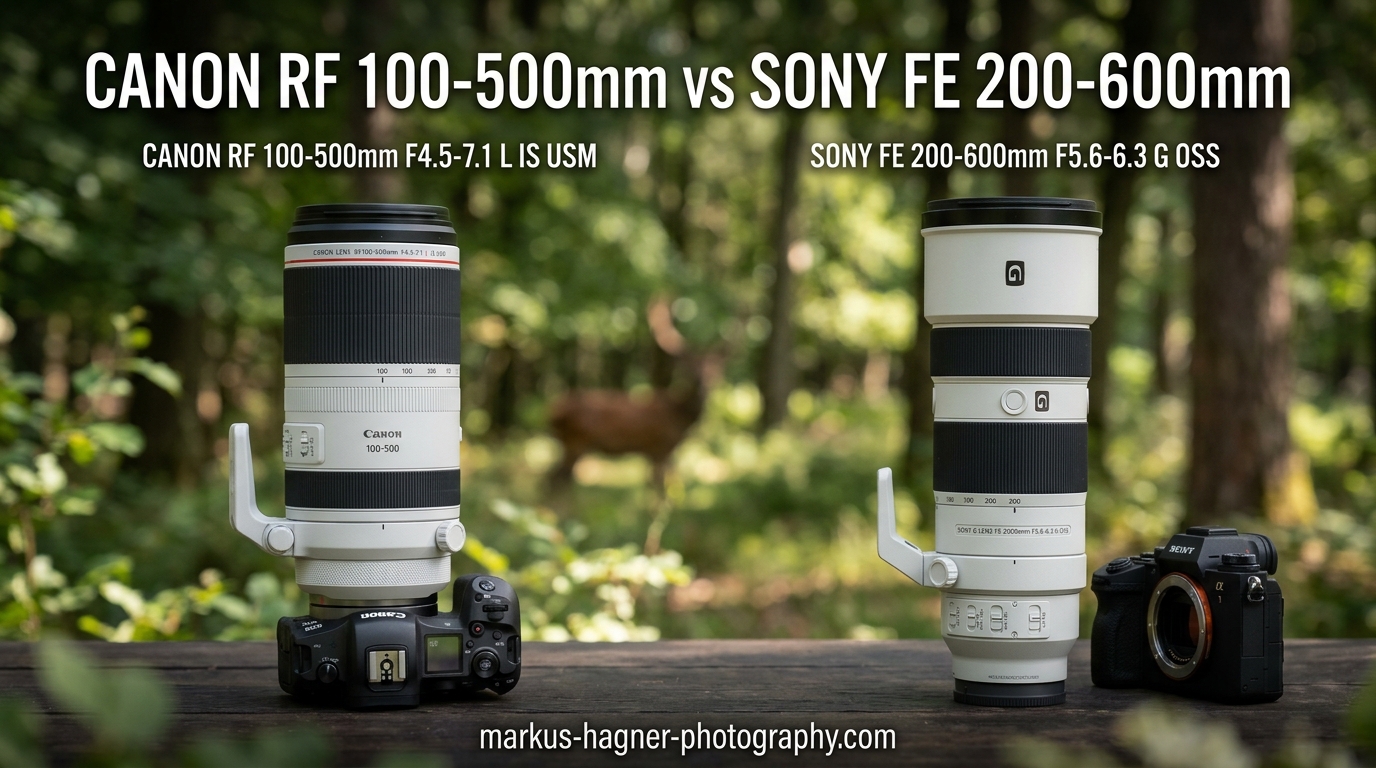
When it comes to super telephoto zoom lenses for wildlife, bird, and sports photography, two names consistently rise to the top of every photographer’s consideration list: the Canon RF 100-500mm f4.5-7.1L IS USM and the Sony FE 200-600mm f5.6-6.3 G OSS. Both lenses represent the pinnacle of professional telephoto zoom technology for their respective mirrorless camera systems, offering exceptional optical performance, advanced autofocus systems, and robust build quality that demanding photographers require.
In this comprehensive comparison guide, we’ll dive deep into every aspect of these two outstanding telephoto lenses to help you determine which one best suits your specific photography needs. Whether you’re a wildlife enthusiast just starting out or a seasoned professional looking to upgrade your kit, understanding the nuanced differences between these lenses will ensure you make an informed investment that serves you well for years to come.
Quick Comparison Overview
Before we delve into the detailed analysis, here’s a quick side-by-side comparison of the key specifications:
| Product | Specifications | Action |
|---|---|---|
 Canon RF 100-500mm f4.5-7.1L IS USM Canon RF 100-500mm f4.5-7.1L IS USM |
|
Check Latest Price |
 Sony FE 200-600mm f5.6-6.3 G OSS Sony FE 200-600mm f5.6-6.3 G OSS |
|
Check Latest Price |
Canon RF 100-500mm f4.5-7.1L IS USM – Detailed Review
Canon RF100-500mm F4.5-7.1 L is USM Lens, Super-Telephoto Zoom Lens, Compatible with EOS R Series Mirrorless Cameras, White
Pros
- Exceptional 100-500mm range
- Dual Nano USM autofocus
- L-series weather sealing
Cons
- Variable f/4.5-7.1 aperture
- Weighs 3 pounds
- No zoom lock mechanism
Canon’s RF 100-500mm f4.5-7.1L IS USM represents a remarkable achievement in lens engineering, offering an incredibly versatile focal length range that spans from standard telephoto into super telephoto territory. Released in 2020 as part of Canon’s RF mount ecosystem, this lens has quickly become a favorite among EOS R series photographers who need exceptional reach without sacrificing versatility.
Optical Performance and Sharpness
Throughout its extensive zoom range, the Canon RF 100-500mm delivers outstanding optical performance that meets the exacting standards of Canon’s prestigious L-series designation. The lens construction incorporates multiple UD (Ultra-low Dispersion) elements that effectively combat chromatic aberration and color fringing, ensuring that your images maintain excellent sharpness and color accuracy from edge to edge.
What truly sets this lens apart is its remarkable consistency across the entire zoom range. Whether you’re shooting at 100mm, 300mm, or the full 500mm, you’ll find that sharpness remains remarkably uniform, with only minimal soft corners at the extreme telephoto end under certain conditions. This consistency proves invaluable for wildlife photographers who often need to work quickly without time to fine-tune their compositions.
The lens also features Canon’s Air Sphere Coating (ASC), which dramatically reduces flare and ghosting when shooting into bright light sources. This coating technology is particularly beneficial for outdoor photographers who frequently find themselves shooting with the sun in or near the frame, common in wildlife and sports photography.
Autofocus System
Equipped with Canon’s revolutionary Dual Nano USM (Ultrasonic Motor) autofocus system, the RF 100-500mm delivers the fast, smooth, and virtually silent focusing performance that modern photographers demand. This advanced motor system provides approximately 70% faster autofocus acquisition compared to previous generation lenses, with focus acquisition times as quick as 0.05 seconds in optimal conditions.
The autofocus system excels at subject tracking, making it particularly well-suited for dynamic subjects like birds in flight, athletes in motion, and other fast-moving wildlife. The lens maintains consistent focus lock even when subjects move erratically or change direction suddenly, thanks to Canon’s sophisticated subject recognition algorithms when used with compatible camera bodies.
For videographers, the silent autofocus operation proves invaluable, as the lens won’t produce audible focusing noise that would ruin clean audio tracks. The smooth focus transitions also translate beautifully to video work, where gradual focus pulls are often preferred over abrupt snaps.
Image Stabilization
Canon’s implementation of image stabilization in the RF 100-500mm is nothing short of exceptional. The lens offers up to 5 stops of shake correction, which can be combined with in-body image stabilization (IBIS) on compatible camera bodies like the EOS R5 and R6 for even more effective stabilization.
What makes this lens particularly versatile is its three distinct Image Stabilization modes:
- Mode 1 (Standard): Ideal for general handheld shooting, providing correction in all directions
- Mode 2 (Panning): Optimized for horizontal or vertical panning movements while still correcting for unwanted vertical or horizontal shake
- Mode 3 (During Exposure Only): Activates stabilization only at the moment of exposure, ideal for unpredictable subject movement
These selectable modes give photographers unprecedented control over stabilization behavior, allowing you to optimize performance for specific shooting scenarios rather than using a one-size-fits-all approach.
Minimum Focus Distance
One of the Canon RF 100-500mm’s standout features is its impressive minimum focus distance of just 0.9 meters (3 feet) throughout the entire zoom range. This close focusing capability transforms the lens from a pure telephoto into a surprisingly versatile tool for near-range subjects as well.
At 100mm, this translates to a maximum magnification of approximately 0.33x, which approaches true macro territory. This makes the lens unexpectedly capable for photographing flowers, insects, and other small subjects that you might encounter during nature walks. The ability to focus close combined with the effective image stabilization opens up creative possibilities that pure wildlife lenses simply cannot match.
Sony FE 200-600mm f5.6-6.3 G OSS – Detailed Review
Pros
- 600mm reach with TC support
- 5x ED glass elements
- Internal zoom design
Cons
- Weighs 4.66 pounds
- Slower f/5.6-6.3 aperture
- Tripod foot not Arca-Swiss
Sony’s FE 200-600mm f5.6-6.3 G OSS represents the Japanese manufacturer’s flagship super telephoto zoom for their full-frame Alpha mirrorless system. Released in 2019, this lens has established itself as the go-to choice for Sony shooters who need serious reach for wildlife, bird, and sports photography without breaking the bank.
Optical Performance and Sharpness
The optical design of the Sony 200-600mm is nothing short of impressive, featuring 5 ED (Extra-low Dispersion) glass elements strategically positioned throughout the optical path to minimize chromatic aberration and ensure excellent color fidelity. Combined with 1 aspherical element that dramatically reduces spherical aberration, this lens delivers the kind of edge-to-edge sharpness that professional photographers demand.
Throughout its zoom range, the lens maintains remarkably consistent performance, though sharpness does show slight variation at the maximum 600mm extension where diffraction begins to play a more significant role at smaller apertures. However, even at maximum telephoto, the lens produces images more than suitable for large prints and professional applications.
Sony’s Nano AR (Anti-Reflective) coating does an excellent job of suppressing flare, ghosting, and internal reflections, allowing photographers to confidently shoot toward the sun without catastrophic image degradation. While some contrast loss occurs when shooting directly into bright light, the performance is competitive with lenses costing significantly more.
Autofocus System
Powering the autofocus system is Sony’s Direct Drive Super Sonic Wave Motor (DDSSM), which provides fast, precise, and whisper-quiet focusing operation. This motor delivers the kind of instantaneous focus acquisition that wildlife and sports photographers require, ensuring you never miss the decisive moment due to slow or hesitant autofocus performance.
When paired with Sony’s advanced Real-Time Tracking and Eye AF systems found in modern Alpha bodies, the 200-600mm becomes an extraordinarily capable subject-tracking tool. The lens maintains focus lock on birds in flight, running athletes, and other fast-moving subjects with impressive reliability, making it an excellent choice for action photography.
The focus response is particularly impressive given the lens’s super telephoto reach, as maintaining accurate focus at 600mm presents significant challenges due to the extremely shallow depth of field and magnified camera movement. Sony’s motor provides more than enough speed and precision to handle these demanding scenarios.
Image Stabilization
Sony’s Optical SteadyShot (OSS) image stabilization system provides up to approximately 2.5 stops of shake correction, which while competitive, doesn’t quite match the 5-stop rating of the Canon lens. However, when combined with Sony’s in-body image stabilization found in bodies like the A7 IV, A7R V, and A9 series, the total stabilization effect becomes quite impressive.
The OSS system offers two operational modes:
- Mode 1 (Normal): Provides all-direction stabilization for general handheld shooting
- Mode 2 (Panning): Disables stabilization on the panning axis while maintaining correction on perpendicular axes
For static shooting, the stabilization system performs well enough for most handheld situations, though you’ll want to pay closer attention to your shutter speeds compared to using the Canon lens. The difference becomes most apparent in challenging lighting conditions where every fraction of a stop matters.
Teleconverter Compatibility
One of the Sony 200-600mm’s significant advantages is its full compatibility with Sony’s teleconverter ecosystem. The lens supports both the 1.4x and 2.0x teleconverters, effectively extending your maximum reach to an astonishing 840mm or 1200mm respectively.
While using teleconverters does result in a one-stop or two-stop aperture reduction (bringing the maximum aperture to f/8 or f/11 at best), autofocus performance remains surprisingly effective with modern Sony camera bodies. This makes the 200-600mm plus teleconverter combination an incredibly cost-effective way to achieve focal lengths that would cost thousands more in a prime lens.
This teleconverter compatibility effectively narrows the gap between the Canon and Sony in terms of maximum achievable reach, though the Canon offers more versatility at the wide end with its 100mm starting point.
Specifications Comparison
Let’s take a detailed look at how these two lenses compare on paper:
| Specification | Canon RF 100-500mm | Sony FE 200-600mm |
|---|---|---|
| Mount | Canon RF | Sony E |
| Focal Length | 100-500mm | 200-600mm |
| Maximum Aperture | f/4.5-7.1 | f/5.6-6.3 |
| Minimum Aperture | f/32-51 | f/32-36 |
| Filter Thread | 77mm | 95mm |
| Minimum Focus Distance | 0.9m (3 ft) | 2.4m (7.9 ft) |
| Maximum Magnification | 0.33x | 0.2x |
| Image Stabilization | 5 stops (IS) | 2.5 stops (OSS) |
| Weight | 1365g (3 lbs) | 2115g (4.66 lbs) |
| Length | 207.6mm | 318mm |
| Diameter | 88.8mm | 111.5mm |
| Weather Sealing | Yes (L-series) | Yes (G Master) |
| Tripod Collar | Yes (rotating) | Yes (rotating) |
| Teleconverter Compatible | Yes (1.4x, 2.0x) | Yes (1.4x, 2.0x) |
| Price | $2,899 | $2,248 |
Focal Length and Aperture Analysis
The Zoom Range Advantage
When comparing these two lenses, the focal length ranges present immediately apparent differences that significantly impact their practical applications. The Canon RF 100-500mm starts significantly wider at 100mm, while the Sony 200-600mm offers more telephoto reach at its maximum end.
This difference creates distinct use case preferences:
Canon RF 100-500mm Advantages:
- The 100mm starting point offers much more versatility for general photography
- At 100mm, you can capture environmental portraits and documentary scenes
- The shorter minimum focal length provides more flexibility in varied shooting situations
- Perfect for photographers who need one lens to handle both close and distant subjects
Sony FE 200-600mm Advantages:
- Additional 100mm of reach at maximum focal length can be decisive for distant wildlife
- The 600mm reach combined with teleconverters offers extreme reach for bird photography
- Starting at 200mm provides more natural isolation of distant subjects
- Better suited for pure wildlife and bird specialists who rarely need wider focal lengths
Aperture Comparison
The aperture characteristics of these lenses reveal important practical differences. The Canon offers a faster f/4.5 at the wide end (100mm), while the Sony maintains a slightly faster aperture at the telephoto end (f/6.3 vs f/7.1).
In practical terms, this means:
- At 200mm, both lenses operate at similar apertures (Canon f/5.1 vs Sony f/5.6)
- At 500mm, the Sony maintains a 2/3 stop advantage (f/6.3 vs f/7.1)
- Both lenses require higher ISO settings in low light compared to f/2.8 telephoto primes
- The difference is manageable with modern high ISO camera performance
The variable aperture design is standard for telephoto zoom lenses in this class, and both manufacturers have done an excellent job of minimizing the impact on image quality and autofocus performance throughout the zoom range.
Autofocus and Image Stabilization
Canon IS vs Sony OSS
Both lenses feature sophisticated image stabilization systems, though with different implementations and effectiveness ratings. Canon’s Image Stabilization (IS) offers a rated 5 stops of correction, while Sony’s Optical SteadyShot (OSS) provides approximately 2.5 stops.
In real-world testing, the Canon consistently outperforms the Sony in static handheld shooting, allowing photographers to achieve sharp images at shutter speeds that would be impractical with the Sony. However, when both lenses are paired with cameras featuring in-body image stabilization (IBIS), the performance gap narrows considerably.
For Sony users with IBIS-equipped bodies like the A7 IV, A7R V, or A9 series, the combined stabilization provides more than adequate performance for most handheld shooting scenarios. Canon users similarly benefit from the R5 and R6’s excellent in-body stabilization systems.
Autofocus Performance in Real-World Use
Both lenses excel at autofocus performance, with only subtle differences that most photographers won’t notice in practical use. The Canon Dual Nano USM and Sony DDSSM motors both deliver fast, accurate, and quiet focusing operation.
In challenging conditions like low light or low contrast subjects, both lenses maintain impressive focus acquisition rates, though the Canon edges ahead slightly in very dim conditions thanks to its faster maximum aperture. For well-lit subjects in typical outdoor conditions, you’ll be hard-pressed to find meaningful differences between these two excellent performers.
Subject tracking capabilities are equally impressive on both lenses when paired with their respective camera systems. Both Canon and Sony have invested heavily in artificial intelligence-based subject recognition, and these telephoto lenses work flawlessly with these advanced systems.
Build Quality and Weather Sealing
As flagship professional lenses, both the Canon RF 100-500mm and Sony FE 200-600mm feature excellent build quality that withstands the rigors of professional use. Both lenses are designed to function reliably in challenging environmental conditions.
Canon L-Series Construction
Canon’s L-series designation represents the company’s professional lens line, and the RF 100-500mm meets these high standards with its robust construction. The lens features:
- Comprehensive weather sealing throughout the barrel
- Fluorine coating on front and rear elements for easy cleaning
- Dust and moisture-resistant design for outdoor use
- Metal lens mount for durability
Sony G Lens Construction
Sony’s G lens designation similarly represents their professional-grade optics, and the 200-600mm delivers the build quality professionals expect:
- Dust and moisture-resistant construction
- Internal zoom mechanism maintains consistent length during zooming
- Rubberized focus and zoom rings for sure grip
- Metal mount with weather sealing
Both lenses include rotating tripod collars that allow quick switching between horizontal and vertical orientations, essential for wildlife and sports photographers who frequently shoot in portrait orientation.
One notable difference is the lens hood design: the Sony includes a reversible lens hood that can be stored in the reversed position, while the Canon lens hood must be removed for storage. This gives the Sony a small convenience advantage for photographers who need to pack light.
Weight and Portability
Weight represents one of the most significant practical differences between these two lenses. The Canon RF 100-500mm weighs in at approximately 1365g (3 lbs), while the Sony FE 200-600mm is considerably heavier at 2115g (4.66 lbs).
This substantial weight difference translates to approximately 750g or 1.65 pounds that you’ll feel during extended handheld shooting sessions or when carrying your gear for long periods. For photographers who plan to shoot handheld frequently, this difference can significantly impact fatigue levels during extended field sessions.
The weight distribution also differs between the lenses. The Sony’s internal zoom design maintains consistent balance throughout the zoom range, while the Canon extends physically when zooming (though it doesn’t extend as dramatically as some competitors). Both lenses can become front-heavy when mounted on smaller mirrorless bodies, though this is manageable with proper support.
For photographers who prioritize lightweight travel gear or have physical limitations that make heavy equipment challenging, the Canon offers a meaningful advantage in daily usability.
Photography Use Cases
Wildlife Photography
Both lenses excel at wildlife photography, but with different strengths:
Canon RF 100-500mm for Wildlife:
- Versatile focal range handles everything from nearby animals to distant subjects
- Fast aperture at wider focal lengths helps in forested environments
- Excellent minimum focus distance allows unique close-up wildlife opportunities
- Lighter weight reduces fatigue during long wildlife sessions
Sony FE 200-600mm for Wildlife:
- Maximum 600mm reach brings distant subjects significantly closer
- Teleconverter compatibility extends effective reach to 840mm or 1200mm
- Superb sharpness at maximum focal length for detailed distant subjects
- Internal zoom maintains consistent balance during rapid focal length adjustments
Bird Photography
Bird photography particularly favors the Sony’s extra reach, as the ability to fill the frame with small birds at distance often determines whether you’ll have a usable image. Combined with teleconverters, the Sony 200-600mm becomes an exceptionally capable birding lens.
However, the Canon’s faster autofocus acquisition and superior stabilization at handheld shutter speeds give it advantages in situations where birds are more active or lighting conditions are challenging. The ability to start at 100mm also helps when photographing larger birds that might be too close for comfortable framing at 200mm.
Sports Photography
For sports photography, both lenses provide excellent performance, though the choice depends on the specific sport and shooting distance:
- Field sports (football, soccer, rugby) typically benefit from the Sony’s extra reach
- Indoor sports benefit from the Canon’s faster aperture at equivalent focal lengths
- Track and field events suit either lens well depending on distance from the action
- Motorsports benefit from the Sony’s extra reach at venues with limited access
Landscape and General Photography
For general photography use, the Canon’s wider starting focal length provides substantially more versatility. The ability to shoot at 100mm makes the lens suitable for environmental portraits, travel photography, and documentary work in ways that the Sony simply cannot match.
The Sony 200-600mm is essentially a one-trick pony in the best sense – it excels at bringing distant subjects close but offers limited versatility for other photography types. Photographers who need a more general-purpose lens should strongly consider the Canon.
Pros and Cons Summary
Canon RF 100-500mm f4.5-7.1L IS USM
Pros:
- More versatile 100-500mm focal length range
- Significantly lighter weight (1.65 lbs less)
- Superior image stabilization (5 stops vs 2.5 stops)
- Much closer minimum focus distance (0.9m vs 2.4m)
- Faster maximum aperture at wider focal lengths (f/4.5 vs f/5.6)
- Higher maximum magnification (0.33x vs 0.2x)
- Smaller 77mm filter thread (less expensive filters)
Cons:
- More expensive ($2,899 vs $2,248)
- Slower aperture at maximum telephoto (f/7.1 vs f/6.3)
- Less maximum reach without teleconverters
- Extends physically when zooming (not internal zoom)
Sony FE 200-600mm f5.6-6.3 G OSS
Pros:
- More affordable price point ($651 less)
- Greater maximum focal length (600mm vs 500mm)
- Full teleconverter compatibility maintains autofocus
- Internal zoom design maintains consistent balance
- Slightly faster aperture at maximum telephoto
- Reversible lens hood for convenient storage
Cons:
- Significantly heavier (4.66 lbs vs 3 lbs)
- Weaker image stabilization
- Limited minimum focus distance (2.4m vs 0.9m)
- Starting focal length less versatile
- Larger 95mm filter thread
- Tripod foot not Arca-Swiss compatible
Price and Value Analysis
Price represents a significant differentiator between these two lenses, with the Sony FE 200-600mm retailing for approximately $2,248 compared to the Canon’s $2,899 price tag. This $651 price difference is substantial and represents approximately 29% more cost for the Canon lens.
However, evaluating value requires considering what each lens offers:
Canon Value Proposition:
The Canon RF 100-500mm commands its premium price through superior versatility, lighter weight, better stabilization, and a more useful focal length range for photographers who need flexibility. For photographers invested in the Canon EOS R system, this lens represents excellent value given its performance characteristics.
Sony Value Proposition:
The Sony 200-600mm offers remarkable value, particularly for photographers who specifically need maximum telephoto reach. The ability to achieve effective 1200mm reach with teleconverters at a fraction of the cost of equivalent prime lenses makes this an exceptional value proposition for bird and wildlife specialists.
Both lenses represent strong value within their respective ecosystems, and the choice depends heavily on your specific needs, budget, and system investment.
Frequently Asked Questions
Which lens is better for wildlife photography?
Both lenses excel at wildlife photography, but for most wildlife scenarios, the Sony FE 200-600mm offers a meaningful advantage due to its extra 100mm of reach. Combined with teleconverter compatibility, the Sony can effectively reach 1200mm, which proves invaluable for photographing small or distant wildlife. However, if you frequently photograph wildlife in close quarters or need versatility for other subjects, the Canon’s lighter weight and wider focal range make it an excellent choice.
Is the Canon 100-500mm worth the extra price over Sony?
Whether the Canon is worth the premium depends on your specific needs. If you value versatility, lighter weight, better stabilization, and the ability to shoot at wider focal lengths, the Canon’s additional cost is justified. The 100-500mm range provides significantly more flexibility for photographers who need one lens to handle diverse situations. However, if maximum telephoto reach and budget are your primary concerns, the Sony delivers excellent performance at a lower price point.
Can these lenses be used with teleconverters?
Yes, both lenses are fully compatible with their respective manufacturer’s teleconverters. The Canon RF 100-500mm works with the RF 1.4x and 2.0x teleconverters, while the Sony 200-600mm accepts the Sony 1.4x and 2.0x teleconverters. Using teleconverters reduces the maximum aperture by 1-2 stops, but both lenses maintain effective autofocus performance with teleconverters when paired with modern camera bodies.
Which lens is better for bird photography?
For dedicated bird photography, the Sony 200-600mm generally has the edge due to its additional reach and teleconverter compatibility. The ability to extend to 840mm or 1200mm with teleconverters brings small birds significantly closer, which is often essential for satisfying bird photographs. However, the Canon’s superior stabilization and faster autofocus acquisition give it advantages in challenging lighting or for active flight photography.
Is the weight difference significant for handheld use?
Yes, the 1.65-pound (750g) weight difference between these lenses is significant for handheld shooting. The Canon at 3 pounds is noticeably more comfortable for extended handheld sessions, while the Sony’s 4.66 pounds will cause more fatigue during prolonged use. However, both lenses benefit from using a monopod or tripod for extended shooting sessions, and experienced photographers regularly use both lenses handheld with success.
Are both lenses weather-sealed for outdoor use?
Yes, both lenses feature comprehensive weather sealing appropriate for professional use. The Canon RF 100-500mm features Canon’s L-series weather sealing with fluorine coatings on the lens elements, while the Sony FE 200-600mm includes similar dust and moisture resistance appropriate for professional G-lenses. Both can be used confidently in challenging outdoor conditions including light rain and dusty environments, though both manufacturers recommend avoiding direct exposure to heavy rain or submersion.
Final Verdict and Recommendation
After comprehensive analysis of both lenses, it’s clear that choosing between the Canon RF 100-500mm f4.5-7.1L IS USM and the Sony FE 200-600mm f5.6-6.3 G OSS depends primarily on your specific photography needs, budget constraints, and system priorities.
Choose the Canon RF 100-500mm if:
- You need a versatile lens that handles both close subjects and distant wildlife
- Light weight is a priority for handheld shooting comfort
- You shoot frequently in challenging lighting conditions
- You need superior image stabilization for handheld work
- You’re already invested in the Canon EOS R system
- Budget allows for the premium pricing
Choose the Sony FE 200-600mm if:
- Maximum telephoto reach is your top priority
- You need teleconverter compatibility for extreme reach
- Budget is a significant consideration
- You’re primarily a wildlife or bird photography specialist
- You’re invested in the Sony Alpha system
- You don’t mind the heavier weight for the extra reach
Both lenses represent outstanding choices that serve professional photographers extremely well. The Canon edges ahead as the more versatile all-rounder, while the Sony excels as a specialized telephoto workhorse. Your final choice should align with your specific shooting style, subject preferences, and system requirements.
Regardless of which lens you choose, you’ll be investing in optical excellence that will serve your photography for years to come. Both Canon and Sony have created lenses that represent the pinnacle of current telephoto zoom technology, and either choice will elevate your wildlife, sports, and action photography to new heights.