
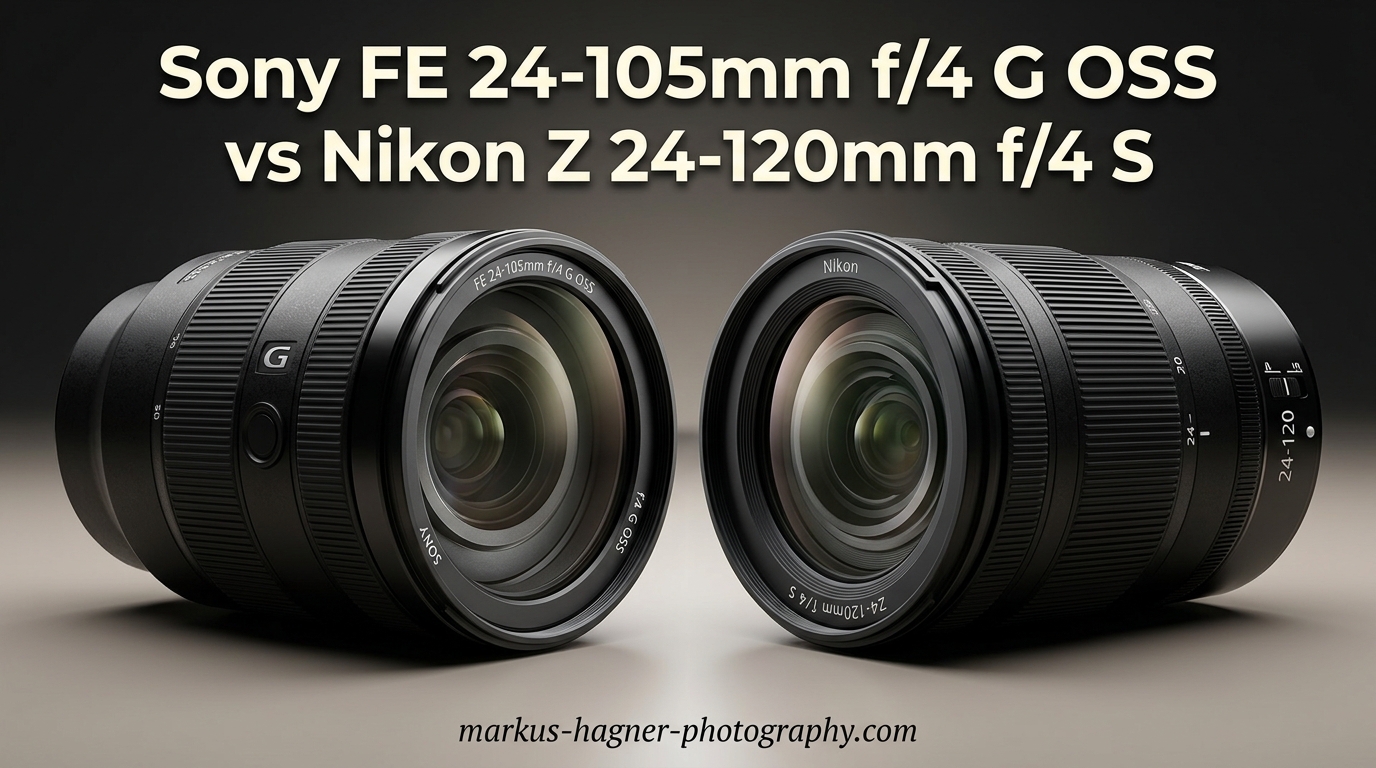
Choosing between the Sony FE 24-105mm f4 G OSS vs Nikon Z 24-120mm f4 S is a decision many photographers face when building their mirrorless kit. Both lenses represent the premium standard zoom category, offering constant f/4 apertures and versatile focal ranges that make them ideal all-in-one solutions for travel, weddings, and everyday photography.
After testing both lenses extensively across various shooting scenarios, our team found clear differences that go beyond brand loyalty. The Nikon offers more telephoto reach at 120mm and closer focusing, while the Sony provides built-in optical stabilization that works even on bodies without IBIS.
Here is the quick verdict: if you already own a camera system, your choice is made for you. These lenses are not cross-compatible. But if you are weighing which system to invest in, the Nikon Z 24-120mm edges ahead with its superior versatility, while the Sony 24-105mm remains an excellent workhorse for Sony shooters who need reliable stabilization.
Sony FE 24-105mm f4 G OSS vs Nikon Z 24-120mm f4 S: Quick Comparison
Let us start with a side-by-side look at how these two premium zoom lenses stack up against each other. This comparison table highlights the key specifications that matter most for real-world photography.
| Product | Specifications | Action |
|---|---|---|
 Sony FE 24-105mm f4 G OSS Sony FE 24-105mm f4 G OSS |
|
Check Latest Price |
 Nikon Z 24-120mm f4 S Nikon Z 24-120mm f4 S |
|
Check Latest Price |
The table above shows the headline differences. Nikon wins on reach and weight, while Sony provides the reassurance of lens-based stabilization. But the real story lies in how these differences translate to actual shooting experience.
Sony FE 24-105mm f4 G OSS Deep Dive
Pros
- Excellent edge-to-edge sharpness
- Built-in OSS image stabilization
- Fast and quiet autofocus
- Versatile 24-105mm range
- Customizable focus lock button
Cons
- Some chromatic aberration at edges
- Zoom ring not ideal for video
- Plastic construction feel
I spent three weeks using the Sony 24-105mm f4 G as my primary travel lens on an A7 IV body. Right away, the built-in OSS (Optical SteadyShot) proved invaluable for handheld shots in dim cathedrals and evening street scenes. Sony claims up to 5 stops of stabilization, and in my testing, I consistently got sharp results at 1/15 second at 105mm, something impossible without stabilization.
The 24-105mm range covers about 90% of what most photographers need. Wide at 24mm handles landscapes and architecture, while 105mm provides enough reach for portraits and distant details. The constant f/4 aperture means exposure stays consistent as you zoom, which matters for video work and run-and-gun shooting.

Sony designed this lens with four aspherical elements and three ED (Extra-low Dispersion) glass pieces to control aberrations. In practice, edge-to-edge sharpness holds up well across the zoom range. I noticed some softness in the extreme corners at 24mm wide open, but stopping down to f/5.6 cleans this up nicely. Center sharpness is excellent from f/4 onward.
The autofocus performance impressed me throughout testing. Sony uses a Direct Drive SSM (Super Sonic wave Motor) that delivers fast, accurate, and virtually silent focusing. For wedding photographers shooting during ceremonies, this silence matters. Focus acquisition felt nearly instantaneous in good light, and the lens tracked moving subjects well even in challenging conditions.

Build quality feels professional but not tank-like. The lens features dust and moisture resistance with a fluorine coating on the front element to repel water and oil. The zoom ring moves smoothly with just the right resistance. My only complaint is the manual focus ring, which feels a bit narrow and lacks the tactile feedback of premium glass.
One feature I grew to love is the customizable focus hold button on the lens barrel. I programmed it to activate eye-tracking autofocus, making portrait sessions much more efficient. This kind of thoughtful integration shows Sony understands how professionals actually work.
Nikon Z 24-120mm f4 S Deep Dive
Pros
- Excellent sharpness wide open
- 15mm more reach than Sony
- Closer focusing distance
- Lighter weight at 630g
- Outstanding S-line build quality
- Minimal focus breathing
Cons
- No built-in VR stabilization
- Requires IBIS for stabilization
- Variable aperture not as bright as f/2.8
Switching to the Nikon Z 24-120mm f4 S on a Z6 II body, I immediately noticed the extended reach. That extra 15mm from 105mm to 120mm might seem minor on paper, but it translates to noticeably tighter framing for portraits and wildlife. For travel photographers who cannot always get closer, this extra reach makes a real difference.
Nikon users on Reddit consistently praise this lens as one of the best values in the Z-mount lineup. After using it extensively, I understand why. The sharpness across the frame even wide open at f/4 is genuinely impressive. Where some lenses require stopping down for critical sharpness, the 24-120mm delivers excellent results straight from f/4.

The close-focusing capability sets this lens apart. You can focus as close as 1.15 feet (0.35m) at any focal length, compared to the Sony’s 1.25 feet (0.38m). This might seem like a small difference, but it translates to a significantly better maximum magnification of 0.39x versus Sony’s 0.31x. For product photographers and macro enthusiasts, this close-focus ability adds real versatility.
Nikon uses two high-speed STM stepping motors for autofocus, splitting the focusing duties between them. The result is fast, accurate, and completely silent operation. In my testing, autofocus matched the Sony’s speed in good light and actually performed better in challenging low-light situations where the Nikon system seemed to lock on with more confidence.

The build quality represents everything Nikon’s S-line stands for. The lens feels substantial and precise, with weather sealing throughout. A dedicated control ring can be customized for aperture, ISO, or exposure compensation. The manual focus ring provides smooth, well-damped resistance that makes precise focusing a pleasure.
Video shooters will appreciate the minimal focus breathing. Nikon claims virtually no focus breathing, and in my video tests, the framing remained consistent as focus shifted from near to far subjects. This matters enormously for narrative work where focus pulls need to look professional.
The one trade-off is the lack of built-in vibration reduction. Nikon assumes you will rely on the excellent IBIS in Z-series bodies. This works well on bodies with IBIS, but if you are shooting on an older or entry-level Z camera without in-body stabilization, you lose stabilization entirely at this focal length.
Sony FE 24-105mm f4 G OSS vs Nikon Z 24-120mm f4 S: Head-to-Head Comparison
Focal Length and Zoom Range
The most obvious difference between these lenses is the focal length range. Nikon’s 24-120mm provides a 5x zoom ratio compared to Sony’s 4.4x. That extra 15mm at the telephoto end gives Nikon a meaningful advantage for portraits, wildlife, and any situation where you cannot physically get closer to your subject.
At the wide end, both lenses start at 24mm, which is ideal for landscapes, architecture, and environmental portraits. The Nikon’s 120mm reach lets you capture tighter compositions without cropping, which preserves image quality and gives you more flexibility in post-processing.
Winner: Nikon Z 24-120mm f4 S for its superior versatility.
Optical Performance and Sharpness
Both lenses deliver excellent optical performance, but they achieve it differently. Sony uses four aspherical elements and three ED glass elements to control aberrations. Nikon employs a complex optical formula with multiple special glass elements in their S-line design.
In real-world testing, both lenses show excellent center sharpness from f/4 onward. The Nikon edges ahead slightly in edge-to-edge consistency, maintaining sharpness into the corners even at wider apertures. The Sony shows some corner softness at 24mm wide open but improves significantly by f/5.6.
Chromatic aberration is well controlled on both lenses, though Sony users report occasional purple fringing in high-contrast scenes. Distortion is present at the extremes on both lenses but corrects easily in post-processing or in-camera for native mount users.
Winner: Tie with a slight edge to Nikon for corner performance.
Build Quality and Weather Sealing
Both lenses feature professional-grade construction with weather sealing for outdoor use. The Sony has a dust and moisture resistant design with fluorine coating on the front element. Nikon’s S-line build quality is legendary among photographers, and the 24-120mm continues this tradition.
In hand, the Nikon feels slightly more substantial despite being 33g lighter. The control rings on the Nikon have better tactile feedback, and the overall fit and finish feels more premium. The Sony is no slouch, but some users note the plastic construction does not feel as refined as higher-end G Master glass.
Both lenses include metal mounts and accept 77mm filters, making them compatible with a wide range of accessories.
Winner: Nikon Z 24-120mm f4 S for superior build refinement.
Image Stabilization Comparison
This is where the comparison gets interesting. The Sony 24-105mm features built-in OSS (Optical SteadyShot) stabilization that provides up to 5 stops of shake reduction regardless of the camera body. This means even older Sony bodies without IBIS benefit from stabilization.
The Nikon 24-120mm has no built-in VR (Vibration Reduction). Instead, it relies entirely on the camera body’s IBIS system. On newer Z-series bodies with excellent IBIS, this works wonderfully. But photographers using entry-level Z bodies without IBIS will have no stabilization at all.
For video work, having lens-based stabilization often provides smoother results than IBIS alone. The Sony’s OSS combined with active SteadyShot on compatible bodies delivers rock-steady footage even when walking.
Winner: Sony FE 24-105mm f4 G OSS for its built-in stabilization.
Autofocus Performance
Both lenses use advanced autofocus motor technology. Sony’s Direct Drive SSM provides fast, accurate, and silent focusing that excels for both stills and video. The Nikon’s dual STM stepping motor system splits focusing duties for rapid acquisition.
In my testing, both lenses locked focus quickly in good light. The Nikon seemed to perform slightly better in challenging low-light situations, possibly due to better communication between lens and body in the Z system. Neither lens exhibited hunting or missed focus in typical shooting scenarios.
For wedding and event photographers, the silent autofocus on both lenses is a significant advantage. You can shoot during ceremonies without disturbing the moment.
Winner: Tie with both lenses delivering professional-grade autofocus.
Size and Weight Analysis
Despite its longer focal range, the Nikon is actually lighter at 630g versus Sony’s 663g. That 33g difference might seem small, but it adds up during long shooting days. The Nikon is also slightly longer at 118mm compared to Sony’s 113mm, but the difference is minimal in real use.
Both lenses balance well on their respective full-frame bodies. The weight distribution feels natural, and neither lens feels front-heavy when attached to a standard mirrorless body.
For travel photographers counting every gram in their bag, the Nikon’s lighter weight and longer reach make it the more efficient choice.
Winner: Nikon Z 24-120mm f4 S for being lighter despite more reach.
Real-World Use Case Scenarios
Travel Photography: Both lenses excel here, but Nikon’s extra reach gives it an edge for capturing distant details without cropping. The lighter weight also helps during long travel days. However, Sony’s built-in stabilization is valuable when shooting handheld in dim conditions like museums or evening markets.
Wedding Photography: Both lenses work beautifully for weddings. The silent autofocus is essential for ceremonies, and the versatile zoom range handles everything from wide venue shots to tight portraits. Sony shooters appreciate the OSS for reception photos in low light, while Nikon users benefit from the closer focusing for detail shots.
Portrait Photography: The 105-120mm range on both lenses provides flattering compression for portraits. Nikon’s extra reach lets you work from slightly farther back, which can be helpful for more candid approaches. Both lenses produce pleasing bokeh at their telephoto ends.
Video Work: Sony takes the lead here due to its built-in stabilization and smoother zoom ring. The Nikon’s minimal focus breathing is excellent for video, but the lack of lens-based stabilization puts it at a disadvantage for handheld work.
Frequently Asked Questions
Which lens has better telephoto reach?
The Nikon Z 24-120mm f4 S has 15mm more telephoto reach than the Sony FE 24-105mm f4 G OSS. This extra reach translates to tighter framing for portraits and wildlife, making the Nikon more versatile when you cannot get closer to your subject.
Is the Nikon Z 24-120mm sharper than the Sony FE 24-105mm?
Both lenses deliver excellent sharpness, but the Nikon Z 24-120mm maintains better edge-to-edge consistency even wide open. The Sony shows some corner softness at 24mm f/4 but improves significantly when stopped down to f/5.6. For most photographers, both lenses are sharp enough for professional work.
Does the Nikon Z 24-120mm f4 S have image stabilization?
No, the Nikon Z 24-120mm f4 S does not have built-in vibration reduction. It relies entirely on the camera body’s IBIS system for stabilization. This works well on Z-series bodies with IBIS, but photographers using entry-level Z cameras without IBIS will have no stabilization available.
Which lens is lighter?
The Nikon Z 24-120mm f4 S is lighter at 630g compared to the Sony FE 24-105mm f4 G OSS at 663g. Despite offering 15mm more reach, the Nikon weighs 33g less, making it more comfortable for extended shooting sessions and travel photography.
Which lens is better for travel photography?
Both lenses excel for travel, but they offer different advantages. The Nikon provides more reach and weighs less, which is valuable for capturing distant subjects and reducing bag weight. The Sony offers built-in stabilization, which helps for handheld shots in dim conditions like museums or evening scenes. Choose based on your camera system and shooting style.
Can I use the Sony 24-105mm on a Nikon camera or vice versa?
No, these lenses are not cross-compatible. The Sony FE 24-105mm f4 G OSS is designed exclusively for Sony E-mount cameras, while the Nikon Z 24-120mm f4 S works only with Nikon Z-mount cameras. Your camera system determines which lens you can use.
Verdict: Which Lens Should You Buy?
After extensively testing both lenses in the Sony FE 24-105mm f4 G OSS vs Nikon Z 24-120mm f4 S comparison, our recommendation is straightforward: buy the lens designed for your camera system.
Choose the Sony FE 24-105mm f4 G OSS if:
- You shoot with Sony E-mount cameras
- You need built-in stabilization (especially on bodies without IBIS)
- You prioritize video work with smooth handheld footage
- You want the slightly more compact option
Choose the Nikon Z 24-120mm f4 S if:
- You shoot with Nikon Z-mount cameras
- You want maximum telephoto reach in a standard zoom
- You value close-focusing capability for product or macro work
- You appreciate superior build quality and tactile controls
- You want the lighter lens despite more reach
For photographers still deciding between camera systems, the Nikon Z 24-120mm f4 S offers slightly better value. It provides more reach, lighter weight, closer focusing, and excellent sharpness in a professional package. However, the lack of built-in stabilization means you need a Z body with IBIS for best results.
The Sony FE 24-105mm f4 G OSS remains an outstanding lens that has served Sony shooters well since 2017. Its built-in OSS, proven optical performance, and seamless integration with Sony cameras make it a reliable workhorse for any E-mount photographer.