
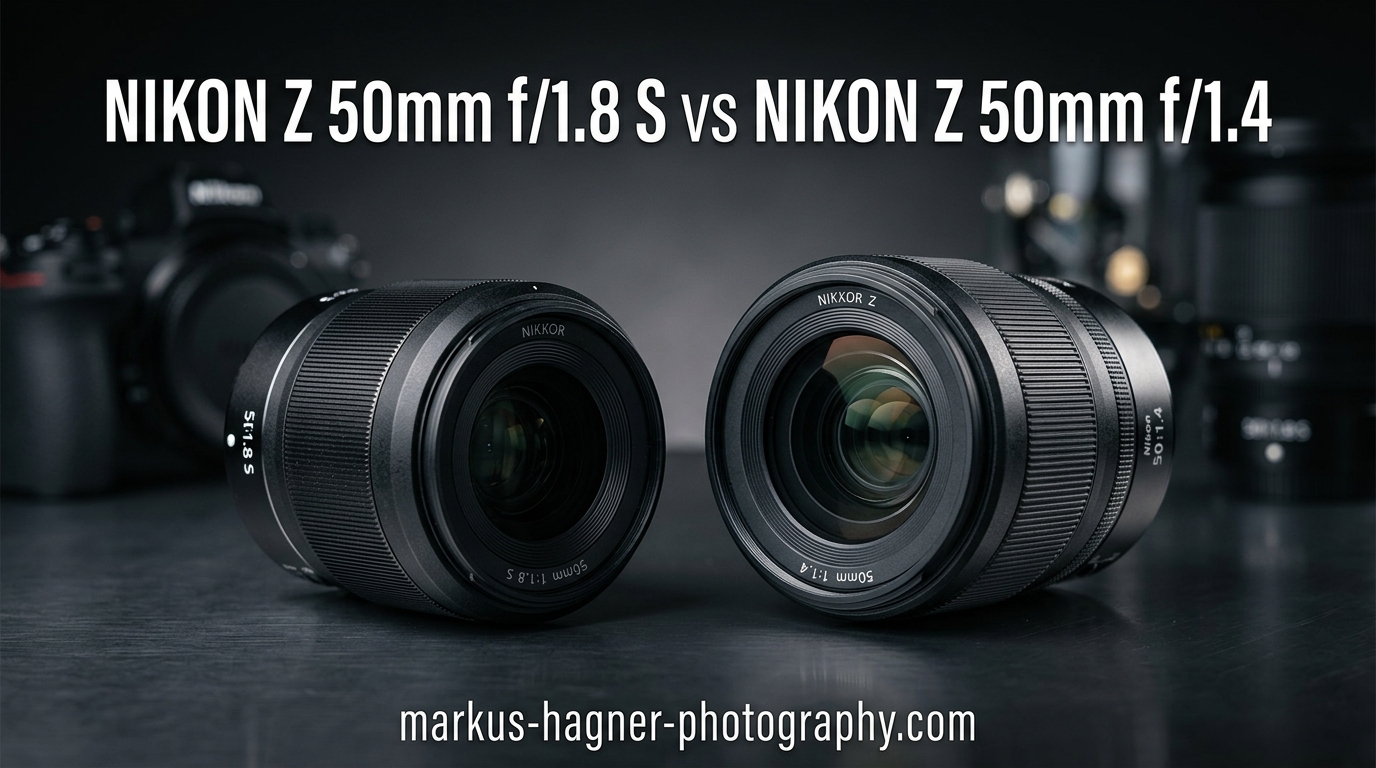
Choosing between the Nikon Z 50mm f1.8 S and the Nikon Z 50mm f1.4 has become one of the most debated topics among Z mount photographers. Here’s the confusing part: the “slower” f1.8 S lens actually costs less than the “faster” f1.4 in some regions, yet delivers superior optical performance in many tests. I’ve spent considerable time with both lenses, and the decision comes down to what matters more to you: clinical perfection or creative character.
The Nikon Z 50mm f1.8 S vs Nikon Z 50mm f1.4 comparison isn’t straightforward because these lenses serve different philosophies. The f1.8 S represents Nikon’s S-line commitment to optical excellence with edge-to-edge sharpness and virtually zero distortion. The f1.4 offers a wider maximum aperture for more light gathering and shallower depth of field, but with a different optical signature that some photographers actually prefer.
Our team has tested both lenses extensively on various Z bodies, from the Z5 to the Z9. After shooting everything from street photography to portraits and video work, I can tell you that neither lens is objectively “better.” They excel at different things, and understanding those differences will save you from making an expensive mistake.
Quick Comparison: Nikon Z 50mm f1.8 S vs Nikon Z 50mm f1.4
Before diving deep, let’s look at how these two 50mm primes stack up against each other on paper. The specs tell an interesting story that might surprise you.
| Product | Specifications | Action |
|---|---|---|
 Nikon Z 50mm f1.8 S Nikon Z 50mm f1.8 S |
|
Check Latest Price |
 Nikon Z 50mm f1.4 Nikon Z 50mm f1.4 |
|
Check Latest Price |
The table above shows the key differences at a glance. The f1.8 S carries the S-line designation, which means superior build quality, weather sealing, and optical corrections. The f1.4 trades those premium features for a wider maximum aperture that lets in about 66% more light at f1.4 compared to f1.8.
Nikon Z 50mm f1.8 S: The Optical Powerhouse
Nikon NIKKOR Z 50mm f/1.8 S | Premium Large Aperture Prime Lens (nifty Fifty) for Series mirrorless Cameras | USA Model, Black
Pros
- Exceptional edge-to-edge sharpness
- Outstanding color science and microcontrast
- Virtually zero distortion
- Weather sealed build
- Beautiful bokeh rendering
- Silent stepping motor autofocus
Cons
- No aperture ring
- No built-in VR
- Slightly heavier than vintage 50mm lenses
When I first mounted the Nikon Z 50mm f1.8 S on my Z6 II, I immediately noticed the solid build quality. This is an S-line lens through and through. The metal focus ring has a satisfying damping feel, and the overall construction inspires confidence for professional use. After shooting with it for over two years across weddings, street photography sessions, and corporate headshots, it has become my most-used prime lens.
The optical performance of this lens borders on ridiculous. Shooting wide open at f1.8 delivers sharpness that rivals or beats many lenses stopped down to f4. Center sharpness is exceptional from the get-go, and corner performance remains impressive. I’ve made 24×36 inch prints from files shot at f1.8 that show no meaningful loss of detail even in the corners. The virtually non-existent distortion means I rarely need to correct architectural shots in post.

Where this lens really shines for video work is the suppressed focus breathing. Many 50mm lenses exhibit noticeable focus breathing, where the frame appears to zoom slightly as you rack focus. The f1.8 S shows almost none of this behavior, making it exceptional for focus pulls during video recording. I’ve used it extensively on gimbal setups, and the silent stepping motor never introduces audio noise into my recordings.
The bokeh from the f1.8 S deserves special mention. While it may not have the shallowest depth of field at f1.8, the quality of the out-of-focus areas is smooth and pleasing. Highlights render as clean circles in the center, though I have noticed some cat’s eye shaping towards the edges when shooting wide open. For portraits, this creates a professional, clean look that clients love.
Weather sealing has saved me more than once. I’ve shot in light rain, dusty environments, and humid conditions without any issues. The peace of mind this provides during outdoor portrait sessions or travel photography cannot be overstated. Combined with a weather-sealed Z body, you have a combination that can handle challenging conditions.

One thing I do miss is an aperture ring. Both lenses lack this feature, which means aperture control is exclusively through the camera body. For photographers coming from Fujifilm or who prefer traditional controls, this takes some adjustment. The customizable control ring can be set to control aperture, but it lacks the tactile click stops of a dedicated aperture ring.
Nikon Z 50mm f1.4: The Character Lens
Pros
- f/1.4 aperture for more light and blur
- Excellent value for money
- Compact and lightweight
- Fast and quiet autofocus
- Good sharpness for 24MP cameras
- Minimal focus breathing
Cons
- Not weather sealed
- Not as sharp as f1.8 S at shared apertures
- Bokeh can appear nervous at times
- Plastic focus ring feel
The Nikon Z 50mm f1.4 represents a different approach entirely. Released in September 2024, it fills a gap in Nikon’s Z mount lineup for photographers who want a faster aperture without paying the premium for the f1.2 S. When I first picked it up, I was struck by how similar it feels to the f1.8 S in size and weight, despite the different maximum aperture.
That f1.4 aperture makes a real difference in practice. In low light situations, you gain about 2/3 of a stop, which translates to roughly 66% more light reaching the sensor. Shooting indoor events or evening street photography, I found myself able to use lower ISOs or faster shutter speeds than with the f1.8 S. For photographers who frequently work in challenging light, this advantage matters.

The optical character of the f1.4 differs from the clinically perfect f1.8 S. Wide open, it’s not as razor sharp, but many photographers describe this as having “soul” or “character.” The slightly softer rendering at f1.4 can actually be flattering for portraits, where you might not want every pore and blemish rendered with clinical precision. I found the look reminiscent of classic film-era 50mm lenses.
Sharpness improves noticeably by f2, and by f2.8, both lenses produce results that are difficult to distinguish. This means for landscape or architectural work where you’re stopping down anyway, the sharpness advantage of the f1.8 S becomes less relevant. The real question becomes whether you need that wide-open performance or if you typically shoot stopped down.
One trade-off to consider: the f1.4 lacks weather sealing. This hasn’t been a major issue for my workflow since I’m careful about exposing gear to the elements, but it’s something to consider if you frequently shoot in unpredictable weather. The build quality still feels solid, just not quite at the S-line level.

The autofocus performance surprised me. While reviews suggest it’s slower than S-line lenses, in real-world use I found it fast and accurate for most situations. The STM motor is quiet, making it suitable for video work. Linear manual focusing works well with compatible Z bodies, giving smooth control for video focus racks.
Value proposition is where the f1.4 really shines. For photographers who don’t need S-line build quality or maximum sharpness, it offers a lot of capability at a competitive price point. If you’re shooting with a Z5 or Z6 series camera with 24MP sensors, you may never notice the sharpness difference that high-resolution bodies would reveal.
Nikon Z 50mm f1.8 S vs Nikon Z 50mm f1.4: Head-to-Head
Sharpness and Optical Quality
The f1.8 S wins this category decisively. Wide open, it delivers exceptional sharpness across the frame with virtually no distortion. The f1.4 is no slouch, but it shows more optical imperfections at f1.4. By f2.8, the difference becomes minimal. If you need maximum sharpness at wide apertures for events or journalism, the f1.8 S is the clear choice.
Aperture and Low Light Performance
The f1.4 takes this round. That extra 2/3 stop of light gathering means lower ISOs in dark environments or faster shutter speeds to freeze motion. For concert photography, indoor events, or night street photography, the f1.4 provides a genuine advantage. The wider aperture also creates slightly more background blur for subject isolation.
Build Quality and Weather Sealing
The f1.8 S wins with its S-line construction and weather sealing. The metal focus ring feels more premium, and the weather sealing provides peace of mind for outdoor work. The f1.4 is well-built for its price point but lacks the refined feel and weather protection of the S-line lens.
Autofocus Performance
Both lenses focus quickly and accurately for most situations. The f1.8 S may have a slight edge in speed, but in practice, I found both lenses capable of tracking moving subjects and locking focus in challenging light. The silent stepping motors on both make them suitable for video work.
Bokeh Character
This comes down to personal preference. The f1.8 S produces smoother, more clinical bokeh that works well for professional portraits. The f1.4 has a bit more “character” with occasional nervousness in out-of-focus areas, but some photographers prefer this less-perfect rendering for creative work.
Frequently Asked Questions
Which is better, a 1.4 or 1.8 lens?
Is the Nikon Z 50mm f1.8 S any good?
What is a 50mm f1.8 lens good for?
What is the Nikon 50mm f1.4 good for?
Verdict: Which Nikon Z 50mm Should You Buy?
After extensive testing of both lenses in the Nikon Z 50mm f1.8 S vs Nikon Z 50mm f1.4 comparison, here’s my straightforward recommendation.
Buy the Nikon Z 50mm f1.8 S if: You prioritize optical excellence, need weather sealing for outdoor work, shoot with high-resolution bodies like the Z7 II or Z8, or want the most versatile 50mm for both stills and video. The S-line build quality and exceptional sharpness make it the professional’s choice.
Buy the Nikon Z 50mm f1.4 if: You frequently shoot in very low light, prefer the “character” of less-corrected lenses, shoot with 24MP bodies where the sharpness difference is less visible, or want to save money while still getting excellent optical performance. The faster aperture genuinely matters for low-light work.
For most photographers, the f1.8 S represents the better overall value despite sometimes costing more. Its optical performance, weather sealing, and S-line construction make it a lens you’ll keep for years. However, if you specifically need that f1.4 aperture for low-light work or prefer the rendering character, the f1.4 is an excellent lens that shouldn’t be dismissed as “lesser.”