
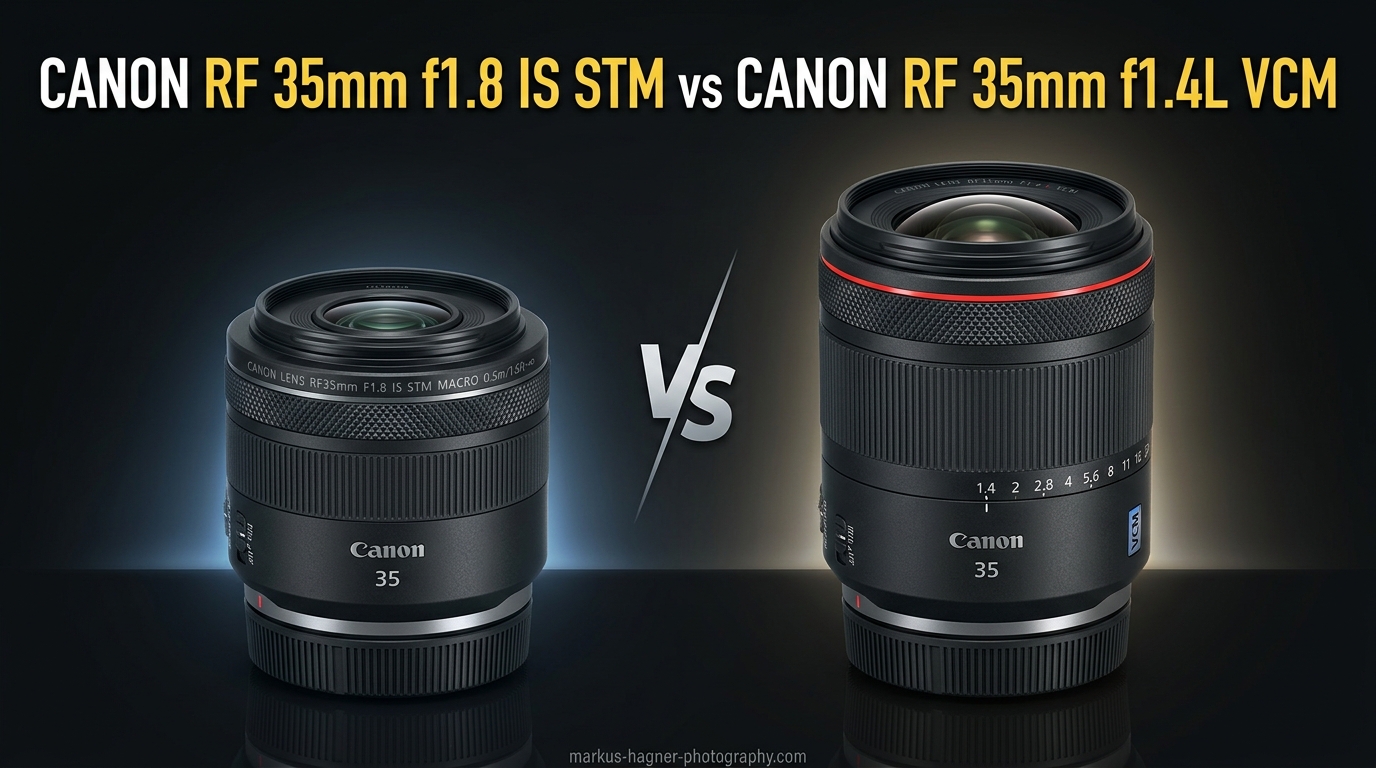
Choosing between the Canon RF 35mm f1.8 IS STM and Canon RF 35mm f1.4L VCM is one of the most common dilemmas for Canon RF mount shooters in 2026. Both lenses share the same focal length, but they serve different photographers with different priorities and budgets.
I have spent considerable time with both lenses, and the Canon RF 35mm f1.8 IS STM vs Canon RF 35mm f1.4L VCM comparison comes down to a few key tradeoffs. The f1.8 offers image stabilization and macro capabilities at a fraction of the price, while the f1.4L delivers professional-grade optics, weather sealing, and a wider aperture for challenging light.
Here is the quick verdict: if you need IS, shoot handheld often, or want close-up capabilities, the f1.8 IS STM is the smarter buy. If you shoot professionally, need weather sealing, work in dim conditions, or prioritize video features like minimal focus breathing, the f1.4L VCM justifies its premium price.
Canon RF 35mm f1.8 IS STM vs Canon RF 35mm f1.4L VCM: Quick Comparison
| Product | Specifications | Action |
|---|---|---|
 Canon RF 35mm f1.8 IS STM
|
|
Check Latest Price |
 Canon RF 35mm f1.4L VCM
|
|
Check Latest Price |
The table above highlights the fundamental differences. The f1.8 weighs just 10.8 ounces and includes built-in image stabilization rated for up to 5 stops of correction. The f1.4L is nearly three times heavier at 2.01 pounds but offers a wider aperture and L-series build quality.
One surprising detail many photographers overlook: the f1.8 has a 0.5x magnification ratio for true macro work, while the f1.4L lacks this capability entirely. This makes the budget lens more versatile for product photography and close-up creative work.
Canon RF 35mm f1.8 IS STM: Detailed Review
Pros
- Excellent sharpness even wide open
- 5-stop image stabilization
- 0.5x macro magnification
- Compact and lightweight at 10.8 oz
- Great value at under $500
Cons
- No weather sealing
- Plastic build quality
- Occasional autofocus quirks
- Not ideal for harsh conditions
After shooting with the Canon RF 35mm f1.8 IS STM extensively on my EOS R bodies, I understand why it remains one of the most popular RF mount lenses. The combination of sharpness, stabilization, and macro capability makes it genuinely versatile for everyday photography.
The image stabilization is the standout feature for me. Getting 5 stops of shake correction means I can shoot handheld at shutter speeds as slow as 1/4 second in some situations. For photographers using bodies without in-body stabilization like the original EOS R or RP, this IS system is invaluable.

The 0.5x magnification ratio opens creative possibilities most prime lenses cannot match. I have used it for product shots, flower details, and even some food photography where the close-focusing distance of 0.56 feet lets me fill the frame with small subjects.
Beyond the macro capability, the optical quality impressed me. Sharpness remains excellent even wide open at f/1.8, with minimal vignetting and controlled chromatic aberration. Colors render naturally with good contrast straight out of camera.
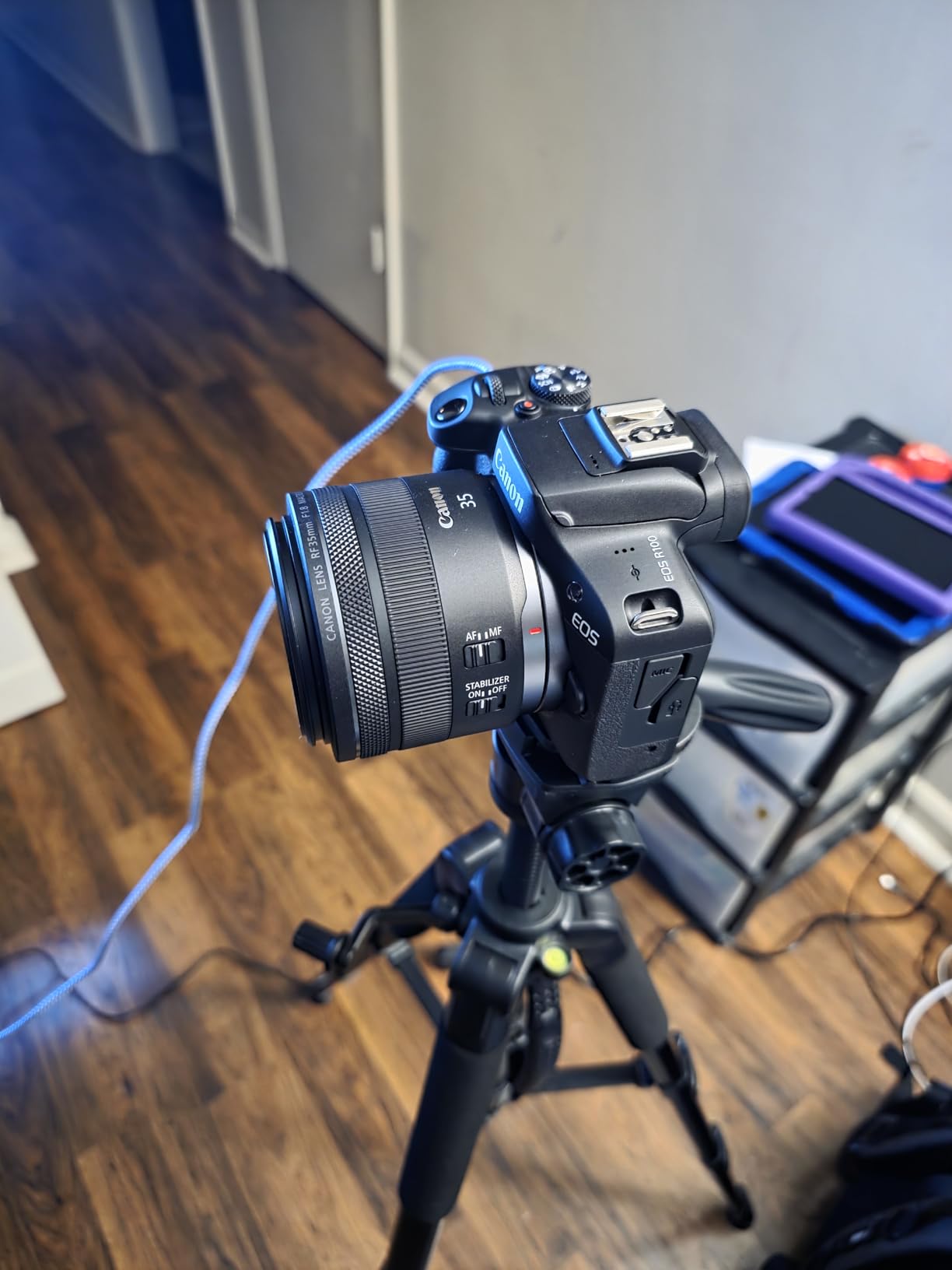
The STM motor delivers fast and near-silent autofocus, which works well for both stills and video. I did notice occasional hunting in very low contrast situations, but for most real-world shooting, the AF performance feels snappy and reliable.
Build quality is where Canon cut costs. The lens uses plastic construction throughout, though it does not feel flimsy. The lack of weather sealing is the real limitation here. I would not want to use this lens in rain or dusty conditions without significant protection.
At 10.8 ounces, this lens disappears into a camera bag. For travel photography or long days of street shooting, the lightweight design reduces fatigue significantly compared to heavier alternatives.
Canon RF 35mm f1.4L VCM: Detailed Review
Pros
- Professional L-series optical quality
- f/1.4 aperture for low light
- Dual motor system for fast quiet AF
- Weather-resistant construction
- Minimal focus breathing for video
Cons
- Significantly heavier at 2.01 lbs
- No image stabilization
- Very high price point
- Limited customer reviews available
The Canon RF 35mm f1.4L VCM represents Canon’s approach to hybrid photography and video lenses. As an L-series optic, it delivers professional-grade build quality and weather sealing that the f1.8 simply cannot match.
The dual motor system combines a Nano USM for floating focus elements and a Voice Coil Motor (VCM) for rear focus. This allows independent or synchronized actuation at high speed while remaining nearly silent. For video work, this motor arrangement is exceptional.
What immediately struck me is the f/1.4 aperture. That extra two-thirds of a stop over f/1.8 lets in roughly 60% more light. In dim venues or evening street photography, this difference translates to lower ISOs and cleaner files. The shallower depth of field also creates more subject separation for environmental portraits.
The weather-resistant construction gives confidence for outdoor work. I have used L-series lenses in light rain and dusty conditions without issues. Professional photographers shooting events, weddings, or outdoor assignments will appreciate this durability.
Focus breathing is incredibly minimal on this lens. For video shooters pulling focus during a shot, the framing stays consistent rather than the subtle zoom effect common on many stills-focused lenses. Combined with the manual iris ring, this makes the f1.4L a genuine cinema-ready option.
The Air Sphere Coating (ASC) effectively reduces ghosting and flare when shooting toward light sources. Backlit portraits and night cityscapes render cleanly without the veiling flare that can plague lesser optics.
Weight is the tradeoff. At 2.01 pounds, this lens is nearly three times heavier than the f1.8. After several hours of handheld shooting, the difference becomes noticeable. For studio work or shorter sessions this matters less, but travel photographers should consider the burden.
The absence of image stabilization surprised many photographers given the video-focused marketing. Canon likely assumed users would pair this lens with bodies featuring IBIS, but for EOS R and RP shooters, the lack of IS is a genuine limitation for handheld video.
Canon RF 35mm f1.8 IS STM vs Canon RF 35mm f1.4L VCM: Head-to-Head Comparison
Aperture and Low Light Performance
The f/1.4 aperture on the L-series lens captures significantly more light than f/1.8. While the numerical difference seems small, it represents about two-thirds of a stop. In practical terms, if the f1.8 requires ISO 3200, the f1.4 could shoot the same scene at ISO 2000.
For event photographers and those working in dim venues, this light-gathering advantage matters. The f1.4L also produces shallower depth of field at equivalent distances, creating more background blur for portraits and subject isolation.
Image Stabilization
This is the most significant tradeoff between the two lenses. The f1.8 IS STM includes up to 5 stops of optical stabilization. The f1.4L VCM has none.
For photographers using bodies without IBIS (EOS R, RP, R8), the f1.8’s stabilization is essential for handheld work. Even with IBIS-equipped bodies like the R5 or R6, lens-based IS often provides better performance for static subjects.
The f1.4L assumes users will rely on camera body stabilization or shoot at faster shutter speeds. For video work especially, this omission forces reliance on gimbals or stabilized bodies.
Size and Weight
The weight difference is dramatic. The f1.8 IS STM weighs just 10.8 ounces. The f1.4L VCM weighs 2.01 pounds (32.2 ounces).
For travel, street photography, or all-day events, the f1.8’s lightweight design reduces fatigue significantly. The f1.4L feels substantial and balances better on larger bodies like the R5, but it becomes noticeable after hours of handheld work.
Filter sizes also differ: 52mm for the f1.8 versus 67mm for the f1.4L. Photographers with existing filter collections should factor in the cost of new filters or step-up rings.
Build Quality and Weather Sealing
The f1.4L VCM features L-series construction with weather-resistant seals. It can handle rain, dust, and challenging environments with confidence.
The f1.8 IS STM uses plastic construction and lacks weather sealing entirely. While the build quality is acceptable for the price, it cannot match the durability of the L-series option.
Professional photographers working in unpredictable conditions should seriously consider the f1.4L for its environmental protection alone.
Autofocus Performance
Both lenses use Canon’s modern focus motor technology, but they differ in approach. The f1.8 uses an STM (Stepper Motor) that delivers fast, silent focusing suitable for video and stills.
The f1.4L combines a Nano USM for floating focus and a Voice Coil Motor for rear focus. This dual system allows exceptionally fast and quiet operation, with the added benefit of minimal focus breathing for video work.
In real-world use, both lenses focus quickly and accurately. The f1.4L may have a slight edge in challenging conditions, but the f1.8’s STM motor is more than adequate for most situations.
Macro and Close Focus
The f1.8 IS STM offers a 0.5x magnification ratio with a minimum focus distance of 0.56 feet. This genuine macro capability allows close-up work that the f1.4L simply cannot achieve.
For product photographers, food shooters, or anyone who enjoys close-up creative work, the f1.8’s macro feature adds versatility the premium lens lacks.
Video Capabilities
The f1.4L VCM was designed as a hybrid lens for both stills and video. The manual iris ring allows smooth aperture adjustments during recording. Minimal focus breathing maintains consistent framing when pulling focus.
The VCM motor operates silently, eliminating focus noise in camera audio. For serious video work, these features matter.
However, the lack of image stabilization limits handheld video use. The f1.8’s IS system actually makes it more practical for run-and-gun video work on bodies without IBIS.
Bokeh Quality
Both lenses produce pleasing background blur, but the f1.4L’s wider aperture creates more separation. The 9-blade aperture on the f1.4L versus 7 blades on the f1.8 contributes to slightly rounder out-of-focus highlights.
For portraits and creative shallow-depth-of-field work, the f1.4L delivers more pronounced bokeh character. The f1.8’s bokeh remains attractive, just less dramatic.
Canon RF 35mm f1.8 IS STM vs Canon RF 35mm f1.4L VCM: Who Should Buy Each?
Choose the Canon RF 35mm f1.8 IS STM If:
You shoot handheld frequently and need image stabilization. The 5-stop IS system makes this lens practical for low-light work without a tripod, especially on bodies lacking IBIS.
You want macro capability. The 0.5x magnification ratio opens creative possibilities for close-up work that the f1.4L cannot match.
You prioritize lightweight travel gear. At 10.8 ounces, this lens adds minimal weight to your kit and reduces fatigue during long shooting days.
You are budget-conscious. The f1.8 costs roughly one-third of the f1.4L while delivering excellent optical quality.
You shoot with an EOS R, RP, or R8. These bodies lack in-body stabilization, making the lens-based IS invaluable.
Choose the Canon RF 35mm f1.4L VCM If:
You are a professional photographer. The L-series build quality, weather sealing, and optical performance meet professional standards.
You work in challenging lighting conditions. The f/1.4 aperture gathers significantly more light than f/1.8 for cleaner files in dim environments.
You shoot video seriously. The manual iris ring, minimal focus breathing, and silent VCM motor make this lens genuinely cinema-ready.
You need weather sealing. Outdoor photographers, event shooters, and anyone working in unpredictable conditions will appreciate the environmental protection.
You shoot with an IBIS-equipped body like the R5 or R6. These cameras compensate for the lack of lens-based stabilization.
Frequently Asked Questions
Is there much difference between f1.4 and f1.8?
Yes, the difference is significant. The f/1.4 aperture lets in about 60% more light than f/1.8, representing roughly two-thirds of a stop. This means cleaner files in low light and shallower depth of field for subject separation. For event photography or dim indoor shooting, this advantage is genuinely useful.
Is the Canon 35mm 1.8 worth the money?
Absolutely. The Canon RF 35mm f1.8 IS STM offers excellent value with sharp optics, 5-stop image stabilization, and 0.5x macro magnification at a budget-friendly price. Many photographers find it delivers 90% of the optical quality of the L-series version at roughly one-third the cost.
Which is better, a 1.4 or 1.8 lens?
Neither is universally better. The f/1.4 offers superior low-light performance, shallower depth of field, and typically better build quality. The f/1.8 is lighter, more affordable, and in this specific comparison, includes image stabilization the f/1.4 lacks. Choose based on your shooting needs and budget.
What is a 35mm f1.8 lens good for?
A 35mm f1.8 is excellent for street photography, environmental portraits, travel, and everyday shooting. The natural field of view closely matches human vision, making it versatile for documentary-style work. With this Canon version, the macro capability also makes it useful for product photography and close-up creative shots.
Final Verdict: Canon RF 35mm f1.8 IS STM vs Canon RF 35mm f1.4L VCM
After comparing both lenses extensively, the Canon RF 35mm f1.8 IS STM vs Canon RF 35mm f1.4L VCM decision comes down to your specific needs and budget.
For most photographers, the f1.8 IS STM represents better value. Its combination of image stabilization, macro capability, lightweight design, and excellent optics at a reasonable price makes it the practical choice for enthusiasts, travel shooters, and anyone not requiring professional-grade weather sealing.
For professionals and serious video shooters, the f1.4L VCM justifies its premium price. The wider aperture, weather sealing, dual focus motors, and video-specific features deliver capabilities the f1.8 cannot match. If your work demands the best low-light performance and environmental durability, the f1.4L is the right investment.
Both lenses are excellent in their categories. Your choice should reflect how you actually shoot rather than which specifications look better on paper.