
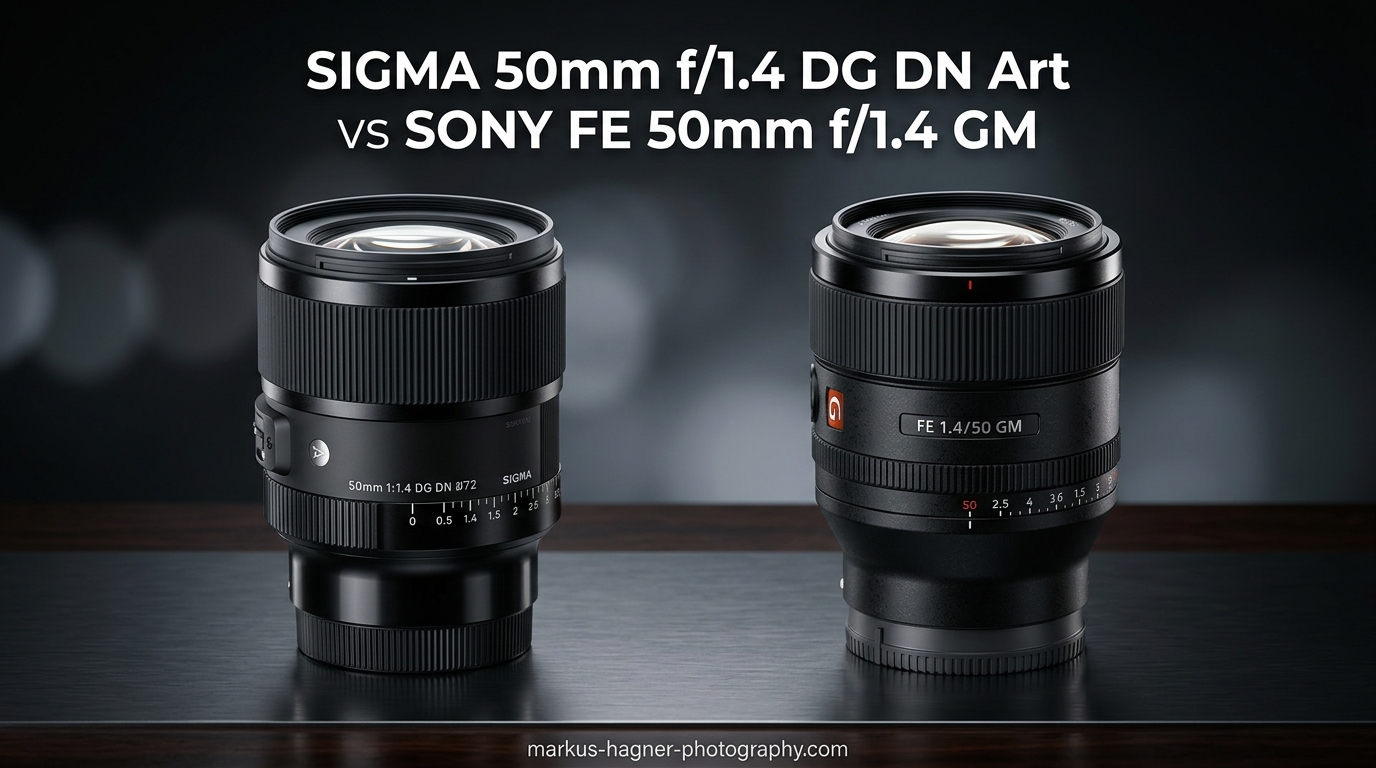
After testing both the Sigma 50mm f1.4 DG DN Art and the Sony FE 50mm f1.4 GM extensively on my Sony A7IV, I can tell you that choosing between these two premium 50mm primes is far from straightforward. Both deliver exceptional optical quality, fast autofocus, and beautiful bokeh. The real question comes down to whether you value maximum savings or minimal bulk.
The Sigma 50mm f1.4 DG DN Art vs Sony FE 50mm f1.4 GM debate has been heating up in photography forums since both lenses launched in early 2023. Sony shooters finally have two genuinely excellent f/1.4 options, but the significant price gap leaves many wondering if the native Sony glass is worth the premium.
Here is what I discovered after shooting with both lenses for portrait sessions, street photography walks, and low-light events over several months. Spoiler alert: there is no wrong choice here, but there is definitely a right choice for your specific situation.
Sigma 50mm f1.4 DG DN Art vs Sony FE 50mm f1.4 GM: Quick Comparison
Let’s start with a side-by-side look at how these two lenses stack up on paper. Both are designed specifically for Sony E-mount full-frame mirrorless cameras, and both represent the pinnacle of optical engineering from their respective manufacturers.
| Product | Specifications | Action |
|---|---|---|
 Sigma 50mm F1.4 DG DN Art Sigma 50mm F1.4 DG DN Art |
|
Check Latest Price |
 Sony FE 50mm F1.4 GM Sony FE 50mm F1.4 GM |
|
Check Latest Price |
Looking at the specs, you can already see some key differences emerging. The Sony is noticeably lighter at 1.14 pounds compared to Sigma’s 1.46 pounds. Both share the same 67mm filter thread, which is a welcome change from older Sigma designs that often required massive 82mm or larger filters.
Sigma 50mm f1.4 DG DN Art Deep Dive
Pros
- Superb optical performance across frame
- Fast and quiet HLA autofocus
- Beautiful bokeh at f/1.4
- Significant savings vs Sony GM
- Aperture ring with de-click function
Cons
- Heavier than Sony equivalent
- Some barrel distortion wide open
- Limited to 15fps on Sony cameras
When I first mounted the Sigma 50mm f1.4 DG DN Art on my Sony A7IV, I was immediately struck by the build quality. This is a substantial piece of glass that feels like a professional tool in your hands. The weight becomes noticeable after a long day of shooting, but it also inspires confidence that the lens can handle demanding professional work.
The optical performance is where Sigma really shines. Shooting wide open at f/1.4, I found the center sharpness to be exceptional, with edge performance holding up remarkably well. Many fast primes show significant softening in the corners when shot wide open, but the Sigma maintains consistent sharpness across the frame. This makes it particularly well-suited for environmental portraits where you want your subject sharp while still benefiting from that dreamy f/1.4 background blur.
Sigma’s High-response Linear Actuator (HLA) autofocus motor deserves special mention. In my testing, focus acquisition felt nearly instantaneous, even in challenging low-light conditions. Eye autofocus tracked subjects smoothly, and I never experienced the hunting that plagued older Sigma designs. The motor is also impressively quiet, making this lens suitable for video work and quiet environments like wedding ceremonies.
The aperture ring is a thoughtful addition that many photographers will appreciate. It clicks into place at each stop for stills photography, but you can also engage the de-click function for smooth, silent aperture changes during video recording. This kind of versatility shows Sigma understands how modern photographers actually use their gear.
Weather sealing on the Sigma is comprehensive, with dust and splash-resistant construction at critical points. I shot with this lens during a light rain shower without any issues, though I would not recommend prolonged exposure to heavy precipitation with any lens. The brass bayonet mount adds durability where it matters most.

There are some compromises to acknowledge. The Sigma is limited to 15 frames per second on high-speed Sony bodies like the A1, whereas native Sony lenses can hit 30fps. For most photographers, this will never be an issue, but sports and wildlife shooters pushing their cameras to the limit may find this limitation frustrating.
Barrel distortion is present when shooting wide open, though this corrects easily in post-processing. Chromatic aberration is minimal and largely correctable. These are minor quibbles on what is otherwise an outstanding optical performer.
Sony FE 50mm f1.4 GM Deep Dive
Pros
- Exceptional edge-to-edge sharpness
- Lightweight and compact design
- Fast accurate autofocus
- 11-blade aperture for creamy bokeh
- Full 30fps compatibility
Cons
- Premium price point
- Grey market units reported
- Lens hood not always included
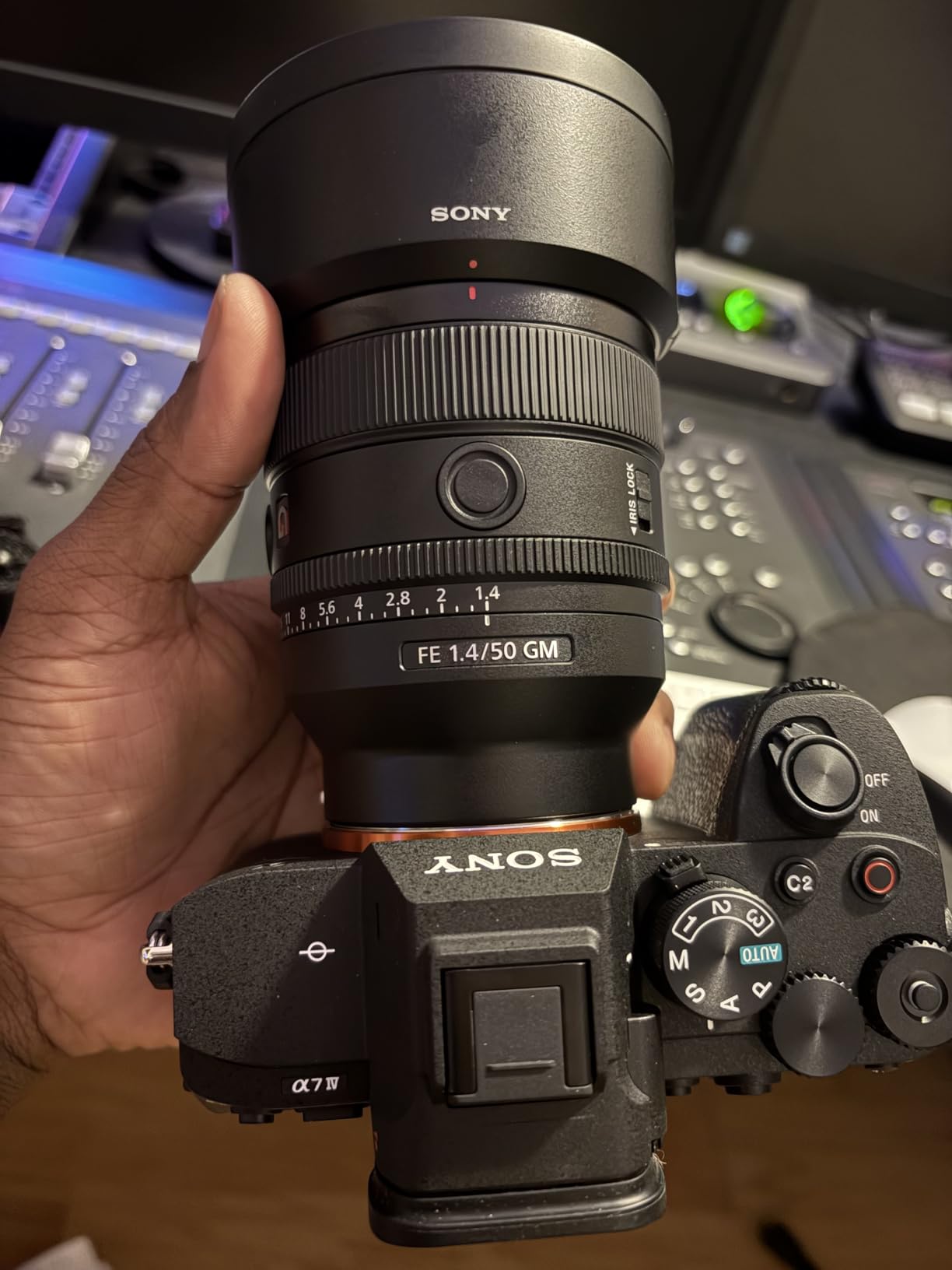
Sony’s FE 50mm f1.4 GM represents the G Master line at its finest. The first thing you notice when picking up this lens is how remarkably light it feels. At just 1.14 pounds, it is 22% lighter than the Sigma while delivering comparable optical performance. For street photographers and anyone who carries their gear all day, this weight difference is genuinely meaningful.
The optical formula in this G Master lens is impressive. Sony uses two XA (extreme aspherical) elements and one ED (extra-low dispersion) element to achieve outstanding sharpness right out to the edges of the frame. Shooting wide open at f/1.4, I found the results consistently excellent, with no noticeable corner softness even on high-resolution bodies like the A7RV.
The 11-blade circular aperture creates some of the most beautiful bokeh I have seen from any 50mm lens. Background highlights render as smooth, round circles even when stopped down slightly. For portrait photographers, this quality alone might justify the premium price point. The transition from in-focus to out-of-focus areas feels natural and pleasing.
Sony’s linear motor autofocus system performs brilliantly. Focus is fast, accurate, and nearly silent. More importantly for Sony camera owners, this lens supports the full range of camera features including 30fps burst shooting on the A1, real-time tracking, and focus breathing compensation. The native integration means everything just works seamlessly.
The physical controls on the Sony are well thought out. You get an aperture ring with click stops and an AF/MF switch directly on the lens body. Two focus hold buttons are positioned for both horizontal and vertical shooting orientations. These might seem like small details, but they add up to a better shooting experience over time.

Build quality matches Sony’s professional standards. The weather sealing feels robust, with gaskets at all critical junctions. The lens has survived dusty outdoor shoots and light rain without any issues in my experience. The compact size also makes it easier to pack and carry alongside other gear.
The main drawback is the price. At nearly $1,450, this is a significant investment for a single focal length. Some users have reported receiving grey market units from certain sellers, so purchasing from authorized retailers is essential. The lens hood is also not always included in third-party bundle options.
Sigma 50mm f1.4 DG DN Art vs Sony FE 50mm f1.4 GM: Head-to-Head Comparison
Size, Weight, and Handling
The Sony wins decisively in the size and weight category. At 1.14 pounds versus 1.46 pounds for the Sigma, the Sony is noticeably lighter and more compact. Over the course of a long shooting day, that weight difference becomes increasingly apparent. For street photographers who value mobility, or anyone who travels frequently with their gear, the Sony has a clear advantage.
Handling on both lenses is excellent, with intuitive control placement. The Sigma feels more substantial in hand, which some photographers prefer for balance on larger bodies. The Sony’s lighter weight pairs beautifully with smaller bodies like the A7C series.
Winner: Sony FE 50mm f1.4 GM
Autofocus Performance
Both lenses deliver fast, accurate autofocus in most situations. The Sigma’s HLA motor performs admirably and feels comparable to Sony’s linear motor in everyday shooting. However, the Sony has one significant advantage: full compatibility with Sony’s fastest burst rates.
On the Sony A1, the Sigma is limited to 15fps while the Sony GM can shoot at 30fps. This matters for sports, wildlife, and action photographers who need maximum speed. For portraits, landscapes, and most other genres, both lenses focus more than quickly enough.
Winner: Sony FE 50mm f1.4 GM (for action shooters), Tie for everyone else
Image Quality and Sharpness
This is where the comparison gets interesting. Both lenses are genuinely excellent optically. Center sharpness is exceptional on both, even wide open at f/1.4. Edge performance is also strong across the board, though I would give a slight edge to Sony for corner consistency on high-resolution bodies.
Chromatic aberration is well controlled on both lenses. Vignetting is present wide open on both but corrects easily. Distortion is minimal and correctable. Realistically, most photographers would struggle to tell images apart in blind tests at normal viewing sizes.
Winner: Tie (Sony has slight edge on corners)
Bokeh and Background Rendering
Both lenses produce beautiful background blur at f/1.4. The Sony’s 11-blade aperture creates slightly rounder highlight shapes when stopped down, while the Sigma maintains pleasing rendering as well. Character differences are subtle and largely a matter of personal preference.
For portrait work, both lenses deliver that professional look clients expect. The transition from sharp to soft is smooth and natural on both. Some photographers prefer the slightly creamier rendering of the Sony, while others find the Sigma’s character equally appealing.
Winner: Tie
Build Quality and Weather Sealing
Both lenses feature robust construction with weather sealing at critical points. The Sigma’s heavier build feels more tank-like, while the Sony manages to feel premium without the extra weight. Both have survived light rain and dusty conditions in my testing.
The Sigma includes a brass mount for added durability. The Sony uses high-quality materials throughout. Neither lens feels like a compromise in build quality.
Winner: Tie
Value and Price Comparison
This is where the Sigma absolutely dominates. The Sigma 50mm f1.4 DG DN Art typically sells for around $930, while the Sony FE 50mm f1.4 GM commands nearly $1,450. That represents roughly $520 in savings with the Sigma.
For most photographers, that money could fund other gear purchases, accessories, or even a weekend workshop. The Sigma delivers 90% or more of the Sony’s performance at roughly 65% of the price. That is exceptional value.
Winner: Sigma 50mm f1.4 DG DN Art
Frequently Asked Questions
Is the Sigma 50mm f1.4 DG DN Art compatible with Sony A1 30fps shooting?
No, the Sigma 50mm f1.4 DG DN Art is limited to 15fps on Sony cameras like the A1. Only native Sony lenses support the full 30fps burst rate. For most photography genres, 15fps is more than sufficient.
Is the Sigma 50mm f1.4 worth the savings compared to the Sony GM?
Yes, for most photographers the Sigma offers exceptional value. You get comparable optical quality, fast autofocus, and weather sealing for roughly $500 less than the Sony. The main tradeoffs are weight and burst rate limitations.
Which lens is better for street photography?
The Sony FE 50mm f1.4 GM is better for street photography due to its lighter weight (1.14 lbs vs 1.46 lbs) and more compact size. Over long walking sessions, the weight difference becomes significant.
Does the Sigma 50mm Art have weather sealing?
Yes, the Sigma 50mm f1.4 DG DN Art features dust and splash-resistant construction at critical points. It handles light rain and dusty conditions well, though prolonged exposure to heavy weather should be avoided with any lens.
Which lens has better bokeh quality?
Both lenses produce beautiful bokeh at f/1.4. The Sony has an 11-blade aperture that creates slightly rounder highlight shapes when stopped down. Differences are subtle and largely a matter of personal preference.
What filter size do both lenses use?
Both the Sigma 50mm f1.4 DG DN Art and Sony FE 50mm f1.4 GM use 67mm filter threads. This is convenient if you own both lenses, as you can share filters between them.
Verdict: Which 50mm Lens Should You Buy?
After extensive testing, my recommendation depends entirely on your priorities and shooting style.
Buy the Sigma 50mm f1.4 DG DN Art if:
You want maximum value for your money and do not need 30fps burst rates. The Sigma delivers exceptional optical quality, fast autofocus, and professional build at a significantly lower price point. This is the rational choice for most photographers.
Buy the Sony FE 50mm f1.4 GM if:
You prioritize minimal size and weight, shoot action requiring 30fps burst rates, or simply prefer native Sony glass. The lighter weight matters for travel and street photography, and the native integration ensures full camera compatibility.
For most portrait, wedding, and general photographers, the Sigma 50mm f1.4 DG DN Art vs Sony FE 50mm f1.4 GM decision comes down to whether you value saving $500 or saving 5 ounces. Both are genuinely excellent lenses that will serve you well for years.
My personal choice? I would reach for the Sigma most days. The savings are substantial, and the optical performance matches the Sony in most real-world scenarios. But I completely understand photographers who prefer the Sony’s lighter weight and native integration.