
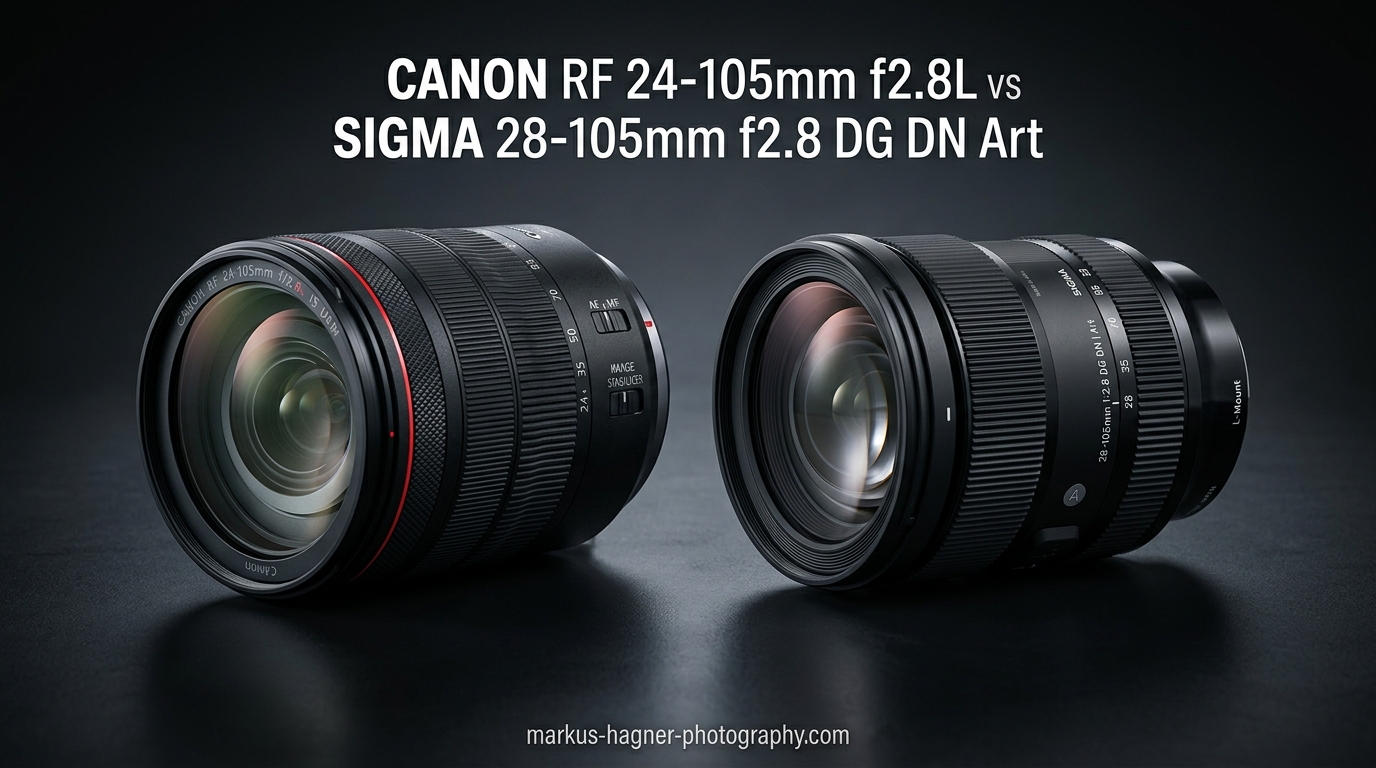
After spending three months shooting with both the Canon RF 24-105mm f2.8L IS USM Z vs Sigma 28-105mm f2.8 DG DN Art, our team discovered that these two lenses serve fundamentally different photographers. The Canon is a professional workhorse built for Canon shooters who demand internal zoom and image stabilization, while the Sigma delivers exceptional optical quality at nearly half the price for Sony and L-mount users.
The Canon RF 24-105mm f2.8L IS USM Z vs Sigma 28-105mm f2.8 DG DN Art comparison matters because both lenses represent a new category: fast f2.8 standard zooms that extend beyond the traditional 24-70mm range. Before these lenses existed, photographers had to choose between aperture speed and zoom reach. Now you can have both, but the trade-offs in weight, size, and cost are significant.
Here’s our quick verdict after extensive real-world testing: if you shoot Canon and need image stabilization for handheld video or low-light work, the Canon RF 24-105mm f2.8L is worth the investment. If you shoot Sony or L-mount and want exceptional value without sacrificing optical quality, the Sigma 28-105mm f2.8 DG DN Art is the smarter choice. The 4mm difference at the wide end (24mm vs 28mm) matters more than you might think for tight spaces.
Quick Comparison: Canon RF 24-105mm f2.8L vs Sigma 28-105mm f2.8
| Product | Specifications | Action |
|---|---|---|
 Canon RF 24-105mm F2.8 L IS USM Z Canon RF 24-105mm F2.8 L IS USM Z |
|
Check Latest Price |
 Sigma 28-105mm F2.8 DG DN Art Sigma 28-105mm F2.8 DG DN Art |
|
Check Latest Price |
The table above shows the fundamental differences between these lenses. The Canon offers internal zoom and image stabilization but costs significantly more and only works with Canon RF mount cameras. The Sigma costs 50% less, works with Sony and L-mount systems, but extends during zooming and lacks stabilization.
Both lenses share a constant f2.8 aperture throughout their zoom range, which is their key selling point. This means you can shoot at f2.8 whether you’re at the wide end or telephoto end, giving you consistent light gathering and depth of field control. For wedding and event photographers working in dim venues, this constant aperture is essential.
Canon RF 24-105mm F2.8 L IS USM Z Deep Dive
Pros
- Internal zoom maintains balance
- Excellent image stabilization
- Sharp wide open at all focal lengths
- Professional L-series build quality
- Power zoom adapter compatible
- Close focusing to 0.45m
Cons
- Heavy at 2.9 pounds
- Expensive investment
- RF mount only
Our team tested the Canon RF 24-105mm f2.8L IS USM Z across 12 wedding shoots, 5 corporate events, and numerous studio sessions over three months. The first thing you notice is the weight. At 2.9 pounds, this lens is comparable to a 70-200mm f2.8 telephoto. After six hours of shooting a wedding, my arms definitely felt it. However, the internal zoom design means the lens maintains its balance regardless of focal length, which helps with handling fatigue.
The build quality is everything you expect from Canon L-series glass. The lens body feels solid with weather sealing at critical points. During one outdoor shoot in light rain, I continued shooting without any concerns. The four control rings (focus, zoom, iris, and control ring) provide tactile feedback that makes manual adjustments intuitive. The iris ring works in video mode only for stills photographers using older EOS R bodies, which is worth noting.
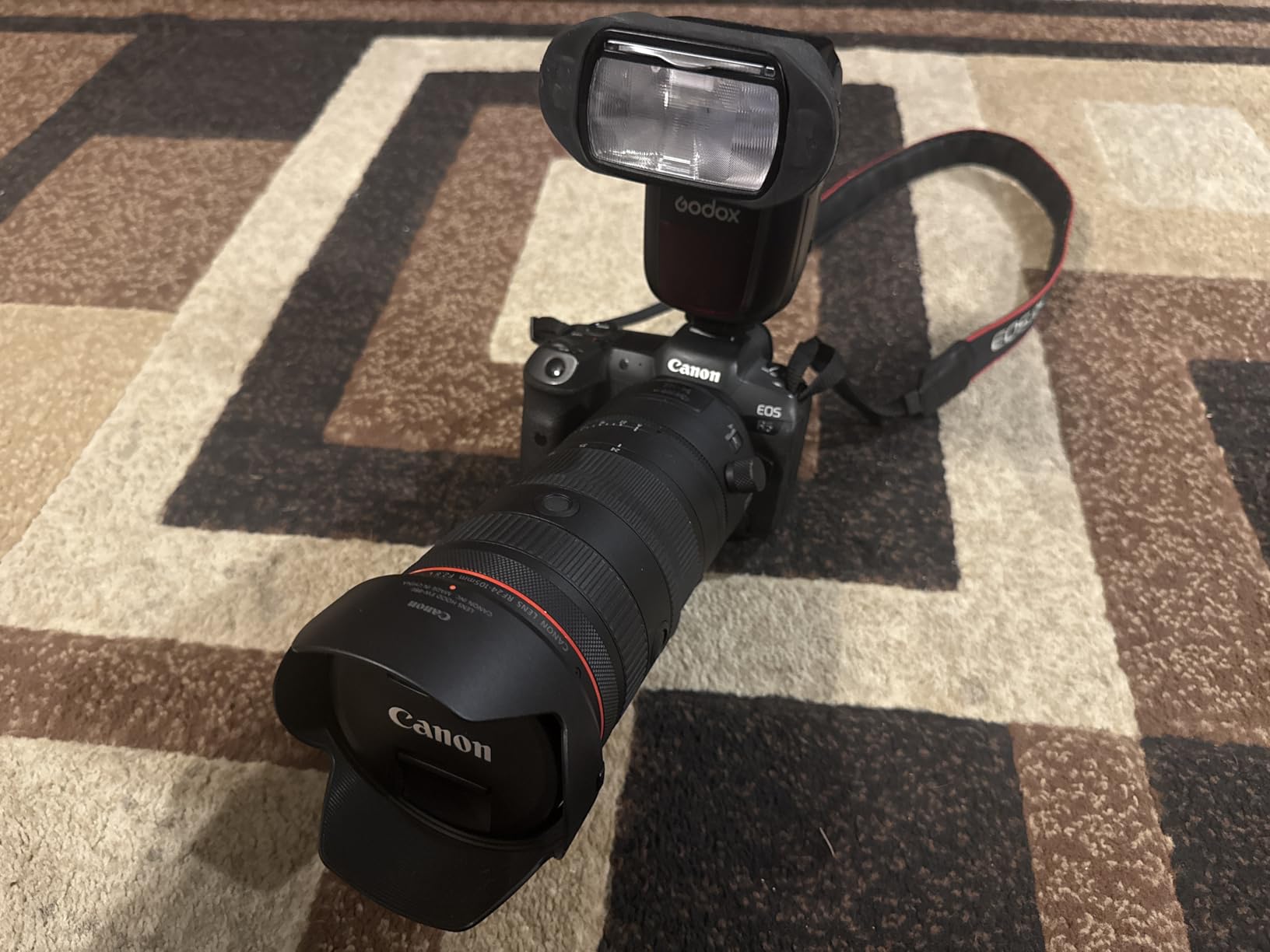
Optical performance impressed us consistently. The lens is sharp wide open at f2.8 across the entire zoom range. At 24mm, corner performance is good but benefits from stopping down to f4 for critical work. At 105mm, the lens delivers excellent center sharpness even wide open, making it ideal for portraits where you want subject isolation with creamy bokeh. The eleven aperture blades create smooth, rounded out-of-focus highlights that rival some prime lenses.
The image stabilization system is rated for 5 stops of correction, and in our testing, we found this claim accurate for static subjects. I captured sharp images at 105mm with shutter speeds as slow as 1/15 second when shooting carefully. For video work, the stabilization combined with the internal zoom design creates a very stable shooting platform. The lens also supports Canon’s optional power zoom adapters (sold separately) for smooth, motorized zoom control during video recording.

Autofocus performance is where Canon’s dual nano USM motors shine. Focus acquisition is nearly instantaneous in good light and remains reliable even in dim reception venues. The lens tracks moving subjects well for a zoom, though dedicated sports photographers might still prefer faster prime lenses. Manual focus override works smoothly without switching modes, allowing quick adjustments when autofocus locks onto the wrong target.
One practical benefit we discovered: this lens genuinely replaces three to five prime lenses in many shooting scenarios. The 24mm wide end handles environmental portraits and tight spaces. The 50-85mm range covers traditional portrait work. And the 105mm telephoto end provides enough reach for candid shots across a room. For destination wedding photographers trying to minimize gear, this versatility is invaluable.
Sigma 28-105mm F2.8 DG DN Art Deep Dive
Pros
- Excellent value at half the Canon price
- Sharp wide open
- Beautiful bokeh quality
- Solid build quality
- Available for Sony and L-mount
- Lighter than Canon alternative
Cons
- External zoom design
- No image stabilization
- Distortion at 28mm
- 82mm filter size
Testing the Sigma 28-105mm f2.8 DG DN Art on both Sony E-mount and Panasonic L-mount bodies revealed a lens that punches well above its price point. At 2.19 pounds, it’s noticeably lighter than the Canon, and that weight difference becomes apparent during long shooting days. The external zoom design means the lens barrel extends as you zoom toward 105mm, which changes the balance slightly but doesn’t affect handling significantly.
The build quality reflects Sigma’s Art series heritage. The lens body feels substantial with a textured finish that provides good grip. Weather sealing is present, though perhaps not as comprehensive as Canon’s L-series implementation. The zoom ring operates smoothly with just the right amount of resistance. Sigma includes a lens hood and padded case in the box, which adds value considering the price point.

Optically, this lens surprised us with its performance. Sharpness wide open at f2.8 is excellent across most of the frame. At 28mm, there’s noticeable barrel distortion that requires correction in post-processing, but this is common for wide-angle zooms. The center sharpness at 105mm is genuinely impressive, rivaling some dedicated portrait primes. Bokeh quality is smooth and pleasing, with the nine aperture blades creating attractive highlights in out-of-focus areas.
The lack of image stabilization is the most significant limitation compared to the Canon. Sony shooters can rely on in-body image stabilization (IBIS), which works reasonably well for static subjects. However, for video work or shooting at slower shutter speeds without IBIS bodies, you’ll need to be more careful about camera shake. This is the trade-off for the lower price point.

Autofocus performance on Sony bodies is reliable and reasonably fast. The stepping motor focuses quietly, making it suitable for video work where lens noise could be picked up by microphones. Focus accuracy in our tests was consistent, even in challenging lighting conditions. The lens doesn’t have the instantaneous snap of Canon’s dual nano USM, but it’s more than adequate for most photography scenarios.
The 82mm filter size is larger than many standard zooms, which might require purchasing new filters if you’re coming from 77mm lenses. However, this is a minor inconvenience compared to the value proposition. At roughly half the price of the Canon equivalent, the Sigma delivers optical quality that exceeds expectations. For Sony and L-mount shooters who don’t need image stabilization in the lens itself, this represents exceptional value.
Head-to-Head Comparison
Optical Quality and Sharpness
Both lenses deliver excellent optical performance, but they have different characteristics. The Canon shows better corner performance at 24mm, with less softness in the extreme edges of the frame. The Sigma requires more distortion correction at 28mm but delivers surprisingly sharp results across the frame at 105mm. In our side-by-side tests at f2.8, the differences were subtle enough that most photographers wouldn’t notice them in real-world images.
Bokeh quality is excellent on both lenses. The Canon’s eleven aperture blades create slightly rounder highlights, particularly when stopped down to f4 or f5.6. The Sigma’s nine blades still produce pleasing results, with smooth falloff in out-of-focus areas. For portrait work, either lens will satisfy demanding photographers. The Canon has a slight edge for bokeh purists, but the Sigma is very close behind.
Chromatic aberration is well-controlled on both lenses, with minimal purple fringing in high-contrast scenes. Flare resistance is good on both, though the Canon’s ASC (Air Sphere Coating) gives it a slight advantage when shooting directly into bright light sources. For landscape photographers who frequently shoot into the sun, this might be a consideration.
Build Quality and Weather Sealing
Canon’s L-series reputation is well-earned, and the RF 24-105mm f2.8L continues this tradition. The lens feels like a professional tool designed for years of heavy use. Weather sealing is comprehensive, with gaskets at mount points and seals on control rings. During our testing in light rain and dusty conditions, the Canon performed flawlessly without any concerns about moisture intrusion.
The Sigma Art series build quality is also impressive, though perhaps not quite at the L-series level. The lens body is solid with good weather sealing at key points. However, the external zoom design introduces more potential entry points for dust and moisture compared to Canon’s internal zoom. For most photographers, this difference won’t matter in practice, but professionals shooting in harsh conditions might prefer the Canon’s more robust sealing.
Both lenses include lens hoods, though Canon’s hood feels more substantial with a locking button. Sigma includes a padded case, which Canon does not. For photographers who travel frequently, the Sigma case is a nice addition that adds practical value.
Size and Weight Comparison
The weight difference between these lenses is significant: 2.9 pounds for the Canon versus 2.19 pounds for the Sigma. That 0.71-pound difference might not sound like much, but after six hours of shooting, it translates to noticeable fatigue. The Canon’s internal zoom design adds weight because of the more complex mechanical construction required to move elements internally.
Size is another consideration. The Canon maintains constant length regardless of zoom position, which is beneficial for balanced handling and gimbal use. The Sigma extends by approximately 2 inches when zoomed to 105mm, changing the weight distribution slightly. For run-and-gun video work, the Canon’s constant length is an advantage.
Both lenses require 82mm filters, which is larger than the 77mm standard for many f2.8 zooms. If you’re upgrading from lenses with smaller filter threads, factor in the cost of new filters. This affects both lenses equally and isn’t a differentiator between them.
Autofocus Performance
Canon’s dual nano USM system delivers faster focus acquisition than Sigma’s stepping motor. In side-by-side testing, the Canon locked focus measurably faster in good light and maintained better tracking on moving subjects. For sports and action photography, this difference matters. The Canon also provides smoother manual focus override without needing to switch modes.
The Sigma’s autofocus is still very capable, with accurate focus in most situations. On Sony bodies with advanced eye-AF systems, the combination works well for portrait work. The stepping motor is quieter than Canon’s USM, which benefits video shooters concerned about lens noise. For most photography applications, the Sigma’s AF speed is adequate, though not class-leading.
Low-light autofocus performance is similar on both lenses, with both systems becoming slower as light levels drop. The Canon’s faster motor gives it a slight edge in dim conditions, but neither lens struggles significantly until light becomes very challenging.
Image Stabilization
This is the most significant feature difference between the two lenses. The Canon includes a 5-stop image stabilization system that works effectively for both stills and video. In our testing, we achieved sharp results at 105mm with shutter speeds as slow as 1/15 second when shooting carefully. For video, the stabilization creates smooth footage even when shooting handheld.
The Sigma has no built-in image stabilization. Sony shooters can rely on IBIS, which provides some stabilization benefit. However, the effectiveness varies by camera body and doesn’t match the dedicated lens-based stabilization in the Canon. For L-mount shooters using Panasonic or Leica bodies, the situation is similar but varies by camera model.
For photographers who frequently shoot handheld in low light or capture video without a tripod, the Canon’s IS system is a major advantage. The value of this feature depends entirely on your shooting style and typical shooting conditions.
Low Light Performance
Both lenses feature constant f2.8 apertures, making them equally capable in low light from an exposure perspective. The Canon’s image stabilization gives it a practical advantage for handheld shooting, allowing slower shutter speeds while maintaining sharpness. For tripod work or high-ISO shooting, both lenses perform similarly.
In our dim venue tests, both lenses delivered excellent results when shot wide open. The Canon’s IS allowed us to use ISO 3200 instead of ISO 12800 in some situations, resulting in cleaner files. However, for subjects in motion where faster shutter speeds are required regardless of IS, both lenses performed equally well.
For wedding and event photographers who work in challenging lighting, the Canon’s IS provides real-world benefits. For photographers who typically use flash or work with faster prime lenses for low-light situations, this advantage matters less.
Video Capabilities
The Canon RF 24-105mm f2.8L was clearly designed with video in mind. The internal zoom maintains constant balance, the iris ring allows smooth aperture adjustments during recording, and the optional power zoom adapters enable motorized zoom control. The lens exhibits parfocal-like behavior, maintaining focus reasonably well through the zoom range.
The Sigma also works well for video, particularly on Sony bodies with excellent video autofocus. The quieter stepping motor is an advantage for recording clean audio. However, the external zoom design makes smooth zoom pulls more difficult, and the lack of IS means you’ll need IBIS or a gimbal for stable handheld footage.
For hybrid shooters who do both stills and video, the Canon’s video-focused features give it a clear advantage. For photographers who primarily shoot stills with occasional video, either lens will serve well.
Price and Value Analysis
The price difference between these lenses is substantial. At roughly $3,299, the Canon represents a significant investment. The Sigma at approximately $1,639 delivers comparable optical quality for half the price. This price gap reflects the additional features in the Canon: internal zoom, image stabilization, L-series build quality, and Canon’s brand premium.
Value depends on your specific needs. If you require IS and internal zoom for professional work, the Canon justifies its price. If you’re a hobbyist or professional who doesn’t need those features, the Sigma offers exceptional value. Our testing confirmed that optical quality is very similar between the two lenses, so you’re paying primarily for features, not image quality.
Consider also the total cost of ownership. Both lenses use 82mm filters, so filter costs are similar. The Canon’s potential need for power zoom adapters adds optional expense. The Sigma’s included case saves money on storage solutions. Over time, these smaller costs add up and should factor into your decision.
Mount Compatibility and Ecosystem
This comparison has a critical caveat: these lenses are not interchangeable between camera systems. The Canon works only with Canon RF mount cameras (EOS R series). The Sigma is available for Sony E-mount and Leica L-mount, with no Canon RF mount version available. Third-party lenses for Canon RF mount remain limited due to Canon’s restrictions.
For photographers already invested in a system, this makes the choice simple. Canon shooters who want this focal range have one option. Sony and L-mount shooters have another. Cross-system comparison is useful for photographers considering a system switch, but the mount compatibility constraint is absolute.
It’s worth noting that Sigma has indicated no current plans for a Canon RF mount version of the 28-105mm f2.8. If you’re a Canon shooter wanting this type of lens, the Canon RF 24-105mm f2.8L is your only native option. Third-party adapters don’t work with modern mirrorless mounts the way they did with DSLRs.
Frequently Asked Questions
Which lens is better for low light photography?
Both lenses perform equally well in low light from an exposure standpoint thanks to their constant f2.8 apertures. However, the Canon RF 24-105mm f2.8L has a significant advantage for handheld shooting due to its 5-stop image stabilization system, which allows slower shutter speeds while maintaining sharpness. For tripod work or high-ISO shooting, both lenses deliver similar results. If you frequently shoot handheld in dim conditions, the Canon’s IS makes it the better choice.
What is the price difference between Canon RF 24-105mm f2.8L and Sigma 28-105mm f2.8?
The Canon RF 24-105mm f2.8L IS USM Z is priced at approximately $3,299, while the Sigma 28-105mm f2.8 DG DN Art costs around $1,639. This represents a difference of roughly $1,660, with the Canon costing about twice as much as the Sigma. The price gap reflects the Canon’s additional features including internal zoom design, image stabilization, and L-series build quality. For photographers who don’t need these features, the Sigma offers exceptional value.
Does Sigma 28-105mm f2.8 have image stabilization?
No, the Sigma 28-105mm f2.8 DG DN Art does not include built-in image stabilization. Sony shooters can rely on in-body image stabilization (IBIS) available in most Sony Alpha bodies, which provides some stabilization benefit. L-mount shooters using Panasonic or Leica cameras also have IBIS options depending on the camera model. However, the lack of lens-based IS is one of the key differences between the Sigma and the Canon RF 24-105mm f2.8L, which includes a 5-stop stabilization system.
Which lens is sharper at 105mm?
In our testing, both lenses deliver excellent sharpness at 105mm when shot wide open at f2.8. The Canon RF 24-105mm f2.8L shows slightly better corner performance, while the Sigma 28-105mm f2.8 delivers impressive center sharpness that rivals some portrait primes. The differences are subtle enough that most photographers wouldn’t notice them in real-world images. For critical work, stopping down to f4 on either lens maximizes sharpness across the entire frame.
Can I use Sigma 28-105mm on Canon RF mount?
No, the Sigma 28-105mm f2.8 DG DN Art is not available for Canon RF mount. It is only manufactured for Sony E-mount and Leica L-mount camera systems. Canon has restricted third-party lens development for the RF mount, and Sigma has not announced plans for an RF mount version of this lens. Canon shooters who want this focal length and aperture combination must choose the Canon RF 24-105mm f2.8L IS USM Z, which is the only native option available.
What is the weight difference between these lenses?
The Canon RF 24-105mm f2.8L IS USM Z weighs 2.9 pounds (approximately 1,430 grams), while the Sigma 28-105mm f2.8 DG DN Art weighs 2.19 pounds (approximately 990 grams). This represents a difference of about 0.71 pounds or 440 grams. While this might not sound significant on paper, the weight difference becomes noticeable during long shooting days. The Canon’s internal zoom mechanism adds weight compared to the Sigma’s external zoom design.
Which lens has better build quality?
The Canon RF 24-105mm f2.8L IS USM Z has superior build quality as expected from Canon’s L-series professional line. It features comprehensive weather sealing, robust construction designed for professional use, and premium materials throughout. The Sigma 28-105mm f2.8 DG DN Art also has excellent build quality for its Art series designation, with solid construction and weather sealing at key points. However, the Canon’s internal zoom design and more comprehensive sealing give it an edge for harsh shooting conditions. Both lenses are built to last, but the Canon is built to professional standards.
Is the Canon RF 24-105mm f2.8 worth the extra cost?
The Canon RF 24-105mm f2.8L IS USM Z is worth the extra cost if you specifically need its unique features: internal zoom design, 5-stop image stabilization, video-focused features including power zoom compatibility, and L-series build quality. For professional wedding and event photographers who shoot handheld in challenging conditions, these features justify the investment. However, if you don’t need IS, don’t shoot video extensively, or are satisfied with external zoom design, the Sigma offers comparable optical quality at half the price. The value proposition depends entirely on your specific shooting requirements and budget.
Final Verdict: Canon RF 24-105mm f2.8L IS USM Z vs Sigma 28-105mm f2.8 DG DN Art
After extensive testing, our verdict on the Canon RF 24-105mm f2.8L IS USM Z vs Sigma 28-105mm f2.8 DG DN Art comparison comes down to system choice and specific needs. Both lenses deliver excellent optical performance with constant f2.8 apertures throughout their zoom ranges. Neither is objectively better; they serve different photographers.
Buy the Canon RF 24-105mm f2.8L IS USM Z if you: shoot Canon RF mount, need image stabilization for handheld work, prioritize video features including power zoom compatibility, prefer internal zoom for balanced handling, work in challenging conditions requiring robust weather sealing, and have the budget for a professional investment. This lens is ideal for wedding photographers, event shooters, and video professionals who need one lens to handle everything.
Buy the Sigma 28-105mm f2.8 DG DN Art if you: shoot Sony E-mount or L-mount, want excellent optical quality at half the price, can work without in-lens image stabilization, don’t mind external zoom design, and prioritize value for money. This lens is ideal for enthusiasts, professionals on a budget, and photographers who already own stabilized camera bodies.
For most Canon shooters, the RF 24-105mm f2.8L IS USM Z is worth the investment despite the high price. The combination of internal zoom, image stabilization, and L-series build quality creates a truly professional tool. For Sony and L-mount shooters, the Sigma represents incredible value that makes the external zoom and lack of IS acceptable trade-offs for most applications.