
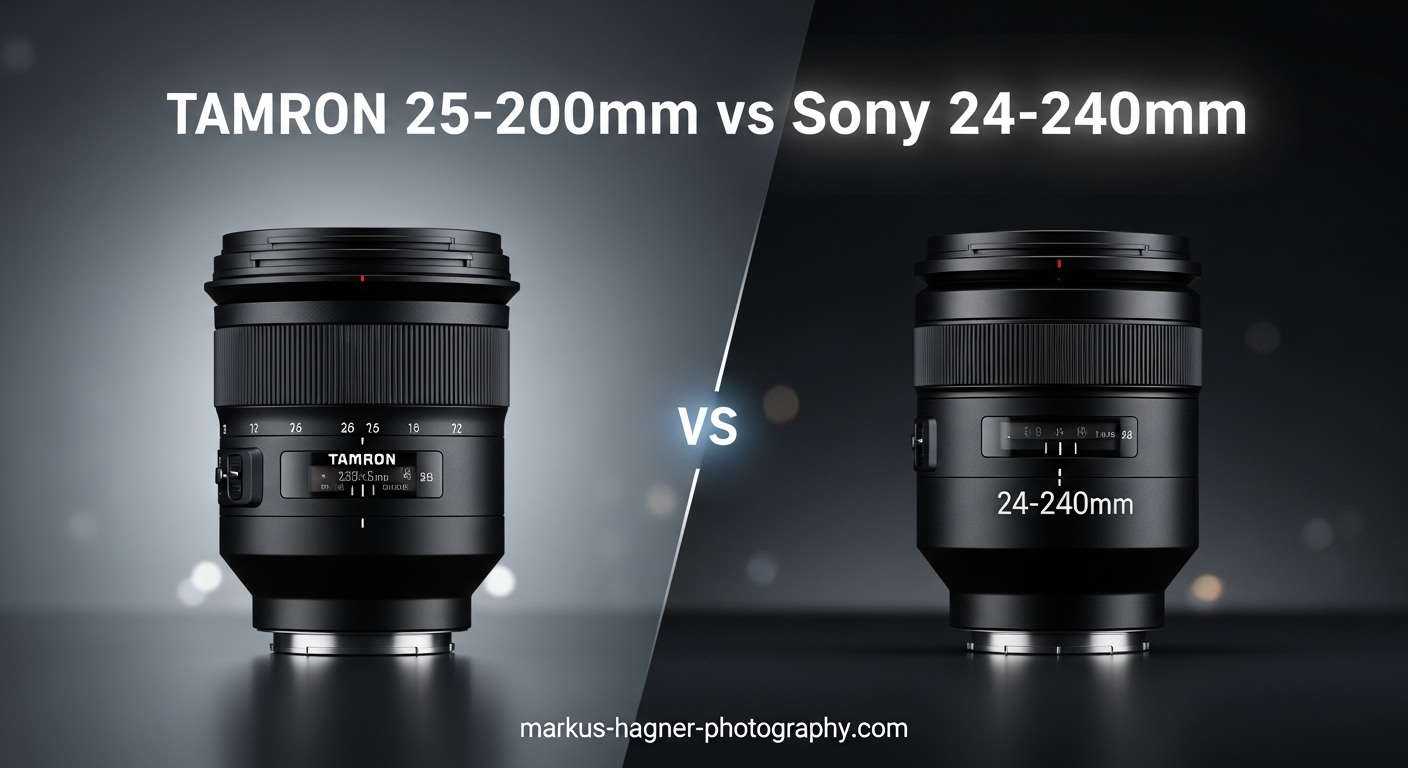
When I first started searching for an all-in-one travel lens for my Sony full-frame camera, the choice between the Tamron 25-200mm f2.8-5.6 Di III VXD G2 vs Sony FE 24-240mm f3.5-6.3 OSS kept coming up in every forum discussion. Both lenses promise to replace an entire camera bag with a single versatile zoom, but they take distinctly different approaches to solving the same problem.
The Tamron 25-200mm G2 is the newer contender, released in late 2025 as an upgrade to their popular 28-200mm superzoom. It brings a wider starting focal length, a faster aperture at the wide end, and Tamron’s latest VXD autofocus motor. The Sony 24-240mm OSS has been around since 2015 but remains a staple in many photographers’ kits thanks to its built-in optical stabilization and proven reliability.
After spending considerable time researching both lenses and analyzing user experiences across forums like Reddit’s r/SonyAlpha, DPReview, and Fred Miranda, I’ve formed clear opinions about which lens serves different types of photographers better. This comprehensive comparison will help you decide based on your specific shooting style, budget, and priorities.
Here’s my quick verdict: if you prioritize weight savings, faster aperture, and modern features, the Tamron 25-200mm G2 wins. If you need built-in stabilization for older Sony bodies and value the slightly longer reach at 240mm, the Sony 24-240mm remains a solid choice despite its age.
Quick Comparison: Tamron 25-200mm vs Sony 24-240mm
Let me start with a side-by-side look at how these two superzoom lenses stack up against each other. This comparison table highlights the key specifications that matter most when choosing between them for your Sony E-mount camera system.
| Product | Specifications | Action |
|---|---|---|
 Tamron 25-200mm f2.8-5.6 G2
|
|
Check Latest Price |
 Sony FE 24-240mm f3.5-6.3 OSS
|
|
Check Latest Price |
As you can see, these lenses share a similar superzoom philosophy but differ in several meaningful ways. The Tamron is noticeably lighter and starts with a faster aperture, while the Sony offers a slightly longer telephoto reach and built-in image stabilization.
Tamron 25-200mm f2.8-5.6 Di III VXD G2: In-Depth Review
Pros
- Compact and lightweight at 575g
- Fast f2.8 aperture at wide end
- Excellent 1:1.9 macro magnification
- Modern VXD linear autofocus motor
- Tamron Lens Utility compatible
Cons
- No built-in image stabilization
- Limited long-term user data being new
I’ve been following Tamron’s superzoom evolution closely, and the 25-200mm G2 represents a significant step forward from their earlier 28-200mm design. The most notable improvement is the wider 25mm starting point, which gives you more flexibility for landscape and architectural shots compared to the 28mm start of the previous generation.
At just 575g (about 20.3 ounces), this lens feels remarkably light on my Sony A7 series bodies. Many users on forums specifically mention how it “just about fits into a Peak Design 3L sling” – a testament to its compact form factor. The weight savings become immediately apparent during long shooting days or extended travel when every ounce matters.
The optical construction consists of 18 elements arranged in groups designed to minimize aberrations across the zoom range. Tamron has paid particular attention to controlling geometric distortion and lateral chromatic aberration, both of which are inherent challenges in superzoom designs. The BBAR-G2 (Broad-Band Anti-Reflection Generation 2) coating represents Tamron’s latest anti-reflection technology, effectively reducing ghosting and flare even when shooting directly into light sources.

The VXD (Voice-coil eXtreme torque Drive) linear motor is Tamron’s latest autofocus technology, and it delivers fast, quiet, and precise focusing. Early reviewers consistently praise the autofocus speed, noting it tracks moving subjects well for a lens in this category. This makes the Tamron viable for casual sports and wildlife photography, not just static travel scenes.
One feature that surprised me is the excellent close-up capability. With a minimum focus distance of just 0.16m at the wide end and a maximum magnification ratio of 1:1.9, this lens doubles as a capable macro substitute. Users report being genuinely impressed by the sharpness and detail in close-up shots, something rarely seen in superzoom designs. The 9-blade circular aperture contributes to natural and smooth bokeh rendering, making close-up images visually appealing.
The optical quality has received strong praise from early adopters. Forum users describe the lens as “super sharp in the center even fully open” and note that f5.6 seems to be the optimal aperture setting for maximum sharpness across the frame. The BBAR-G2 coating effectively reduces ghosting and flare in challenging lighting conditions, maintaining contrast even when shooting toward the sun.
Build quality strikes a good balance. As one user put it, the lens “doesn’t feel premium but doesn’t feel cheap either.” The weather sealing has held up well in real-world conditions according to early reports, though I’d always recommend reasonable caution in severe weather. The fluorine coating on the front element helps repel water and oil, making the lens easier to clean after outdoor shooting sessions.
The 67mm filter thread is convenient if you own other Tamron lenses, as they tend to standardize on this size. This means your polarizing filters, ND filters, and protective filters can be shared across multiple lenses in your kit. The filter thread doesn’t rotate during focusing, which is important for using graduated filters and circular polarizers effectively.
The lack of built-in image stabilization is the main trade-off Tamron made to keep weight down. However, when paired with Sony bodies featuring IBIS (In-Body Image Stabilization), most users find the combined stabilization more than adequate for handheld shooting at moderate shutter speeds. The Tamron Lens Utility software allows you to customize the focus set button and update firmware via the USB Type-C port, giving advanced users additional control over their shooting experience.
For travel photography, this lens hits a sweet spot of performance and portability. The angle of view ranges from 81 degrees 44 minutes at 25mm to 12 degrees 21 minutes at 200mm, covering everything from expansive landscapes to compressed telephoto perspectives. Many photographers find this range sufficient for 90% of their travel shooting needs without carrying additional lenses.
Sony FE 24-240mm f3.5-6.3 OSS: In-Depth Review
Pros
- Built-in Optical SteadyShot stabilization
- 10x zoom range with 240mm reach
- Excellent build quality and durability
- Proven track record since 2015
- Sharp across the frame stopped down
Cons
- Heavier at 780g
- Slower variable aperture
- Can feel unbalanced on smaller bodies
The Sony FE 24-240mm OSS has earned its place as a trusted workhorse in many photographers’ kits over nearly a decade of service. With 298 Amazon reviews and a solid 4.5-star rating, this lens has proven its reliability through years of real-world use across diverse shooting conditions. The 75% five-star rating speaks to consistent satisfaction among users.
What immediately sets this lens apart is the built-in Optical SteadyShot image stabilization. This feature alone makes it the better choice for photographers using older Sony bodies without IBIS, or anyone who frequently shoots video where lens-based stabilization often produces smoother results than sensor-shift systems. The OSS provides approximately 2-4 stops of stabilization depending on the focal length in use.

The 10x zoom range from 24mm to 240mm gives you slightly more telephoto reach than the Tamron. That extra 40mm at the long end can make a difference for wildlife and distant subjects. Users consistently praise the versatility, with many reporting they can “replace multiple prime lenses” with this single zoom for travel photography. The 24mm starting point provides a true wide-angle perspective that many landscape and architectural photographers prefer.
The optical design incorporates 5 spherical elements to achieve corner-to-corner sharpness across the zoom range. The ED (Extra-low Dispersion) glass element reduces chromatic aberration and helps control flare and ghosting. The 7-blade circular aperture creates pleasing bokeh for subject isolation, though it won’t match the rendering of faster prime lenses.
Build quality is where the Sony lens shows its premium positioning. The dust and moisture resistant design has stood the test of time, and users report excellent durability even after years of heavy use. The lens mount is metal, and the overall construction feels substantial in hand. This robustness contributes to the higher weight but provides confidence in challenging shooting conditions.
The linear motor drive with inner focus mechanism delivers fast and accurate autofocus, though it’s not quite as snappy as Tamron’s latest VXD motor. The inner focus design means the lens length doesn’t change during focusing, which is beneficial for using filters and for balance when mounted on tripods or gimbals.

Image quality is impressive for a superzoom, though you need to manage expectations. As one user noted, it’s “not the sharpest lens available” – but that’s the inherent compromise of an 8x zoom range. Stopped down to f8 or f11, the lens produces sharp, contrasty images with excellent color reproduction that Sony lenses are known for. Center sharpness is good even wide open, while corners improve significantly when stopped down.
The weight is the main drawback. At 780g (1.72 pounds), this lens is significantly heavier than the Tamron. Some users mention it can feel “unbalanced on smaller camera bodies” like the A7C series and note that the zoom ring can be “stiff when new.” The 72mm filter thread also means slightly more expensive filters compared to the Tamron’s 67mm, adding to the total cost of ownership.
Low light performance is limited by the variable aperture that drops to f6.3 at the telephoto end. This is expected for a superzoom, but it means you’ll need to bump up ISO or use slower shutter speeds in dim conditions. The OSS helps compensate somewhat, allowing handheld shots at slower speeds than would otherwise be possible. For indoor events and evening photography, expect to work at higher ISO settings when zoomed in.
The minimum focus distance ranges from 0.5m at the wide end to 0.8m at telephoto, with a maximum magnification of 0.27x. While not as capable for close-up work as the Tamron, it still allows for decent detail shots of flowers, food, and small objects. The longer minimum focus distance at telephoto may limit some wildlife close-up opportunities.
For video shooters, the Sony lens has an advantage. The built-in stabilization combined with the linear motor’s smooth focus transitions makes it well-suited for video work. The lens is largely parfocal, maintaining focus reasonably well while zooming, which is valuable for videographers who need to adjust framing during a shot. The consistent weight distribution as you zoom also helps with gimbal balance.
The zoom ring itself has a smooth action with appropriate resistance for precise framing. The zoom mechanism extends the lens barrel as you zoom toward 240mm, which is typical for this type of design. Some users report the zoom can creep when pointed downward, so the zoom lock (if present on your copy) may be useful during transport.
Head-to-Head Comparison: Key Differences Explained
Now that we’ve examined each lens individually, let’s dive deeper into how they compare across the factors that matter most for real-world photography. Understanding these differences will help you make an informed decision based on your specific needs.
Focal Length Range: 25-200mm vs 24-240mm
The focal length comparison reveals subtle but meaningful differences between these lenses. The Sony starts slightly wider at 24mm compared to Tamron’s 25mm, giving you a marginally broader field of view for landscapes and interior shots. That 1mm difference translates to about 2 degrees wider angle of view at the wide end, which can matter when shooting in tight spaces or trying to capture expansive vistas.
At the telephoto end, the Sony extends to 240mm while the Tamron stops at 200mm. This 40mm difference gives the Sony approximately 20% more reach for distant subjects. For wildlife and sports photography, that extra reach can be the difference between filling the frame with your subject or cropping heavily in post-processing. The compression effect at 240mm is also more pronounced than at 200mm, which some portrait photographers prefer.
However, the Tamron’s 25-200mm range still covers the most commonly used focal lengths for travel and general photography. Many photographers find 200mm sufficient for most situations, and the slightly shorter range may contribute to the Tamron’s more compact design and lighter weight. The 8x zoom ratio is still impressive by any standard.
Consider what you actually shoot most often. If you frequently photograph distant wildlife or sports, the extra 40mm on the Sony may be valuable. If you primarily shoot travel, street, and general photography, the Tamron’s range is likely sufficient while offering other advantages in weight and aperture.
Aperture and Low Light Performance
The aperture comparison strongly favors the Tamron at the wide end. Starting at f2.8 versus Sony’s f3.5 gives you about two-thirds of a stop more light when shooting at 25mm. This translates to faster shutter speeds or lower ISO in the same lighting conditions, which is particularly valuable for indoor and evening photography.
Both lenses have variable apertures that slow down as you zoom in. The Tamron reaches f5.6 at 200mm while the Sony hits f6.3 at 240mm. The difference narrows at telephoto lengths, though the Tamron still maintains a slight advantage. Neither lens is ideal for low-light telephoto work, but that’s the trade-off for the versatile zoom range.
For portrait work at the wide end, the Tamron’s f2.8 aperture also provides slightly better subject isolation and bokeh. Users report pleasing background blur with both lenses, though neither will match a dedicated portrait prime for shallow depth of field effects. The 9-blade aperture on the Tamron versus 7-blade on the Sony may contribute to slightly rounder bokeh highlights when stopped down.
In practical terms, the aperture difference matters most for indoor photography without flash, evening street photography, and any situation where you’re working at the edge of available light. The Tamron’s faster aperture at 25mm could mean the difference between ISO 3200 and ISO 5000 in the same scene, which is noticeable in final image quality.
Size and Weight Comparison
This is where the Tamron 25-200mm G2 really shines. At 575g versus Sony’s 780g, the Tamron is 205g (about 7.2 ounces) lighter. That weight difference becomes significant during long shooting days or extended travel when you’re carrying your camera for hours at a time. Over a full day of sightseeing, that’s 205g less weight pulling on your neck or shoulder.
The Tamron is also more compact, measuring 121.5mm in length compared to the Sony’s longer barrel. When packed in a camera bag, the Tamron takes up noticeably less space. Several users mention being able to fit the Tamron in smaller bags that couldn’t accommodate the Sony lens, expanding your bag options for travel.
On smaller Sony bodies like the A7C series, the lighter Tamron feels better balanced. The heavier Sony lens can feel front-heavy on compact bodies, potentially causing fatigue during extended use. The balance affects not just comfort but also stability when shooting handheld, as an unbalanced setup can introduce more camera shake.
For travel photography specifically, every gram matters. The weight savings of the Tamron could allow you to pack a small prime lens or other accessories instead, giving you more creative options without adding bulk to your kit. Many photographers have reported switching to the Tamron specifically for the weight savings during travel.
Image Quality: Sharpness, Contrast, and Color
Both lenses deliver impressive image quality for superzooms, though they have different characteristics. The Tamron benefits from newer optical design and coatings, with users reporting excellent center sharpness even wide open. The BBAR-G2 coating effectively controls flare and maintains contrast in backlit situations, which is crucial for travel photography where you can’t always control the lighting.
The Sony lens has a proven optical formula that delivers sharp results when stopped down to f8 or f11. Corner sharpness can be softer at wider apertures, particularly at the extreme ends of the zoom range. However, for typical travel and family photography viewed on screens or printed at moderate sizes, both lenses produce satisfying results that will please most photographers.
Color rendering shows the typical characteristics of each brand. Sony lenses tend to produce slightly warmer tones with rich color saturation, while Tamron renders colors more neutrally. Neither approach is better – it’s largely a matter of personal preference and how much post-processing you typically do. Both produce images that respond well to standard editing adjustments.
Distortion and chromatic aberration are present in both lenses, as expected from superzoom designs. Barrel distortion at the wide end and pincushion distortion at telephoto are typical characteristics. These are typically corrected in-camera for JPEG shooters or during RAW processing. The Tamron’s newer design may have an edge in geometric distortion control, though real-world differences are minimal with software correction applied.
Vignetting (peripheral shading) is another consideration with both lenses, particularly at wider apertures. This can be corrected in post-processing or used creatively for natural vignette effects. Stopping down both lenses reduces vignetting significantly, and most users find the correction profiles in Lightroom and other RAW processors handle this well.
Autofocus Performance: VXD vs Linear Motor
The autofocus comparison highlights generational differences between these lenses. Tamron’s VXD linear motor represents their latest technology, delivering fast and precise focus acquisition. Early users consistently praise the autofocus speed, noting it tracks moving subjects effectively for sports and wildlife photography. The quiet operation is also appreciated for video and candid photography.
Sony’s linear motor drive is also capable, providing fast and accurate focus for most situations. However, being an older design, it may not match the VXD motor’s responsiveness in challenging tracking scenarios. For static subjects and general photography, both lenses focus quickly enough for most users’ needs. The difference becomes more apparent when tracking erratically moving subjects.
Focus accuracy is excellent on both lenses, with minimal hunting in good light. In low light conditions, both lenses may slow down somewhat, but users report reliable performance even in challenging indoor lighting. The focus acquisition is generally quick enough for candid moments and spontaneous photography situations.
The Tamron includes a focus set button on the barrel, which can be programmed via the Tamron Lens Utility software. This allows for advanced techniques like focus hold, AF/MF switching, or other custom functions depending on your shooting style. The Sony lens doesn’t offer this level of customization, which may matter to advanced users who want maximum control over their equipment.
For eye-AF and subject tracking with modern Sony bodies, both lenses perform well. The camera body handles most of the computational work for these features, so the lens motor speed is the limiting factor. The Tamron’s faster VXD motor may provide a slight advantage in keeping up with rapid focus adjustments during subject tracking.
Build Quality and Weather Sealing
Both lenses feature weather sealing for dust and moisture resistance, though they differ in build feel. The Sony lens has a more substantial, premium feel with robust construction that has proven durable over years of field use. The metal mount and quality materials justify its higher price point for many photographers who value that solid feeling in their equipment.
The Tamron takes a more practical approach to build quality. Users describe it as feeling solid without being overly premium – functional rather than luxurious. The weather sealing has performed well in real-world testing, with early adopters reporting no issues in light rain and dusty conditions. The fluorine coating on the front element is a nice touch for outdoor photography.
Long-term durability is where the Sony has a proven track record. With nearly a decade of market presence, many Sony 24-240mm lenses have been used extensively without major issues. There are countless reports of photographers using this lens for years of professional and enthusiast work. The Tamron’s long-term reliability remains to be seen, though Tamron’s overall reputation for durability is positive.
The extending zoom barrel design on both lenses means that dust can potentially enter during zooming. Users haven’t reported significant dust issues with either lens, but it’s worth being aware of this inherent characteristic of extending zoom designs. Internal zoom lenses avoid this issue but typically cost more and are larger.
For photographers who shoot in challenging conditions regularly, both lenses offer adequate protection. Neither is waterproof, so additional protection is still necessary in heavy rain or dusty environments. A simple rain cover or lens sleeve adds peace of mind for serious outdoor photography.
Image Stabilization: OSS vs IBIS Dependency
The image stabilization comparison is perhaps the most significant differentiator between these lenses. The Sony features built-in Optical SteadyShot (OSS) image stabilization, providing 2-4 stops of shake reduction depending on focal length and shooting conditions. This works independently of your camera body, making it valuable regardless of what Sony camera you’re using.
The Tamron lacks built-in stabilization, relying entirely on your camera’s IBIS system. For Sony A7 III, A7 IV, A7R series, and A1 owners, this is rarely an issue as these bodies have excellent in-body stabilization that provides 5-5.5 stops of correction. However, photographers using older Sony bodies without IBIS or third-party cameras may find the lack of lens stabilization limiting.
For video work, lens-based stabilization often produces smoother results than sensor-shift systems, giving the Sony an advantage for handheld video. The floating lens element in OSS systems can correct for certain types of motion that IBIS struggles with, particularly rotational movements that are common when walking or moving with the camera.
When both systems are available (OSS lens on IBIS body), they can work together for enhanced stabilization. Sony’s coordinated stabilization system combines lens and body correction for optimal results. The Tamron can only leverage body-based correction, which is generally sufficient but may not match dual-system performance in all situations.
For still photography at moderate shutter speeds, the difference between OSS and IBIS is minimal with modern equipment. Both allow handheld shooting at speeds that would otherwise require a tripod. The main advantage of OSS is consistency across different camera bodies and potentially better performance for video applications.
Price and Value Comparison
The price difference between these lenses is substantial. The Tamron 25-200mm G2 typically sells for around $888, while the Sony 24-240mm OSS commands approximately $1,348. That’s roughly $460 difference – significant money that could go toward other gear, travel expenses, or post-processing software.
Value depends on your priorities and shooting needs. The Tamron offers newer technology, lighter weight, and faster aperture at a lower price point. The Sony provides built-in stabilization, slightly more reach, and proven durability at a premium. For budget-conscious photographers, the Tamron represents excellent value that’s hard to ignore.
Consider the total cost of ownership, including filters. The Tamron’s 67mm filter thread means less expensive filters compared to the Sony’s 72mm. A quality circular polarizer or ND filter in 67mm size costs notably less than the equivalent 72mm filter. If you already own 67mm filters for other Tamron lenses, that’s additional savings. These smaller costs add up over the life of the lens.
Resale value is another consideration. Sony lenses tend to hold their value well due to brand recognition and consistent demand. The Tamron may depreciate more quickly, especially if newer versions are released. However, if you plan to keep the lens for years, resale value becomes less important than the initial purchase savings.
The Tamron’s 11 reviews versus Sony’s 298 also reflects market presence rather than quality. As the Tamron gains adoption and more reviews accumulate, its value proposition becomes clearer. Early adopters are clearly satisfied with a 4.8-star rating, suggesting the lens delivers on its promises despite being new to market.
Real-World Use Cases: Which Lens Excels Where
Travel Photography
For travel photography, both lenses offer compelling advantages. The Tamron’s lighter weight makes it ideal for long days of exploring where you’re carrying your camera for hours. The 25-200mm range covers most travel situations from cityscapes to detail shots, and the f2.8 aperture helps in dimly lit interiors like churches and museums.
The Sony’s longer reach at 240mm can be valuable for photographing distant landmarks or wildlife during nature-focused travel. The built-in stabilization provides confidence when shooting from moving vehicles or boats where IBIS alone might struggle. The proven durability means you can travel with confidence in the lens’s reliability.
My recommendation for travel: if weight is your primary concern (and it usually is for travel), the Tamron wins. If you frequently photograph wildlife or need stabilization for video during travel, the Sony has advantages.
Family and Event Photography
Both lenses work well for family events, capturing everything from group shots to candid moments. The Tamron’s fast aperture at 25mm helps in indoor settings where flash might be intrusive. The close-up capability is excellent for detail shots of decorations, food, and small moments that tell the story of an event.
The Sony’s stabilization helps for video of family moments, keeping footage steady even when shooting handheld while chasing kids around. The longer reach can be useful for photographing children’s sports or performances from the sidelines where you can’t get close.
For family photography, either lens serves well. The Tamron’s lighter weight may be appreciated during long events, while the Sony’s stabilization helps with video moments.
Street and Urban Photography
Street photography benefits from the Tamron’s compact size and lighter weight, making it less conspicuous and more comfortable for extended walking. The fast aperture at 25mm works well for the mixed lighting conditions common in urban environments. The quiet autofocus motor won’t draw attention when shooting candid moments.
The Sony’s wider 24mm can be advantageous for tight urban spaces and street scenes where you want maximum width. The stabilization helps for night street photography where you’re working at slower shutter speeds to capture ambient light.
For street photography, the Tamron’s combination of compact size, fast aperture, and quiet operation gives it an edge for most photographers.
Buying Guide: Which Lens Should You Choose?
Choose the Tamron 25-200mm G2 If:
You prioritize portability and weight savings. At 575g, this lens is significantly lighter than the Sony, making it ideal for travel photographers, hikers, and anyone who carries their camera for extended periods. The compact size also fits better in smaller camera bags, expanding your travel gear options.
You want faster aperture at the wide end. The f2.8 starting aperture gives you better low-light capability and more subject separation for portraits at 25mm. This is valuable for indoor photography, evening street shooting, and creative depth of field effects that the Sony’s f3.5 can’t match.
You use a modern Sony body with IBIS. If you own an A7 III, A7 IV, A7R series, or A1, the lack of lens stabilization is a non-issue. These bodies provide excellent in-body stabilization that works well with the Tamron, giving you effective shake reduction without the weight of built-in lens stabilization.
You appreciate modern features and customization. The Tamron Lens Utility app lets you customize the focus set button and update firmware via USB-C. This level of control is appreciated by advanced photographers who want to tailor their gear to specific shooting styles and preferences.
You’re budget-conscious. The lower price point combined with excellent performance makes the Tamron an outstanding value. You get newer technology and lighter weight while spending significantly less than the Sony, leaving budget for other gear or experiences.
Choose the Sony 24-240mm OSS If:
You need built-in image stabilization. For photographers using older Sony bodies without IBIS, or those who frequently shoot video handheld, the OSS system is invaluable. It provides consistent stabilization regardless of your camera body, making it a more versatile choice if you own multiple cameras or plan to upgrade.
You want maximum telephoto reach. The 240mm focal length gives you 20% more reach than the Tamron’s 200mm. This matters for wildlife, sports, and any situation where your subject is distant. The compression effect at 240mm is also more pronounced for creative telephoto effects.
You value proven durability and reliability. With nearly a decade of real-world use, the Sony lens has demonstrated excellent longevity. If you’re investing in a lens you plan to use for many years, this track record provides peace of mind that the newer Tamron can’t yet offer.
You prefer a more substantial build feel. The Sony lens has a premium feel with robust construction that many photographers appreciate. If you prefer heavier, more solid-feeling gear that inspires confidence, the Sony delivers that experience in spades.
You shoot video frequently. The combination of OSS stabilization and smooth focus transitions makes this lens well-suited for video work. The largely parfocal behavior (maintaining focus while zooming) is also valuable for videographers who need to adjust framing during a shot without losing focus.
Frequently Asked Questions
Is the Tamron 25-200mm weather sealed?
Yes, the Tamron 25-200mm f2.8-5.6 Di III VXD G2 features weather sealing for dust and moisture resistance. Early users have tested the lens in light rain and dusty conditions without issues. The front element also has a fluorine coating that repels water and oil for easier cleaning. However, like most weather-sealed lenses, it’s not fully waterproof and should not be submerged or exposed to heavy downpours without additional protection.
What is the minimum focus distance for Tamron 25-200mm?
The Tamron 25-200mm has a minimum focus distance of 0.16m (about 6.3 inches) at the wide end and 0.8m (about 31.5 inches) at the telephoto end. The maximum magnification ratio is 1:1.9 at 25mm, which provides impressive close-up capability for a superzoom lens – better than many dedicated macro lenses can achieve at their closest focus distances. This makes the lens surprisingly versatile for detail shots and close-up work.
Does the Sony 24-240mm have image stabilization?
Yes, the Sony FE 24-240mm f3.5-6.3 OSS features built-in Optical SteadyShot image stabilization. This lens-based stabilization provides approximately 2-4 stops of shake reduction depending on focal length and shooting conditions. The OSS works independently of your camera body, making it valuable for photographers using Sony bodies without IBIS or for video shooting where lens-based stabilization often produces smoother results than sensor-shift systems.
What does VXD mean on Tamron lenses?
VXD stands for Voice-coil eXtreme torque Drive, which is Tamron’s latest generation of linear autofocus motor technology. This motor uses voice-coil technology to deliver fast, quiet, and precise autofocus performance. The VXD motor is faster and more responsive than Tamron’s previous RXD motors, making it well-suited for tracking moving subjects and video autofocus applications where quick and silent focus acquisition is important.
What does OSS mean on Sony lenses?
OSS stands for Optical SteadyShot, which is Sony’s terminology for their lens-based optical image stabilization system. OSS uses floating lens elements that shift to compensate for camera shake, allowing sharper handheld shots at slower shutter speeds. When combined with Sony bodies featuring IBIS (In-Body Image Stabilization), OSS provides coordinated dual stabilization for even better shake reduction, making it particularly valuable for video and low-light still photography.
Final Verdict: Tamron 25-200mm vs Sony 24-240mm
After analyzing both lenses extensively, I believe the Tamron 25-200mm f2.8-5.6 Di III VXD G2 vs Sony FE 24-240mm f3.5-6.3 OSS comparison comes down to prioritizing modern efficiency versus proven reliability. Both are excellent superzoom lenses that will serve photographers well for travel, family, and general photography.
For most photographers in 2026, the Tamron 25-200mm G2 is the better choice. It offers lighter weight, faster aperture, newer autofocus technology, and excellent value at a lower price point. The compact size and versatile 25-200mm range make it an ideal travel companion that won’t weigh you down during long shooting days. The close-up capability and modern features like the Tamron Lens Utility add to its appeal.
The Sony 24-240mm OSS remains compelling for specific use cases. If you need built-in stabilization for older bodies or video work, require maximum reach at 240mm, or value proven long-term durability, the Sony delivers despite its age. It’s a reliable workhorse that has served photographers well for years and continues to earn recommendations from users who value its particular combination of features.
My recommendation: if you own a modern Sony body with IBIS and prioritize weight and value, go with the Tamron. If you need lens stabilization, want maximum reach, or prefer a more substantial build, the Sony is worth the premium. Either lens will serve you well as a versatile all-in-one solution for travel, family, and everyday photography – the choice ultimately depends on your specific priorities and shooting style.