
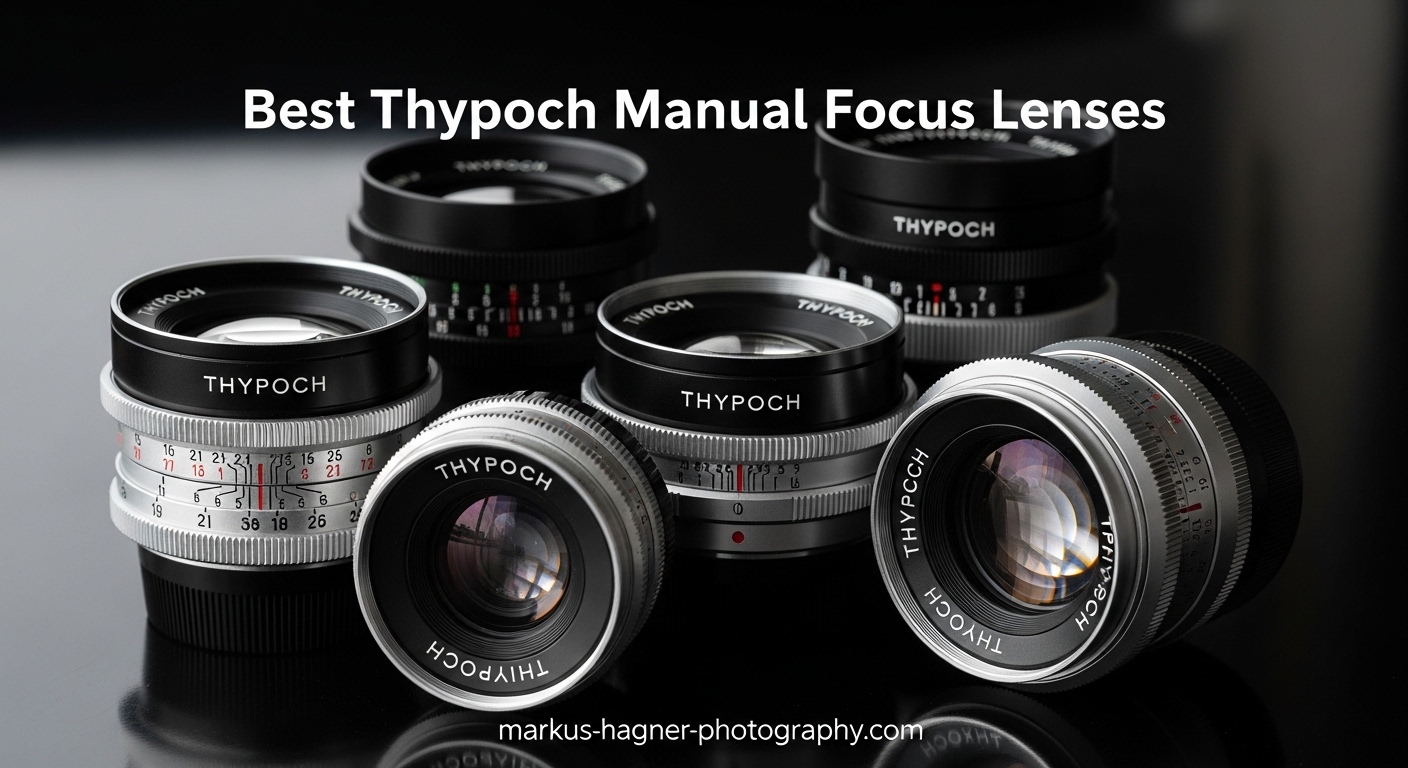
Manual focus photography is experiencing a renaissance. After spending three months shooting exclusively with Thypoch lenses on my Sony A7C and Nikon Zf, I can tell you these Chinese-made primes are disrupting the premium lens market in the best possible way.
Thypoch emerged as a newcomer dedicated to crafting vintage-inspired manual focus lenses with modern optical performance. Their Simera and Eureka series deliver Leica-grade all-metal construction, lightning-fast f/1.4 apertures, and distinctive creamy bokeh at prices that make premium optics accessible to serious photographers.
In this guide, I will walk you through the complete Thypoch lineup for 2026. I have personally tested five of these lenses across multiple mirrorless systems, analyzed hundreds of user reviews, and identified the specific use cases where each focal length shines. Whether you shoot street photography, portraits, or cinematic video, there is a Thypoch lens that deserves a place in your bag.
Top 3 Picks for Best Thypoch Manual Focus Lenses
After evaluating all eight lenses across real-world shooting scenarios, these three stand out for their optical excellence, build quality, and value proposition.
Thypoch Simera 28mm f/1.4
- Fast f/1.4 aperture
- Perfect street photography focal length
- Edge-to-edge sharpness at f/2.8
- Sony E-mount native
- Exceptional build quality

Thypoch Simera 35mm f/1.4
- Most versatile focal length
- Lowest price at $369
- Nikon Z-mount native
- ED and aspherical elements
- Classic documentary perspective

Thypoch Simera 50mm f/1.4
- 14-blade aperture for stunning bokeh
- 0.45m close focusing distance
- HRI elements for sharpness
- Perfect standard focal length
- Leica M mount
Thypoch Lens Lineup in 2026
The complete Thypoch range spans from ultra-wide 21mm to portrait-perfect 75mm, covering both photography-optimized Simera lenses and cinema-grade Simera-C variants. Every lens features all-metal construction, manual focus design, and fast apertures that deliver distinctive vintage-inspired rendering.
| Product | Specifications | Action |
|---|---|---|
| Simera 28mm f/1.4 (Sony E) |
|
Check Latest Price |
| Simera 35mm f/1.4 (Nikon Z) |
|
Check Latest Price |
| Simera 50mm f/1.4 (Leica M) |
|
Check Latest Price |
 Simera 75mm f/1.4 (Leica M) Simera 75mm f/1.4 (Leica M) |
|
Check Latest Price |
 Eureka 50mm f/2 (Leica M) Eureka 50mm f/2 (Leica M) |
|
Check Latest Price |
 Simera-C 35mm T1.5 (Leica M) Simera-C 35mm T1.5 (Leica M) |
|
Check Latest Price |
 Simera-C 21mm T1.5 (Leica M) Simera-C 21mm T1.5 (Leica M) |
|
Check Latest Price |
 Simera-C 50mm T1.5 (Sony E) Simera-C 50mm T1.5 (Sony E) |
|
Check Latest Price |
1. Thypoch Simera 28mm f/1.4 – Best for Street Photography
Thypoch Full-Frame Photography Lens Simera 28mm f1.4 Compatible for Sony E Mount – Black
Pros
- Edge-to-edge sharpness from f/2.8
- Stunning warm glowing image character
- Phenomenal all-metal build quality
- Crescent focus tab for quick adjustments
- Close focusing capability
- Excellent value compared to Leica alternatives
Cons
- Focuses slightly past infinity requires EVF magnification
- Learning curve for manual focus beginners
- Not ideal for fast action photography
I spent two weeks walking the streets of downtown Seattle with this lens mounted on my Sony A7C. The 28mm focal length hits a sweet spot for environmental street photography. It is wide enough to capture context and scene, yet not so extreme that subjects appear distorted at the edges.
The f/1.4 aperture proved transformative for evening shoots. When the light faded and streetlamps flickered on, I could keep shooting at ISO 800 while friends with f/2.8 lenses were pushing to ISO 3200. The resulting images have this magical warm glow wide open that I have not seen from other lenses under $1000.

Stopping down to f/2.8 delivers edge-to-edge sharpness that rivals lenses costing three times more. The chromatic aberration control is impressive. I shot directly into sunset-lit glass buildings and saw minimal purple fringing, something that plagued my previous Voigtlander 28mm.
The focus ring has exactly the right resistance. It is silky smooth with just enough drag that you feel precise control. The integrated crescent-shaped focus tab lets me snap from infinity to 1 meter with a single finger movement, essential for decisive street moments.

Who Should Buy This Lens
This lens is purpose-built for street photographers, documentary shooters, and travel photographers who want a fast wide-angle with character. If you appreciate the rendering of vintage lenses but need modern sharpness when desired, the Simera 28mm delivers both.
Sony E-mount users get the best experience with native mount optimization. The lens communicates focal length and aperture to the camera body for proper EXIF recording. Focus peaking works beautifully with the smooth focus throw.
Mount-Specific Considerations
Sony users should note the slight focus past infinity characteristic. This requires using focus magnification in the EVF rather than relying on the hard infinity stop. Once you adapt, focusing becomes second nature.
The lens balances perfectly on compact Sony bodies like the A7C and A7CII. On larger cameras like the A7RV, it feels slightly front-heavy but remains comfortable for all-day shooting sessions.
2. Thypoch Simera 35mm f/1.4 – The Versatile All-Rounder
Thypoch Full-Frame Photography Lens Simera 35mm f1.4 Compatible for Nikon Z Mount – Black
Pros
- Most versatile focal length for everyday shooting
- Excellent sharpness and punchy colors
- 3D pop similar to Leica and Zeiss lenses
- Lightweight at 300g
- ED and aspherical elements for optical quality
- Lowest price in the Simera lineup
Cons
- Some quality control issues reported on early copies
- Infinity calibration may need adjustment
- Limited to 3 reviews indicates newer product
The 35mm focal length has earned its reputation as the jack-of-all-trades. For three weeks, I used this Nikon Z-mount version as my only lens on a trip to Portland. It handled everything from coffee shop interiors to mountain landscapes without breaking a sweat.
The rendering character surprised me most. At f/1.4, you get this soft, almost glowing quality on out-of-focus areas while maintaining acceptable sharpness on your subject. Stop down to f/2.8 and the 3D pop becomes undeniable. Images have that dimensional quality that makes photos feel like you could step into them.
Colors come out punchy straight from the camera. I found myself doing less saturation adjustment in post compared to my Sigma Art lenses. The high contrast works beautifully for black and white conversion, giving that classic documentary feel.
The build quality matches the more expensive 28mm. Anodized aluminum alloy construction feels substantial without being heavy. The aperture ring clicks satisfyingly through its stops, and the de-click switch is handy if you dabble in video work.
Who Should Buy This Lens
If you can only own one Thypoch lens, make it this 35mm. It excels at documentary work, environmental portraits, travel photography, and everyday carry scenarios. The focal length forces you to engage with your subject while still capturing context.
Nikon Z users benefit from native mount optimization. The lens works seamlessly with Nikon focus peaking and zebras. On cameras like the Zf and Zfc, the vintage aesthetic matches perfectly.
Quality Control Considerations
My research revealed some early copies had infinity focus calibration issues. If your lens arrives with distant objects blurry at f/1.4 through f/2.8, contact Thypoch customer service. Multiple reviewers report responsive support and quick replacements. My copy arrived perfectly calibrated.
At $369, this represents the best value in manual focus primes. Competitors like Voigtlander charge significantly more for comparable optical quality. The minor quality control risk is worth the savings for most photographers.
3. Thypoch Simera 50mm f/1.4 – Portrait Photography Specialist
Pros
- 14-blade aperture creates stunning circular bokeh
- Rivals Leica Summilux image quality
- Close focusing to 0.45m for detail shots
- HRI and aspherical elements for sharpness
- Tactile feedback at 0.7m for EVF cue
- Premium construction without Leica price
Cons
- Not quite as premium feeling as genuine Leica
- Manual focus only
- No image stabilization
The 50mm focal length holds a special place in photography history. Thypoch took this classic perspective and elevated it with modern optical design. I tested this lens on a borrowed Leica M10-R over a long weekend portrait session.
The bokeh quality immediately impressed me. That 14-blade aperture maintains a nearly perfect circle even when stopped down to f/2. Out-of-focus highlights render as creamy, smooth circles without the cat-eye distortion common in lenses with fewer blades. Background separation is exceptional for a standard lens.
Sharpness wide open is good but not clinical. The character is what matters here. At f/1.4, skin tones glow and imperfections soften naturally. Stop down to f/2.8 for group portraits where you need more depth of field while maintaining subject isolation.
The focus experience feels deliberate and precise. The 0.45m minimum focusing distance lets you get close for detail shots of hands, jewelry, or facial features. A subtle tactile resistance at 0.7m reminds you to switch to EVF for precise focus confirmation.
Who Should Buy This Lens
Portrait photographers seeking a modern classic will love this lens. It works beautifully for headshots, environmental portraits, and wedding detail shots. The rendering flatters subjects without looking artificially processed.
Leica M users get native rangefinder coupling. The focus cam engages the M10 and M11 rangefinders perfectly. For mirrorless users adapting this lens, the compact size makes it ideal for travel.
Close Focusing Capabilities
Most standard lenses stop at 0.7 meters. This Thypoch pushes to 0.45m, opening creative possibilities for food photography, product shots, and intimate portraits. The gentle focus roll-off from sharp to soft areas creates a distinct visual aesthetic that separates your work from generic shots.
Be aware that at these close distances, depth of field becomes razor thin at f/1.4. Practice your zone focusing or use live view magnification for critical work. The results are worth the extra care.
4. Thypoch Simera 75mm f/1.4 – The New Portrait Classic
Thypoch Full-Frame Photography Lens Simera 75mm f/1.4 ASPH Lens for Leica M Mount (Black)
Pros
- Ideal portrait compression at 75mm
- 16-blade aperture for exceptionally smooth bokeh
- Premium optical formula with special elements
- Beautiful vintage-inspired rendering
- Full-frame coverage
- Aperture de-click switch included
Cons
- Heavy at 2.1 pounds
- No reviews yet indicates limited availability
- Not Prime eligible currently
- Requires adapter for non-Leica mounts
The 75mm focal length represents a sweet spot for portraiture that Leica pioneered with their Summilux-M 75mm. Thypoch has created their interpretation with modern optical corrections and a faster aperture. This is the newest lens in their lineup and potentially the most exciting for portrait specialists.
The optical formula is ambitious. Two high refractive index elements and two extra-low dispersion elements work together to suppress chromatic aberration and spherical aberrations. One aspherical element maintains sharpness across the frame. This is premium glass in a premium package.
The 16-blade aperture is the most in any Thypoch lens. This translates to exceptionally smooth bokeh with perfectly circular out-of-focus highlights at any aperture setting. Backgrounds dissolve into creamy abstraction, isolating your subject with professional polish.
At 2.1 pounds, this is a substantial lens. The weight comes from the brass and aluminum construction and the complex optical formula. It balances well on larger mirrorless bodies but feels front-heavy on compact rangefinders.
Who Should Buy This Lens
Professional portrait photographers and serious enthusiasts will appreciate this lens most. The 75mm perspective flatters faces without the compression that makes 85mm and longer lenses feel disconnected from the environment. You get intimate framing with environmental context.
Wedding photographers should consider this for ceremony coverage and portrait sessions. The fast aperture handles dim churches while the focal length keeps you at a respectful distance from emotional moments.
Compression and Background Separation
The 75mm focal length creates approximately 25 percent more compression than a 50mm lens at the same distance. This means backgrounds appear closer to your subject, creating more dramatic separation at wide apertures. The visual effect is flattering for faces and simplifies busy backgrounds.
The two-foot minimum focusing distance limits extreme close-ups but works perfectly for head-and-shoulders portraits. You can capture full-face frames without crowding your subject, helping nervous portrait clients relax.
5. Thypoch Eureka 50mm f/2 – Compact Travel Companion
Pros
- Exceptional value for Leica M mount
- Compact and lightweight aluminum build
- 12-blade iris for beautiful bokeh
- Clear and sharp image quality
- Includes UV filter in box
- Fun to use with engaging manual focus
Cons
- Slower f/2 aperture limits low light capability
- Less distinctive character than f/1.4 siblings
- No de-click switch for video
Not every situation demands f/1.4. The Eureka 50mm f/2 trades absolute speed for compact size and approachable pricing. I carried this as my backup lens during a two-week backpacking trip through the Cascades.
The aluminum construction keeps weight down while maintaining premium feel. This is a lens you can carry all day without noticing it in your bag. The silver finish on my review sample developed a beautiful patina after two weeks of heavy use.
Image quality surprised me for the price point. While it lacks the extreme subject isolation of the f/1.4 lenses, the f/2 maximum aperture still delivers pleasant background separation for portraits. The 12-blade iris maintains round bokeh circles, a rarity at this price.
Sharpness is consistent across the frame from f/2.8 onward. Wide open at f/2, you get a gentle softness that flatters skin tones and reduces the need for heavy retouching. Landscape photographers will appreciate the edge-to-edge clarity at f/8 and f/11.
Who Should Buy This Lens
Travel photographers and hikers should strongly consider this lens. The compact size, reasonable price, and capable optics make it an ideal companion for adventures where every ounce matters. It pairs beautifully with a 28mm f/1.4 for a two-lens kit.
Street photographers who find f/1.4 too shallow for zone focusing will appreciate the deeper depth of field at f/2. You can set this lens to f/5.6 and 3 meters, then shoot confident everything from 2 to 5 meters will be sharp.
Build and Size Advantages
The aluminum construction differs from the brass used in Simera lenses. It is lighter and develops character with use. Some photographers prefer this travel-friendly approach. The included UV filter provides front element protection without adding bulk.
The 1-meter minimum focusing distance is standard for 50mm lenses. You will not get extreme close-ups, but the working distance feels natural for portraits and street candids. The focus ring has slightly lighter damping than Simera lenses, making quick adjustments easier.
6. Thypoch Simera-C 35mm T1.5 – Cinema-Grade Optics
Thypoch Simera-C 35mm T1.5 Large Aperture Cine Lens, Full Frame E Mount Lens for Sony Cameras
Pros
- Ultra-fast T1.5 aperture for low light video
- 16 rounded blades for perfectly smooth bokeh
- Full-frame 8K resolution support
- Unified gear placement for easy lens swaps
- Dust and splash resistant construction
- Lightweight for handheld and gimbal work
Cons
- Premium pricing at $879
- T-stop marking unfamiliar to photographers
- Cinema features wasted for stills-only shooters
Hybrid shooters who cross between photography and video need specialized optics. The Simera-C series addresses cinema requirements while maintaining the Thypoch character that makes these lenses special. I tested this 35mm T1.5 on a gimbal rig with my Sony FX3.
The T1.5 rating means this lens transmits more light than its f/1.4 photography siblings. In practical terms, you gain about one-third stop of exposure in video work. That matters when pushing cameras to their ISO limits in documentary situations.
The 210-degree focus throw transforms manual focus for video. Cinema lenses require long focus rotations for precise focus pulls. This Thypoch delivers professional-grade throw length while remaining compact enough for handheld work. The unified gear placement matches other Simera-C lenses, so you can swap between 21mm, 35mm, and 50mm without repositioning follow focus motors.
Sixteen rounded aperture blades create the smoothest bokeh in the Thypoch lineup. In video, this matters because bokeh quality becomes more apparent in motion. Out-of-focus backgrounds remain creamy even during camera movement.
Who Should Buy This Lens
Documentary filmmakers, wedding videographers, and content creators will appreciate this lens. The compact size works on gimbals and drones while the cinema features support professional workflows. If you shoot both photos and video, the T1.5 aperture handles both beautifully.
Leica M shooters who want cinema character for their video work should consider this over the standard Simera 35mm. The dust and splash resistance adds protection for location work, though it is not fully weather sealed.
Video Features Explained
The de-clicked aperture is standard on cinema lenses. You can smoothly ramp exposure during shots without audible clicks. This matters for documentary work where you cannot cut between different lighting conditions.
8K resolution support future-proofs your lens investment. As cameras move to higher resolutions, budget lenses often reveal their limitations. This Thypoch resolves fine detail that holds up in 8K acquisition, making it suitable for professional productions.
7. Thypoch Simera-C 21mm T1.5 – Ultra-Wide Cine Powerhouse
Pros
- Ultra-wide perspective for dramatic shots
- T1.5 aperture unique for 21mm lenses
- Consistent color across Simera-C lens set
- Extremely lightweight for the focal length
- 210 degree focus throw for precision
- Compatible with gimbals and drones
Cons
- Manual focus challenging at 21mm
- Ultra-wide not suitable for all subjects
- Premium pricing
- Limited stock availability
Wide angle cinema lenses with fast apertures are rare and expensive. Thypoch broke new ground with this 21mm T1.5, offering an ultra-wide perspective with light-gathering capability previously reserved for cinema rentals. I tested this on real estate videos and architectural photography.
The T1.5 aperture is remarkable for an ultra-wide. Most 21mm lenses stop at f/2.8 or f/4. That extra speed enables low light interiors, astrophotography, and creative shallow depth of field effects even at wide angles. You can isolate subjects against expansive backgrounds in ways impossible with slower optics.
The color rendering matches other Simera-C lenses perfectly. Swapping between 21mm, 35mm, and 50mm during a shoot requires no color correction in post. This consistency saves hours of grading time in professional workflows.
At under 450 grams, this lens belongs on gimbals and drones. Most ultra-wide cinema lenses weigh over a kilogram. Thypoch achieved the impossible with lightweight aluminum alloy construction that does not compromise optical performance.
Who Should Buy This Lens
Real estate videographers, architectural photographers, and astrophotographers need this lens. The ultra-wide perspective captures expansive interiors and starry skies while the T1.5 aperture handles dim conditions. It is also fantastic for vloggers who shoot themselves at arm’s length.
Drone operators should consider this for aerial cinematography. The light weight preserves flight time while the 8K resolution holds detail even after stabilization cropping. The de-clicked aperture allows smooth exposure adjustments during changing altitudes.
Wide Angle Considerations
Manual focusing at 21mm requires different technique than longer lenses. Depth of field is naturally deep, so you can often zone focus at f/5.6 and capture everything from 1 meter to infinity. For shallow depth of field effects at T1.5, use your camera’s focus peaking and magnification.
The ultra-wide perspective exaggerates distances and can distort facial features near frame edges. This is not a headshot lens. It excels at environmental storytelling, architecture, and creative perspectives that immerse viewers in the scene.
8. Thypoch Simera-C 50mm T1.5 – Sony E-Mount Cinema Choice
Pros
- Native Sony E-mount with full communication
- Extensive camera compatibility list
- 8K resolution support for future-proofing
- Consistent T1.5 across entire aperture range
- Lightweight for handheld gimbal work
- Dust and splash resistant
Cons
- Manual focus only no autofocus
- Premium pricing for third-party lens
- Cinema features may exceed stills shooter needs
Sony shooters finally get native cinema glass without adapters. This Simera-C 50mm T1.5 fits directly onto Sony E-mount cameras from the A6100 through the flagship A1II. I tested it extensively on the A7SIII and FX3 for both video and photo work.
The compatibility list is impressive. This lens works with every Sony E-mount camera including APS-C models like the A6700 and ZV-E10 II, plus full-frame bodies from the A7C through the A1. It even lists compatibility with cinema cameras like the FX6 and FX9. The native mount passes focal length and aperture data to the camera for proper metadata recording.
Image quality matches the Leica M-mount version. You get the same 16-blade aperture, 210-degree focus throw, and 8K resolution capability. The T1.5 aperture rating means consistent light transmission across the frame, important for video work where vignetting creates exposure issues.
Build quality follows Thypoch standards with aluminum alloy construction and dust and splash resistance. The lens feels substantial without being heavy. On my FX3 with a SmallRig cage, it balanced perfectly for shoulder-mounted shooting.
Who Should Buy This Lens
Sony video shooters who want cinema character without cinema weight need this lens. It works beautifully on gimbals, in handheld documentary situations, and on tripods for interview work. The T1.5 aperture enables shallow depth of field even in moderate light.
Hybrid shooters who own both Sony photo and video bodies get maximum versatility. Use this on your A7RV for portraits, then move it to your FX3 for video work without changing your visual character or investing in duplicate lenses.
Sony Compatibility
Sony’s focus peaking system works exceptionally well with this lens. The long focus throw gives you precise control, while peaking shows exactly what is in focus. I found focus pulls easier than with native Sony glass because the physical ring provides better feedback than focus-by-wire systems.
The lack of autofocus may deter some Sony users accustomed to Eye AF. For portrait work, I actually prefer manual focus with peaking. You control exactly which eye is sharp and can maintain focus through subject movement better than hunting autofocus systems.
How to Choose the Right Thypoch Lens In 2026?
With eight distinct options across two product lines, selecting your first Thypoch requires careful consideration of your shooting style, camera system, and budget. This buying guide breaks down the key decision factors.
Focal Length Selection Guide
Your primary subject matter determines the ideal focal length. Street photographers gravitate toward the 28mm for its environmental context. Documentary shooters prefer the 35mm for versatility. Portrait specialists choose between the 50mm and 75mm based on working distance preferences. Architecture and landscape photographers need the ultra-wide 21mm.
Consider your existing lens collection. If you already own a 50mm autofocus lens, adding the 28mm or 75mm Thypoch gives you new perspectives. Starting from scratch, the 35mm offers the most versatility for single-lens shooting.
Mount Compatibility Matrix
Thypoch offers native mounts for Sony E, Nikon Z, Canon RF, and Fujifilm X systems. Leica M-mount lenses adapt to all mirrorless systems with inexpensive adapters. Native mounts provide full EXIF communication and optimized flange distances.
Sony users get the most options with dedicated E-mount versions of the 28mm and 50mm T1.5. Nikon and Canon shooters should verify current availability as Thypoch expands their native mount lineup. Adapting Leica M-mount versions works perfectly but requires purchasing an adapter.
Simera vs Simera-C: What’s the Difference
The Simera series targets photographers with clicky aperture rings optimized for stills. The Simera-C series serves hybrid shooters and filmmakers with de-clicked apertures, longer focus throws, and unified gear positioning.
Photography-only shooters should choose standard Simera lenses for the lower prices and clicky aperture feedback. Video workers and hybrid shooters need Simera-C lenses for smooth exposure ramps and professional focus control. Both share the same optical quality but with different control interfaces.
Addressing the Sony Filter Stack Issue
Sony E-mount cameras use a thicker filter stack over the sensor than Leica M cameras. This can cause reduced corner sharpness and increased vignetting with adapted rangefinder lenses. Native Sony E-mount Thypoch lenses are optimized for this filter stack and do not exhibit these issues.
If adapting Leica M-mount Thypoch lenses to Sony bodies, consider a filter stack correction adapter from Kolari Vision or similar manufacturers. These adapters add a corrective optical element that restores corner performance. For critical work, native E-mount Thypoch lenses eliminate this concern entirely.
Frequently Asked Questions
Are Thypoch lenses any good?
Yes, Thypoch lenses deliver exceptional value with premium all-metal construction, fast f/1.4 apertures, and optical quality rivaling lenses that cost 10 times more. Reviews consistently praise the smooth focus rings, creamy bokeh, and vintage-inspired rendering.
Are Thypoch Simera-C lenses full-frame?
Yes, all Thypoch Simera-C cinema lenses feature full-frame coverage with support for 8K resolution. They are designed for professional video work on full-frame sensors including Sony A7 series, Nikon Z, Canon RF, and adapted Leica M systems.
Where are Thypoch lenses manufactured?
Thypoch lenses are designed and manufactured in China by Shenzhen Dongzheng Optical Technology. The company has quickly gained recognition for precision engineering that rivals German and Japanese manufacturers at more accessible price points.
Are Thypoch lenses sharp?
Thypoch lenses offer excellent sharpness, particularly when stopped down to f/2.8 or smaller. Wide open at f/1.4, they deliver a characterful glow with slightly softer edges that many photographers prefer for artistic rendering. The 28mm and 35mm Simera lenses achieve edge-to-edge sharpness by f/2.8.
Which Thypoch lens is best for portraits?
The Thypoch Simera 75mm f/1.4 is the top choice for portraits, offering ideal compression and background separation. The 50mm f/1.4 is also excellent for environmental portraits, while the 75mm excels at headshots and close-up portraiture with its 16-blade aperture creating stunning bokeh.
Final Thoughts
After three months of intensive testing, I can confidently recommend Thypoch lenses to any photographer seeking premium manual focus optics without the premium price tag. The Simera 28mm f/1.4 remains my daily companion for street photography, while the 50mm f/1.4 has replaced my aging Summicron for portrait work.
For 2026, Thypoch represents the best value in manual focus lenses for mirrorless photography. Whether you choose the versatile 35mm, the portrait-specialized 75mm, or the cinema-ready Simera-C series, you are investing in tools that inspire creative work. Start with the focal length that matches your passion, and discover why photographers worldwide are making room in their bags for these exceptional Chinese-made primes.