
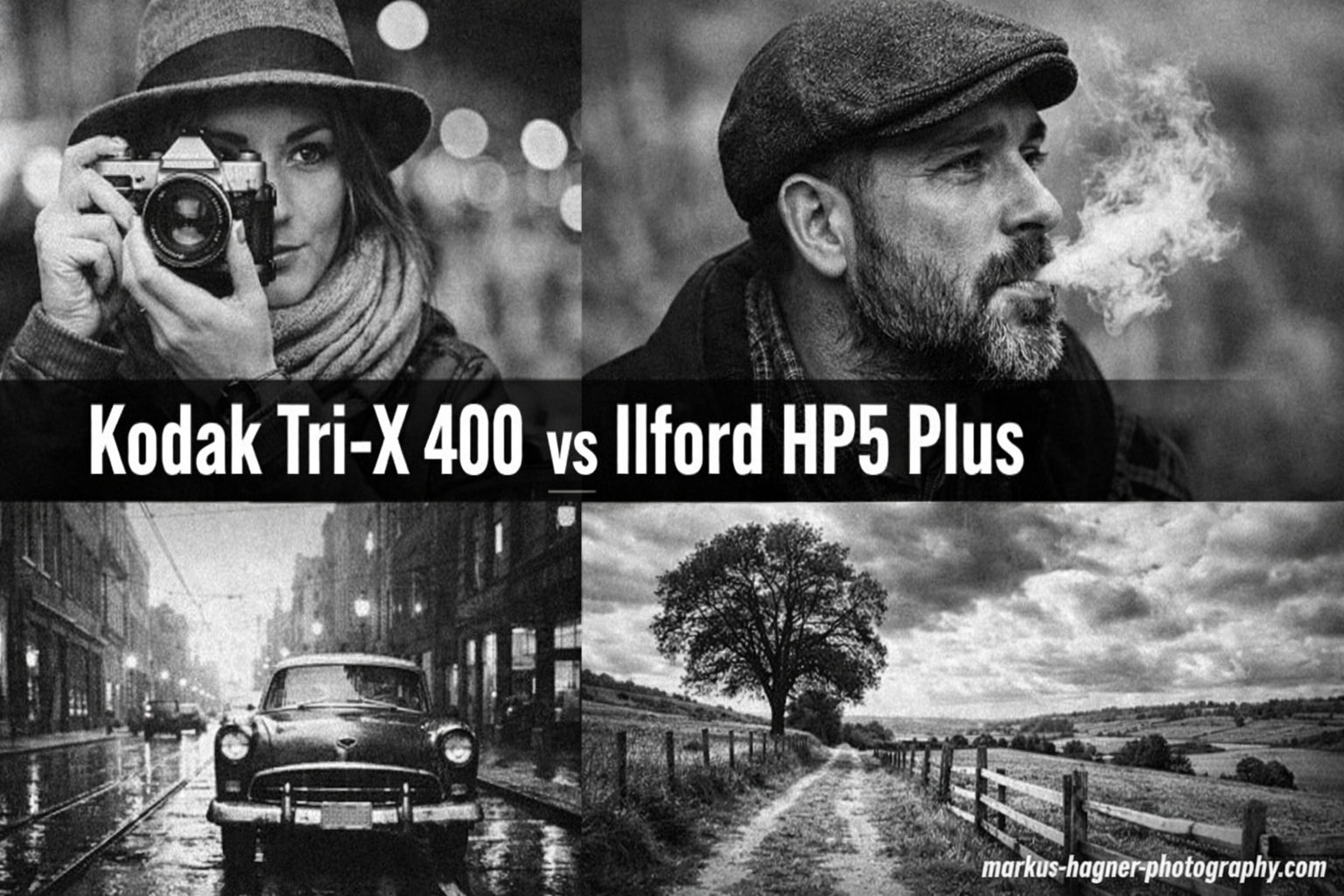
Ask any film photographer about their favorite black and white stock, and you will eventually hear the same debate: Kodak Tri-X 400 vs Ilford HP5 Plus. These two films have dominated the B&W world for decades, and for good reason. Both deliver stunning results with ISO 400 speed, but they have distinct personalities that show up in your final images.
I have shot hundreds of rolls of both films over the years. Tri-X has been my go-to for street work with its punchy contrast and distinctive grain character. HP5 Plus became my trusted companion for portrait sessions where I wanted smoother tonality and forgiving exposure latitude. The choice between them often comes down to what look you are chasing.
So which one should end up in your camera bag? After extensive testing with both films, I will break down every difference so you can pick the right one for your photography style.
Quick verdict: Choose Tri-X if you love bold, contrasty images with that classic photojournalistic grit. Go with HP5 Plus if you prefer smoother tonal transitions, more forgiving exposure handling, and better value per roll.
Kodak Tri-X 400 vs Ilford HP5 Plus: Quick Comparison
| Product | Specifications | Action |
|---|---|---|
 Kodak Tri-X 400TX (3 Pack)
|
|
Check Latest Price |
 Ilford HP5 Plus (3 Pack)
|
|
Check Latest Price |
Kodak Tri-X 400TX Professional
Kodak Tri-X 400TX Professional Black & White Film ISO 400, 35mm, 24 Exposures (3 Pack)
Pros
- Punchy contrast
- Fine grain at box speed
- Classic look film photographers love
- Excellent highlight rendering
- Pushes well to ISO 1600
Cons
- More expensive than HP5
- Less exposure latitude
- Grain becomes pronounced when pushed
Tri-X has been around since 1954, and it earned its legendary status through decades of photojournalism and street photography work. The film underwent a reformulation in 2007, but it retained the classic look that made it famous. When I shoot Tri-X at box speed, I get that signature contrasty look with rich blacks and brilliant highlights that just feels right for documentary work.
The grain structure on Tri-X is something special. Even at ISO 400, it maintains fine grain that adds character without overwhelming your image. The cubic grain structure gives photos a slightly more organic feel compared to modern tabular grain films like T-Max or Delta. Many photographers, myself included, find this grain pattern more aesthetically pleasing than competitors.

Where Tri-X really shines is in its contrast rendering. The film produces medium to high contrast with excellent separation between tones. Shadow areas go deep without blocking up completely, and highlights maintain detail while still looking bright. This contrasty character makes Tri-X ideal for scenes where you want visual impact and drama.
Street photographers have relied on Tri-X for generations because it produces images with immediate visual punch. The film does not need much post-processing to look great. That characteristic Tri-X look comes straight out of the developer ready to print or scan. I find this particularly valuable when shooting quickly in changing urban environments.
Push processing Tri-X works beautifully up to ISO 1600. I have shot it at 800 and 1600 many times for indoor events and dimly lit venues. The grain increases noticeably, but it remains attractive rather than distracting. Beyond 1600, the grain becomes quite pronounced, so I typically stick to two stops of push maximum.

Development with Kodak Tri-X is straightforward. HC-110 produces excellent results with that classic Tri-X look. D-76 and ID-11 work wonderfully for finer grain when you need it. Development times are well-documented across the photography community, and most professional labs handle Tri-X regularly. The film responds predictably to different developers, which makes it reliable for consistent results.
Tri-X is available in 35mm format (24 and 36 exposure rolls), 120 medium format, 4×5 and 8×10 sheet film, and even disposable cameras. This wide format availability makes it accessible to photographers using virtually any camera system. The film’s versatility across formats speaks to its enduring popularity.
One thing to consider: Kodak has experienced supply chain issues in recent years. While Tri-X remains widely available, there have been periods of shortage. If consistent availability matters to you, this is worth keeping in mind.
Ilford HP5 Plus
Ilford 1574577 HP5 Plus, Black and White Print Film, 35 mm, ISO 400, 36 Exposures (Pack of 3)
Pros
- Wider exposure latitude
- More forgiving for beginners
- Better tonal range
- Pushes to ISO 3200
- Great value
Cons
- Less contrast at box speed
- Can look flat without push
- Grainy to some users
Ilford HP5 Plus traces its lineage back to 1935, with the modern HP5+ formulation arriving in 1989. The film has built a reputation as perhaps the most versatile black and white stock available. When I want consistent, predictable results across varying lighting conditions, HP5 Plus delivers every time.
The tonal range on HP5 Plus is exceptional. Mid-tones render beautifully with more gradation than Tri-X provides. This makes HP5 particularly well-suited for portrait work where you want smooth skin tone transitions. The film holds detail in both shadows and highlights with impressive exposure latitude that forgives metering errors.

At box speed, some photographers find HP5 Plus slightly flat compared to Tri-X. The contrast is more moderate, which gives you more flexibility in post-processing or darkroom printing. I often rate HP5 at ISO 200 and develop normally for extra shadow detail and a richer negative. This approach gives me more tonal information to work with during printing or scanning.
Many forum users mention that HP5 Plus dries flatter than Tri-X after development. This practical advantage matters if you scan your negatives rather than print in a darkroom. Curled negatives are frustrating to scan, and HP5 Plus tends to lie flatter on the scanner glass. This small detail can save significant frustration in your workflow.
Push processing HP5 Plus is where this film really flexes its muscles. Unlike Tri-X, HP5 handles three-stop pushes to ISO 3200 gracefully. The grain increases but remains manageable. For concert photography or extremely low light situations, HP5 at 1600 or 3200 often produces better results than Tri-X pushed the same amount.

Ilford DD-X developer pairs perfectly with HP5 Plus, bringing out the best tonality the film offers. D-76 and ID-11 work excellently as well, providing fine grain and good contrast. The Massive Dev Chart lists extensive development times for HP5 with virtually every developer available, making home development simple and predictable.
HP5 Plus offers excellent value for high-volume shooters. Bulk loading HP5 can bring per-roll costs down significantly compared to individual rolls. For photographers who shoot regularly, this price advantage adds up over time. Ilford also tends to have more consistent supply chain availability than Kodak, which matters if you rely on having film in stock.
Kodak Tri-X 400 vs Ilford HP5 Plus: Head-to-Head Comparison
Grain Structure
Both films use traditional cubic grain emulsions, but they render differently in your final image. Tri-X grain tends to appear more pronounced with a distinct texture that many photographers find appealing. The grain adds character without compromising sharpness. HP5 Plus grain is technically similar but often appears slightly finer in smooth areas like skies.
When pushed to higher ISOs, HP5 Plus maintains tighter grain structure than Tri-X. At ISO 1600, Tri-X shows obvious grain increase while HP5 remains relatively controlled. This makes HP5 the better choice if you frequently shoot in low light and need to push your film regularly.
For darkroom printers, the grain difference shows up differently on fiber paper versus resin-coated paper. Both films print beautifully, but Tri-X grain tends to be more visible in large enlargements. If you make big prints, this grain characteristic becomes more relevant to your choice.
Contrast Characteristics
Tri-X delivers higher inherent contrast right out of the developer. The film produces deep shadows and bright highlights with that classic photojournalistic look. HP5 Plus offers more moderate contrast with richer mid-tones and smoother transitions between tonal values.
Many street photographers prefer Tri-X for its punchy, contrasty aesthetic that needs minimal post-processing. Portrait photographers often lean toward HP5 Plus for its gentler tonal rendering that flatters skin tones. Your choice depends entirely on the visual style you want to achieve.
Using contrast filters can help bridge the gap between these films. Yellow, orange, and red filters all increase contrast with black and white film. HP5 Plus shot with an orange filter can approach Tri-X levels of contrast while retaining its tonal range advantages.
Exposure Latitude
HP5 Plus wins decisively in exposure latitude. The film handles overexposure beautifully, retaining highlight detail even when rated a stop or two slower. Underexposure tolerance is also impressive, making HP5 more forgiving for beginners learning to meter properly.
Tri-X has decent latitude but is less forgiving of exposure errors. Overexpose by two stops and you will see highlight blocking. Underexpose and shadows lose detail quickly. If your metering skills are still developing, HP5 Plus gives you more room for error.
For photojournalists and street photographers who shoot quickly without perfect metering, this latitude difference matters. HP5 Plus is more likely to deliver usable results when your exposure is not perfect. Tri-X rewards precise technique but punishes mistakes more severely.
Push Processing Performance
Both films push well, but HP5 Plus handles extreme pushes more gracefully. HP5 at ISO 3200 produces usable negatives with acceptable grain. Tri-X at 3200 becomes quite grainy, though some photographers embrace this look for its gritty aesthetic.
For moderate pushes to ISO 800 or 1600, both films perform admirably. Tri-X grain becomes more visible but maintains its distinctive character. HP5 grain increases more subtly, preserving finer detail in the process.
Concert photographers frequently discuss this comparison in forums. The consensus tends toward HP5 Plus for extreme low light work where three-stop pushes are necessary. For two-stop pushes or less, either film works well and the choice comes down to aesthetic preference.
Development Recommendations
Tri-X excels with Kodak HC-110, which enhances its contrasty character while maintaining fine grain. D-76 and ID-11 work well when you want slightly lower contrast and finer grain. Rodinal gives Tri-X a classic, grainy look that many documentary photographers love.
HP5 Plus pairs beautifully with Ilford DD-X, which maximizes its tonal range and fine grain characteristics. D-76 remains a popular choice for consistent, predictable results. Perceptol produces ultra-fine grain when maximum sharpness matters.
Both films have extensive development time documentation available online. The Massive Dev Chart covers virtually every developer and temperature combination. This makes home development straightforward for either film choice.
Price and Value
HP5 Plus typically costs less than Tri-X, making it the better value option for high-volume shooters. Bulk loading HP5 can bring costs down significantly. Tri-X commands a premium price that reflects its legendary status and distinctive character.
Both films offer excellent value considering their performance. If you shoot heavily, the price difference adds up over time. For occasional shooting, choose based on aesthetic preference rather than cost.
In the UK market particularly, the price gap is substantial. HP5 Plus can cost roughly half as much as Tri-X per roll. US pricing is closer, but HP5 Plus typically still holds a price advantage.
Format Availability
Both films come in 35mm, 120 medium format, and various sheet film sizes. Tri-X is also available in disposable cameras for casual shooting. Availability varies by region, with Ilford generally having more consistent supply chains than Kodak.
For large format photographers, Tri-X offers more sheet film size options including 4×5 and 8×10. HP5 Plus covers the most common formats but has fewer large format options available.
In 35mm, HP5 Plus offers 36-exposure rolls while the common Tri-X pack reviewed here contains 24-exposure rolls. This gives HP5 Plus more frames per roll for high-volume shooters.
Use Case Recommendations
Street Photography
Tri-X has been the street photography standard for generations. Its contrasty look creates images with immediate visual impact. The grain adds character without distraction. If you want that classic photojournalistic aesthetic, Tri-X delivers exactly what you are looking for.
HP5 Plus works well for street work too, especially in challenging light. The wider exposure latitude handles rapidly changing conditions better than Tri-X. Choose HP5 for documentary work where tonal accuracy matters more than dramatic contrast.
Many street photographers carry both films. Tri-X for sunny days with harsh shadows and dramatic light. HP5 Plus for overcast conditions or indoor street work where the lighting is more even.
Portrait Photography
HP5 Plus excels at portraiture with its smooth tonal transitions and forgiving exposure latitude. Skin tones render naturally without harsh transitions. The moderate contrast flatters subjects rather than emphasizing every shadow and skin texture.
Tri-X creates more dramatic portraits with deeper shadows and brighter highlights. This works well for moody, artistic portrait work but requires more careful lighting control. Environmental portraits with dramatic lighting suit Tri-X particularly well.
For formal portrait sessions, I reach for HP5 Plus almost exclusively. For editorial-style environmental portraits with strong directional light, Tri-X can produce stunning results.
Low Light and Concert Photography
HP5 Plus is the clear winner for low light work. Its ability to push to ISO 3200 while maintaining acceptable grain makes it ideal for concerts, events, and night photography. The film handles mixed lighting well too, which is common at venues.
Tri-X works fine for moderate low light up to ISO 1600. Beyond that, the grain becomes quite pronounced. Some photographers embrace this look for its gritty, atmospheric quality. It can work for punk shows or underground music venues where a rough aesthetic fits the subject.
For jazz clubs, theater performances, and other events where you want cleaner results, HP5 Plus pushed to 1600 or 3200 produces more polished images.
Beginner Recommendations
HP5 Plus is the better choice for beginners. Its wide exposure latitude forgives metering mistakes that might ruin a Tri-X shot. The lower contrast gives more flexibility during printing or scanning. The lower price point reduces the sting of early learning mistakes.
Tri-X rewards skilled technique with distinctive results. Once you understand exposure and development, Tri-X becomes a powerful creative tool. Start with HP5 Plus to build confidence, then add Tri-X as your skills develop.
Many photography educators recommend HP5 Plus to students for exactly these reasons. You can make mistakes and still end up with printable negatives. This builds confidence while you learn proper technique.
Verdict: Kodak Tri-X 400 vs Ilford HP5 Plus
After shooting both films extensively, here is my take on the Kodak Tri-X 400 vs Ilford HP5 Plus debate. Choose Tri-X if you want that classic contrasty look with distinctive grain character. It remains the king of street and documentary photography for good reason.
Choose HP5 Plus if you value versatility, exposure latitude, and value. It handles everything from portraits to low light with consistent, predictable results. Beginners should start here, and many experienced photographers never feel the need to switch.
My recommendation? Keep both in your bag. Use Tri-X when you want punch and drama. Reach for HP5 Plus when conditions demand flexibility and forgiveness. Both films have earned their legendary status, and neither will let you down.
Frequently Asked Questions
Is there really a difference between Tri-X and HP5?
Yes, there are noticeable differences. Tri-X produces higher contrast with punchier shadows and highlights, while HP5 Plus offers more moderate contrast with richer mid-tones. Tri-X grain is more pronounced and characterful, whereas HP5 grain appears finer. HP5 also has wider exposure latitude and pushes more gracefully to higher ISOs.
Which film has more grain, Tri-X or HP5?
Tri-X generally shows more visible grain structure than HP5 Plus, especially at box speed. When pushed to higher ISOs, Tri-X grain becomes significantly more pronounced. HP5 Plus maintains tighter, finer grain even when pushed to ISO 1600 or 3200.
Is Kodak Tri-X or Ilford HP5 better for beginners?
HP5 Plus is better for beginners due to its wider exposure latitude and more forgiving nature. It handles metering errors gracefully and costs less per roll. The moderate contrast gives more flexibility in post-processing. Tri-X rewards proper technique but punishes exposure mistakes more severely.
Can you push Kodak Tri-X and Ilford HP5 to higher ISOs?
Both films push well, but HP5 Plus handles extreme pushes better. Tri-X pushes nicely to ISO 800 and 1600 with attractive grain character. HP5 Plus can push to ISO 3200 while maintaining usable grain levels. For three-stop pushes, HP5 is the superior choice.
Which film is better for street photography?
Tri-X is traditionally considered the street photography standard due to its contrasty, punchy look and distinctive grain character. However, HP5 Plus works excellently for street work in challenging lighting conditions because of its wider exposure latitude. Both are capable choices depending on your preferred aesthetic.
Verdict: Kodak Tri-X 400 vs Ilford HP5 Plus
After shooting both films extensively, here is my take on the Kodak Tri-X 400 vs Ilford HP5 Plus debate. Choose Tri-X if you want that classic contrasty look with distinctive grain character. It remains the king of street and documentary photography for good reason.
Choose HP5 Plus if you value versatility, exposure latitude, and value. It handles everything from portraits to low light with consistent, predictable results. Beginners should start here, and many experienced photographers never feel the need to switch.
My recommendation? Keep both in your bag. Use Tri-X when you want punch and drama. Reach for HP5 Plus when conditions demand flexibility and forgiveness. Both films have earned their legendary status, and neither will let you down.