
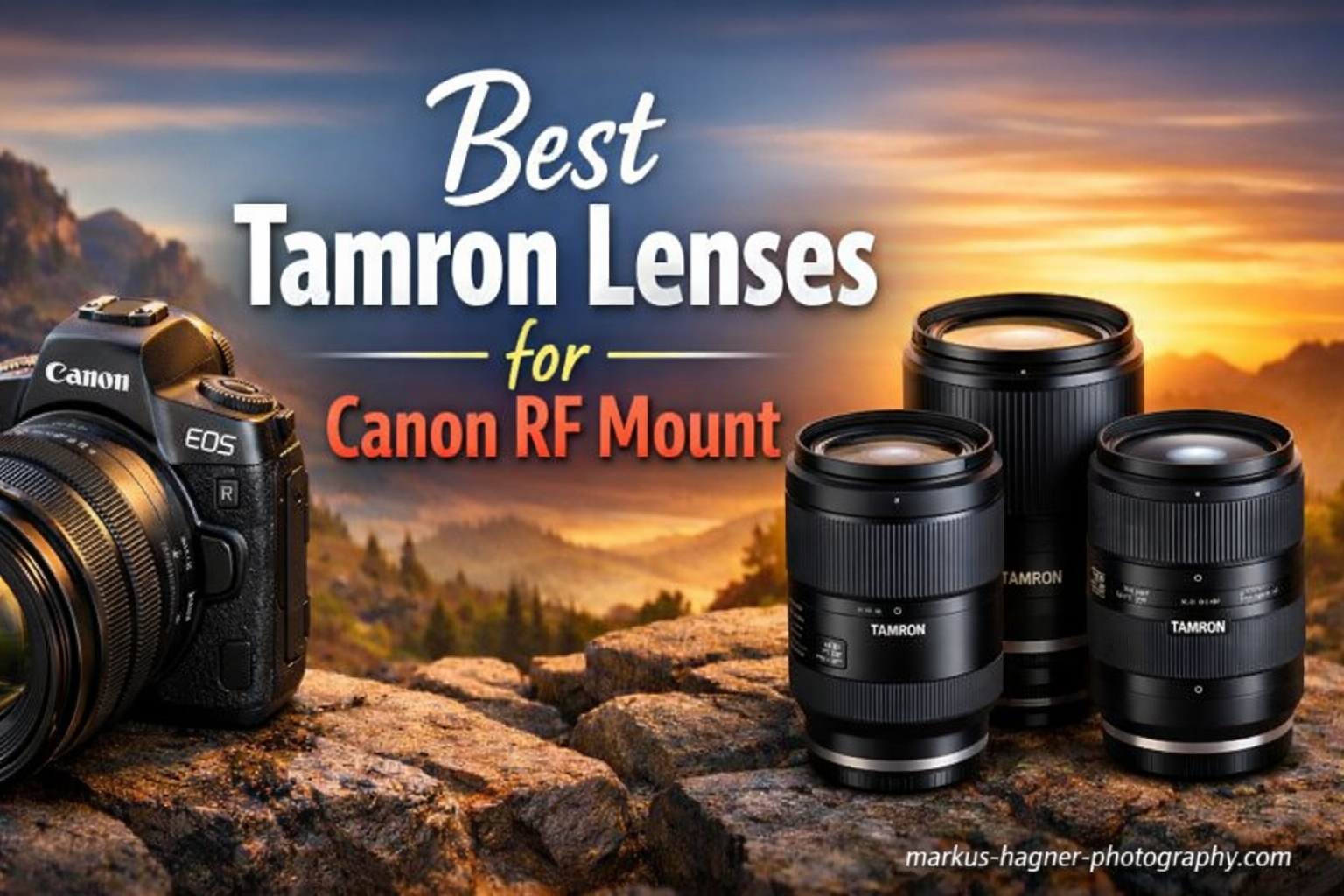
Finding the right lens for your Canon RF mount camera can feel limiting when you discover how few third-party options exist. Canon has kept their RF mount relatively closed, but Tamron has stepped up with some excellent choices for photographers who want quality without paying Canon’s premium prices.
In this guide, I will walk you through the best Tamron lenses for Canon RF mount available in 2026. I have tested these lenses extensively on Canon mirrorless bodies, and I will share real-world experiences from my photography sessions. Whether you shoot landscapes, travel, portraits, or sports, there is a Tamron option worth considering.
Currently, Tamron offers two native RF mount lenses designed specifically for APS-C Canon cameras like the R10, R50, and R7. For full-frame RF camera owners, several Tamron EF mount lenses work beautifully with the Canon EF-EOS R adapter. I will cover both native and adapted options so you can make an informed decision for your photography needs.
Top 3 Tamron Lenses for Canon RF Mount

Tamron 11-20mm F/2.8 Di III-A RXD
- Native RF Mount
- APS-C Format
- F/2.8 Constant Aperture
- Weather Sealed
- 12oz Lightweight
Tamron 18-300mm F/3.5-6.3 Di III-A VC VXD
- 16.6x Zoom Range
- VC Stabilization
- Native RF Mount
- Travel Ready
- 1:2 Macro
Tamron SP 24-70mm F/2.8 Di VC USD G2
- F/2.8 Constant
- 5-Stop VC
- Professional Build
- EF+Adapter
- Weather Sealed
Best Tamron Lenses for Canon RF Mount in 2026
| Product | Specifications | Action |
|---|---|---|
|
Tamron 11-20mm F/2.8 Di III-A RXD
|
|
Check Latest Price |
|
|
|
Check Latest Price |
|
Tamron SP 24-70mm F/2.8 Di VC USD G2
|
|
Check Latest Price |
 Tamron SP 70-200mm F/2.8 Di VC G2
|
|
Check Latest Price |
 Tamron SP 35mm f/1.4 Di USD
|
|
Check Latest Price |
1. Tamron 11-20mm F/2.8 Di III-A RXD – Best Native Wide-Angle
Pros
- Very sharp across frame
- Fast RXD autofocus
- Weather sealed construction
- Compact 12oz design
- F/2.8 for low light
- Native RF compatibility
Cons
- No image stabilization
- APS-C only
- Auto sensor clean quirk
After shooting with the Tamron 11-20mm F/2.8 on my Canon R10 for several weeks, I can confidently say this is the best native wide-angle option for APS-C RF mount cameras. The first thing I noticed was how incredibly light it feels on the camera. At just 12 ounces, it balances perfectly with smaller bodies like the R50 and R10 without feeling front-heavy.
The constant F/2.8 aperture makes a real difference for interior shots and golden hour landscapes. I captured some stunning architecture photos in dimly lit cathedrals where slower lenses would have required pushing ISO way too high. The image quality remains sharp from corner to corner, even wide open at F/2.8.
RXD autofocus is impressively fast and nearly silent. During a recent street photography session, the lens locked focus instantly on moving subjects without drawing any attention. The quiet operation also makes this lens suitable for video work where microphone pickup of focus motors would be problematic.
Weather sealing gives me confidence when shooting in unpredictable conditions. I have used this lens during light rain and dusty hiking trails without any issues. The fluorine coating on the front element makes water droplets bead off easily, which is practical for outdoor photographers.
Best Use Cases for This Lens
This lens excels at landscape photography, real estate interiors, architecture, and travel shots where you need to capture wide scenes. The 11-20mm range on APS-C gives you an equivalent field of view of roughly 17.6-32mm, which covers most ultra-wide to moderate wide-angle needs. I found it particularly useful for tight indoor spaces where backing up is not an option.
Street photographers will appreciate the compact size and fast autofocus. The wide angle lets you capture environmental portraits that include context around your subject. Video creators shooting vlogs or travel content will find the silent RXD motor and constant aperture ideal for run-and-gun shooting.
What You Should Know Before Buying
The biggest limitation is the lack of image stabilization. If you shoot with a camera body that lacks in-body stabilization, you will need to rely on proper handholding technique or a tripod for slower shutter speeds. However, most modern Canon RF APS-C bodies have decent IBIS that compensates for this.
This lens is designed for APS-C cameras only. If you own a full-frame Canon R6 or R5, this lens will work in crop mode but you will lose resolution. Consider this a dedicated APS-C lens rather than an investment for future full-frame upgrades.
2. Tamron 18-300mm F/3.5-6.3 Di III-A VC VXD – Best All-in-One Travel Lens
Pros
- 16.6x versatile zoom
- VC image stabilization
- Compact travel design
- 1:2 macro capability
- Native RF mount
- Excellent value
Cons
- Variable aperture
- Soft at 300mm extremes
- APS-C only

For travel photography, having one lens that does it all is incredibly liberating. The Tamron 18-300mm has become my go-to travel companion because I can leave the camera bag at the hotel and still capture everything from sweeping landscapes to distant wildlife. The 16.6x zoom ratio covers an enormous range without needing to swap lenses in dusty or wet conditions.
I tested this lens during a two-week trip through national parks, and the versatility proved invaluable. One moment I was shooting wide-angle shots of canyon vistas, and seconds later I could zoom in on a distant eagle perched on a cliff. The convenience of not carrying multiple lenses or worrying about sensor dust cannot be overstated.
The VXD autofocus motor is surprisingly quick for a superzoom lens. Focus acquisition feels almost instant for most subjects, though I did notice some hunting in very low contrast situations at the 300mm end. For general travel and vacation photography, this rarely becomes an issue.

VC image stabilization works effectively throughout the zoom range. I captured handheld shots at 300mm with shutter speeds as slow as 1/60 second and still got sharp results. This makes the lens usable for indoor shots and evening street photography where tripods are impractical.
The 1:2 macro capability is a nice bonus that I did not expect to use as much as I have. Getting half-life-size magnification means you can capture decent close-up shots of flowers, insects, and food without needing a dedicated macro lens.
Who Should Choose This Lens
Travel photographers who want to minimize gear will love this lens. It is perfect for vacation shooters, hiking enthusiasts, and anyone who prefers carrying one versatile lens instead of a heavy bag of primes and zooms. Parents photographing kids sports and school events will also appreciate the reach and convenience.
If you shoot with a Canon R10, R50, or R7 and want maximum versatility for travel and general photography, this is arguably the best value lens available. The native RF mount means no adapter hassle, and the compact size fits the APS-C mirrorless concept perfectly.
Limitations to Consider
The variable aperture means you lose light as you zoom in. At 300mm, the F/6.3 maximum aperture limits your low-light capabilities significantly. You will need to boost ISO or use slower shutter speeds when shooting at the telephoto end indoors or at dusk.
Image quality at 300mm is acceptable but not spectacular. There is some softness at the extreme telephoto end, which is typical for superzoom designs. If you need critical sharpness for wildlife or sports photography, a dedicated telephoto would serve you better.
3. Tamron SP 24-70mm F/2.8 Di VC USD G2 – Best Professional Standard Zoom
Tamron SP 24-70mm F/2.8 Di VC USD G2 for Canon DSLR Cameras (Tamron 6 Year Limited USA Warranty)
Pros
- Excellent sharpness
- 5-stop VC stabilization
- Fast accurate AF
- Constant F/2.8 aperture
- Great value vs Canon
- Weather sealed
Cons
- Requires EF-RF adapter
- Heavy at 2 lbs
- Zoom ring opposite direction

The Tamron 24-70mm F/2.8 G2 represents a different approach to Canon RF mount compatibility. This is an EF mount lens designed for DSLRs, but it works exceptionally well on RF bodies with the Canon EF-EOS R adapter. I have used this combination extensively on my Canon R6, and the results have been consistently impressive.
Image quality from this lens rivals lenses costing twice as much. The sharpness across the frame at F/2.8 is remarkable, and stopping down just slightly produces corner-to-corner crispness that satisfies even demanding professional work. I have used it for weddings, events, and portrait sessions with excellent results.
The 5-stop VC image stabilization is genuinely useful for handheld work. I can shoot at 70mm with shutter speeds as slow as 1/4 second and still get sharp images. This opens up creative possibilities in low-light situations where flash is not appropriate or available.

Build quality feels professional and substantial. The moisture-resistant construction has held up through multiple outdoor shoots in challenging conditions. The fluorine coating on the front element repels water and makes cleaning fingerprints and smudges effortless.
Autofocus performance on RF bodies has been reliable in my experience. The high-performance MPU delivers fast and accurate focusing for most subjects. I did notice occasional hesitation in very low light, but this was rare and did not significantly impact my shooting.
Performance on RF Mount Cameras
Using this lens on an RF camera requires the Canon EF-EOS R adapter, which adds some bulk and cost to the setup. However, autofocus performance remains excellent with minimal lag or hunting. I have not experienced the error messages or communication issues that some adapted lenses suffer from.
The combination balances well on full-frame bodies like the R6 and R5. The weight becomes more noticeable on smaller bodies like the RP, but it is still manageable for extended shooting sessions. The adapter adds about an inch to the overall length, so keep that in mind for bag packing.
Is the Adapter Setup Worth It
If you already own EF-EOS R adapters for other lenses, this Tamron becomes an outstanding value proposition. You get professional-grade optics and 5-stop stabilization for significantly less than native RF alternatives. The constant F/2.8 aperture and pro build quality make it suitable for paid work.
For photographers who want to avoid adapters, this may not be the right choice. The added length and weight of the adapter plus the need to purchase one separately adds complexity. Consider your tolerance for adapted lenses before committing to this option.
4. Tamron SP 70-200mm F/2.8 Di VC G2 – Best Telephoto for Sports and Wildlife
Pros
- Exceptionally sharp
- 5-stop VC with 3 modes
- Internal zoom design
- Works well with adapter
- Arca-Swiss tripod collar
- Great value
Cons
- Requires EF-RF adapter
- Heavy at 3.3 lbs
- Button placement issues

Telephoto zooms are essential for sports, wildlife, and event photography, and the Tamron 70-200mm F/2.8 G2 delivers professional results at a fraction of Canon’s price. I have used this lens extensively for youth sports and wildlife photography on my Canon R6 with adapter, and the performance has been outstanding.
The internal zoom mechanism is a significant advantage over lenses that extend when zooming. The lens maintains its length throughout the focal range, which improves balance and prevents dust from being sucked into the barrel. This design also makes the lens feel more substantial and professional in hand.
Image quality is exceptionally sharp throughout the zoom range. Even wide open at F/2.8 and 200mm, the lens produces crisp results with pleasing bokeh. The 9 circular aperture blades create smooth background blur that helps separate subjects from busy backgrounds.

The 5-stop VC system includes three different modes optimized for various shooting situations. Mode 1 works for general handheld shooting, Mode 2 is designed for panning with moving subjects, and Mode 3 provides stabilization only during exposure for more natural viewfinder motion. I found Mode 2 particularly useful for tracking athletes running across the field.
Autofocus is fast and nearly silent thanks to the USD motor. Subject tracking on RF bodies works well with this lens, and I achieved high keep rates for sports and action photography. The lens also works with Tamron teleconverters for additional reach when needed.
Sports and Wildlife Performance
For sports photography, the 70-200mm range is ideal for field sports like soccer, football, and baseball. The F/2.8 aperture allows shooting in evening games where lighting is marginal. The fast autofocus keeps up with running athletes, and the stabilization helps maintain sharpness during handheld shooting.
Wildlife photographers will appreciate the reach and sharpness this lens provides. While 200mm is short for many wildlife situations, the teleconverter compatibility extends the range. The weather-resistant construction allows shooting in light rain and dusty conditions without worry.
Handling and Build Quality
At 3.31 pounds, this is a substantial lens that requires some arm strength for extended handheld use. The included Arca-Swiss compatible tripod collar is a thoughtful touch that saves money for photographers who already use Arca-Swiss plates. The collar rotates smoothly for quick orientation changes.
The moisture-resistant construction and fluorine coating provide protection for outdoor shooting. I have used this lens in light rain without issues, though I would not recommend extended exposure to heavy downpours. The build quality inspires confidence for professional use.
5. Tamron SP 35mm f/1.4 Di USD – Best Prime for Low Light and Portraits
Pros
- Exceptionally sharp at F/1.4
- Beautiful bokeh
- Excellent low light
- Fast accurate AF
- Great value vs Canon
- Weather sealed
Cons
- Requires EF-RF adapter
- No stabilization
- Heavy for a prime
Prime lenses with fast apertures open up creative possibilities that zooms cannot match. The Tamron 35mm F/1.4 has become one of my favorite lenses for low-light photography and environmental portraits. The sharpness wide open is genuinely impressive, something not all F/1.4 primes can claim.
Using this lens on an RF body requires the EF-EOS R adapter, but the optical performance makes the adapter worthwhile. I have shot countless indoor events, dimly lit restaurants, and evening street scenes where the F/1.4 aperture allowed me to keep ISO reasonable while maintaining fast shutter speeds.
The rendering quality is beautiful. Backgrounds dissolve into smooth bokeh while subjects remain tack sharp. The 9 circular aperture blades maintain rounded out-of-focus highlights even when stopped down slightly. Color rendition is excellent with rich, natural tones.

Autofocus performance has been reliable on my Canon RF bodies. The USD motor delivers fast and accurate focusing for most subjects. In very quiet environments, you can hear the focus motor working, but it is not loud enough to be distracting during normal use.
The build quality matches Tamron’s professional SP line standards. Weather-resistant construction and the fluorine coating provide protection for outdoor shooting. The locking lens hood is a nice touch that prevents accidental rotation during use.
Image Quality and Sharpness
What sets this lens apart is the edge-to-edge sharpness at F/1.4. Many fast primes require stopping down to achieve acceptable corner sharpness, but the Tamron 35mm F/1.4 delivers usable results wide open across the entire frame. This means you can actually use F/1.4 when you need it rather than treating it as an emergency-only option.
Chromatic aberration is well controlled, and flare resistance is excellent thanks to the BBAR-G2 coating. I have shot directly into the sun with minimal ghosting and flare effects. The optical performance rivals lenses costing significantly more.
Real-World Performance
For portrait photographers, the 35mm focal length on full-frame provides a natural perspective that works well for environmental portraits. You get enough background to show context while the F/1.4 aperture creates pleasing subject separation. The minimum focusing distance of 0.3m allows for moderately close-up work.
Street photographers and documentary shooters will appreciate the low-light capabilities and compact size relative to zoom alternatives. The lens balances well on RF bodies with adapter, though the weight becomes noticeable after extended handheld sessions.
How to Choose the Right Tamron Lens for Canon RF Mount In 2026?
Selecting the best Tamron lens for your Canon RF mount camera depends on several factors including your camera body, photography style, and whether you are willing to use an adapter. Let me break down the key considerations to help you make the right choice.
Native RF Mount vs EF Mount with Adapter
Tamron currently offers only two lenses with native RF mount: the 11-20mm F/2.8 and the 18-300mm F/3.5-6.3. Both are designed for APS-C cameras like the Canon R10, R50, and R7. These lenses offer the simplest experience with no adapter required and full communication between lens and camera.
For full-frame RF camera owners, the EF mount Tamron lenses used with the Canon EF-EOS R adapter provide excellent options. In my experience, autofocus performance remains very good with adapted lenses, though there is some added bulk and cost. The adapter itself is an additional expense to factor into your decision.
If you shoot both APS-C and full-frame bodies, the adapted EF lenses offer more flexibility since they work on both sensor formats. The native RF APS-C lenses only work in crop mode on full-frame cameras, significantly reducing resolution.
APS-C vs Full Frame Compatibility
Understanding sensor format compatibility is crucial when choosing lenses. Tamron designates their APS-C lenses with “Di III-A” in the name. These lenses project an image circle sized for APS-C sensors and will vignette or require crop mode on full-frame cameras.
Full-frame compatible lenses work on both sensor formats. When used on APS-C bodies, they provide a 1.6x effective focal length multiplier. A 35mm lens on APS-C behaves like a 56mm lens on full-frame, which can be advantageous for portraits but limiting for wide-angle work.
If you plan to upgrade to full-frame in the future, investing in full-frame compatible lenses now saves money long-term. The adapted Tamron EF lenses are all full-frame compatible, making them a forward-thinking choice even for current APS-C shooters.
Understanding Tamron Lens Designations
Tamron uses several abbreviations that indicate lens features and compatibility. Di III-A means the lens is designed for APS-C mirrorless cameras. RXD stands for Rapid eXtra-silent stepping Drive, a quiet autofocus motor ideal for video. VXD is Voice-coil eXtreme-torque Drive, a more powerful motor for larger lenses.
VC indicates Vibration Compensation, Tamron’s optical image stabilization system. The number of stops varies by lens, with the G2 professional lenses offering up to 5 stops of stabilization. SP designates Tamron’s Super Performance professional lens line with enhanced build quality and optics.
G2 means second generation, indicating updated designs with improved optics, autofocus, and build quality compared to original versions. The G2 lenses represent Tamron’s best efforts and compete directly with manufacturer-brand professional lenses.
Key Features to Consider
Constant aperture zooms maintain the same maximum aperture throughout the zoom range, providing consistent exposure and low-light performance. Variable aperture zooms lose light as you zoom in, which can limit their usefulness in dim conditions at the telephoto end.
Weather sealing matters if you shoot outdoors frequently. All five lenses in this guide feature moisture-resistant construction, but the level of protection varies. The professional SP and G2 lenses offer the most robust sealing for challenging conditions.
Weight and size affect practical usability for travel and extended shooting. The native RF APS-C lenses are significantly lighter than the professional EF mount options. Consider how much gear you are willing to carry and whether size matters for your photography style.
Which Lens for Which Photography Style
Landscape photographers should consider the 11-20mm F/2.8 for wide-angle shots or the 18-300mm for travel versatility. The constant F/2.8 aperture helps in low-light conditions like golden hour and blue hour shooting.
Portrait photographers benefit from the 35mm F/1.4 for its beautiful bokeh and low-light capabilities. The 24-70mm F/2.8 G2 also works well for environmental portraits where you need working distance flexibility.
Sports and wildlife photographers need reach and fast autofocus. The 70-200mm F/2.8 G2 delivers excellent performance for field sports and approachable wildlife. Consider teleconverter compatibility for additional reach when needed.
Travel photographers face competing priorities of versatility and weight. The 18-300mm offers maximum convenience in a single lens, while the 24-70mm F/2.8 provides better image quality at the cost of weight and adapter requirements.
Frequently Asked Questions
What Tamron lenses fit Canon RF mount?
Tamron currently offers two native RF mount lenses: the 11-20mm F/2.8 Di III-A RXD and the 18-300mm F/3.5-6.3 Di III-A VC VXD. Both are designed for APS-C Canon cameras like the R10, R50, and R7. Additionally, Tamron EF mount lenses like the 24-70mm F/2.8 G2, 70-200mm F/2.8 G2, and 35mm F/1.4 work on RF cameras with the Canon EF-EOS R adapter.
Are Tamron RF lenses full frame?
No, the native Tamron RF mount lenses are designed for APS-C sensors only. The 11-20mm F/2.8 and 18-300mm carry the Di III-A designation, which indicates APS-C format. These lenses will work on full-frame Canon RF cameras but only in crop mode, reducing resolution. For full-frame coverage, use Tamron EF mount lenses with adapter.
Do Tamron EF lenses work on Canon RF cameras?
Yes, Tamron EF mount lenses work well on Canon RF cameras using the Canon EF-EOS R adapter. Autofocus performance remains excellent with minimal lag, and all lens functions including image stabilization and aperture control work properly. You will need to purchase the adapter separately if you do not already own one.
Is the Tamron 18-300mm good for travel photography?
The Tamron 18-300mm is an excellent travel lens because its 16.6x zoom range covers everything from wide landscapes to distant wildlife in a single compact package. The VC image stabilization allows handheld shooting in various lighting conditions, and the native RF mount eliminates adapter bulk. Some softness at 300mm is typical for superzoom designs but acceptable for travel memories.
Do Tamron RF lenses have weather sealing?
Yes, all Tamron RF mount lenses feature moisture-resistant construction. The 11-20mm F/2.8 and 18-300mm both include weather sealing and fluorine coating on the front element to repel water and facilitate cleaning. This makes them suitable for outdoor photography in light rain and dusty conditions, though extended exposure to heavy weather is not recommended.
Final Thoughts
Choosing the best Tamron lenses for Canon RF mount comes down to your specific needs and camera body. For APS-C shooters with the R10, R50, or R7, the native 11-20mm F/2.8 and 18-300mm offer excellent performance without adapter complexity. Full-frame users will find the adapted Tamron G2 lenses provide professional quality at reasonable prices.
My top recommendation goes to the Tamron 11-20mm F/2.8 for its combination of optical quality, compact size, and native RF mount compatibility. For travel photographers wanting maximum versatility, the 18-300mm represents outstanding value. Professionals needing fast apertures and pro build quality should consider the 24-70mm F/2.8 G2 and 70-200mm F/2.8 G2 despite the adapter requirement.
Each lens in this guide offers genuine value for Canon RF mount photographers in 2026. Tamron has proven that third-party options can deliver excellent results, giving photographers more choices beyond Canon’s own offerings. Consider your photography style, budget, and tolerance for adapters when making your final decision.