
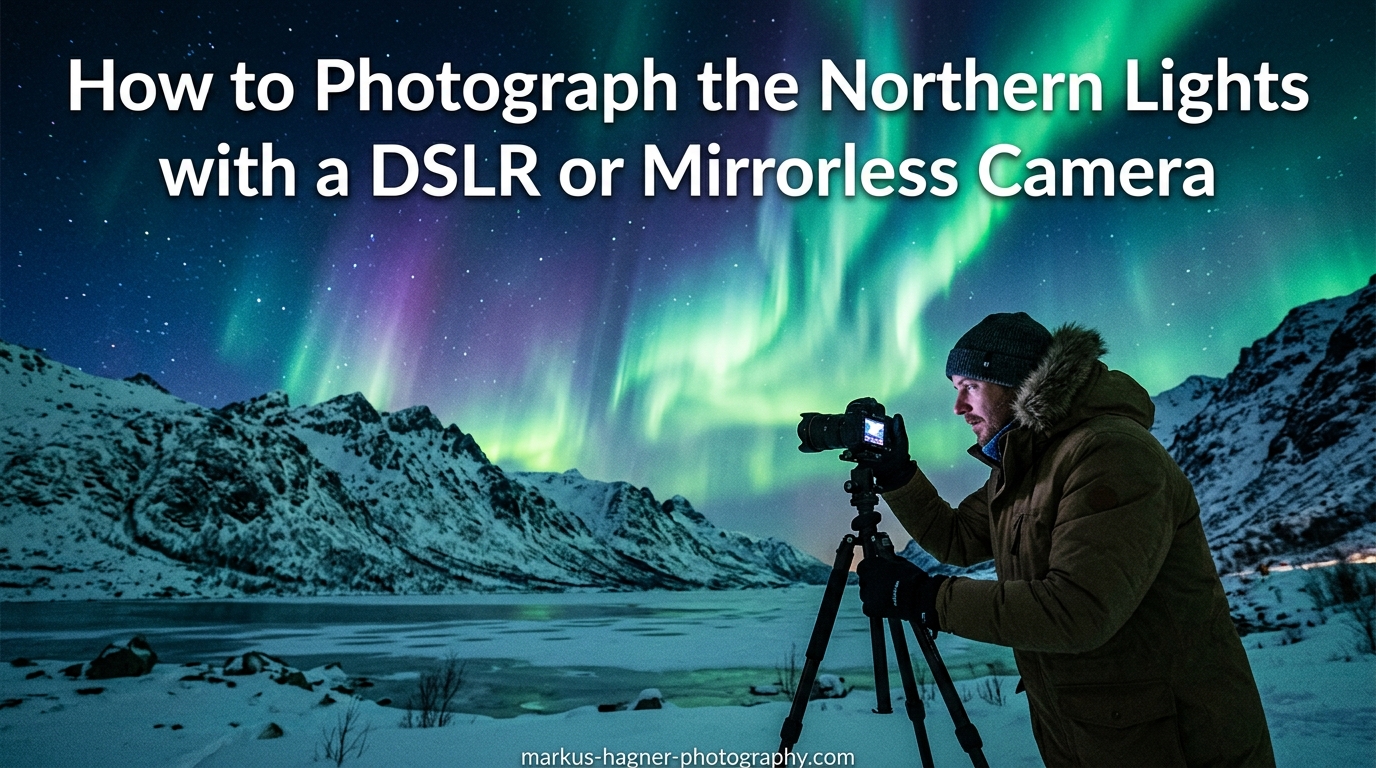
Standing beneath the dancing ribbons of green, purple, and red light that make up the Aurora Borealis is an experience that words struggle to capture. But as photographers, we want more than just the memory. We want to preserve that magic in an image we can share. Learning how to photograph the Northern Lights with a DSLR or mirrorless camera opens up a world of creative possibilities that smartphone cameras simply cannot match.
The good news? Capturing stunning aurora photos is absolutely achievable with the right approach. You do not need the most expensive gear on the market. What you need is an understanding of how your camera works in extreme low-light conditions and a solid workflow that eliminates guesswork when you are standing in the dark at minus 20 degrees.
In this guide, I will walk you through everything I have learned from years of photographing the aurora borealis. We will cover the essential equipment, the exact camera settings that work, how to focus when you cannot see anything, and how to plan your shoot so you are in the right place at the right time. By the end, you will have a complete roadmap for capturing breathtaking Northern Lights images.
Quick Camera Settings for Northern Lights Photography
If you are heading out tonight and need settings immediately, here is the quick reference that works for most situations:
1. Set your camera to Manual Mode (M) – Automatic settings cannot handle the extreme contrast of aurora against a dark sky. You need full control.
2. Use your widest aperture (f/2.8 or lower) – The lower the f-number, the more light enters your lens. An f/1.4 or f/1.8 lens will capture aurora faster than f/2.8 or f/4.
3. Set ISO between 800 and 3200 – Start at ISO 1600 as your baseline. Increase if the aurora is faint, decrease if shots look too bright or noisy.
4. Shutter speed between 5 and 15 seconds – Faster-moving aurora needs shorter exposures (3-8 seconds) to preserve detail. Slower displays can handle 15-25 seconds.
5. Manual focus set to infinity – Autofocus will hunt endlessly in darkness. Set focus manually and tape the ring if needed.
6. Mount your camera on a sturdy tripod – Any movement during a 10-second exposure will ruin the shot. A solid tripod is non-negotiable.
These settings are your starting point. From here, you will adjust based on aurora brightness, movement speed, and your specific gear. Let me explain each element in detail so you understand why these settings work and how to adapt them.
Essential Equipment for Aurora Photography
The right equipment makes a tremendous difference in your success rate. Here is what you actually need versus what is nice to have.
Camera Requirements: DSLR vs Mirrorless
Both DSLR and mirrorless cameras work excellently for Northern Lights photography. The key requirement is manual control over exposure settings and the ability to shoot in RAW format.
Full-frame cameras have an advantage in high-ISO performance and wider field of view with any given lens. However, crop sensor (APS-C) cameras produce excellent aurora images too. I have seen stunning photos from Micro Four Thirds systems. The sensor size matters less than understanding how to maximize what you have.
Mirrorless cameras offer some distinct advantages for night photography. The electronic viewfinder shows you approximately how your exposure will look before you press the shutter. This real-time feedback is invaluable when learning. Many modern mirrorless bodies also have better high-ISO performance than older DSLRs.
DSLRs still have their place. The optical viewfinder uses no battery power, which matters in cold conditions where batteries drain quickly. Many photographers also prefer the ergonomics and button layout of traditional DSLRs for gloved hands.
Lens Requirements: Wide-Angle and Fast Aperture
Your lens choice matters more than your camera body for aurora photography. You need two things: a wide field of view and a fast aperture.
A focal length between 14mm and 24mm (full-frame equivalent) captures the broad expanse of aurora displays. Wider lenses like 12mm or 14mm work beautifully for dramatic skies-filling compositions. Slightly longer lenses around 35mm can isolate interesting aurora formations.
The aperture is critical. An f/2.8 lens is considered the minimum for serious aurora work. Faster lenses like f/1.4 or f/1.8 gather two to four times more light, allowing lower ISO settings and shorter exposures. This translates to cleaner images with less noise.
What if you only have an f/4 lens? You can still capture aurora by increasing ISO and extending shutter speed. Many photographers have produced beautiful images with slower lenses. The trade-off is more noise and potential blur from aurora movement during longer exposures.
Tripod and Stability Essentials
A sturdy tripod is absolutely essential. You cannot handhold 10-second exposures. Period. The tripod needs to be stable enough to withstand wind gusts without vibrating.
Carbon fiber tripods offer the best combination of stability and weight. They dampen vibrations better than aluminum and weigh less for travel. Look for a tripod rated to support at least twice your camera and lens weight.
Ball heads work well for aurora photography because they allow quick repositioning. Make sure the head locks securely and does not creep during long exposures.
Additional Helpful Accessories
A remote shutter release or intervalometer eliminates camera shake from pressing the shutter button. If you do not have one, use your camera’s 2-second self-timer. Many cameras also have exposure delay modes that flip the mirror up before the exposure starts, reducing internal vibration.
Spare batteries are crucial. Cold temperatures dramatically reduce battery life. Bring at least three fully charged batteries, and keep spares in an inside pocket close to your body heat. Some photographers use chemical hand warmers wrapped around batteries or stored in the same pocket.
A headlamp with a red light mode preserves your night vision while letting you see your camera controls. The red light also will not interfere with other photographers or attract unwanted attention from wildlife.
Complete Camera Settings Guide for Northern Lights
Understanding why each setting matters helps you adapt to changing conditions. Let me break down the exposure triangle as it applies specifically to aurora photography.
Aperture Settings Explained
Aperture controls how much light passes through your lens and affects depth of field. For aurora photography, you want the widest aperture your lens allows.
Set your lens to its maximum opening (lowest f-number). An f/2.8 lens should be set to f/2.8. An f/1.8 prime lens should shoot at f/1.8. There is rarely a reason to stop down for aurora photography since your subjects (stars and aurora) are effectively at infinity focus.
Some very fast lenses (f/1.2 or f/1.4) may have slight softness wide open in the corners. If this bothers you, stopping down to f/2 or f/2.8 improves edge sharpness at the cost of one to two stops of light. Most aurora photographers prioritize light gathering over corner sharpness.
Shutter Speed Guidelines
Shutter speed determines how long your sensor collects light and how much motion blur appears in your image. Aurora moves, sometimes slowly and sometimes rapidly.
For slowly moving or stationary aurora, shutter speeds of 15-25 seconds work well. These longer exposures reveal faint aurora invisible to the naked eye and create silky, flowing light patterns.
For fast-moving, dancing aurora, use shorter exposures of 3-8 seconds. Longer exposures smear the beautiful curtains and pillars into mush. Shorter exposures freeze the detail and structure of active displays.
The 500 Rule provides a guideline for avoiding star trails: divide 500 by your focal length (full-frame equivalent) to get maximum exposure before stars streak. A 20mm lens can shoot for 25 seconds. A 14mm lens can go 35 seconds. Crop sensor users should use 300 instead of 500.
However, aurora movement often forces shorter exposures than the 500 Rule allows. If the aurora is dancing quickly, prioritize freezing its motion over avoiding minor star trailing.
ISO Settings for Clean Images
ISO amplifies the signal from your sensor. Higher ISO values increase sensitivity but also amplify noise. Finding the right balance is key.
Start at ISO 1600 for most situations. This provides good sensitivity without excessive noise on modern cameras. Review your image and histogram, then adjust.
If your image is too dark, increase ISO to 3200 or even 6400. Modern full-frame cameras handle ISO 6400 quite well. Crop sensor cameras start showing more noise above ISO 3200, though noise reduction software can clean this up in post-processing.
If your image is too bright or the aurora is particularly intense, drop to ISO 800. Very bright aurora can overexpose quickly, washing out the vibrant greens and pinks into white.
The key is checking your histogram rather than trusting your LCD. In darkness, your eyes adjust and make the LCD appear brighter than the image actually is.
White Balance Settings
White balance affects the color rendering of your aurora images. Auto white balance often fails in extreme low light, producing inconsistent or overly warm results.
Set a custom white balance between 3500K and 4500K for natural-looking aurora. This cool temperature preserves the characteristic green and preserves any pink or purple hues. Some photographers prefer slightly warmer settings around 5000K for a more pleasing sky color.
Shooting in RAW gives you complete flexibility to adjust white balance in post-processing. If you shoot JPEG, white balance matters much more since you cannot change it later.
Why RAW Format is Essential
Always shoot Northern Lights in RAW format. RAW files contain vastly more information than JPEGs, giving you the flexibility to recover details in shadows, adjust white balance, and apply noise reduction without degrading image quality.
Aurora photography pushes your camera to its limits. High ISO settings introduce noise. Extreme dynamic range between bright aurora and dark foreground challenges exposure. RAW files provide the headroom needed to create polished final images from challenging captures.
The file sizes are larger and require post-processing, but the results are worth it. Every professional aurora photographer shoots RAW.
Reading the Histogram for Night Photography
The histogram is your most reliable exposure tool at night. Your LCD lies in darkness, appearing brighter than your image actually is.
A properly exposed aurora image shows data spread across the histogram without touching either edge. The peak will be toward the left (dark tones) since most of the frame is dark sky.
Watch for data piling up against the right edge. This indicates overexposure, which blows out aurora detail. Overexposed highlights cannot be recovered, even in RAW.
Underexposure is more forgiving since you can brighten RAW files in post-processing. However, extreme underexposure increases noise when you push the exposure in editing.
How to Focus Your Camera at Night
Focusing in darkness is one of the biggest challenges beginners face. Autofocus will hunt endlessly and fail. You must use manual focus, but how do you focus when you cannot see anything through the viewfinder?
The Manual Focus Technique
Switch your lens to manual focus mode immediately. The switch is usually on the lens barrel. Set it and forget it. Autofocus has no place in aurora photography.
Most lenses have an infinity mark on the focus distance scale. Setting focus to infinity seems like the obvious solution. However, many lenses actually focus slightly past true infinity. The mark is an approximation, not a precision setting.
Daytime Focus Preparation
The most reliable technique I have found is setting focus during daylight before your shoot. Find a distant subject at least 50 meters away. Use autofocus to lock onto it, then switch to manual focus without touching the focus ring.
Take note of where the focus ring sits. Some photographers mark it with a small piece of tape. Now your lens is calibrated for infinity focus, and you can set it to the same position in darkness.
Live View and Magnification Method
If you cannot prepare during the day, use Live View at night. Point your camera at the brightest star or a distant light. Enable Live View and use the magnification button to zoom in on the star.
Slowly adjust the focus ring until the star appears as small and sharp as possible. When stars look like tiny pinpoints rather than blobs, your focus is set. This takes practice but becomes quick with experience.
Once focus is locked, some photographers tape the focus ring to prevent accidental movement. Cold fingers and gloves make it easy to bump the ring while handling the camera.
Planning Your Northern Lights Photography Session
Showing up at a random location and hoping for aurora is a recipe for disappointment. Successful aurora photography requires planning around three factors: aurora activity, weather, and dark skies.
Aurora Forecasting Apps and the Kp-Index
The Kp-index measures geomagnetic activity on a scale of 0 to 9. Higher numbers indicate stronger aurora activity and visibility at lower latitudes.
A Kp of 3-4 typically produces visible aurora at high-latitude locations like Iceland, northern Norway, and Alaska. A Kp of 5 or higher can push aurora visibility into the northern United States and central Europe.
Several excellent apps help you track aurora forecasts. Aurora Now, My Aurora Forecast, and Aurora Fcst all provide real-time Kp-index readings, solar wind data, and probability forecasts. I check at least two apps to cross-reference predictions.
Websites like NOAA Space Weather, Space Weather Live, and the Icelandic Met Office (vedur.is) provide detailed forecasts. Remember that aurora prediction is not perfectly accurate. Forecasts change rapidly, and sometimes the best displays happen when predictions were low.
Weather Considerations
Clear skies are essential. Clouds block your view of the aurora completely. Check detailed weather forecasts for cloud cover, not just general conditions.
Apps like Yr.no, NOAA Weather, and local meteorological services provide hour-by-hour cloud cover predictions. Look for areas with less than 30% cloud cover. Complete clear skies are ideal but rare in many aurora regions.
Partial cloud cover is not always bad. Thin clouds can add interesting foreground elements. Some of my favorite aurora images include dramatic cloud formations catching the green glow. Thick overcast skies, however, will ruin your chances.
Finding Dark Skies
Light pollution washes out aurora just like it does stars. You need to get away from city lights for the best viewing and photography.
Light pollution maps like Blue Marble or Dark Site Finder help you identify dark areas within driving distance. Look for locations rated Bortle Class 1-3 for optimal conditions. Class 4-5 can still work, especially when aurora activity is strong.
The aurora oval typically sits between 65 and 72 degrees north latitude. Locations within this band see aurora most frequently. However, strong geomagnetic storms push the oval south, making aurora visible at much lower latitudes.
Best Locations for Aurora Photography
Tromso and the Lofoten Islands in Norway offer dramatic mountain backdrops and frequent aurora activity. Iceland provides accessible dark skies and stunning landscapes. Finnish Lapland has excellent infrastructure for aurora hunting.
In North America, Fairbanks and the interior of Alaska sit directly under the aurora oval. Northern Canada, including Yellowknife and Whitehorse, offers consistent viewing. During strong storms, locations as far south as Michigan, Minnesota, and the Dakotas can see aurora.
Wherever you go, scout locations during daylight. Identify interesting foregrounds like mountains, lakes, or distinctive trees. Arriving at a new location in complete darkness makes composition nearly impossible.
Composition Tips for Stunning Aurora Photos
A technically perfect exposure of a green sky is boring. Composition transforms a snapshot into a photograph worth sharing.
Using Foreground Elements
The most compelling aurora images include interesting foreground elements. A mountain range, a lone tree, a frozen lake, or a rustic cabin adds scale and context to the dancing lights above.
Position yourself so the aurora appears to emanate from or frame your foreground subject. This creates visual connection between earth and sky. Silhouettes work beautifully against the glowing backdrop.
Be aware that including foreground usually requires some light to render detail. If the foreground is completely dark, consider light painting with a flashlight during your exposure. A few seconds of gentle light on a nearby tree or rock adds depth without looking artificial.
Applying Rule of Thirds in Night Photography
The rule of thirds applies to aurora photography just like any other genre. Place the horizon in the lower third if the aurora is the star. Place it in the upper third if your foreground deserves equal attention.
Position the brightest part of the aurora at an intersection point rather than dead center. This creates more dynamic, visually interesting compositions.
Including People and Silhouettes
A human silhouette gazing at the aurora creates powerful, relatable images. Position a subject in your frame and expose for the sky. The person becomes a dark shape against the glowing lights.
Keep your subject still during the exposure. Any movement will blur the silhouette. Have them stand like a statue for the full shutter duration.
For more advanced shots, use a flash or flashlight to illuminate your subject while keeping the aurora properly exposed. This requires careful balance and often some post-processing to blend two exposures.
Cold Weather Photography Tips
Aurora photography happens in winter. Temperatures regularly drop below minus 20 degrees Celsius (minus 4 Fahrenheit) in prime aurora locations. Your gear and your body need protection.
Battery Management in Extreme Cold
Cold temperatures devastate battery performance. A battery that lasts 500 shots at room temperature might only deliver 50 shots at minus 20 degrees.
Bring at least three fully charged batteries. Keep spares in an inside jacket pocket where your body heat keeps them warm. Rotate batteries as they drain, returning cold ones to your warm pocket.
Some photographers use battery grips that hold multiple batteries, extending shooting time. Others tape chemical hand warmers to the battery compartment. Both strategies help extend cold-weather performance.
Protecting Your Gear
Condensation is your enemy when moving between cold outdoors and warm buildings or vehicles. Moisture forms on cold surfaces entering warm air, potentially damaging electronics.
Place your camera in a sealed plastic bag before entering a warm space. Let it warm up gradually inside the bag. Condensation forms on the bag rather than your camera.
Weather-sealed cameras and lenses handle cold and moisture better than non-sealed equipment. If your gear lacks weather sealing, be extra cautious about condensation and moisture exposure.
Personal Comfort and Safety
You cannot photograph well when you are miserably cold. Dress in layers with a windproof outer shell. Insulated boots, thick gloves (with thin liner gloves for operating camera controls), and a warm hat are essential.
Hand warmers in your gloves and boots make a tremendous difference. Bring a thermos of hot coffee or tea. Plan for frequent warm-up breaks in your vehicle.
Common Mistakes to Avoid When Photographing Northern Lights
After years of aurora photography and countless conversations with other photographers, these are the most common errors I see beginners make.
Leaving filters on the lens. UV filters and polarizers cause reflections and reduce light transmission. Remove all filters before shooting aurora. The only exception is if you need a filter for weather sealing on a non-weather-sealed lens.
Trusting the LCD instead of the histogram. In darkness, your LCD appears much brighter than your image actually is. Always check your histogram for accurate exposure assessment.
Using autofocus. Autofocus will fail in darkness. Every time. Switch to manual focus and set it before you need to shoot.
Too long shutter speeds for fast aurora. When aurora is dancing rapidly, 20-30 second exposures turn beautiful curtains into green mush. Use shorter exposures to freeze detail.
Ignoring foreground composition. A technically perfect shot of just aurora and stars is forgettable. Find interesting foregrounds to anchor your compositions.
Not bringing enough batteries. Cold kills batteries faster than you expect. Bring more than you think you need.
Giving up too soon. Aurora is unpredictable. Sometimes the best displays happen after hours of nothing. Patience is part of the process.
Frequently Asked Questions
How to shoot northern lights with a mirrorless camera?
Set your mirrorless camera to Manual mode. Use your widest aperture (f/2.8 or lower), ISO 1600-3200, and shutter speed between 5-15 seconds. Focus manually on a bright star using Live View magnification. Mount the camera on a sturdy tripod and use a remote shutter or 2-second timer to avoid shake. Mirrorless cameras excel at aurora photography because the electronic viewfinder shows your exposure in real-time, making adjustments easier than with optical viewfinders.
How do you photograph the northern lights with a DSLR?
Photographing northern lights with a DSLR requires Manual mode with full control over settings. Set aperture to your lens maximum (f/2.8 preferred), ISO between 800-3200 depending on aurora brightness, and shutter speed of 5-15 seconds. Focus manually on infinity, ideally setting focus during daylight on a distant object. Use a sturdy tripod and remote shutter release. DSLRs work excellently for aurora photography, and their optical viewfinders consume no battery power, which helps in cold conditions.
What mode do I put my camera on for the northern lights?
Use Manual mode (M) for Northern Lights photography. Automatic modes cannot properly expose for extreme low-light conditions with bright aurora against a dark sky. Manual mode gives you complete control over aperture, shutter speed, and ISO, which is essential for capturing properly exposed aurora images. Avoid Aperture Priority or Shutter Priority modes as they will be fooled by the darkness.
What is the best camera for northern lights beginners?
Any modern DSLR or mirrorless camera with manual controls and RAW capability works for northern lights photography. Entry-level full-frame cameras like the Nikon Z5, Canon EOS RP, or Sony A7 series offer excellent high-ISO performance. Crop sensor cameras like the Fujifilm X-T5, Sony A6700, or Nikon Z50 also produce great results. More important than the camera body is having a fast, wide-angle lens (f/2.8 or wider) and a sturdy tripod. Start with whatever camera you have and invest in a quality lens if budget allows.
Final Thoughts on Photographing the Northern Lights
Learning how to photograph the Northern Lights with a DSLR or mirrorless camera combines technical skill with the willingness to endure cold, dark nights waiting for nature’s light show. The settings and techniques in this guide will give you the foundation to capture stunning aurora images.
Remember the essentials: Manual mode, wide aperture (f/2.8 or faster), ISO 800-3200, shutter speed 5-15 seconds, manual focus at infinity, and a sturdy tripod. Master these basics before worrying about advanced techniques.
Most importantly, do not forget to look up from your camera. Sometimes we get so focused on settings and compositions that we miss the actual experience of standing beneath one of Earth’s most spectacular phenomena. The photos are wonderful, but the memories of watching the aurora dance overhead will stay with you forever.
Now get out there, find some dark skies, and start practicing. Your first aurora photograph is waiting.