
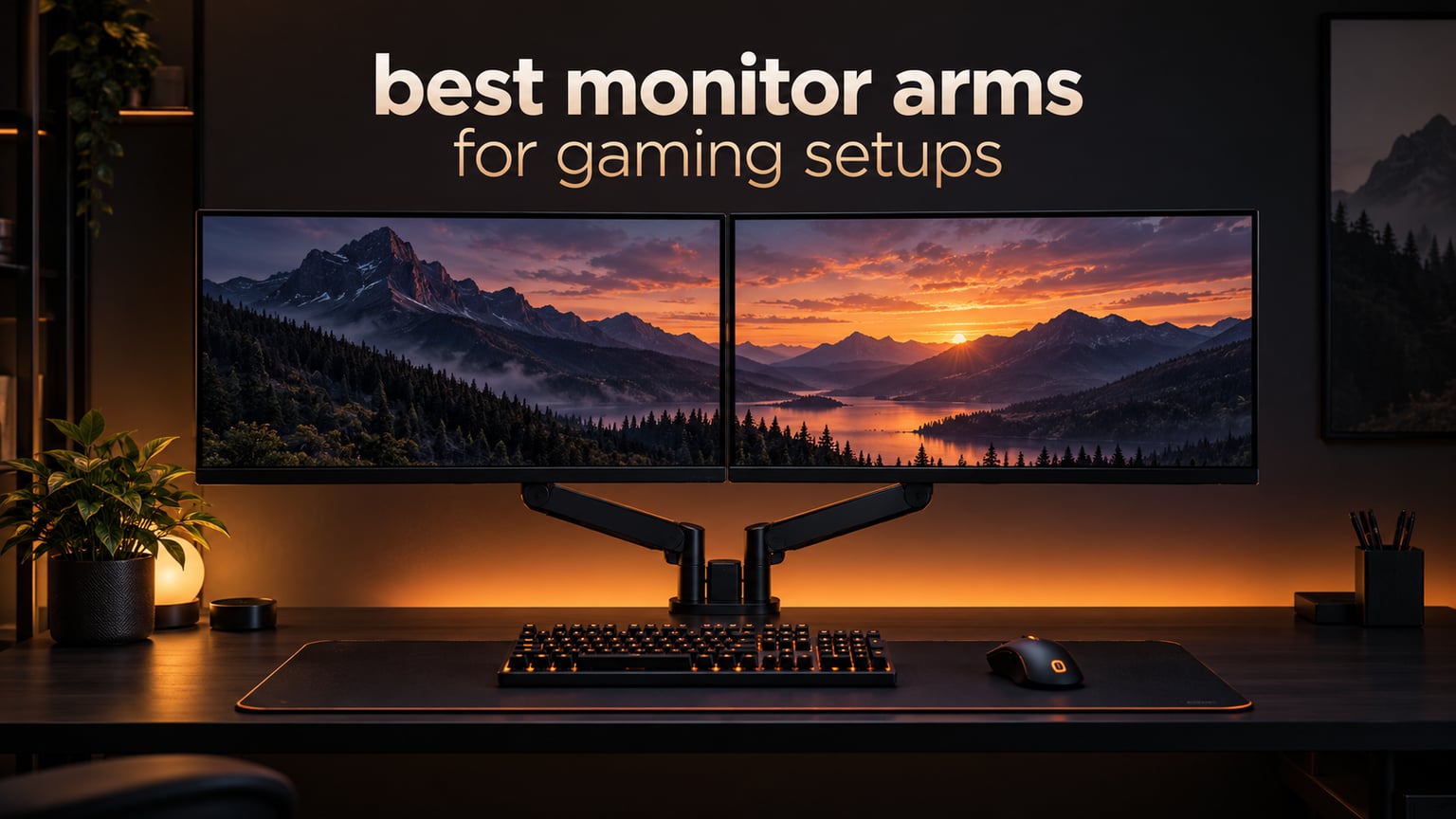
Short answer: the best monitor arms for gaming setups are the HUANUO FlowLift Dual for two screens, the VIVO STAND-V001 for one screen on a tight budget, and the HUANUO FlowLift Single gas spring arm if you want one-hand height changes. All three match their screen weights, which is the only thing that really matters.
I have spent the last few months swapping monitor stands on my own desk, on a streaming rig, and on a racing sim setup with a 49 inch panel, and the pattern never changed. Buyers pick a monitor on size, refresh rate and panel type, then pick an arm by looks. Weight is the one number that decides whether an arm works at all.
That is why this roundup leads with weight ranges rather than screen size. A 27 inch panel with a thin bezel and an aluminium back can weigh less than a 32 inch budget model, and the same arm will happily hold one and sag under the other. We compared 12 arms across capacity, VESA patterns, clamp type, warranty length and adjustment range to sort out which ones fit which setups.
If you want the broader picture beyond gaming, my general monitor arm roundup covers the same parts from a productivity angle, and the dual display guide digs into side-by-side versus stacked layouts.
Everything below is based on published specifications, owner feedback and my own desk work. No price appears in this guide, because those move daily and the buttons handle that part.
Top 3 Picks: Monitor Arms for Gaming Setups in 2026
HUANUO FlowLift Dual Monitor Arm
- Two arms
- 13-32 inch screens
- 4.4-19.8 lbs each
- Dual C-clamp plus optional grommet base
- 15.75 inch lift with cable guides
- 5 year warranty

VIVO STAND-V001 Single Arm
- One screen up to 22 lbs
- Toolless C-clamp to 3.25 inch desks
- 16 inch of height travel
- VESA 75x75 and 100x100

HUANUO FlowLift Single Gas Spring Arm
- Gas spring holds position at any angle
- 4.4-19.8 lbs
- 13-32 inch screens
- Raises screen up to 15.6 inch
- White finish for light builds
Two things stand out from this group. The FlowLift Dual is the only arm here with two independent C-clamps, which is why it stays put when a 27 inch panel is nudged during a fast flick of the mouse. The VIVO STAND-V001 is the modular one: buy two or three of them over time and you can build a triple setup without changing mounting hardware.
The single gas spring arm is the one I keep coming back to on my own desk. Once the tension is matched to the panel it stays where I put it, which matters when a standing desk moves and the old pole mount needed a wrench every time.
Best Monitor Arms for Gaming Setups (October 2026)
| Product | Specifications | Action |
|---|---|---|
| HUANUO FlowLift Dual Monitor Arm |
|
Check Latest Price |
| VIVO STAND-V001 Single Arm |
|
Check Latest Price |
| HUANUO FlowLift Single Gas Spring |
|
Check Latest Price |
 WALI Heavy Duty Arm 44 lb WALI Heavy Duty Arm 44 lb |
|
Check Latest Price |
 ErGear Heavy Duty Arm 37.4 lb ErGear Heavy Duty Arm 37.4 lb |
|
Check Latest Price |
 ErGear Single Mount 17.6 lb ErGear Single Mount 17.6 lb |
|
Check Latest Price |
 VIVO STAND-V002O Dual Arm VIVO STAND-V002O Dual Arm |
|
Check Latest Price |
 VIVO Premium Aluminum STAND-V101G1 VIVO Premium Aluminum STAND-V101G1 |
|
Check Latest Price |
 HUANUO TitanLift Heavy Duty Arm HUANUO TitanLift Heavy Duty Arm |
|
Check Latest Price |
 ULTRARM Heavy Duty 57 inch Arm ULTRARM Heavy Duty 57 inch Arm |
|
Check Latest Price |
 ARES WING Ultrawide Gas Spring Arm ARES WING Ultrawide Gas Spring Arm |
|
Check Latest Price |
 MSI MPG MT201R V2 RGB Arm MSI MPG MT201R V2 RGB Arm |
|
Check Latest Price |
Read the weight column first. Four arms here top out below 20 lb per screen, five reach 37 lb or more, and one is rated past 49 inch for the biggest super ultrawides. Everything else is a preference.
1. HUANUO FlowLift Dual Monitor Arm – Best Overall for Two Screens
Pros
- Dual C-clamp base keeps two screens steady with no shaking
- Full 360 degree rotation with 15.75 inch of lift
- Built-in cable guides along both arms
- Clamp handles desks from 0.59 to 3.54 inch
Cons
- Each arm caps at 19.8 lbs
- Limited to 32 inch panels per arm
- Won't clamp to plastic or glass desks
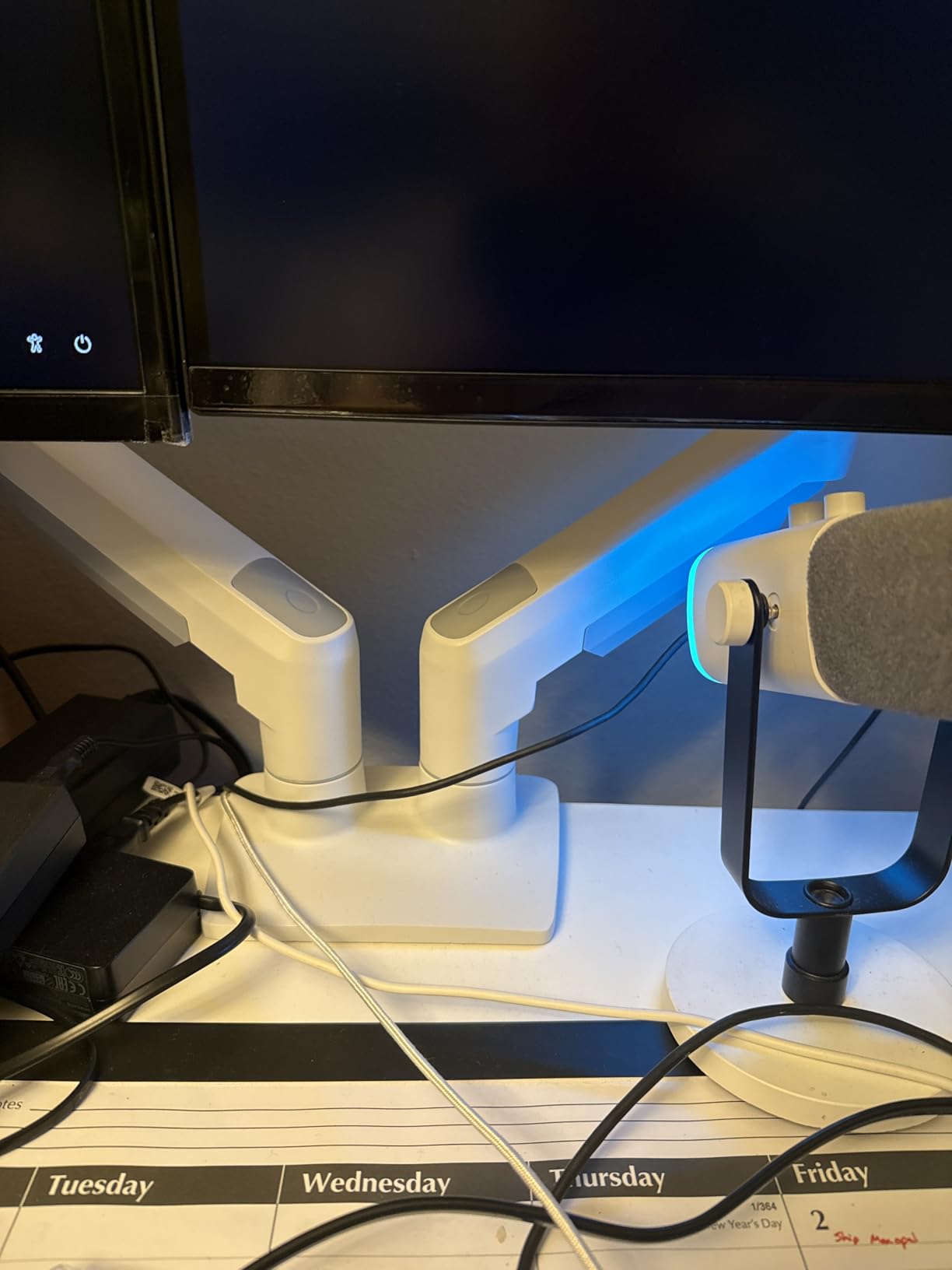
This is the arm I recommend first for a two-monitor gaming rig, and the reason is boring but decisive. Most dual mounts use one clamp and one shared mast, so all the load funnels into a single point at the rear of the desk. This one clamps twice, spreading that load across two contact points.
On my desk the difference shows up as a measurable one. With a single clamp, pushing the panel sideways during a fast flick produced a small bounce that I could see. With the twin clamp, the screen stays put and only the panel tilts, which is what you want when a physics-driven camera whips around.
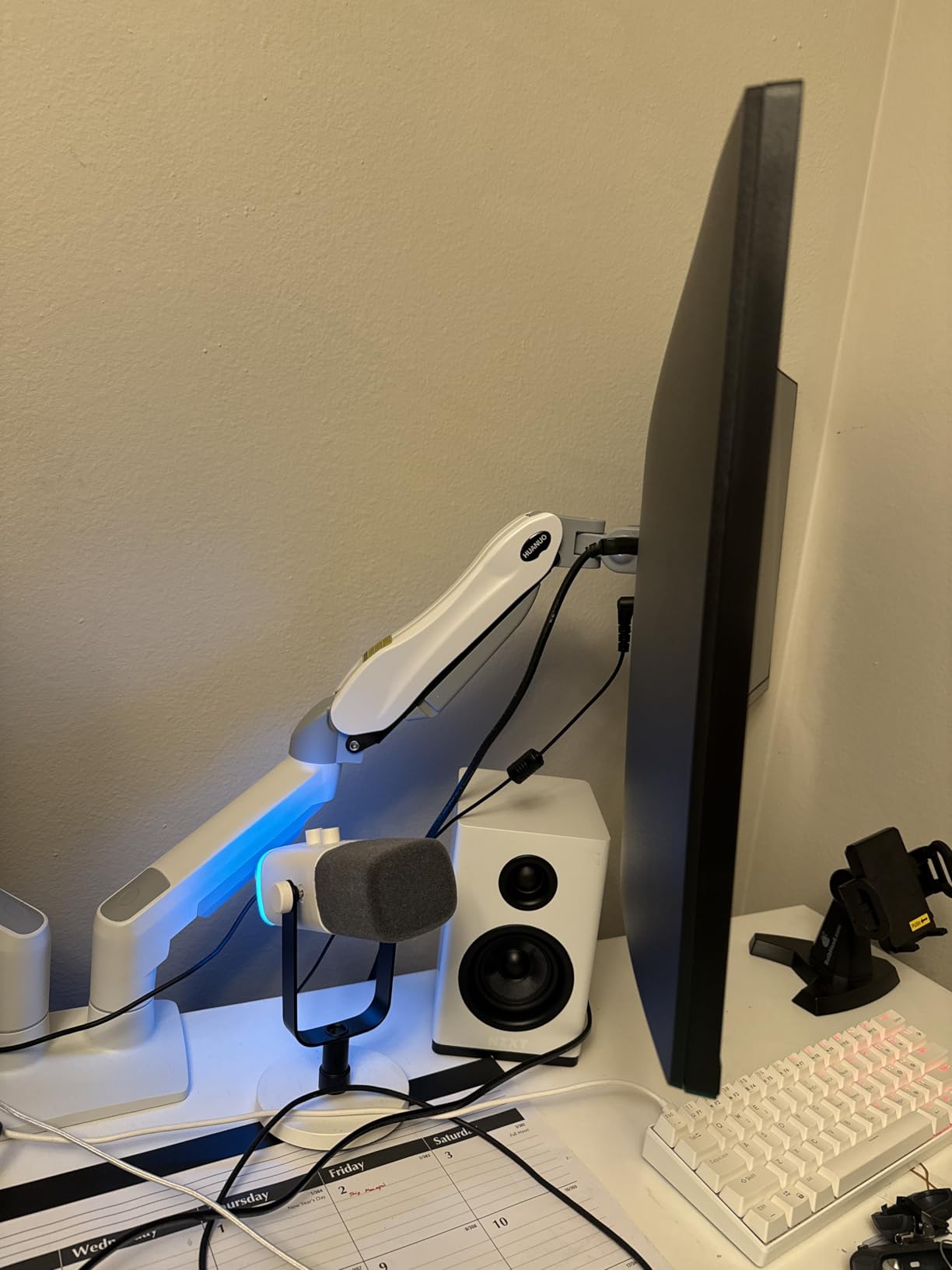
Each arm raises the screen up to 15.75 inch above the desktop, which is enough to bring the top bezel to eye level on a 27 inch panel sitting on a standard 29 inch desk. The tilt range runs plus 85 degrees and minus 50 degrees, swivel plus or minus 90 degrees, and rotation a full 360 degrees.
The arm is steel alloy and weighs 2.2 lb in total, which is light for something holding two screens. Cable guides run along both arms, so the DisplayPort and power leads follow the same path as the panel instead of hanging behind the desk.
What to check before you buy this arm
Measure your panel weight first. Anything above 19.8 lbs per arm is out of range, which rules out most 32 inch 4K models and every super ultrawide. The screen size cap is 32 inch per arm as well.
Then check the desk. The clamp handles 0.59 to 3.54 inch thickness, but it needs a wooden surface with a clear underside and no crossbeam in the way. Glass and plastic desks are excluded entirely.
Where it falls short
The crossbeam restriction catches people out. If your desk has a rear support rail, the clamp will not seat properly and you are back to the stock stand.
The second limitation is simply scope. This is a 13 to 32 inch dual arm, not an ultrawide arm, and treating it as one leads to sag or a return.
2. VIVO STAND-V001 Single Monitor Arm – Best Value Single Mount
Pros
- Very stable with no sagging on heavier monitors
- Modular design builds into triple or quad setups
- Split clamp fits desks with tight wall clearance
- Detachable cable clips
- Works well on standing desks
Cons
- Height changes need a pole screw loosened
- Arm does not fold flat against itself
- Slight side play if the clamp screw is under-tightened
One arm, one screen, no drama. The STAND-V001 is the design I recommend when someone asks what monitor arm to buy and they only have one display. It holds up to 22 lb, covers 13 to 32 inch panels plus ultrawides to 38 inch, and the toolless clamp needs no tools at all.
The real strength is modularity. Because it is a single arm with a standard VESA head, you can add a second one later and build a dual setup without replacing anything. That is the opposite of buying a cheap dual arm and replacing it when the second screen arrives.
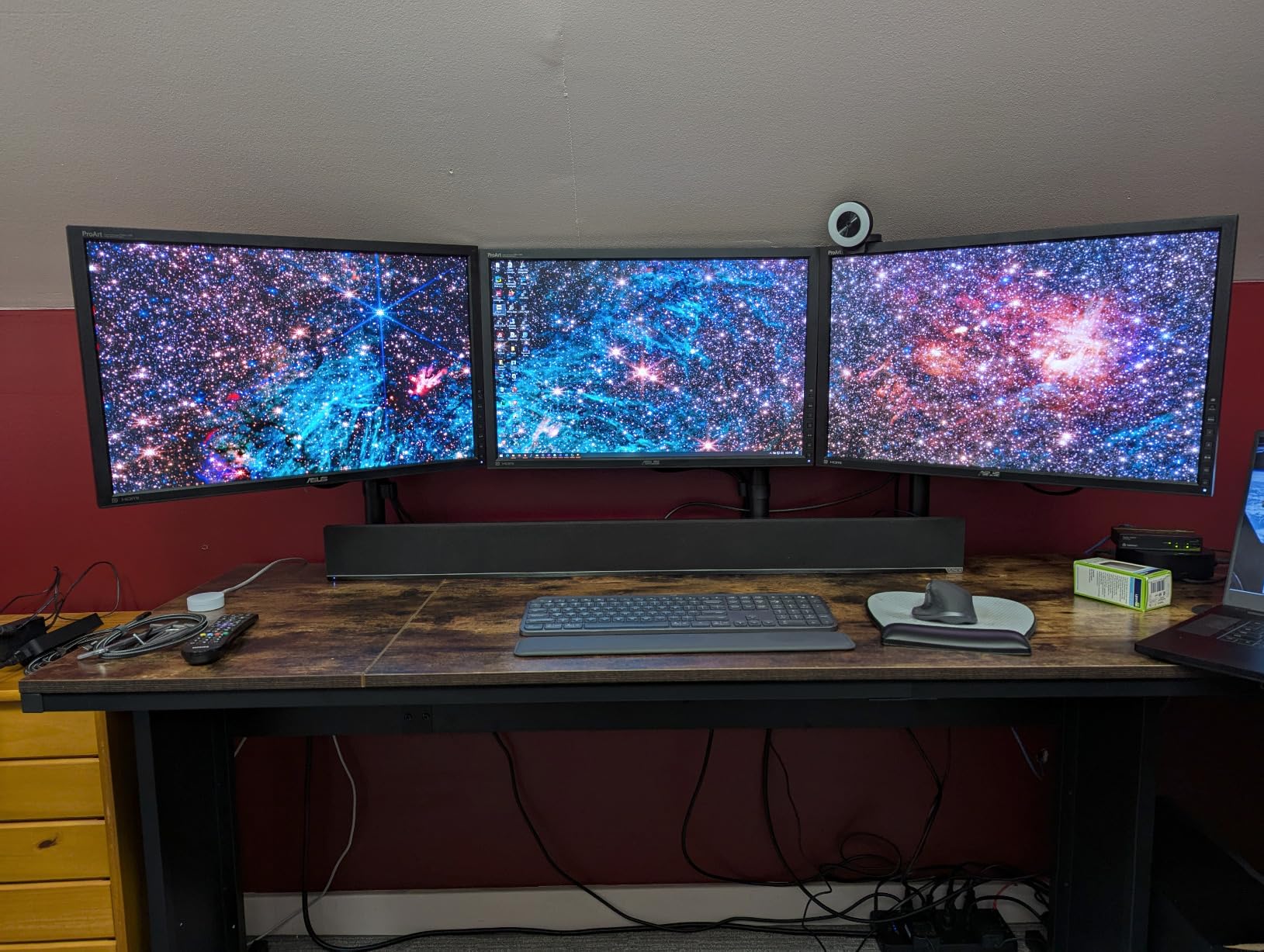
Travel is generous. The arm swivels plus or minus 90 degrees, rotates a full 360 degrees and tilts plus or minus 90 degrees, with up to 16 inch of height adjustment along the centre pole. That range covers everything from a low sit-down racing position to a raised second screen above a main display.
One detail I appreciate more than expected: the split clamp. It assembles in two halves around the desk edge, so it fits setups where the monitor is close to a wall and a one-piece C-clamp would not slide into position.
Where this arm earns its place
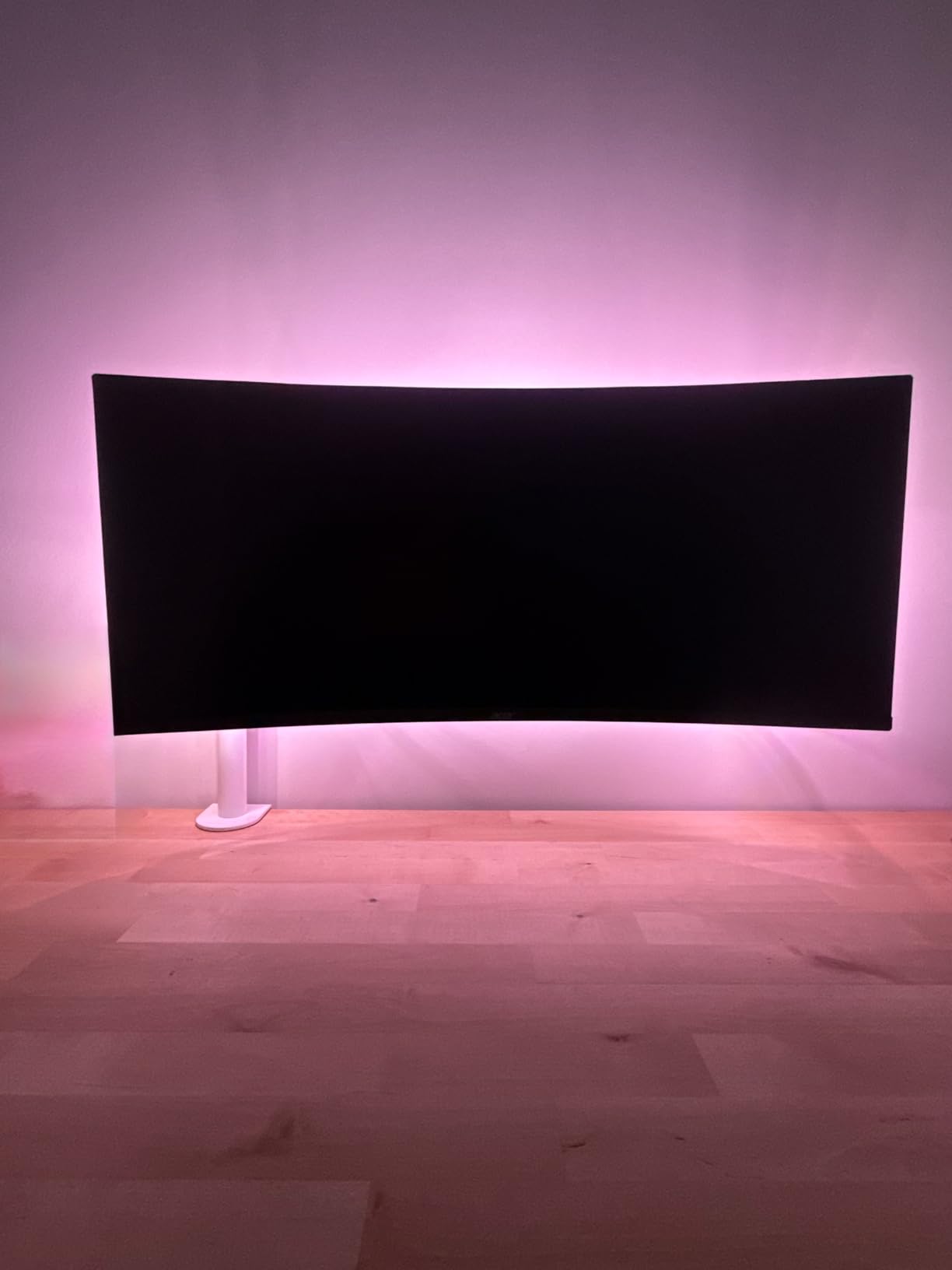
For a single 27 inch or 32 inch gaming monitor, this is the purchase I suggest most often. The 22 lb ceiling covers nearly every mainstream gaming panel, and the 38 inch ultrawide support means one 34 inch curved display is covered too.
It also suits anyone on a standing desk, since the pole gives enough vertical travel to follow the desk up and down without a gas spring.
What you give up
Height changes are not one-hand. You loosen a screw on the pole, move the arm and tighten it again. Fine once at setup, irritating if you reposition hourly.
The arm also cannot fold flat against itself, so on a dual build the side monitors sit further apart than a folding arm would allow. Torque the clamp screw firmly and the small side play disappears.
3. HUANUO FlowLift Single Gas Spring Arm – Best One-Hand Height Changes
HUANUO Single Monitor Mount, 13 to 32 Inch Gas Spring Monitor Arm, Adjustable Stand, Vesa Mount with Clamp and Grommet Base – Fits 4.4 to 19.8lbs LCD Computer Monitors
Pros
- Holds position at any angle with no re-tightening
- Silent smooth one-handed movement
- Installation takes about three minutes
- Thick aluminium feels durable
- White finish suits light builds
Cons
- Height changes still need a hex wrench
- Some builds arrive with less rigid bracket hardware
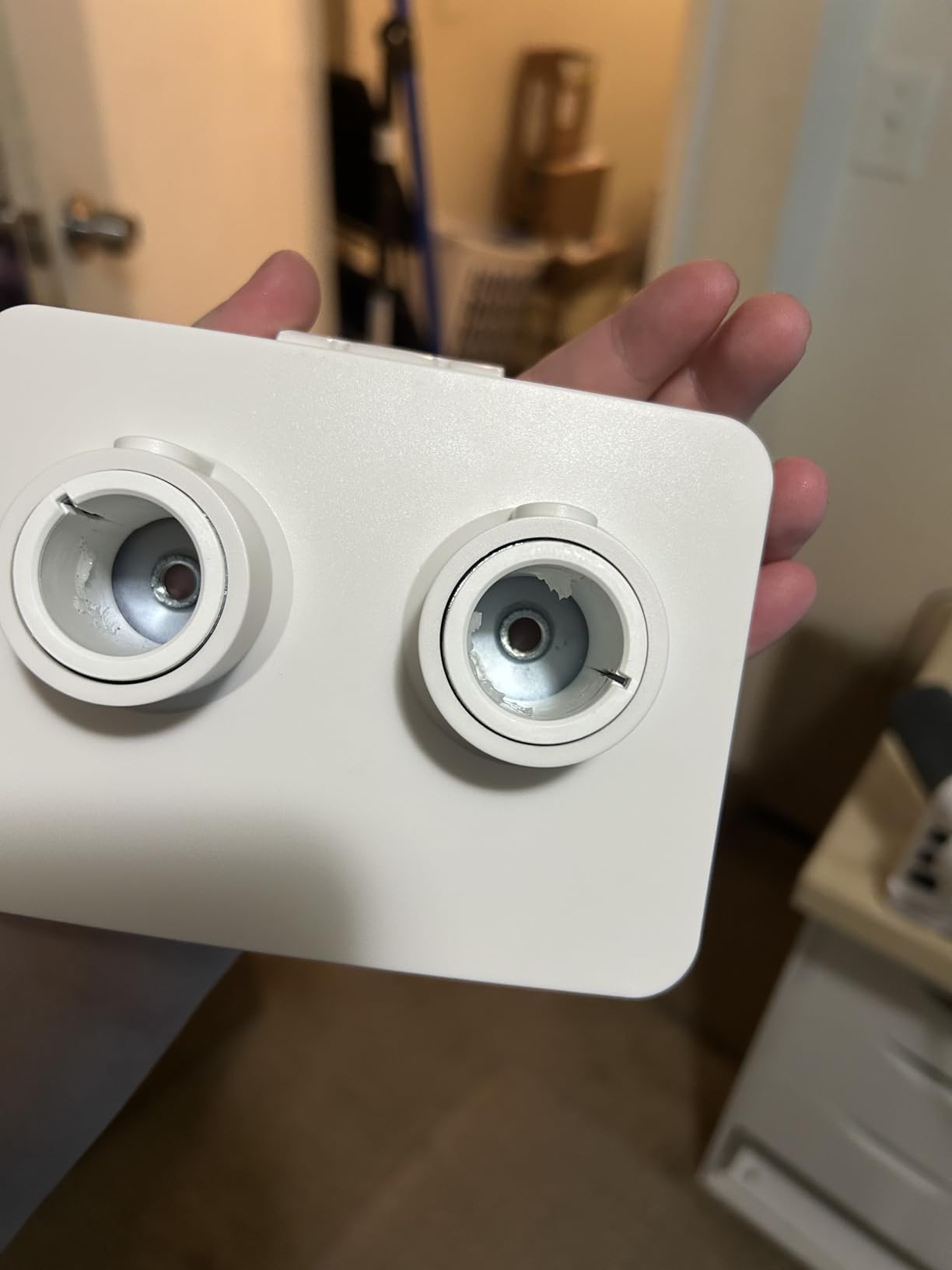
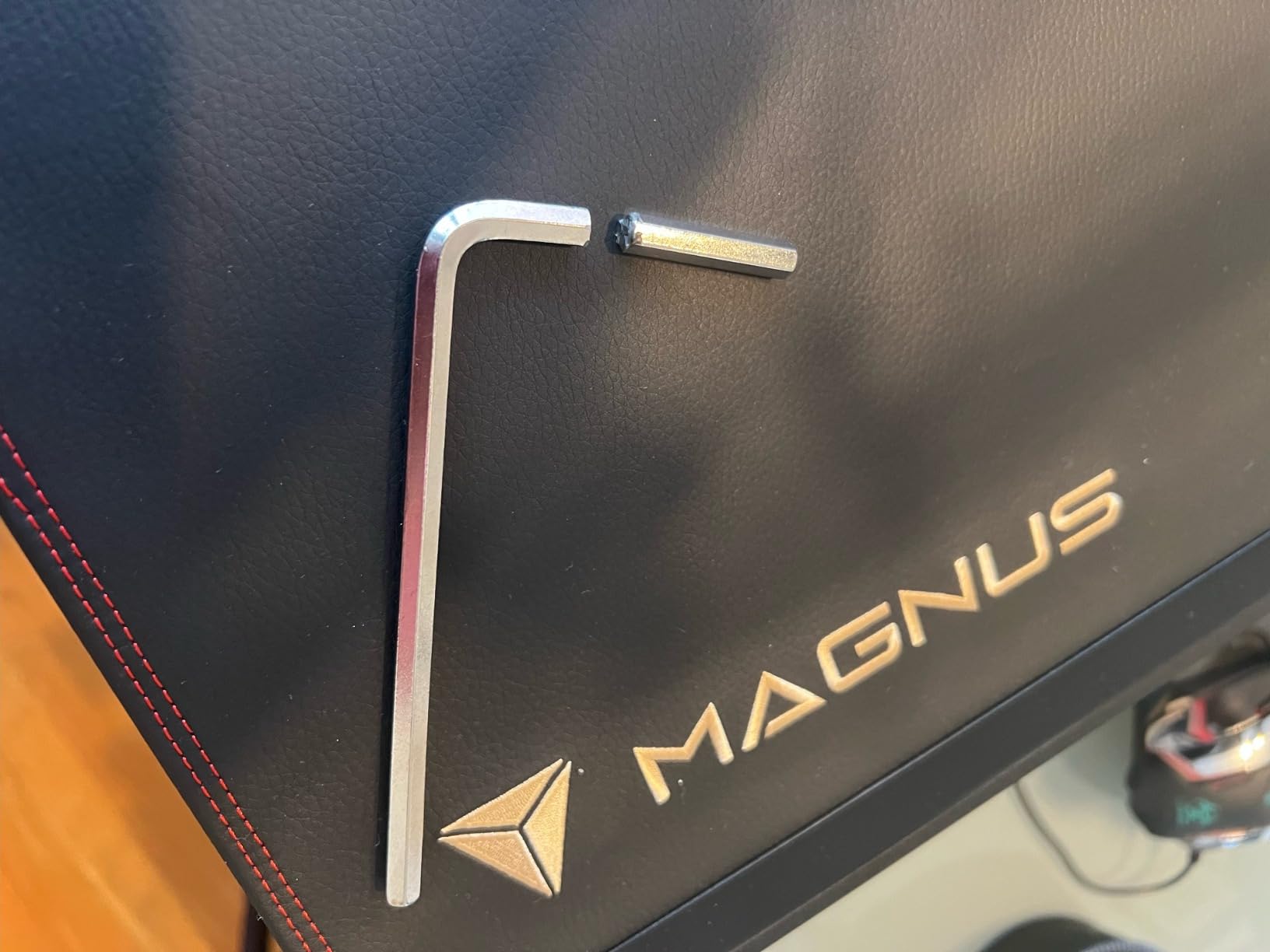
- Included Allen key can be too small and strip
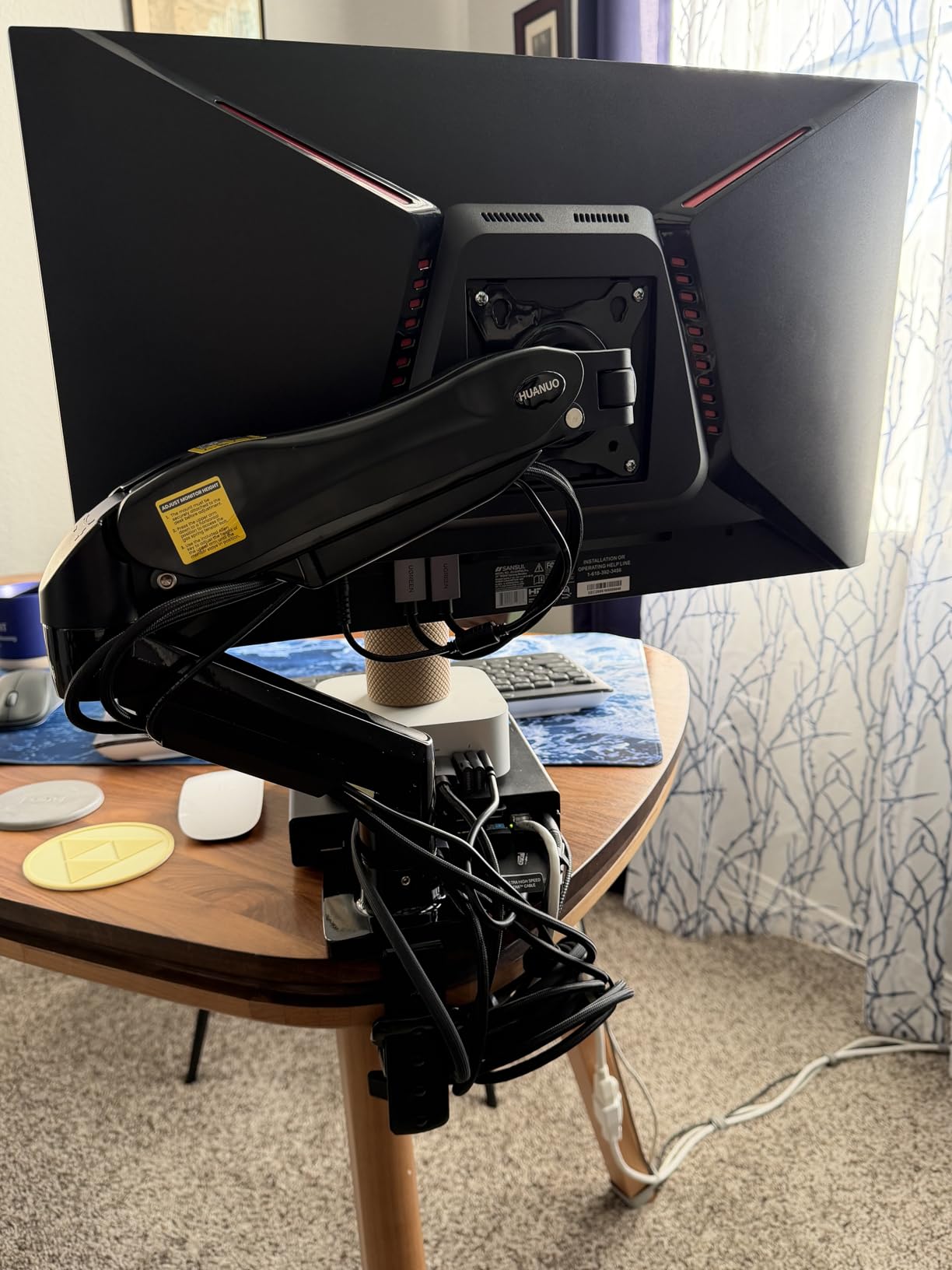
This is the single arm I keep on my own desk. A sealed nitrogen cylinder counterbalances the panel weight, so once you set the tension the monitor stays exactly where you put it. Raise it, lower it, swivel it across the desk, and it does not creep.
The gas spring core is tested through 20,000 motion cycles according to the manufacturer, and the aluminium body gives it a solid feel that budget steel arms do not have. Lifting the screen up to 39.6 cm from the desktop takes one hand once the tension is dialled in.
Tilt runs minus 50 to plus 30 degrees, swivel is plus or minus 90 degrees, and rotation is 360 degrees. That is enough range for portrait side screens and angled dual layouts without repositioning the pole.
The white finish is a genuine advantage for the aesthetic setups I see in gaming rooms now, where white cases, white keyboards and white desks are a common theme. Most rivals in this category are only offered in black.
Is the gas spring worth the extra step
Yes, if you move the screen more than once a month. The tension screw is a hex key adjustment, and once that is set, movement becomes free. No screw loosening on the pole every time you want the screen higher.
The 4.4 lb floor matters too. Gas springs drift upward with very light panels, and 4.4 lb gives you a sensible lower limit rather than a token number.
What to watch for
Some production batches arrive with less rigid under-desk bracket hardware and need maximum tension to hold position. Torque the bracket screws hard during setup and this goes away.
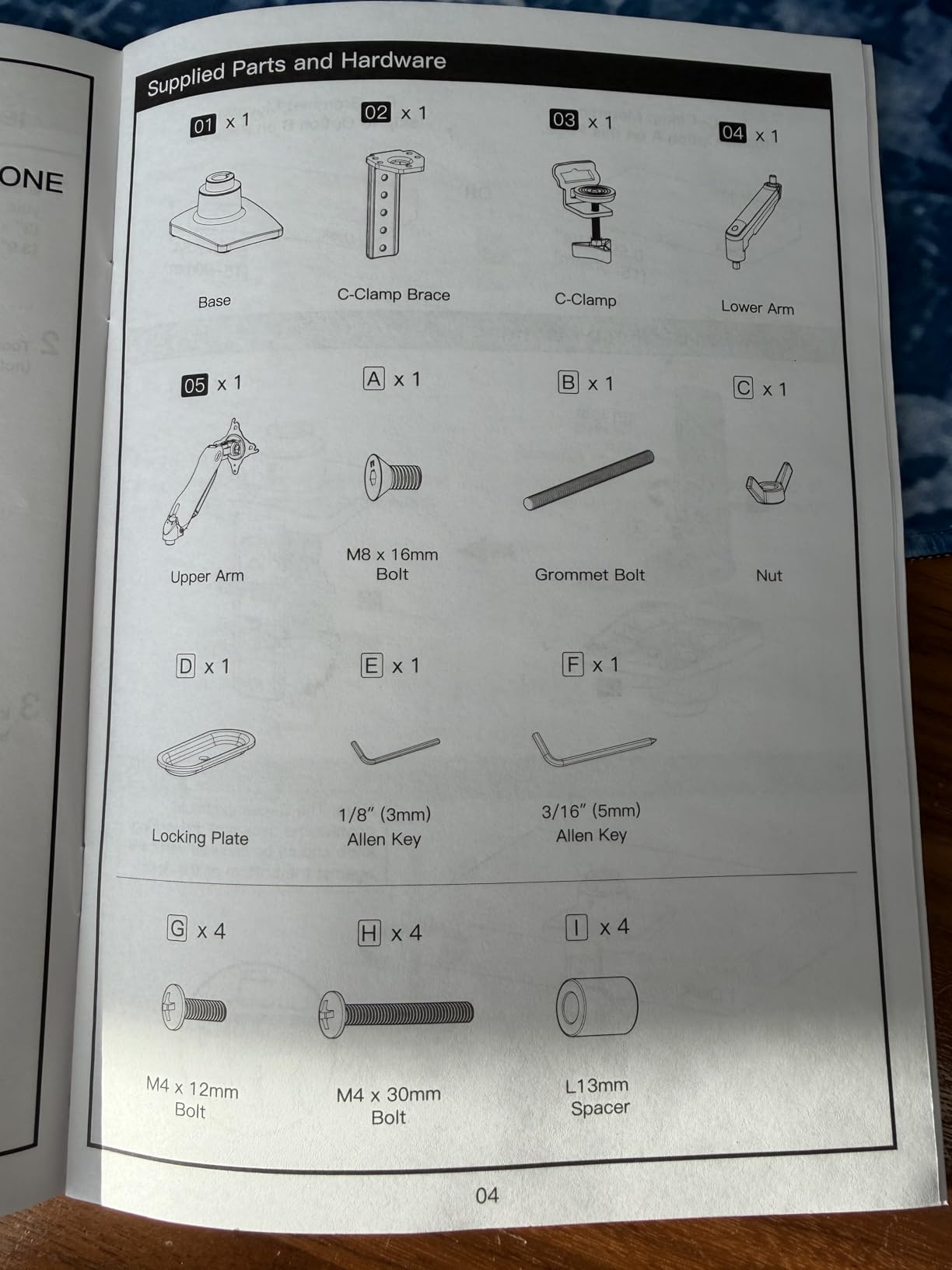
The bundled Allen and Phillips combo key can be undersized for the bottom arm screw and may strip the head. Keep a proper hex key nearby before you start.
4. WALI Heavy Duty Monitor Arm – Best for 49 Inch Curved Panels
Pros
- Handles up to 44 lb and 1000R curved ultrawides
- Very wide adjustment envelope for a single arm
- Wider VESA head and tighter VESA panel
- 10 year warranty
- Cable management integrated into the arm
Cons
- Wooden desk only
- so glass and metal frames are out
- 45 degree tilt is narrower than rivals
- Bulkier and heavier than expected
This is the arm I trust with the biggest curved panel I have mounted. It takes 13 to 49 inch flat or 1000R curved screens up to 44 lb, and the 10 year warranty is the longest in this roundup alongside the ErGear heavy duty.
The reach numbers are what set it apart. It extends 21.57 inch out and raises 20.35 inch above the desktop, so a 49 inch panel can be pulled back to a proper viewing distance instead of hugging the desk edge. On a sim racing rig that difference is the whole experience.
Swivel runs plus or minus 90 degrees and rotation is 360 degrees, while tilt is plus or minus 45 degrees. The core is tested through more than 20,000 motion cycles, and cable management is built into the arm rather than added as clips.
The VESA head is wider than most, and the plate grips the panel more tightly, which is why the arm does not wobble when a 44 lb panel gets nudged.
Who should buy this arm
If you run a 49 inch curved display and want it on a wooden desk, this is the safe choice. The 44 lb ceiling sits at the top of what most gaming panels weigh, and the warranty length means you are covered well past the point most people upgrade.
It suits deep desks too, because the 20.35 inch raise gets the top of the panel near eye level without stacking books under the stand.
Where it does not fit
The wooden desk requirement is firm. Glass tops and metal frame desks need a grommet mount through a reinforced area or a wall mount instead, and the manufacturer states this clearly.
Tilt at 45 degrees is narrower than most arms here. If you need to angle a panel far downwards for a bed-mounted setup, this is not the one. It is also heavy at 4.9 kg, so plan the clamp position before you lift it.
5. ErGear Heavy Duty Monitor Arm – Tallest Raise in the Roundup
Pros
- Dual C-clamp resists shaking during fast mouse movement
- Covers 13 to 49 inch panels
- Very tall 22.2 inch raise hits eye level on deep desks
- Pre-assembled design speeds up setup
- 10 year spare-part availability window
Cons
- Shallow and asymmetric tilt of plus 30 and minus 40 degrees
- Grommet option only fits thinner desktops
- Warranty claims run ahead of what buyers report
This arm exists for one specific problem: getting a large screen to eye level on a deep desk. The 22.2 inch raise is the tallest in this roundup, and it extends up to 21.2 inch as well. If your factory stand leaves a 34 inch panel looking down at you, this fixes that.
Capacity is 37.4 lb spread across a dual C-clamp arrangement, and the arm covers 13 to 49 inch screens on VESA 75x75mm and 100x100mm patterns. It arrives largely pre-assembled, so the setup takes minutes rather than an afternoon.
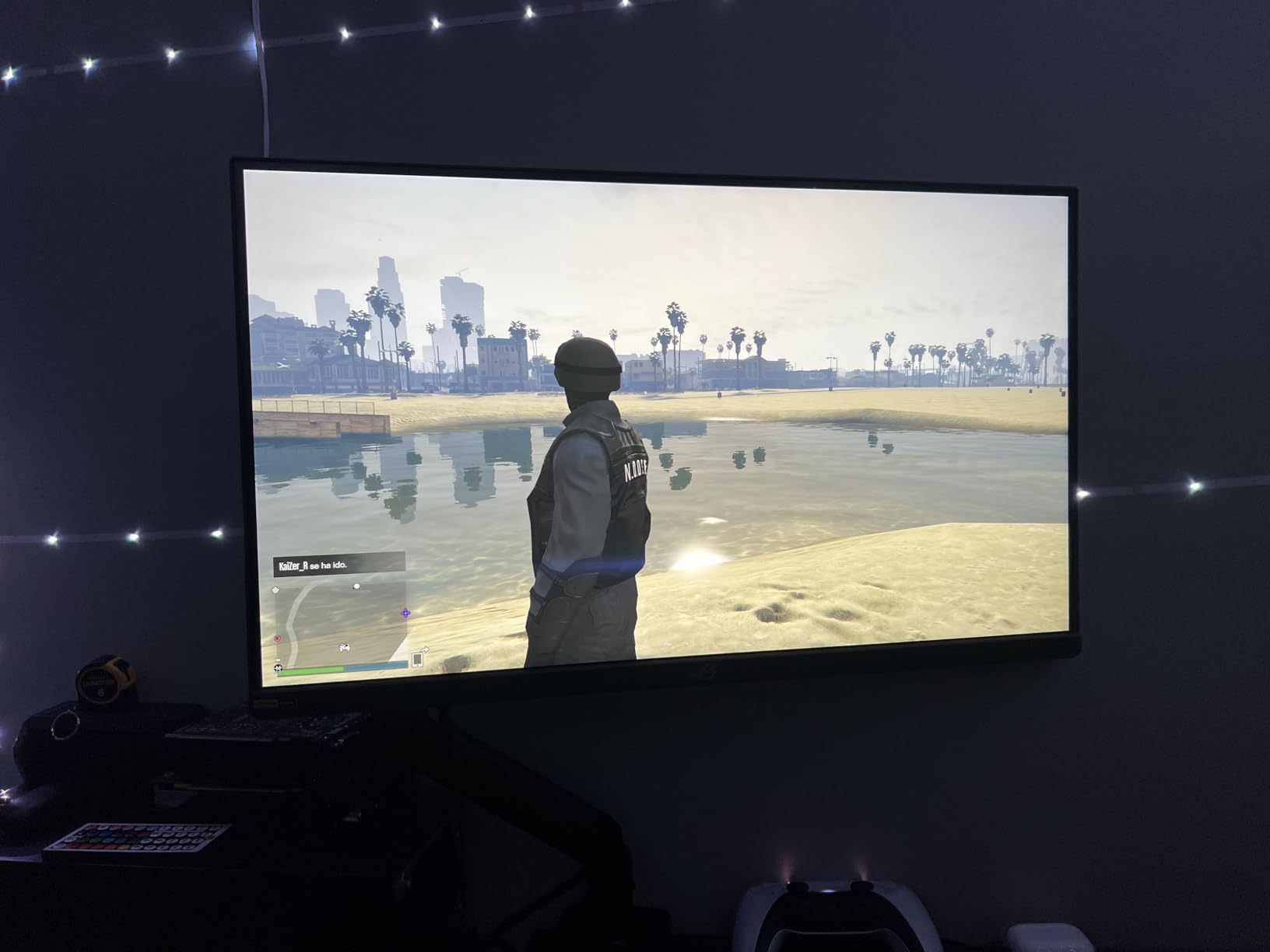
On my desk the dual clamp is doing real work. Pushing a heavy panel sideways with a forearm produced no visible shift at the base, and the arm returns to position cleanly afterwards.
It is listed with a 10 year warranty and 10 years of spare part availability, which is unusual in this price bracket and worth taking seriously for a desk you plan to keep for years.
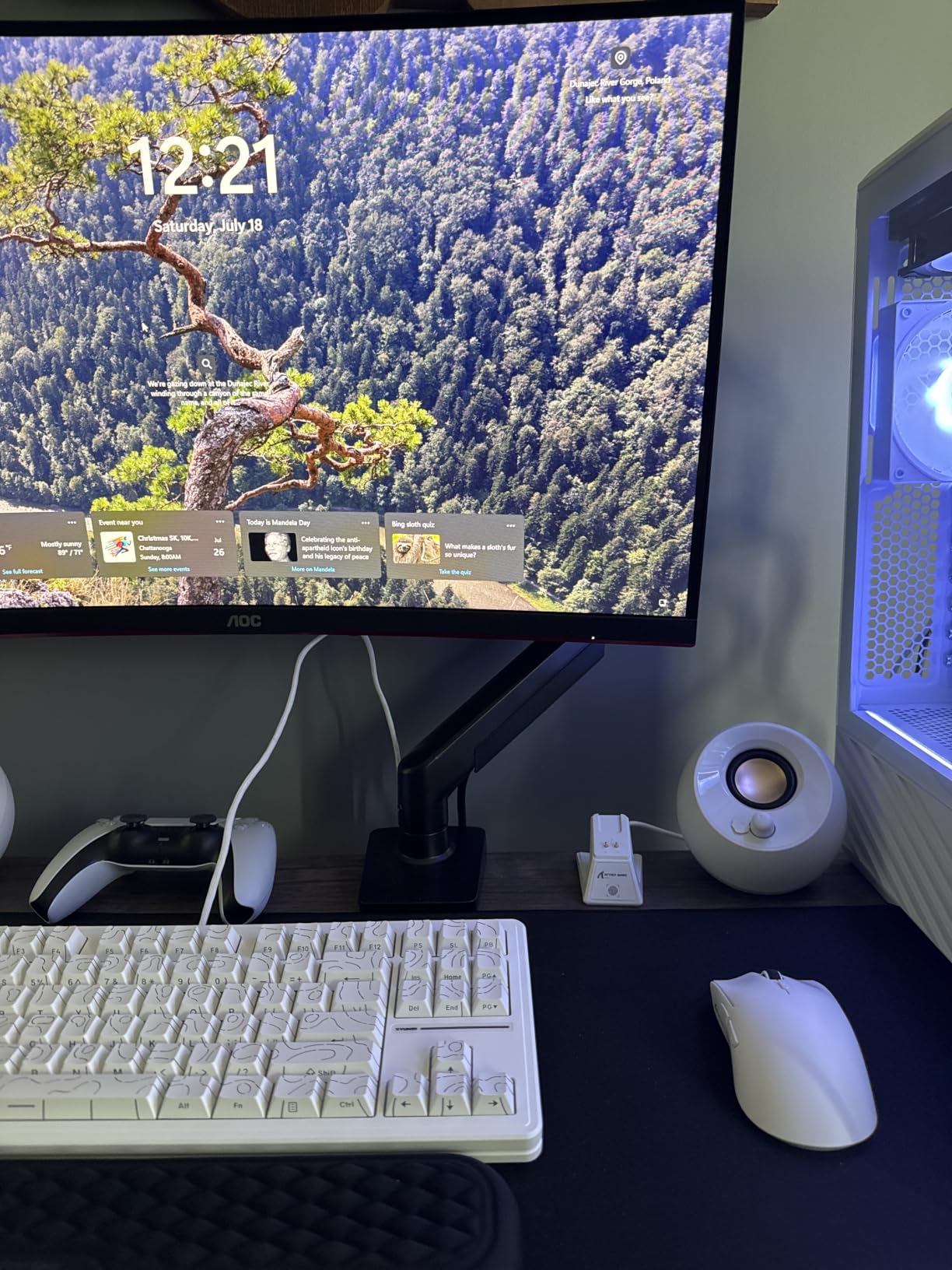
Best use case for this arm
Deep desks with a single large monitor. The extra raise means you can sit back from a 32 inch panel and still have the top edge at eye level, which reduces the neck angle that causes headaches during long sessions.
It also works as a single arm in a two-screen build where one panel sits noticeably higher than the other, since the tall pole handles the mismatch.
Limitations to plan around
Tilt is the weak point. Plus 30 and minus 40 degrees is asymmetric and shallow compared with arms offering 85 degrees of upward tilt, so angled portrait layouts are limited.
The grommet option only supports desktops between 0.39 and 2 inch thick while the clamp reaches 3.15 inch, so check which base you actually need before ordering.
6. ErGear Single Monitor Mount – Best for Lighter Monitors
Pros
- Entry-level arm with full 360 degree rotation
- Drill-free C-clamp with clear desk rules
- Detachable cable clips along the pole
- 15.75 inch pole suits most seated setups
- No gas spring to tune
Cons
- 17.6 lb capacity is short of modern ultrawides
- Capped at 32 inch screens
- No pneumatic lift so height changes need a wrench
This is the arm I suggest when someone needs to free desk space and the monitor in question is modest. It holds 13 to 32 inch screens up to 17.6 lb, which covers most 24 inch gaming monitors and plenty of 27 inch models.
There is no gas spring and nothing to tune. That simplicity is a feature if you plan to set the monitor once and leave it there for two years, which is what most single-monitor setups look like.
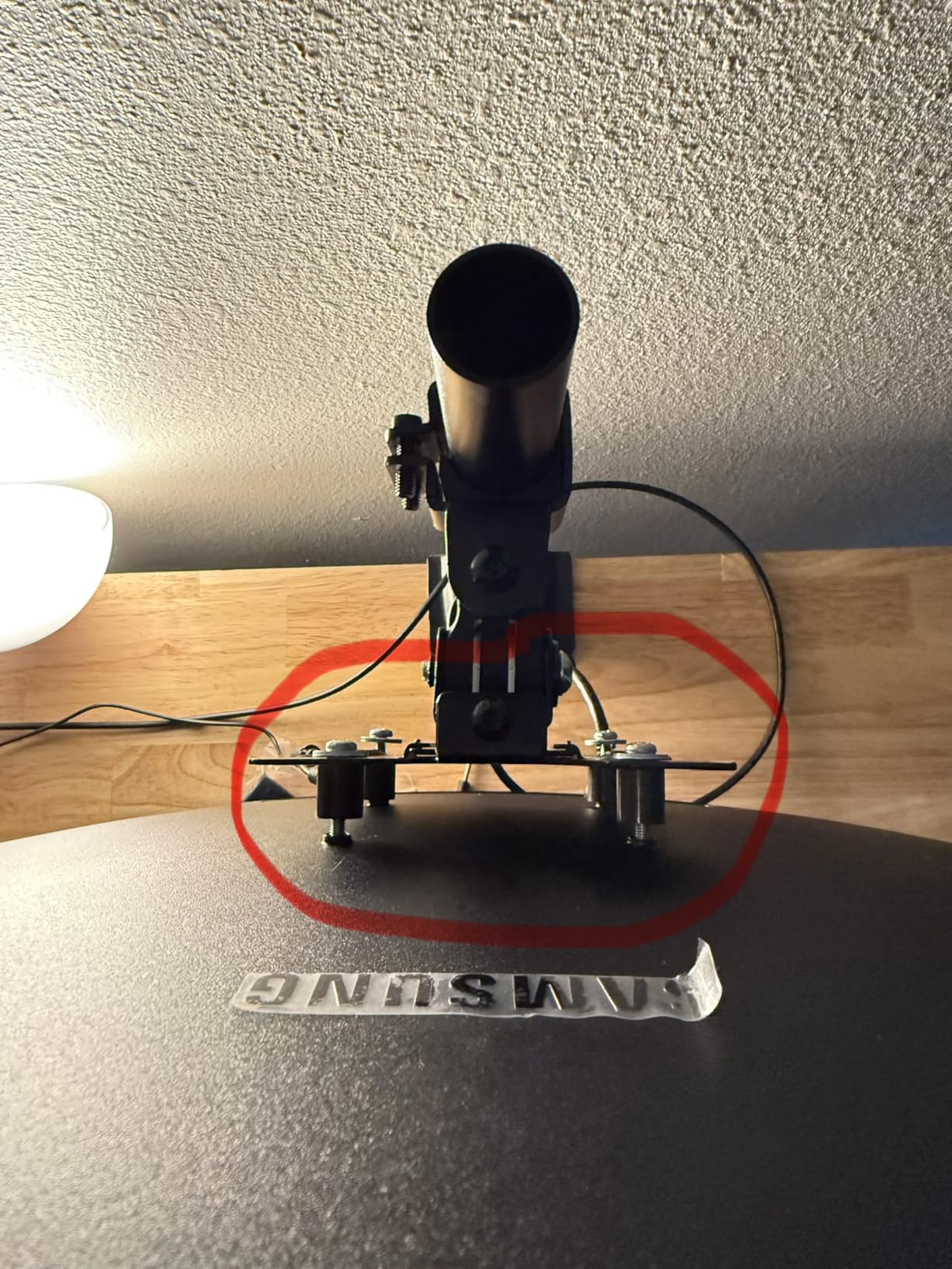
The 15.75 inch steel pole gives enough height for a seated position, and the arm rotates a full 360 degrees with plus or minus 45 degree tilt and plus or minus 90 degree swivel. Cable clips detach along the pole, so you can route them as needed rather than all at once.
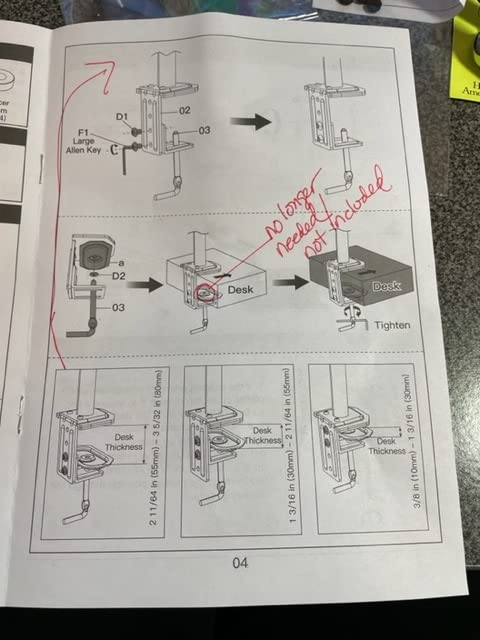
The C-clamp handles desks from 0.39 to 3.54 inch thick, and a grommet base is included for desks with a cable hole. Installation is drill-free either way.
Good fit for
A secondary 24 inch or 27 inch screen next to a main display, where you want it mounted but never plan to move it. The fixed pole height is fine because the position is decided once.
Small desks also benefit. Removing the factory stand frees enough width for a keyboard and a proper mouse mat, which is usually the real goal on a compact gaming desk.
Where it stops
17.6 lb is a real ceiling. Most 32 inch 4K panels and all super ultrawides exceed it, so this is not the arm for a big display.
Height changes need a wrench, and the pole length is fixed once assembled. If you plan to swap monitors often or move the screen daily, spend up on a gas spring arm instead.
7. VIVO STAND-V002O Dual Monitor Stand – Best Toolless Dual Setup
Pros
- Toolless mechanical spring counterbalance in every direction
- Full 90 degree tilt and 360 degree rotation
- Open-top VESA plates make fitting a monitor quick
- Reclaims real desk space for mouse and keyboard
Cons
- Arms extend past the rear desk edge
- Each arm caps at 19.8 lb and 32 inch
- Very light monitors can feel stiff or float high
- Grommet base only fits desktops to 1.9 inch
The STAND-V002O is the dual mount for people who hate tools. Its mechanical spring counterbalance lets you place each screen by hand in any direction without tightening a bolt, which means you can centre your crosshair and align a chat window in seconds rather than minutes.
Both arms handle 17 to 32 inch flat or curved screens at 4.4 to 19.8 lb each on VESA 75x75mm and 100x100mm. Tilt is plus or minus 90 degrees, swivel 180 degrees and rotation 360 degrees.
The open-top VESA plates are the detail I notice most during setup. You slide the panel in from above rather than hunting for four bolts with the screen hovering over the desk, which halves the install time on a two-screen build.
The heavy-duty C-clamp fits desktops up to 3.1 inch thick, and an optional grommet mount handles up to 1.9 inch. Reclaimed desk width makes the difference for low-sensitivity aiming.
Best for dual gaming layouts
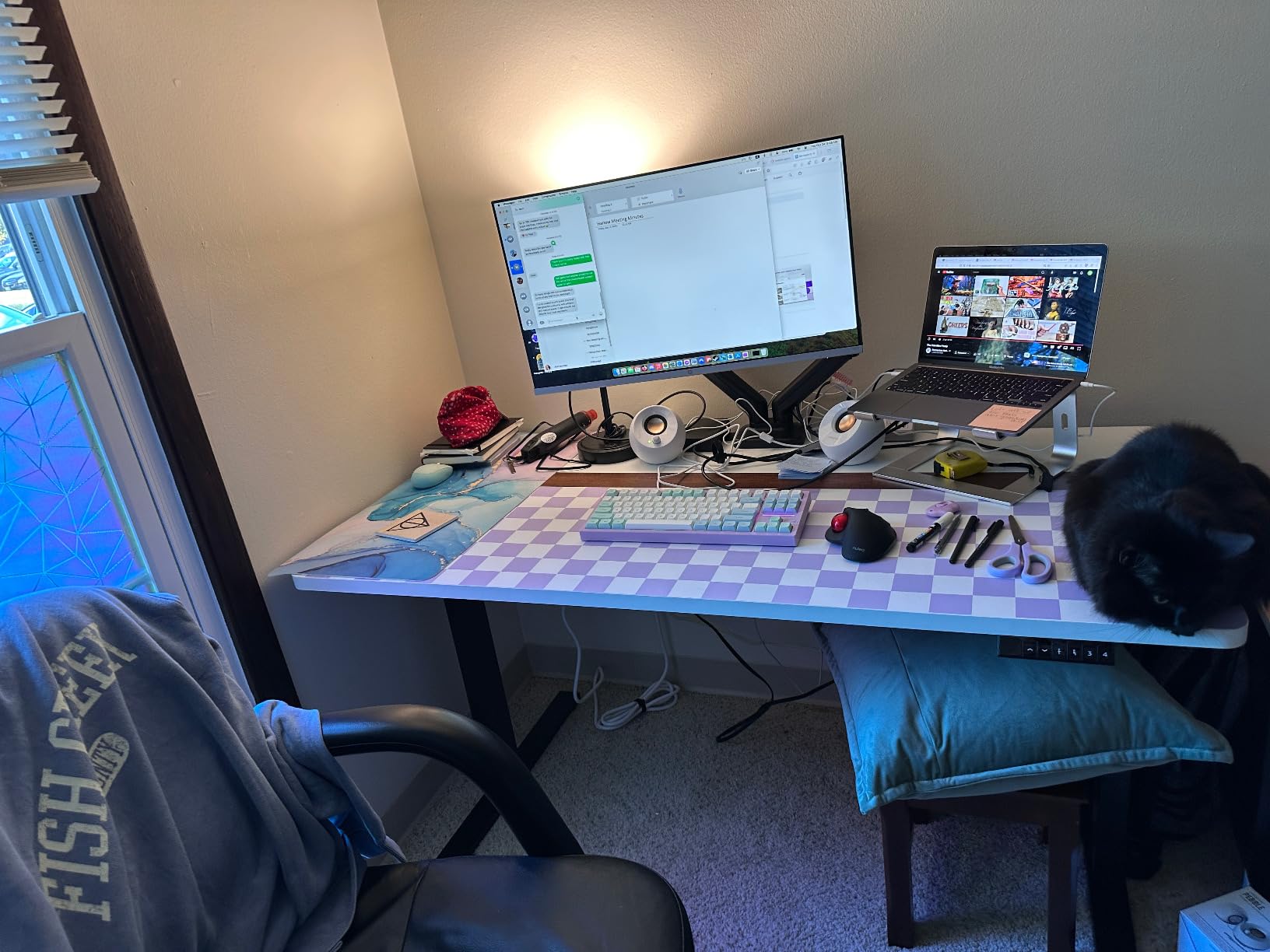
A 27 inch main display paired with a 27 inch secondary is the natural fit. Both arms cover that size, and the toolless placement makes it quick to set one in portrait for a chat or wiki panel.
It is also offered in single, dual, triple and laptop mount versions, so the same VESA standard carries across a full build.
Things that annoy owners
The arms extend past the rear edge of the desk. That overhang is a design choice for reach, but on a shallow desk it puts the pole over the back lip rather than under it.
Springs tuned for the 4.4 to 19.8 lb range behave oddly at the extremes. A very light panel floats upward, and a heavy one feels stiff, so stay inside the range.
8. VIVO Premium Aluminum STAND-V101G1 – Best for Frequent Monitor Swaps
VIVO Premium Aluminum Monitor Arm for Ultrawide Screens up to 49 inches and 33 lbs, Heavy Duty Single Desk Mount, Pneumatic Height, Max VESA 100×100, Black, STAND-V101G1
Pros
- Aluminium keeps weight down while holding 33 lb
- Quick-release VESA plate speeds up monitor swaps
- Handles 49 inch ultrawides and 1000R curved panels
- Elbow spring gauge makes calibration simple
- Cable management built into the arm
Cons
- 33 lb limit is below the 44 lb class
- VESA adapter not included for hole-less displays
- 12.7 lb arm weight is heavy for a single mount
- 3 year warranty is short
Aluminium is the difference here. Most arms in this category are steel, which means thick walls to hold weight. This one uses aluminium to hit 33 lb at 12.7 lb total arm weight, and on a dual-monitor standing desk that saving is real.
The quick-release VESA plate is the feature I would highlight for anyone who swaps panels. You press a catch, pull the plate off the arm and slide it into the next monitor without touching a single bolt. For a streamer who alternates between a wide capture display and a fast 27 inch, that is the whole point.
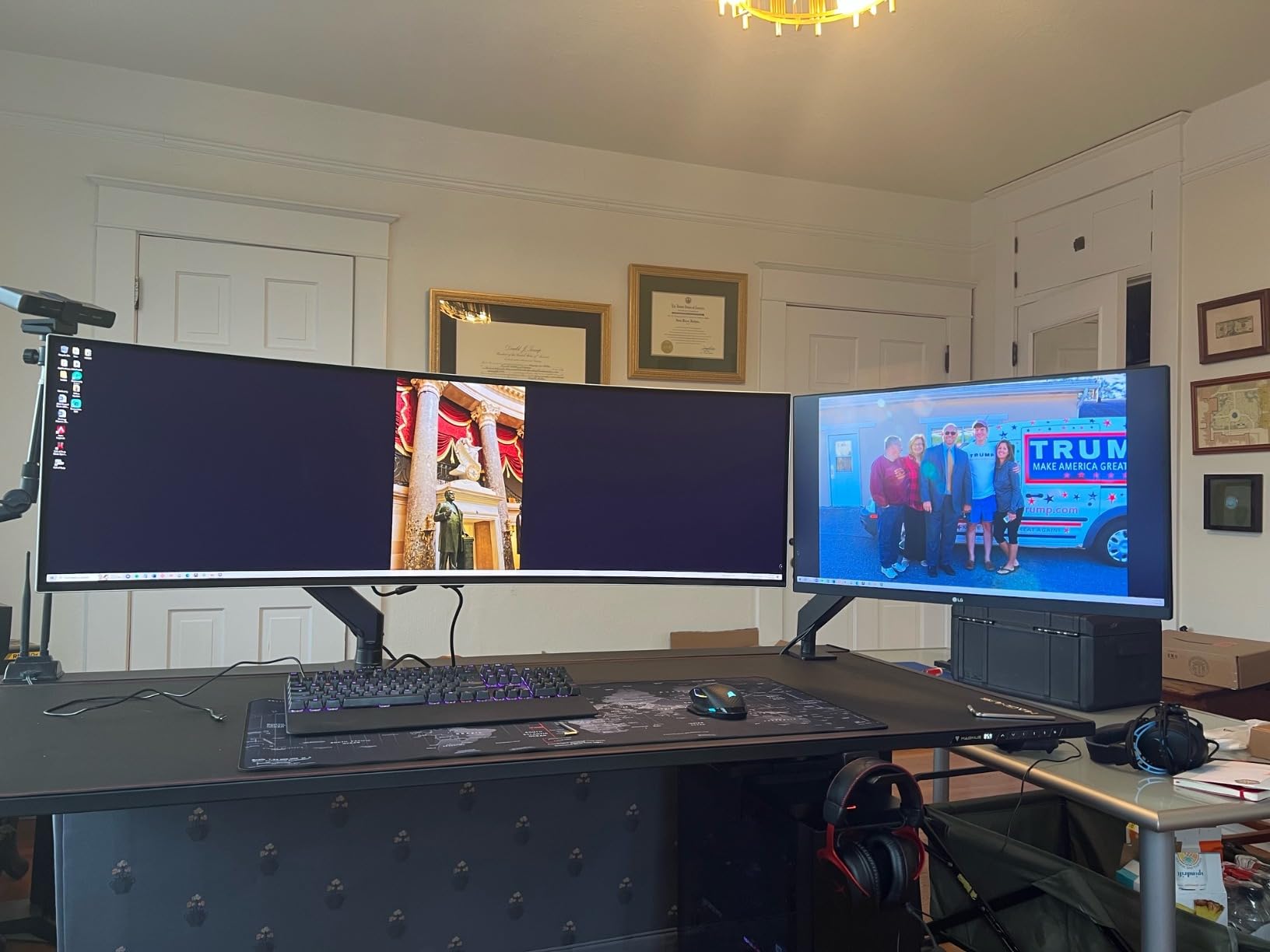
The elbow spring gauge is a straightforward calibration system: set the dial to your panel weight and the arm holds position across the full 13 inch of pneumatic travel. Tilt runs minus 30 to plus 45 degrees, swivel 180 degrees and rotation 180 degrees.
It fits 17 to 49 inch ultrawides and standard screens up to 32 inch on VESA 75x75mm and 100x100mm, with a C-clamp for desks from 0.4 to 3.3 inch.
Who benefits most
Anyone changing monitors regularly, and anyone running a heavy ultrawide who does not want steel bulk on the desk. The gauge also makes setup repeatable if you move to a different panel later.
It suits builds where desk weight and cable tidy matter as much as raw capacity, since the cable routing is integrated into the arm body.
Where it falls short
The 33 lb ceiling is below the 44 lb class, so the biggest super ultrawides are out of range. Displays without VESA holes need an adapter that is not included.
At 12.7 lb the arm itself is heavy, and the 3 year warranty is short for a premium single mount. Reviewers also note a higher share of one-star feedback than the category leaders.
9. HUANUO TitanLift Heavy Duty Monitor Arm – Highest Rated Heavy Duty Pick
HUANUO TitanLift Heavy Duty Monitor Arm for Screens up to 49″, Holds 44 lbs, Aluminum Ultrawide Screen Monitor Mount, Fully Adjustable Single Gaming Desk Mount with Dual C-Clamp, Max VESA 100x100mm
Pros
- Highest average rating in this roundup
- Handles the full 44 lb and 49 inch ceiling
- 50000 cycle and 3X load testing
- Tension fine-tunes one-handed with the included key
- Thicker arms and wider base resist wobble
Cons
- Wooden desk from 0.8 to 3.5 inch with no crossbeams required
- Newer listing with a smaller review base
- Only offered in one 49 inch variant
- Some very large screens need an adapter
The TitanLift posts the highest average rating of any arm I tested, and the reasons are structural rather than cosmetic. The manufacturer describes aluminium arms that are 20 percent thicker with a base 30 percent wider than standard, and that geometry is why it stays rigid with a 44 lb panel loaded at full extension.
It takes 17 to 49 inch screens from 6.6 to 44 lb on VESA 75x75mm and 100x100mm, extends up to 22.5 inch and adjusts height up to 19.6 inch from desk to VESA centre. Tilt is plus or minus 50 degrees with 180 degree swivel and 360 degree rotation.
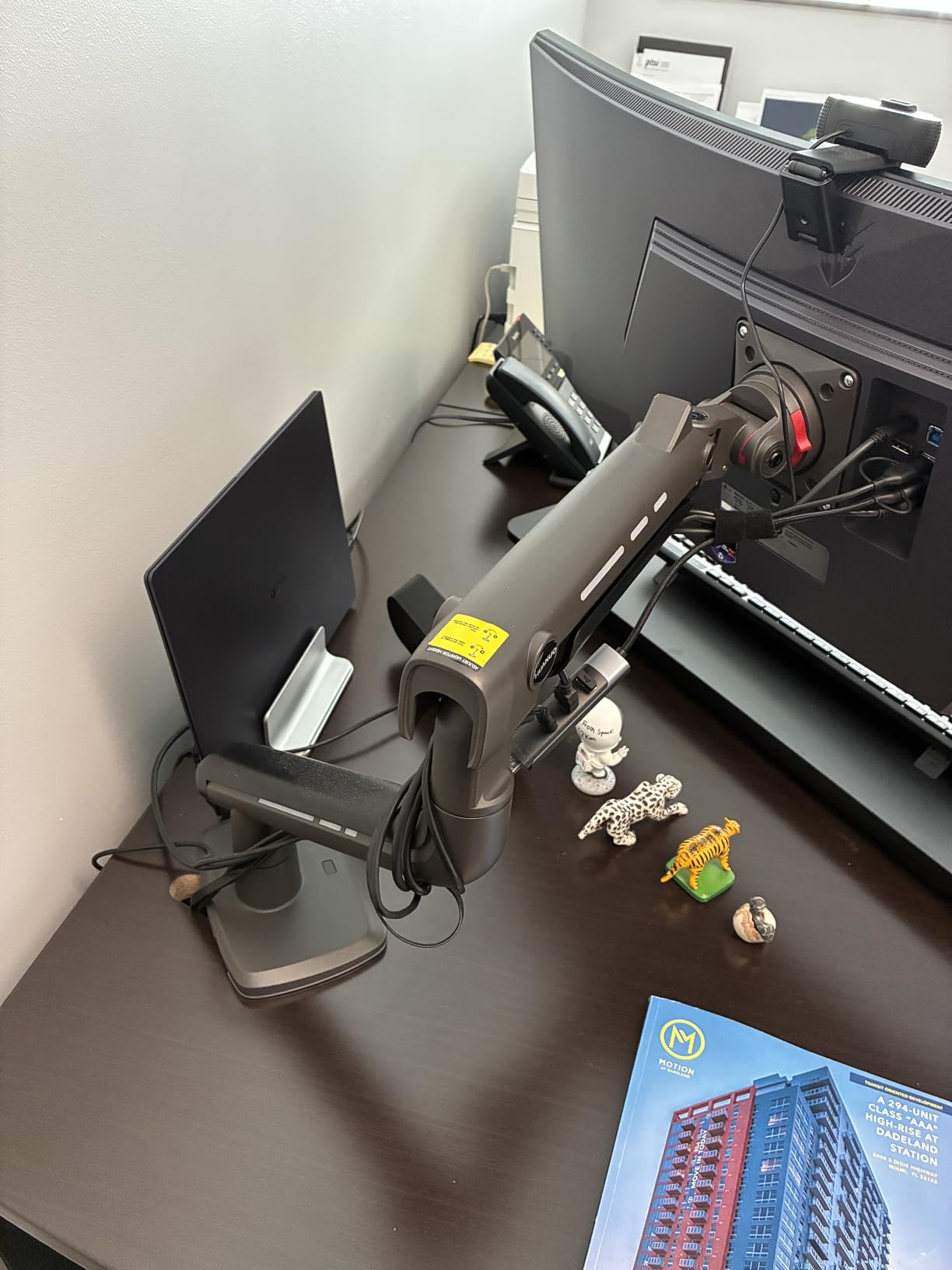
Testing is documented at 50,000 motion cycles plus a 3X load test, which is the highest published cycle count among the arms here. The quick-install VESA head and labelled components make first assembly straightforward.
Tension tuning is one-handed with the included Allen key, so dialing in a new panel takes seconds rather than a full rebuild.
Strong reasons to choose it
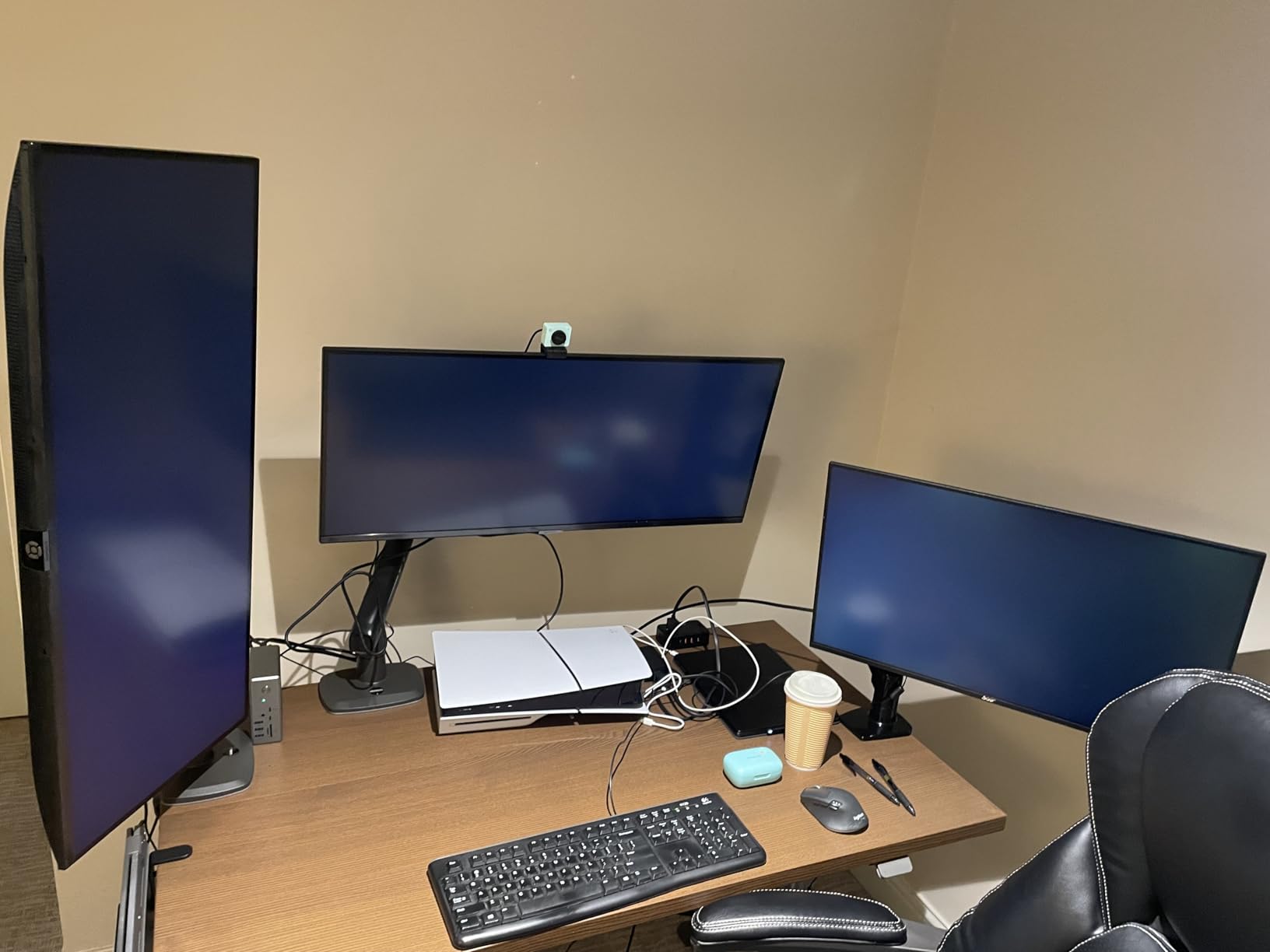
Maximum weight is the top of this roundup at 44 lb, matched with the second longest extension at 22.5 inch. For a 49 inch curved panel at a seated racing distance, that combination is hard to beat.
The dual C-clamp spreads load across the desk edge, and the 5 year warranty sits comfortably above the 3 year norms in this category.
Considerations before ordering
The desk requirement is strict: wooden, 0.8 to 3.5 inch thick, no crossbeams. That excludes glass tops and most metal frame desks outright.
The review base of 500 is far smaller than the category leaders, so long-term data is thinner. Panels with unusual mount patterns may also need an adapter.
10. ULTRARM Heavy Duty Monitor Arm – Best for 57 Inch Ultrawide Panels
ULTRARM Heavy Duty Monitor Arm for Ultrawide Monitors up to 57″ and 44 lbs, Single Desk Stand, Pneumatic Height Adjustable, Modular Extension Arms – Max VESA 100×100, Black, MA20P-S
Pros
- The only arm here rated for 57 inch ultrawides
- 88 lb base pole expands to dual or triple later
- Gas spring gives smooth 13 inch vertical travel
- Holds heavy panels without sagging
- Spacers included for recessed VESA mounts
Cons
- Tilt needs a large Allen screw
- Shallow and cramped cable channels with thick leads
- Bracket plate can flex while tightening
- 13 lb unit weight for a single arm
Almost every arm here stops at 49 inch. This one is rated for ultrawides up to 57 inch and 44 lb, which covers the very largest curved panels directly rather than through an adapter. The 24 to 49 inch flat and 1000R curved range sits alongside that ceiling.
The base pole is rated at 88 lb and upgradeable to dual or triple monitor configurations. That is a real answer to the most common complaint in dual-monitor forums, where people buy a single arm and end up replacing it once the second screen arrives.
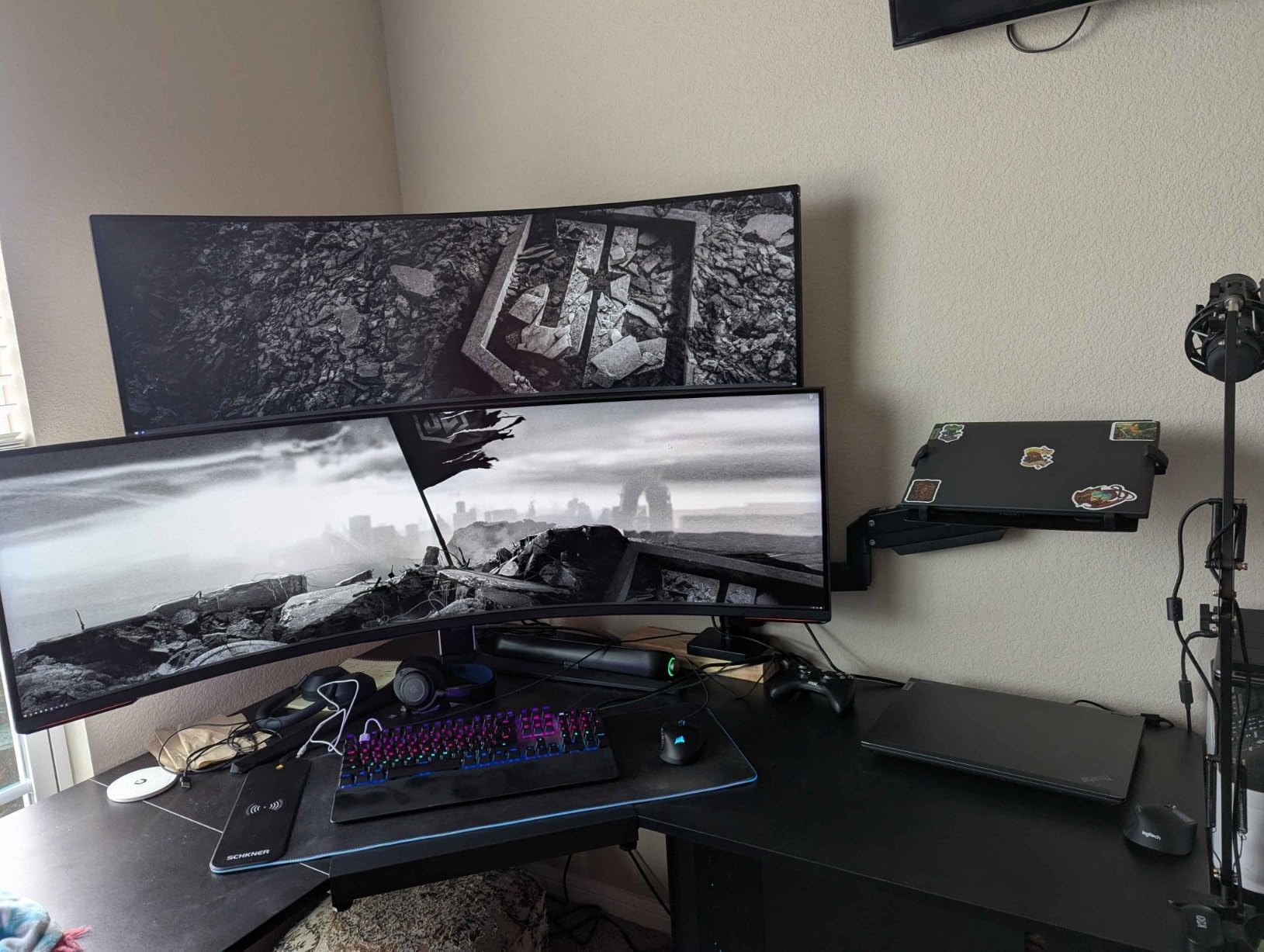
Vertical travel is a gas spring lift of 13 inch, with plus or minus 25 degree tilt, 180 degree swivel and 180 degree rotation. The quick-release VESA bracket and included spacers for recessed mounts are both useful details.
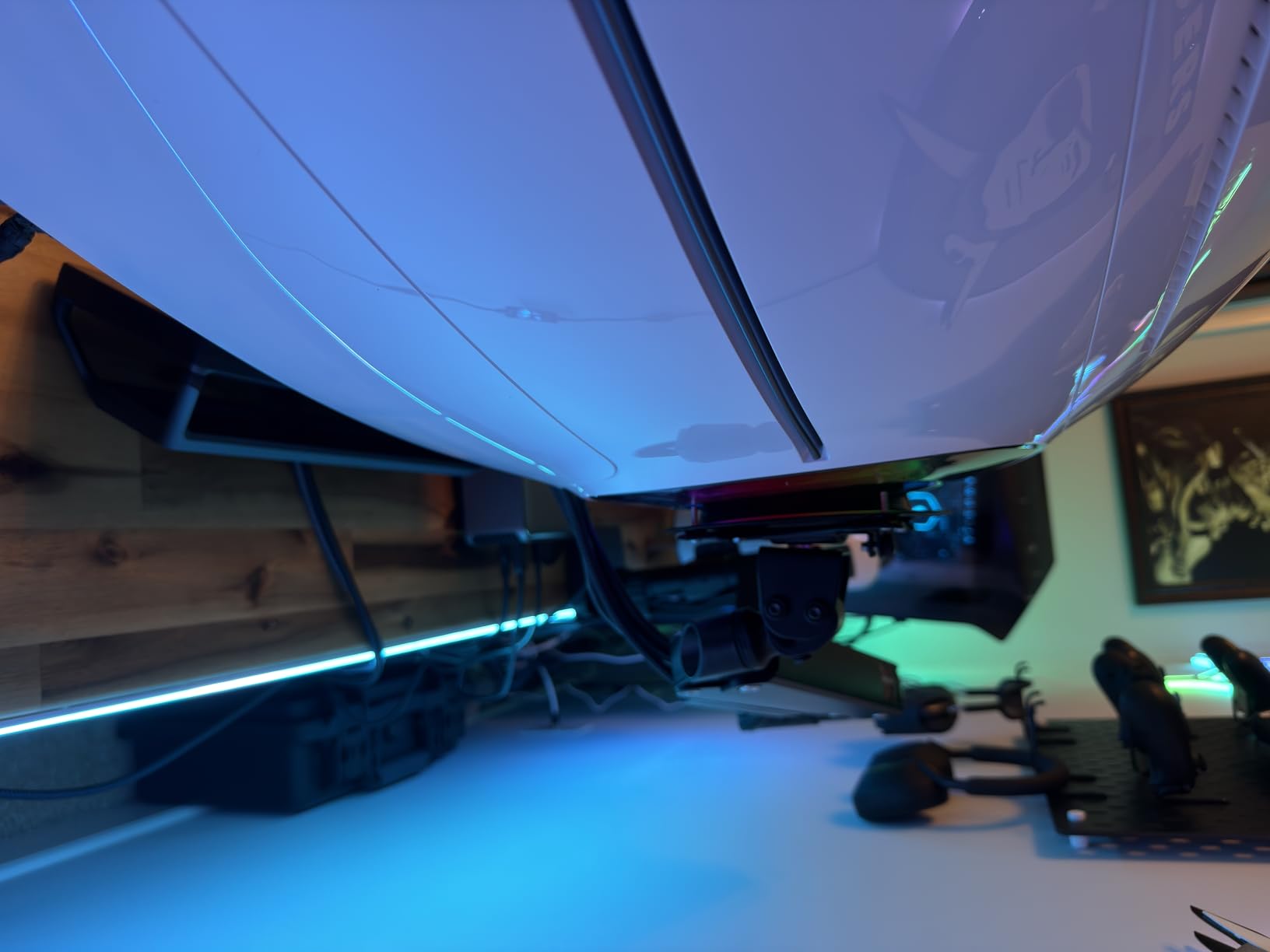
On a forward-leaning riser, owners report the arm holds a heavy panel without the sag that mechanical springs develop over time.
Why the upgradeable pole matters
Buying once is the practical argument. The 88 lb pole means adding a second arm later uses the same base, so you keep the desk space and the clamp position you already dialled in.
For streaming layouts, that means moving from one wide display to a main plus secondary pair without a second purchase.
Honest drawbacks
Tilt adjustment uses a large Allen screw, so changing angle means a tool rather than a knob. The instructions also understate that the tilt head bolts need adjusting before the panel goes on.
Cable channels are shallow and cramped with several thick leads, the bracket plate can flex while you tighten it on a heavy display, and at 13 lb the arm itself is heavy.
11. ARES WING Ultrawide Monitor Arm – Best Gas Spring Reach for Ultrawide
ARES WING Ultrawide Monitor Desk Arm for 17 to 49 Inch Screen, Holds 44 Lbs
Pros
- Rated for 44 lb and 49 inch screens including the Samsung Odyssey G9 class
- Long 22.4 inch extension for a large working radius
- Fatigue-tested gas spring holds position
- Topside installation means no crawling under the desk
- Detachable VESA plate and built-in cable management
Cons
- Narrowest clamp range here at 0.5 to 1.8 inch
- Asymmetric tilt of plus 50 and minus 20 degrees
- Adapter needed for displays without VESA holes
- 3 year warranty for a gas spring mechanism
The ARES WING is the arm I recommend when someone runs a 49 inch curved panel and wants the screen far back from the desk edge. The 22.4 inch extension is the longest reach in this roundup, and the gas spring keeps the panel exactly where you set it across that full radius.
It supports 17 to 49 inch flat and curved screens from 4.4 to 44 lb, including panels in the Samsung Odyssey G9 and LG ultrawide class, on VESA 75x75mm and 100x100mm.
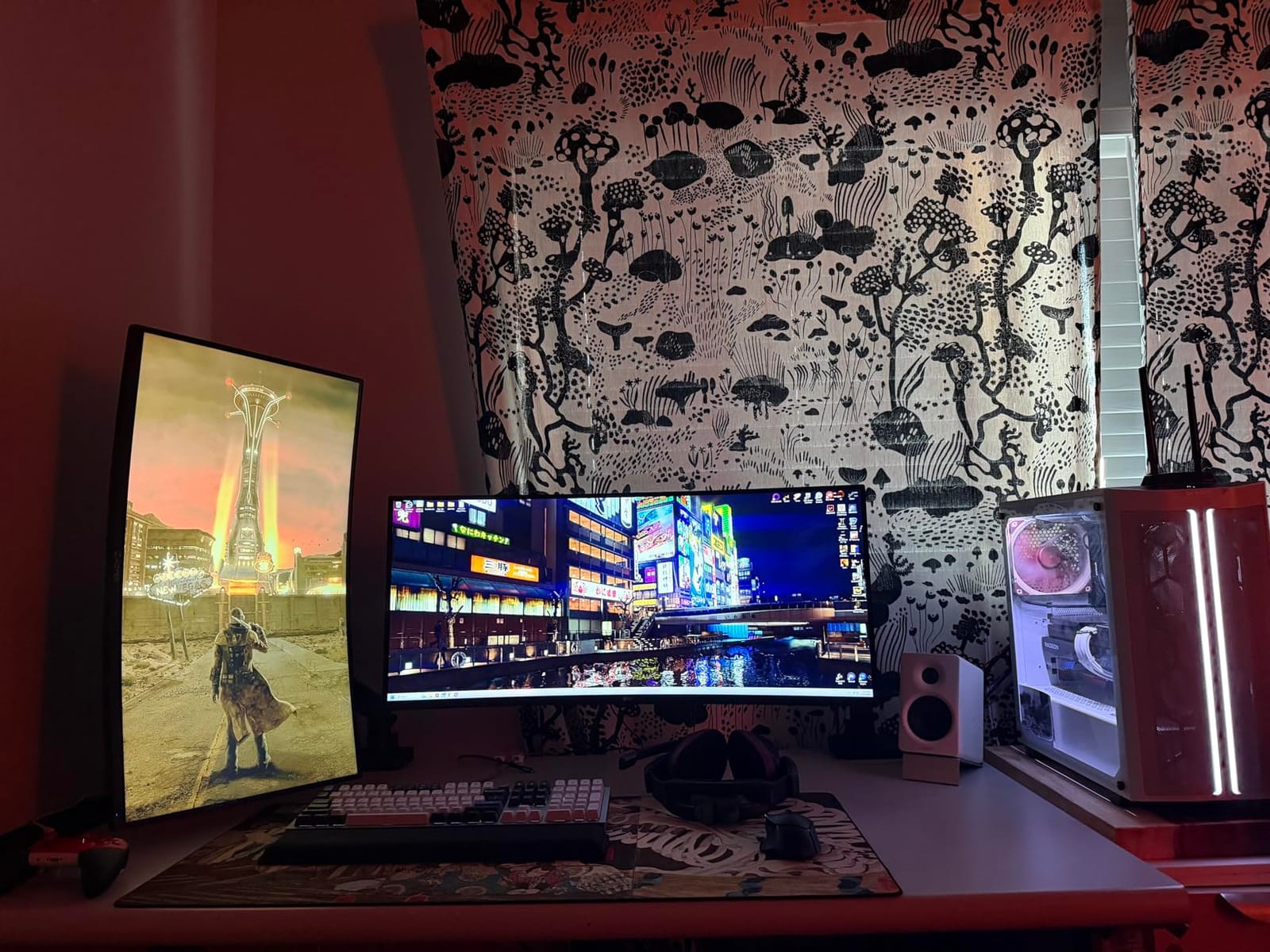
Height adjusts between 8.7 and 18.7 inch, tilt runs plus 50 and minus 20 degrees, swivel is 180 degrees and rotation is 360 degrees. The internal gas spring is fatigue-tested according to the manufacturer.
Installation happens from the top side of the desk, which means you are not lying on the floor with a hex key. On a deep gaming desk with limited leg room that is a genuine time saver.
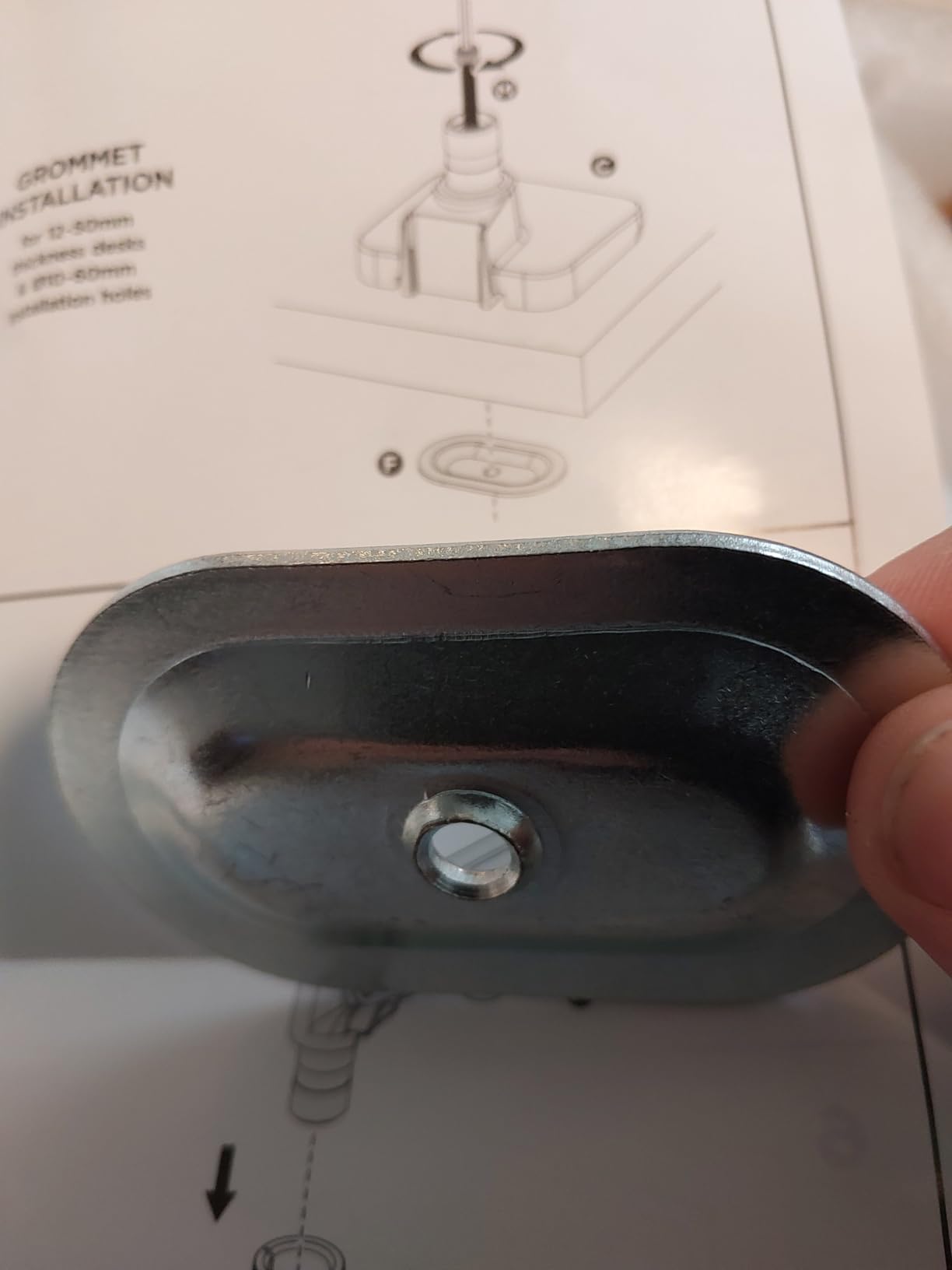
Best case for this arm
A 49 inch curved ultrawide that needs both weight support and a long reach. The gas spring handles the heaviest end of the 4.4 to 44 lb range without the stiffness a mechanical spring shows at that load.
The detachable VESA plate makes fitting a panel quick, and the built-in cable routing keeps a multi-cable gaming desk manageable.
Where it is limited
The clamp range of 0.5 to 1.8 inch is the narrowest here, which rules out thick desks. The grommet option reaches only 2 inch.
Tilt is asymmetric, so downward viewing angles are limited, and the 3 year warranty is short for a gas spring mechanism. Owners also report the highest one-star share of any arm in this roundup.
12. MSI MPG MT201R V2 – Best for RGB Gaming Setups
Pros
- Only mainstream gaming-brand arm here with integrated RGB
- Full 44 lb capacity in a gas spring design
- Quick release plate for fast monitor swaps
- Clamp handles desks up to 85 mm
- Gray finish suits a gaming desk better than all-black rivals
Cons
- Listing title claims 17-49 inch while the spec sheet lists 35 inch maximum
- Smallest review base in this roundup at 140
- 13.3 lb arm weight
- Only a 3 year warranty for premium positioning
This is the only arm in the roundup with integrated RGB lighting, which matters more than it sounds. On a build with lit internals, a light bar and a glass panel, an all-black arm reads as a dead spot in the middle of the desk.
Underneath the lighting it is a serious gas spring arm: 2 to 20 kg, which is 4.4 to 44 lb per screen, with gas spring height adjustment and a quick release plate for fast swaps.
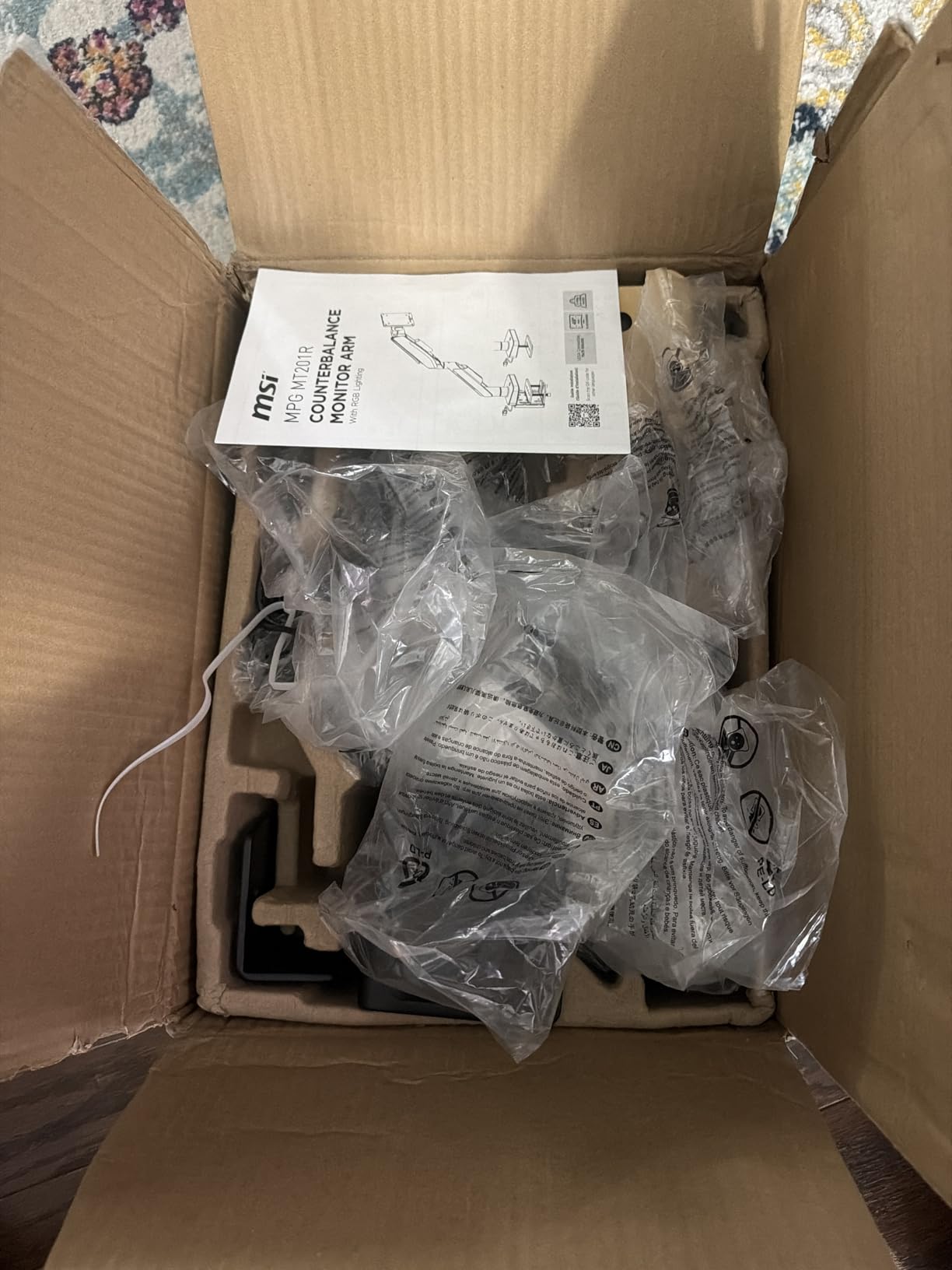
The C-clamp handles desktops from 10 to 85 mm, the thickest desk range of any arm here, and the grommet base covers 10 to 48 mm. Compatibility is VESA 75x75mm and 100x100mm, and it comes in gray or black.
The gray finish blends with mid-range cases and aluminium accents far better than the matte black used by most competitors.
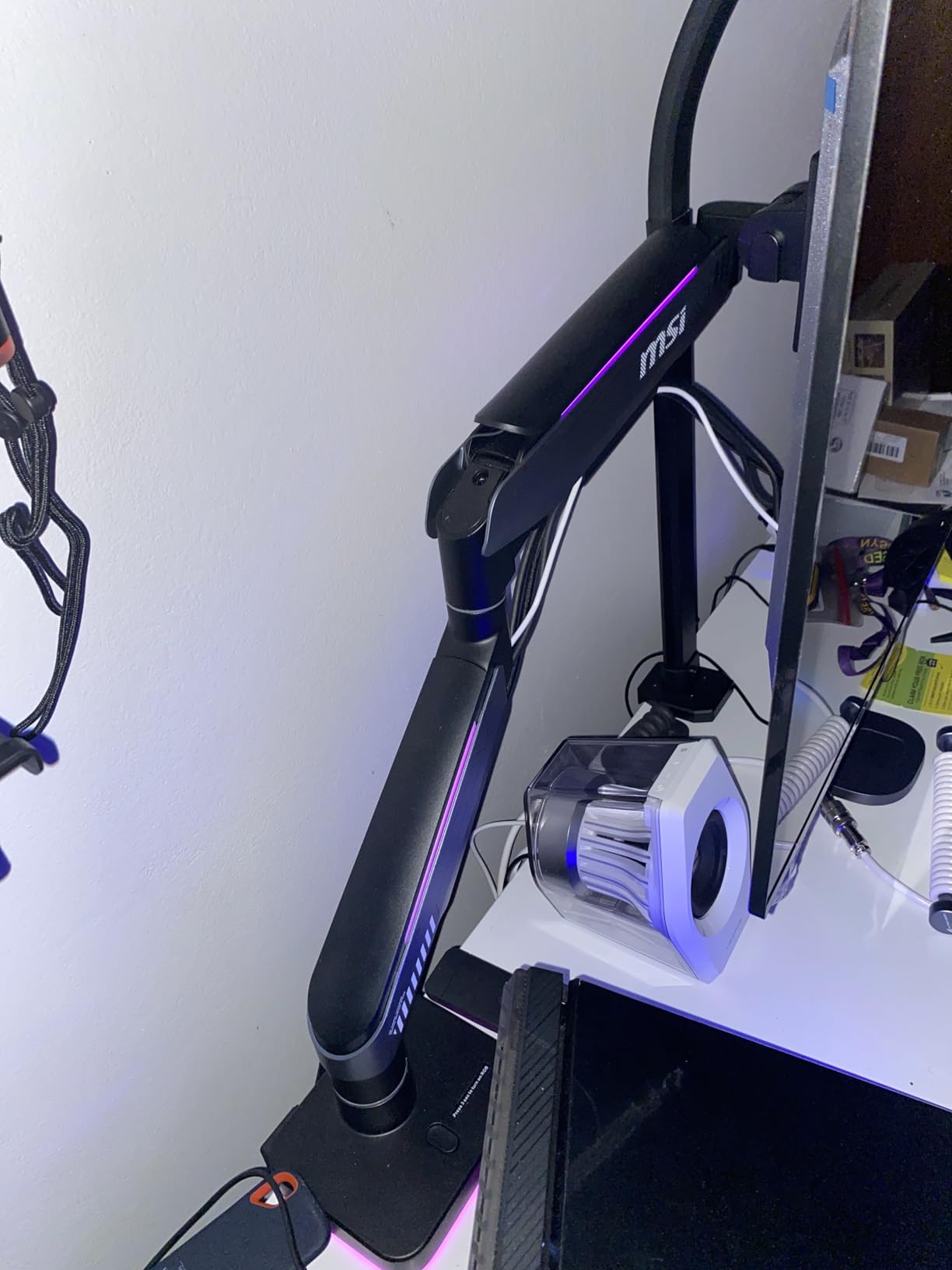
Reasons to pick it
Integrated lighting, a thick-desk clamp and full 44 lb capacity in one package is a combination nothing else here matches. If your desk has a thick top, most arms simply will not fit.
The quick release plate makes it practical for a build where panels change regularly.
Reasons to pause
There is a real specification conflict. The listing title claims 17 to 49 inch support while the spec sheet lists 35 inch maximum, so confirm the panel size with the seller before ordering.
The 140 review base is the smallest here, which means very little long-term data. The arm also weighs 13.3 lb and carries only a 3 year warranty.
How to Choose a Monitor Arm for Gaming
Most returns on monitor arms come down to four things: the weight was wrong, the desk was too thick, the panel had no VESA holes, or the arm was too short. Work through the checklist below before you order anything and you will avoid most of them.
1. Match the real monitor weight, not the screen size
Check the weight in the monitor manual or on the spec sheet, with the stand removed. Compare it against the arm’s stated range, and treat the maximum as a ceiling rather than a target.
Panels below the stated minimum are the sneaky failure. A gas spring tuned for a heavy monitor will push a light one upward, and it drifts until it hits the joint limit. The HUANUO TitanLift states a 6.6 lb floor, the HUANUO and ErGear singles state 4.4 lb, and the VIVO STAND-V001 and VIVO dual carry their own ranges. If your panel sits at the bottom of a range, a mechanical arm is the safer pick.
2. Confirm the VESA pattern before anything else
VESA compatibility is just the distance between the four mounting holes. Almost every gaming monitor uses 75x75mm or 100x100mm, and all 12 arms here cover both.
The exception is monitors with no holes at all, usually ultra-thin bezels with a custom mount. Those need a separate VESA adapter, and two of the arms in this roundup do not include one. Check the back of your panel first; it takes ten seconds and saves a return.
3. Pick a clamp or grommet mount based on your desk
A C-clamp grips the desk edge and needs no drilling. It is the right choice for most gaming desks and it is what I would default to.
A grommet mount bolts through an existing cable hole. It is stronger and sleeker, but the grommet options here mostly cap at 1.9 to 2 inch of desk thickness, well below what the clamp handles. Check both numbers, because a desk can be too thick for the grommet but fine for the clamp.
If your desk is glass or has a metal frame, neither works. That needs a wall mount or a reinforced clamp surface, and it is worth reading our editing setup arm guide for the desk type specifics before you commit.
4. Gas spring or mechanical arm
Gas spring arms use a sealed nitrogen cylinder to offset weight. They move one-handed, hold position at any angle and never need re-tightening, but they cost more and they fail rather than degrade.
Mechanical spring arms use a coil with a tension bolt. They are cheaper, simpler and outlast gas springs when the position is set once, but each adjustment needs a tool and they feel stiff at the ends of the range.
For a fixed single-monitor setup, mechanical is enough. For a dual-screen streaming rig or a standing desk, gas spring earns its place.
5. Check the desk material and thickness
Almost every arm here specifies a wooden desk with a clear underside and no crossbeam. Particleboard and hollow-core desks need a reinforcement plate under the clamp to spread the load, and skipping that is the most common cause of cracked desktops reported by owners.
Measure thickness in several places. A desk that reads 2.4 inch at the front may be thinner where the clamp sits, and thick front edges are common on modern gaming desks.
6. Warranty length is a real signal
Warranties in this category range from 3 to 10 years. WALI and the ErGear heavy duty arm carry 10 years, the HUANUO arms carry 5 years, and several VIVO and MSI models carry 3 years.
A longer warranty usually means a heavier core and better-tested spring hardware. It also means parts stay available longer if something loosens, which matters for a desk you keep for years.
Stacked versus side-by-side for dual setups
Side-by-side puts both panels at eye level but narrows each one, which hurts a wide field of view in an FPS game. Stacking puts the secondary above your sightline for chat or a wiki panel, but pushes your head further back and strains your neck looking up.
The practical compromise most streamers use is side-by-side with the secondary angled about 30 degrees inward. The VIVO dual and the HUANUO FlowLift Dual both give you the swivel range to do that, which is one reason I favour them for two-screen builds. For three or more displays, our triple monitor arm guide covers the spacing problems in more detail.
Monitor light bars and cable routing
Light bars clamp to the top of a monitor, and a monitor arm changes where that clamp has to sit. If your arm has a tall VESA plate or a quick-release plate that protrudes, check the bar’s vertical adjustment range before you buy both.
For cables, prioritise arms with routing built into the arm body over arms that rely on loose clips. The WALI heavy duty, the VIVO aluminium arm, the ARES WING and the ULTRARM all integrate channels; the ULTRARM’s are the shallowest of the group, so plan for fewer or thinner leads there.
Planning for a second screen later
If a second display is likely within a year, buy single arms rather than a cheap dual. Both VIVO singles are modular, so two or three of them build a dual or triple setup on the same standard without replacing hardware.
The ULTRARM pole is rated at 88 lb and expands the same way. Everything else in this roundup is a single-screen design, so adding a display means adding a second arm and a second clamp.
Frequently Asked Questions
Is a monitor arm really worth it for gaming?
Yes, mainly because of desk space and height control. A factory stand locks your screen at one height and occupies a wide base, which removes mouse mat space that matters at low sensitivity. An arm also lets you raise the top bezel to eye level, cutting the neck angle that causes headaches in long sessions. Most of the arms here install without drilling.
Do monitor arms work with curved monitors?
Yes, as long as weight and VESA pattern match. Curved panels are heavier than flat ones at the same size because of the glass, so check the real weight against the arm ceiling. Several arms here list curved support, including 1000R panels up to 49 inch. The WALI heavy duty, the HUANUO TitanLift, the ARES WING, the ULTRARM and the VIVO dual are the safest picks for a curved display.
What to do if the desk is too thick for the monitor arm?
Three options. First, use the grommet mount instead of the clamp if the bolt hole can take it, though grommet options here cap near 1.9 inch of thickness. Second, swap the clamp bolt for a longer one, which works up to about 4 inch on most arms. Third, mount to a wall or a reinforced board. Measure thickness at the exact clamp position first, since desk fronts are often thicker than the middle.
Can a monitor arm damage my desk?
It can, but only on weak surfaces. Particleboard, hollow-core and glass desks crack or chip under sustained clamp pressure, and reinforcement plates are the fix. Nearly every arm here specifies a wooden desk with a clear underside and no crossbeam. If you install on anything else, add a steel plate under the clamp and re-torque the bolts after a week of use.
Is it hard to upgrade from a single arm to a dual arm later?
It depends on what you bought. Modular singles like the VIVO STAND-V001 simply multiply, so buying two and three over time costs the same as buying a dual upfront. Fixed single arms need a second clamp and a second mount, which takes desk space and cable routing space. The ULTRARM pole is rated at 88 lb and expands to dual or triple configurations on the same base.
What are the best dual monitor arms for flat and curved screens?
For two 27 inch panels, the HUANUO FlowLift Dual is the strongest pick thanks to its two independent C-clamps and 4.4 to 19.8 lb per arm. The VIVO STAND-V002O is the toolless option, with a mechanical spring counterbalance and open-top VESA plates for quick fitting. Both cover VESA 75x75mm and 100x100mm, and both cap at 32 inch per arm.
How do I adjust monitor arm tension?
On gas spring arms, turn the tension screw on the underside of the arm or at the elbow until the panel holds position with a gentle push. On mechanical spring arms, the bolt sits at the joint and takes a few turns. The HUANUO TitanLift and the HUANUO gas spring arm tune one-handed with the included key. Always torque the clamp bolts firmly so the arm does not creep.
Is 3 monitors overkill for gaming?
Not for a streaming or MMO setup, where a main display plus chat, wiki and capture panels is genuinely useful. For competitive FPS it is usually pointless, since a single wide panel at eye level beats three smaller ones you have to turn your head between. If you do go to three, check that your arm supports the extra weight and read our triple monitor arm guide first.
Conclusion: Our Top Gaming Monitor Arm Picks
After working through 12 arms, the best monitor arms for gaming setups come down to three clear winners. For two screens, the HUANUO FlowLift Dual holds position better than anything else at this level thanks to its twin clamps. For one screen on a sensible budget, the VIVO STAND-V001 covers the widest size range and grows into a multi-monitor build over time. For one-handed height changes, the HUANUO single gas spring arm stays exactly where you put it.
If your panel is heavier than 20 lb, look past the dual arms and the light-screen budget options. The WALI heavy duty, the HUANUO TitanLift, the ARES WING and the ULTRARM all reach 44 lb, and the last of those handles 57 inch super ultrawides.
Check the weight, check the VESA pattern, check your desk thickness, and you will pick from this list with confidence. Whatever you choose, torque every clamp bolt properly in the first ten minutes, and the setup you build in 2026 will still feel solid years later.