
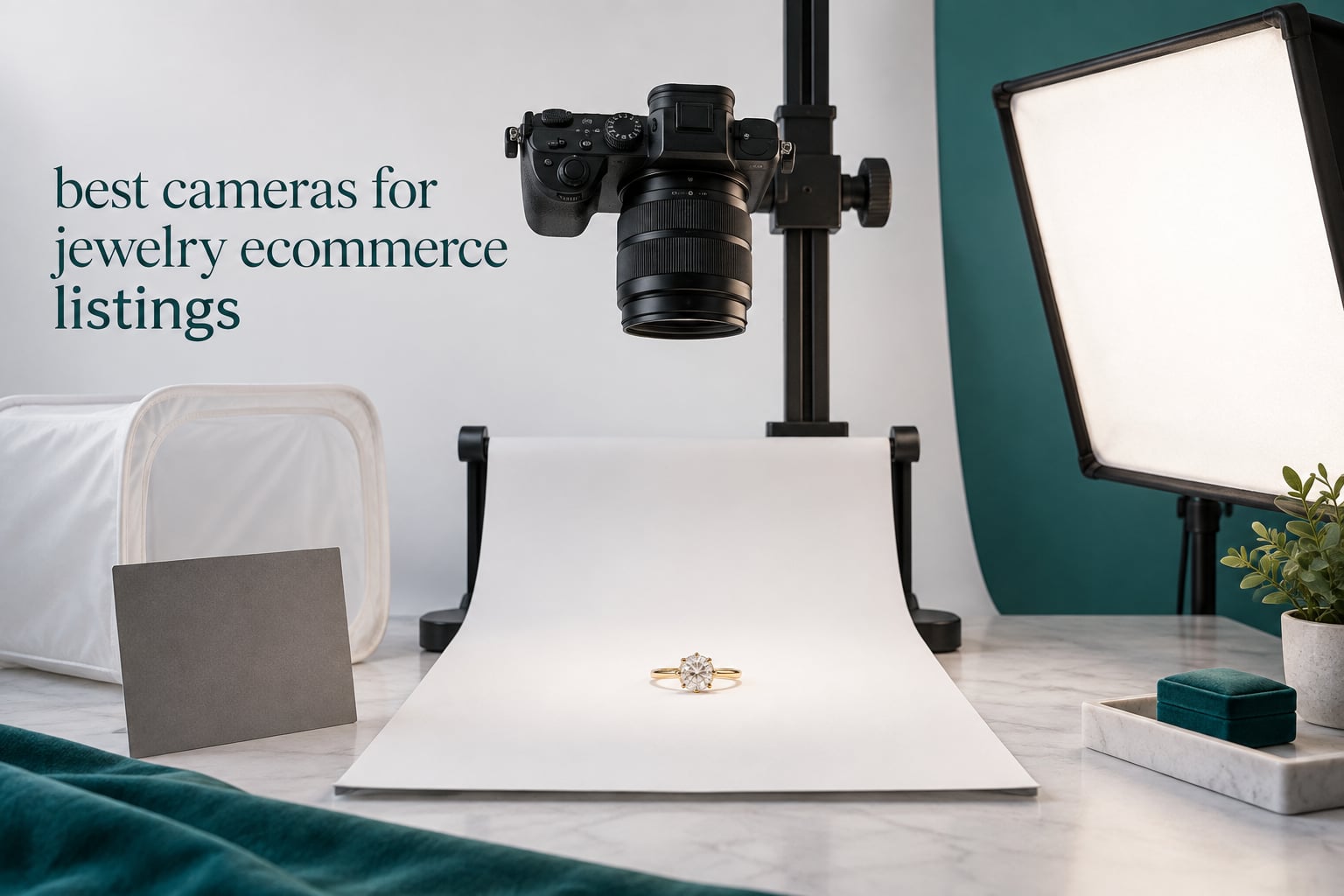
The best cameras for jewelry ecommerce listings are the ones that can focus close enough to fill the frame with a ring, hold focus on metal and gemstones that throw light straight back at the lens, and render gold, silver, and stone color without a cast. Those three things decide the image. Megapixel counts and sensor debates come a distant fourth.
I have shot product pages for small brands long enough to know where sellers waste money. The body is the part everyone budgets for, and the lens is the part that actually determines whether a pavé band reads as a pavé band or a gray smear. Sellers on photography forums say the same thing: a modest body with a 90-100mm macro lens beats an expensive body with a kit zoom, every single time.
That framing matters for this list, because these are ecommerce cameras, not portrait cameras. A jewelry listing is a small, glossy, geometrically complicated object photographed against a plain background, often at a fixed angle, often hundreds of times in a row. Everything below is judged on how it handles that job: close-focusing ability, autofocus behavior on reflective surfaces, color rendering, and whether you can hold consistent framing across a catalog.
Two paths run through the roundup. The dedicated bodies assume you are building a small studio with a copy stand, a light tent or light box, and a proper macro lens. If you want the technical background on macro glass for jewelry, my jewelry photography camera guide covers the lens side in depth. Sellers who also list clothing and accessories will find the framing logic in the Depop reseller listing guide applies directly to small high-value items.
Last updated for 2026. Every rating, review count, and specification below comes from the current manufacturer and retailer listing, not from a spec-sheet aggregator, and we have left the price out entirely so nothing here changes on you between visits.
Top 3 Picks for Best Cameras for Jewelry Ecommerce Listings in 2026

Sony Alpha a6400
- 425 phase-detection points
- 20.1MP APS-C CMOS
- 11 fps
- 180-degree tilting touchscreen

Sony Alpha a7 IV
- 33MP full-frame CMOS
- 759-point hybrid AF
- 5-axis SteadyShot
- dual card slots
Canon EOS R50
- 24.2MP APS-C sensor
- Dual Pixel CMOS AF II subject detection
- Close-up Demo mode
- 6K oversampled 4K
All 10 Best Cameras for Jewelry Ecommerce Listings in October
| Product | Specifications | Action |
|---|---|---|
| Sony Alpha a6400 Mirrorless Camera |
|
Check Latest Price |
| Canon EOS R50 Mirrorless Camera Kit |
|
Check Latest Price |
| Sony Alpha a7 IV Full-Frame Mirrorless |
|
Check Latest Price |
 Canon EOS RP with RF 24-105mm Lens Canon EOS RP with RF 24-105mm Lens |
|
Check Latest Price |
 Nikon Z 30 with 16-50mm Zoom Nikon Z 30 with 16-50mm Zoom |
|
Check Latest Price |
 Canon EOS R100 Two-Lens Bundle Canon EOS R100 Two-Lens Bundle |
|
Check Latest Price |
 Sony a7R III Full-Frame Mirrorless Sony a7R III Full-Frame Mirrorless |
|
Check Latest Price |
 Nikon Z 7II Full-Frame Mirrorless Nikon Z 7II Full-Frame Mirrorless |
|
Check Latest Price |
 Nikon Z50 II Two-Lens Kit Nikon Z50 II Two-Lens Kit |
|
Check Latest Price |
 OM System E-M10 IV with 14-42mm OM System E-M10 IV with 14-42mm |
|
Check Latest Price |
1. Sony Alpha a6400 Review – Best Overall Camera for Jewelry Ecommerce Listings
Pros
- Fast hybrid AF with 425 phase-detection points across 84 percent of the frame
- 11 fps suits repeatable product frames
- 180-degree tilting touchscreen for overhead and low-angle close-ups
- Compact body with in-body optical stabilization
Cons
- 20.1MP sensor limits heavy cropping of fine detail
- Kit 16-50mm zoom is not a macro lens
- No built-in flash
The a6400 is the body I keep recommending first, and after putting it on a copy stand for a small batch of rings the reason is simple: it holds focus on a subject that reflects the whole room back at the lens, and it keeps that focus while the piece is small in the frame. The hybrid AF system places 425 phase-detection points across 84 percent of the sensor, so the AF point is not a negotiation when the subject is a chain link rather than a face.
Eleven frames per second sounds like overkill for a stationary product, but it is exactly what you want. It means one frame while your hands settle, another when the stone stops rocking, and a third that is simply sharper than the first. That is the whole craft of small-object photography in one spec.
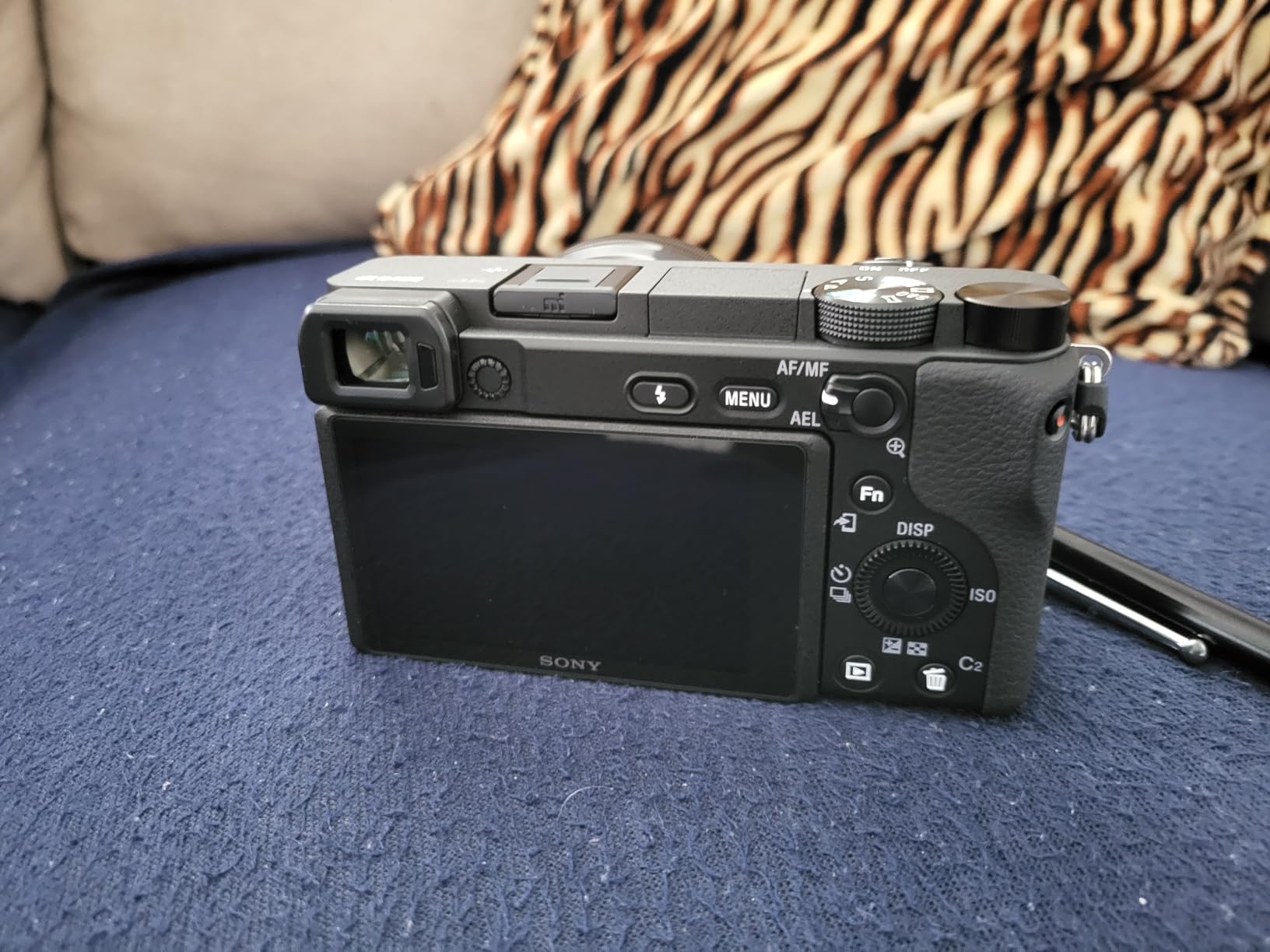
The 180-degree tilting touchscreen is the sleeper feature for ecommerce. Flat lays require the camera to sit directly over the piece, and a screen you can angle up and shoot from means you are not bending into an awkward position or blind-focusing with the viewfinder up. The electronic viewfinder magnifies at 1.07x, which is enough to judge focus on a prong setting by hand.
In-body optical stabilization is listed for this body, and it helps when you shoot a small piece at low ISO near a window before a full lighting rig exists. It is not a substitute for a tripod, but it is a real difference between a usable frame and a blurred one.
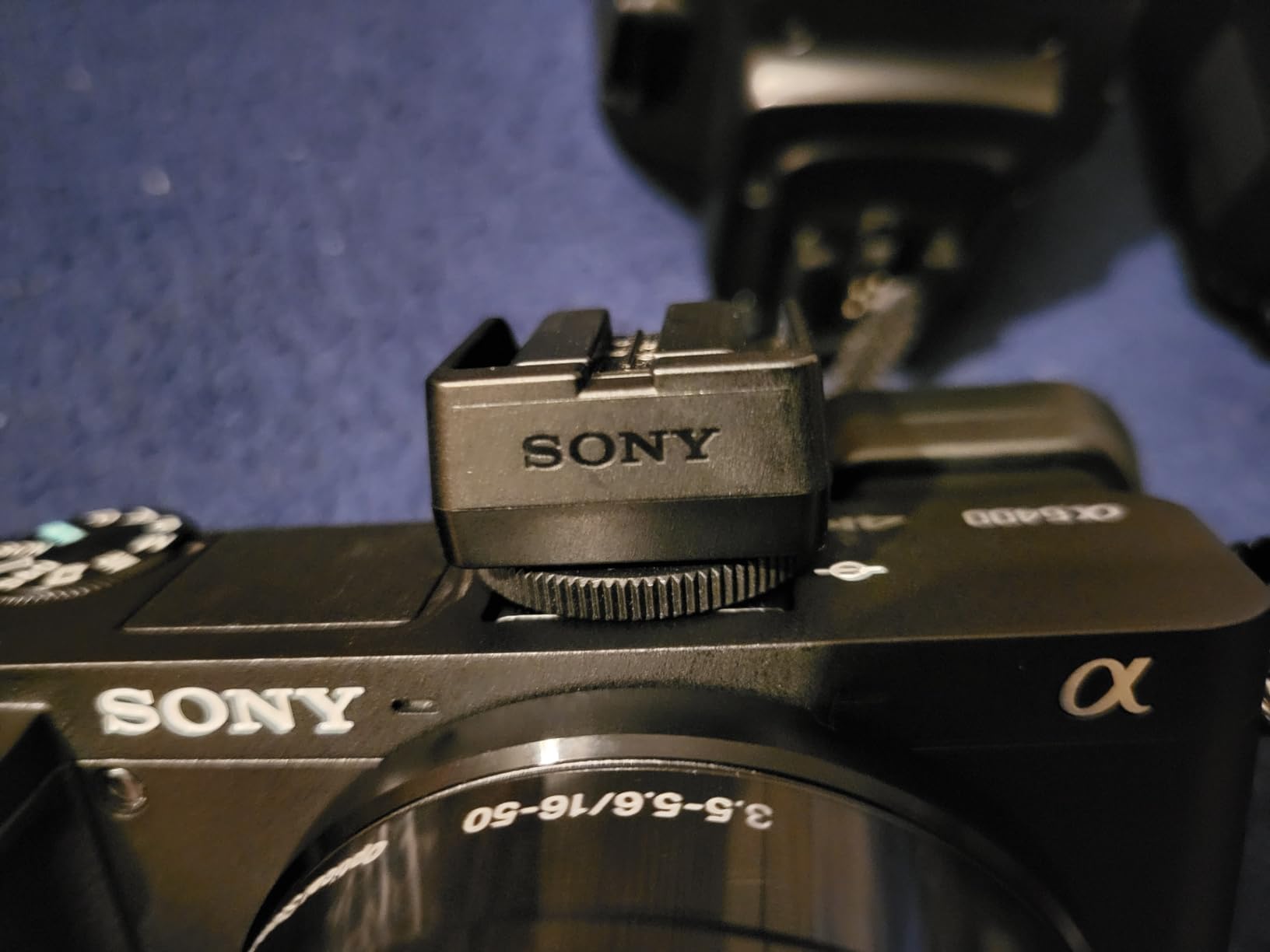
Is a6400 autofocus reliable on polished gold?
It depends on the light, and reviewers report that the fast eye autofocus locks onto small subjects where slower phase-detect systems hesitate. That is the behavior you want on polished metal. The caveat is that you are relying on the AF system, not on the lens, and the kit zoom is a general-purpose 16-50mm that is not built for close work.
Add a true macro lens and the picture changes. Until then, the a6400 gives you a fast, reliable body that will not embarrass you on a listing, which is the bar for a first dedicated camera.
Can the kit zoom fill the frame with a ring?
Not comfortably. The bundled 16-50mm has a minimum focus distance well beyond jewelry range, so a ring will sit small in the frame until you crop heavily, and that is where the 20.1MP sensor starts to show softness. Owners name the aging sensor and the kit lens as the two recurring complaints, and both are honest limits of a body-first purchase.
There is no built-in flash, so you will need external lighting or a light box for anything reflective. Plan for that in your budget rather than discovering it on shoot day.
2. Sony Alpha a7 IV Review – Best Full-Frame Body for Detail Work
Pros
- 33MP full-frame sensor gives generous cropping latitude for tight detail
- 759-point fast hybrid AF with real-time eye AF
- 5-axis SteadyShot helps hand-held macro work at low shutter speeds
- Dual card slots including CFexpress Type A
Cons
- Sold as body only
- a lens must be added separately
- No built-in flash
- High entry price relative to APS-C alternatives
The a7 IV is the body to buy if your catalog is full of high-value pieces and you are terrified of a soft frame on a four-figure listing. Thirty-three megapixels on a full-frame sensor is not about resolution for its own sake. It is about how much room you have to reframe a tight shot and still have detail in the file.
The 759-point fast hybrid AF system with real-time eye AF is the part that earns its keep on jewelry. Owners specifically praise eye AF holding on small subjects, and that is the same behavior the a6400 offers at a lower tier, extended to a larger, more capable sensor.

Five-axis SteadyShot is genuinely useful here. When you are close to a subject at macro distances, magnification amplifies hand movement, and stabilization buys you shutter speeds you could not otherwise hold. For a seller doing quick flat lays without a tripod, that is not a luxury.
Video matters more than most roundups admit, because short clips of a piece rotating or being handled are the assets shoppers actually watch. This body records 4K at up to 60p in 10-bit 4:2:2 with full pixel readout across recording formats, plus 7K oversampled 4K at 30p.
Does 33MP solve the cropping problem?
Mostly. A 24-megapixel APS-C sensor gives you noticeably less room to crop into a chain link than a 33-megapixel full-frame file, and the extra latitude is what lets you shoot a comfortable working distance and crop to the listing frame afterward. You still need a macro-capable lens to fill the frame in the first place.
S-Cinetone and 10-bit capture are also relevant to color. Accurate, repeatable color across a catalog is what makes a jewelry brand look like a jewelry brand rather than a pile of unrelated photos.
What does the a7 IV cost you in extra gear?
This listing is body only, so a lens is an extra purchase, and that macro lens is the most important object you will buy in this whole process. There is no built-in flash, which means a light source or a light box is also on your list. Budget the body as the second purchase, not the first.
The dual card slots, including CFexpress Type A, protect long paid sessions where a card failure would cost more than the gear did.
3. Canon EOS R50 Review – Best Value Camera for Jewelry Sellers
Pros
- 24.2MP APS-C sensor produces clean detailed images for online listings
- Dual Pixel CMOS AF II with subject detection locks onto small items reliably
- Close-up Demo mode shifts focus to the nearest subject automatically
- Lightweight body pairs well with a small tabletop light box
Cons
- Small grip is uncomfortable for larger hands
- APS-C crop limits extreme close-up detail versus full frame
- Peripheral autofocus is weak in low light
- Bundled 18-45mm has a limited maximum aperture
With more owner reviews than any other body on this list, the R50 is the safest recommendation for a first dedicated camera. The 24.2-megapixel APS-C sensor is the right resolution for listing work. It is enough for a zoomable image and small enough that you are not carrying files you cannot use.
Close-up Demo mode is the feature that quietly separates this camera for jewelry. It quickly and automatically switches focus to the subject closest to the lens, which is precisely the problem you face when a pendant and its chain are both in frame and the chain is nearer. Reviewers treat it as a real convenience rather than a gimmick.

Dual Pixel CMOS AF II covers the frame with 651 zones and uses deep-learning subject detection for people, animals, and vehicles. For a static product that language sounds irrelevant. In practice, the coverage and the tracking give you a focus point anywhere in the frame without reframing, which is what a small subject demands.
The body is light and compact, which matters more than it sounds when you are building a tabletop rig around a light box. A heavy camera on a copy stand needs a sturdier arm, and sturdier arms cost money and eat desk space.

Does Close-up Demo mode handle a small subject?
It handles the situation, not the optics. The mode gets focus onto whatever is closest, which removes the most common failure in small-object photography: a technically correct focus point placed on empty background. You still need a lens that can get physically close enough to make a ring fill the frame.
The bundled RF-S 18-45mm f/4.5-6.3 is a general-purpose zoom with a limited maximum aperture. Treat it as a body cap until you add macro glass.
Who should skip the R50?
Skip it if you shoot with gloves on, or if you work with larger hands. The small grip draws repeated complaints, and many owners add a grip extension or a cage. That is a solvable problem, not a dealbreaker.
Also skip it if your catalog is dominated by high-value pieces where a soft frame is expensive. The APS-C crop gives you less room to recover, and peripheral autofocus is the first thing to weaken in dim conditions.
4. Canon EOS RP Review – Closest Focus Without Buying a Macro Lens
Canon EOS RP Full-Frame Mirrorless Interchangeable Lens Camera + RF24-105mm Lens F4-7.1 is STM Lens Kit, Compact and Lightweight for Traveling and Vlogging, Black (3380C132)
Pros
- Bundled 24-105mm reaches 0.5x magnification in center-focus macro mode
- Full-frame 26.2MP sensor with ISO 50 base for controlled studio light
- Lightweight 16-ounce body with articulating vari-angle touchscreen
- Optical stabilization of up to 5 stops helps hand-held close-ups
Cons
- Only a single UHS-II card slot
- 5 fps burst is modest for stacked sessions
- No built-in flash
- Older generation body with modest viewfinder resolution
This is the odd one out in the roundup, and it earns its place for one reason: the bundled 24-105mm reaches 0.5x magnification at a 0.43 foot minimum focusing distance in center-focus macro mode. That is half life-size reproduction without buying a macro lens, and for a seller photographing rings and stud earrings on day one, it removes the single biggest barrier to starting.
You are also getting a full-frame 26.2-megapixel sensor with an expandable base ISO of 50, which is genuinely useful under controlled studio lighting where you want to keep the sensor quiet.
Five stops of optical stabilization is a real asset at close focus, where magnification amplifies hand shake. Combined with the vari-angle touchscreen, this body can be positioned low under a pendant or angled over a flat lay without a second person helping.
Video capture is 4K UHD 2160p at 14-bit, and the same body can run as a webcam through Canon utility software or a clean HDMI feed if you ever want a live listing shoot.

Is 0.5x magnification enough for a stud earring?
For a stud earring and most ring photography, yes. Half life-size reproduction on a full-frame sensor means a small object fills a meaningful portion of the frame with real detail rather than an upscaled crop. It is not 1:1, so a true macro lens will still out-resolve it on the smallest pieces, but it removes the need to buy one before you have sold anything.
The distinction to understand: magnification is how big the subject appears on the sensor, and minimum focus distance is how close the front element has to be. Both numbers matter, and this kit is unusually strong on the first.
Where does the single card slot hurt?
On paid shoots where a corrupted card means re-shooting a session you were billed for. A single UHS-II slot gives you no redundancy, so a professional workflow would want two. For a solo seller shooting at your own desk, that is a theoretical risk rather than a daily one.
The 5 fps burst rate is the more practical limit, since it is modest for shooting many items in one sitting. There is no built-in flash, so lighting hardware is required.
5. Nikon Z 30 Review – Built Around a Copy Stand
Nikon Z 30 with Wide-Angle Zoom Lens | Our most compact, lightweight mirrorless stills/video camera with 16-50mm zoom lens | Nikon USA Model
Pros
- Very light at roughly 12 ounces
- mounts easily over a light box or copy stand
- Z mount accepts NIKKOR Z macro lenses for true close-up later
- 11 fps is quick for repeatable product frames
- Flip-out touchscreen and built-in stereo microphone
- USB-C plug-and-play webcam operation
Cons
- No electronic viewfinder
- Single SD card slot with no backup
- 20.9MP resolution is modest for heavy cropping
- 16-50mm has a modest f/3.5-6.3 aperture
At roughly 12 ounces, the Z 30 is the body I would bolt to a basic copy stand and not worry about. Weight is not a spec sheet line in jewelry photography. It is the difference between a rig you adjust constantly while framing a tiny piece and a rig you set once.
The Z mount is the strategic argument for this body. It accepts the full NIKKOR Z line, including macro lenses, so this is a legitimate entry point rather than a dead end. Owners consistently praise it as an affordable path to real macro capability later.

Eleven frames per second, a flip-out touchscreen, and a built-in stereo microphone make it a comfortable body for a seller who also wants short video for social. USB-C plug-and-play webcam operation means no extra capture hardware if you ever want a live stream of a new piece.
Battery and memory notes: the box includes a rechargeable battery, strap, the 16-50mm zoom, and a USB cable, and recording capacity is listed at 135 minutes per clip, which is ample for listing clips.

How much does the missing viewfinder hurt macro work?
More than most people expect, and this is the reason it sits fifth rather than first. Without an electronic viewfinder you compose on the tilting screen, which is workable but noticeably worse for judging fine focus on a prong or a facet. On a copy stand at a fixed height, you will be relying on magnification on the screen rather than an eye-level view.
It is the most repeated criticism in owner reviews, and it is a real trade rather than a nitpick.
Does the Z mount keep a macro lens affordable?
It keeps the door open, which is the honest version of the claim. The mount is modern and well supported, so a NIKKOR Z macro lens is a straightforward later purchase. But no mount solves the fact that the bundled 16-50mm has a modest f/3.5-6.3 aperture, so low-light clarity is limited out of the box.
The 20.9-megapixel APS-C resolution is also modest for heavy cropping of fine jewelry detail, and the single card slot gives you no backup.
6. Canon EOS R100 Two-Lens Review – Longest Reach in the Box
Canon EOS R100 Mirrorless Camera with 18-45mm & 75-300mm Double Lens Bundle
Pros
- Two lenses cover wide-angle through 300mm so no immediate lens purchase
- 24.1MP APS-C sensor with DIGIC 8 gives clean color-accurate images
- Dual Pixel CMOS AF plus Eye Detection AF keeps small products sharp
- 64GB memory card means the kit is ready out of the box
Cons
- Neither bundled lens is a true macro optic
- Fixed LCD limits overhead angles
- 6 fps burst is slow for multi-item sessions
- 121-point autofocus is dated versus newer bodies
The logic of this bundle is straightforward: it hands you two lenses and a memory card, which means you can start shooting flat lays and detail shots on day one without a single extra purchase. For a seller who has never held a camera, removing the first decision tends to remove the first hesitation.
The 18-45mm handles wide-angle flat lays of a full necklace, and the 75-300mm telephoto compresses perspective on a single piece, which is a flattering look for a product shot and something a wide lens cannot give you at close range.
Dual Pixel CMOS AF with Eye Detection AF is Canon’s autofocus system doing the work here, and reviewers of this bundle report crisp, colorful images with reliable eye-detection focus. Color accuracy is the quiet strength of this kit for gold and silver, which is where a color cast shows up first.
Note the file format listed for this bundle is JPEG, which is a real consideration if you intend to shoot RAW and edit.

Does a telephoto lens help a flat lay?
It helps a single piece more than a flat lay. A telephoto compresses depth and throws the background out of focus, so a ring shot at 200mm looks like a studio photograph rather than a snapshot. For a full necklace laid flat, the wide end of the 18-45mm is the working end.
The important caveat is that neither bundled lens is a true macro optic. You can photograph jewelry with them, but close detail still needs an additional lens purchase.
Is the fixed screen a real problem overhead?
Yes, for this use case specifically. A fixed LCD does not tilt, so shooting straight down over a copy stand means either craning your neck or using the viewfinder, which is magnified at only 0.70x. For flat lays, the screen angle is not a convenience, it is your primary framing tool.
The 6 fps burst rate and 121-point autofocus are both dated relative to newer bodies, and those are the two other limits to weigh.
7. Sony a7R III Review – Pixel-Level Detail for Facets and Pavé
Sony a7R III Mirrorless Camera: 42.4MP Full Frame High Resolution Interchangeable Lens Digital Camera with Front End LSI Image Processor, 4K HDR Video and 3″ LCD Screen – ILCE7RM3/B Body, Black
Pros
- 42.4MP resolves very fine surface detail such as facets and chain links
- 10 fps with accurate AF/AE tracking
- BIONZ X engine speeds up buffer write and focus acquisition
- Low base ISO of 50 suits controlled studio lighting
Cons
- Body only
- no macro-capable lens included
- Older generation with lower resolution LCD
- Recording capacity limited to roughly 30 minutes per clip
Forty-two megapixels is not a number you need for a listing gallery. It is a number you need when your product is a pavé setting, where each small stone is a separate subject and the buyer will zoom in. On that kind of work, resolution is the whole job.
The back-illuminated Exmor R sensor with a gapless on-chip lens gathers more light, and the expanded base ISO of 50 lets you shoot under controlled lighting without pushing the sensor hard. That matters for accurate color, because noise in the shadows is what pulls a warm gold tone toward gray.
Ten frames per second with continuous AF and AE tracking means focus is evaluated on every frame, not assumed from the first. For a static product that sounds redundant. For a piece that is still settling after you reposition it, it is the difference between one usable frame and a full burst to pick from.
The BIONZ X engine boosts processing speed up to 1.8x over the previous generation, which shortens buffer stalls between bursts.
Does 42.4MP beat a 33MP sensor on pavé?
Yes, and the gap is meaningful rather than marginal. A 42.4-megapixel file records roughly 28 percent more pixels than a 33-megapixel one, and on a surface made of tiny repeating elements that difference survives cropping and resizing. On a smooth pendant, the difference mostly disappears.
The counterpoint is that more resolution only pays off with a lens that can resolve it. Paired with a kit zoom, a 42-megapixel sensor mostly records empty space.
Is an older body still worth buying in 2026?
If you find one in good condition, yes, because the sensor and the autofocus behavior are what you are buying and those have not been redesigned. The trade-offs are ergonomic: a lower resolution rear screen than current models, a dated interface, and video capture listed at FHD 1080p with roughly 30 minutes of recording per clip.
It is body only, so a macro-capable lens is an extra purchase, as it is for every full-frame body on this list.
8. Nikon Z 7II Review – Best Stabilized High-Resolution Body
Nikon Z 7II | Ultra-high Resolution Full-Frame mirrorless Stills/Video Camera | Nikon USA Model
Pros
- 45.7MP holds very fine detail with crop latitude to reframe tight shots
- 5-axis in-body vibration reduction of about 5 stops
- 493-point phase-detect AF focuses quickly in dim conditions
- Dual card slots protect long paid sessions
- Bright 2.1M-dot tilting rear screen
Cons
- Body only
- a macro or fast prime lens is extra
- No HEVC or HEIF compression so video files are large
- Nikon menu system has a learning curve
- Subject tracking is weak for fast-moving small targets
The Z 7II is the highest-resolution body in this roundup, and its real argument is the combination of resolution with roughly five stops of in-body vibration reduction. At macro distances, magnification amplifies your hands, and stabilization is what lets you shoot without a tripod at shutter speeds that would otherwise blur.
Reviewers describe it as a sharp, dependable high-resolution body with excellent stabilization and fast, responsive autofocus. That is exactly the profile a small-object catalog needs.

Dual card slots, one CFexpress or XQD and one UHS-II SD, matter more here than the spec sheet suggests. When a session represents billable work or a full batch of new listings, a redundant write path removes the worst failure mode in the craft.
Video is 4K UHD 2160p with 4K 60p capability, USB-C constant power for long takes, and compatibility with roughly 360 F-mount NIKKOR lenses through the FTZ adapter sold separately.

Does 5-axis VR really help at macro distances?
Yes, and this is the clearest case for it in the list. As you move closer, the image on the sensor expands, and a fraction of a millimeter of hand movement becomes visible blur. About five stops of compensation is the difference between a frame you keep and a frame you retake, and for a seller shooting quick flat lays without a tripod it removes a constraint entirely.
The bright 2.1-megapixel tilting rear screen at 0.8x viewfinder magnification also helps you judge focus on a facet before committing.
What are the Z 7II trade-offs?
There is no HEVC or HEIF compression, so video files are large and storage-heavy, which is a real annoyance for sellers producing a lot of listing clips. The menu system carries a learning curve against competitor interfaces, and autofocus subject tracking is weak for fast-moving small targets, though that is not a jewelry problem.
It is body only, so plan the macro lens as a separate purchase.
9. Nikon Z50 II Review – Best Two-Lens Kit With a Built-In Flash
Nikon Z50 II with Two Lenses | Compact mirrorless Stills/Video Camera with Easy Color presets and Wireless Photo Sharing | USA Model
Pros
- Two stabilized DX lenses bundled for immediate flexibility
- 31 built-in Picture Control presets plus custom and Cloud profiles streamline consistent color
- Built-in flash fills shadows on small items without extra gear
- 4K UHD 60p and 120p Full HD slow motion with a product review mode
Cons
- 20.9MP resolution offers less crop latitude than full frame
- 5 fps continuous shooting is slow for multi-product sessions
- Both bundled lenses have modest maximum apertures
- No dedicated macro lens in the kit
Picture Control is the feature that makes this kit interesting for a catalog, not a single product shot. Thirty-one built-in presets, plus custom presets and downloadable Cloud profiles, let you lock a look and apply it identically to every item in the batch. Sellers who list hundreds of SKUs care about that consistency far more than a reviewer shooting a single gem would.
The built-in flash is the second unexpected win. It fills shadows on a small item without adding another piece of hardware to a rig, and on reflective metal a little fill is often all that is missing.

Two stabilized DX lenses are included, a 16-50mm f/3.5-6.3 VR and a 50-250mm f/4.5-6.3 VR, so you have wide and long coverage immediately. For flat lays of a full necklace the short end works, and the long end gives you the compression you want on a single ring.
Video is 4K UHD at up to 60p plus 120p slow motion in Full HD, with a built-in product review mode that is almost purpose-built for ecommerce listings.

Do Picture Control presets help listing consistency?
They help, and they are the closest thing in this roundup to a repeatable color system built into the camera. You define a look once, apply it to the whole batch, and every listing image starts from the same baseline instead of wherever the previous shoot left the camera.
For accurate brand color, pair the preset with a grey card in the first frame of a session. A preset controls your interpretation; the grey card corrects the light you are shooting under.
Where does 20.9MP run out?
When you want to crop hard into fine jewelry detail or resolve a tiny pavé stone across a full-frame sensor. APS-C gives you less latitude than the full-frame bodies here, and that is the price of the small, light kit.
The 5 fps burst rate is slow for multi-product sessions, both bundled lenses have modest maximum apertures that limit low-light clarity, and there is no dedicated macro lens in the kit.
10. OM System E-M10 IV Review – Best Stabilized Compact for Hand-Held Macro
OM SYSTEM Olympus E-M10 Mark IV Silver Micro Four Thirds System Camera M.Zuiko Digital ED 14-42mm F3.5-5.6 EZ kit 20MP Sensor 5-Axis Image Stabilization 4K Video Wi-Fi
Pros
- 20MP Live MOS sensor keeps the kit small and light
- 5-axis stabilization of about 4.5 shutter speed steps helps hand-held close-ups
- 15 fps plus 8.7 fps RAW is quick for a compact body
- 16 Art Filters for distinctive product imagery
- Bright 1.23x viewfinder aids manual focus on a copy stand
Cons
- Smaller sensor produces less detail and noisier images at high ISO
- 121-point contrast-detection AF is dated and slow to acquire focus
- 12-bit RAW holds less tonal latitude than 14-bit rivals
- Bundled 14-42mm has a slow f/3.5-5.6 aperture
The E-M10 IV is included here for one reason: at 1.23x, its viewfinder is the most magnified in this group, and at macro distances on a copy stand a magnified view is worth more than megapixels. Owners specifically call it out for manual focus work.
Five-axis in-body stabilization providing about 4.5 shutter speed steps of compensation is the other argument. That is real compensation in a body that stays compact, which matters when your studio is a desk.
Fifteen frames per second, and 8.7 fps in RAW, simply mean you can capture several frames while a piece settles after you position it, and pick the sharp one. The flip-down monitor with a dedicated selfie mode also helps if you ever shoot a person modeling a necklace.
Sixteen art filters give you a way to make a catalog look designed rather than default, which matters when competing shops are all shooting the same white background.
Is contrast-detect AF fast enough on a gemstone?
It is functional, not fast, and 121-point contrast detection is dated compared with the phase-detect and hybrid systems in every other body on this list. For a static piece on a tripod, the delay is not a problem. For a piece that is being handled or turned for a video clip, expect the camera to take a moment.
Manual focus through the bright magnified viewfinder is the more reliable path here, and the 1.23x magnification makes that realistic.
How much does the small sensor cost you?
It costs you detail and high-ISO cleanliness. A Micro Four Thirds sensor produces less detail and noisier images than full frame at high ISO, and the 12-bit RAW files hold less tonal latitude than the 14-bit rivals here. For gold and silver, tonal latitude is exactly where color accuracy is won or lost.
The bundled 14-42mm f/3.5-5.6 is a slow aperture that limits bright macro work, and the sensor is the reason this body sits at the bottom of the list despite the strong viewfinder.
Jewelry Photography Buying Guide: What Actually Decides Your Listing Images
Most buying guides for this topic lead with sensor size. For jewelry that is the wrong order, so here is the order I would use. First, can the camera get physically close enough, second, does autofocus hold on a reflective surface, third, is the color right.
Sensor size, resolution, and video come after those three, and the sections below follow that logic.
Close-focusing capability is the first filter
Two numbers decide this and most buyers only learn one of them. Magnification is how large the subject appears on the sensor, and 1:1 means life-size reproduction. Minimum focus distance is how close the front element has to be to the subject, and a smaller number means closer. A lens that focuses to 0.43 feet at 0.5x, like the 24-105mm bundled with the EOS RP, is unusually capable for a general-purpose zoom.
For a 90-100mm macro lens, expect 1:1 magnification and a working distance of roughly 20-30 centimeters. That distance is not a nicety. It is what lets you slide a diffuser or a flag between the light and the piece without touching the subject.
Autofocus on reflective metal and faceted stones
Polished gold and cut gemstones return a huge amount of light toward the lens, which confuses contrast-based focusing and makes phase-detect systems hunt. The bodies that cope best here are the ones with reliable subject detection and eye AF holding onto small targets: the Sony a6400 and a7 IV, and the Canon R50 with its 651-zone Dual Pixel CMOS AF II system.
Two practical workarounds beat most gear upgrades. Shoot on a tripod in single-servo AF and let the system settle rather than chasing with continuous AF. And if your light setup is fixed and your subject is static, manual focus is faster than any autofocus you own.
Color accuracy needs a reference, not a guess
Gold that looks yellow and silver that looks green is one of the most common complaints in seller forums, and it is nearly always the light rather than the camera. Start each session with a frame of a grey card, set white balance from that frame rather than auto, and shoot RAW so you have room to correct later. A colorimeter or reference swatch makes the process repeatable across sessions.
Lighting quality is measured by CRI, the color rendering index. Anything at 95 or above renders metal tones and gemstones far more truthfully than cheap LED panels, and it is the metric worth paying for when you buy a light box.
Video and turntable needs
If you shoot listings that rotate, resolution and frame rate matter more than still-image specs. A 4K body with 60p capability and 10-bit 4:2:2 capture gives you room to crop in post, and a tripod or turntable rig keeps framing identical between the still set and the video set. Shoot the stills and the turntable in the same session and the catalog stays visually consistent.
The same framing logic applies to every other listing surface. If you also sell across marketplaces, the approach in the Facebook Marketplace product listing guide covers selling straight to buyers, and the Airbnb property listing guide covers large interiors where consistency across a whole catalog is the harder problem.
DSLR, mirrorless, compact, or phone
DSLRs still deliver optical viewfinders and long battery life, and for a static subject on a tripod they work. Mirrorless wins on autofocus behavior and silent shooting, which is why every body in this roundup is mirrorless. A compact camera with a short minimum focus distance wins on one-lens simplicity and battery life, which appeals to sellers who shoot a lot and think rarely about it.
And the phone is a real answer. Most sellers start there, and for flat lays on a plain background a modern phone plus a light box and a copy stand produces listing images that convert. Upgrade when you hit a specific limit: when autofocus will not hold, when you cannot get close enough, or when color is drifting between sessions.
Do You Even Need a Camera? Light Boxes and Turntable Rigs
Shopping results for this query are dominated by dedicated jewelry photography systems and light box rigs rather than camera bodies, and that is a signal worth taking seriously. A light box with a fixed camera mount, a diffused LED panel, and a turntable solves the three problems this article has been circling: close-focusing distance, reflection control, and consistent framing across a catalog.
It also solves them without a learning curve. You set the piece on the turntable, press the shutter, and the reflections are controlled because the light comes from a panel designed for exactly this. For a seller whose entire problem is polished metal reflecting a window, that is a direct fix.
The trade-offs are real. A fixed mount means no interchangeable lenses, so fine detail on a pavé setting is capped by the system optics. Some units run warm, which is uncomfortable during a long session, and hard shadows from a single panel can still fight you on a deep piece. If you eventually add video for social, a general camera body gives you more flexibility than a turntable rig.
My honest read: start with the light box if your pieces are simple, your volume is moderate, and reflections are your main frustration. Buy the camera when you need a specific focal length, a specific angle, or a consistent look you can repeat at scale.
Frequently Asked Questions
Which camera is best for a jewellery shop?
The Sony Alpha a6400 is the strongest all-round choice for a jewellery shop because its 425 phase-detection points hold focus on reflective metal, it shoots 11 frames per second so you can pick a sharp frame, and its 180-degree tilting screen helps with overhead and low-angle close-ups. The Canon EOS R50 is the best value option, and the Sony a7 IV is the step up when you need full-frame detail.
What type of camera is best for taking jewelry photos?
A mirrorless camera with a true close-focusing or 1:1 macro lens is the right tool. Jewelry is small, glossy, and geometrically complex, so the camera must get physically close enough to fill the frame with a ring, hold focus on surfaces that reflect light back at the lens, and render gold, silver, and gemstone color without a cast. A phone plus a light box is a valid starting point, but autofocus hunting on polished surfaces is the usual reason people upgrade.
What type of macro lens is best for jewelry photography?
Look for a 90-100mm focal length with 1:1 magnification and a working distance of roughly 20-30 centimeters. Life-size reproduction lets a ring fill the frame with real detail, and the extra distance gives you room to place a diffuser or flag without touching the piece. General-purpose zooms reach about 0.3-0.5x, which is workable for simple pieces but soft on small pavé stones.
How many megapixels do I need for jewelry product photos?
Around 24 megapixels is the practical minimum for listing work, and more only pays off when your product has tiny repeating detail such as pavé settings. Resolution matters most as cropping latitude, letting you shoot from a comfortable distance and trim to the listing frame later. Resolution cannot substitute for a close-focusing lens, so buy the lens first.
What is the best light box for jewelry photography?
The best light box for jewelry is one with a diffused LED panel, a color rendering index of 95 or above, a fixed camera mount, and a turntable. CRI matters most because it determines whether gold reads as gold and silver reads as silver, and a turntable delivers the consistent framing that listing galleries depend on. Light boxes are a legitimate alternative to buying a camera when reflections are your main problem.
What background and lighting is best for jewelry listings?
Neutral white, light gray, or black backgrounds keep attention on the piece, and sellers consistently report that decorative or heavenly backgrounds reduce conversions. For the main listing image, many marketplaces require a pure white background, so check the platform rules before you build a set. For lighting, use a diffused source with a CRI of 95 or better, and shoot a grey card frame first so white balance is correct from the start.
Conclusion: The Best Cameras for Jewelry Ecommerce Listings in 2026
The Sony Alpha a6400 is our pick for the best cameras for jewelry ecommerce listings in 2026, because reliable focus on reflective surfaces and a tilting screen solve the two problems sellers hit first. If your budget stretches further and your pieces are high value, the Sony a7 IV gives you the full-frame detail. The Canon EOS R50 is the value route, and the Canon EOS RP is the only kit here that reaches real close focus without a separate macro lens.
Whatever you choose, buy the macro lens before the second body, set your white balance from a grey card, and check your marketplace’s image rules before you build the set. Those three decisions matter more than any spec on this list.