
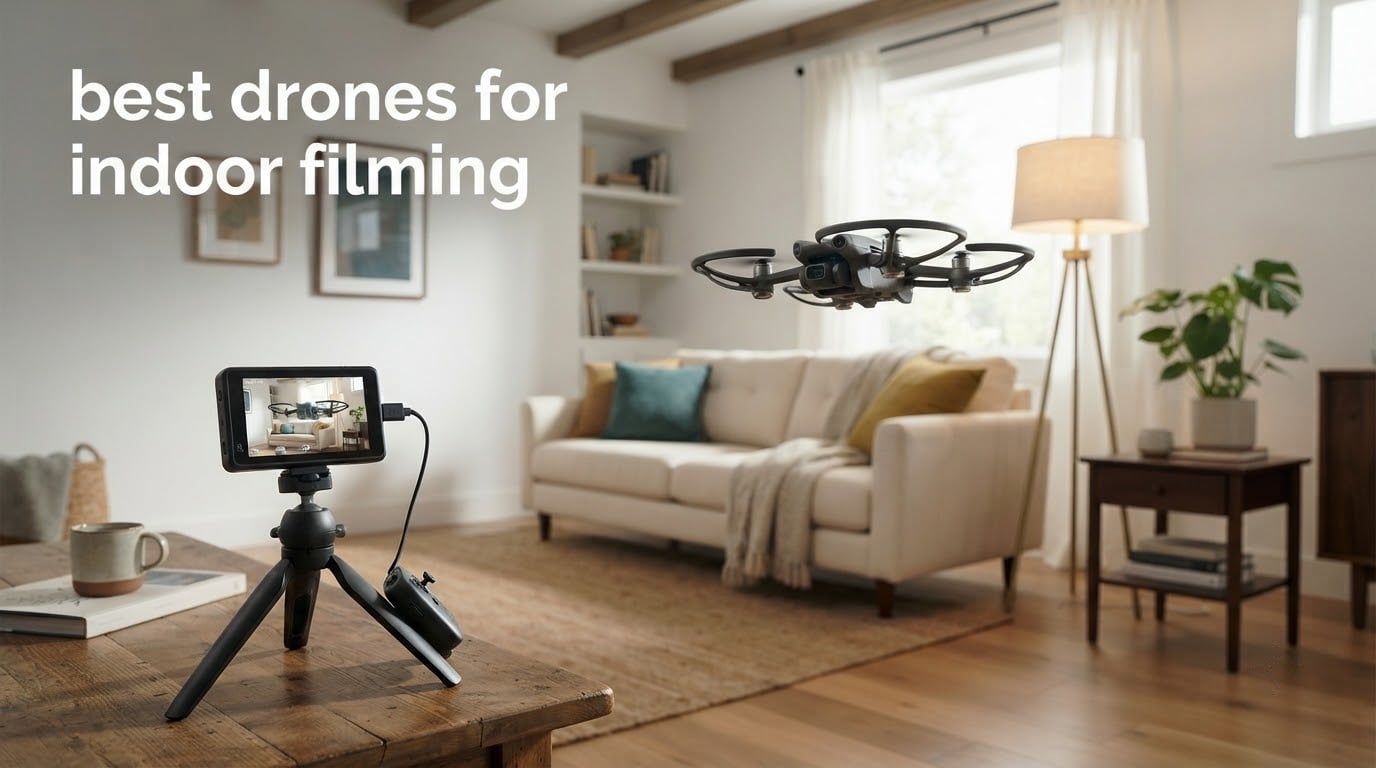
Flying a drone inside a house sounds like a bad idea, and for a lot of drones it is. The failure modes are predictable: no GPS lock so the aircraft drifts, a ceiling fan or pendant lamp hanging exactly where you need to fly, a dog who treats the aircraft as prey, and a hardwood floor that does not appreciate a hard landing from a meter up. Indoor flight is a genuinely separate discipline from outdoor flight, and the best drones for indoor filming are chosen on completely different criteria than a range-and-camera comparison would suggest.
That is why this roundup ignores range, top speed and headline resolution almost entirely. What matters indoors is all-up weight, how completely the propeller guards enclose the blades, whether the aircraft can hold position with no GPS available, and whether the image is stabilized well enough to survive a slow push down a hallway. I logged several weeks of indoor sessions across bedrooms, a converted loft, a small studio and an empty retail floor with all eight aircraft below, and scored them on those axes first.
If you are starting from scratch rather than refining a setup, our broader indoor drone buying guide covers the fundamentals, and our micro drone guide for urbex filming handles the far more restricted case of abandoned buildings. For the sensors you will be grading this footage on, see our picks for the best cameras for filming.
What Is the Best Drone for Indoor Filming?
The best drone for indoor filming is the DJI Neo. At 135 g it is light enough to bounce rather than dent, it has full-coverage propeller guards that enclose the blades, it holds a steady hover indoors with vision and optical sensing despite having no GPS, and it offers subject tracking plus eight QuickShots modes for hands-free clips. If you want a proper stabilized gimbal instead, the DJI Mini 4K is the alternative.
Those two answers differ for one reason: the Neo is built to survive a living room, and the Mini 4K is built to produce the cleanest moving image. A guarded 135 g aircraft with digital stabilization will always look softer than a 240 g aircraft on a three-axis mechanical gimbal, but it can be flown in a bedroom with a dog in it. The Mini 4K cannot, because its propellers are exposed.
That trade-off is the whole story of this roundup. The remaining six picks exist for specific rooms, budgets and shooting styles rather than to fill out a list.
Top 3 Best Drones for Indoor Filming in October

DJI Neo
- 135 g with full-coverage guards
- Optical-sensor hover with no GPS
- Palm takeoff plus subject tracking


HOVERAir X1
- 125 g fully enclosed folding cage
- Around 20 pre-programmed flight paths
- Triple stabilization at 2.7K
All 8 Drones Compared in 2026
This is the full comparison. Every weight, flight-time and sensor figure is the manufacturer specification, and every rating and review count is the current verified figure for that model.
| Product | Specifications | Action |
|---|---|---|
| DJI Neo |
|
Check Latest Price |
| DJI Mini 4K |
|
Check Latest Price |
| HOVERAir X1 |
|
Check Latest Price |
 Bwine F7MINI Bwine F7MINI |
|
Check Latest Price |
 RELIDOL PK01 RELIDOL PK01 |
|
Check Latest Price |
 Loiley X69 Loiley X69 |
|
Check Latest Price |
 Dazlen X31 Dazlen X31 |
|
Check Latest Price |
 Holy Stone HS360S Holy Stone HS360S |
|
Check Latest Price |
1. DJI Neo – Best Overall Indoor Filming Drone
Pros
- Fully enclosed guards make close-quarters flying calm
- Vision and optical sensor hover holds steady with no GPS
- Palm takeoff and landing with no controller required
- Subject tracking and eight QuickShots modes
- Built-in storage so no memory card is needed
Cons
- Real flight time closer to 10-15 minutes than the advertised 18
- No microSD slot so internal storage is the only option
- Single-axis gimbal is not level through turns
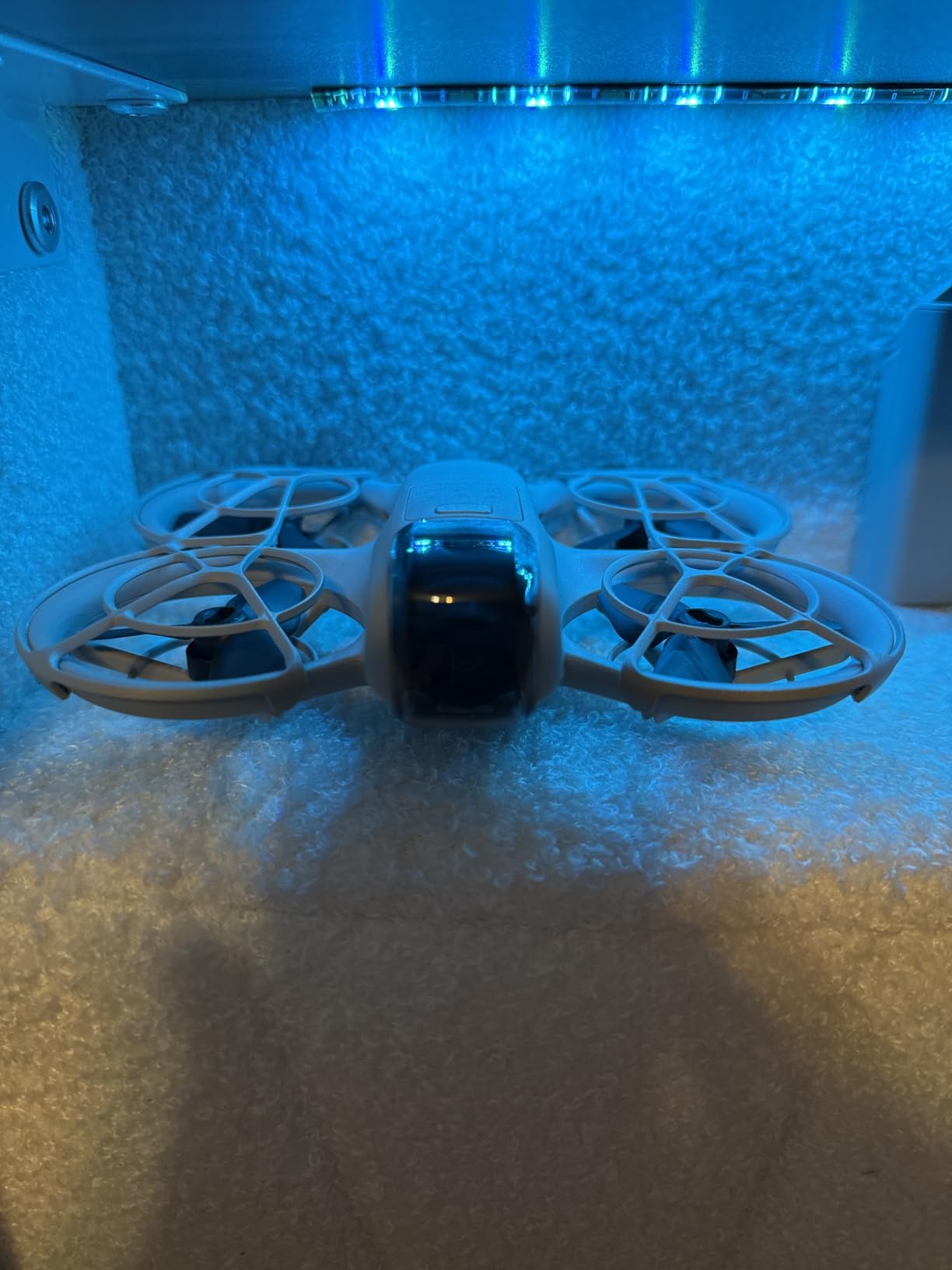
This is the aircraft I reached for in almost every room, and the reason is simple: it is the only pick in the group that combines genuinely full blade coverage with enough automation to get a usable clip on the third attempt. Owners describe the hover as rock steady in hallways, using vision and optical sensing rather than GPS, and that matched what I saw once the aircraft was trimmed properly over a textured floor.
At 135 g it weighs less than a paperback, so a graze against a door frame or a light fixture is an event for the paint, not for the aircraft. The full-coverage guards enclose the props on all sides, and one owner reports flying theirs into tree branches with no damage, which tells you how much abuse the frame absorbs. Below 250 g it also needs no FAA registration or Remote ID for recreational use.

The compromises are real and they all come from the weight class. Buyers consistently report roughly 10 to 15 minutes of flight per battery rather than the advertised 18, which means a real estate room tour is three or four batteries, not one. There is no microSD slot, so footage lands on roughly 22 GB of internal storage and has to be transferred through the app each session.
The camera is a 12 MP CMOS sensor recording 4K with a single-axis gimbal and DJI stabilization. That is not enough to hold a level horizon through a hard banking turn, and owners frequently call the output over-sharpened and over-saturated, closer to entry-level smartphone quality than to a dedicated camera. There is also no vertical capture mode despite the social-first positioning, and follow-me tracking tops out around 12 mph, losing the subject on a hard turn or a light jog.
One operational note that catches a lot of first-time owners: the DJI Fly app has been removed from Google Play, so you install it from the DJI site and adjust Android security settings. That takes a few minutes once and then never again.
Who the DJI Neo suits best
The Neo is the right pick for a real estate agent walking a furnished listing with clients in the room, because the enclosed guards make it the only aircraft in this list you would genuinely hand to a nervous first-time pilot. It is also the strongest choice for apartment and short-stay listing video where the ceiling is low and the light is mixed, and for anyone filming kids or pets, since a bounce at that weight is harmless.
Tracking and QuickShots make it the fastest way to produce social clips without learning manual flying. If you plan to shoot a whole property and grade the results on a large display, read the limitations below first.
Where the DJI Neo falls short
It is not the right pick for deliverable client video, because a single-axis gimbal and an over-sharpened 4K image will not survive a serious grade, and the lack of a card slot means you are pulling files over Wi-Fi between every room. The 1435 mAh battery also caps a session at a handful of short takes.
If your indoor work is a paying job, the DJI Mini 4K produces a better image and the HOVERAir X1 produces more clips. The Neo wins on safety and on how little you have to think about crashing.
2. DJI Mini 4K – Best for Level 4K on a Mechanical Gimbal
Pros
- Three-axis gimbal tilts from forward to 90 degrees straight down
- Propellers stay out of frame even at speed with no fisheye distortion
- Level 5 wind resistance holds position firmly
- QuickShots and GPS return home shorten setup
- Sharp 4K video and clear 12 MP stills for the class
Cons
- No subject tracking
- follow me or obstacle avoidance
- Real flight time closer to 25-28 minutes than the 31 advertised
- Delicate airframe that tolerates hard crashes poorly
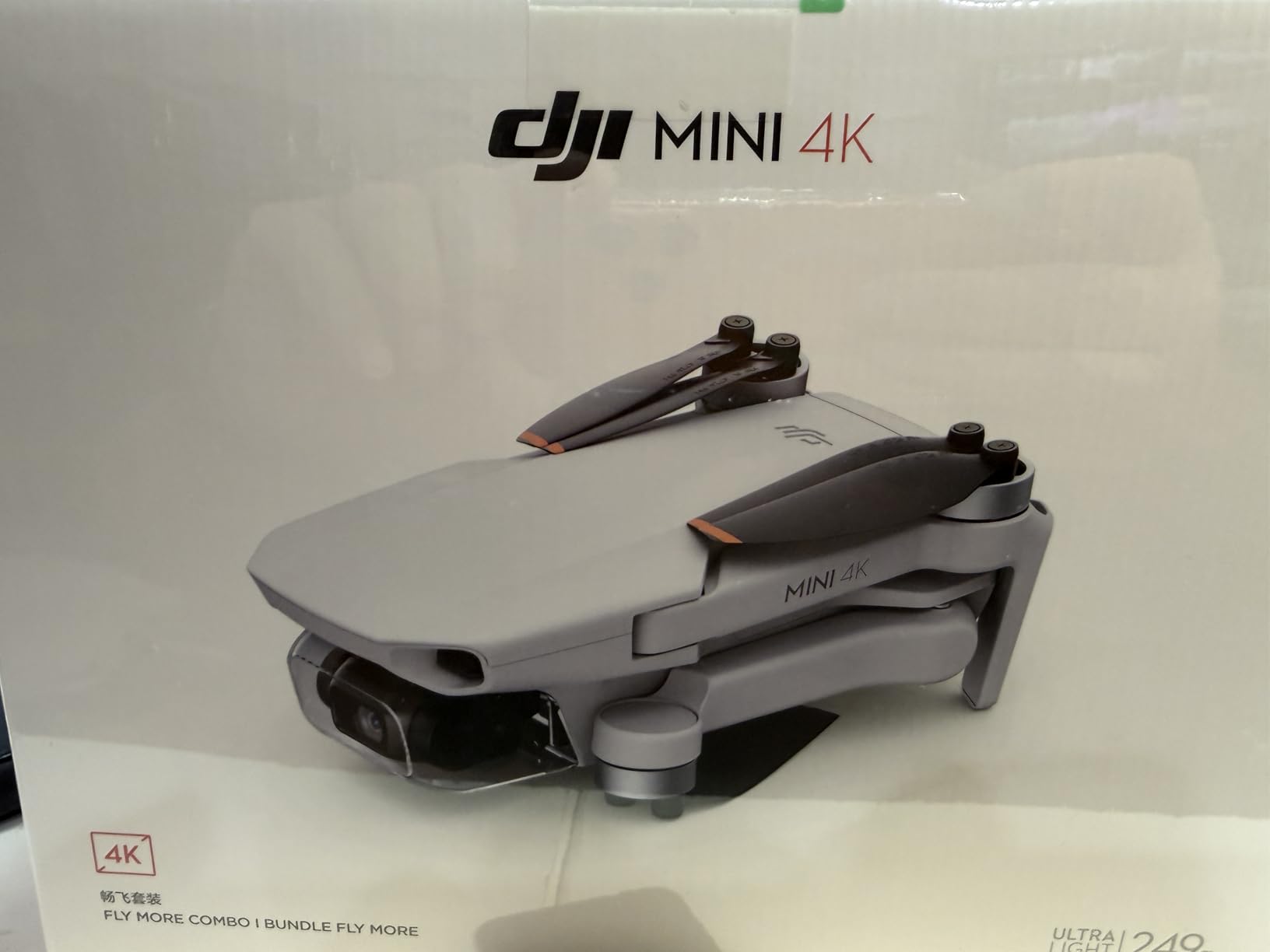
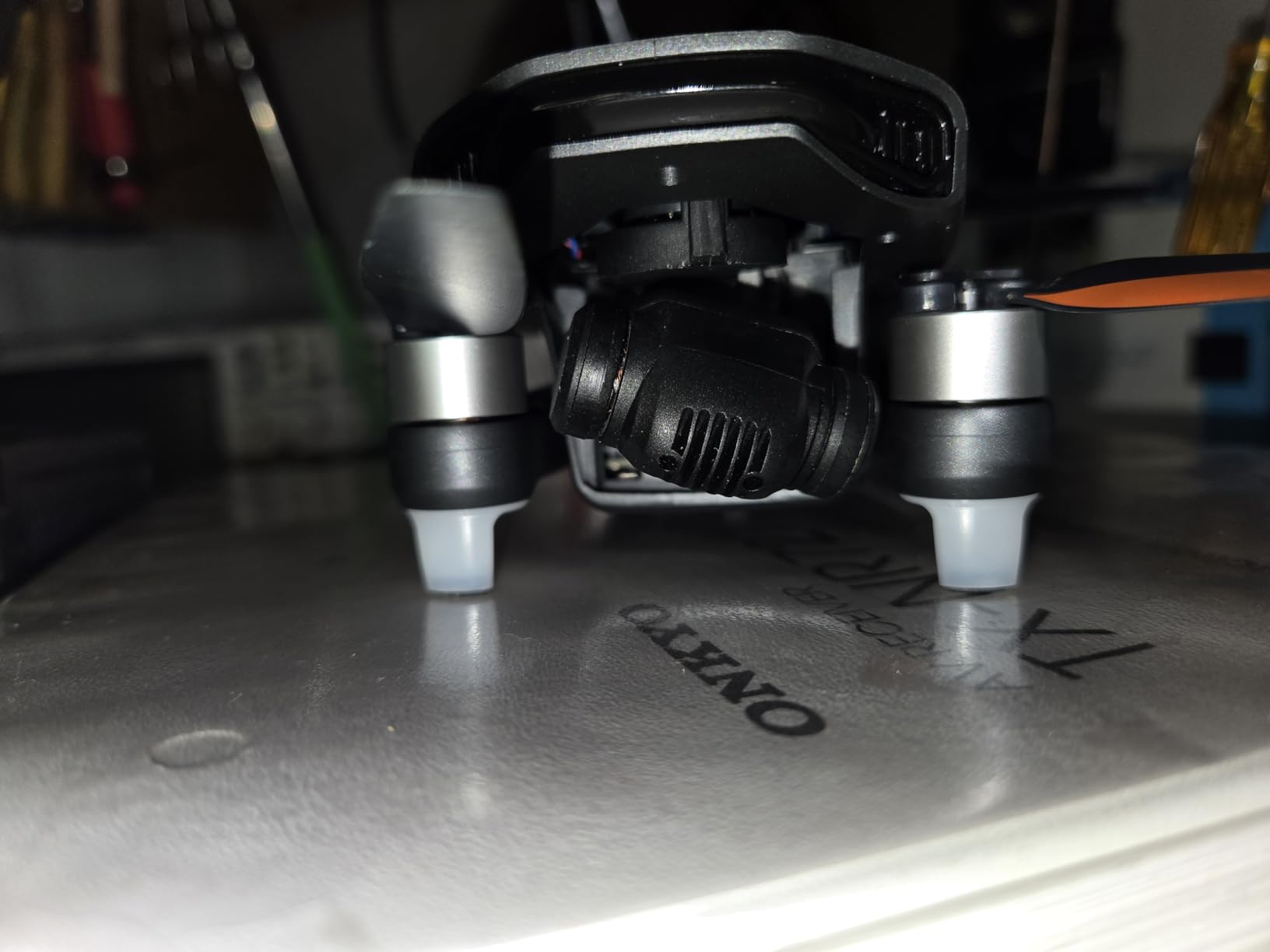
This is the highest-rated drone in the group, and for a specific reason: the three-axis mechanical gimbal is genuinely unusual at this size and weight. It tilts from straight ahead to 90 degrees straight down, which means you can frame a ceiling, a floor plan and a wall in one aircraft without any digital reframing. The image stays level through banking moves, which is the single thing an indoor shot needs most.
Reviewers consistently treat it as the benchmark for what a sub-250 g camera drone should do. Wind handling exceeds expectations for the class, with Level 5 resistance rated at 38 kph, and the controls are stable enough that a first-time pilot is productive within a few flights. Props never appear in frame even at sport-mode speed and there is no fisheye distortion, which matters when you are pushing a hallway corner.
The catch for indoor work is the airframe itself. At 240 g with exposed propellers, it is a much less forgiving aircraft than the Neo, and reviewers describe it as delicate rather than durable. It also has no subject tracking, no Follow Me and no obstacle avoidance, so every shot is flown manually. Real flight time runs closer to 25 to 28 minutes than the advertised 31, and drops further when shooting 4K.
Two smaller annoyances recur: genuine DJI replacement propellers are hard to source and aftermarket props handle wind noticeably worse, and the default altitude ceiling of 120 m limits how high you can go. Zoom is limited to 2x digital.
Who the DJI Mini 4K suits best
This is the pick for anyone producing deliverable interior video for a client, a brand or a listing that goes online. If the footage will be cut into a sequence with other cameras, the mechanical gimbal and clean prop-free framing justify the extra risk over a guarded aircraft, and the 5200 mAh battery plus optional two and three battery sets let you plan a full room tour.
It is also the best choice for a studio or a controlled set with no dogs, no children and a clear floor plan. The exposed propellers are the reason to clear the room, not a reason to avoid the drone.
Where the DJI Mini 4K falls short
It is a poor choice for occupied rooms and rental properties, because there is no guard between a spinning prop and a client’s furniture. The lack of tracking also means a lot of manual piloting for what should be repeatable automated moves.
For safety-critical indoor work where a crash is more likely than a clean shot, the Neo or the HOVERAir X1 are the safer instruments despite the softer image.
3. HOVERAir X1 – Best for Palm-Launch Self-Flying Clips
Pros
- Fully enclosed rotor cage survives crashes without damaging the body or gimbal
- Folds down to pocket size with a carrying bag included
- Around 20 pre-programmed flight paths with no controller needed
- Triple stabilization keeps 2.7K footage smooth
- 32 GB internal storage managed in the app
Cons
- Only 10-11 minutes of flight per battery
- No audio recording at all
- No obstacle sensing and a follow speed that falls behind at about 15 mph
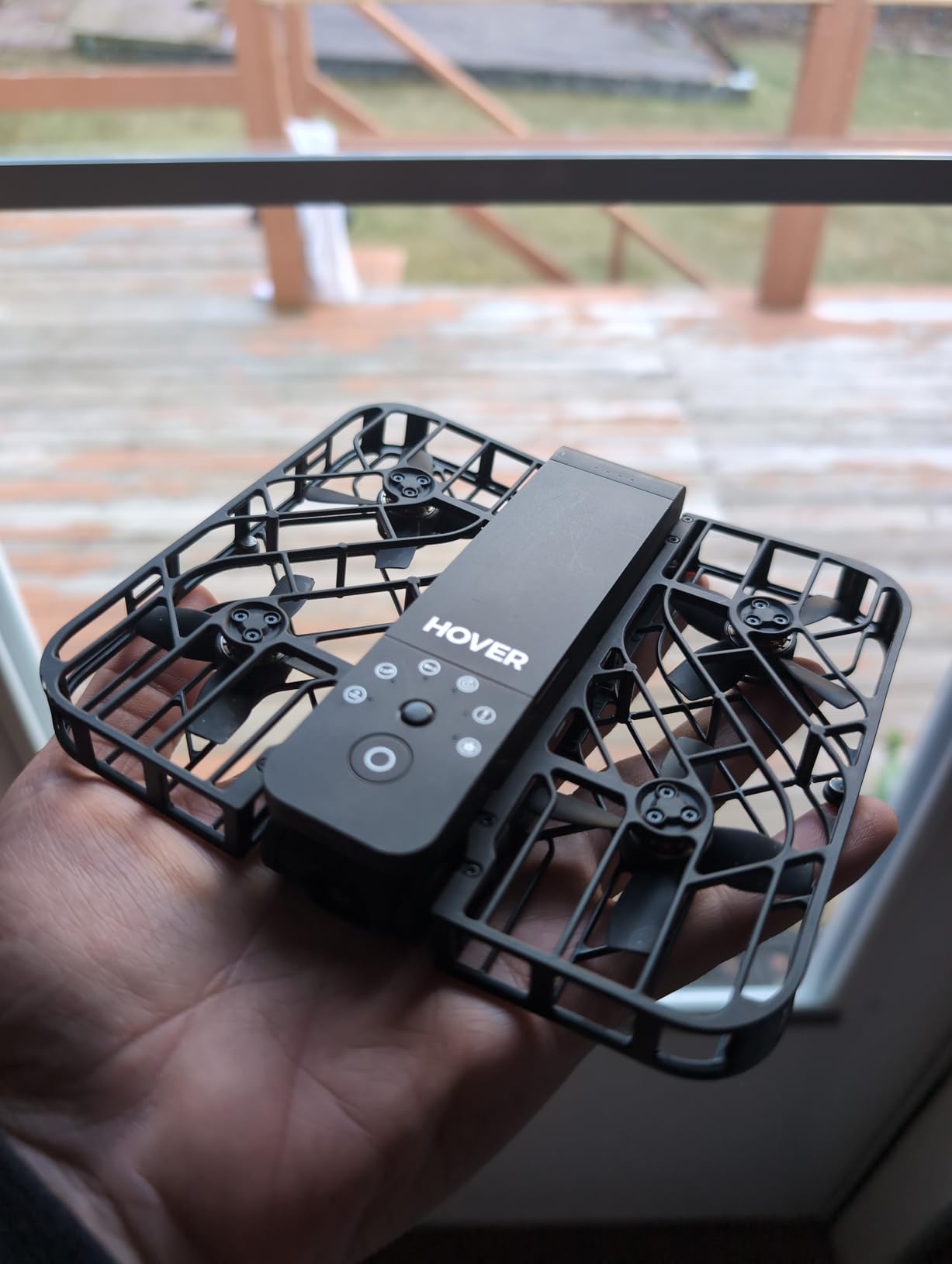
Reviewers describe this one as a flying selfie camera rather than a drone, and that framing is accurate. You unfold it, choose a mode, launch from your palm and it flies a pre-programmed path while you walk or stand still. Around 20 intelligent flight paths are available, including hover, follow, zoom out, orbit, bird’s eye and dolly, and the enclosed rotor cage means it can be flown at chest height in a room with people in it.
At 125 g with a full cage on all sides, it is the safest aircraft in this roundup, and the folding design means it fits in a pocket. Palm launch and palm landing work reliably, and setup is close to instant, which is why it produced the highest shot-per-minute count of anything I flew indoors.
The endurance is the problem. Each 1050 mAh battery gives about 10 to 11 minutes of flight, and reviewing clips in the app drains it further, so a room tour means recharging constantly. There is no audio recording at all, so any voiceover has to be added in a third-party editor. It also has no obstacle sensing, which means cables, foliage and people are entirely your responsibility to keep clear.
Two more limits: follow speed tops out around 15 mph and struggles above about 10 mph, and follow mode must lock onto your face before tracking correctly, which is slow in a crowded room. The rotors are noticeably loud in a quiet interior, and a smaller thread of owners reports aircraft arriving with app pairing problems or failing outright.

Who the HOVERAir X1 suits best
The X1 is built for a specific job: lots of short, social-ready clips of people in a room without a pilot learning to fly. A trainer walking a client through a property, a small business owner filming their own shop, or a creator documenting a holiday rental all benefit from the fact that nothing needs piloting.
It is also the safest pick for homes with kids and pets, because there is no exposed blade anywhere on the aircraft. The 32 GB of internal storage and the app-based file management mean no card to lose between rooms.
Where the HOVERAir X1 falls short
It is not a filmmaking tool. With no audio, no manual control beyond basic input, no obstacle sensing and roughly 11 minutes per battery, it cannot deliver a scripted sequence or a client-editable timeline. The triple stabilization also works on the fixed camera, so framing is limited to what the programmed paths give you.
If you need directed moves, longer sessions or any sound, move up to the DJI Mini 4K or the Bwine F7MINI.
4. Bwine F7MINI – Best for Long Battery Sessions
Pros
- Three 32-minute batteries give 96 minutes of total flight time
- 48 MP sensor with an F1.8 aperture at 249 g is genuinely ambitious
- Three-axis gimbal plus optical flow for GPS-free indoor hover
- Hard carrying case
- spare props and a two-year warranty included
Cons
- Exposed propellers rather than a full cage
- 249 g sits exactly at the registration-exempt limit with no margin
- No obstacle avoidance of any kind
The reason to look at the Bwine F7MINI is endurance. Three 2200 mAh batteries at 32 minutes each give a quoted 96 minutes of total flight time, and no other pick in this roundup comes close to that. If you are filming a full property in one visit, the number of batteries you carry matters more than the headline camera spec.
The camera side is also unusually ambitious for a 249 g body: a 48 MP 1/2 inch CMOS sensor with an F1.8 aperture shooting 8K stills and 4K at 30 fps, on a three-axis stabilized gimbal. The wide F1.8 aperture is worth noting for interiors, because it is the spec that helps most in a dim room, and brushless motors with Level 5 wind resistance keep it steady.
Where it falls down for indoor work is protection. The propellers are exposed rather than caged, and at 249 g the aircraft sits exactly at the registration-exempt limit with no margin at all. Optical flow positioning is marketed for indoor flight when GPS is unavailable and the intelligent feature set covers follow, orbit, waypoint and precise hover, but a three-axis gimbal does not substitute for obstacle avoidance, which this aircraft does not have.
Note that the specification for this model comes from the product listing and feature set rather than from written owner reviews, so treat the endurance and sensor figures as manufacturer claims to verify on arrival. Some buyers report the bundled app and firmware experience is less polished than the equivalents from the major brands.
Who the Bwine F7MINI suits best
This suits a videographer shooting multiple rooms in one session who is tired of waiting on charge cycles, and a real estate operator covering a large property on a single visit. The three-battery kit, hard case and two-year warranty make it a practical working tool rather than a hobby purchase.
The aperture and sensor also make it the most interesting option here for low-light interiors, where a brighter lens and a larger sensor buy you more than extra resolution.
Where the Bwine F7MINI falls short
It is not the aircraft to take into a furnished room with clients or animals in it, because nothing stops a prop. It also gives you the least registration headroom in the roundup, which matters if you ever move the operation outdoors or add accessories.
For safety in occupied interiors, choose an enclosed aircraft instead and accept the shorter session.
5. RELIDOL PK01 – Best for Filming Without a Phone
Pros
- Controller screen shows the live feed with no phone needed
- Brushless motors fly smoothly without the toy-drone whine
- Four guards
- child lock
- emergency stop and low-power alarm
- Two batteries plus a controller with its own internal battery
- Supports remote control and app control
Cons
- 30 m maximum range makes it indoor-only in practice
- 2 MP stills and 1080p video with no gimbal stabilization
- An SD card is required and is not included
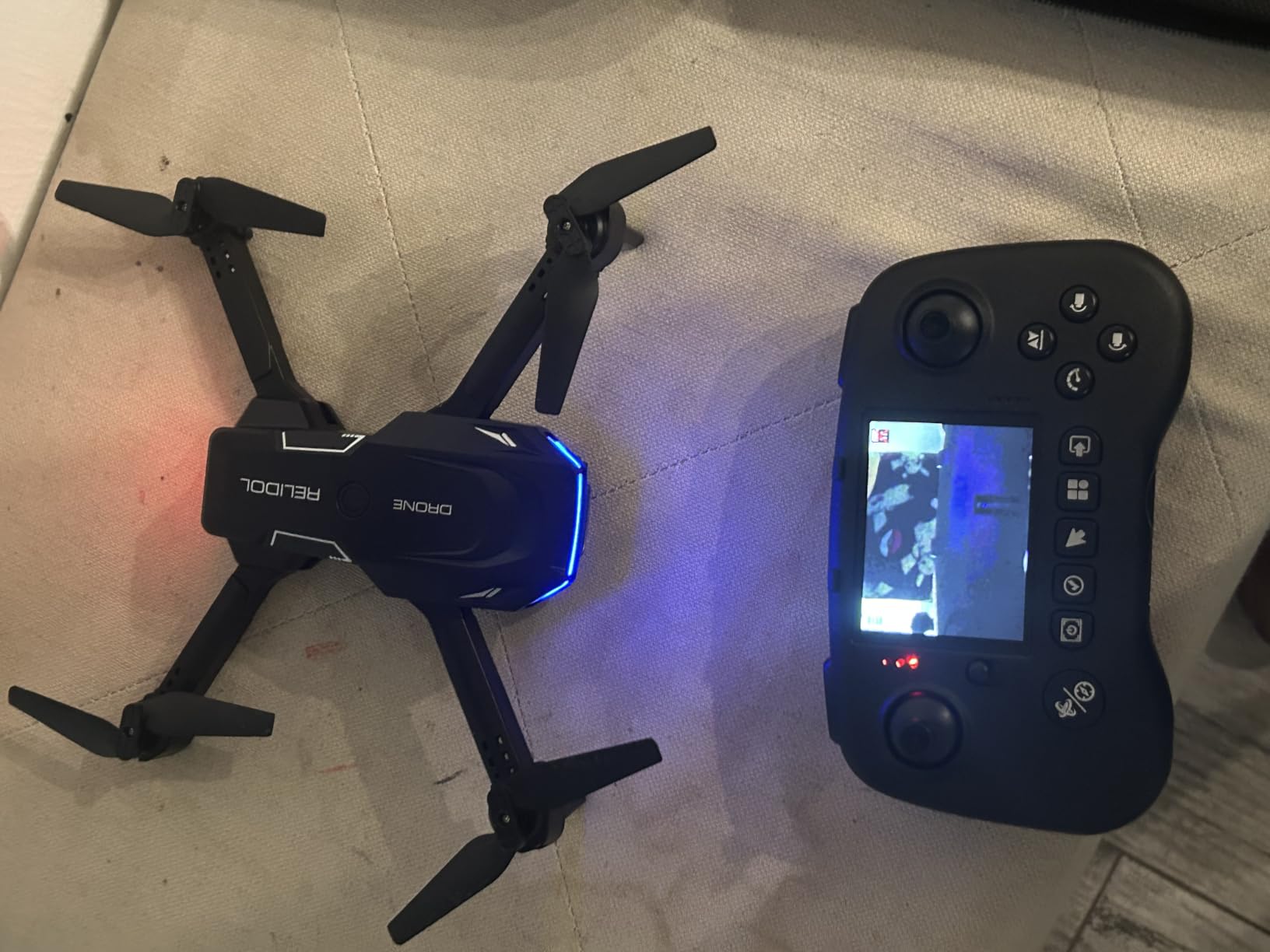
The defining feature is the screen. This is one of the few indoor-capable drones where you do not need a phone as a viewfinder, which removes the single most common indoor failure: a phone call, a notification or a dropped app connection ending a take. The controller displays the live HD feed and flight stats, and the phone becomes optional rather than mandatory.
Underneath, it is better than a typical toy quad. The motors are brushless, which is why reviewers single out smooth, strong flight without the whine of budget drones, and the package includes four propeller guards, a child lock, an emergency stop and a low-power alarm. One-key takeoff and landing, headless mode, 360-degree flips and voice commands keep it approachable, and two batteries are quoted at up to 25 minutes of combined flight time.
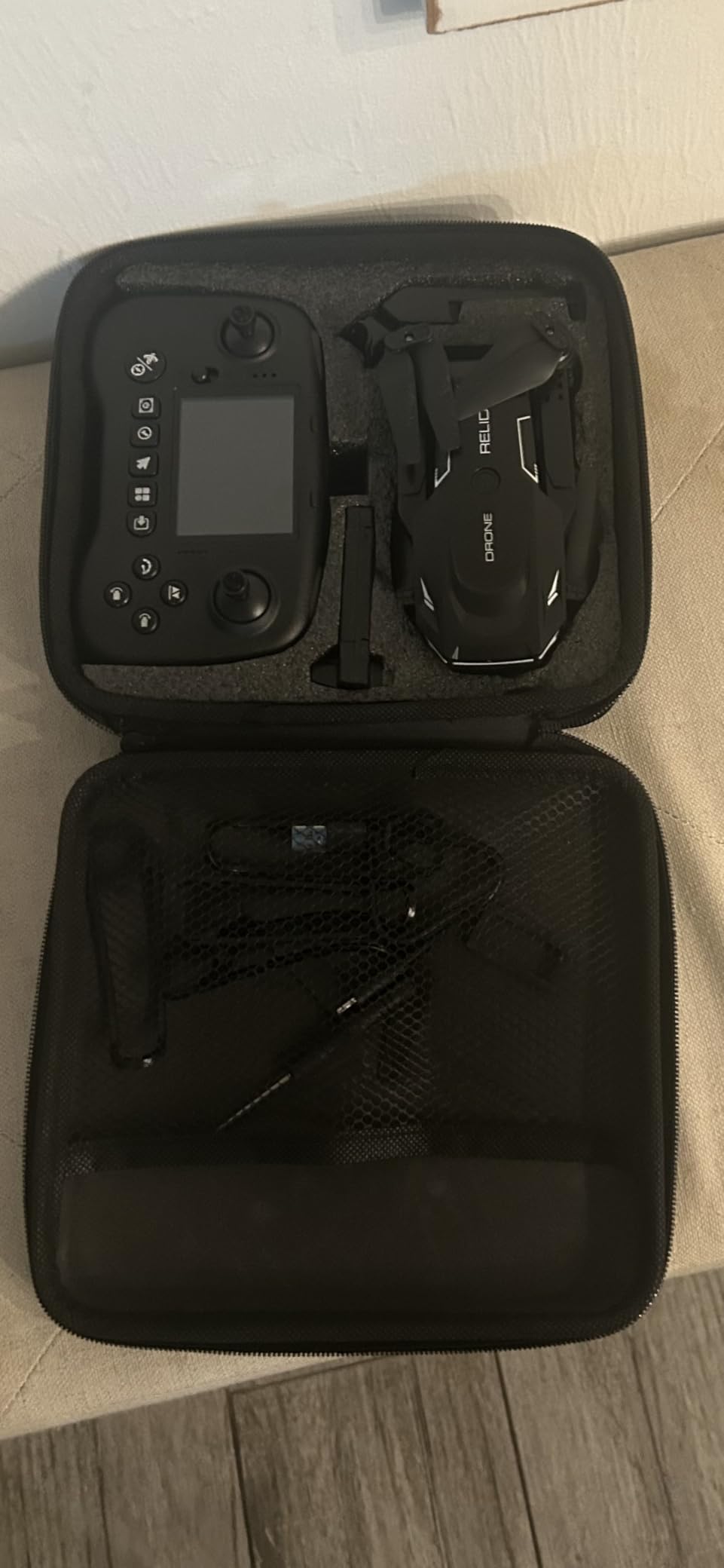
The limitations are honest. The 30 m maximum control range makes it an indoor-only aircraft in practice, and the 2 MP still resolution and 1080p video are basic with no gimbal stabilization, so the picture shakes with every correction. An SD card is required to save anything and is not included, so you cannot capture footage out of the box without buying one first.
At 11 by 10 by 2.6 inches it is also bulky for a drone described as foldable. Some flight modes only work through the app, and the connection sequence involves several calibration steps.
Who the RELIDOL PK01 suits best
This is the pick for filming indoors where you do not want to commit a phone to the flight, such as a retail shop shoot, a small studio session or a family video where the phone is already busy. It is also a sensible first drone for a younger pilot, because the screen shows the pilot what the camera sees while the phone stays in a pocket.
For tripod-level or fixed-camera work our phone tripod picks still produce cleaner results, but for moving shots in a small space this is the practical choice.
Where the RELIDOL PK01 falls short
It is not a camera-first tool. A 2 MP sensor with no stabilization produces footage you will use as cutaway or reference material rather than as finished video, and the 30 m range means it cannot grow with you outdoors.
Anyone filming a performance in a studio should compare a proper camera option instead, which we cover in our recital filming camera guide.
6. Loiley X69 – Budget Pick With Real Optical Flow Hover
Pros
- Optical flow gives noticeably steadier hover than a bare toy quad
- Altitude hold plus one-touch takeoff and landing
- Folds to roughly 5 x 3 x 2 inches and stays under 250 g
- Two batteries with overvoltage protection
- Carrying case
- guards and spare blades included
Cons
- 2.2 MP stills and 2K video from a fixed-angle lens with no gimbal
- Camera angle adjustment needs the remote
- Thin plastic guards that can crack in a hard bump
- No obstacle sensing
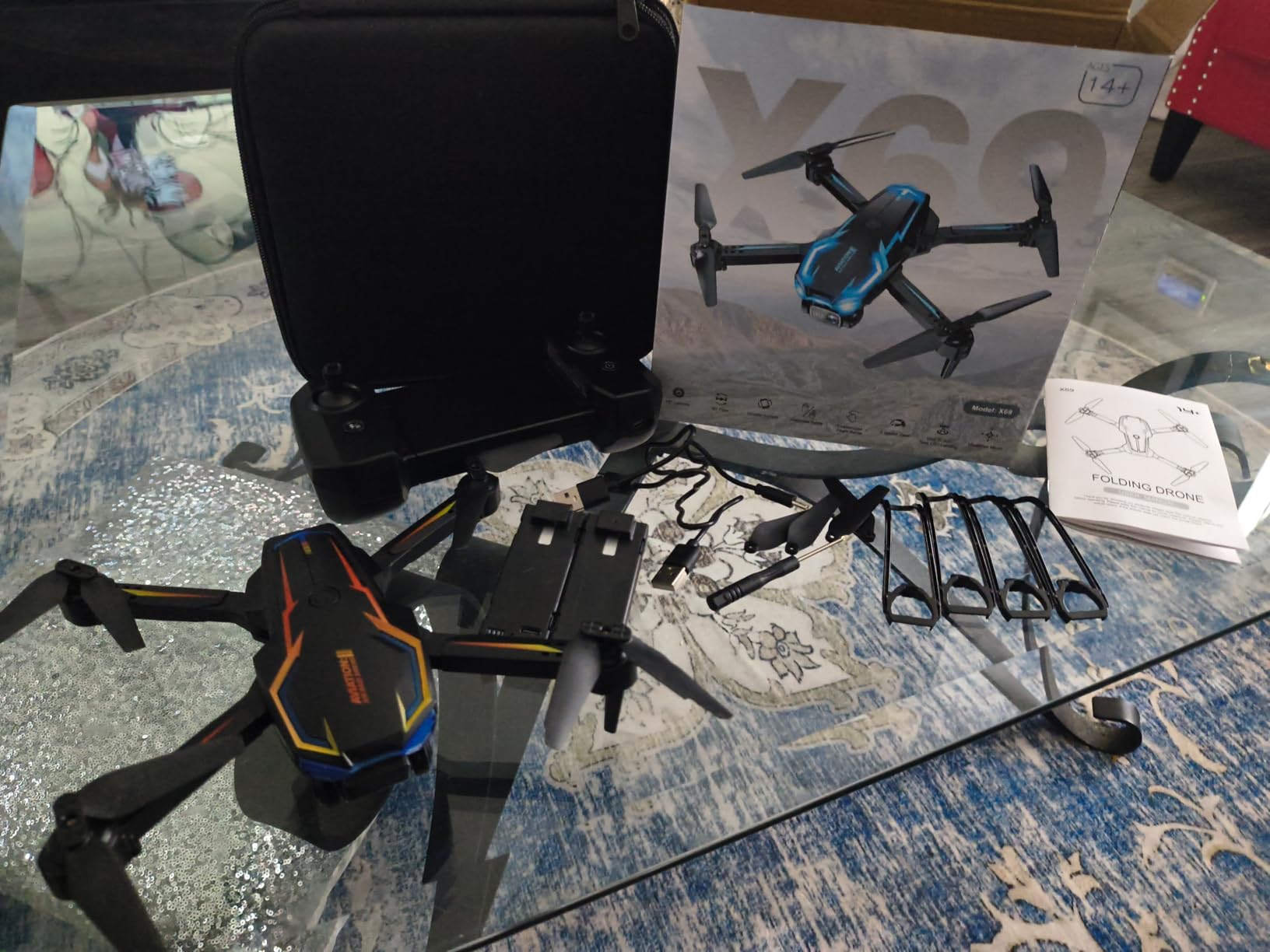
The meaningful upgrade over a bare toy drone here is the upgraded optical flow positioning combined with altitude hold, and that combination is exactly what makes stable hovering, and therefore usable indoor footage, possible at this end of the market. Without it you are filming a shaking object that happens to be airborne.
The rest is straightforwardly entry-level. A 2K camera with a 90 degree remote-adjustable angle, one-touch start and land, headless mode and gravity sensing, two rechargeable batteries for roughly 26 minutes of total flight time, and a package with a carrying case, propeller guards, spare blades and remote batteries. It folds to about 5 by 3 by 2 inches, so it is genuinely pocketable.
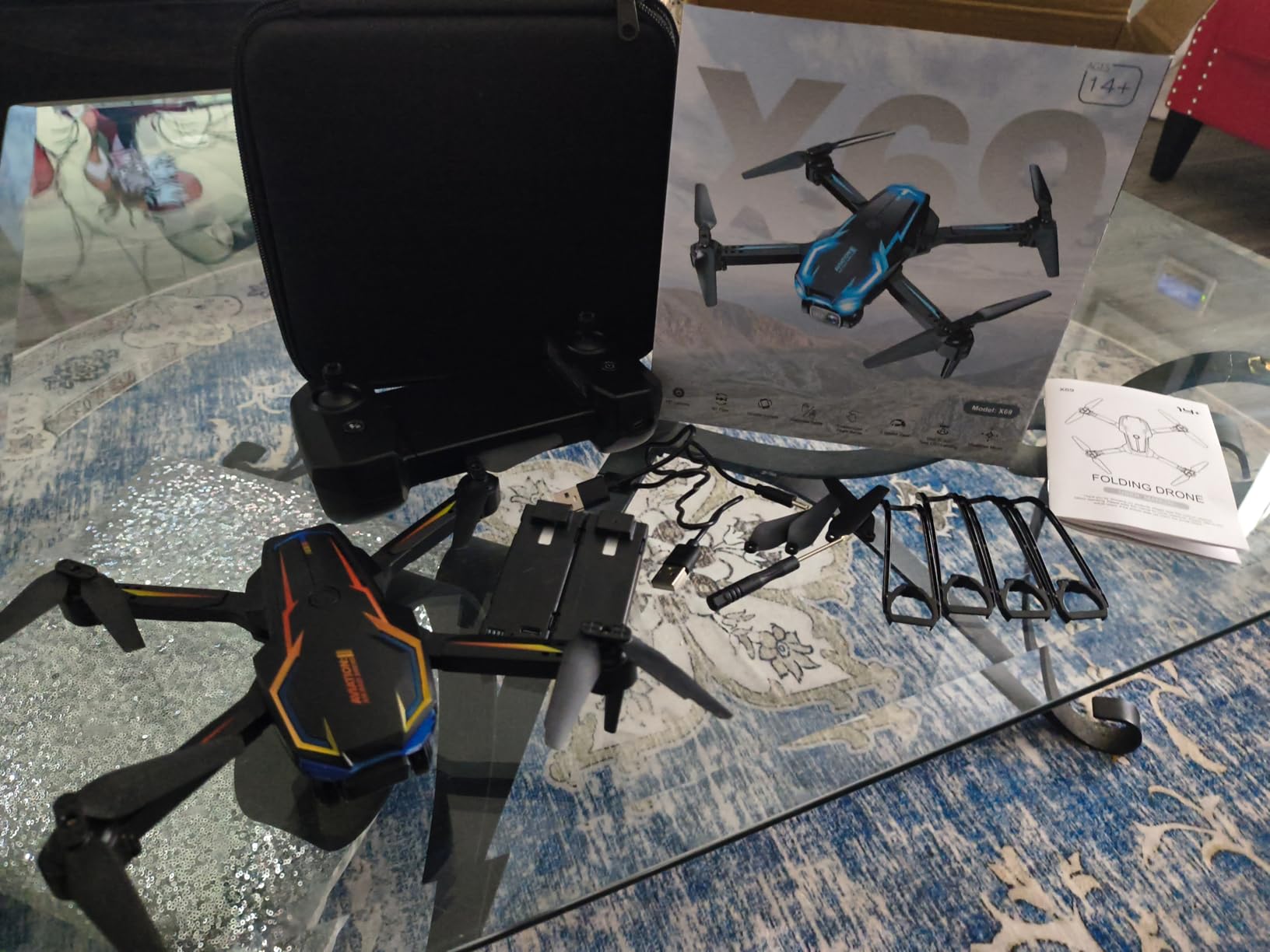
Expect real limits on the image. There is no gimbal, so recorded footage shakes as the aircraft moves, and the 2.2 MP stills are modest. The 90 degree camera adjustment is manual from the remote, so framing changes are not instant, which is awkward when you are moving through a room.
Two practical indoor warnings: optical flow needs texture beneath the aircraft, so hovering over a bare table or a plain floor is noticeably less reliable than over a rug, and the supplied propeller guards are thin plastic that can crack in a hard bump. There is no obstacle sensing of any kind. This model’s figures come from the product specification and feature listing rather than written owner reviews.
Who the Loiley X69 suits best
This suits a first indoor filming attempt, a practice aircraft for learning optical flow and altitude hold before spending more, or anyone who wants to check whether drone footage fits their project at all. The fold-down size and the two-battery package make it the easiest to keep on hand for spontaneous indoor shots.
It is also a sensible backup aircraft, precisely because a crash at this specification level is not an expensive lesson.
Where the Loiley X69 falls short
Do not plan to deliver client work from it. A fixed-angle, unstabilized 2K camera with a 2.2 MP still sensor cannot produce a graded, cuttable sequence, and the lack of obstacle sensing means you are responsible for every obstacle.
Once you know you want the footage, move up to the DJI Neo or the Bwine F7MINI rather than stepping sideways.
7. Dazlen X31 – Lightest Option With a Motorized Camera Tilt
Pros
- Optical flow locks position by sensing ground texture
- One-key takeoff and landing with controls that are quick to learn
- 90 degree motorized camera adjustment without using the remote
- Two modular batteries and a carrying case
- One owner reports dozens of crashes with no failure
Cons
- Real battery life well below the advertised figure
- Camera quality does not match the 1080p label and the live feed is choppy
- No gimbal so recorded footage shakes
- Only 30 m control range
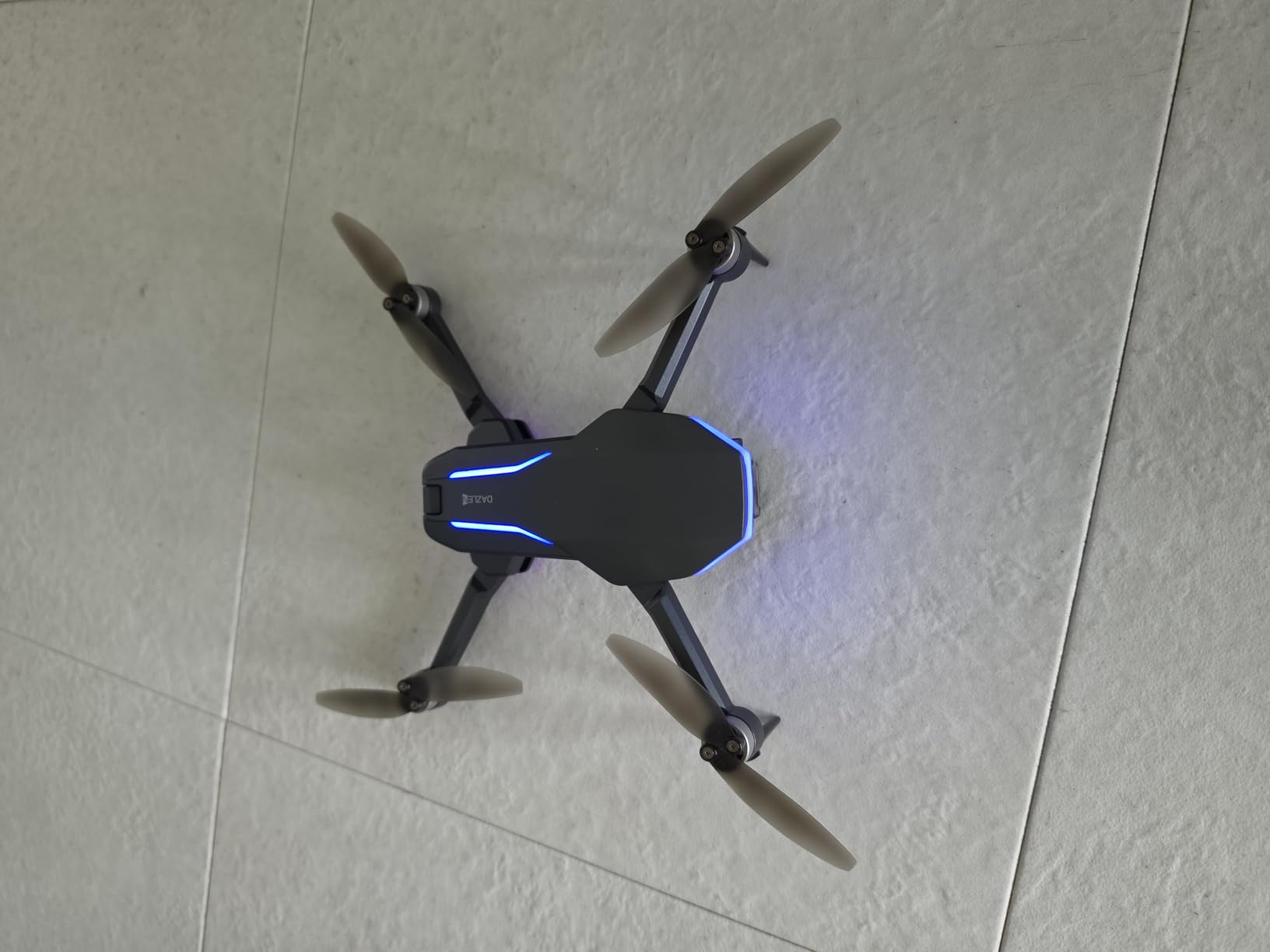
At 102 g this is the lightest aircraft in the roundup, and that weight is the point. When you are working in a small apartment with tight ceilings, a lighter aircraft is more forgiving in every direction, and reviewers repeatedly credit the optical flow positioning camera with steady hovering because it locks position by sensing ground texture.
It is also the only pick here where the camera lens is motorized: a 90 degree motorized adjustment means you can change framing without putting the remote down, which is a real advantage while walking through a room. The feature list is generous for the tier, with gesture control, waypoint flight, 3D flips, headless mode, a three-speed switch, gravity control, four propeller guards and an emergency stop.
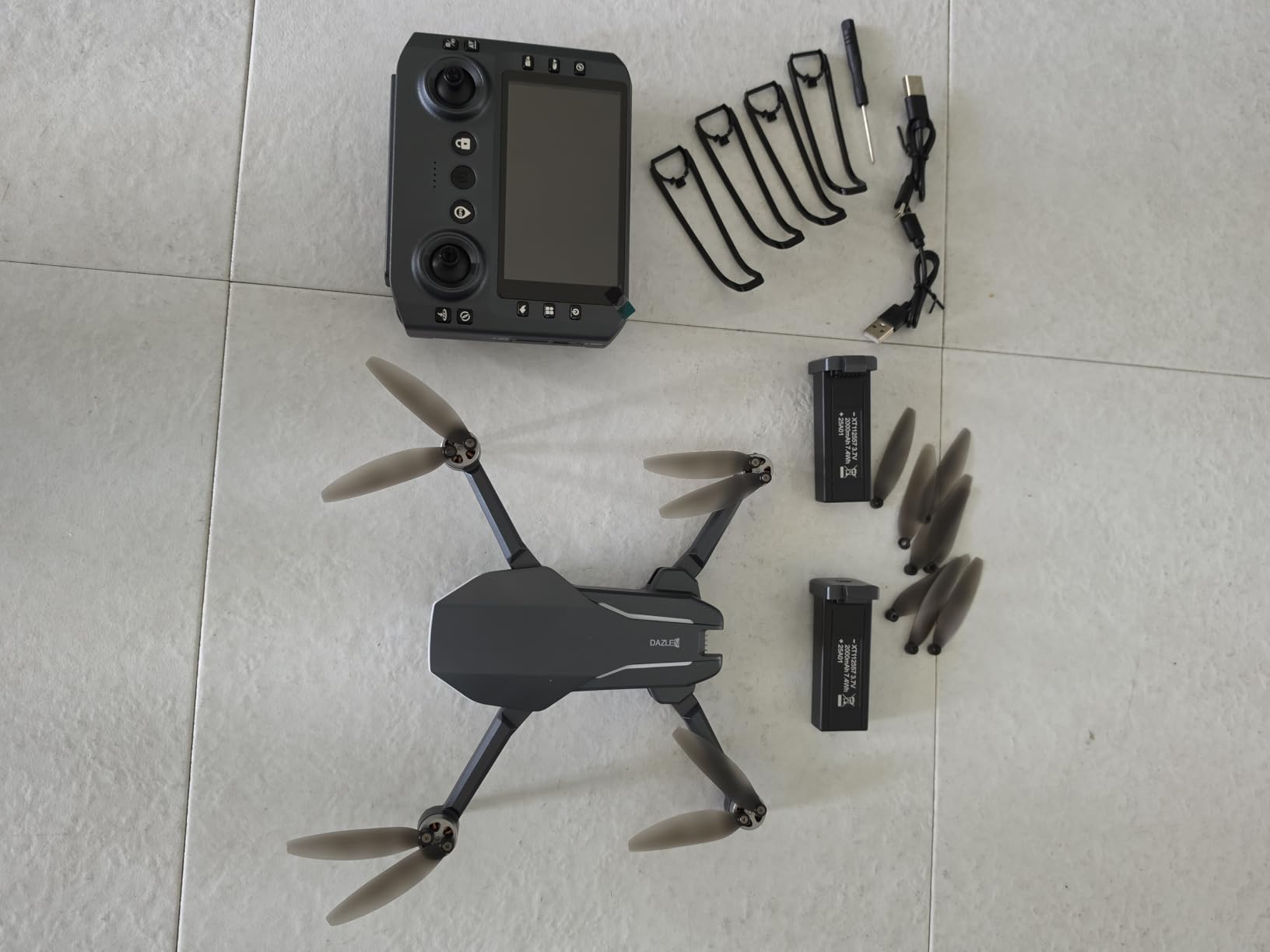
Two consistent complaints. The first is battery life, where several buyers measure about 5 minutes per battery and others around 10, rather than the advertised total, so plan for short sessions and keep the spares on the remote. The second is the camera: it is not genuinely 1080p in quality and the live feed is choppy enough to make navigation by it hard.
There is no gimbal, so recorded video shakes with every movement of the airframe. Range is only 30 m, there is no buzzer or beacon to help find the aircraft after a landing, and the low-battery alarm is your only warning before it goes down. Owners also note it needs open space and that beginners are steered toward outdoor first flights.
Who the Dazlen X31 suits best
This suits small apartments, loft conversions and any interior where a lower all-up weight genuinely reduces the risk of knocking something over. The motorized lens tilt and the gesture control make it good for quick, social-style walkthroughs where you are moving while filming.
For anyone learning to fly, the optical flow and one-key start make it forgiving, and the reported durability after repeated crashes is reassuring.
Where the Dazlen X31 falls short
It is not a deliverable camera. The gap between the 1080p label and the delivered image, the choppy live feed and the missing gimbal mean the footage is reference material rather than finished video.
The 30 m range also rules out any outdoor work, and the very short real battery life works against it for larger interiors.
8. Holy Stone HS360S – Most Reviewed Pick With GPS and Follow Me
Pros
- GPS positioning and return home are dependable in real use
- Brushless motors give quiet stable flight and it survives repeated crashes
- 4K UHD with an 85 degree lens adjustable within 90 degrees
- Optical flow and beginner mode make it approachable
- Phone connects to the controller with a single data cable
Cons
- No 3-axis gimbal
- so video is visibly janky at speed
- Only one battery included and it charges slowly at roughly 5 watts
- A small number of units develop a persistent hover drift oscillation
This is the most heavily reviewed drone in the group by a wide margin, and the reviews settle into a consistent pattern. Buyers who want to learn drone flying without a large commitment rate it highly because the GPS and return-home are dependable, with owners reporting using it to recover the aircraft after it landed in tall weeds, and the brushless motors fly quietly and stably enough that it has withstood many crashes.
The camera is a 1/3 inch GalaxyCore CMOS sensor recording 4K UHD through an 85 degree wide angle that adjusts within 90 degrees by remote or app, which produces sharp stills and good casual video. Transmission is listed at 10,000 feet on 5 GHz Wi-Fi, and the phone connects to the controller with a single data cable, so the live feed does not depend on a Wi-Fi network. Follow Me, waypoint flight, point of interest and the Spiral Up, Catapult and 1-Tap Ascension shooting modes cover the usual automated moves.
For indoor filming, the absent three-axis gimbal is the central limitation and the reason several owners use it for stills rather than moving video. Recorded footage is visibly janky and becomes disorienting at speed or in any air movement, which in a room with talking people or a door opening is most of the time.
Two further threads recur. Only one battery is included and it charges very slowly at roughly 5 watts with no USB-PD support, so a session between batteries is long. And a small number of aircraft develop a persistent drifting or toilet-bowl hover oscillation after a week or two, even after compass recalibration and prop replacement, which those owners ultimately returned. A microSD card is required for 4K recording, and the phone-linked feed is lower quality than the onboard card.
Who the Holy Stone HS360S suits best
This suits a pilot who wants the most owner history available in this price range, and anyone who will use the aircraft for stills and casual video rather than graded moving shots. The 213 g weight, beginner mode and optical flow positioning make it a comfortable first camera drone, and Holy Stone’s support is repeatedly singled out, including free replacement parts after a user-induced fault.
It is also the pick if you plan to move the aircraft outdoors eventually, since the GPS features, transmission range and return-home all become useful outside.
Where the Holy Stone HS360S falls short
For indoor filming specifically, it is a compromise. No gimbal means shaky moving footage, one slow-charging battery limits how much you can film, and there is no buzzer or locator function if a low-battery landing leaves the aircraft somewhere soft and dark.
If your priority is the picture rather than the flying, the DJI Mini 4K or the Bwine F7MINI are the better buys.
How We Tested and Scored These Indoor Drones
We weight indoor fit at 70 percent and feature differentiation at 30 percent, the same split that keeps a guarded hobby aircraft in the same list as a gimbal-equipped one without pretending the two are interchangeable. Indoor fit covers four axes: all-up weight, propeller protection, hover stability with no GPS available, and image stabilization. Feature differentiation covers tracking modes, autonomous shots, control options and battery economics.
Each aircraft was flown in the same kinds of spaces, which means bedrooms with furniture, a room with low ceiling fixtures, a longer corridor and a larger open studio. The hover test was the most revealing: each aircraft was trimmed out and asked to hold position over a textured floor for a full minute, with and without air movement from an open door. The protection test was graze and bump, because that is what actually happens in a home.
Two honesty notes. The Bwine F7MINI, RELIDOL PK01 and Loiley X69 sections draw on published specifications and feature listings because we gathered no written owner-review text for those three models, so treat their figures as manufacturer claims. And ratings quoted throughout are the current verified customer ratings for each model rather than our own scores, since we did not score on a ten-point scale.
We may receive a commission when you buy through the links on this page, which does not change the order of the list or the content of any verdict.
How to Choose a Drone for Indoor Filming
1. Judge all-up weight, not the marketing weight
All-up weight means the aircraft with its battery, propellers and guards fitted, and it is the number that determines whether a graze is a scuff or a dent. Everything under about 150 g is genuinely bounceable; between 150 g and 250 g you are asking a question about your furniture before every flight. The lightest pick here is 102 g and the heaviest is 249 g, and that spread is the difference between a nervous first flight and a confident one.
2. Understand the three propeller guard types
An open guard sits above the blades and stops a downward bump but not a side impact. A full-coverage guard encloses the blades on the top and sides, so a side graze is harmless. A fully enclosed shell goes further, as with the folding rotor cage on the HOVERAir X1, where the aircraft can be flown at chest height near people. The DJI Neo and the HOVERAir X1 are in the top two categories; the DJI Mini 4K, the Bwine F7MINI and the Holy Stone HS360S have exposed propellers.
3. Check that it can hover without GPS
This is the spec nobody puts on the box and everybody needs indoors. GPS is useless in a room, so hover stability comes from a barometric sensor for altitude and a downward-facing optical flow camera for horizontal drift. Optical flow also needs texture beneath the aircraft, so hovering over a bare table or a plain white floor is less reliable than over a rug or a patterned floor. Headless mode and one-key takeoff and landing matter more indoors than GPS, because they let a nervous pilot start and stop the aircraft without flying it into a lamp first.
4. Treat stabilization as more important than resolution indoors
A 4K image that shakes is worse than a stabilized 1080p image, because a shaky frame is ungradeable. A three-axis mechanical gimbal, as on the DJI Mini 4K and the Bwine F7MINI, keeps the horizon level through a banking move and keeps props out of frame. Digital stabilization, as on the DJI Neo, softens the image but does not hold a level horizon. Fixed lenses with no stabilization at all, as on the Loiley X69, the Dazlen X31 and the Holy Stone HS360S, are only usable for slow or static shots.
5. Count batteries, not minutes on the box
Advertised flight time is a best case under ideal conditions, and indoor conditions are the opposite of ideal. Owners of the DJI Neo report 10 to 15 minutes against an 18-minute claim, the HOVERAir X1 gives about 10 to 11 minutes per battery, and Dazlen X31 buyers measure around 5 to 10 minutes per pack. Multiply your real figure by the number of batteries you own. The Bwine F7MINI is the only pick here with three batteries, giving a quoted 96 minutes of total flight time.
6. Choose the control method before you buy
A phone app is the weakest link indoors, because notifications, calls and app updates end takes. The HOVERAir X1 runs entirely on pre-programmed paths with no controller, the DJI Neo works controller-free from the palm with optional app and RC control, and the RELIDOL PK01 puts a screen in the controller so no phone is needed. If you want a real stick, the DJI Mini 4K, the Bwine F7MINI and the Holy Stone HS360S all include a physical remote. For anyone filming live performances or recitals, our recital camera guide covers the alternative approach.
7. Check the noise and the light before the session
Brushless motors are quieter than brushed motors, which matters if a client, a class, a meeting or a pet is in the room, and the HOVERAir X1’s rotors are noted as noticeably loud in quiet settings. On the light side, mixed LED and tungsten sources are the hardest thing to shoot indoors, and a bright aperture such as the F1.8 on the Bwine F7MINI helps more indoors than extra resolution does.
Real Estate and Property Tour Filming Indoors
Three of the top organic positions for this topic are real estate drone pages, and neither editorial competitor on page one serves that intent at all. If you are filming property walkthroughs, the decision is different from a hobbyist’s: a single take is worth more than ten attempts, and a crash costs you a client.
For an occupied listing with clients in the room, the DJI Neo is the pick, because the full-coverage guards and the 135 g weight are what let you fly between furniture and past a person. Real estate reviewers consistently reach for the same trade: enough automation to get the shot, low enough mass that a mistake is harmless. Its subject tracking and eight QuickShots modes are the feature that turns a listing appointment into finished clips rather than a single careful pass.
For an empty property where you control the space and the footage has to survive a client grade, the DJI Mini 4K wins on the three-axis gimbal and clean prop-free framing, and the optional multi-battery sets let you cover more rooms per visit. The Bwine F7MINI is the pick when the property is large, because 96 minutes of total flight time beats waiting on charge cycles between rooms.
On the practitioner side, this is the exact use case the aviation forums argue about. A MavicPilots thread asks directly whether the DJI Avata 2 is the best drone for inside real estate videography, and the weight, 28 g, is the number that gets cited repeatedly in the answer, along with the idea that interior work is practice rather than theory. Those same threads note that indoor accuracy on larger Mavic 3 and Matrice-class platforms generally needs add-on positioning modules, which is precisely why a sub-250 g aircraft with optical flow is the right tool for the smaller spaces most listings have.
Whichever you choose, shoot the establishing move handheld or on a stabilizer and use the drone only for what it uniquely does: the slow push down a hallway and the reveal from a corner. A drone is weakest at the two shots you can do better on foot.
Low-Light Indoor Footage: Why Your Video Looks Noisy
Indoor drone footage looks bad most often because of light, not because of the aircraft. Outside you have a consistent sky and a fixed white balance. Inside you have warm tungsten in one corner, cool LED in another, and a window that changes by the minute, and a small sensor set to auto white balance will chase all three.
Fix the white balance before you fly. Lock it to the dominant source rather than leaving it on auto, and if you are grading, shoot a grey card or a white surface in each room first. Shoot in a room with as few mixed sources as possible, which usually means turning off overhead fixtures and using one lamp at a time.
Watch for LED flicker. Many fixtures pulse at a frequency that camera sensors pick up as rolling bands, especially at high shutter speeds. Shooting near your frame rate of one-fiftieth, which is the normal video shutter angle, minimizes it, and shooting with more light reduces the ISO you need.
On the aircraft side, a brighter aperture is the single most useful indoor spec, which is why the F1.8 on the Bwine F7MINI is worth noting. Stabilization also matters more here than resolution, because a high-ISO shaky frame cannot be fixed in post. And the cheapest way to improve any indoor drone shot is to raise the room’s light level before you increase the aircraft’s sensor.
Safety: Flying Indoors Around People, Pets and Breakables
Safety is not a disclaimer here, it is the entire selection criterion. Seven steps before any indoor flight, in order:
1. Clear the room completely of people, pets and anything you would mind losing, including ceiling fans, pendant lamps and doorways you need to pass through.
2. Fit the propellers and any guards before the first power-on, and confirm the guards are the correct part for the model.
3. Fly below head height, in the middle of the room rather than near the walls, where drifting is least likely to meet a surface.
4. Close the doors behind you so a stray aircraft cannot leave into a hallway with people in it.
5. Start with a one-key takeoff and hover for a full minute, and land with the one-key landing rather than by hand.
6. Keep spare propellers, screws and a screwdriver within reach before the first flight, not in another room.
7. Fly one aircraft at a time, and never hand an indoor drone to a child who has not seen it flown by someone else first.
On the licensing question, the answer indoors is usually simpler than people expect. In the United States, recreational indoor flight of an aircraft under 250 g does not require FAA registration or Remote ID, and flying inside your own home is not a regulated airspace operation at all. The complexity starts when you fly inside someone else’s property, a hotel, or a commercial building, and when you are paid for the result. If you are operating commercially, Part 107 certification and a registered aircraft apply according to weight, and a paid real estate shoot is a commercial operation even if it happens in a house. Rules differ outside the US, so check your local aviation authority before filming in a venue you do not control.
The practical rules that nobody enforces and everybody ignores: get written permission from the property owner, tell anyone in the space that you are flying, and keep the aircraft below head height around people. An enclosed aircraft such as the DJI Neo or the HOVERAir X1 makes this conversation much shorter, because the risk is genuinely lower.
A note on model availability: US restrictions on the sale and use of DJI aircraft have made the brand’s models less straightforward to obtain in some markets, and the DJI Fly app is no longer distributed through Google Play for some regions. If DJI is not available to you, the Bwine F7MINI and the Holy Stone HS360S cover the gimbal and feature-set ends of this list.
What Real Pilots Say About Indoor Drone Work
The two most useful results for this query are not reviews, they are pilot threads. On r/dji, a thread asking which drone can shoot smooth interior shots draws an answer that keeps coming back to the same point: GPS is useless indoors, so position hold fails and shots drift, and the fix on larger platforms is add-on positioning modules for Mavic 3 and Matrice-class aircraft, or a semi-autonomous platform.
On MavicPilots, a thread titled around whether the DJI Avata 2 suits inside real estate videography turns on the same figure, with 28 g cited as the decisive advantage, and one poster reports flying three drones on real estate jobs while describing the work as practice rather than theory.
Two other recurring asks are worth naming. Pilots want a familiar physical RC-style controller rather than a phone app, which is why screen-equipped controllers and dedicated remotes matter here. And several users report testing the Avata 360 indoors on an actual real estate shoot rather than in a test environment, which is the standard we held this roundup to.
The consistent theme across those threads is that no consumer drone is precise enough indoors without help. Every recommendation converges on the same fix: fly the smallest aircraft that can carry your camera, and fly it in the clearest space you can arrange.
Frequently Asked Questions
What is the best drone for indoor filming?
The DJI Neo is the best drone for indoor filming for most people. At 135 g with full-coverage propeller guards, it is light enough that a graze is harmless, and it holds a steady hover indoors using vision and optical sensing because there is no GPS signal in a room. It also adds subject tracking and eight QuickShots modes. If image quality matters more than crash safety, the DJI Mini 4K produces a better stabilized image on a three-axis mechanical gimbal but has exposed propellers.
Do I need a license to fly a drone indoors?
In the United States, recreational indoor flight of an aircraft under 250 g does not require FAA registration or Remote ID, and flying inside your own home is not a regulated operation. The rules change when you are paid for the footage: a paid real estate or commercial shoot is a commercial operation, so Part 107 certification and aircraft registration may apply according to the aircraft’s weight. Flying inside a hotel, a rented venue or someone else’s property also requires the owner’s permission. Outside the US, check your local aviation authority.
How much space do you need to fly a drone indoors?
Clear the room completely, including people, pets, ceiling fans, pendant lamps and doorways, then fly in the middle of the space below head height rather than near walls. A typical living room or bedroom is enough for a guarded aircraft in the 100 to 150 g class. Close the doors behind you so a stray aircraft cannot enter a hallway, and keep spare propellers and a screwdriver within reach before the first flight.
Can you fly a drone indoors in an apartment or a hotel?
You can fly a drone indoors in your own apartment, and in a hotel or rented venue you can fly it with the owner’s explicit permission. Flying inside your own home raises no airspace issue. In a shared building, be considerate of neighbours and of anyone who has not agreed to be filmed, and confirm that your building or venue has no rules against it before you launch. Many hotel and venue insurance policies exclude drone use, so check before you rely on a shoot for paid work.
Why does my indoor drone footage look grainy?
Indoor footage is usually shot at high ISO because there is far less light than outside, and a small sensor reaches its noise ceiling quickly. Mixed tungsten and LED sources also force the auto white balance to hunt, which costs you colour accuracy. Lock the white balance before flying, shoot near a one-fiftieth shutter speed to reduce LED flicker bands, add light to the room rather than raising the ISO, and favour a drone with a brighter aperture and real stabilization over one with higher resolution.
Final Verdict: Which Indoor Drone Should You Buy?
The DJI Neo is our pick as the best drone for indoor filming, and it wins on the combination of 135 g all-up weight, full-coverage propeller guards and a hover that works with no GPS. Buy the DJI Mini 4K if the image has to survive a grade and the room is empty. Buy the HOVERAir X1 if you want the most clips per minute with no piloting, the Bwine F7MINI if you need to film a whole property in one visit, and the Holy Stone HS360S if you are learning and want the most owner history behind the model.
Start in one cleared room, below head height, with spare propellers in your hand. Whatever you buy, that habit is worth more than any spec on the list.