
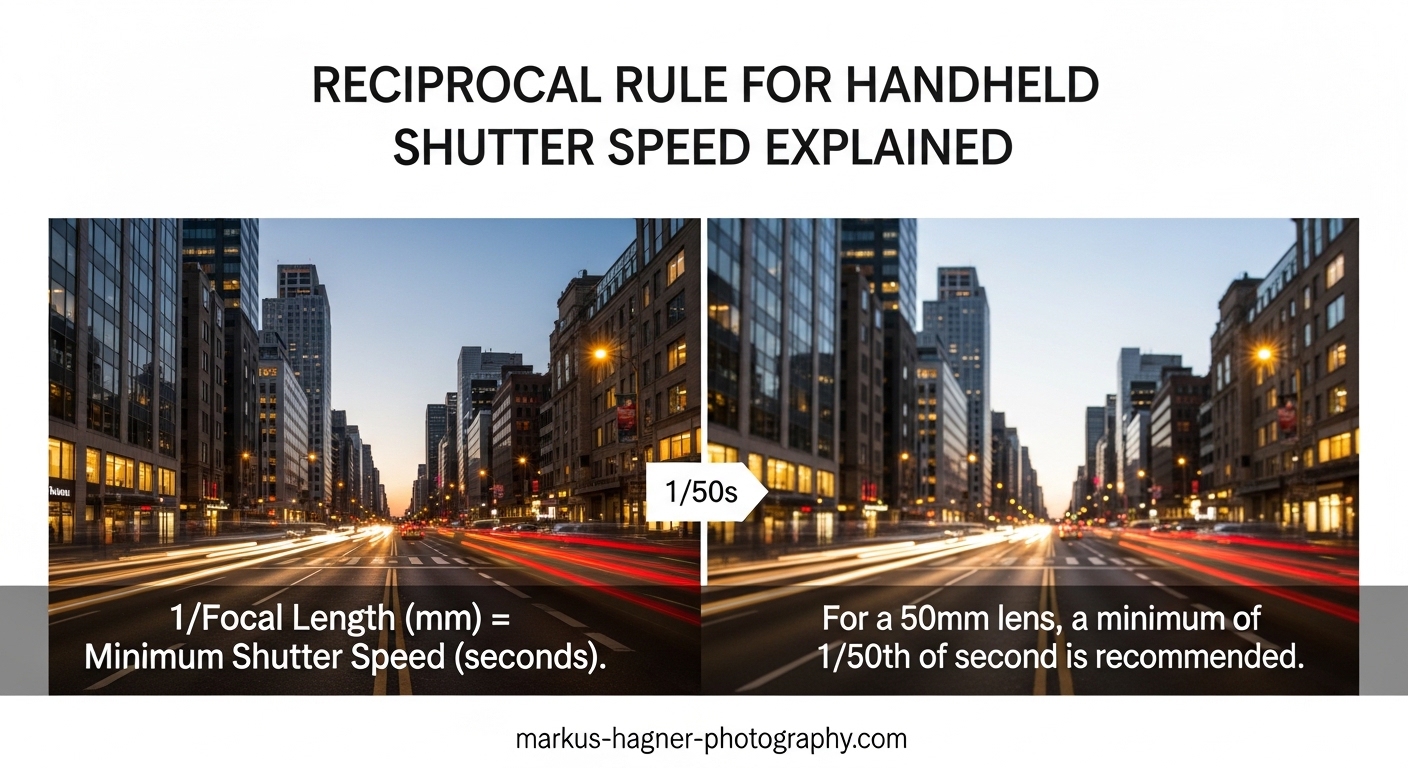
Blurry photos from camera shake frustrate every photographer at some point. You frame the perfect shot, press the shutter, and later discover your image is soft despite proper focus. The reciprocal rule for handheld shutter speed solves this problem with a simple formula anyone can remember and apply instantly.
In this guide, I will explain exactly what the reciprocal rule is, how to calculate it for any lens, and when you can safely break it. You will also learn how crop factor and image stabilization change the equation, plus practical tips I have gathered from years of shooting handheld in challenging conditions.
Table of Contents
- What Is the Reciprocal Rule for Handheld Shutter Speed?
- How the Reciprocal Rule Works: The Science Behind It
- Crop Factor and Effective Focal Length
- How Image Stabilization Affects the Rule
- Practical Examples: Shutter Speeds by Focal Length
- Exceptions and Limitations
- How to Test Your Personal Handheld Limits
- Handholding Technique Tips
- Using Auto ISO with the Reciprocal Rule
- Frequently Asked Questions
- Conclusion
What Is the Reciprocal Rule for Handheld Shutter Speed?
The reciprocal rule states that your minimum shutter speed should equal the reciprocal of your focal length to prevent camera shake blur when shooting handheld. In plain terms: set your shutter speed to 1 over your focal length, or faster.
For a 50mm lens, use 1/50 second or faster. For a 200mm telephoto, you need at least 1/200 second. The formula is simple: 1 divided by your focal length equals your minimum safe shutter speed.
This rule works because longer focal lengths magnify any camera movement along with your subject. A tiny wobble that goes unnoticed at 24mm becomes a significant blur at 300mm. The reciprocal rule compensates by requiring progressively faster shutter speeds as focal length increases.
I have used this rule as my baseline for over a decade of photography. It gives me a reliable starting point, though I have learned to adjust it based on several factors we will cover shortly.
How the Reciprocal Rule Works: The Science Behind It
Understanding why this rule works helps you know when to trust it and when to modify it. The principle comes down to magnification and how it affects image sharpness.
When you handhold a camera, your body naturally moves slightly. Your heartbeat, breathing, and muscle fatigue all contribute to subtle motion. This movement transfers to the camera and creates blur in your photos.
At wide focal lengths like 24mm, this movement gets recorded across a broad field of view. The relative shift at the sensor level remains small. But when you zoom to 200mm, that same physical movement now represents a much larger angular shift. Your 200mm lens magnifies the scene eight times more than your 24mm lens, which means it also magnifies your camera shake by eight times.
The reciprocal rule compensates for this magnification effect. By using a shutter speed eight times faster at 200mm compared to 24mm, you freeze that magnified motion before it can blur your image.
Think of it this way: your shutter opens and closes so quickly that even if your hands move, the exposure ends before that movement registers on the sensor. The faster your shutter, the less time for shake to affect the image.
Crop Factor and Effective Focal Length
Here is where many photographers get confused. If you shoot with an APS-C or Micro Four Thirds camera, the reciprocal rule needs adjustment for your crop factor.
Crop sensors capture a smaller portion of the image circle compared to full-frame sensors. This effectively multiplies your focal length. A 50mm lens on an APS-C camera (1.5x crop factor) behaves like a 75mm lens on full-frame in terms of field of view and camera shake magnification.
The rule applies to effective focal length, not the number printed on your lens. For APS-C cameras, multiply your focal length by 1.5 (Nikon, Sony, Fujifilm) or 1.6 (Canon) to get your effective focal length. For Micro Four Thirds, multiply by 2.
Let me show you how this works in practice:
- 50mm on full-frame: Minimum 1/50 second
- 50mm on APS-C (1.5x crop): Effective 75mm, minimum 1/80 second
- 50mm on Micro Four Thirds: Effective 100mm, minimum 1/100 second
Many forum discussions reveal this causes real confusion. I have seen photographers wonder why their APS-C shots blur at 1/50 second with a 50mm lens. The answer is simple: they needed 1/80 second because their effective focal length was 75mm.
Some photographers take this a step further and add an extra safety margin for crop sensors. They multiply by the crop factor and then round up to the next standard shutter speed. This conservative approach accounts for the higher pixel density often found in crop-sensor cameras.
How Image Stabilization Affects the Rule
Modern image stabilization fundamentally changes the reciprocal rule equation. Both in-body image stabilization (IBIS) and lens-based optical stabilization (VR, IS, OSS) allow you to use slower shutter speeds while maintaining sharpness.
Most stabilization systems claim 3 to 8 stops of improvement. Each stop doubles the exposure time you can use. If a lens offers 4 stops of stabilization at 200mm, you could theoretically shoot at 1/13 second instead of 1/200 second and still get a sharp image.
In practice, I treat manufacturer claims as optimistic starting points. My real-world testing shows that 3 to 5 stops is more realistic for most situations. The effectiveness varies based on your technique, the specific lens or body, and shooting conditions.
Here is how I modify the reciprocal rule when using stabilization:
- 3 stops of stabilization: Divide your minimum speed by 8 (1/200 becomes 1/25)
- 4 stops of stabilization: Divide by 16 (1/200 becomes roughly 1/13)
- 5 stops of stabilization: Divide by 32 (1/200 becomes roughly 1/6)
Keep in mind that image stabilization only counters camera shake. It does nothing for subject movement. If you are photographing a running child at 1/13 second, stabilization might keep the background sharp, but your subject will still blur from their own motion.
I also notice that stabilization effectiveness drops at the extremes. At very long focal lengths (400mm+), I rarely achieve the full rated stops. Similarly, very slow shutter speeds below 1/10 second become hit-or-miss regardless of stabilization claims.
Practical Examples: Shutter Speeds by Focal Length
Let me give you a quick reference that I wish I had when starting out. This table shows minimum handheld shutter speeds for common focal lengths across different sensor formats.
Full-Frame Cameras:
- 24mm: 1/25 second minimum
- 35mm: 1/35 second minimum
- 50mm: 1/50 second minimum
- 85mm: 1/85 second minimum (round to 1/100)
- 100mm: 1/100 second minimum
- 135mm: 1/135 second minimum (round to 1/160)
- 200mm: 1/200 second minimum
- 300mm: 1/300 second minimum
- 400mm: 1/400 second minimum
APS-C Cameras (1.5x crop factor):
- 16mm: 1/25 second (effective 24mm)
- 24mm: 1/40 second (effective 36mm)
- 35mm: 1/50 second (effective 52mm)
- 50mm: 1/80 second (effective 75mm)
- 85mm: 1/125 second (effective 127mm)
- 135mm: 1/200 second (effective 202mm)
- 200mm: 1/320 second (effective 300mm)
Micro Four Thirds (2x crop factor):
- 12mm: 1/25 second (effective 24mm)
- 17mm: 1/35 second (effective 34mm)
- 25mm: 1/50 second (effective 50mm)
- 45mm: 1/100 second (effective 90mm)
- 75mm: 1/160 second (effective 150mm)
- 100mm: 1/200 second (effective 200mm)
These numbers represent conservative baselines. If you want extra safety, go one stop faster. For critical work or high-resolution cameras, consider going two stops faster.
Real-World Scenario Examples
Let me walk you through some actual shooting situations where I applied the reciprocal rule.
Street Photography with a 35mm Lens: Walking through a market in low evening light, I set my shutter to 1/40 second (slightly faster than 1/35) and let Auto ISO handle the rest. This gave me sharp environmental portraits while keeping ISO reasonable.
Wildlife with a 300mm Telephoto: Handholding a 300mm lens requires discipline. I used 1/320 second as my minimum, braced my elbows against my body, and controlled my breathing. The images came out sharp even at longer distances.
Travel Photography with Stabilization: My travel zoom has 5 stops of optical stabilization. At 100mm, instead of needing 1/100 second, I successfully shot at 1/15 second for dimly lit interiors. I still braced against doorframes whenever possible.
Event Photography in Low Light: Shooting a wedding reception with an 85mm lens, I knew 1/85 second would not freeze the action. I went to 1/160 second and accepted higher ISO. The slight noise was preferable to motion blur on the couple’s first dance.
Exceptions and Limitations
The reciprocal rule works well as a guideline, but several situations make it irrelevant or insufficient.
When Using a Tripod
On a stable tripod, camera shake becomes negligible. You can use any shutter speed the situation requires. The reciprocal rule simply does not apply when your camera rests on a solid support.
Fast-Moving Subjects
Subject motion blur and camera shake blur are different problems. The reciprocal rule only addresses camera shake. A running athlete at 1/200 second might have a sharp background but a blurred body. Action photography often demands 1/500 second or faster regardless of focal length.
Flash and Strobe Photography
When using flash as your primary light source, the extremely short flash duration (often 1/1000 second or faster) freezes motion. Camera shake matters less because the flash provides the bulk of the exposure in a tiny fraction of a second.
High-Resolution Cameras
Photographers with 45MP or higher sensors report needing faster shutter speeds than the reciprocal rule suggests. This makes sense when you think about it. Higher pixel density means smaller pixels, and smaller pixels reveal blur that would be invisible on lower-resolution sensors.
For cameras above 40MP, I recommend going one to two stops faster than the reciprocal rule indicates. What looks sharp at 24MP might show slight softness when viewed at 100% on a 60MP sensor.
Macro Photography
At close focusing distances, the reciprocal rule breaks down completely. Macro magnification increases effective focal length far beyond the marked number on your lens. A 100mm macro lens at 1:1 magnification behaves more like a 200mm lens for shake purposes.
Macro photographers typically use much faster speeds or rely on flash and tripods. I shoot handheld macro at 1/250 second minimum, often going to 1/500 second for critical work.
Individual Variation
Not everyone holds a camera with the same stability. Age, fitness, caffeine consumption, and natural tremor levels all affect your personal minimum shutter speed. Some photographers can handhold two stops slower than the rule suggests. Others need to go faster.
Forum discussions consistently show this variation. One photographer swears by the rule while another reports constant blur despite following it precisely. Both are telling the truth. Your personal physiology matters.
Environmental Factors
Cold weather numbs your hands and increases shake. Fatigue from a long shoot degrades your stability as the day progresses. Windy conditions add external vibration. Strong coffee before a shoot might give you the jitters.
I have learned to adjust my shutter speeds based on conditions. A cold morning wildlife shoot calls for faster speeds than a relaxed indoor portrait session.
Common Mistakes Beginners Make
Through teaching photography workshops, I see these mistakes repeatedly:
- Ignoring crop factor: Using 1/50 second with a 50mm lens on APS-C when 1/80 second is needed
- Over-relying on stabilization: Expecting sharp results at 1/4 second handheld
- Confusing subject blur with camera shake: Blaming technique when the subject simply moved
- Pixel peeping at 100%: Viewing high-resolution files at extreme magnification reveals imperfections invisible in normal viewing or prints
- Not bracing properly: Holding the camera away from the body with arms extended
How to Test Your Personal Handheld Limits
I recommend every photographer run this simple test to discover their actual stability limits. The results might surprise you.
Step 1: Set Up Your Test
Find a subject with fine detail at a moderate distance. A brick wall or text on a distant sign works well. Use your longest commonly used focal length.
Step 2: Start at the Reciprocal Rule
Set your shutter speed to the reciprocal of your focal length. Take three shots using proper handholding technique: elbows tucked, camera against your face if using a viewfinder, controlled breathing.
Step 3: Go Slower in Stops
Reduce your shutter speed by one stop and take three more shots. Continue this process until you reach speeds where blur becomes obvious.
Step 4: Analyze Your Results
View your images at 100% magnification on a computer. Note the slowest shutter speed where all three shots remained sharp. This is your personal handheld limit for that focal length.
Step 5: Test Multiple Focal Lengths
Repeat this test with your other commonly used lenses. You might find you are steadier at 50mm than at 200mm, or vice versa.
Step 6: Test with Stabilization
Run the same test with your image stabilization turned on. Compare the results to see how many stops of benefit you actually achieve in practice.
I re-run this test annually and whenever I get a new camera or lens. It takes about 30 minutes but saves me from countless blurry shots throughout the year.
Handholding Technique Tips
Better technique can extend your handheld capabilities beyond what the reciprocal rule suggests. Here are the methods I use to maximize stability.
Hold the camera with both hands, gripping the right side firmly while cradling the lens from below with your left hand. Keep your elbows pressed against your torso rather than extending outward. This creates a stable triangle between your hands and body.
Use the viewfinder instead of the rear LCD when possible. Pressing the camera against your face adds a third point of contact. If you must use the LCD, pull the camera strap taut against your neck and push the camera forward to create tension.
Control your breathing. Exhale partially, then hold your breath for the moment of exposure. Avoid shooting while inhaling or exhaling, as your chest movement transfers to the camera.
Squeeze the shutter button gently rather than jabbing at it. A quick jab shakes the camera. A smooth press minimizes disturbance.
Brace against available supports. A wall, tree, doorframe, or even your own knee when kneeling can dramatically improve stability. I often lean against lamp posts when shooting street photography in low light.
Using Auto ISO with the Reciprocal Rule
Many modern cameras offer Auto ISO with a minimum shutter speed setting. This feature automates the reciprocal rule, letting you focus on composition while the camera maintains shake-free shutter speeds.
Set your minimum shutter speed to match your focal length (accounting for crop factor if needed). The camera will raise ISO as necessary to maintain that speed, dropping it when light allows.
Some cameras offer a focal-length-aware Auto ISO mode that automatically adjusts the minimum shutter speed based on your zoom position. This is ideal for zoom lenses where the reciprocal rule changes as you zoom.
I use Auto ISO with a minimum shutter speed set one stop faster than the reciprocal rule suggests. This gives me a safety margin while still letting the camera handle exposure calculations.
Frequently Asked Questions
What is the reciprocal rule for shutter speed?
The reciprocal rule states that your minimum shutter speed should equal the reciprocal of your focal length when shooting handheld. For a 100mm lens, use at least 1/100 second. This formula compensates for how longer focal lengths magnify camera shake along with your subject.
What is the shutter speed rule for handheld cameras?
The handheld shutter speed rule (also called the reciprocal rule) says to use a shutter speed of at least 1 over your focal length. With a 50mm lens, set 1/50 second or faster. For crop sensor cameras, use your effective focal length (actual focal length multiplied by crop factor) for the calculation.
What shutter speed is good for handhelds?
A good handheld shutter speed depends on your focal length. For 24mm, use 1/25 second minimum. For 50mm, use 1/50 second. For 200mm, use 1/200 second. With image stabilization, you can typically go 3-5 stops slower. High-resolution cameras and unsteady hands may require faster speeds.
Does image stabilization affect the reciprocal rule?
Yes, image stabilization allows you to use slower shutter speeds than the reciprocal rule suggests. Most stabilization systems provide 3-5 stops of improvement in practice. If the rule says 1/200 second, 4 stops of stabilization could let you shoot at roughly 1/13 second while maintaining sharpness from camera shake.
Does the reciprocal rule apply to crop sensor cameras?
Yes, but you must use effective focal length, not the marked focal length on your lens. Multiply your focal length by the crop factor (1.5x for most APS-C, 1.6x for Canon APS-C, 2x for Micro Four Thirds). A 50mm lens on APS-C has an effective focal length of 75mm, requiring 1/80 second minimum.
Conclusion
The reciprocal rule for handheld shutter speed gives photographers a reliable baseline for sharp images. Remember the formula: set your shutter speed to at least 1 over your focal length. Account for crop factor on smaller sensors, and understand that image stabilization can extend your capabilities significantly.
But also remember that this rule is a guideline, not a law. Your personal stability, camera resolution, environmental conditions, and subject movement all affect what shutter speed you actually need. Test your own limits, practice good handholding technique, and adjust based on real-world results.
Next time you are unsure what shutter speed to use handheld, start with the reciprocal rule and adjust from there. It has saved me from countless blurry shots, and I am confident it will do the same for you.