
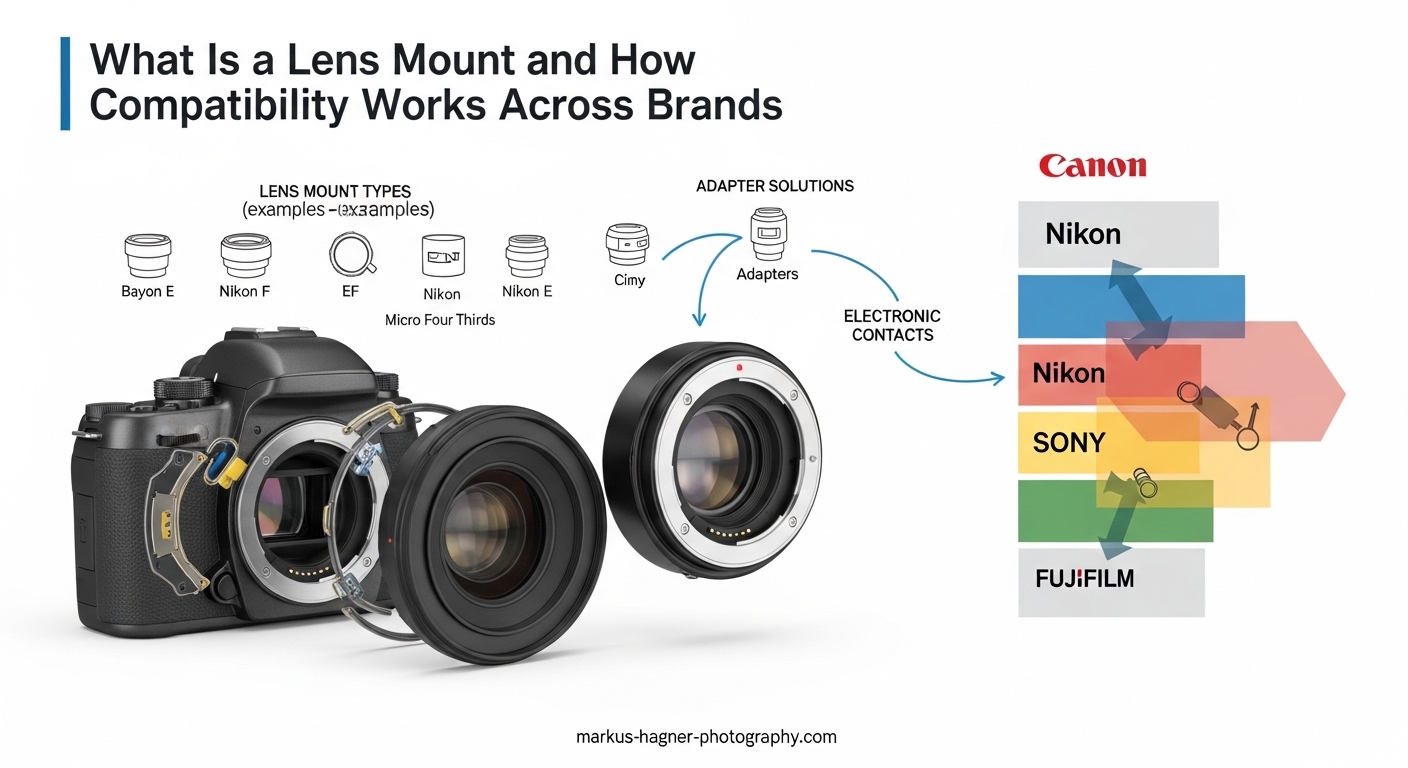
If you have ever shopped for a new lens and felt overwhelmed by compatibility questions, you are not alone. The lens mount is one of the most important yet often misunderstood aspects of camera systems. It determines which lenses attach to your camera body and how well they communicate with it.
Understanding lens mount compatibility helps you make smarter purchasing decisions and unlocks more lens options for your photography. Whether you shoot with Canon, Nikon, Sony, or another brand, knowing how mounts work saves you from buying lenses that won’t fit or function properly.
In this guide, I will explain what a lens mount is, how compatibility works across different camera systems, and when you can use adapters to expand your lens choices. By the end, you will have a clear framework for evaluating any lens purchase.
Table of Contents
What Is a Lens Mount
A lens mount is the mechanical and electrical interface that connects a camera lens to a camera body. Think of it as the handshake point between your lens and camera. It serves two critical functions: securing the lens physically and enabling electronic communication between the lens and camera.
Physical Components
The physical side of a lens mount includes the bayonet mechanism that twists and locks the lens into place. Most modern mounts use a bayonet design with three or more tabs that rotate and click into position. This design provides a secure attachment while allowing quick lens changes.
The mount diameter also matters. Larger diameter mounts can accommodate larger rear lens elements, which often translates to better optical performance for wide-angle and fast aperture lenses. This is why newer mirrorless mounts like Canon RF (54mm) and Nikon Z (55mm) are larger than their DSLR predecessors.
Electronic Contacts
Behind the physical connection lies a row of metal contacts. These pins transmit data between the lens and camera body. They carry information about autofocus commands, aperture settings, image stabilization data, lens identification, and EXIF metadata.
When you press the shutter button halfway, your camera communicates with the lens through these contacts. The camera tells the lens where to focus, and the lens reports back its current settings. Without proper electronic communication, you lose autofocus, automatic aperture control, and image stabilization.
Why Different Brands Use Different Mounts
Each camera manufacturer develops proprietary mount systems. This is not just about being different; it is about controlling the optical and electronic design. Canon uses EF and RF mounts. Nikon uses F-mount and Z-mount. Sony uses E-mount and the older A-mount. Fujifilm uses X-mount for APS-C and G-mount for medium format.
These mounts differ in diameter, flange focal distance (the space between the mount and sensor), number of electronic contacts, and communication protocols. This means a Canon lens simply cannot attach directly to a Nikon body, and vice versa.
How Lens Compatibility Works
Lens compatibility depends on two factors working together: physical fit and electronic communication. Both must align for a lens to work properly on a camera body.
Physical Fit Requirements
For a lens to mount on a camera, the physical dimensions must match. The mount diameter, bayonet tab placement, and locking mechanism all need to be identical or very close. If these do not match, the lens will not attach at all.
Even within the same brand, physical compatibility varies. Canon EF lenses fit all Canon EOS DSLRs, but Canon EF-S lenses (designed for crop-sensor cameras) cannot mount on full-frame Canon DSLRs. The rear element of EF-S lenses protrudes too far and would hit the mirror on a full-frame camera.
Electronic Communication
Physical fit is just the first hurdle. For autofocus, aperture control, and image stabilization to work, the lens and camera must speak the same electronic language. Each manufacturer uses proprietary communication protocols.
Third-party lens manufacturers like Sigma and Tamron reverse-engineer these protocols to make lenses that communicate properly with different camera brands. This is why a Sigma lens is available in Canon RF, Nikon Z, and Sony E-mount versions. The optical design may be identical, but the mount and electronics differ for each system.
Flange Focal Distance: The Key Concept
Flange focal distance is the measurement from the lens mount surface to the camera’s sensor plane. This distance varies significantly between mount systems. Canon EF has a 44mm flange distance. Nikon F-mount is 46.5mm. Sony E-mount is only 18mm.
This difference explains why adapting lenses works better in one direction. You can adapt DSLR lenses (long flange distance) to mirrorless cameras (short flange distance) because adapters have room to maintain the correct optical distance. However, you cannot adapt mirrorless lenses to DSLRs because there is no physical space for the adapter.
Think of it this way: if your lens needs to sit 44mm from the sensor, but your camera mount is only 18mm away, you can add a 26mm adapter. But if your lens needs to sit 18mm away and your mount is 44mm from the sensor, there is no way to push the lens closer without it hitting the mirror box.
Major Brand Mount Systems
Let me break down the major mount systems you will encounter. Understanding each system helps you navigate compatibility within and across brands.
Canon Mount Systems
Canon has evolved through several mount systems over the decades. The current landscape includes EF, EF-S, EF-M, and RF mounts.
The EF mount launched in 1987 with the Canon EOS system. It is a full-frame mount with a 44mm flange distance. EF lenses work on all Canon EOS DSLRs, both full-frame and crop-sensor bodies. They also work on Canon mirrorless cameras with the EF-EOS R adapter.
EF-S lenses arrived in 2003 for Canon’s APS-C DSLRs. These lenses project a smaller image circle and have a rear element that extends deeper into the camera. They mount on Canon crop-sensor DSLRs but cannot physically fit on full-frame Canon DSLRs.
The EF-M mount served Canon’s original mirrorless APS-C line. These lenses are not compatible with DSLRs or the newer RF-mount cameras without specific adapters. Canon has largely transitioned away from this system.
The RF mount is Canon’s current full-frame mirrorless system. It features a larger 54mm diameter and shorter 20mm flange distance. RF lenses only fit Canon full-frame mirrorless cameras. Canon also offers RF-S lenses for their APS-C mirrorless bodies, similar to the EF-S relationship.
Nikon Mount Systems
Nikon’s mount history centers on two systems: the legendary F-mount and the modern Z-mount.
The F-mount debuted in 1959 and remained Nikon’s primary DSLR mount for over 60 years. This mount has incredible backward compatibility. Many vintage F-mount lenses from the 1970s still mount on modern Nikon DSLRs, though autofocus and metering capabilities vary based on lens generation.
The Z-mount is Nikon’s mirrorless system, introduced in 2018. It features a massive 55mm diameter and short 16mm flange distance. This large mount allows for extremely fast lenses and improved optical designs. Nikon offers the FTZ adapter to use F-mount lenses on Z cameras, though older screw-drive AF lenses lose autofocus capability.
Sony Mount Systems
Sony operates two mount systems: A-mount (inherited from Konica Minolta) and E-mount.
The A-mount was Sony’s DSLR and SLT system. Sony has discontinued A-mount camera production, but many photographers still use these bodies and lenses.
E-mount is Sony’s mirrorless system, available in both APS-C and full-frame variants. The physical mount is identical for both sensor sizes. Sony full-frame E-mount cameras can use APS-C E-mount lenses in crop mode. Sony APS-C cameras can mount full-frame lenses, though they only use the center portion of the image circle.
Sony E-mount has the most robust third-party lens ecosystem. Sigma, Tamron, Samyang, and other manufacturers offer extensive E-mount lineups, often at lower prices than Sony’s own lenses.
Fujifilm Mount Systems
Fujifilm maintains two distinct mount systems for different sensor formats.
X-mount serves Fujifilm’s APS-C mirrorless cameras. It has a 44mm flange distance and 44mm diameter. The X-mount lens lineup is extensive, with excellent prime and zoom options from Fujifilm and third parties.
G-mount is designed for Fujifilm’s medium format GFX cameras. These lenses project a much larger image circle for the medium format sensor. G-mount lenses cannot be adapted to X-mount cameras, and X-mount lenses cannot cover the medium format sensor.
Other Major Mount Systems
The L-mount Alliance unites Panasonic, Leica, and Sigma under one full-frame mirrorless mount. L-mount cameras can use lenses from any of these three manufacturers. This alliance gives L-mount users access to Leica’s premium optics, Panasonic’s professional zooms, and Sigma’s affordable Art series.
Micro Four Thirds (MFT) is an open standard used by OM System (formerly Olympus) and Panasonic. The smaller sensor size allows for very compact camera and lens designs. MFT lenses and bodies from different manufacturers are fully cross-compatible.
Pentax K-mount has remained remarkably consistent since 1975. Pentax DSLRs can mount virtually any K-mount lens ever made, including manual focus vintage glass. This makes Pentax popular among photographers who enjoy using legacy lenses.
Cross-Brand Lens Compatibility
Direct cross-brand compatibility essentially does not exist. A Canon lens will not mount on a Nikon body. A Sony lens will not attach to a Fujifilm camera. The physical designs are completely different.
However, cross-brand compatibility becomes possible through adapters. The key factor is flange focal distance. Camera systems with shorter flange distances can adapt lenses from systems with longer flange distances.
What Works Well
Adapting DSLR lenses to mirrorless cameras works excellently. Canon EF lenses adapt well to Sony E-mount, Nikon Z-mount, and other mirrorless systems. Nikon F-mount lenses adapt nicely to Sony and Canon mirrorless. The longer flange distance of DSLR lenses gives adapters room to maintain the correct optical distance.
Manufacturers often produce official adapters for this purpose. Canon’s EF-EOS R adapter lets you use EF lenses on RF cameras with full autofocus and aperture control. Nikon’s FTZ adapter does the same for F-mount to Z-mount.
What Does Not Work
Adapting mirrorless lenses to DSLRs is impossible due to flange distance constraints. You also cannot adapt between mirrorless systems easily. A Sony E-mount lens cannot be used on a Canon RF camera because both have short flange distances, leaving no room for an adapter.
Some combinations are technically possible but impractical. Adapting Canon RF lenses to Nikon Z bodies requires optical elements in the adapter, which degrades image quality and loses infinity focus in many cases.
Third-Party Lens Manufacturers
Companies like Sigma, Tamron, and Samyang produce lenses for multiple mount systems. A Sigma 24-70mm f/2.8 exists in Canon RF, Nikon Z, Sony E, and L-mount versions. The optical design is similar, but each version has the correct mount and electronics for its target system.
These third-party options often provide excellent value. They expand your lens choices beyond what the camera manufacturer offers, frequently at lower prices. Just ensure you purchase the correct mount version for your camera.
Using Adapters: Options and Limitations
Adapters open up lens possibilities but come with trade-offs. Understanding these limitations helps you set realistic expectations.
Types of Adapters
Passive adapters provide only a physical connection. They have no electronics, so autofocus and automatic aperture control do not work. These adapters are common for mounting vintage manual-focus lenses on modern cameras. They are affordable but limit functionality.
Active adapters include electronic contacts that translate communication between the lens and camera. Canon’s EF-EOS R adapter and Nikon’s FTZ adapter are examples. These maintain autofocus, aperture control, and image stabilization in most cases.
Functionality You May Lose
Even with quality adapters, some features may not work perfectly. Autofocus speed often slows down compared to native lenses. Some advanced autofocus modes may not function. Continuous autofocus for video might hunt more than usual.
Older lenses with screw-drive autofocus (common in Nikon AF-D lenses) lose autofocus entirely when adapted to mirrorless cameras. These lenses require a mechanical coupling that adapters cannot provide.
Quality Matters
Not all adapters are created equal. Cheap, unbranded adapters may have poor fit, misaligned mounts, or unreliable electronics. A poorly made adapter can damage your camera or lens mount. Stick with adapters from reputable brands like Metabones, Sigma, or the camera manufacturer’s own adapters.
I learned this lesson the hard way years ago. A budget adapter I purchased had slightly off tolerances and made my lens wobble on the camera. After noticing increased softness in my images, I realized the adapter was not seating the lens parallel to the sensor. I switched to a quality adapter and the problem disappeared.
Quick Compatibility Checklist
Before purchasing any lens, run through this checklist to verify compatibility.
Step 1: Identify your camera’s mount. Check your camera manual or look at the mount index mark on your camera body. Canon EOS DSLRs show EF or EF-S. Canon mirrorless shows RF. Nikon DSLRs show F. Nikon mirrorless shows Z.
Step 2: Check the lens mount designation. Lenses clearly state their mount type. A Canon lens will be marked EF, EF-S, RF, or RF-S. A Nikon lens will be marked F or Z. Sony lenses show E-mount.
Step 3: Verify sensor format compatibility. Full-frame lenses work on crop-sensor cameras of the same mount system. Crop-sensor lenses (EF-S, RF-S, Nikon DX) may have limitations on full-frame bodies.
Step 4: Consider adapter options. If the lens does not match your camera’s mount natively, research whether an adapter exists and what functionality it maintains.
Step 5: Read user reports. Forum discussions and reviews often reveal real-world compatibility issues that specifications do not mention.
What Is a Lens Mount and How Compatibility Works Across Brands
Understanding lens mount compatibility is essential for building your camera system wisely. The mount determines which lenses you can use, what adapters might expand your options, and how your investment in glass will serve you over time.
Remember the key principles: physical fit and electronic communication must both align for full compatibility. Flange focal distance dictates which adapter combinations work. Third-party lenses offer alternatives but require the correct mount version.
Whether you stay within one brand’s ecosystem or explore adapted lenses from other systems, this knowledge helps you make confident purchasing decisions. Your lens collection often outlasts your camera bodies, so choosing a mount system that serves your needs is a decision worth making carefully.
Frequently Asked Questions
Are camera lenses compatible across brands?
Generally, lenses from one brand are not directly compatible with camera bodies from another brand due to proprietary mount designs. However, adapters can enable cross-brand compatibility in many cases, particularly when adapting DSLR lenses to mirrorless systems. Always verify mount compatibility before purchasing lenses or adapters.
How does camera lens compatibility work?
Lens compatibility depends on two factors: physical fit and electronic communication. The lens and camera must have matching mounts for physical attachment, and compatible electronic protocols for features like autofocus and aperture control. When mounts do not match, adapters can sometimes bridge the gap, though functionality may be limited.
Are lens mounts universal?
No, lens mounts are not universal. Each camera manufacturer uses proprietary mount designs with unique physical dimensions and electronic communication protocols. While some third-party manufacturers produce lenses for multiple mounts, native lenses from one brand cannot be directly mounted on another brand’s cameras without adapters.
Are EF and EF-S lenses interchangeable?
EF lenses work on all Canon EOS DSLRs including both full-frame and crop-sensor bodies. However, EF-S lenses are designed specifically for crop-sensor cameras and cannot be mounted on full-frame Canon DSLRs due to physical design differences. EF-S lenses can be used on Canon mirrorless cameras with the appropriate adapter.
Do all Canon lenses fit all Canon cameras?
No, not all Canon lenses fit all Canon cameras. Canon has multiple mount systems across different camera lines. EF lenses offer broad compatibility across Canon’s DSLR lineup. EF-S lenses only fit crop-sensor DSLRs. RF and RF-S lenses are designed specifically for Canon’s mirrorless system and do not fit DSLRs.