
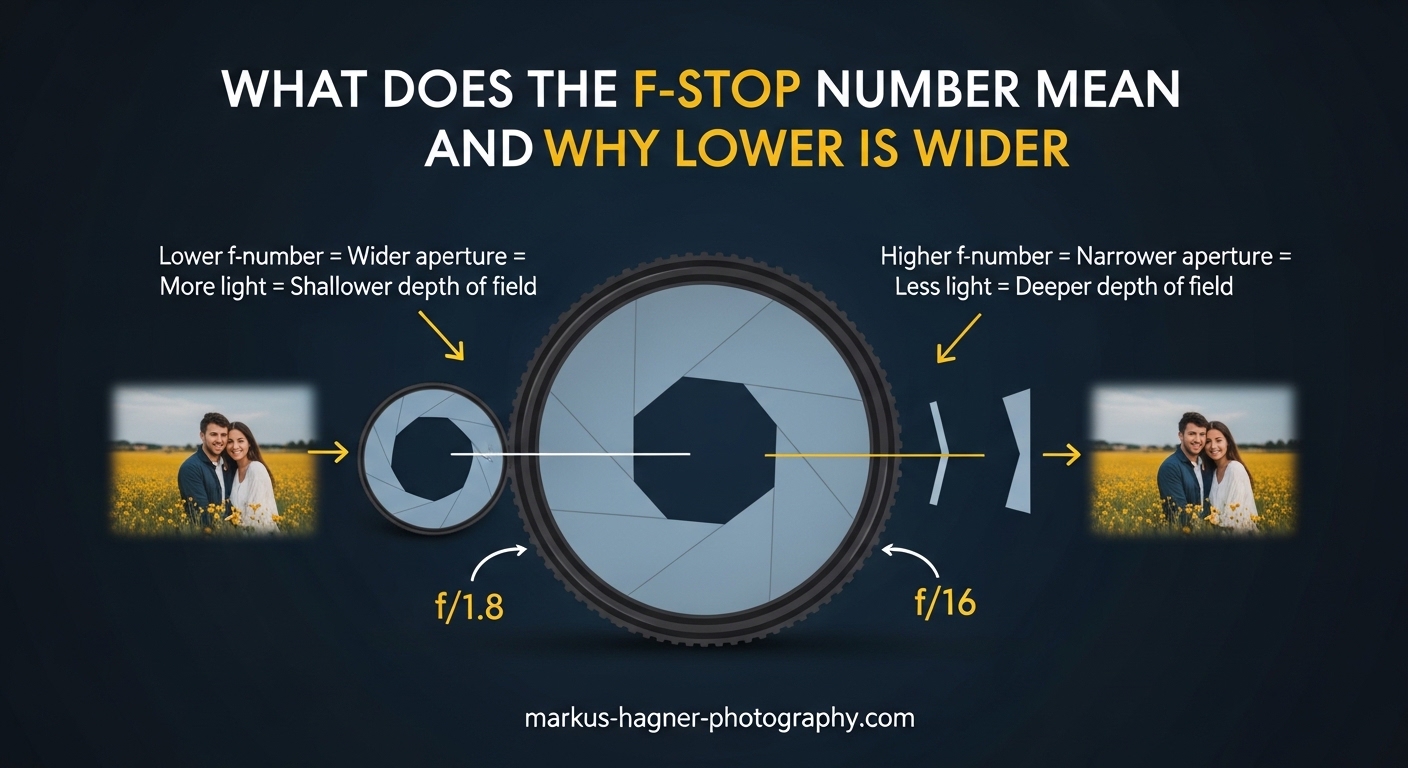
If you’ve ever picked up a camera and felt confused by those mysterious f-numbers, you’re not alone. I remember staring at my first DSLR, completely baffled why f/2.8 seemed to let in more light than f/16. It felt backwards. The smaller number was somehow… bigger?
Here’s the thing: understanding what the f-stop number means unlocks creative control over your photography. Once you grasp why lower numbers mean wider apertures, everything from blurry backgrounds to sharp landscapes suddenly makes sense. This guide will walk you through the concept step by step, using plain language and real examples.
By the end of this article, you’ll understand exactly how f-stops work, why the numbers seem counterintuitive, and which f-stop to choose for any shooting situation. Let’s demystify this together.
Table of Contents
What Does the f-Stop Number Mean?
The f-stop (also called f-number) is simply a ratio that describes the size of your lens’s aperture opening relative to its focal length. Think of it as a fraction. When you see f/8 written on your camera, it literally means the aperture diameter is one-eighth of the focal length.
Here’s the formula: f-number = focal length divided by aperture diameter. So if you’re using a 50mm lens at f/2, your aperture opening measures 25mm (50 divided by 2). At f/4 on that same lens, the opening shrinks to 12.5mm (50 divided by 4).
The aperture itself is created by a series of overlapping blades inside your lens called the diaphragm. When you change the f-stop setting, these blades move together or apart, making the opening larger or smaller. This opening is technically called the entrance pupil, but photographers usually just say “aperture.”
Why write aperture as an f-number instead of just stating the diameter in millimeters? Because the actual size that creates proper exposure depends on the focal length. A 25mm opening means something completely different on a 50mm lens versus a 200mm lens. The f-number system normalizes this, so f/4 produces the same brightness regardless of what lens you attach.
Why Lower F-Stop Numbers Mean Wider Apertures
This is where most people get tripped up, so let me address the elephant in the room. Yes, the relationship is backwards. Lower f-numbers equal larger openings. Higher f-numbers equal smaller openings. Here’s why it actually makes perfect sense.
Remember that f-stops are fractions. Think about slicing a pizza. If you divide it into 2 pieces, each slice is huge. Divide it into 16 pieces, and each slice is tiny. The denominator (bottom number) gets bigger while the actual slice gets smaller. F-stops work the same way.
f/2 is like 1/2 of your focal length. f/16 is like 1/16 of your focal length. One-half is obviously larger than one-sixteenth. So f/2 creates a much wider opening than f/16.
Let’s work through a concrete example. Imagine you’re shooting with a 100mm lens. At f/2, your aperture measures 50mm across (100 divided by 2). That’s a big opening letting in tons of light. Now switch to f/16. Your aperture shrinks to just 6.25mm (100 divided by 16). Same lens, dramatically different opening.
The mathematical relationship explains everything. Since f-number equals focal length divided by aperture diameter, a smaller f-number means the aperture diameter must be larger. When you divide by a smaller number, you get a bigger result. That’s all there is to it.
I’ve found that once photographers internalize the fraction analogy, the confusion disappears. Every time you see an f-number, mentally add “1/” in front of it. f/4 becomes 1/4. f/22 becomes 1/22. Suddenly the relationship feels intuitive.
What Does the ‘f’ Stand For?
The ‘f’ in f-stop stands for focal length. It’s that straightforward. When you write f/4, you’re essentially writing “focal length divided by 4.” This notation comes from optical physics and has been used in photography for over a century.
Some photographers wonder if the ‘f’ might mean “factor” or “fraction” or even “F-number” (named after some forgotten optical scientist). But in technical terms, it simply represents the focal length of your lens. The notation makes the formula visible right in front of you.
Understanding this connection helps reinforce why the math works. The f-number describes how many times the aperture diameter fits into the focal length. At f/8, the aperture is one-eighth the focal length. At f/2, it’s half the focal length. The notation literally tells you the relationship.
The term “stop” has a different origin. In early photography, photographers used physical metal plates with holes of different sizes that literally “stopped” light. They would slide these plates into the lens barrel. Each smaller hole was called a stop because it stopped more light. The terminology stuck even though we now use adjustable iris diaphragms.
The F-Stop Scale Explained
The standard f-stop scale might look random at first: f/1.4, f/2, f/2.8, f/4, f/5.6, f/8, f/11, f/16, f/22. But these numbers follow a precise mathematical pattern. Each step (called a “stop”) either halves or doubles the amount of light reaching your sensor.
Here’s the pattern: each number is approximately 1.4 times the previous one. More precisely, each full stop represents a factor of the square root of 2 (about 1.414). Why? Because the area of a circle depends on the square of its diameter. To halve the light, you need to reduce the diameter by a factor of the square root of 2.
Let me show you how this works in practice. Moving from f/2.8 to f/4 means cutting the light in half. Going from f/4 to f/2.8 doubles the light. Each full stop represents a 2x change in brightness.
Here’s a quick reference for the standard full-stop scale:
f/1.4 – Very wide aperture, excellent for low light and maximum background blur. Requires expensive, fast lenses.
f/2 – Still very wide. Great for portraits and indoor photography without flash.
f/2.8 – A popular maximum aperture for professional zoom lenses. Versatile for many situations.
f/4 – The sweet spot for many lenses in terms of sharpness. Good for general photography and some portraits.
f/5.6 – Middle ground. Often used for group photos and general outdoor shooting.
f/8 – Many lenses are sharpest around this aperture. Excellent for landscapes and product photography.
f/11 – Provides significant depth of field. Useful when you need more of the scene in focus.
f/16 – Very small aperture. Deep depth of field but watch for diffraction softening your image.
f/22 – Smallest common aperture. Maximum depth of field but often shows visible diffraction effects.
Modern cameras also offer third-stop and half-stop increments between these full stops, giving you finer control over exposure. But understanding the full-stop scale gives you the foundation.
How F-Stop Affects Depth of Field
Depth of field describes how much of your image appears acceptably sharp from foreground to background. F-stop is one of the three main factors controlling this (along with focal length and focusing distance). The relationship is direct and powerful.
Lower f-numbers (wider apertures) create shallow depth of field. Less of the image will be in focus. Your subject pops against a soft, blurred background. This effect is why portrait photographers love shooting at f/1.4 or f/2.8.
Higher f-numbers (smaller apertures) create deep depth of field. More of your image stays sharp from front to back. Landscape photographers typically shoot at f/8 to f/16 to keep everything from the foreground rocks to distant mountains in focus.
The background blur created by wide apertures is called bokeh. This term comes from the Japanese word for “blur” or “haze.” Good bokeh appears smooth and creamy, with out-of-focus highlights rendering as pleasing circles. The quality of bokeh depends on your lens design, including the number and shape of aperture blades.
Here’s something I wish someone had told me earlier: the depth of field extends roughly one-third in front of your focus point and two-thirds behind it. This isn’t perfectly accurate at close distances or very wide apertures, but it’s a useful mental model for most situations.
The practical implications are enormous. At f/1.4, you might have just inches of depth of field when focusing close. Miss your focus by a small amount, and your subject’s eyes could be soft while their ears are sharp. At f/16, you might have feet or even yards of depth of field, keeping everything from nearby flowers to distant hills acceptably focused.
This creative control is what makes aperture so powerful. You’re not just adjusting exposure. You’re deciding what your viewer sees clearly and what fades into abstraction. You’re directing attention through selective focus.
One caution about very small apertures: diffraction. When light passes through a tiny opening, it bends and spreads out. This optical phenomenon softens your image, counteracting the benefit of increased depth of field. Most lenses perform best between f/5.6 and f/11. Going beyond f/16 often trades too much sharpness for depth of field.
When to Use Each F-Stop: Practical Guide
Understanding the theory is great, but what really matters is applying it in the field. Here’s how I choose f-stops for different photography situations.
Portrait Photography (f/1.4 to f/2.8)
For individual portraits, I typically reach for the widest aperture my lens allows. f/1.4 to f/2.8 creates that dreamy background blur that makes subjects stand out. The shallow depth of field also helps hide messy backgrounds that would otherwise distract from your subject.
Just remember to focus carefully on the eyes. At f/1.4, your depth of field might be less than an inch. If the eyes aren’t perfectly sharp, the portrait fails regardless of how beautiful the bokeh looks.
Group Photos (f/4 to f/8)
When photographing multiple people at different distances, you need enough depth of field to keep everyone sharp. I usually stop down to f/5.6 or f/8 for groups. This provides a comfortable zone of focus while still offering some background separation.
Landscape Photography (f/8 to f/16)
Landscape photographers typically want everything sharp from the foreground to the horizon. f/8 to f/11 usually provides the best balance of depth of field and lens sharpness. I rarely go beyond f/16 unless absolutely necessary because diffraction starts degrading image quality.
The technique called “focus stacking” lets you capture maximum sharpness at optimal apertures. You take multiple shots focused at different distances, then blend them in software. But for single-shot landscapes, f/11 is often the sweet spot.
Low Light Photography (f/1.4 to f/2.8)
When light is scarce, wide apertures become essential. Opening up to f/1.4 or f/2 lets you maintain reasonable shutter speeds without cranking ISO to noisy levels. This is why “fast” lenses (those with wide maximum apertures) are so valuable for indoor and night photography.
Street Photography (f/5.6 to f/8)
Street photography often requires quick reactions. Many street photographers use f/8 with zone focusing, setting focus at a middle distance and relying on depth of field to keep subjects sharp. This eliminates autofocus delay and lets you capture fleeting moments.
Product Photography (f/8 to f/11)
Products need to appear sharp throughout, but you still want some background separation. f/8 to f/11 typically provides enough depth of field while maintaining excellent image quality. For maximum sharpness, many product photographers use focus stacking.
Wildlife and Sports (f/4 to f/5.6)
These subjects often require fast shutter speeds to freeze motion. A moderately wide aperture like f/4 or f/5.6 lets in enough light while providing enough depth of field to keep your subject sharp even if focus isn’t perfect.
Frequently Asked Questions
Is a lower f-stop wider?
Yes, a lower f-stop number means a wider aperture opening. This happens because f-stops are fractions. Just as 1/2 is larger than 1/16, f/2 represents a larger aperture opening than f/16. The lower the f-number, the more light enters your lens.
What does the f-stop number actually mean?
The f-stop number represents the ratio of your lens’s focal length to the aperture diameter. It’s calculated by dividing focal length by aperture diameter. For example, at f/4 on a 100mm lens, the aperture opening measures 25mm (100 divided by 4). This standardization means f/4 produces the same exposure regardless of lens focal length.
Is f/2.8 or f/4 better?
Neither is inherently better. f/2.8 lets in twice as much light as f/4, making it ideal for low light situations and creating shallow depth of field with blurry backgrounds. f/4 provides more depth of field and often represents a lens’s sweet spot for sharpness. Choose based on your creative goals and lighting conditions.
Why is a lower f-stop faster?
Lower f-stops are called ‘faster’ because wider apertures let in more light, allowing you to use faster shutter speeds while maintaining proper exposure. A lens that opens to f/1.4 is ‘faster’ than one that only reaches f/4 because you can shoot at higher shutter speeds in the same lighting conditions.
Conclusion
The f-stop concept might seem backwards at first, but it’s actually elegant once you understand the fraction relationship. Lower numbers mean wider apertures because f/2 literally means one-half of your focal length, while f/16 means one-sixteenth. The math works out perfectly.
What does the f-stop number mean for your photography? It means creative control. You decide whether to blur backgrounds or keep everything sharp. You decide how much light reaches your sensor. Understanding f-stops transforms you from someone who takes pictures into someone who makes photographs with intention.
My recommendation: switch your camera to aperture priority mode and spend a day shooting the same subject at different f-stops. Watch how depth of field changes. See how the background transforms. Experience is the best teacher, and modern digital photography lets you experiment freely without wasting film.