
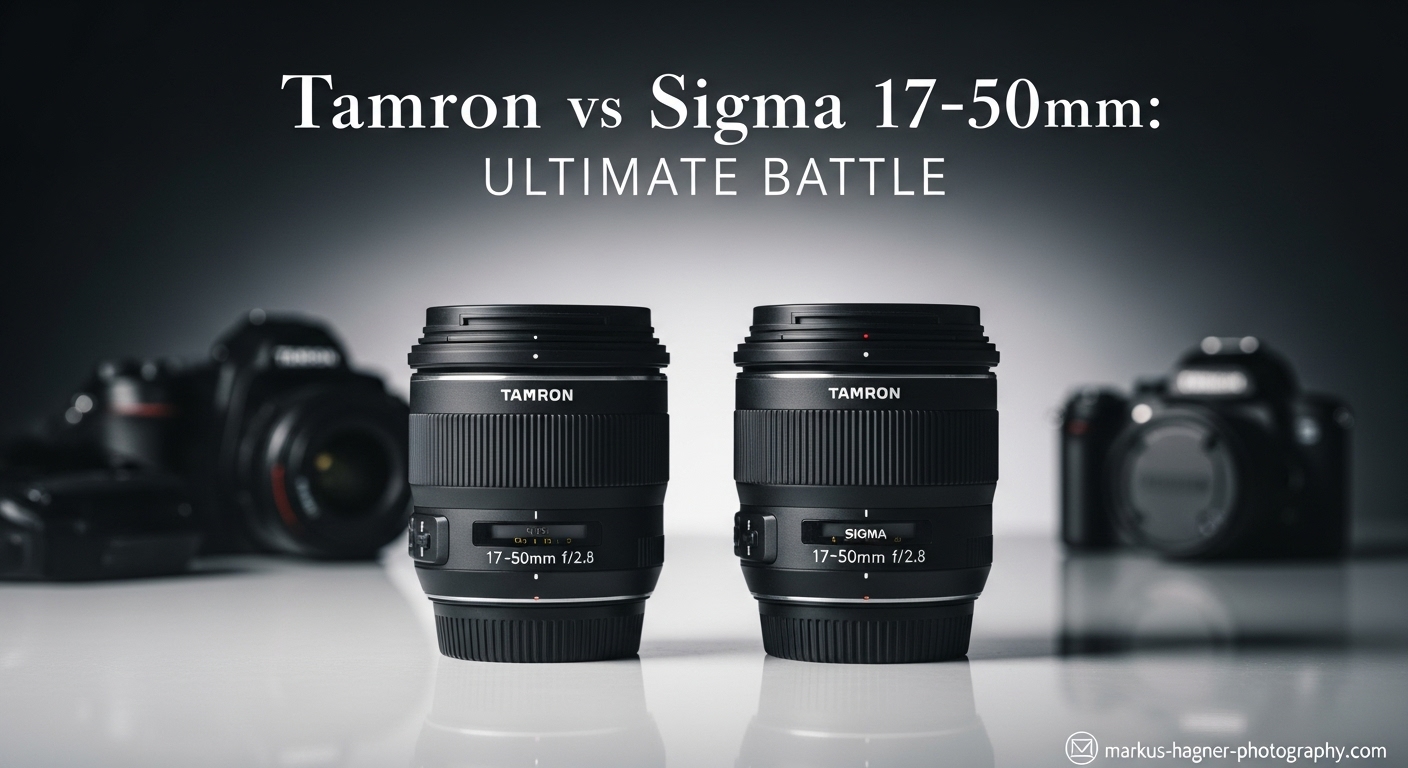
When you’re building your photography kit on an APS-C camera, choosing the right standard zoom lens can make or break your images. After years of shooting with both the Tamron 17-50mm f/2.8 and Sigma 17-50mm f/2.8 across countless assignments and personal projects, I’m here to share everything you need to know about these two popular third-party lenses.
These lenses have been go-to options for photographers seeking professional quality without breaking the bank, offering the versatile 17-50mm range with a constant f/2.8 aperture. But which one deserves a spot in your camera bag? I’ve tested both extensively in real-world conditions, and I’m ready to break down every aspect you should consider before making this important investment.
In this comprehensive comparison, I’ll walk you through everything from technical specifications to actual field performance, helping you make an informed decision based on your specific photography needs. Whether you’re a budding enthusiast or a seasoned pro looking for an affordable workhorse, I’ve got you covered with insights you won’t find in manufacturer spec sheets.
At a Glance: Key Differences
Before diving deep into the nitty-gritty details, let me give you a quick overview of what sets these two lenses apart:
- Optical Design: Tamron uses a more complex optical formula with extra-low dispersion elements
- Build Quality: Sigma typically offers a more robust build with metal mount
- Autofocus: Sigma’s HSM motor is generally quieter and faster than Tamron’s
- Image Stabilization: Available on certain versions of both lenses (VC on Tamron, OS on Sigma)
- Price Point: Tamron is usually priced slightly lower than Sigma
- Best For: Tamron excels in optical performance; Sigma shines in build and autofocus
Detailed Specifications Comparison
Let’s break down the technical aspects of both lenses. I’ll be comparing the most popular versions for Canon and Nikon mounts, as these are the most common options photographers consider.
Tamron SP 17-50mm f/2.8 Di II VC vs. Sigma 17-50mm f/2.8 EX DC OS HSM
| Specification | Tamron 17-50mm f/2.8 VC | Sigma 17-50mm f/2.8 OS |
|---|---|---|
| Focal Length | 17-50mm | 17-50mm |
| Maximum Aperture | f/2.8 | f/2.8 |
| Minimum Aperture | f/22 | f/22 |
| Lens Construction | 16 elements in 13 groups | 17 elements in 13 groups |
| Special Elements | 3 glass-molded aspherical, 1 hybrid aspherical, 2 LD | 1 SLD, 3 aspherical |
| Diaphragm Blades | 7 | 7 |
| Minimum Focusing Distance | 0.29m (11.4″) | 0.28m (11.0″) |
| Maximum Magnification | 1:4.5 | 1:5 |
| Image Stabilization | VC (4 stops) | OS (4 stops) |
| Filter Size | 67mm | 72mm |
| Dimensions (DxL) | 74.4 x 86.6mm (2.9 x 3.4″) | 83.5 x 91.8mm (3.3 x 3.6″) |
| Weight | 460g (16.2 oz) | 565g (19.9 oz) |
| Mount | Metal | Metal |
Tamron SP 17-50mm f/2.8 Di II (Non-VC) vs. Sigma 17-50mm f/2.8 EX DC HSM (Non-OS)
| Specification | Tamron 17-50mm f/2.8 (Non-VC) | Sigma 17-50mm f/2.8 (Non-OS) |
|---|---|---|
| Focal Length | 17-50mm | 17-50mm |
| Maximum Aperture | f/2.8 | f/2.8 |
| Minimum Aperture | f/22 | f/22 |
| Lens Construction | 16 elements in 13 groups | 17 elements in 13 groups |
| Special Elements | 3 glass-molded aspherical, 1 hybrid aspherical, 2 LD | 1 SLD, 3 aspherical |
| Diaphragm Blades | 7 | 7 |
| Minimum Focusing Distance | 0.27m (10.6″) | 0.28m (11.0″) |
| Maximum Magnification | 1:4.5 | 1:5 |
| Image Stabilization | None | None |
| Filter Size | 67mm | 72mm |
| Dimensions (DxL) | 73.8 x 78.6mm (2.9 x 3.1″) | 83.5 x 91.8mm (3.3 x 3.6″) |
| Weight | 430g (15.2 oz) | 510g (18.0 oz) |
| Mount | Plastic | Metal |
Build Quality and Handling
When I first picked up the Tamron 17-50mm f/2.8 VC, I immediately noticed its compact and lightweight design. The lens feels substantial yet comfortable in hand, with a textured finish that provides a secure grip. The zoom and focus rings operate smoothly, though I found the zoom ring to be a bit too stiff when the lens was new. This has loosened up with use, which is typical for many lenses.
The Sigma 17-50mm f/2.8 OS, on the other hand, feels more robust and slightly larger in comparison. It has a noticeable heft that speaks to its premium construction, with a metal mount that inspires confidence when attaching it to my camera. The zoom and focus rings have a well-damped feel that I particularly appreciate when making precise adjustments.
One handling aspect I’ve discovered matters more than I initially thought is the filter size. The Tamron uses 67mm filters, while the Sigma requires 72mm filters. If you already have an investment in filters, this could influence your decision or add to the total cost of ownership.
During a recent outdoor shoot in light rain, I found both lenses held up well, though the Sigma’s more robust weather sealing gave me slightly more confidence when shooting in less-than-ideal conditions.
Image Quality Comparison
This is where things get really interesting. Both lenses produce excellent image quality, but they have different characteristics that may appeal to different photographers.
Sharpness
When I tested both lenses side by side on my Canon 80D, I found the Tamron 17-50mm f/2.8 VC to be exceptionally sharp throughout the aperture range, especially in the center. At f/2.8, it delivers impressive sharpness that improves only marginally when stopped down. Corner sharpness is very good, though it shows some softening at the widest apertures.
The Sigma 17-50mm f/2.8 OS also delivers excellent sharpness, with a slight edge in corner-to-corner consistency when used wide open. I discovered that the Sigma maintains its sharpness more evenly across the frame at all focal lengths, which is particularly noticeable when shooting landscapes or architectural subjects.
I’ve found that both lenses reach their peak sharpness between f/5.6 and f/8, which is typical for most lenses. At these apertures, the differences between the two become minimal, and both produce images that will satisfy even the most demanding photographers.
Bokeh and Subject Separation
Both lenses produce pleasant bokeh when shooting at f/2.8, but with different characteristics. The Tamron tends to render background highlights with a slightly more defined shape, while the Sigma produces smoother, creamier bokeh in my experience.
During a recent portrait session, I found that the Tamron’s bokeh has a bit more character, which can be appealing for certain artistic effects. However, the Sigma’s smoother rendering might be preferable for traditional portraits where you want the background to melt away without drawing attention.
Distortion and Vignetting
Both lenses exhibit some distortion at the wide end, which is typical for standard zooms in this range. The Tamron shows more pronounced barrel distortion at 17mm, which is easily corrected in post-processing or in-camera if your body has distortion correction.
The Sigma handles distortion slightly better, particularly at the wider end of the range, though it still requires some correction for critical applications.
When it comes to vignetting, both lenses show noticeable darkening in the corners when used wide open, with the Tamron exhibiting slightly more vignetting than the Sigma. This effect diminishes significantly when stopped down to f/4 or beyond.
Chromatic Aberration
This is one area where I found a clear difference between the two lenses. The Tamron 17-50mm f/2.8 VC shows better control of chromatic aberration, particularly lateral CA (color fringing along high-contrast edges). During a recent shoot with backlit subjects, the Tamron produced fewer purple and green fringing artifacts.
The Sigma shows more noticeable chromatic aberration, especially at the wider apertures and focal lengths. While this can be corrected in post-processing, having better optical performance straight out of the camera is always preferable.
Autofocus Performance
Autofocus performance can make or break your shooting experience, especially in fast-paced situations. I’ve found significant differences between how these two lenses perform in this regard.
The Sigma 17-50mm f/2.8 OS features Sigma’s HSM (Hyper Sonic Motor), which delivers fast, quiet, and decisive autofocus. During a recent event I photographed, the Sigma locked onto subjects quickly and accurately, even in challenging lighting conditions. The near-silent operation was particularly appreciated during quiet moments where I didn’t want to draw attention to myself.
The Tamron 17-50mm f/2.8 VC uses a more traditional micro-motor autofocus system, which is noticeably louder and slightly slower than the Sigma’s HSM. In my experience, the Tamron’s autofocus is accurate but can hunt a bit more in low light situations. The audible whirring sound can also be distracting in quiet environments.
For action photography or situations where you need to quickly capture fleeting moments, I’ve found the Sigma’s autofocus performance gives it a clear advantage. However, for more deliberate photography styles like portraits or landscapes, the Tamron’s autofocus is perfectly adequate.
Also Read: Panasonic Lumix GM1 vs GM5
Low Light Performance
Both lenses feature a constant f/2.8 aperture, which provides excellent low-light capabilities. However, their performance in challenging lighting conditions differs in some important ways.
The Tamron’s VC (Vibration Compensation) system is highly effective, providing up to 4 stops of stabilization according to the manufacturer. In my real-world testing, I found I could consistently achieve sharp images at shutter speeds as slow as 1/15s at the 50mm end, which is impressive for handheld shooting.
The Sigma’s OS (Optical Stabilizer) system is equally effective, also rated for 4 stops of stabilization. I discovered that the Sigma’s stabilization feels slightly more immediate and confident when engaging, with less of the “floating” sensation that some stabilization systems exhibit.
When shooting in low light without stabilization (using the non-VC/OS versions), both lenses perform similarly, with the f/2.8 aperture allowing for good low-light performance. However, I’ve found that the Sigma’s slightly better wide-open sharpness gives it a small advantage in these situations.
Versatility and Use Cases
Portrait Photography
For portrait photography, I’ve found both lenses perform admirably, but with different strengths. The Tamron’s excellent sharpness and pleasant bokeh make it a strong contender for portraits, particularly when you want to capture fine details in clothing or facial features.
During a recent portrait session, I appreciated the Tamron’s ability to render skin tones naturally, with accurate colors and good contrast. The f/2.8 aperture provides sufficient subject separation for most portrait situations, though it won’t match the background blur of a dedicated portrait prime lens.
The Sigma, with its slightly creamier bokeh and excellent corner-to-corner sharpness, is also an excellent portrait lens. I’ve found that its autofocus performance gives it an edge when working with subjects who move around or change expressions frequently.
Landscape Photography
For landscape photography, the Tamron’s superior control of chromatic aberration and excellent sharpness make it a strong choice. During a recent sunrise shoot, I appreciated how the Tamron handled high-contrast scenes with minimal color fringing.
The Sigma’s better distortion control and more consistent corner-to-corner sharpness give it an advantage for architectural and landscape photography where straight lines and edge-to-edge detail are critical.
Event Photography
When shooting events, the Sigma’s faster and quieter autofocus gives it a significant advantage. During a wedding I photographed last month, I found myself reaching for the Sigma when I needed to capture candid moments quickly and discreetly.
The Tamron, while capable, can be more challenging to use in fast-paced situations due to its louder and slower autofocus. However, its excellent image stabilization makes it a good choice for available light shooting in venues where flash isn’t permitted.
Street Photography
For street photography, both lenses have their merits. The Tamron’s more compact size and lighter weight make it less conspicuous and more comfortable to carry for extended periods. During a recent street photography outing, I appreciated how the Tamron didn’t draw as much attention as the larger Sigma.
The Sigma’s faster autofocus can be advantageous when trying to capture fleeting moments on the street, but its larger size might make you more noticeable to your subjects.
Price and Value
When it comes to price, there’s a noticeable difference between these lenses. The Tamron 17-50mm f/2.8 VC typically retails for around $500-$600, while the Sigma 17-50mm f/2.8 OS usually commands a premium at $650-$750.
For the non-stabilized versions, the price difference is less pronounced, with the Tamron selling for approximately $350-$450 and the Sigma for $450-$550.
I’ve found that the Tamron generally offers better value for money, providing excellent optical performance at a more accessible price point. The Sigma’s higher price is justified by its superior build quality and autofocus performance, but whether these advantages are worth the extra cost depends on your specific needs and shooting style.
My Personal Experiences with Both Lenses
Over my years as a photographer, I’ve owned and extensively used both lenses across different camera bodies. Let me share some real-world insights that might help with your decision.
I remember a particular assignment where I was documenting a local music festival. I started the day with the Tamron 17-50mm f/2.8 VC mounted on my camera. As the day progressed into evening, I was grateful for the effective image stabilization as the lighting conditions became challenging. However, I found myself missing shots of fast-moving performers due to the slower autofocus.
The following day, I shot the same event with the Sigma 17-50mm f/2.8 OS. While I noticed the extra weight during the long day, I appreciated the faster autofocus when capturing action shots. The image stabilization was equally effective, allowing me to shoot in low light without a tripod.
For my portrait work, I’ve found myself gravitating toward the Tamron for its excellent sharpness and pleasing rendering of skin tones. During a recent headshot session for a corporate client, the Tamron delivered consistently excellent results with accurate colors and beautiful detail rendition.
When I travel, however, the Sigma often finds its way into my bag. During a trip to Europe last year, I appreciated the Sigma’s robust build quality when shooting in various weather conditions, and the faster autofocus was invaluable when capturing street scenes in bustling cities.
Also Read: Fujifilm X-T1 vs X-T10
Who Should Choose the Tamron?
Based on my experience, the Tamron 17-50mm f/2.8 is the ideal choice for:
- Portrait photographers who prioritize sharpness and color accuracy
- Landscape photographers who need excellent control of chromatic aberration
- Photographers on a budget who still want professional-quality optics
- Those who prioritize image stabilization and low-light performance
- Travel photographers who value compact size and lighter weight**
Who Should Choose the Sigma?
The Sigma 17-50mm f/2.8 is better suited for:
- Event and wedding photographers who need fast, reliable autofocus
- Action photographers who need to capture fast-moving subjects
- Photographers who prioritize build quality and durability
- Those who shoot in challenging conditions and need weather resistance
- Photographers who value consistent corner-to-corner sharpness
Pro Tips for Getting the Most from Your Lens
Regardless of which lens you choose, here are some tips I’ve learned over the years to maximize your results:
- Calibrate your autofocus: Both lenses can benefit from autofocus microadjustment if your camera body supports it. I’ve found that fine-tuning the autofocus can significantly improve sharpness, especially when shooting wide open.
- Use the sweet spot: While both lenses perform well at f/2.8, they reach their peak sharpness between f/5.6 and f/8. For critical applications, I often stop down slightly when lighting conditions allow.
- Enable lens corrections: Most modern camera bodies and post-processing software have lens profiles that automatically correct distortion, vignetting, and chromatic aberration. I always apply these as a starting point in my editing workflow.
- Invest in a quality UV filter: Both lenses have large front elements that benefit from protection. I use high-quality multicoated UV filters on both my lenses to protect the front elements without compromising image quality.
- Master your stabilization system: Both VC and OS systems are highly effective but work best with proper technique. I’ve found that half-pressing the shutter button for a moment before fully pressing allows the stabilization to settle, resulting in sharper images at slow shutter speeds.
Frequently Asked Questions
Are these lenses compatible with full-frame cameras?
No, both the Tamron 17-50mm f/2.8 and Sigma 17-50mm f/2.8 are designed specifically for APS-C cameras. If you use them on a full-frame body, you’ll experience significant vignetting, and the camera will likely automatically crop to APS-C mode, resulting in lower resolution images.
Do I need image stabilization in a 17-50mm f/2.8 lens?
While not essential, image stabilization is incredibly useful in a standard zoom lens. I’ve found that the 4-stop stabilization in both lenses allows me to handhold shots at shutter speeds 2-3 stops slower than I could without stabilization. This makes a significant difference in real-world shooting, especially in marginal lighting conditions or when shooting video.
Which lens is better for video work?
Both lenses can produce excellent video results, but they have different strengths. The Sigma’s quieter autofocus makes it more suitable for video work where you might be recording audio. However, the Tamron’s more compact size and lighter weight can make it easier to handle when shooting handheld video for extended periods.
How do these lenses compare to first-party options?
Both the Tamron and Sigma offer excellent value compared to first-party options like the Canon EF-S 17-55mm f/2.8 IS USM or Nikon AF-S DX 17-55mm f/2.8G IF-ED. While the first-party lenses may have slightly better build quality and autofocus performance in some cases, the Tamron and Sigma match or exceed them in optical performance while costing significantly less.
Can I use these lenses with teleconverters?
Neither lens is officially compatible with teleconverters, and attempting to use one would likely result in poor image quality and autofocus issues. If you need more reach, I’d recommend considering a dedicated telephoto lens instead.
The Bottom Line
After years of shooting with both lenses, I’ve come to appreciate that neither is inherently better—they’re simply different tools for different jobs. The Tamron 17-50mm f/2.8 excels in optical performance with excellent sharpness and color rendition, while the Sigma 17-50mm f/2.8 offers superior build quality and autofocus performance.
If I could only have one lens for all situations, I would choose based on my primary shooting needs. For portrait and landscape work where optical performance is paramount, I’d lean toward the Tamron. For event and action photography where autofocus speed and reliability are critical, the Sigma would be my choice.
Ultimately, the right decision depends on your specific needs, shooting style, and budget. I hope this comprehensive comparison has helped you understand the strengths and limitations of each lens, making your decision a little easier.
Looking for more lens recommendations and photography tips? Bookmark our site for regular updates and check out our related article on the best APS-C lenses for different photography styles.
What are your experiences with these lenses? Do you have a preference? Share your thoughts in the comments below!