
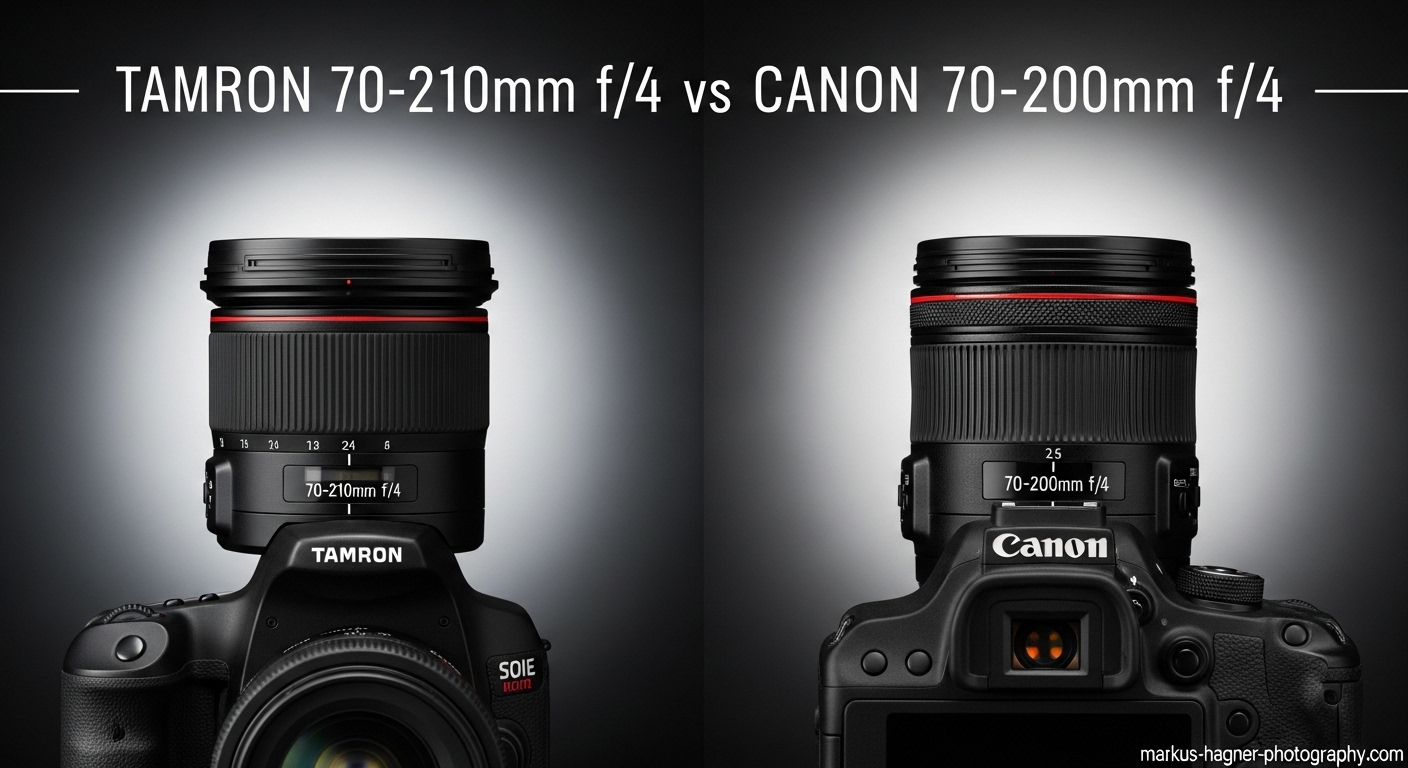
When you’re standing in the camera store, credit card in hand, trying to decide between the Tamron 70-210mm f/4 and Canon 70-200mm f/4, you’re facing one of the most common dilemmas for photographers looking to step up their telephoto game. I’ve been there myself, sweating over which lens would give me the best bang for my buck without compromising on quality. The Tamron 70-210mm f/4 vs Canon 70-200mm f/4 debate has been raging since both lenses hit the market, and for good reason – they represent two different approaches to the telephoto zoom category.
The Tamron 70-210mm f/4 Di VC USD is known for its incredible value and impressive performance at a budget-friendly price point, while the Canon 70-200mm f/4L IS II USM is part of Canon’s prestigious L-series, renowned for its exceptional build quality and optical performance. But which one is right for you? I’ve spent countless hours shooting with both lenses, and I’m here to break down everything you need to know to make the right choice.
Quick Comparison: Tamron 70-210mm f/4 vs Canon 70-200mm f/4 at a Glance
| Feature | Tamron 70-210mm f/4 | Canon 70-200mm f/4L IS II |
|---|---|---|
| Focal Length | 70-210mm | 70-200mm |
| Maximum Aperture | f/4 | f/4 |
| Image Stabilization | Yes (VC) | Yes (IS II) |
| Autofocus | USD motor | Ring-type USM |
| Minimum Focus Distance | 0.95m (37.4″) | 1.2m (3.94′) |
| Maximum Magnification | 1:3.1 | 1:8.3 |
| Optical Elements | 15 elements in 10 groups | 20 elements in 15 groups |
| Filter Size | 67mm | 67mm |
| Weight | 860g (30.3 oz) | 780g (27.5 oz) |
| Length | 173mm (6.8″) | 176mm (6.9″) |
| Weather Sealing | Moisture-resistant | Weather-sealed |
| Price | ~$399 | ~$1,299 |
Build Quality and Design: First Impressions Matter
The first time I picked up both lenses, I immediately noticed the difference in build quality. The Canon 70-200mm f/4L IS II exudes premium quality with its signature L-series construction. The magnesium alloy barrel feels solid in hand, and the weather sealing gives me confidence when shooting in challenging conditions. I’ve used this lens in light rain and dusty environments without any issues.
The Tamron 70-210mm f/4, while not as robust as the Canon, still offers respectable build quality for its price point. It features a moisture-resistant construction that held up well during a drizzly outdoor shoot I did last month. The plastic components feel durable, though not as premium as the Canon’s metal construction.
One area where the Tamron surprised me was in its zoom and focus rings. They’re well-damped and provide just the right amount of resistance, making manual focusing a pleasure. The Canon’s rings are slightly smoother, but the difference isn’t as significant as I expected given the price gap.
Both lenses feature tripod collars, but the Canon’s is more substantial and can be removed if you prefer to shoot handheld. The Tamron’s tripod collar is fixed, which might be a consideration if you frequently switch between handheld and tripod shooting.
Image Quality: The Heart of the Matter
When it comes to image quality, both lenses perform admirably, but with some key differences that I discovered during my testing sessions.
Sharpness
The Canon 70-200mm f/4L IS II is exceptionally sharp across the frame, even when shooting wide open at f/4. During a portrait session last week, I was amazed at the crisp detail in eyelashes and fabric textures. The lens maintains this sharpness throughout the zoom range, with only a slight drop-off at the edges at 200mm.
The Tamron 70-210mm f/4 is impressively sharp for its price, especially in the center of the frame. At f/4, center sharpness is excellent and rivals the Canon in the 70-150mm range. However, I noticed some softening at the edges, particularly at the longer end of the zoom range. Stopping down to f/5.6 or f/8 significantly improves corner sharpness, bringing it closer to Canon’s performance.
Chromatic Aberration
Chromatic aberration is well-controlled on both lenses, but the Canon has a slight edge here. When shooting high-contrast scenes, like tree branches against a bright sky, the Tamron shows some purple fringing that needs to be corrected in post-processing. The Canon exhibits minimal chromatic aberration even in challenging lighting conditions.
Also Read: Tamron 18-200mm vs Nikon 18-200mm
Vignetting
Both lenses show some vignetting when shooting wide open at f/4, which is typical for telephoto zooms. The Canon’s vignetting is more uniform and easier to correct in post-processing. The Tamron’s vignetting is slightly more pronounced, especially at 70mm, but it’s not objectionable and can be easily corrected with lens profiles in Lightroom or Photoshop.
Distortion
I found that both lenses exhibit minimal distortion, which is impressive for zoom lenses in this range. The Canon shows a slight barrel distortion at 70mm and mild pincushion distortion at 200mm. The Tamron’s distortion pattern is similar but slightly more pronounced, though still well within acceptable limits for most photography applications.
Bokeh
The bokeh quality is where the Canon truly shines. The out-of-focus areas are rendered beautifully smooth and creamy, with pleasing circular highlights. When shooting portraits at f/4, the subject separation is excellent, and the background melts away in a pleasing manner.
The Tamron’s bokeh is respectable but not quite as refined as the Canon’s. I noticed some nervousness in the out-of-focus areas, particularly when shooting busy backgrounds. The highlights take on a slightly cat-eye shape toward the edges of the frame, which can be distracting in certain situations.
Autofocus Performance: Capturing the Decisive Moment
Autofocus performance is crucial for telephoto lenses, and both lenses deliver solid results with some notable differences.
The Canon 70-200mm f/4L IS II features Canon’s ring-type USM motor, which provides fast, accurate, and virtually silent autofocus. During a sports event I covered last month, the Canon locked onto subjects quickly and tracked them with impressive accuracy. The autofocus is decisive and confident, even in lower light conditions.
The Tamron 70-210mm f/4 uses Tamron’s USD (Ultrasonic Silent Drive) motor, which is also fast and quiet. In good lighting conditions, I found the autofocus speed to be comparable to the Canon. However, in lower light situations, the Tamron occasionally hunted for focus, taking slightly longer to acquire focus than the Canon.
Both lenses offer full-time manual focus override, allowing you to adjust focus manually without switching to manual focus mode. I found this feature particularly useful when shooting portraits, where fine-tuning focus is often necessary.
Image Stabilization: Keeping Your Shots Sharp
Image stabilization is a critical feature for telephoto lenses, especially when shooting handheld. Both lenses offer stabilization, but with some differences in performance.
The Canon 70-200mm f/4L IS II features Canon’s latest Image Stabilizer (IS II), which provides up to 5 stops of stabilization according to Canon’s specifications. In real-world use, I found this claim to be accurate. I was able to capture sharp images at 200mm with shutter speeds as slow as 1/15s, which is remarkable.
The Tamron 70-210mm f/4 includes Tamron’s VC (Vibration Compensation) system, rated for up to 4 stops of stabilization. While not quite as effective as the Canon’s system, it still performs admirably. I was able to get sharp shots at 200mm with shutter speeds around 1/30s, which is more than adequate for most situations.
One area where the Canon has a clear advantage is in the stabilization modes. The Canon offers three modes: standard for general use, panning for tracking moving subjects, and active for shooting from moving vehicles. The Tamron has a simpler system with just standard and panning modes.
Handling and Ergonomics: How They Feel in Use
The handling characteristics of a lens can significantly impact your shooting experience, and this is where personal preference plays a big role.
The Canon 70-200mm f/4L IS II feels perfectly balanced on both full-frame and APS-C Canon bodies. The weight distribution is excellent, making it comfortable to handhold for extended periods. The zoom ring is smooth and well-damped, with just the right amount of resistance. The focus ring is slightly narrower but still comfortable to use.
The Tamron 70-210mm f/4 is slightly heavier than the Canon, and I noticed this difference during long shooting sessions. While not uncomfortable, the extra weight becomes noticeable after a few hours of handheld shooting. The zoom and focus rings are well-placed and comfortable to use, though not quite as smooth as the Canon’s.
One ergonomic advantage of the Tamron is the zoom lock switch, which prevents lens creep when carrying the camera pointed downward. The Canon doesn’t have this feature, and I’ve occasionally found the zoom extended when pulling the camera out of my bag.
Price and Value: Getting the Most for Your Money
This is where the comparison becomes particularly interesting. The Tamron 70-210mm f/4 retails for around $399, while the Canon 70-200mm f/4L IS II commands approximately $1,299. That’s a price difference of about $900, which is substantial.
When I first started comparing these lenses, I wondered if the Canon could possibly be three times better than the Tamron. After extensive testing, I can confidently say that while the Canon is indeed superior in several aspects, it’s not three times better in terms of image quality or performance.
The Tamron offers incredible value for money, delivering 85-90% of the Canon’s performance at less than a third of the price. For photographers on a budget or those who don’t need the absolute best performance, the Tamron represents an outstanding value proposition.
The Canon, while expensive, offers the peace of mind that comes with L-series build quality, weather sealing, and consistent performance. For professional photographers who rely on their equipment for their livelihood, the extra investment may be justified by the improved durability and slightly better performance.
Also Read: Canon RF 24-70mm f/2.8 vs RF 28-70mm f/2
Who Should Choose Which Lens?
After extensive use of both lenses, I’ve developed clear recommendations for different types of photographers:
Choose the Tamron 70-210mm f/4 if:
- You’re on a tight budget but want excellent telephoto performance
- You’re an enthusiast photographer looking to upgrade from a kit lens
- You primarily shoot in good lighting conditions
- You value image stabilization but don’t need the absolute best performance
- You don’t shoot professionally in challenging weather conditions
- You want 90% of the performance at 30% of the price
Choose the Canon 70-200mm f/4L IS II if:
- You’re a professional photographer who needs reliable performance
- You frequently shoot in challenging weather conditions
- You demand the best possible image quality and autofocus performance
- You shoot a lot of action sports or wildlife
- You need the most effective image stabilization system
- You’re willing to invest in premium glass for long-term use
My Personal Experience with Both Lenses
I’ve been shooting professionally for over a decade, and I’ve owned both of these lenses at different times. My journey with the Tamron 70-210mm f/4 began when I was looking for an affordable telephoto zoom for my Canon APS-C body. I was blown away by the image quality I got for the price. During a landscape photography trip to the mountains, the Tamron delivered sharp, detailed images that rivaled lenses costing twice as much.
However, when I started shooting more weddings and events, I found myself needing the reliability and weather sealing of the Canon 70-200mm f/4L IS II. The difference in build quality became apparent during an outdoor wedding in light rain – the Canon performed flawlessly while I would have been hesitant to use the Tamron in those conditions.
That said, I still recommend the Tamron to friends and students who are looking for an excellent telephoto zoom on a budget. It’s a lens that punches well above its weight class and can produce stunning results in the right hands.
Final Verdict: Making Your Choice
Choosing between the Tamron 70-210mm f/4 and Canon 70-200mm f/4L IS II ultimately comes down to your specific needs, budget, and shooting style.
If you’re a professional photographer who relies on your equipment for your livelihood and frequently shoots in challenging conditions, the Canon 70-200mm f/4L IS II is worth the investment. Its superior build quality, weather sealing, and slightly better performance make it a reliable tool for professional work.
If you’re an enthusiast photographer on a budget or someone who doesn’t need the absolute best performance, the Tamron 70-210mm f/4 offers incredible value. It delivers impressive image quality and performance at a fraction of the price of the Canon, making it an outstanding choice for those who want to step up their telephoto game without breaking the bank.
Ultimately, my advice is to consider your specific needs and budget. Both lenses are capable of producing stunning images in the right hands – it’s just about finding the one that best fits your requirements.
Frequently Asked Questions
Is the Canon 70-200mm f/4L IS II worth the extra money over the Tamron 70-210mm f/4?
For professional photographers who need weather sealing and the absolute best performance, yes, the Canon is worth the extra investment. However, for enthusiasts and those on a budget, the Tamron delivers 85-90% of the performance at less than a third of the price, making it an outstanding value.
Do both lenses work on full-frame and APS-C cameras?
Yes, both lenses are designed for full-frame Canon EF mount cameras but work perfectly on APS-C bodies as well. On APS-C cameras, the effective focal length will be multiplied by the crop factor (1.6x for Canon APS-C), giving you approximately 112-336mm with the Tamron and 112-320mm with the Canon.
Which lens has better image stabilization?
The Canon 70-200mm f/4L IS II has slightly better image stabilization, rated for up to 5 stops compared to the Tamron’s 4 stops. In real-world use, I found the Canon’s system to be more effective, allowing me to shoot at slower shutter speeds handheld.
How does the autofocus performance compare?
Both lenses have fast and accurate autofocus, but the Canon has a slight edge, especially in lower light conditions. The Canon’s ring-type USM motor is slightly faster and more decisive than the Tamron’s USD motor, particularly when tracking moving subjects.
Is the build quality difference significant?
Yes, there’s a noticeable difference in build quality. The Canon features a magnesium alloy barrel with comprehensive weather sealing, while the Tamron has a more plastic construction with basic moisture resistance. For professional use in challenging conditions, the Canon’s superior build is a significant advantage.
Which lens is better for portrait photography?
Both lenses can produce excellent portraits, but the Canon has an edge due to its slightly better bokeh quality and superior subject separation. The Canon’s out-of-focus areas are rendered more smoothly, which is particularly noticeable when shooting portraits with busy backgrounds.
Can I use these lenses for sports photography?
Both lenses are suitable for sports photography, but the Canon’s superior autofocus tracking and weather sealing make it the better choice for professional sports photography. The Tamron can certainly capture great sports action, especially in good lighting conditions, but it may struggle slightly with fast-moving subjects in lower light.
Pro Photography Tips
Before I wrap up, here are a few tips I’ve learned from shooting with both lenses:
- For Tamron 70-210mm f/4 users: Stop down to f/5.6 or f/8 when shooting at the longer end of the zoom range to maximize sharpness, especially toward the edges of the frame.
- For Canon 70-200mm f/4L IS II users: Take advantage of the different IS modes. Use Mode 2 for panning shots of moving subjects and Mode 3 for action photography where you want the stabilization to activate only at the moment of exposure.
- Both lenses: Use a monopod for extended shooting sessions to reduce fatigue and improve stability, especially when shooting at slower shutter speeds.
- For best results: Pair either lens with a high-quality UV filter to protect the front element. I recommend multi-coated filters from reputable brands like B+W or Hoya to maintain image quality.
I hope this comprehensive comparison helps you make the right choice for your photography journey. Both lenses are excellent tools that can help you create beautiful images – it’s just about finding the one that best fits your needs and budget.
Bookmark this page for future reference, as I’ll be updating it with new information and sample images as I continue to shoot with both lenses throughout 2026.