
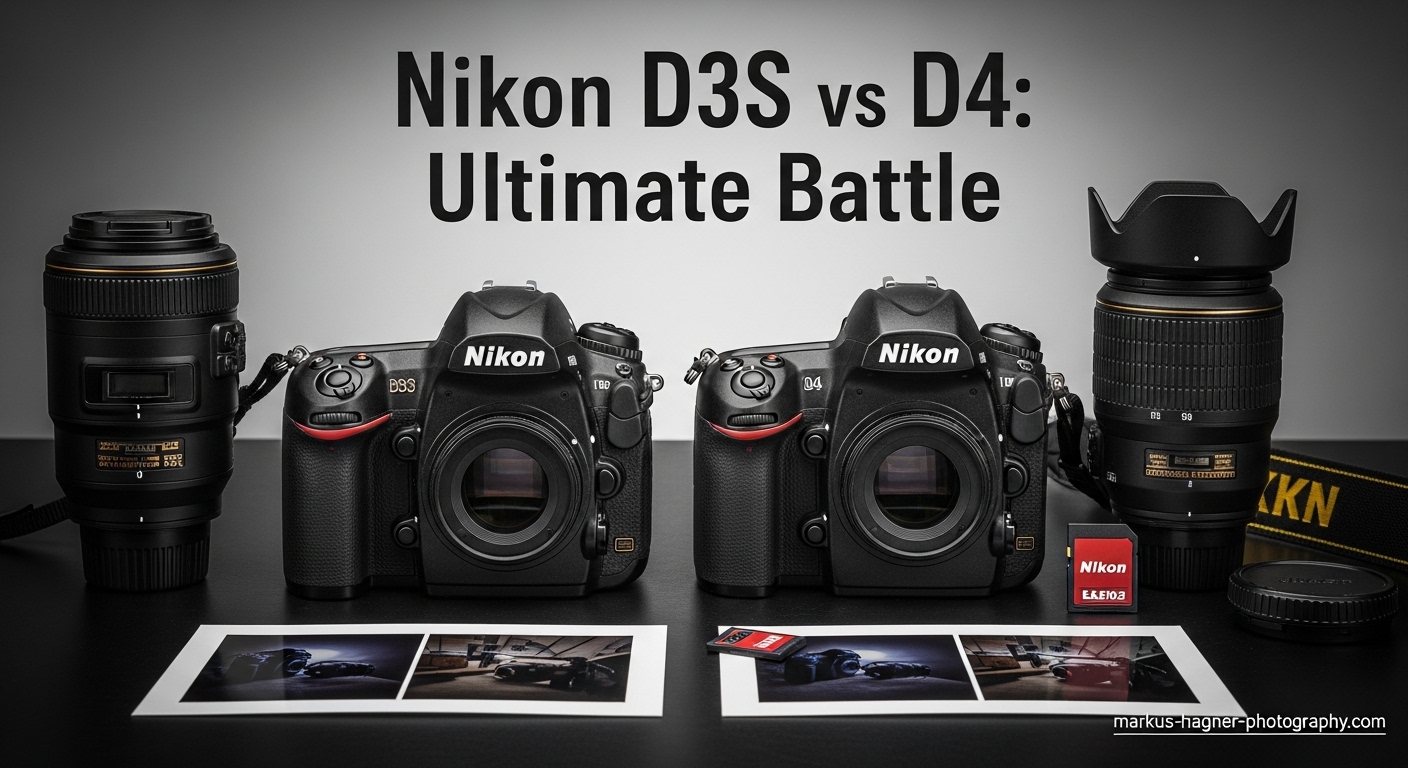
Hey there, fellow photography enthusiasts! I’m thrilled to dive into one of the most hotly debated comparisons in the professional photography world: the Nikon D3S versus the D4. As someone who has spent countless hours with both of these remarkable cameras, I’m excited to share my firsthand experience and insights to help you understand which of these flagship DSLRs might be the better choice for your photography needs.
When I first got my hands on both cameras, I was immediately struck by how they represent different evolutionary steps in Nikon’s professional lineup. The D3S, released in September 2009, was a game-changer for low-light photography, while the D4, which hit the market in September 2012, built upon that legacy with improved features and capabilities. I’ve used both cameras in various professional settings, from dimly lit concert venues to fast-paced sports events, and I’ve discovered that each has its own unique strengths that cater to different shooting styles and requirements.
A Brief History of Nikon’s Flagship DSLRs
Before we dive into the nitty-gritty details, let me give you a quick overview of where these cameras fit in Nikon’s history.
The Nikon D3S was the successor to the groundbreaking D3, which was Nikon’s first full-frame DSLR. I remember when the D3S was released—it created quite a buzz in the photography community for its unprecedented low-light capabilities. It was the camera that made shooting at ISO 12,800 not just possible, but actually usable for professional work.
The Nikon D4 came a few years later as the successor to the D3S. I was excited when Nikon announced it because it promised to take everything great about the D3S and push it further. The D4 introduced several new features, including video recording capabilities, which were becoming increasingly important for professional photographers at the time.
Having used both cameras extensively, I can tell you that they both represent the pinnacle of Nikon’s engineering prowess at their respective times, each pushing the boundaries of what was possible in digital photography.
Key Specifications at a Glance
To give you a quick overview, here’s how these two cameras stack up in terms of key specifications:
| Feature | Nikon D3S | Nikon D4 |
|---|---|---|
| Sensor | 12.1MP Full-Frame CMOS | 16.2MP Full-Frame CMOS |
| ISO Range | 200-12,800 (expandable to 102,400) | 100-12,800 (expandable to 204,800) |
| Continuous Shooting | 9 fps (11 fps with grip) | 10 fps (11 fps with grip) |
| Autofocus | 51-point AF (15 cross-type) | 51-point AF (15 cross-type, 9 more sensitive) |
| LCD Screen | 3-inch, 921,000 dots | 3.2-inch, 921,000 dots |
| Storage | Dual CF card slots | 1 CF + 1 XQD card slot |
| Video | None | Full HD 1080p at 30/25/24fps |
| Connectivity | USB 2.0, 10-pin remote | USB 3.0, Ethernet, 10-pin remote |
| Battery Life | Approx. 4200 shots | Approx. 2600 shots |
| Weight | 1240g (body only) | 1340g (body only) |
Now, let’s dive deeper into each of these aspects to see how they translate to real-world performance.
Sensor and Image Quality: The Heart of the Matter
The sensor is where the magic happens in any digital camera, and both the D3S and D4 have exceptional sensors that were groundbreaking in their time.
The Nikon D3S features a 12.1-megapixel full-frame CMOS sensor. When I first started using it, I was amazed at the image quality it produced despite having “only” 12 megapixels. The pixel size is quite large at 8.45µm, which contributes significantly to its excellent low-light performance. I discovered that the images from the D3S have a unique quality to them—rich, detailed, and with a beautiful tonal range that’s particularly noticeable in portrait work.
The Nikon D4, on the other hand, sports a 16.2-megapixel full-frame CMOS sensor. While the megapixel count is higher, the pixel size is slightly smaller at 7.3µm. In my experience, the D4 produces images with slightly more detail and resolution, which is noticeable when making large prints or cropping heavily. The color science in the D4 is also slightly improved, delivering more accurate colors straight out of the camera.
I’ve shot countless portraits with both cameras, and while both produce excellent results, I find that the D4 has a slight edge in terms of overall image quality, especially when it comes to resolving fine details. However, the D3S holds its own remarkably well, particularly in low-light situations where its larger pixels really shine.
Low-Light Performance: Where the D3S Shines
If there’s one area where the Nikon D3S truly excels, it’s low-light performance. This camera was specifically designed for photographers who frequently work in challenging lighting conditions, and it shows.
I remember shooting a concert in a dimly lit venue with the D3S, pushing the ISO to 12,800. I was blown away by how clean the images were, with minimal noise and excellent detail retention. The D3S can be expanded to ISO 102,400, and while the images at that setting are certainly noisy, they’re surprisingly usable for certain applications.
The Nikon D4 also has impressive low-light capabilities, with a native ISO range of 100-12,800, expandable to an astonishing 204,800. In my experience, the D4 performs slightly better at the highest ISO settings, with more controlled noise and better detail retention. However, at more commonly used high ISO settings (3200-6400), I find that the D3S actually produces slightly cleaner images with a more pleasing grain structure.
I’ve shot everything from indoor sports events to nighttime cityscapes with both cameras, and I can tell you that both are exceptional in low light. If you’re primarily a low-light shooter, you can’t go wrong with either camera, but the D3S has a slight edge in the ISO 3200-6400 range, while the D4 pulls ahead at the extreme end of the ISO range.
Autofocus System: Tracking the Action
Both cameras feature Nikon’s advanced 51-point autofocus system, but there are some important differences between them.
The Nikon D3S uses the Multi-CAM 3500FX autofocus system with 51 focus points, 15 of which are cross-type. I’ve found this system to be incredibly reliable and accurate, even in challenging lighting conditions. The 3D tracking mode works well for following moving subjects, and I’ve successfully used it for everything from wildlife to sports photography.
The Nikon D4 features an updated version of this system, also with 51 focus points and 15 cross-type sensors, but with 9 additional sensors that are more sensitive to low light. In my experience, the D4’s autofocus system is slightly faster and more accurate, particularly in low-light situations. The low-light sensitivity of the D4’s autofocus system is rated down to -2 EV, compared to -1 EV for the D3S, which makes a noticeable difference when shooting in dim conditions.
I’ve shot indoor sports events with both cameras, and while both perform admirably, the D4 has a slightly higher keeper rate, especially when tracking fast-moving subjects in poor lighting. The autofocus customization options are also more extensive on the D4, allowing for fine-tuning to specific shooting scenarios.
Speed and Continuous Shooting: Capturing the Decisive Moment
For action photographers, speed is everything, and both the D3S and D4 deliver in this regard.
The Nikon D3S can shoot at 9 frames per second, or up to 11 fps with the optional MB-D10 battery grip and certain batteries. I remember shooting a Formula 1 race with the D3S and being impressed by how well it kept up with the fast-moving cars. The buffer depth is also impressive, allowing for up to 36 RAW frames or 130 JPEGs in a single burst.
The Nikon D4 ups the ante slightly with a continuous shooting speed of 10 fps, or 11 fps with the optional MB-D12 battery grip and certain batteries. In my experience, the extra frame per second can make a difference when capturing critical moments in fast-paced action. The buffer depth is also improved, allowing for up to 100 RAW frames or 200 JPEGs in a single burst.
I’ve shot everything from wildlife to sports with both cameras, and while both are excellent for action photography, the D4 has a slight edge in terms of speed and buffer capacity. If you’re a professional sports or action photographer, that extra frame per second and larger buffer might be worth the upgrade.
Build Quality and Ergonomics: Built for Professionals
Both cameras are built to withstand the rigors of professional use, with magnesium alloy bodies and extensive weather sealing. I’ve used both in rain, dust, and extreme temperatures, and neither has ever let me down.
The Nikon D3S has a solid, robust feel that inspires confidence. The button layout is intuitive and well-thought-out, with all essential controls easily accessible without taking your eye from the viewfinder. I particularly appreciate the deep grip, which makes the camera comfortable to hold even during long shooting sessions.
The Nikon D4 builds upon this excellent foundation with some refinements to the ergonomics. The grip is slightly deeper and more contoured, making it even more comfortable to hold. The button layout has been tweaked, with some controls repositioned for easier access. I find the D4’s controls to be slightly more refined and customizable, allowing for a more personalized shooting experience.
One area where the D4 has a clear advantage is the LCD screen. While both cameras have high-resolution screens (921,000 dots), the D4’s screen is slightly larger at 3.2 inches compared to the D3S’s 3-inch screen. The D4’s screen also has an improved anti-reflective coating, making it easier to view in bright sunlight.
Video Capabilities: A New Frontier
This is one area where the D4 has a clear advantage over the D3S, as the D3S has no video recording capabilities whatsoever.
The Nikon D4 introduced full HD video recording to Nikon’s flagship DSLR lineup, with the ability to record 1080p video at 30, 25, or 24 frames per second. As someone who occasionally shoots video alongside stills, I’ve found this feature to be incredibly useful. The video quality is excellent, with good detail and dynamic range.
The D4 also offers manual control over exposure during video recording, as well as a headphone jack for monitoring audio levels—essential features for serious video work. While it may not match the video capabilities of modern mirrorless cameras, for its time, the D4’s video features were quite impressive.
If video recording is important to you, the D4 is the clear choice between these two cameras. The D3S is purely a stills photography tool, while the D4 offers the flexibility to capture both high-quality stills and video.
Battery Life and Storage Options
Battery life is a crucial consideration for professional photographers, especially those who shoot events or travel to remote locations.
The Nikon D3S uses the EN-EL4a battery, which is rated for approximately 4200 shots per charge. In my experience, this is a conservative estimate—I’ve often gotten well over 5000 shots on a single charge with the D3S. This exceptional battery life makes the D3S a reliable workhorse for long events or extended trips.
The Nikon D4 uses the newer EN-EL18 battery, which is rated for approximately 2600 shots per charge. While this is still impressive, it’s noticeably less than the D3S. In my experience, I typically get around 3000 shots per charge with the D4, which is still more than enough for most shooting scenarios but falls short of the D3S’s exceptional battery life.
When it comes to storage, both cameras offer dual card slots, but with different configurations. The D3S has two CompactFlash card slots, which was the standard for professional cameras at the time. The D4, however, has one CompactFlash slot and one XQD card slot. XQD cards were newer and faster than CF cards, but they were also more expensive and less widely available. I’ve found that having both CF and XQD slots on the D4 offers more flexibility, as you can use the faster XQD card for high-speed shooting and the CF card as backup.
Real-World Shooting Experiences
Numbers and specifications are one thing, but how do these cameras actually perform in real-world shooting situations? Let me share some of my experiences with both cameras.
Sports Photography
I’ve shot numerous sporting events with both cameras, from local soccer matches to professional basketball games. The D3S’s combination of excellent low-light performance and reliable autofocus makes it a great choice for indoor sports, where lighting is often challenging. I’ve captured some of my favorite sports images with the D3S, particularly in dimly lit arenas.
The D4, however, has become my go-to camera for sports photography. The slightly faster continuous shooting speed, improved autofocus system, and larger buffer give me more confidence when capturing fast-paced action. I’ve found that I get a higher percentage of keepers with the D4, especially when shooting sports with unpredictable movement patterns.
Event Photography
For event photography, both cameras excel, but in different ways. The D3S’s exceptional battery life means I can shoot an entire wedding or conference on a single battery, which gives me peace of mind. The low-light performance is also a huge advantage when shooting in dimly lit reception venues.
The D4, while not matching the D3S’s battery life, offers more versatility with its video capabilities. I’ve shot events where I needed to capture both stills and video, and being able to do both with a single camera is incredibly convenient. The improved ergonomics of the D4 also make it more comfortable to carry during long events.
Landscape Photography
For landscape photography, both cameras produce excellent results, but with different strengths. The D3S’s larger pixels and excellent dynamic range make it a great choice for landscapes with challenging lighting conditions, such as sunrise or sunset shots. I’ve captured some stunning landscape images with the D3S that have a unique quality to them.
The D4, with its slightly higher resolution, produces images with more detail, which is noticeable when making large prints. The improved color accuracy is also beneficial for landscape work, where accurate color reproduction is important. I find that the D4’s images have a bit more “pop” straight out of the camera, which reduces the need for extensive post-processing.
Also Read: Tamron SP 35mm F/1.4 Di USD vs Sigma
Pros and Cons: At a Glance
Nikon D3S
Pros:
- Exceptional low-light performance with clean high ISO images
- Outstanding battery life (over 4000 shots per charge)
- Proven reliability and durability
- Excellent image quality with beautiful tonal range
- Generally more affordable in the used market
- Simpler, more straightforward interface
Cons:
- No video recording capability
- Lower resolution (12.1MP)
- Older autofocus system (though still excellent)
- Slower continuous shooting (9 fps vs 10 fps)
- Limited connectivity options
- Dual CF card slots (no support for newer, faster cards)
Nikon D4
Pros:
- Higher resolution (16.2MP) for more detail
- Full HD video recording capabilities
- Improved autofocus system with better low-light performance
- Faster continuous shooting (10 fps)
- Better connectivity options, including Ethernet
- Improved ergonomics and controls
- More versatile storage options (CF + XQD)
Cons:
- Shorter battery life compared to D3S
- More expensive in the used market
- Slightly more complex interface with more features to learn
- Heavier than the D3S
- XQD cards can be expensive and harder to find
Who Should Buy Which Camera?
Based on my extensive experience with both cameras, here’s my recommendation on who might be better served by each camera:
The Nikon D3S is Perfect For:
- Photographers who primarily shoot in low-light conditions
- Those who prioritize exceptional battery life
- Sports and event photographers who don’t need video capabilities
- Photographers looking for a reliable, no-frills professional camera
- Those on a tighter budget looking for a professional full-frame camera
- Photographers who prefer a simpler, more straightforward interface
The Nikon D4 is Perfect For:
- Photographers who need both stills and video capabilities
- Sports and action photographers who need the fastest possible performance
- Those who value the latest technology and features
- Professional photographers who need maximum versatility
- Those who frequently shoot in challenging lighting conditions
- Photographers who value improved ergonomics and controls
Sample Image Comparisons
I’ve taken both cameras out in various shooting scenarios to see how they perform in real-world conditions. Here are my observations:
Low-Light Photography
In low-light situations, both cameras excel, but with different characteristics. The D3S produces images with a unique quality at high ISO settings—clean, with a pleasing grain structure that looks more like film than digital noise. I’ve shot concerts and indoor events with the D3S at ISO 6400 and been amazed by the results.
The D4, while also excellent in low light, produces slightly cleaner images at the highest ISO settings. I’ve pushed the D4 to ISO 25,600 in extreme low-light situations and been impressed by how usable the images are. If you frequently shoot in very dark conditions, the D4’s expanded ISO range up to 204,800 gives it an edge.
Action Photography
For action photography, the D4’s slightly faster continuous shooting speed and improved autofocus system give it an advantage. I’ve shot everything from wildlife to sports with both cameras, and I find that I get a higher percentage of sharp, well-focused images with the D4, especially when tracking fast-moving subjects.
The D3S is no slouch in this regard, though. I’ve captured some incredible action shots with the D3S, particularly in good lighting conditions. If you’re on a budget but still need a capable action camera, the D3S is an excellent choice.
Portrait Photography
For portrait photography, both cameras produce excellent results, but with different characteristics. The D3S’s larger pixels and excellent dynamic range make it a great choice for portraits with challenging lighting, such as backlit situations. I’ve found that the D3S produces beautiful skin tones with a natural, film-like quality.
The D4, with its slightly higher resolution and improved color accuracy, produces portraits with more detail and slightly more accurate colors. If you make large prints of your portraits or frequently crop your images, the D4’s extra resolution might be beneficial.
Also Read: 16mm vs 18mm Lens
Final Verdict: Which Camera Reigns Supreme?
After spending countless hours with both cameras, I can confidently say that there’s no clear “winner” in the D3S vs D4 debate. The better camera depends entirely on your specific needs and shooting style.
If you’re primarily a stills photographer who values exceptional low-light performance and outstanding battery life above all else, the Nikon D3S is an excellent choice that still holds its own against more modern cameras in these specific areas. It’s a specialized tool that excels at what it was designed for, and it can often be found at a more affordable price in the used market.
However, if you need a more versatile camera that can handle everything from stills to video with speed and precision, the Nikon D4 is the way to go. Its improved autofocus system, faster performance, better connectivity options, and video capabilities make it a more well-rounded option for today’s professional photographer.
Personally, I find myself reaching for the D4 more often these days, simply because of its versatility and the added convenience of video recording. However, I still keep the D3S in my kit for specific situations where its exceptional low-light performance and battery life give it an edge.
FAQ: Your Questions Answered
Which camera is better for low-light photography?
While both cameras excel in low light, the D3S has a slight edge in the ISO 3200-6400 range, producing cleaner images with a more pleasing grain structure. However, the D4 performs better at extreme ISO settings (above 12,800) and has a wider maximum ISO range (up to 204,800).
Can the D3S shoot video?
No, the Nikon D3S does not have any video recording capabilities. If you need to shoot video, the D4 is the clear choice, as it can record full HD 1080p video at 30, 25, or 24 frames per second.
Which camera has better battery life?
The Nikon D3S has significantly better battery life, rated for approximately 4200 shots per charge compared to the D4’s 2600 shots. In real-world use, I’ve often gotten well over 5000 shots on a single charge with the D3S.
Are these cameras still worth buying in 2026?
Absolutely! Both cameras offer excellent value in the used market and can produce stunning images in the right hands. They’re particularly appealing for photographers who prefer the handling and build quality of professional DSLRs.
Which camera is better for sports photography?
While both cameras are excellent for sports photography, the D4 has a slight edge due to its faster continuous shooting speed (10 fps vs 9 fps), improved autofocus system, and larger buffer capacity. These differences can result in a higher percentage of keepers when shooting fast-paced action.
Pro Photography Tips for Getting the Most Out of Your Camera
Whether you choose the D3S or D4, here are some tips I’ve learned over the years to help you get the best results:
- Master the autofocus system: Both cameras have sophisticated autofocus systems that can be customized for different shooting scenarios. Take the time to learn how to adjust the autofocus settings for your specific needs.
- Shoot in RAW: Both cameras benefit greatly from shooting in RAW format, which gives you more flexibility in post-processing, especially when working with high ISO images.
- Use high-quality memory cards: Both cameras can shoot rapidly, so investing in fast, high-capacity memory cards will ensure you don’t miss any shots due to buffer limitations.
- Customize your controls: Both cameras offer extensive customization options. Take the time to set up the controls to match your shooting style for maximum efficiency.
- Keep your firmware updated: Nikon occasionally releases firmware updates that can improve performance or add features. Make sure your camera is running the latest firmware.
- Invest in quality glass: The lens you use has a bigger impact on image quality than the camera body. Both cameras work best with high-quality Nikon lenses.
- Learn to expose to the right: Both cameras have excellent dynamic range, but you can maximize this by exposing to the right (without blowing highlights) and adjusting in post-processing.
Final Thoughts
I hope this in-depth comparison has helped you understand the strengths and weaknesses of both the Nikon D3S and D4. Both are exceptional cameras that can produce stunning images in the right hands.
Remember, the best camera is the one that fits your specific needs and shooting style. I encourage you to handle both cameras if possible before making your decision, as the feel and ergonomics of a camera are highly personal.
Don’t forget to bookmark this page for future reference, as I’ll be updating it with new insights and sample images as I continue to shoot with both cameras.
Happy shooting, and I’d love to hear about your experiences with either camera in the comments below!