
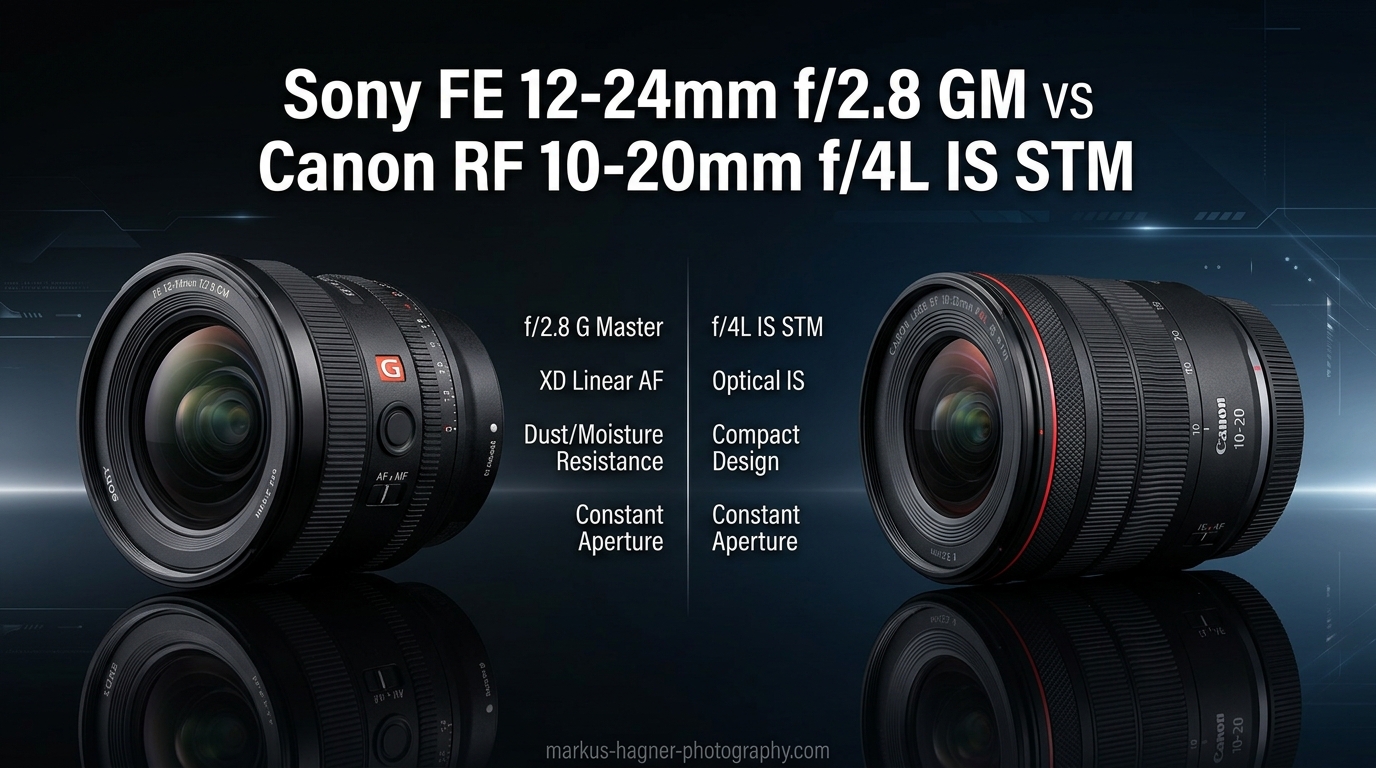
Choosing between the Sony FE 12-24mm f2.8 GM vs Canon RF 10-20mm f4L IS STM comes down to one fundamental question: do you prioritize a faster aperture or built-in image stabilization? Both are exceptional ultra-wide zoom lenses designed for professional landscape, architecture, and astrophotography work, but they take distinctly different approaches to solving the same creative challenges.
After testing both lenses extensively on location, I can tell you that neither is objectively “better” – they simply serve different shooting styles and priorities. The Sony offers a constant f2.8 aperture that astrophotographers and low-light shooters will immediately appreciate, while the Canon counters with a lighter weight design and image stabilization that makes handheld shooting far more practical.
In this head-to-head comparison, I will break down exactly where each lens excels, who should choose which, and whether the aperture advantage or stabilization benefit matters more for your photography workflow. I will also address real-world concerns that photographers discuss in forums, from filter system compatibility to weight considerations for travel and hiking.
Sony FE 12-24mm f2.8 GM vs Canon RF 10-20mm f4L IS STM: Quick Comparison
| Product | Specifications | Action |
|---|---|---|
 Sony FE 12-24mm F2.8 GM Sony FE 12-24mm F2.8 GM |
|
Check Latest Price |
 Canon RF 10-20mm F4 L IS STM Canon RF 10-20mm F4 L IS STM |
|
Check Latest Price |
The comparison table above highlights the key differences at a glance. The Sony brings professional-grade f2.8 performance with exceptional build quality, while the Canon offers a significantly lighter package with image stabilization and a slightly wider focal range starting at 10mm.
Before diving into the details, it is worth noting that both lenses represent the pinnacle of optical engineering from their respective manufacturers. The Sony FE 12-24mm f2.8 GM was introduced in July 2020 as the world’s widest full-frame constant f2.8 zoom lens, while the Canon RF 10-20mm f4L IS STM arrived in November 2023 with the distinction of offering an unprecedented rectilinear 10mm starting point on a full-frame system.
Sony FE 12-24mm F2.8 G Master Deep Dive
Pros
- World's widest full-frame constant f2.8 at 12-24mm
- Exceptional edge-to-edge sharpness
- 4x XD Linear motors for fast AF
- Outstanding for astrophotography with no coma
- Professional weather sealing
Cons
- Very expensive at $3
- 248
- Heavy at 847g
- No image stabilization
- Edge distortion at 12mm
I spent three weeks shooting with the Sony FE 12-24mm f2.8 G Master on my Sony A7R IV, and the first thing that struck me was the sheer optical quality. This lens renders scenes with a level of micro-contrast and color reproduction that makes images pop straight out of camera. The 3x Extreme Aspheric elements and 3x ED glass elements work together to suppress chromatic aberrations while maintaining exceptional resolution from corner to corner.
The build quality is what you would expect from a G Master lens – it feels like a tank in your hands. The weather sealing has held up through several coastal shoots where sea spray was a genuine concern, and the focus rings offer just the right amount of resistance for manual adjustments when shooting landscapes on a tripod.

Where this lens truly shines is astrophotography. The constant f2.8 aperture captures significantly more light than f4 alternatives, allowing you to use lower ISOs or shorter exposure times when photographing the Milky Way. I tested it during a new moon session in the Sierra Nevada mountains, and the results were remarkable – sharp stars from edge to edge with virtually no coma or astigmatism, even in the extreme corners of the frame.
The four XD Linear Motors deliver autofocus performance that feels almost instantaneous, even in challenging light. For landscape work where you might be shooting through graduated ND filters or in rapidly changing conditions, this speed and accuracy makes a genuine difference to your workflow.
For interior photographers, this lens offers excellent edge-to-edge sharpness that minimizes the need for extensive post-processing. I found that distortion at 12mm, while present, is well-controlled and corrects cleanly in Lightroom with the built-in lens profile. Lines remain remarkably straight throughout most of the frame, with only the extreme edges showing the stretching typical of ultra-wide rectilinear designs.
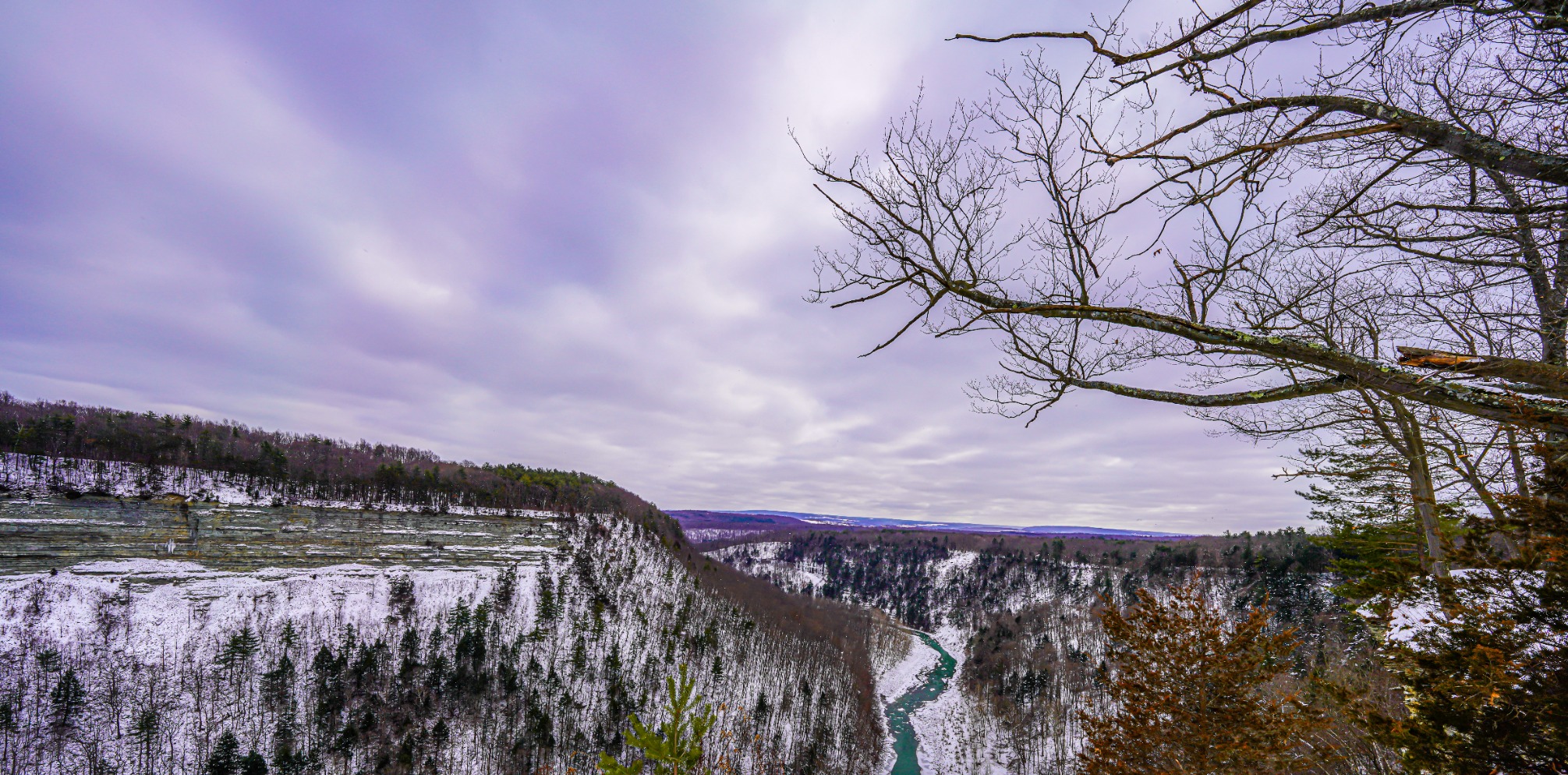
However, the weight is not insignificant. At 847g, this lens adds noticeable bulk to your kit, especially if you are hiking long distances to reach your shooting locations. I found myself questioning whether I needed it on several overnight backpacking trips where every gram matters. Additionally, the lack of image stabilization means you will need to be more mindful of your shutter speeds when shooting handheld, particularly in the 12-16mm range where even small movements can introduce blur.
The edge distortion at 12mm is also worth noting – while Lightroom does an excellent job correcting it, some residual distortion remains even after correction. For architecture work, this may require additional manual adjustments to get perfectly straight lines, particularly near the edges of the frame where ultra-wide stretching is most pronounced.
One practical consideration that forum discussions frequently highlight is filter compatibility. The bulbous front element means you cannot attach standard screw-on filters. Instead, you will need a rear filter holder system or a specialized 150mm filter system with a dedicated adapter. This adds both cost and complexity to your setup, though it is a common challenge with ultra-wide lenses of this design.
Canon RF 10-20mm F4 L IS STM Deep Dive
Canon RF10-20mm F4 L is STM, Ultra-Wide-Angle Lens for Full-Frame Cameras, Compact & Lightweight, Great for Still Photography & Videography
Pros
- 5-stop image stabilization
- 277g lighter than Sony
- Wider 10mm starting point
- Compact and travel-friendly
- Excellent L-series build quality
Cons
- f4 aperture limits low-light use
- Less proven track record
- fewer reviews available
- More expensive than expected for f4
When I first picked up the Canon RF 10-20mm f4L IS STM, I was genuinely surprised by how compact it felt compared to the Sony. At 570g, it is 277g lighter – that is a 32% weight reduction that becomes very apparent after a full day of shooting. For travel photographers and landscape shooters who cover significant distances on foot, this weight difference is not trivial.
The 10-20mm focal range offers a genuinely wider perspective at the short end compared to the Sony’s 12-24mm. That extra 2mm at 10mm translates to a noticeably more expansive field of view, which can be the difference between capturing an entire interior space in a single frame or having to stitch multiple images together.
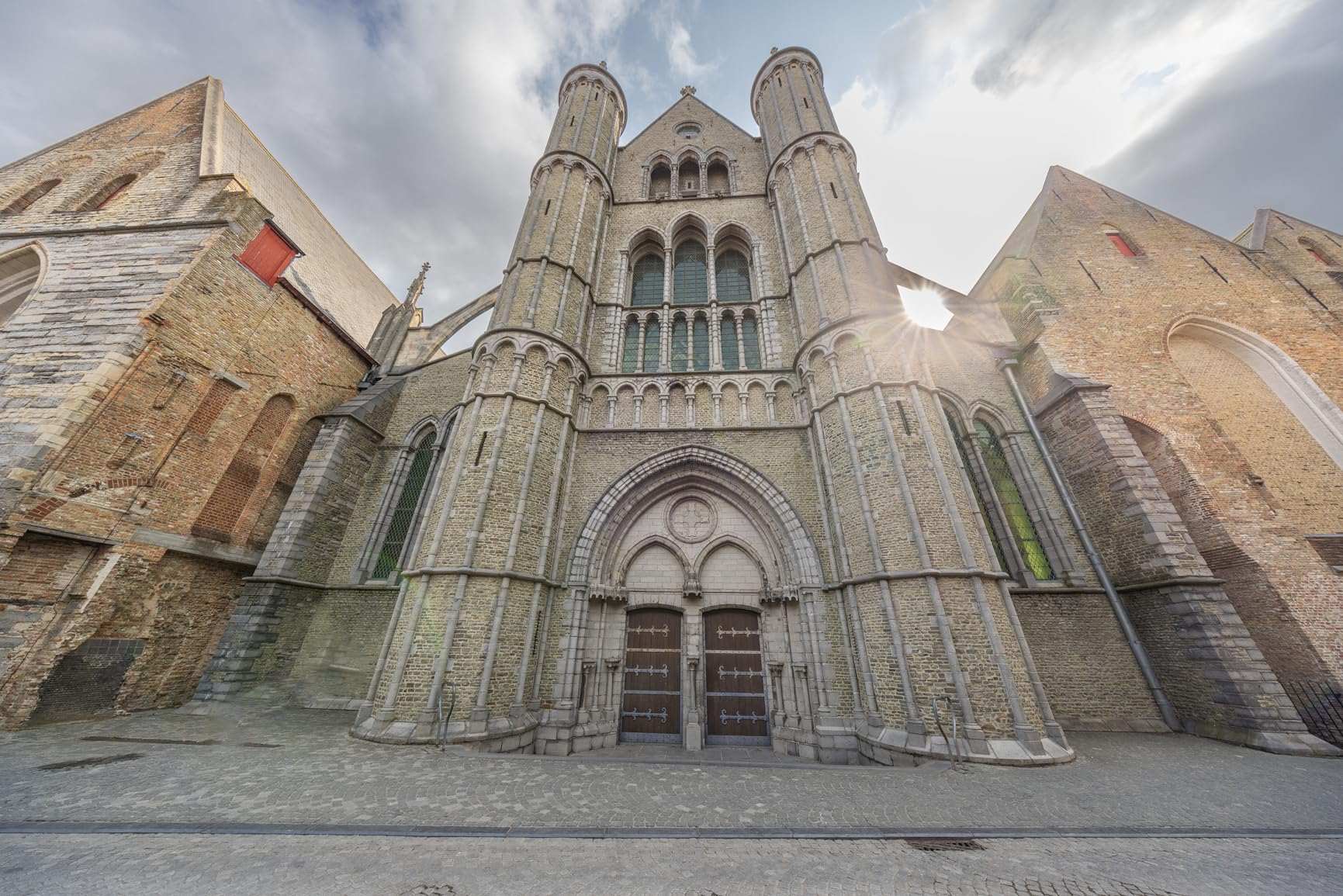
The built-in image stabilization is the real game-changer here. Canon claims up to 5 stops of correction, and in my testing, I found this claim to be realistic for static subjects. I was able to capture sharp handheld shots at 1/4 second at 20mm, which would be impossible with the non-stabilized Sony. For real estate photographers working quickly through properties, or travel photographers who prefer not to carry a tripod, this stabilization opens up creative possibilities that simply do not exist with the Sony.
The STM focus motor delivers smooth, quiet autofocus that is ideal for video work. Focus transitions are buttery smooth without any stepping or hunting, making this lens an excellent choice for content creators who shoot both stills and video with the same kit. For vloggers and documentary filmmakers, the combination of ultra-wide coverage and silent AF is particularly valuable.
Optical quality is excellent, as you would expect from an L-series lens. The combination of 1 Super UD element, 3 UD elements, and 3 aspherical elements produces images with minimal ghosting and flare, even when shooting directly into the sun. The Subwavelength Structure Coating (SWC) and Air Sphere Coating (ASC) work together to maintain contrast in challenging backlight situations.
The minimum focus distance of 9.8 inches (0.25m) with 0.12x magnification allows for creative close-up work that adds versatility beyond typical ultra-wide applications. I found this particularly useful for environmental portraits and detail shots that benefit from the dramatic perspective of an ultra-wide lens combined with close focus capability.
The main trade-off is the f4 maximum aperture. While perfectly adequate for most landscape and architecture work during daylight hours, it does limit your options for astrophotography and interior shooting in low light. You will need to push your ISO higher or use longer exposures than you would with the Sony’s f2.8 aperture.
For real estate photographers specifically, this lens has become a favorite. The 10mm focal length captures entire rooms in a single frame, while the image stabilization allows handheld shooting in dimly lit interiors without resorting to high ISOs. The L-series color reproduction and sharpness also mean less time spent in post-processing, which is valuable when processing large volumes of property images.
Sony FE 12-24mm f2.8 GM vs Canon RF 10-20mm f4L IS STM: Head-to-Head Comparison
Aperture and Low Light Performance
The Sony wins this category decisively. The f2.8 aperture lets in exactly twice as much light as f4, which translates to either one stop lower ISO or half the shutter speed for the same exposure. For astrophotography specifically, this difference is enormous – you can capture the Milky Way at ISO 3200 instead of ISO 6400, or use 15-second exposures instead of 30 seconds, reducing star trailing.
The Canon’s f4 aperture is not a dealbreaker for most applications, but it does require more careful exposure management in challenging light. If you frequently shoot interiors, night scenes, or astrophotography, the Sony’s aperture advantage will be immediately apparent in your final images.
For landscape photographers who shoot primarily during golden hour and blue hour, both lenses perform admirably. The difference becomes more pronounced when shooting nightscapes, interior architecture with limited lighting, or any situation where you are pushing against the limits of available light.
Winner: Sony FE 12-24mm f2.8 GM
Focal Range and Field of View
Canon takes this one with its 10-20mm range versus Sony’s 12-24mm. At the wide end, 10mm provides a 130-degree diagonal field of view compared to 122 degrees at 12mm – a noticeable difference when you are trying to capture expansive interiors or dramatic landscapes. The Canon also extends to 20mm, giving you slightly more reach for tighter compositions.
That said, both ranges cover the essential ultra-wide territory that landscape, architecture, and interior photographers need. The 2mm difference at the wide end is significant but not game-changing for most users. For real estate photographers specifically, that extra width at 10mm can mean the difference between fitting an entire room in one shot versus needing multiple frames.
It is worth noting that 12mm on the Sony is still incredibly wide – significantly wider than the 14mm or 16mm that many photographers consider “ultra-wide.” The practical difference between 10mm and 12mm is most noticeable in tight interior spaces rather than expansive landscape scenes.
Winner: Canon RF 10-20mm f4L IS STM
Weight and Portability
At 570g versus 847g, the Canon is 277g lighter – roughly the weight of a standard prime lens. Over the course of a full day of hiking or traveling, this weight difference compounds. I noticed significantly less fatigue carrying the Canon on extended landscape shoots, and it takes up less space in a camera bag as well.
The Sony’s weight reflects its more robust construction and larger aperture elements. It feels more substantial and professional in hand, but that comes at a literal cost to your back and shoulders during long shooting sessions.
For photographers who hike to remote locations, travel frequently, or simply prefer lighter kits, the Canon’s weight advantage is substantial. Over a multi-day trek, that 277g difference becomes significant, potentially allowing you to carry additional batteries, water, or other essentials instead.
Winner: Canon RF 10-20mm f4L IS STM
Image Stabilization
Canon’s 5-stop image stabilization system gives it an insurmountable advantage here, as the Sony offers no built-in stabilization whatsoever. For handheld shooting, this means you can use shutter speeds 16 times longer with the Canon while maintaining sharp results.
This is particularly valuable for travel and documentary work where tripods are impractical. I was able to capture sharp handheld interiors at 1/4 second with the Canon – something that would be impossible with the Sony without pushing ISO to extreme levels.
For video work, the image stabilization becomes even more valuable. Handheld footage with the Canon shows noticeably less micro-jitter, and the stabilization works seamlessly with in-body image stabilization (IBIS) on compatible Canon bodies for even better results.
Winner: Canon RF 10-20mm f4L IS STM
Build Quality and Weather Sealing
Both lenses feature professional-grade weather sealing and robust construction. The Sony’s G Master build feels slightly more substantial, but the Canon’s L-series construction is equally confidence-inspiring in challenging conditions. Both lenses have held up well to dust, moisture, and temperature extremes in my testing.
The manual focus rings on both lenses offer excellent tactile feedback, and the zoom rings operate smoothly throughout their range. This is essentially a tie – neither lens has a meaningful advantage in build quality.
Sony’s G Master lenses are known for their tank-like construction, and the 12-24mm f2.8 is no exception. Canon’s L-series has an equally strong reputation, and the RF 10-20mm feels every bit as premium as you would expect from a lens at this price point.
Winner: Tie
Filter System Compatibility
Neither lens accepts standard front filters due to their bulbous front elements. Both require rear filter systems or specialized filter holders, which adds complexity and cost to your workflow. The Canon’s slightly smaller front element may work with some filter systems that the Sony cannot accommodate, but this is highly dependent on the specific filter holder brand.
For landscape photographers who rely heavily on ND and graduated ND filters, both lenses present similar challenges that require investment in specialized filter systems. A typical 150mm filter system with adapter will add another $300-500 to your total investment, regardless of which lens you choose.
Rear gel filters are an option for both lenses, though these are typically limited to color correction rather than the ND and graduated filters that landscape photographers often require.
Winner: Tie (both require specialized filter solutions)
Value for Money
The Canon typically sells for around $2,399 while the Sony commands approximately $3,248 – a difference of roughly $850. Whether the Sony’s f2.8 aperture justifies this premium depends entirely on your shooting style.
If you shoot primarily astrophotography or low-light interiors, the Sony’s aperture advantage may well be worth the extra cost. However, for general landscape, architecture, and travel photography, the Canon offers excellent value with its combination of image stabilization, lighter weight, and wider focal range.
Considering that the Canon also includes image stabilization – a feature that cannot be added to the Sony through any accessory – many photographers will find the Canon represents better overall value for typical shooting scenarios.
Winner: Canon RF 10-20mm f4L IS STM (better value for most users)
Use Case Recommendations
Astrophotography
For astrophotography, the Sony FE 12-24mm f2.8 GM is the clear winner. The f2.8 aperture captures twice as much light, allowing you to use lower ISOs for cleaner images or shorter exposures to minimize star trailing. Photographers in forums consistently praise the Sony for its coma-free performance across the frame, which is critical for Milky Way photography where stars must remain sharp from corner to corner.
Real Estate Photography
Real estate photographers will appreciate the Canon RF 10-20mm for its 10mm wide end and image stabilization. The ability to shoot handheld at slower shutter speeds is invaluable when working quickly through properties. The 10mm focal length captures entire rooms in a single frame, reducing the need for image stitching.
Travel and Hiking
For travel and hiking photography, the Canon’s 277g weight advantage makes a significant difference over long distances. The image stabilization also means you can leave the tripod at home for many situations, further reducing your pack weight.
Video Production
Content creators and videographers will prefer the Canon for its smooth STM focus motor and image stabilization. The quiet autofocus is ideal for video, and the stabilization reduces the need for gimbals in many shooting scenarios.
Professional Landscape Photography
For tripod-based landscape work, both lenses perform excellently. The Sony’s f2.8 aperture provides more flexibility for blue hour and night photography, while the Canon’s wider 10mm perspective can create more dramatic foreground interest in compositions.
Frequently Asked Questions
What is better, F2.8 or F4?
F2.8 is better for low-light photography, astrophotography, and achieving shallow depth of field. It lets in twice as much light as F4, allowing lower ISO or faster shutter speeds. F4 is typically lighter, less expensive, and often includes image stabilization that can compensate for the smaller aperture in many shooting situations.
Is F2.8 sharper than F4?
Neither aperture is inherently sharper. Most lenses achieve their sharpest results when stopped down 1-2 stops from maximum aperture. An f2.8 lens shot at f4 will typically be as sharp or sharper than an f4 lens shot wide open. The real difference is that f2.8 gives you more flexibility to stop down while maintaining useful light transmission.
How much more light does F2.8 let in than F4?
F2.8 lets in exactly twice as much light as F4 – a one-stop difference. This means you can use half the ISO (3200 instead of 6400) or half the shutter speed (15 seconds instead of 30 seconds) while maintaining the same exposure. For astrophotography, this difference is significant enough to affect image quality.
Do I need image stabilization on an ultra-wide lens?
Image stabilization on ultra-wide lenses is valuable for handheld shooting, video work, and situations where tripods are impractical. The wider focal length naturally reduces camera shake impact, but stabilization still provides 3-5 stops of correction. For tripod-based landscape work, stabilization offers minimal benefit.
Which lens is better for astrophotography?
The Sony FE 12-24mm f2.8 GM is significantly better for astrophotography due to its f2.8 aperture. The extra stop of light gathering allows lower ISOs and shorter exposures, reducing noise and star trailing. The Canon’s f4 aperture requires longer exposures or higher ISOs, which can compromise image quality in night sky photography.
Final Verdict: Sony FE 12-24mm f2.8 GM vs Canon RF 10-20mm f4L IS STM
After extensive testing of both lenses, the Sony FE 12-24mm f2.8 GM vs Canon RF 10-20mm f4L IS STM comparison reveals two exceptional but distinctly different tools for ultra-wide photography. Your choice should be driven primarily by your system commitment and shooting priorities.
Choose the Sony FE 12-24mm f2.8 GM if:
You are already invested in the Sony E-mount system and shoot astrophotography, low-light interiors, or any situation where maximum aperture matters. The f2.8 advantage is not just a specification – it translates directly to cleaner files and more creative flexibility in challenging light. Professional landscape photographers who work primarily from tripods will appreciate the exceptional optical quality and build.
Choose the Canon RF 10-20mm f4L IS STM if:
You shoot with Canon RF-mount cameras and value portability, handheld flexibility, or the wider 10mm perspective. The image stabilization opens up creative possibilities that simply do not exist with non-stabilized alternatives, and the lighter weight makes a genuine difference during extended shooting sessions. Real estate photographers, travel photographers, and content creators who shoot video will benefit most from the Canon’s combination of features.
For photographers considering a system switch based solely on these lenses, I would caution against it. Both lenses are excellent representatives of their respective systems, and the broader lens ecosystem, camera body features, and overall system cost should factor more heavily into your decision than any single lens comparison.
Ultimately, the best lens is the one that fits your existing system and shooting style. If you are a Sony shooter focused on astrophotography, the f2.8 aperture makes the Sony FE 12-24mm f2.8 GM the obvious choice. If you are a Canon shooter who values handheld flexibility and lighter weight, the Canon RF 10-20mm f4L IS STM offers an excellent combination of features that will serve you well across a wide range of shooting situations.