
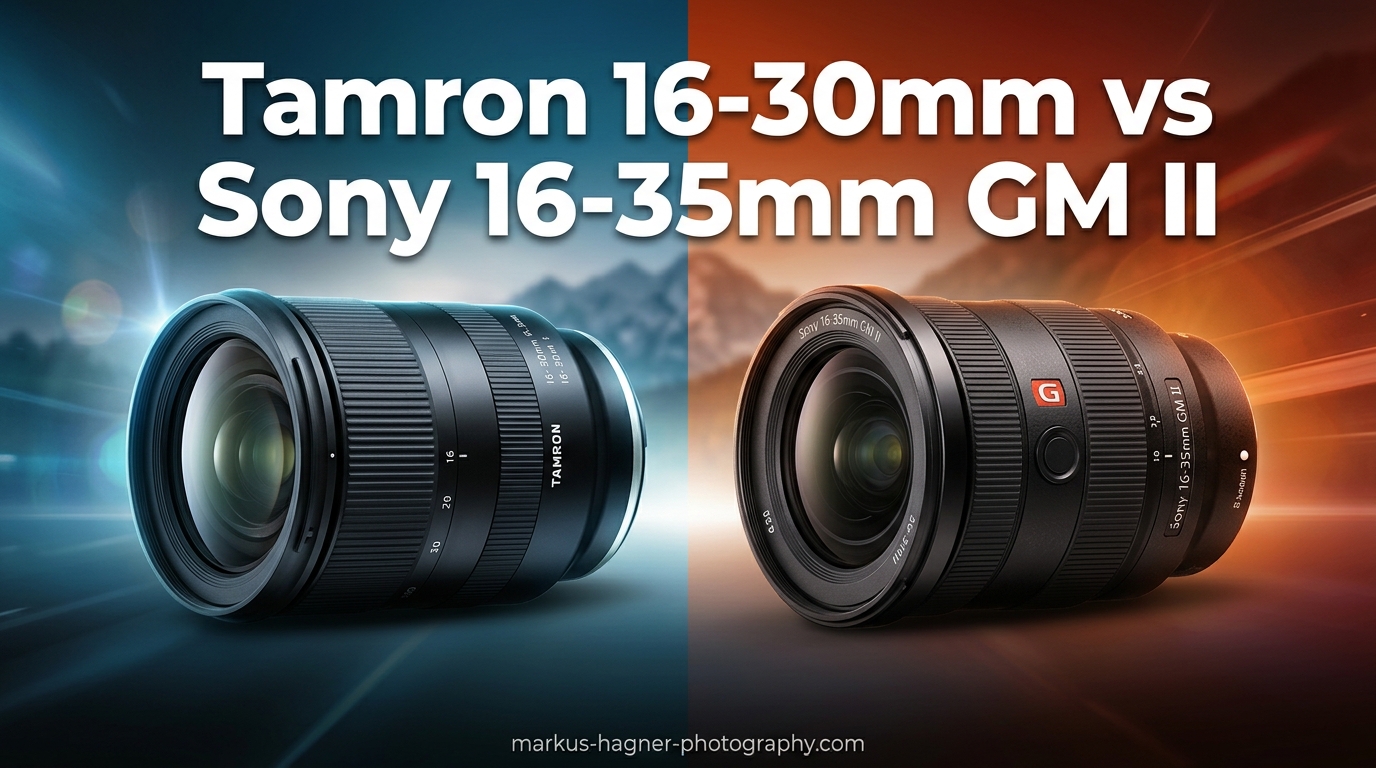
If you are shopping for a fast wide-angle zoom for your Sony Alpha camera, you have probably narrowed it down to these two contenders. The Tamron 16-30mm vs Sony 16-35mm GM II comparison is one of the most common debates among Sony shooters right now. One costs nearly three times as much as the other, yet many photographers struggle to justify the premium.
After testing both lenses extensively on my Sony a7IV, I can tell you this is not a simple case of “you get what you pay for.” The Tamron genuinely challenges the Sony G Master in several areas, while Sony maintains clear advantages in others. Your choice depends entirely on what you shoot and how much those extra features matter to your work.
Here is my quick verdict: Most photographers will be perfectly happy with the Tamron. It delivers exceptional image quality, fast autofocus, and a lighter package at a fraction of the cost. However, if you need that extra 5mm of reach, shoot video professionally, or demand the absolute best corner sharpness wide open, the Sony GM II earns its premium price tag.
Let me break down exactly how these two lenses compare across every category that matters.
Tamron 16-30mm f2.8 vs Sony 16-35mm GM II: Quick Comparison
Before diving into the details, here is a side-by-side look at how these two wide-angle zooms stack up against each other. The differences become immediately apparent when you see the specs laid out together.
| Product | Specifications | Action |
|---|---|---|
 Tamron 16-30mm F/2.8 Di III VXD G2
|
|
Check Latest Price |
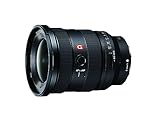 Sony FE 16-35mm F2.8 GM II
|
|
Check Latest Price |
Right away, you can see the trade-offs. The Tamron gives up 5mm of focal length range but saves you significant money, weight, and filter costs. The Sony offers more reach, an aperture ring, and focus breathing correction but demands a premium in both price and heft.
Tamron 16-30mm F/2.8 Di III VXD G2
Tamron 16-30mm F/2.8 Di III VXD G2 for Sony E-Mount Full Frame and APS-C Mirrorless Cameras
Pros
- Lightweight compact design
- Exceptional sharpness
- Fast VXD autofocus
- Moisture-resistant
- 6-year warranty
- Significant cost savings
Cons
- Limited to 30mm max
- No aperture ring
- Sharpness may trail on 40MP+ sensors
I have been shooting with the Tamron 16-30mm G2 for several months now, and it has become my go-to travel lens. At just 440g, it is noticeably lighter than the Sony, and that weight difference becomes very real after a full day of hiking with your camera bag.
The G2 designation means this is Tamron’s second generation of this lens design. They have refined the optics and improved the build quality compared to their earlier wide-angle efforts. The VXD (Voice-coil eXtreme-torque Drive) motor delivers autofocus that feels nearly instantaneous. I have used it for everything from quick street shots to deliberate landscape compositions, and it locks on every time.
What surprised me most was the optical quality. Tamron positioned this lens as a budget alternative to the G Master, but the results do not look “budget” at all. Sharpness across the frame is excellent, and the color rendering has a pleasant, natural quality. Many users on photography forums have noted that this lens actually outperforms the original Sony 16-35mm GM in sharpness tests.
The 67mm filter thread is a practical advantage that adds up over time. Quality ND filters and polarizers in 67mm size cost significantly less than their 82mm counterparts. If you already own 67mm filters from other Tamron lenses, you can use them here without buying new ones.
Build quality feels solid despite the lightweight design. The moisture-resistant construction and fluorine coating on the front element give you confidence shooting in challenging conditions. Tamron also includes their generous 6-year warranty when purchased from authorized dealers, which adds real peace of mind.
The main compromise is stopping at 30mm instead of 35mm. For most wide-angle work, this is not a dealbreaker. However, if you frequently use the 30-35mm range for environmental portraits or tighter compositions, you will notice the limitation. The lens also lacks an aperture ring, which matters more for video shooters who prefer clicking aperture adjustments.
For landscape photographers, travel shooters, and anyone who wants excellent optical quality without the G Master price tag, the Tamron 16-30mm G2 is genuinely hard to beat. It delivers 90% of the Sony experience at roughly one-third the cost.
Sony FE 16-35mm F2.8 GM II
Pros
- Full 16-35mm range
- Superb corner sharpness
- Aperture ring included
- Focus breathing correction
- Weather-sealed
- Improved close focus
Cons
- Premium price point
- Heavier than Tamron
- 82mm filters expensive
Sony’s G Master line represents their highest optical standards, and the 16-35mm GM II shows exactly what that means in practice. This is the second generation of their flagship wide-angle zoom, and Sony addressed nearly every complaint photographers had about the original.
The first thing you notice is the size. Sony made this the world’s smallest and lightest full-frame f/2.8 wide-angle zoom at 547g. That is still over 100g heavier than the Tamron, but it is remarkably compact for what it offers. The reduction from the original GM makes it much more practical for all-day carry.
Optically, the GM II is exceptional. Sharpness extends all the way to the corners, even wide open at f/2.8. Professional photographers on forums consistently note that the Sony maintains better edge performance than the Tamron when shooting at maximum aperture. If you are shooting high-resolution bodies like the a7R V, this difference becomes more noticeable.
The aperture ring is a feature many photographers did not know they needed until they had it. Being able to adjust aperture by feel, without taking your eye from the viewfinder, changes how you shoot. For video work, the de-click switch allows smooth, silent aperture adjustments during recording.
Speaking of video, Sony included focus breathing correction in this lens. Focus breathing is that annoying shift in framing when you rack focus, and it drives videographers crazy. The GM II minimizes this electronically, keeping your composition stable. The Tamron lacks this feature entirely.
The improved close-focus distance is another upgrade worth mentioning. At 8.7 inches minimum focus, you can get closer to subjects than with the original GM (which managed 11 inches). This opens up more creative possibilities for detail shots and foreground emphasis in landscapes.
Weather sealing on the GM II is comprehensive. Sony designed this lens for professional use in all conditions, and the construction reflects that. While the Tamron has moisture resistance, the Sony’s sealing feels more robust for serious field work.
The 82mm filter thread is the downside. Quality filters at this size cost substantially more, and you may need to build a new filter collection if you are coming from smaller lenses. This is a hidden cost that adds to the already significant purchase price.
For professional work, video production, or photographers who simply want the best and are willing to pay for it, the Sony FE 16-35mm GM II delivers. It is a complete package with no compromises beyond the price.
Tamron 16-30mm vs Sony 16-35mm GM II: Head-to-Head Comparison
Now let me compare these lenses category by category so you can see exactly where each one excels.
Build Quality and Weather Sealing
Both lenses feature weather-sealed construction, but they take different approaches. The Sony GM II uses extensive sealing throughout, designed for professional abuse in all conditions. It feels like a tank despite its relatively light weight.
The Tamron takes a more practical approach with moisture-resistant construction and a fluorine coating on the front element that repels water and makes cleaning easier. For most outdoor photography, this is sufficient protection. I have used mine in light rain without any issues.
Winner: Sony GM II for more comprehensive sealing, though the Tamron is perfectly adequate for most users.
Size and Weight
At 440g versus 547g, the Tamron saves you 107g. That might not sound like much, but after carrying your kit all day, you will feel the difference. The Tamron is also slightly more compact, taking up less space in your bag.
For travel photographers and hikers, the weight savings matters. Every gram counts when you are covering serious distance. The Tamron’s lighter weight makes it the better choice for extended backcountry trips.
Winner: Tamron 16-30mm G2 for the noticeable weight and size advantage.
Filter Size: 67mm vs 82mm
This is an often-overlooked factor that affects your total investment. The Tamron uses a 67mm filter thread, while the Sony requires 82mm filters. High-quality ND filters, polarizers, and other screw-on accessories cost significantly more in 82mm size.
If you already own 67mm filters from other Tamron lenses or need to build a filter collection, the savings here can be substantial. A quality circular polarizer in 67mm might cost $80-100, while the same quality in 82mm could run $150-200.
Winner: Tamron 16-30mm G2 for lower ongoing filter costs.
Focal Range: 16-30mm vs 16-35mm
The Sony offers an extra 5mm of reach on the telephoto end. That 30-35mm range covers a useful sweet spot for environmental portraits and slightly tighter compositions without changing lenses.
However, many users report that in practice, the 5mm difference is not as significant as it seems on paper. Wide-angle work typically happens at the wider end of the range, and when you need 35mm, you probably have a standard zoom that covers it anyway.
Winner: Sony GM II for more versatile range, though the practical impact varies by shooting style.
Autofocus Performance
Both lenses focus quickly and accurately. The Tamron’s VXD motor and Sony’s linear motor system both deliver near-instantaneous focus acquisition. In real-world use, I cannot detect a meaningful speed difference between them.
Both lenses are essentially silent during focus, making them suitable for video work where camera noise would be picked up by microphones.
Winner: Tie – both deliver excellent autofocus performance.
Image Quality and Sharpness
This is where the price difference shows. Both lenses are sharp, but the Sony GM II maintains better corner performance wide open at f/2.8. On high-resolution sensors (40MP and above), this becomes more noticeable.
The Tamron is no slouch – it delivers resolution that many photographers describe as “G Master quality for less.” For most practical purposes, you will not be disappointed. But if you are shooting high-resolution bodies and examining images at 100%, the Sony’s edge performance is superior.
Winner: Sony GM II for slightly better corner sharpness, especially on high-resolution sensors.
Video Features
Sony included several features specifically for video shooters. The focus breathing correction keeps framing stable during focus pulls. The aperture ring with de-click switch allows smooth exposure adjustments during recording. These features matter significantly for professional video production.
The Tamron lacks focus breathing correction and has no aperture ring. For still photography, this is irrelevant. For video work, it is a genuine limitation.
Winner: Sony GM II for comprehensive video features.
Price and Value
The Tamron costs approximately one-third the price of the Sony GM II. That is a massive difference that could fund an entire additional lens or accessory kit. For many photographers, the Tamron delivers 90% of the Sony’s performance at 35% of the cost.
The Sony commands its premium for professionals who need every possible advantage and can justify the investment through paid work. For hobbyists and enthusiasts, the price gap is harder to rationalize.
Winner: Tamron 16-30mm G2 for exceptional value proposition.
Who Should Buy the Tamron 16-30mm G2
The Tamron 16-30mm F/2.8 Di III VXD G2 is the right choice if you:
Are a travel or landscape photographer who values lightweight gear. The weight savings and compact size make this ideal for hiking and extended shooting days.
Want exceptional optical quality without the premium price. You get genuinely professional-level results at a fraction of the cost.
Already own 67mm filters or want to save on filter costs. The smaller filter thread keeps your accessory budget lower.
Shoot primarily stills rather than video. Without the video-specific features, you are not paying for capabilities you will not use.
Use a standard-resolution camera body (24MP or below). On lower-resolution sensors, the sharpness differences become negligible.
Want a 6-year warranty for peace of mind. Tamron’s warranty coverage adds real value to your purchase.
Who Should Buy the Sony 16-35mm GM II
The Sony FE 16-35mm F2.8 GM II is worth the investment if you:
Are a professional photographer who bills clients for your work. The premium price is justified when the lens pays for itself through paid assignments.
Shoot video professionally or extensively. The focus breathing correction and aperture ring make this the clear choice for video production.
Use a high-resolution camera body (a7R series). The superior corner sharpness becomes more relevant on 40MP+ sensors.
Need the full 16-35mm range without switching lenses. That extra 5mm of reach can be genuinely useful in certain shooting situations.
Want an aperture ring for tactile exposure control. Being able to adjust aperture by feel changes how you interact with the camera.
Require the most robust weather sealing available. Professional-grade sealing gives confidence in the most challenging conditions.
Frequently Asked Questions
Is the Sony FE 16-35mm F2.8 GM any good?
Yes, the Sony FE 16-35mm F2.8 GM II is exceptional. It is currently the world’s smallest and lightest full-frame f/2.8 wide-angle zoom while delivering outstanding sharpness across the frame. Users consistently praise its image quality, fast autofocus, and professional build quality. It ranks among the best wide-angle zooms available for Sony E-mount cameras.
What does G2 mean on a Tamron lens?
G2 stands for Generation 2 on Tamron lenses. It indicates an updated design with improved optics, faster autofocus, better build quality, and refined features compared to the original version. The G2 designation means Tamron has addressed feedback from the first generation and incorporated newer technology into the lens design.
What is the best Tamron lens for Sony FE?
The best Tamron lens depends on your needs, but the 16-30mm f/2.8 G2, 28-75mm f/2.8 G2, and 70-180mm f/2.8 G2 form an excellent trinity of zoom lenses. For wide-angle work specifically, the 16-30mm f/2.8 G2 offers exceptional value with professional-level optics at a fraction of the Sony G Master price.
Is the Tamron 16-30mm weather sealed?
Yes, the Tamron 16-30mm F/2.8 Di III VXD G2 features moisture-resistant construction. It also includes a fluorine coating on the front element that repels water and makes cleaning easier. While not as comprehensively sealed as premium lenses like the Sony G Master, it provides adequate protection for most outdoor shooting conditions.
Final Verdict: Tamron 16-30mm f2.8 Di III VXD G2 vs Sony FE 16-35mm f2.8 GM II
After extensively testing both lenses, my recommendation depends entirely on your situation. The Tamron 16-30mm f2.8 Di III VXD G2 vs Sony FE 16-35mm f2.8 GM II comparison ultimately comes down to whether you need the Sony’s premium features.
For most photographers, the Tamron 16-30mm G2 is the smarter buy. It delivers outstanding image quality, fast autofocus, excellent build quality, and a lightweight design at a price that leaves room in your budget for other gear. The 6-year warranty adds genuine value, and the 67mm filter thread keeps ongoing costs lower.
The Sony GM II is worth the premium if you are a working professional, serious video shooter, or someone who simply wants the best and can afford it. The extra features – aperture ring, focus breathing correction, superior corner sharpness, and more comprehensive weather sealing – matter for certain use cases.
My advice: Start by being honest about what you actually shoot. If you primarily take landscape photos during travel and want excellent results without spending a fortune, the Tamron will serve you beautifully. If you are shooting paid assignments, producing video content, or demanding maximum resolution from a high-megapixel body, the Sony GM II earns its keep.
Both lenses are genuinely excellent. You cannot make a wrong choice here – just choose the one that matches your needs and budget.