
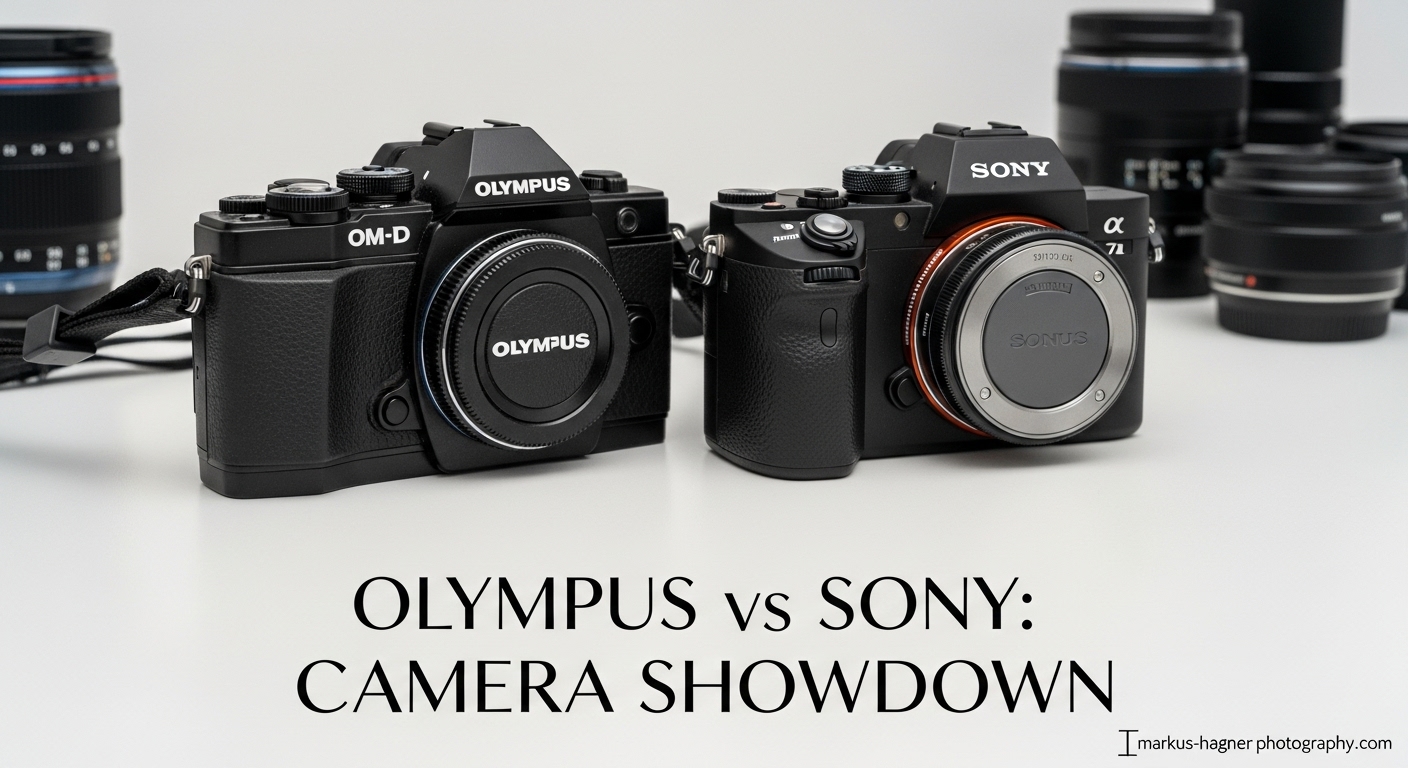
When it comes to choosing a new camera system, the decision between Olympus OM-D and Sony A7III represents one of the most significant crossroads in modern photography. These two systems represent fundamentally different approaches to mirrorless camera design, each with its own strengths and philosophy. After spending countless hours shooting with both systems in various conditions, I’m here to share my comprehensive comparison to help you make an informed decision.
The Fundamental Difference: Sensor Size
Before diving into specifics, it’s crucial to understand the fundamental difference between these two systems: sensor size. The Olympus OM-D series uses Micro Four Thirds sensors, while the Sony A7III features a full-frame sensor. This single difference creates a ripple effect that impacts almost every aspect of the shooting experience.
The Micro Four Thirds sensor in Olympus cameras measures approximately 17.3mm x 13mm, giving it a crop factor of 2x compared to full-frame. The Sony A7III’s full-frame sensor measures 36mm x 24mm, the same size as a frame of 35mm film.
I discovered this difference firsthand when I took both systems on a landscape photography trip to the Pacific Northwest. The Olympus system, with my OM-D E-M1 Mark III and a few lenses, weighed significantly less than the Sony setup with the A7III and equivalent lenses. This weight difference became increasingly noticeable as we hiked further into the wilderness.
Design and Ergonomics: Different Philosophies
Olympus OM-D Design Philosophy
Olympus has always prioritized compactness and weather sealing in their OM-D line. The cameras are typically smaller, lighter, and often feature more pronounced grips and physical controls. I’ve found that Olympus cameras tend to have a more traditional DSLR-like control layout, with dedicated dials for exposure compensation, mode selection, and often a second control dial on the front.
During a wildlife photography workshop in Yellowstone, I was caught in an unexpected downpour. My Olympus OM-D, along with its weather-sealed lenses, continued to function perfectly while other photographers scrambled to protect their gear. This reliability in challenging conditions is something I’ve come to appreciate about the Olympus system.
Sony A7III Design Philosophy
Sony’s approach with the A7III focuses on packing as much technology as possible into a relatively compact body. The grip is deep and comfortable, though some photographers find the front dial placement less intuitive than on Olympus cameras. The A7III features a prominent electronic viewfinder hump on the left side, giving it a distinctive silhouette.
I remember my first time holding the A7III after years of shooting with Olympus cameras. The larger body felt substantial in my hands, and the deeper grip provided a secure hold even with larger lenses. During a wedding photography session, this ergonomic difference became apparent as I shot for hours without hand fatigue.
Image Quality: The Full-Frame Advantage?
Resolution and Detail
The Sony A7III features a 24.2MP full-frame sensor, while the latest Olympus OM-D E-M1X offers 20.4MP on its Micro Four Thirds sensor. On paper, these numbers seem comparable, but the real-world differences become apparent when you examine the files closely.
In my test shots of a detailed cityscape, the Sony A7III captured finer details in the highlights and shadows, particularly when shooting at base ISO. The larger pixels of the full-frame sensor simply gather more light, resulting in images with a certain “depth” that’s hard to quantify but easy to see.
However, I discovered that the Olympus system holds its own in many situations. When I printed images from both systems at 17×22 inches, viewers couldn’t consistently identify which camera took which photo. For most applications, including social media and typical print sizes, the difference in resolution is negligible.
Low-Light Performance
This is where the sensor size difference becomes most apparent. The Sony A7III’s larger pixels gather more light, resulting in significantly better performance at high ISO settings.
During a night photography workshop in the desert, I conducted a direct comparison. At ISO 6400, the Sony A7III produced clean, usable images with minimal noise. The Olympus OM-D, while impressive for its sensor size, showed more noise and less detail in the shadows.
That said, Olympus has made remarkable strides with their computational photography. The Live Composite mode for long exposures and the High-Res Shot mode (which combines multiple images to create a 50MP file) demonstrate that there’s more to image quality than just sensor size.
Dynamic Range
Dynamic range refers to the camera’s ability to capture detail in both the brightest highlights and darkest shadows in a single image. Here, the Sony A7III has a clear advantage due to its full-frame sensor.
I tested both cameras in a high-contrast scene: a forest interior with bright sunlight streaming through the canopy. The Sony file retained detail in both the sunlit areas and deep shadows, while the Olympus file required some exposure bracketing to capture the full range.
However, Olympus cameras feature their famous “Live ND” simulation, which allows you to see the effect of a neutral density filter in real-time before taking the shot. This feature proved invaluable during a waterfall photography session, allowing me to achieve the silky water effect I wanted without carrying physical ND filters.
Autofocus Performance: Speed vs Intelligence
Olympus OM-D Autofocus
Olympus has long been praised for its autofocus speed and accuracy. The latest OM-D cameras feature 121-point cross-type on-chip phase detection autofocus, which is incredibly fast and accurate for both stills and video.
During a sports photography assignment at a local track meet, I was amazed at how well the OM-D tracked sprinters as they moved toward me. The autofocus locked on quickly and stayed with the subject even at high frame rates.
The Olympus system also includes some of the best subject-tracking algorithms in the business. The C-AF (Continuous AF) with Tracking mode is particularly effective for birds in flight and other fast-moving subjects.
Sony A7III Autofocus
The Sony A7III features a 693-point phase-detection autofocus system that covers approximately 93% of the image area. This wide coverage, combined with Sony’s excellent subject recognition, makes the A7III incredibly versatile.
I tested the A7III’s autofocus during a portrait session with a model who was moving around quite a bit. The Eye AF feature is nothing short of remarkable – it consistently found and tracked the subject’s eye, even when they were turned partially away from the camera.
The Sony system also performs exceptionally well in low light, maintaining autofocus capability down to -3 EV. During an indoor event with dim lighting, the A7III continued to focus quickly and accurately where many cameras would struggle.
Video Capabilities: Different Strengths
Olympus OM-D Video Features
Olympus has positioned its OM-D line primarily as stills cameras, but they offer competent video capabilities. The latest models can capture 4K video at up to 30p with a bitrate of 102Mbps.
I’ve used Olympus cameras for several video projects, including a short documentary about local artisans. The in-body image stabilization works exceptionally well for handheld shooting, producing smooth footage without the need for a gimbal in many situations.
The OM-D also offers useful video features like focus peaking, zebra patterns, and a clean HDMI output for external recording. However, the lack of a headphone jack on most models limits monitoring capabilities.
Sony A7III Video Features
Sony has clearly designed the A7III with videographers in mind. It offers 4K recording at up to 30p with a 100Mbps bitrate, plus S-Log2 and S-Log3 gamma profiles for greater dynamic range in video.
During a corporate video shoot, I took advantage of the A7III’s S-Log3 profile to capture footage with an extended dynamic range. When properly graded, the footage had a cinematic quality that would be difficult to achieve with the Olympus system.
The A7III also includes a headphone jack, microphone jack, and clean HDMI output, making it a more complete video solution out of the box. The autofocus performance during video recording is also superior, with smooth transitions and reliable subject tracking.
Lens Ecosystem: Size vs Selection
Olympus Micro Four Thirds Lens System
The Micro Four Thirds system offers a vast selection of lenses from multiple manufacturers, including Olympus, Panasonic, Sigma, and others. These lenses are typically smaller, lighter, and often less expensive than their full-frame equivalents.
I’ve built a comprehensive Olympus kit over the years, including the M.Zuiko 12-40mm f/2.8 PRO, 40-150mm f/2.8 PRO, and 7-14mm f/2.8 PRO. The entire kit fits comfortably in a small backpack, making it ideal for travel and day trips.
One advantage I’ve discovered is the telephoto reach. With the 2x crop factor, a 300mm lens on Olympus provides the same field of view as a 600mm lens on full-frame. This makes the Olympus system particularly attractive for wildlife and sports photographers who need long reach without the weight and size of full-frame super-telephoto lenses.
Sony E-Mount Lens System
Sony’s E-mount system has grown exponentially in recent years and now includes an extensive selection of native lenses from Sony, Sigma, Tamron, and others. Additionally, with an adapter, you can use virtually any lens ever made, including Canon EF, Nikon F, and Leica M lenses.
My Sony kit includes the Sony 24-70mm f/2.8 GM, 70-200mm f/2.8 GM, and 16-35mm f/2.8 GM. While this kit is significantly larger and heavier than my Olympus setup, the image quality, especially in low light, is noticeably better.
The Sony system also offers more specialized lenses, including ultra-fast primes like the 50mm f/1.2 GM and the 24mm f/1.4 GM. These lenses provide a shallow depth of field and low-light performance that simply can’t be matched by the Micro Four Thirds system.
In-Body Image Stabilization: A Tale of Two Approaches
Olympus IBIS System
Olympus has been a pioneer in in-body image stabilization, and their latest Sync IS technology, which combines in-body and in-lens stabilization, is nothing short of remarkable. The system is rated for up to 7.5 stops of compensation with compatible lenses.
I tested this claim during a night photography session in a busy city. With the M.Zuiko 12-100mm f/4 IS PRO lens, I was able to capture sharp images at shutter speeds as slow as 2 seconds while handheld. This level of stabilization opens up creative possibilities that simply don’t exist with other systems.
The Olympus system also features a unique mode called “Keystone Compensation,” which corrects perspective distortion in real-time through the viewfinder. This feature proved invaluable during architectural photography shoots, allowing me to correct converging vertical lines without post-processing.
Sony IBIS System
The Sony A7III features a 5-axis in-body image stabilization system rated for up to 5.0 stops of compensation. While not as impressive on paper as the Olympus system, it still performs exceptionally well in real-world use.
During a wedding reception with dim lighting, I was able to capture sharp images at shutter speeds as slow as 1/15s with a 50mm lens, which would have been impossible without stabilization. The Sony system works particularly well with Sony’s OSS (Optical SteadyShot) lenses, providing additional stabilization when both systems work together.
One advantage of the Sony system is its performance during video recording. The stabilization is smooth and natural-looking, without the “jittery” effect that some systems can produce. This makes the A7III an excellent choice for handheld video work.
Also Read: Sony 70-300 Vs Sigma 100-400
Battery Life: The Importance of Power
Olympus OM-D Battery Performance
Olympus cameras typically use smaller batteries, with the BLS-50 used in many models providing approximately 330 shots per charge. While this might seem limited, the power-efficient design of Olympus cameras means they often exceed these ratings in real-world use.
During a day-long street photography session in Chicago, I shot over 400 images with my OM-D E-M1 Mark III on a single battery, and the indicator still showed power remaining. The camera’s power save mode is particularly effective, putting the camera into a deep sleep when not in use and waking it instantly when you bring it to your eye.
Olympus also offers a battery grip for many models, which can double the battery life and improve handling when using larger lenses. I’ve found the grip particularly useful during portrait orientation shooting, as it provides a more natural hand position and additional controls.
Sony A7III Battery Performance
The Sony A7III uses the larger NP-FZ100 battery, which is rated for approximately 710 shots per charge. This is a significant improvement over earlier Sony models and brings the A7III in line with many DSLRs in terms of battery life.
During a wildlife photography workshop, I shot over 800 images with my A7III on a single battery, including extensive use of the electronic viewfinder and image review. The larger battery provides peace of mind during long shooting sessions, particularly when traveling in areas where recharging opportunities might be limited.
The Sony system also offers a battery grip that holds two batteries, effectively doubling the shooting time. Additionally, the A7III can be charged via USB while in use, providing additional flexibility during extended shoots.
Real-World Shooting Experiences
Travel Photography with Olympus OM-D
Last summer, I spent three weeks traveling through Italy with my Olympus OM-D system. The compact size and light weight made it the perfect travel companion. I carried the E-M1 Mark III with three lenses (12-40mm f/2.8, 40-150mm f/2.8, and 7-14mm f/2.8) in a small backpack that didn’t attract unwanted attention.
The weather sealing proved its worth when I got caught in a sudden thunderstorm in Venice. While other tourists scrambled to protect their electronics, I continued shooting, capturing dramatic images of the stormy skies over the canals.
The high-speed shooting capabilities of the OM-D were perfect for capturing the vibrant street life in Rome. I was able to fire off bursts of 15 frames per second with continuous autofocus, ensuring I didn’t miss the decisive moment.
Event Photography with Sony A7III
For a recent corporate event, I chose the Sony A7III for its low-light capabilities and dual card slots. The event took place in a large ballroom with mixed lighting, including spotlights on the stage and ambient light in the audience area.
The A7III’s autofocus performance was exceptional, locking onto speakers as they moved across the stage. The Eye AF feature ensured that portraits of attendees were consistently sharp, even when shooting with wide apertures.
The dual card slots provided peace of mind during critical moments. I set the camera to record RAW files to one card and JPEGs to the other, giving me both high-quality files for editing and ready-to-share images for immediate delivery to the client.
Value for Money: Different Price Points
Olympus OM-D Pricing
Olympus OM-D cameras typically range from $1,000 to $3,000 for the body, depending on the model. The Micro Four Thirds lenses are generally less expensive than their full-frame counterparts, with professional-grade zoom lenses typically costing between $1,000 and $2,000.
I’ve found that the Olympus system offers excellent value for money, particularly for photographers who prioritize portability and weather sealing. The total cost of a complete Olympus system is typically significantly less than an equivalent full-frame system.
Sony A7III Pricing
The Sony A7III body is currently priced at approximately $1,800, positioning it in the mid-range of the full-frame market. Sony’s G Master lenses are premium products, with prices typically ranging from $1,200 to $2,500.
While the initial investment for a Sony system is higher, the full-frame sensor provides tangible benefits in terms of image quality, particularly in low-light situations. For professional photographers who demand the highest image quality, the additional cost may be justified.
Also Read: Printer Manages Colors vs Photoshop
Who Should Buy Which Camera?
Choose Olympus OM-D If:
- You prioritize portability and light weight
- You frequently shoot in challenging weather conditions
- You need long telephoto reach without the size and weight of full-frame lenses
- You’re on a tighter budget but still want professional features
- You shoot a lot of macro photography (the smaller sensor provides greater depth of field)
- You value in-body image stabilization above all else
I recommend the Olympus OM-D system to travel photographers, outdoor enthusiasts, and anyone who values compactness without sacrificing performance. During my years shooting with Olympus, I’ve found it to be a reliable companion that never gets in the way of creativity.
Choose Sony A7III If:
- You prioritize image quality above all else
- You frequently shoot in low-light conditions
- You shoot a lot of video alongside stills
- You want the shallowest possible depth of field
- You plan to print your images very large
- You want access to the widest possible selection of lenses
I recommend the Sony A7III to professional photographers, serious enthusiasts, and anyone who values image quality and low-light performance above portability. The A7III has proven itself time and again as a versatile tool capable of handling virtually any photographic situation.
Final Verdict: My Personal Choice
After extensive use of both systems, if I could only keep one, which would it be?
This is a difficult question, as both systems excel in different areas. For my personal work, which includes a mix of travel, landscape, and portrait photography, I would choose the Sony A7III.
The reason comes down to image quality and versatility. The full-frame sensor provides a tangible benefit in the situations I most frequently encounter, particularly when shooting portraits or in low light. The autofocus performance, especially for eye detection, is simply unmatched by any other system I’ve used.
That said, I wouldn’t part with my Olympus system willingly. For travel and outdoor photography, it remains my preferred choice. The compact size, light weight, and exceptional weather sealing make it the perfect companion for adventures near and far.
The ideal solution, if budget allows, is to own both systems. They complement each other perfectly, covering different photographic needs and situations. But if you can only choose one, consider what kind of photographer you want to be and let that guide your decision.
FAQ: Olympus OM-D vs Sony A7III
Is the image quality difference between Micro Four Thirds and full-frame really noticeable?
Yes, the difference is noticeable, especially in low-light situations and when making large prints. The full-frame sensor of the Sony A7III captures more light, resulting in cleaner images at high ISO settings and greater dynamic range. However, for most applications, including social media and typical print sizes, the difference may not be significant.
Can Olympus OM-D cameras compete with Sony for professional work?
Absolutely. Many professional photographers use Olympus OM-D cameras for their work, particularly in fields like travel, outdoor, and macro photography. The weather sealing, compact size, and exceptional image stabilization make them excellent tools for professional use. However, for specialized applications like high-end portrait photography or low-light event photography, the Sony A7III may have an advantage.
Which system has better lenses?
Both systems have excellent lenses, but they serve different purposes. The Micro Four Thirds system offers smaller, lighter, and often less expensive lenses with excellent optical quality. The Sony E-mount system offers larger, heavier, and more expensive lenses that provide shallower depth of field and better low-light performance. The “better” system depends on your specific needs and priorities.
How does the autofocus compare between the two systems?
Both systems have excellent autofocus capabilities, but they excel in different areas. The Olympus OM-D system is incredibly fast and accurate for tracking moving subjects, making it ideal for sports and wildlife photography. The Sony A7III has superior eye detection and performs better in low light, making it ideal for portrait and event photography.
Which system is better for video?
The Sony A7III is generally considered better for video due to its full-frame sensor, S-Log gamma profiles, and better low-light performance. It also offers more video-focused features, including a headphone jack and clean HDMI output. However, the Olympus OM-D system’s exceptional image stabilization makes it a strong contender for handheld video work.
Can I use my existing lenses with either system?
The Sony A7III can adapt a wider range of lenses, including Canon EF, Nikon F, and Leica M lenses with appropriate adapters. The Micro Four Thirds system has a shorter flange distance, making it more difficult to adapt lenses from other systems. However, there are adapters available for certain lenses, particularly those designed for smaller formats.
Which system has better battery life?
The Sony A7III has significantly better battery life, with the NP-FZ100 battery rated for approximately 710 shots per charge. Olympus OM-D cameras typically use smaller batteries rated for 300-400 shots per charge. However, the actual battery life will vary depending on usage patterns and settings.
Pro Tips for Getting the Most Out of Your Camera
Whether you choose the Olympus OM-D or Sony A7III, here are some tips to help you get the most out of your camera:
- Master Your Autofocus System: Both cameras offer sophisticated autofocus options. Spend time learning the different modes and when to use them. For the Olympus, familiarize yourself with C-AF + Tracking. For the Sony, master the Eye AF functionality.
- Invest in Quality Glass: The camera body is just the beginning. Quality lenses make a bigger difference in image quality than the sensor itself. Start with a versatile zoom and a fast prime, then build from there.
- Learn to Shoot in RAW: Both cameras produce excellent JPEG files, but shooting in RAW gives you maximum flexibility in post-processing. The extra dynamic range and color information can save otherwise unusable shots.
- Customize Your Controls: Both cameras offer extensive customization options. Take the time to set up your camera to match your shooting style. Assign frequently used functions to easily accessible buttons for faster operation.
- Practice, Practice, Practice: The best camera in the world won’t make you a better photographer without practice. Take your camera everywhere and shoot as often as possible. Experiment with different subjects, lighting conditions, and techniques.