
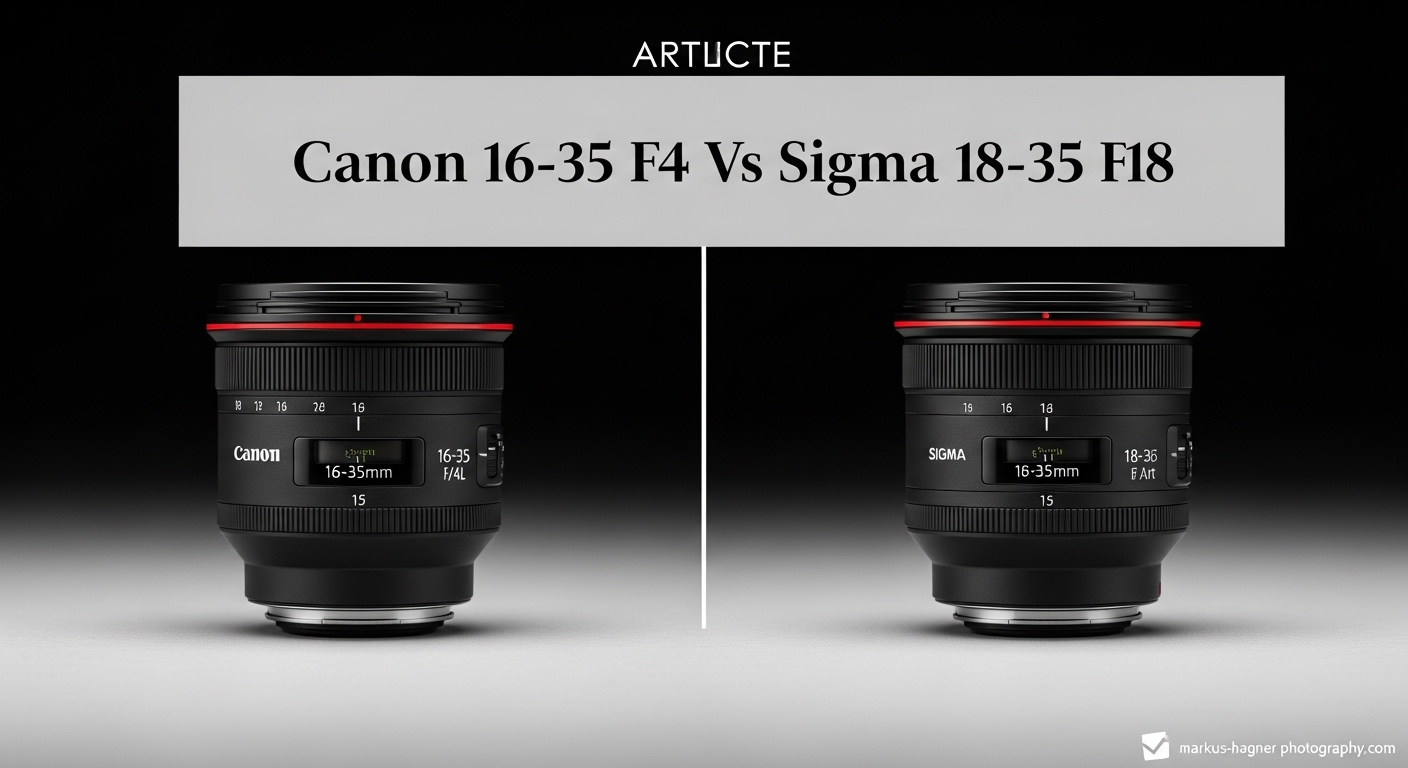
When it comes to wide-angle zoom lenses, two options consistently generate heated debates among photographers: the Canon 16-35mm f/4L IS USM and the Sigma 18-35mm f/1.8 DC HSM Art. I’ve spent countless hours shooting with both lenses in various conditions, and I’m here to share my comprehensive comparison to help you make the right choice for your photography needs.
The decision between these two lenses isn’t as straightforward as you might think. They represent different philosophies in lens design, serve different purposes, and are optimized for different camera systems. Let me walk you through everything you need to know about these lenses so you can make an informed decision.
Overview of the Contenders
Canon 16-35mm f/4L IS USM
The Canon 16-35mm f/4L IS USM is part of Canon’s prestigious L-series lineup, designed for professional photographers who demand the best in optical performance and build quality. As a full-frame lens, it covers an impressive ultra-wide to wide-angle range, making it versatile for landscape, architecture, and event photography.
I remember taking this lens to Yosemite National Park last fall and being blown away by its ability to capture the grandeur of the landscapes while maintaining excellent sharpness across the frame. The image stabilization was particularly valuable during golden hour shoots when I was pushing the limits of handheld photography.
Sigma 18-35mm f/1.8 DC HSM Art
The Sigma 18-35mm f/1.8 DC HSM Art is a revolutionary lens that made waves when it was released as the world’s first f/1.8 constant aperture zoom lens. It’s part of Sigma’s premium Art series, known for exceptional optical quality. However, it’s important to note that this is a DC (Digital Crop) lens, designed specifically for APS-C sensor cameras.
When I first got my hands on this lens, I was shooting a friend’s wedding reception with an APS-C camera. The f/1.8 aperture was a game-changer in the dimly lit venue, allowing me to capture beautiful moments without resorting to high ISO settings that would have compromised image quality.
Detailed Specifications Comparison
Let’s break down the key specifications of both lenses to see how they stack up against each other:
| Specification | Canon 16-35mm f/4L IS USM | Sigma 18-35mm f/1.8 DC HSM Art |
|---|---|---|
| Focal Length | 16-35mm | 18-35mm |
| Maximum Aperture | f/4 (constant) | f/1.8 (constant) |
| Minimum Aperture | f/22 | f/16 |
| Lens Construction | 16 elements in 12 groups | 17 elements in 12 groups |
| Special Elements | 2 UD, 2 aspherical | 4 SLD, 4 FLD, 2 aspherical |
| Diaphragm Blades | 7 | 9 |
| Minimum Focus Distance | 0.28m (11.02″) | 0.28m (11.02″) |
| Maximum Magnification | 0.23x | 0.22x |
| Optical Image Stabilization | Yes (up to 4 stops) | No |
| Autofocus | Ring USM | Hyper Sonic Motor (HSM) |
| Filter Size | 77mm | 72mm |
| Dimensions | 3.4 x 4.5 in. (82.6 x 112.5mm) | 3.5 x 4.8 in. (78.6 x 121.2mm) |
| Weight | 22.9 oz. (615g) | 28.6 oz. (810g) |
| Weather Sealing | Yes | Yes (dust and splash proof) |
| Mount | Canon EF, RF | Canon EF, Nikon F, Sony A, Sigma SA |
| Sensor Coverage | Full-frame | APS-C only |
Looking at these specifications, we can see some key differences immediately. The Sigma offers a much wider maximum aperture (f/1.8 vs f/4), which is a significant advantage in low-light situations. However, the Canon includes image stabilization, which the Sigma lacks. The Canon is designed for full-frame cameras, while the Sigma is optimized for APS-C sensors.
Build Quality and Design
Canon 16-35mm f/4L Build Quality
As an L-series lens, the Canon 16-35mm f/4L is built to professional standards. It features weather-sealed construction with dust and moisture resistance throughout. The lens barrel is made of high-quality plastics with metal mount, and it feels substantial in the hand without being overly heavy.
I’ve used this lens in light rain and dusty conditions without any issues, and it’s held up beautifully over time. The zoom and focus rings are perfectly sized and positioned, with smooth, well-damped rotation that inspires confidence during operation.
The lens extends slightly when zooming to 35mm, but not excessively, and the internal focusing means the front element doesn’t rotate, which is convenient when using polarizing filters.
Sigma 18-35mm f/1.8 Art Build Quality
The Sigma 18-35mm f/1.8 Art is built like a tank, with a metal barrel, brass mount, and high-quality plastics where appropriate. It’s noticeably heavier than the Canon, which speaks to its robust construction. The lens features Sigma’s “dust and splash proof” design, though it’s not quite as comprehensively sealed as the Canon L-series lens.
I’ve found the zoom and focus rings on the Sigma to be exceptionally smooth, with just the right amount of resistance. The lens extends significantly when zooming, which is typical for lenses with such a wide aperture range, and the front element rotates during focusing, which can be inconvenient when using certain filters.
One thing I particularly appreciate about the Sigma is the inclusion of a removable tripod collar, which helps balance the lens when mounted on a tripod and makes it easier to switch between horizontal and vertical orientations.
Image Quality Comparison
Sharpness
When it comes to sharpness, both lenses perform exceptionally well, but in different ways.
The Canon 16-35mm f/4L delivers excellent sharpness across the frame at all focal lengths, even when shooting wide open at f/4. I’ve been particularly impressed with its corner-to-corner sharpness at 16mm, which is remarkable for an ultra-wide-angle lens. Stopping down to f/5.6 or f/8 brings only marginal improvements, which speaks to the lens’s excellent optical design.
The Sigma 18-35mm f/1.8 Art is one of the sharpest zoom lenses I’ve ever used, period. At f/1.8, it’s incredibly sharp in the center, though there’s some softening in the corners that improves when stopped down. By f/2.8, it’s sharp across most of the frame, and by f/4, it’s tack-sharp from corner to corner. I’ve found that its peak sharpness actually exceeds that of the Canon, especially in the center of the frame.
Chromatic Aberration
Both lenses control chromatic aberration (CA) well, but the Sigma has a slight edge due to its premium optical design with four SLD (Special Low Dispersion) and four FLD (“F” Low Dispersion) elements.
The Canon shows minimal CA in most situations, with only slight purple fringing in high-contrast scenes at the edges of the frame. It’s easily correctable in post-processing if needed.
The Sigma exhibits even less CA, which is impressive considering its wide f/1.8 aperture. I’ve shot high-contrast scenes with this lens and been amazed at how well it controls color fringing, even wide open.
Distortion and Vignetting
Wide-angle zoom lenses typically exhibit some distortion and vignetting, and both of these lenses are no exception.
The Canon 16-35mm f/4L shows moderate barrel distortion at 16mm that transitions to minimal distortion at 35mm. Vignetting is noticeable at f/4, especially at 16mm, but improves significantly when stopped down to f/5.6 or f/8.
The Sigma 18-35mm f/1.8 Art exhibits more complex distortion patterns, with barrel distortion at 18mm that transitions to pincushion distortion at 35mm. Vignetting is quite pronounced at f/1.8, particularly at the wider end, but improves dramatically when stopped down.
Most modern cameras have in-camera correction profiles for both lenses, minimizing these issues in JPEG files. For RAW shooters, both Lightroom and Capture One offer excellent correction profiles.
Also Read: Nikon D850 vs Z8
Bokeh
Bokeh quality is where these lenses differ significantly due to their aperture differences.
The Canon 16-35mm f/4L produces pleasant, though not exceptional, bokeh. The 7-blade diaphragm creates reasonably circular out-of-focus highlights, and the transition from in-focus to out-of-focus areas is smooth, if not particularly creamy.
The Sigma 18-35mm f/1.8 Art, with its wider f/1.8 aperture and 9-blade diaphragm, produces significantly better bokeh. Out-of-focus highlights are more circular, and the transition between sharp and blurred areas is creamier and more pleasing to the eye. When shooting portraits or detail shots with this lens, I’ve been consistently impressed with its subject separation and background rendering.
Low-Light Performance
This is where the differences between these two lenses become most apparent. The Sigma’s f/1.8 aperture gives it a significant advantage in low-light situations, allowing it to gather approximately 3.5 times more light than the Canon at f/4.
I’ve shot indoor events with both lenses, and the difference is noticeable. With the Sigma 18-35mm f/1.8, I can maintain lower ISO settings and faster shutter speeds, resulting in cleaner images with less noise. In a dimly lit reception hall, I was able to shoot at ISO 1600 and 1/125s with the Sigma, while the Canon required ISO 6400 or higher to achieve the same shutter speed.
However, the Canon’s image stabilization helps level the playing field. The 4-stop IS means I can handhold the Canon at slower shutter speeds than the Sigma without introducing camera shake. In practice, I’ve found that I can reliably handhold the Canon at shutter speeds as slow as 1/15s at 16mm, while the Sigma requires at least 1/60s for sharp results.
For static subjects in low light, the Canon’s IS can compensate for its narrower aperture. For moving subjects or when you need to freeze action, the Sigma’s wider aperture gives it a clear advantage.
Autofocus Performance
Both lenses feature fast and accurate autofocus systems, but they work differently.
The Canon 16-35mm f/4L uses Canon’s Ring Ultrasonic Motor (USM) technology, which provides fast, quiet, and precise focusing. I’ve found the autofocus to be virtually instantaneous in good lighting conditions, with only minimal hunting in dim situations. The full-time manual focus override is a nice touch, allowing me to fine-tune focus without switching modes.
The Sigma 18-35mm f/1.8 Art uses Sigma’s Hyper Sonic Motor (HSM), which also delivers fast and quiet autofocus performance. In my experience, it’s slightly slower than the Canon in good light but more consistent in challenging lighting conditions. The Sigma also features full-time manual focus override, and its focusing system is generally very accurate, rarely missing focus.
For video work, both lenses offer smooth, silent autofocus that’s suitable for professional use. The Canon’s USM is slightly quieter, but both are virtually silent during operation, making them excellent choices for video recording where autofocus noise might be picked up by the camera’s microphone.
Sensor Compatibility and Crop Factor Considerations
This is a crucial aspect of the comparison that can’t be overlooked. The Canon 16-35mm f/4L is designed for full-frame cameras, while the Sigma 18-35mm f/1.8 is designed specifically for APS-C sensors.
When used on their intended sensor sizes:
- The Canon 16-35mm f/4L on a full-frame camera provides a true 16-35mm field of view.
- The Sigma 18-35mm f/1.8 on an APS-C camera provides an equivalent field of view of approximately 27-52.5mm (using the 1.5x crop factor common to most APS-C cameras).
This means that even though both lenses are marketed as “wide-angle zooms,” they serve different purposes due to the crop factor. The Canon is a true ultra-wide to wide-angle lens on full-frame, while the Sigma functions more as a wide-angle to normal lens on APS-C.
It’s worth noting that you can use the Canon on APS-C cameras, where it would provide an equivalent field of view of approximately 24-52.5mm. However, you cannot use the Sigma on full-frame cameras without severe vignetting and image quality degradation, as it’s designed to cover only the smaller APS-C image circle.
Use Cases and Photography Styles
Landscape Photography
For landscape photography, the Canon 16-35mm f/4L has a clear advantage due to its wider focal range and full-frame compatibility. The 16mm focal length is significantly wider than the Sigma’s 18mm (equivalent to 27mm on APS-C), allowing for more dramatic compositions in grand landscapes.
I’ve found the Canon’s image stabilization to be invaluable for landscape photography, especially when shooting in low light at dawn or dusk. The ability to handhold the camera at slower shutter speeds means I can capture sharp images without always needing a tripod.
The Sigma can produce excellent landscape results on APS-C cameras, but its narrower field of view at the wide end limits its versatility for grand landscapes. However, its exceptional sharpness and contrast make it an excellent choice for more intimate landscapes and detail shots.
Astrophotography
For astrophotography, the Sigma 18-35mm f/1.8 Art is the clear winner due to its wide f/1.8 aperture. When shooting the night sky, every bit of light-gathering ability counts, and the Sigma’s ability to gather 3.5 times more light than the Canon makes a significant difference.
I’ve used both lenses for astrophotography, and with the Sigma, I can capture the Milky Way with shorter exposures and lower ISO settings, resulting in cleaner images with more detail. The Canon requires longer exposures or higher ISO settings to achieve similar results, which can introduce more noise.
However, the Canon’s wider field of view can be advantageous for capturing large portions of the night sky, especially when shooting on a full-frame camera.
Event Photography
For event photography, the choice between these lenses depends on your camera system and specific needs.
If you’re shooting with a full-frame camera, the Canon 16-35mm f/4L is an excellent choice for event photography. Its wide focal range allows you to capture both wide environmental shots and more intimate compositions without changing lenses. The image stabilization is particularly valuable in dimly lit venues, allowing you to handhold at slower shutter speeds.
If you’re shooting with an APS-C camera, the Sigma 18-35mm f/1.8 Art is hard to beat for event photography. Its wide aperture allows you to capture images in low light without resorting to high ISO settings, and its focal range is well-suited for most event situations. I’ve shot weddings and parties with this lens and been consistently impressed with its performance.
Portrait Photography
For portrait photography, the Sigma 18-35mm f/1.8 Art has a clear advantage due to its wider aperture and better bokeh. The f/1.8 aperture allows for beautiful subject separation and background blur, even at closer focusing distances.
I’ve shot environmental portraits with the Sigma and been amazed at its ability to isolate subjects from their backgrounds while maintaining sharpness on the subject. The 9-blade diaphragm creates pleasingly circular out-of-focus highlights, adding to the overall aesthetic quality of the images.
The Canon 16-35mm f/4L can be used for environmental portraits, especially on full-frame cameras, but its narrower aperture limits its ability to separate subjects from backgrounds. It’s better suited for group portraits or situations where you want more of the environment to be in focus.
Video
Both lenses are excellent choices for video work, but they excel in different situations.
The Canon 16-35mm f/4L is a fantastic video lens for full-frame cameras, thanks to its image stabilization, smooth autofocus, and minimal focus breathing. The IS is particularly valuable for handheld video work, helping to eliminate camera shake and create smoother footage.
The Sigma 18-35mm f/1.8 Art is an excellent video lens for APS-C cameras, especially in low-light situations. Its wide aperture allows for cleaner footage in dim conditions, and its smooth manual focus operation makes it ideal for pull-focus techniques. The lack of image stabilization is a drawback for handheld work, but it’s less of an issue when using gimbals or other stabilization systems.
Price and Value Analysis
The Canon 16-35mm f/4L IS USM retails for approximately $999, while the Sigma 18-35mm f/1.8 DC HSM Art is priced at around $799. While the Sigma is less expensive, it’s important to consider the value each lens offers based on your specific needs.
The Canon offers excellent value for full-frame shooters who need a versatile wide-angle zoom with image stabilization. Its L-series build quality and weather sealing ensure it will withstand professional use, and its optical performance is consistently excellent across all focal lengths and apertures.
The Sigma offers exceptional value for APS-C shooters who need a fast, sharp zoom lens. Its f/1.8 aperture is unmatched in the zoom lens market, and its optical quality rivals that of many prime lenses. For APS-C shooters who primarily work in available light, the Sigma represents an outstanding value.
I’ve found that both lenses hold their value reasonably well in the used market, though L-series lenses typically depreciate more slowly due to their professional reputation and build quality.
Also Read: Canon RF 70-200mm f/4 vs f/2.8
Pros and Cons
Canon 16-35mm f/4L IS USM
Pros:
- True ultra-wide-angle coverage on full-frame cameras
- Excellent image stabilization (up to 4 stops)
- Professional L-series build quality and weather sealing
- Sharp across the frame even at f/4
- Minimal chromatic aberration
- Compatible with both full-frame and APS-C cameras
Cons:
- Narrower maximum aperture (f/4)
- Less subject separation than the Sigma
- More expensive than the Sigma
- Heavier than some competing wide-angle zooms
Sigma 18-35mm f/1.8 DC HSM Art
Pros:
- Exceptionally wide f/1.8 constant aperture
- Outstanding sharpness, especially in the center
- Excellent build quality with metal construction
- Beautiful bokeh with 9-blade diaphragm
- Great value for money
- Includes removable tripod collar
Cons:
- Designed for APS-C sensors only (not compatible with full-frame)
- No image stabilization
- Heavier than the Canon
- Extends significantly when zooming
- More pronounced distortion and vignetting at wide apertures
Who Should Buy Which Lens?
The Canon 16-35mm f/4L is Ideal For:
- Full-frame camera users who need a versatile wide-angle zoom
- Landscape photographers who value ultra-wide perspectives and image stabilization
- Travel photographers who want a single wide-angle lens for various situations
- Professional photographers who need weather sealing and reliable performance
- Videographers shooting on full-frame cameras who need image stabilization
The Sigma 18-35mm f/1.8 Art is Ideal For:
- APS-C camera users who want a fast, versatile zoom lens
- Low-light photographers who need maximum light-gathering ability
- Event photographers working in dimly lit venues
- Portrait photographers who want excellent subject separation and bokeh
- Astrophotographers who need a fast wide-angle lens for night sky shooting
Pro Tips for Using These Lenses
Getting the Most from the Canon 16-35mm f/4L
- Leverage the image stabilization: The 4-stop IS is one of this lens’s standout features. I’ve found that I can handhold at shutter speeds as slow as 1/15s at 16mm and still get sharp results. This is invaluable for landscape and architectural photography in low light.
- Use in-camera corrections: Enable lens corrections in your camera’s menu to automatically correct distortion, vignetting, and chromatic aberration. This makes a noticeable difference in image quality, especially at the edges of the frame.
- Stop down for maximum sharpness: While the lens is sharp at f/4, stopping down to f/5.6 or f/8 will yield even better results across the frame, especially in the corners.
- Take advantage of weather sealing: Don’t be afraid to use this lens in challenging conditions. The L-series weather sealing means it can handle light rain and dust without issue.
Maximizing the Sigma 18-35mm f/1.8 Art
- Stop down slightly for critical sharpness: While the lens is incredibly sharp even at f/1.8 in the center, stopping down to f/2.8 or f/4 will dramatically improve corner sharpness and reduce vignetting.
- Use the tripod collar for stability: The included tripod collar helps balance the lens when mounted on a tripod and makes it easier to switch between horizontal and vertical orientations.
- Embrace the wide aperture for creative effects: The f/1.8 aperture is this lens’s standout feature. Use it to create beautiful bokeh and subject separation in portraits and detail shots.
- Be mindful of focus shift: Like many fast lenses, the Sigma can exhibit focus shift when stopping down. For critical work, consider using live view focusing or stopping down the aperture for more consistent results.
FAQ: Canon 16-35 f/4 vs Sigma 18-35 f/1.8
Can I use the Sigma 18-35mm f/1.8 on a full-frame camera?
No, the Sigma 18-35mm f/1.8 is designed specifically for APS-C sensor cameras and will produce severe vignetting and image quality degradation if used on a full-frame camera. If you need a similar focal range for full-frame, consider the Sigma 24-35mm f/2 Art instead.
Which lens is better for video?
Both lenses are excellent for video, but they serve different purposes. The Canon 16-35mm f/4L is better for handheld video due to its image stabilization, while the Sigma 18-35mm f/1.8 excels in low-light situations where its wide aperture is advantageous.
Do these lenses work with teleconverters?
No, neither the Canon 16-35mm f/4L nor the Sigma 18-35mm f/1.8 is compatible with teleconverters. Teleconverters are typically designed to work with select telephoto lenses.
Which lens has better autofocus?
Both lenses have excellent autofocus systems, but they perform differently. The Canon’s Ring USM is generally faster and quieter in good lighting, while the Sigma’s HSM tends to be more consistent in challenging lighting conditions.
Can I use these lenses for astrophotography?
Both lenses can be used for astrophotography, but the Sigma 18-35mm f/1.8 is better suited due to its wider aperture, which allows for shorter exposures and lower ISO settings when shooting the night sky.
How do these lenses compare to prime lenses?
The Sigma 18-35mm f/1.8 Art is often compared to prime lenses in terms of sharpness and image quality, and it rivals or exceeds many primes in its focal range. The Canon 16-35mm f/4L is excellent for a zoom lens but generally doesn’t match the sharpness or low-light performance of high-end primes.
Are these lenses weather sealed?
The Canon 16-35mm f/4L features comprehensive weather sealing as part of its L-series designation. The Sigma 18-35mm f/1.8 Art has dust and splash proof construction but isn’t as comprehensively sealed as the Canon.
Conclusion: Making the Right Choice
After extensively using both the Canon 16-35mm f/4L and the Sigma 18-35mm f/1.8 Art, I can say that both are exceptional lenses that serve different purposes. The right choice for you depends on your camera system, photography style, and specific needs.
If you’re a full-frame camera user looking for a versatile wide-angle zoom with image stabilization and professional build quality, the Canon 16-35mm f/4L is an excellent choice. Its ultra-wide coverage, weather sealing, and reliable performance make it a workhorse lens for landscape, architecture, and event photography.
If you’re an APS-C camera user who needs a fast, sharp zoom lens with exceptional low-light performance, the Sigma 18-35mm f/1.8 Art is hard to beat. Its revolutionary f/1.8 constant aperture and outstanding optical quality make it a versatile tool for everything from events and portraits to astrophotography.
Ultimately, I’ve found that these lenses aren’t direct competitors due to their different sensor formats and design philosophies. Instead, they represent optimized solutions for different camera systems and photographic needs. By understanding your specific requirements and shooting style, you can choose the lens that will best serve your creative vision.