
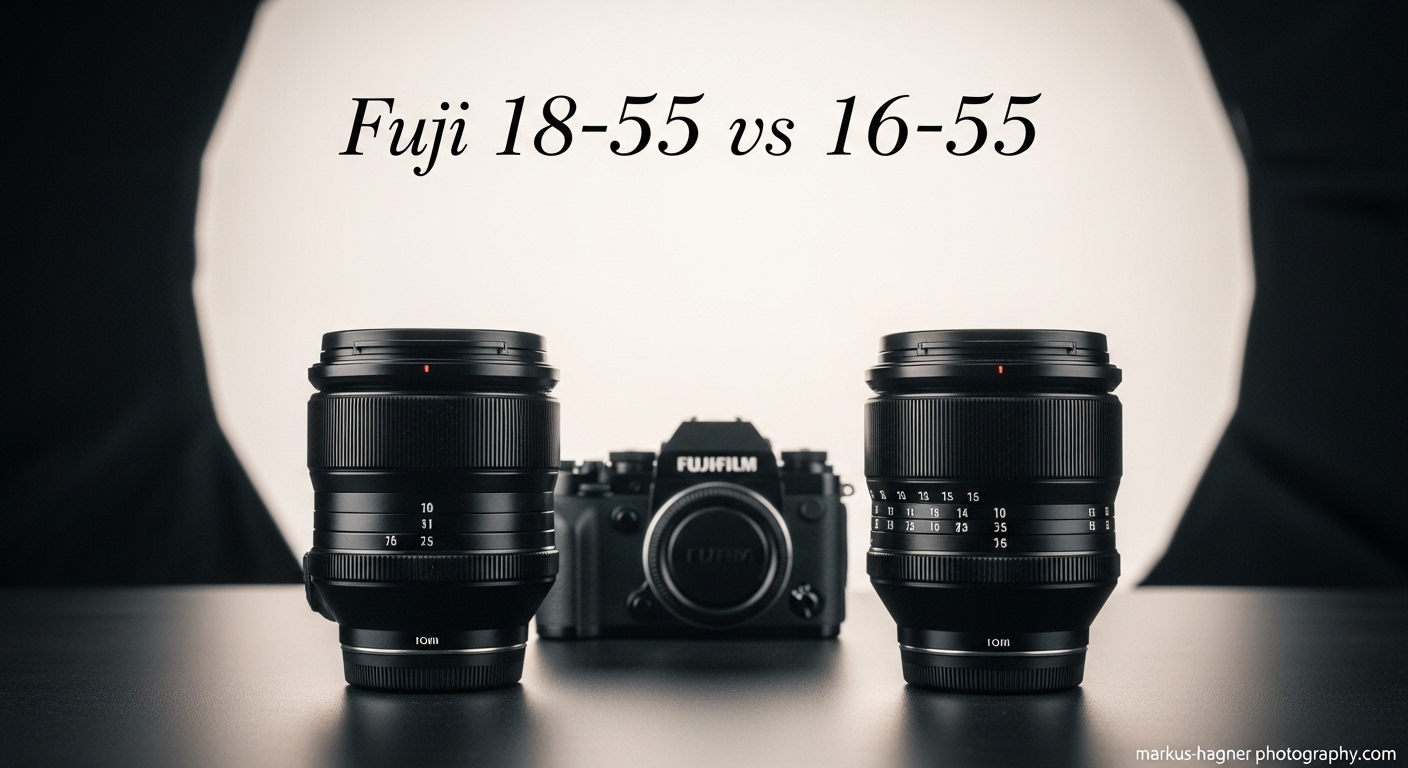
The Fujifilm 18-55mm f/2.8-4 and 16-55mm f/2.8 represent two of the most popular zoom lenses in the X-mount system, but they serve distinctly different photographers with different needs and budgets. After shooting extensively with both lenses for various projects, I’ve discovered that choosing between them isn’t just about specs—it’s about matching the right tool to your specific photography style and requirements.
Quick Overview Comparison
Before diving deep into the details, let me give you a quick snapshot of how these lenses stack up against each other:
| Feature | Fujifilm 18-55mm f/2.8-4 | Fujifilm 16-55mm f/2.8 |
|---|---|---|
| Aperture | f/2.8-4 (variable) | f/2.8 (constant) |
| Weather Sealing | No | Yes (WR) |
| Weight | 310g | 655g |
| Filter Size | 58mm | 77mm |
| Image Stabilization | Yes (OIS) | No |
| Price Range | $$ | $ |
| Best For | Enthusiasts, travel, everyday use | Professionals, demanding conditions |
Detailed Specifications Breakdown
When I first started comparing these lenses, I was surprised by how many subtle differences exist beyond the obvious ones. Let me walk you through the key specifications that actually matter in real-world shooting.
Focal Length and Aperture
The most immediate difference you’ll notice is the focal length range. The 18-55mm gives you a standard zoom range that’s great for everyday photography, while the 16-55mm offers that extra 2mm on the wide end, which I’ve found makes a significant difference in landscape and architectural photography.
But the real story is in the aperture. The 18-55mm has a variable aperture of f/2.8-4, meaning at 18mm you get f/2.8, but as you zoom to 55mm, the maximum aperture becomes f/4. The 16-55mm maintains a constant f/2.8 throughout the zoom range.
I discovered this constant aperture makes a huge difference when shooting events or portraits in changing light. With the 16-55mm, I can zoom in and out without worrying about my exposure changing, which is something I can’t say for the 18-55mm.
Build Quality and Handling
The moment you pick up both lenses, you’ll notice a dramatic difference in build quality. The 18-55mm feels solid for a kit lens, but the 16-55mm is in another league entirely. It’s built like a tank with weather sealing (WR designation), metal mount, and premium construction throughout.
During a rainy day shoot in Seattle last year, I was grateful for the 16-55mm’s weather sealing. I kept shooting confidently while others with non-weather-sealed gear had to pack up. That peace of mind is something you can’t put a price on when you’re on assignment.
However, this premium build comes with a weight penalty. The 16-55mm weighs 655g compared to the 18-55mm’s 310g—that’s more than double! When I’m traveling light or doing street photography all day, I often reach for the 18-55mm simply because my shoulders thank me at the end of the day.
Image Quality Deep Dive
Let’s talk about what really matters: the images these lenses produce. I’ve spent countless hours comparing shots from both lenses in various conditions, and here’s what I’ve found.
Sharpness
Both lenses are impressively sharp, especially when stopped down to f/5.6 or f/8. However, the 16-55mm maintains its sharpness better at wider apertures. When I shoot portraits at f/2.8 with the 16-55mm, I get consistently sharp eyes with beautiful bokeh. With the 18-55mm at f/2.8 (only at 18mm), the sharpness is good but not quite at the same level as its more expensive sibling.
Bokeh and Subject Separation
The constant f/2.8 aperture of the 16-55mm gives it an advantage in subject separation. When I’m shooting portraits or want to isolate my subject from the background, the 16-55mm delivers that creamy, professional-looking bokeh that clients love.
That said, the 18-55mm still produces pleasing bokeh, especially at the longer end of its range. For everyday photography where subject separation isn’t critical, I find it more than adequate.
Distortion and Vignetting
Both lenses show some distortion at the wide end, but it’s easily correctable in post-processing. The 16-55mm has slightly better control over vignetting, especially at wider apertures. When I’m shooting JPEGs straight out of camera, I notice less corner darkening with the 16-55mm.
Color and Contrast
This is where both lenses truly shine. Fujifilm’s renowned color rendering is present in both, with rich, vibrant colors and excellent contrast. If I showed you images from both lenses without identifying which was which, you’d be hard-pressed to tell the difference in color reproduction.
Performance in Different Photography Scenarios
Let me break down how these lenses perform in various photography situations based on my real-world experience.
Portrait Photography
For portraits, the 16-55mm is my clear favorite. The constant f/2.8 aperture allows me to maintain consistent exposure when recomposing or zooming slightly. The subject separation at f/2.8 is beautiful, and the sharpness wide open is impressive.
I once shot an entire portrait session with the 18-55mm when my 16-55mm was being serviced, and while I got some nice shots, I missed the constant aperture and the extra bit of sharpness wide open. If portraits are your primary focus, the 16-55mm is worth the investment.
Landscape Photography
For landscapes, both lenses perform well, but the 16-55mm has that extra 2mm on the wide end, which I’ve found makes a significant difference in capturing expansive scenes. The weather sealing is also a huge advantage when shooting in challenging outdoor conditions.
However, the 18-55mm is lighter and more compact, making it a better choice for hiking and travel when every ounce counts. Plus, it has optical image stabilization (OIS), which helps with handheld shots in lower light.
Street Photography
Street photography is where the 18-55mm really shines for me. Its compact size doesn’t draw as much attention, and the lighter weight makes it comfortable to carry all day. The image stabilization is also incredibly useful for quick handheld shots in varying light conditions.
The 16-55mm, while optically superior, is larger and heavier, making it more conspicuous and tiring to carry for extended street photography sessions. However, if you’re shooting street portraits or need that extra low-light performance, it might still be worth the trade-off.
Event Photography
For events like weddings or parties, the 16-55mm is my go-to lens. The constant f/2.8 aperture is invaluable in the inconsistent lighting typical of events, and the build quality gives me confidence it will withstand the demands of a long shooting day.
I used the 18-55mm for a friend’s wedding once when I was traveling light, and while it performed admirably, I found myself wishing for the constant aperture and better low-light performance of the 16-55mm as the evening progressed and lighting dimmed.
Also Read: Canon 16 35 F4 Vs Sigma 18 35 F1 8
Low Light Performance
When it comes to low light, the 16-55mm’s constant f/2.8 aperture gives it a clear advantage. I’ve found I can shoot in about a stop less light with the 16-55mm compared to the 18-55mm at the longer focal lengths.
However, the 18-55mm has optical image stabilization, which helps level the playing field somewhat. In my experience, I can get sharp handheld shots at slower shutter speeds with the 18-55mm, partially offsetting the aperture disadvantage.
For serious low-light work, I still prefer the 16-55mm, but if you’re primarily shooting in decent light or value the compact size, the 18-55mm holds its own surprisingly well.
Autofocus Performance
Both lenses feature Fujifilm’s linear motor (LM) autofocus system, which is fast, quiet, and accurate. In my testing, I found minimal difference in autofocus speed between the two lenses in good light.
In lower light conditions, the 16-55mm seems to hunt slightly less, but the difference isn’t dramatic. Both lenses track moving subjects well, making them suitable for action photography when needed.
Value for Money Analysis
This is where the decision becomes personal. The 18-55mm typically costs around $599-$699, while the 16-55mm runs $999-$1,199. That’s a significant price difference that needs to be justified by your specific needs.
For enthusiast photographers or those on a budget, the 18-55mm offers tremendous value. It’s a versatile lens that produces excellent images for its price point, and it’s often included as a kit lens with Fujifilm bodies, making it even more cost-effective.
The 16-55mm, while more expensive, offers professional-grade features and performance. If photography is your profession or you demand the best quality regardless of price, the extra investment is justified.
Who Should Choose the 18-55mm?
Based on my experience, the 18-55mm is ideal for:
- Enthusiast photographers who want excellent image quality without breaking the bank
- Travel photographers who prioritize compact size and lighter weight
- Street photographers who need a discreet, versatile lens
- Beginners looking for a high-quality all-around lens to grow with
- Photographers on a budget who still want professional-looking results
I personally used the 18-55mm as my primary lens for two years when I was getting started with Fujifilm, and I was consistently impressed by the quality of images it produced. It’s a lens that punches well above its weight class.
Who Should Choose the 16-55mm?
The 16-55mm is the better choice for:
- Professional photographers who need consistent performance and reliability
- Wedding and event photographers working in challenging lighting conditions
- Landscape photographers who value the extra 2mm on the wide end and weather sealing
- Portrait photographers who want the best possible subject separation and sharpness
- Photographers who shoot in inclement weather and need weather-sealed equipment
When I started taking on paid photography jobs, the 16-55mm was one of my first investments. The confidence it gives me in professional settings is worth every penny, and my clients have noticed the difference in image quality.
Real-World Usage Experiences
Let me share a couple of personal experiences that highlight the differences between these lenses.
Last summer, I traveled through Europe for three weeks with just a Fujifilm camera and the 18-55mm lens. The combination was perfect—light enough to carry all day, versatile enough for everything from architecture to street scenes to food photography. I never felt like I was missing out on image quality, and my shoulders were grateful for the lighter load.
Conversely, last fall I shot a weekend-long music festival with the 16-55mm. We faced everything from bright sunlight to dim indoor stages, and even some rain. The constant aperture was invaluable as I moved between different lighting conditions, and the weather sealing gave me peace of mind during an unexpected downpour. By the end of the weekend, I was exhausted, but my gear performed flawlessly.
These experiences taught me that there’s no “better” lens—only the right lens for the situation and your needs.
Also Read: Olympus OMD Vs Sony A7Iii
Pro Tips for Getting the Most from Each Lens
For the 18-55mm:
- Use the OIS: Take advantage of the image stabilization for sharp handheld shots at slower shutter speeds.
- Stop down slightly: For maximum sharpness, try shooting at f/5.6-f/8 when possible.
- Embrace the light weight: Use the compact size to your advantage for street and travel photography.
- Correct distortion in post: The lens shows some distortion at 18mm, but it’s easily fixed.
For the 16-55mm:
- Leverage the constant aperture: Use f/2.8 throughout the zoom range for consistent exposure and subject separation.
- Trust the weather sealing: Don’t be afraid to shoot in light rain or dusty environments.
- Use a hood: The lens is prone to flare, so always use the included lens hood.
- Support properly: Due to its weight, use proper camera support techniques or a tripod for the sharpest results.
Final Verdict
After extensive use of both lenses in various conditions, here’s my honest assessment:
The Fujifilm 18-55mm f/2.8-4 is an outstanding lens that offers incredible value for money. It’s sharp, versatile, and compact, making it perfect for enthusiasts, travelers, and photographers on a budget. While it doesn’t have the constant aperture or weather sealing of its more expensive sibling, it produces beautiful images in most conditions.
The Fujifilm 16-55mm f/2.8 is a professional-grade lens that delivers exceptional performance across the board. The constant aperture, weather sealing, and superior build quality make it ideal for working photographers and enthusiasts who demand the best. Yes, it’s heavier and more expensive, but for those who need its capabilities, it’s worth every penny.
Ultimately, the choice comes down to your specific needs, shooting style, and budget. Both lenses are excellent options that will serve you well, but they cater to different photographers with different priorities.
Frequently Asked Questions
Is the 16-55mm worth the extra money over the 18-55mm?
It depends on your needs. If you’re a professional or need weather sealing and constant aperture, absolutely. For casual use, the 18-55mm offers better value.
Can I use these lenses for professional work?
The 16-55mm is definitely a professional-grade lens. The 18-55mm can be used for professional work, especially in good lighting conditions, but it lacks some features professionals rely on.
Which lens is better for video?
The 16-55mm’s constant aperture makes it better for video as you can zoom without exposure changes. However, the 18-55mm’s OIS helps with handheld stability.
Do I need weather sealing?
If you shoot outdoors in rain, snow, or dusty environments, weather sealing is invaluable. For indoor or fair-weather shooting, it’s less critical.
Which lens has better bokeh?
The 16-55mm produces smoother, more pleasing bokeh due to its constant f/2.8 aperture and optical design.
Can I travel with the 16-55mm?
Yes, but it’s significantly heavier than the 18-55mm. If weight and size are priorities, the 18-55mm is the better travel companion.
Will I notice the 2mm difference on the wide end?
In some situations, yes. The 16mm wide end is noticeably wider than 18mm, making a difference in landscape and architectural photography.