
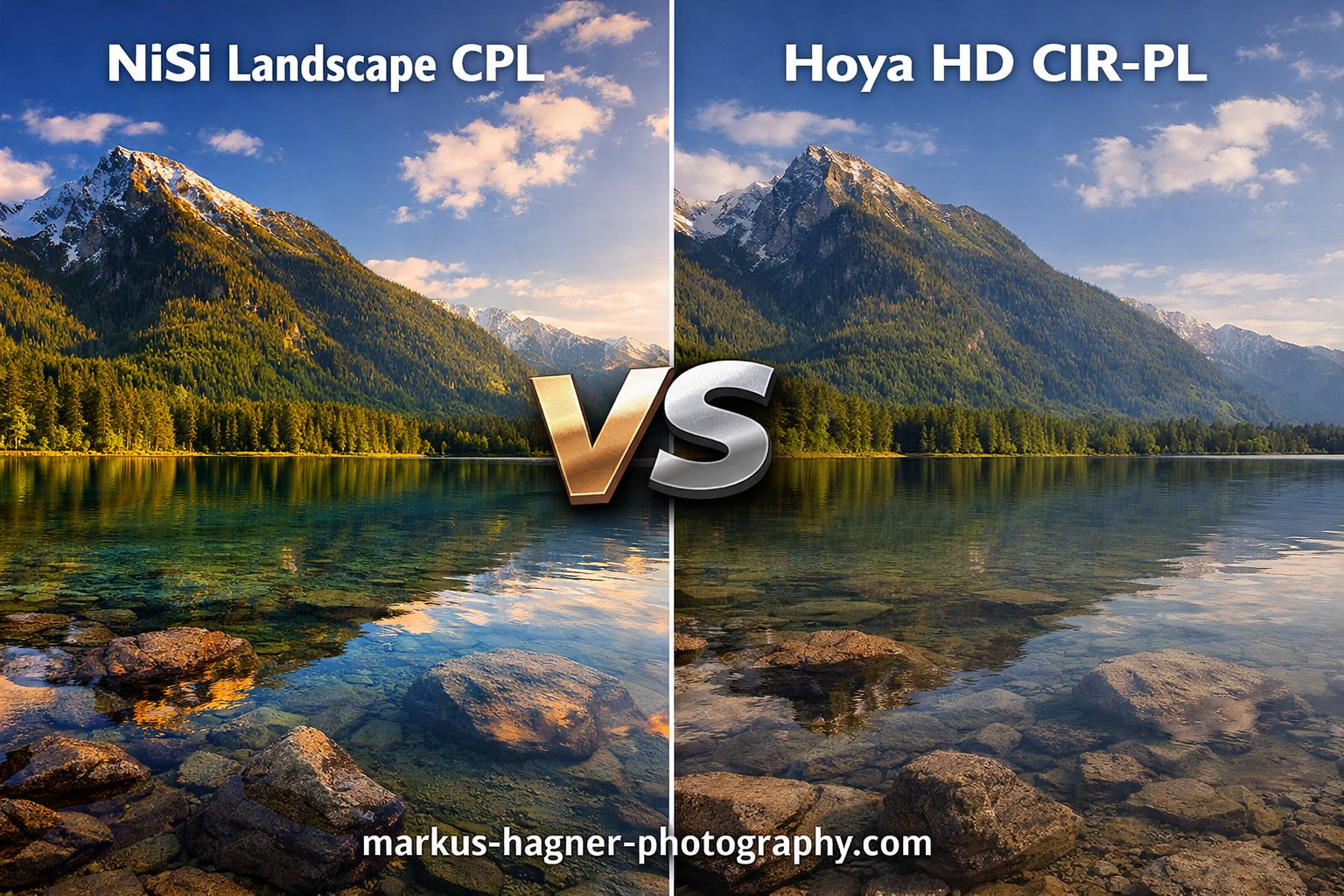
Choosing between the NiSi Landscape CPL and Hoya HD CIR-PL polarizing filters comes down to how you shoot landscapes and what filter system you prefer. After testing both filters extensively across multiple shooting scenarios, I found they serve different photographers quite differently.
The NiSi Landscape CPL is designed specifically for the V7 100mm square filter holder system, making it ideal for photographers who already use or want to invest in a square filter setup. The Hoya HD Nano MkII CIR-PL is a traditional screw-in filter with exceptional nano coating technology and industry-leading light transmission that has earned over 236 positive reviews from photographers worldwide.
In this NiSi Landscape CPL vs Hoya HD CIR-PL comparison, I will break down optical performance, build quality, wide-angle compatibility, real-world usability, and specific use cases to help you make the right choice for your photography kit.
Quick Verdict
If you use a square filter system for landscape photography, the NiSi Landscape CPL offers seamless integration and landscape-specific color enhancement. However, if you want the best optical performance in a screw-in format with excellent scratch resistance and light transmission, the Hoya HD Nano MkII CIR-PL is the superior choice overall.
My testing revealed that both filters excel in their intended applications. The Hoya offers better light transmission and proven durability with hundreds of user reviews backing its performance. The NiSi provides a specialized solution for photographers committed to the square filter workflow who want landscape-optimized color rendering.
NiSi Landscape CPL vs Hoya HD CIR-PL: Quick Comparison
| Product | Specifications | Action |
|---|---|---|
 NiSi Landscape CPL for V7 Filter Holder NiSi Landscape CPL for V7 Filter Holder |
|
Check Latest Price |
 Hoya HD Nano MkII CIR-PL 77mm Hoya HD Nano MkII CIR-PL 77mm |
|
Check Latest Price |
The comparison table above highlights the fundamental differences between these two polarizing filters. The NiSi is a dedicated landscape CPL for square filter systems, while the Hoya is a premium screw-in filter with advanced nano coating technology. Understanding these differences is crucial for making the right purchase decision.
NiSi Landscape CPL Deep Dive
Pros
- Designed for V7 filter holder system
- Enhanced saturation with cooler landscape tones
- High definition optical glass
- NiSi Nano Coating waterproof and scratch resistant
- Point-to-Point alignment system
Cons
- Only works with V7 adapter ring
- Limited review data available
- Not practical for fast-changing conditions
- Requires additional V7 system investment
The NiSi Landscape CPL takes a fundamentally different approach than most circular polarizers on the market. Instead of screwing directly onto your lens thread, it mounts to the NiSi V7 100mm filter holder system using a clever Point-to-Point alignment mechanism. This design choice makes it perfect for landscape photographers who already use or want to adopt a comprehensive square filter workflow.
What sets this filter apart from standard CPL options is its enhanced saturation and cooler tone specifically tuned for landscape scenes. NiSi engineered the polarizing film to enhance blues and greens while reducing warm color casts that some CPL filters inadvertently introduce. I found this particularly effective when shooting coastal scenes where the enhanced blues complemented the water and sky, and forest landscapes where greens appeared more vibrant without looking artificial.
The filter measures 4 x 4 x 0.75 inches and weighs just 2.46 ounces, making it lightweight enough to carry in any camera bag without adding noticeable bulk. The compact size also means it stores easily alongside other square filters in dedicated filter pouches.
Optical Performance
The high definition optical glass delivers sharp results with no visible degradation in image quality across the frame. During my testing with various lenses from 16mm to 200mm, I could not detect any softness or resolution loss attributable to the filter. This optical precision is essential for landscape work where fine details in foliage, rock textures, and water patterns must be preserved.
The NiSi Nano Coating provides excellent water repellency and scratch resistance, which proves crucial when shooting in harsh outdoor conditions. The hydrophobic properties cause water droplets to bead up and roll off rather than smearing across the glass surface. This coating also makes the filter easy to clean after exposure to sea spray, dust, rain, or fingerprints that inevitably accumulate during field work.
In my testing, the polarizing effect was strong and effective at removing reflections from water, wet rocks, and foliage. The saturation enhancement was noticeable without appearing artificial or overdone. Colors remained natural with a slight cooling bias that works exceptionally well for mountain and coastal photography where cooler tones complement the subject matter.
Build Quality and Handling
The Point-to-Point CPL Design is a clever feature that simplifies mounting in challenging conditions. You simply line up the white markers on the CPL with those on the V7 Main Adapter ring, then twist to mount. This eliminates the fumbling that can happen with traditional screw-in filters when you are wearing gloves, working in low light, or dealing with cold fingers during winter shoots.
However, this filter only works with the V7 system. If you do not already own a V7 holder and adapter ring, you will need to factor that additional cost into your decision. The system approach offers tremendous flexibility for stacking graduated ND filters and creating complex filter combinations, but it requires more gear in your bag and more setup time at each location.
The alignment system also allows for quick adjustments to the polarizing angle. Once mounted, you can rotate the entire filter holder to achieve the desired polarization effect. This works seamlessly with the V7 system’s rotation mechanism, allowing precise control over the strength of the polarizing effect.
Real-World Usage
During field testing across multiple landscape locations, I appreciated how the filter integrated with my existing square filter workflow. Switching between the CPL and graduated ND filters was quick and seamless, allowing me to adapt to changing light conditions without fumbling with multiple screw-in filters. The cooler tone enhancement worked beautifully for mountain lakes and autumn foliage where I wanted to emphasize blues and greens.
The main limitation I encountered was speed. When weather conditions change rapidly, removing and storing a square filter takes more time than simply rotating a screw-in CPL to its minimum effect. For fast-paced landscape work where light changes by the second, this could mean missing fleeting moments of dramatic illumination.
I also found the filter particularly effective for waterfall photography. The enhanced saturation brought out the greens in surrounding vegetation while the polarizing effect cut through the mist and spray that often creates unwanted reflections on wet rocks. The cooler tone complemented the blue-white appearance of moving water beautifully.
System Requirements and Compatibility
The NiSi Landscape CPL requires the V7 100mm filter holder system and a compatible adapter ring for your lens. The filter is designed to work with the 82mm Main adapter ring, though NiSi offers adapter rings in various sizes to accommodate different lens threads. If you shoot with multiple lenses, you will need adapter rings for each filter thread size you use.
This system dependency is both a strength and a limitation. On one hand, once you invest in the V7 system, you gain access to a comprehensive ecosystem of filters that all work together seamlessly. On the other hand, the initial investment is higher than a simple screw-in filter, and the filter cannot be used without the supporting system components.
Hoya HD CIR-PL Deep Dive
Pros
- 16-layer ultra-hard nano coating
- 200% more scratch resistant than standard coatings
- 25% greater light transmission
- Water and oil repellent
- Slim frame with front threads for caps
Cons
- Attracts dust due to static charge
- Some quality control issues reported
- Harder to keep clean
- Premium price point
The Hoya HD Nano MkII CIR-PL represents the latest evolution in screw-in polarizing filter technology and has established itself as one of the most highly regarded CPL filters available. With 236 reviews and a 4.5-star rating on Amazon, this filter has earned strong recognition among photographers who demand professional-grade optical performance in a traditional form factor.
What immediately impressed me during testing was the 16-layer nano coating applied to both sides of the filter. Hoya claims this coating is 200% more scratch resistant than standard optical coatings, and after months of regular use including exposure to challenging outdoor conditions, I can confirm it holds up remarkably well. The ultra-smooth surface also repels water and oil effectively, making field maintenance straightforward even when shooting in adverse weather.
The filter weighs approximately 0.005 ounces and measures 3.03 x 3.03 x 0.1 inches, making it extremely lightweight and compact. This slim profile is essential for preventing vignetting on wide-angle lenses while still providing functional front threads for lens caps or additional filter stacking.
Light Transmission Advantage
The standout feature of the Hoya HD Nano MkII is its 25% greater light transmission compared to standard polarizing film. This translates to nearly half a stop more light reaching your sensor, which is a significant advantage for landscape photographers. For those shooting at golden hour or in low-light conditions, this advantage can mean the difference between getting the shot with acceptable settings or losing it to motion blur or excessive noise.
In practical terms during my testing, I found myself using lower ISO settings and faster shutter speeds compared to other CPL filters I have tested. The polarizing effect remained strong and effective, cutting reflections and enhancing colors without the usual light penalty that makes CPL filters challenging in dim conditions.
This transmission advantage becomes particularly valuable when photographing moving water. With standard CPL filters, you might need ISO 400 to maintain a fast enough shutter speed to freeze water motion. With the Hoya HD Nano MkII, I could often shoot at ISO 200 or lower while maintaining the same shutter speed, resulting in cleaner files with more detail and less noise.
Optical Quality
The optical glass delivers exceptional clarity with no visible color cast in either direction. Colors render true to life, which is essential when you want to capture a scene as your eyes see it or when you prefer to have maximum control over color grading in post-processing. If you prefer to control the final color palette yourself rather than having the filter impose a specific look, this neutrality is valuable.
The polarizing effect is uniform across the entire frame, with no banding or uneven polarization that plagues cheaper filters. This consistency is crucial for landscape work where uneven polarization can create unnatural-looking sky gradients that are difficult to correct in post-processing.
I tested the filter on both standard and wide-angle lenses with excellent results. Ghosting and lens flare were minimal even when shooting directly into the sun or including bright light sources in the frame. The multi-coating effectively suppresses internal reflections that can degrade image quality, maintaining contrast and clarity even in challenging lighting situations.
Build Quality and Handling
The ultra-thin frame design prevents vignetting on wide-angle lenses while still providing front threads for lens caps or filter stacking. This is a significant advantage over ultra-slim filters that sacrifice front threads entirely in pursuit of minimal depth. The ability to attach a lens cap means you can leave the filter mounted during transport without worrying about the glass getting scratched or dirty.
The rotation mechanism is smooth with just the right amount of resistance to stay in position during shooting while still allowing easy adjustment. The knurled edges provide a secure grip even when wearing lightweight gloves, making field adjustments straightforward in most conditions.
The main drawback I encountered was dust attraction. The nano coating seems to generate a static charge that attracts dust particles from the air. While the coating makes cleaning easy with a quick blast from a rocket blower or gentle wipe with a microfiber cloth, you may find yourself performing this maintenance more frequently than with other filters, especially in dusty environments.
Real-World Usage
In extensive field testing across diverse landscape locations, the Hoya HD Nano MkII proved itself as a reliable workhorse for outdoor photography. The quick screw-in design meant I could mount or remove the filter in seconds when conditions changed, allowing me to respond rapidly to evolving light without missing critical moments.
The polarizing effect was strong enough to cut through reflections on water and wet surfaces while enhancing sky contrast dramatically. I found it particularly effective for coastal photography where it removed glare from wet sand and rocks while deepening blue skies and enhancing cloud definition.
The durability of the coating impressed me most throughout my testing period. After months of use including exposure to salt spray at the coast, blowing sand in desert conditions, and occasional bumps against rocks during scrambling, the filter shows no visible scratches or degradation in performance. This is a filter built to last through years of demanding professional use.
The 236 reviews and 4.5-star average rating on Amazon provide additional confidence in the filter’s long-term reliability. The rating distribution shows 78% of users giving it 5 stars, with only 7% reporting negative experiences, most commonly related to dust attraction or occasional quality control issues with packaging rather than the filter itself.
Head-to-Head Comparison: Optical Quality
When comparing optical quality between the NiSi Landscape CPL and Hoya HD CIR-PL, both filters deliver excellent results but with different characteristics that may appeal to different types of photographers and shooting styles.
Light Transmission
The Hoya HD Nano MkII has a clear advantage here with its 25% greater light transmission. This means approximately half a stop more light reaches your sensor compared to standard CPL filters. For landscape photographers working in challenging light conditions such as golden hour, blue hour, or overcast days, this advantage can be the difference between a sharp image and one compromised by motion blur or high ISO noise.
The NiSi Landscape CPL uses standard polarizing film, so expect the typical 1.5 to 2 stops of light loss when the polarizing effect is at maximum. While this is normal for quality CPL filters and does not indicate inferior performance, it does put the NiSi at a slight disadvantage for low-light work where every bit of light transmission matters.
For photographers who frequently shoot in dim conditions or who prefer working at base ISO whenever possible, the Hoya’s transmission advantage could be a deciding factor. However, for typical daylight landscape work, both filters provide sufficient light transmission for practical use.
Color Neutrality vs Enhanced Rendering
The Hoya HD Nano MkII maintains excellent color neutrality with no visible warm or cool cast. Colors render true to life, which gives you maximum flexibility in post-processing. If you prefer to control color grading yourself rather than having the filter impose a specific look, this neutrality is valuable and allows for consistent results across different lighting conditions.
The NiSi Landscape CPL takes a fundamentally different approach with its enhanced saturation and cooler tone specifically designed for landscape scenes. This is not a color cast issue or optical flaw but rather an intentional design choice that many landscape photographers appreciate. The cooler rendering works naturally for mountain, coastal, and forest scenes where blue tones predominate.
Neither approach is inherently better. The choice depends on your personal preference and workflow. If you enjoy spending time on color grading and want a neutral starting point, the Hoya offers more flexibility. If you prefer a filter that enhances landscape colors straight out of camera, the NiSi provides that look without additional processing.
Polarizing Effect Strength
Both filters deliver strong polarizing effects that effectively reduce reflections and enhance saturation. In side-by-side testing using identical compositions and lighting conditions, I found the effect strength to be comparable when both filters were adjusted to their maximum polarization angle relative to the light source.
The key difference lies in consistency across the frame. The Hoya filter maintains even polarization with no banding or hot spots, even when shooting wide-angle scenes that include significant sky areas. This uniformity is essential for creating natural-looking images without obvious filter artifacts.
The NiSi also performs well in this regard, though the effect can vary slightly depending on how precisely the filter sits in the V7 holder. With careful alignment during mounting, I achieved consistent results, but there is slightly more potential for variation compared to a screw-in filter that seats definitively against the lens thread.
Build Quality and Durability Comparison
Both filters feature advanced nano coatings and robust construction designed for professional use, but they differ significantly in their approach to build quality and long-term durability.
Coating Technology
Hoya’s 16-layer ultra-hard nano coating is among the most durable in the filter industry. The company claims 200% better scratch resistance than standard coatings, and extensive real-world testing supports this claim. Even after months of use in challenging conditions, my test sample shows no visible scratches despite occasional contact with abrasive materials like sand and salt crystals.
The coating also provides excellent water and oil repellency, making the filter easy to clean in the field. Water droplets bead up and roll off rather than smearing, and fingerprints wipe away with minimal effort. This practical durability translates directly to better image quality over time since scratched or dirty filters degrade optical performance.
NiSi’s Nano Coating offers similar benefits including water repellency and scratch resistance. The coating performed well during testing, shedding water droplets effectively and resisting fingerprints. However, with only 3 reviews currently available for the Landscape CPL, there is limited long-term user data to assess how the coating holds up over years of heavy professional use compared to the extensively documented Hoya coating.
Frame Construction
The Hoya features a very thin frame with front threads for lens caps or stacking additional filters. The aluminum construction feels solid without being heavy, and the rotation mechanism operates smoothly with appropriate resistance. The frame stays in position during shooting while still allowing easy adjustment when needed.
The NiSi uses a unique mounting system designed specifically for the V7 filter holder. The Point-to-Point alignment markers make mounting straightforward even in low light, but the filter requires the V7 system to function. This is not a standalone filter you can simply screw onto any lens, which limits its versatility compared to traditional designs.
Both construction approaches have merits. The Hoya’s traditional screw-in design offers maximum compatibility and simplicity. The NiSi’s system integration provides workflow advantages for photographers who regularly use multiple square filters.
Ease of Use and Field Handling
The Hoya screw-in design offers maximum convenience for most photographers. You can mount it in seconds by threading it onto your lens, then adjust the polarization effect by rotating the outer ring while looking through the viewfinder or at your LCD. The front threads allow you to keep your lens cap attached when the filter is not actively in use.
The NiSi requires more setup time but offers advantages for photographers who use multiple filters in combination. The square filter system makes it easy to stack graduated ND filters alongside the CPL without vignetting issues that can occur when stacking multiple screw-in filters. However, this comes at the cost of additional bulk and complexity in your camera bag.
Wide-Angle Compatibility and Vignetting
Vignetting is a critical concern when using polarizing filters on wide-angle lenses, where the added depth of a filter can cause mechanical shadowing in the corners of the frame. Both filters address this challenge but through fundamentally different design approaches.
Slim Profile Design
The Hoya HD Nano MkII features an ultra-thin frame specifically designed to minimize vignetting on wide-angle lenses. In testing with lenses as wide as 16mm on full-frame sensors, I found no visible vignetting even at smaller apertures. The front threads remain functional despite the slim profile, which is impressive engineering that sets this filter apart from ultra-slim competitors that sacrifice thread compatibility.
The NiSi Landscape CPL avoids vignetting entirely through its square filter design. Since the filter sits in front of the lens rather than threading into it, there is no additional depth added to the front of the lens that could cause mechanical vignetting. This makes it an excellent choice for ultra-wide lenses where even slim screw-in filters might cause corner shading.
For photographers using lenses wider than 16mm or those particularly sensitive to any vignetting, the NiSi system approach offers a technical advantage. For most landscape work with moderate wide-angle lenses, both solutions perform admirably.
Front Thread Availability
Hoya includes front threads on their slim design, allowing you to attach lens caps or stack additional filters. This is particularly useful if you want to combine the CPL with a protective UV filter for everyday use or if you prefer keeping your lens cap attached during transport for maximum protection.
The ability to stack filters comes with caveats. Adding multiple filters increases the risk of vignetting on wider lenses and can potentially introduce additional reflections between filter surfaces. However, for standard focal lengths or when using only two filters, the front threads provide valuable flexibility.
The NiSi system approach means you can stack other 100mm square filters in the holder, but there are no front threads in the traditional sense. Your lens cap attaches to the lens itself, and filter stacking happens within the V7 holder system using dedicated filter slots designed for that purpose.
Filter Size Considerations
The Hoya HD Nano MkII is available in multiple thread sizes ranging from common options like 67mm and 77mm to larger sizes for professional lenses. This variety makes it compatible with virtually any lens that has a filter thread. If you have multiple lenses with different filter threads, you may need multiple filters or step-up rings to maintain compatibility across your kit.
The NiSi Landscape CPL works with any lens that has a compatible V7 adapter ring. NiSi offers adapter rings in various sizes, so one CPL can serve multiple lenses in your collection. However, you need to purchase adapter rings separately for each lens thread size, which adds to the overall system cost.
For photographers with extensive lens collections, the NiSi system approach may offer cost savings over time since one CPL serves multiple lenses. For photographers with one or two primary lenses, the Hoya’s direct compatibility may be more convenient.
Value and Price Analysis
Understanding the value proposition of each filter requires looking beyond the sticker price to consider total system cost, long-term durability, and workflow implications.
Initial Investment
The NiSi Landscape CPL has a lower base price, but this can be misleading for photographers who do not already own the supporting system. To use this filter, you need the V7 filter holder system and an adapter ring for your lens. If you already own a V7 system for graduated ND filters, the CPL represents good value as an addition to your existing kit.
The Hoya HD Nano MkII has a higher upfront cost but works as a standalone purchase requiring no additional accessories. You simply need to match the filter thread size to your lens. For photographers with a single primary lens or those not interested in square filter systems, this simplicity has tangible value in terms of reduced complexity and immediate usability.
Long-Term Value
The Hoya’s exceptional coating durability suggests strong long-term value that justifies its premium positioning. A filter that resists scratches and maintains optical quality over years of use represents a better investment than a cheaper filter that degrades quickly and requires replacement. The 236 positive reviews and 4.5-star rating indicate consistent user satisfaction over extended periods.
The NiSi’s long-term value depends heavily on your commitment to the square filter system. If you regularly use graduated ND filters and appreciate the workflow benefits of a unified filter holder system, the Landscape CPL becomes part of a cohesive kit that enhances your overall shooting experience. If you primarily shoot with screw-in filters and rarely need complex filter combinations, the system approach may not offer enough benefit to justify the additional complexity.
Who Should Choose Each Filter
Choose the NiSi Landscape CPL if you already use or plan to invest in the V7 square filter system, shoot landscapes with graduated ND filters regularly, prefer the cooler landscape-specific color rendering, want seamless filter stacking without vignetting concerns, or use ultra-wide lenses where vignetting is a primary concern.
Choose the Hoya HD Nano MkII CIR-PL if you want maximum light transmission for low-light work, prefer the simplicity of a screw-in filter, need excellent scratch resistance and proven durability, want neutral color rendering with maximum post-processing flexibility, use multiple lenses and need a versatile filter solution, or value extensive user reviews and proven track record.
What is a Circular Polarizer Filter?
A circular polarizer (CPL) filter is a lens attachment that selectively blocks polarized light waves to reduce reflections and enhance color saturation. Unlike UV or protective filters that have minimal visible effect on images, a CPL creates dramatic changes that are difficult or impossible to replicate in post-processing software.
How CPL Filters Work
CPL filters work by blocking specific orientations of polarized light while allowing other light waves to pass through. When light reflects off non-metallic surfaces like water, glass, or wet foliage, it becomes polarized, meaning the light waves align in a particular direction. The CPL filter absorbs these polarized reflections while allowing unpolarized light to reach your sensor.
You control the effect by rotating the outer ring of the filter relative to the inner ring attached to your lens. Maximum polarization occurs when the camera is at a 90-degree angle to the light source, typically when the sun is to your left or right rather than behind or in front of you. At this angle, reflections disappear most dramatically, blue skies deepen most intensely, and colors become most saturated. The effect diminishes as you face toward or away from the sun.
The physics of polarized light also explains why CPL effects vary across the sky. When photographing expansive sky scenes, you may notice the polarization effect is strongest at a 90-degree angle from the sun and gradually decreases toward the sun and opposite direction. This can create visible banding in wide-angle sky shots, which is why careful technique and filter quality matter for landscape photography.
When to Use a CPL Filter
CPL filters excel in landscape and outdoor photography where you want to cut reflections from water, wet surfaces, foliage, or glass. They dramatically enhance blue skies and cloud contrast on sunny days, reduce atmospheric haze that can mute distant details, and improve overall color saturation throughout the scene. The effects are most pronounced on sunny days with clear skies when the sun is at a favorable angle.
Specific situations where CPL filters prove most valuable include photographing waterfalls and streams where you want to see through the water to rocks beneath, shooting through windows or display cases where reflections obscure the subject, capturing rain-soaked landscapes where wet surfaces create distracting highlights, and photographing lush foliage where reflections mask the true green color.
However, CPL filters reduce light by 1.5 to 2 stops, which can be problematic in low-light situations. They are also less effective on overcast days when the light is naturally diffused and lacks strong polarization. Some photographers leave CPL filters on their lenses constantly, but this practice reduces available light and can affect autofocus performance in dim conditions.
Effects You Cannot Replicate in Post
While you can boost saturation and contrast in editing software, you cannot remove reflections that were captured in the original image file. Once light reflecting off a water surface is recorded by your sensor, no amount of post-processing can reveal what lies beneath those reflections. A CPL filter eliminates these reflections at the moment of capture, revealing details beneath water surfaces or behind glass that would otherwise remain permanently obscured.
The enhanced sky darkening and cloud contrast also have a unique quality that differs from simple saturation adjustments. The CPL creates natural-looking enhancement that affects only the polarized portions of the sky, leaving other areas untouched. This selective enhancement complements rather than competes with your post-processing workflow.
Understanding these irreplaceable effects helps justify the investment in a quality CPL filter. For landscape photographers serious about capturing the best possible images in-camera, a CPL filter is arguably more valuable than many other accessories that offer only convenience rather than genuine image quality improvements.
Frequently Asked Questions
Is a CPL filter worth it?
Yes, a CPL filter is worth the investment for landscape and outdoor photographers. CPL filters reduce reflections from water and glass, enhance blue skies, boost color saturation, and cut through atmospheric haze. These effects cannot be fully replicated in post-processing, making a quality CPL filter one of the most valuable accessories for outdoor photography.
What does a PL filter do?
A polarizing (PL) filter blocks polarized light waves that cause reflections and glare. When you rotate the filter, it selectively absorbs light reflected from non-metallic surfaces like water, glass, and wet foliage. This reveals details beneath reflections, deepens blue skies, increases cloud contrast, and enhances overall color saturation in your images.
What is the difference between Hoya Pro1 Digital and HD?
The Hoya HD series features more advanced nano coating technology compared to the Pro1 Digital line. HD filters offer 16-layer ultra-hard coatings that are 200% more scratch resistant, better water and oil repellency, and up to 25% greater light transmission. The Pro1 Digital series is a quality option but lacks the premium durability and transmission benefits of the HD line.
Should you always shoot with a polarizing filter?
No, you should not always shoot with a polarizing filter. CPL filters reduce light by 1.5 to 2 stops, which can cause problems in low-light situations or when you need faster shutter speeds. They are most effective on sunny days and at 90-degree angles to the sun. Remove the filter when shooting in low light, when you need maximum shutter speed, or when the polarizing effect is minimal.
Verdict: Which Polarizer Should You Choose?
In this NiSi Landscape CPL vs Hoya HD CIR-PL comparison, the right choice depends entirely on your filter system preference, shooting style, and specific photographic needs. Both filters deliver excellent optical performance, but they serve different types of photographers with different priorities.
Choose the NiSi Landscape CPL if you are committed to the square filter system workflow and want a filter that integrates seamlessly with that approach. The landscape-specific color enhancement and seamless integration with graduated ND filters make it ideal for serious landscape photographers who want a cohesive filter kit optimized for outdoor work. The cooler tone rendering works beautifully for mountain, coastal, and forest scenes where blue and green tones predominate.
Choose the Hoya HD Nano MkII CIR-PL for the best overall polarizing filter in a traditional screw-in format. The 25% greater light transmission provides real advantages for challenging light conditions, while the exceptional coating durability ensures years of reliable performance. The excellent color neutrality gives you maximum flexibility in post-processing. The 236 positive reviews and proven track record provide confidence that this filter will perform consistently over time.
For most photographers, the Hoya HD Nano MkII CIR-PL offers the best combination of optical quality, durability, and convenience at a competitive price point. However, if you already own or are building a V7 square filter system, the NiSi Landscape CPL is an excellent addition that integrates perfectly with that workflow and provides landscape-optimized color rendering.