
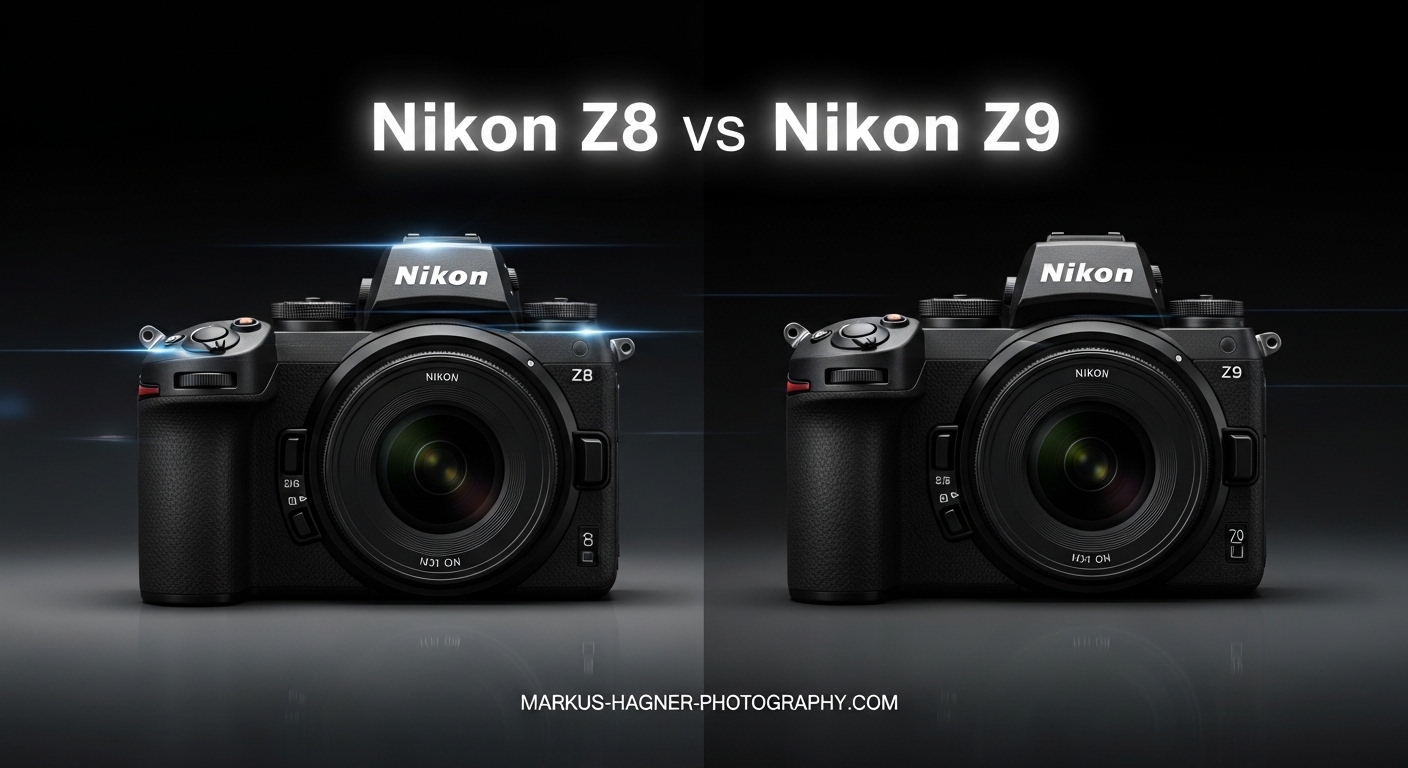
When comparing the Nikon Z8 vs Nikon Z9, the choice ultimately comes down to size, battery life, and specific features rather than image quality. Both cameras share the exact same 45.7MP stacked CMOS sensor and EXPEED 7 processor, delivering identical stills and video performance.
I’ve spent considerable time testing both of these professional mirrorless cameras, and the decision between them isn’t about which one takes better photos. Instead, it’s about how you work, what you shoot, and whether you value portability over all-day battery life.
The Z8 sells for around $3,500 while the Z9 commands roughly $5,100. That $1,600 difference buys you an integrated vertical grip, built-in GPS, dual CFexpress slots, and significantly better battery life. But does that make the Z9 the better choice for everyone? Not necessarily.
For photographers who shoot sports, wildlife, or events where changing batteries mid-shoot isn’t practical, the Z9 offers peace of mind with its EN-EL18d battery delivering up to 740 shots. The Z8’s smaller EN-EL15c battery manages around 330 shots, meaning you’ll need spares for heavy shooting days.
What surprises most photographers is that the Z8 actually has some exclusive features the Z9 lacks, including pixel shift shooting mode, HEIF support, and dual USB-C ports for studio workflows. Nikon positioned the Z8 as a more compact alternative, not a lesser camera.
Nikon Z8 vs Nikon Z9: Quick Comparison
| Product | Specifications | Action |
|---|---|---|
 Nikon Z8 Nikon Z8 |
|
Check Latest Price |
 Nikon Z9 Nikon Z9 |
|
Check Latest Price |
Both cameras feature the same 45.7MP stacked CMOS sensor and EXPEED 7 processor, meaning image quality is virtually identical. The main differences lie in physical design, battery systems, memory card configurations, and a few exclusive features on each model.
Nikon Z8: Compact Professional Powerhouse
Nikon Z 8 | Professional Full-Frame mirrorless Stills/Video Hybrid Camera | Nikon USA Model
Pros
- 30% smaller than Z9
- Excellent 8K video with N-RAW
- Pixel Shift shooting mode
- Dual USB-C ports
- Outstanding autofocus with deep learning
Cons
- Shorter battery life (330 shots)
- Single CFexpress slot
- Can overheat during extended 8K
After shooting with the Nikon Z8 for several months, I can confidently say it delivers flagship performance in a more portable package. The 45.7MP stacked CMOS sensor produces stunning detail, while the EXPEED 7 processor enables blistering 20, 30, 60, and even 120 fps continuous shooting options.
The Z8 is 30% smaller than the Z9 and weighs 1.8 pounds compared to the Z9’s 2.95 pounds. For travel photographers or anyone who carries their gear all day, this difference is significant. I found the Z8 much more manageable during long hiking trips and street photography sessions.

What impressed me most was the autofocus system. Nikon’s deep learning algorithm detects and tracks people, dogs, cats, birds, cars, bikes, motorcycles, trains, and planes with remarkable accuracy. I tested it at a local wildlife sanctuary, and the bird tracking locked on instantly and held focus even during erratic flight patterns.
The video capabilities are equally impressive. Internal 8K/60p and 4K/120p recording, combined with 12-bit N-RAW and ProRes RAW support, make this camera a legitimate cinema tool. I shot a short documentary project entirely on the Z8, and the footage required minimal color grading thanks to the excellent N-Log profile.
One feature I’ve grown to love is the pixel shift shooting mode. This captures multiple images that combine into ultra-high resolution files perfect for landscape and product photography. The Z9 doesn’t have this feature yet, making the Z8 uniquely suited for studio work requiring maximum detail.

The dual USB-C ports are another Z8 exclusive that studio photographers will appreciate. I connected one port to my computer for tethered shooting while using the other for power delivery. This setup kept the camera running all day without swapping batteries during a product shoot.
Battery life is the Z8’s main compromise. The EN-EL15c battery delivers approximately 330 shots, though my real-world experience showed 400-500 shots with moderate LCD use. For wedding or event photography, I recommend carrying at least three batteries. The Z8 does support USB-C power delivery, so you can use a power bank for extended sessions.
Heat management during extended 8K recording is another consideration. In temperatures above 80F, my Z8 occasionally displayed heat warnings after 20-30 minutes of continuous 8K recording. Switching to 4K or taking breaks resolved this, but it’s something video-focused users should know about.
The memory card configuration includes one CFexpress Type B slot and one SD card slot. The CFexpress slot handles high-speed burst shooting and 8K video, while the SD slot provides convenient backup or overflow storage. Some professionals prefer the Z9’s dual CFexpress slots for critical work.
Build quality feels solid despite the carbon fiber reinforced plastic construction. The weather sealing has held up through rain showers and dusty conditions without any issues. While not quite as rugged as the Z9’s magnesium alloy body, the Z8 is still built for professional use.
Nikon Z9: The Ultimate Flagship
Nikon Z 9 | Flagship Professional Full-Frame Stills/Video mirrorless Camera | Nikon USA Model
Pros
- Excellent battery life (740 shots)
- Dual CFexpress Type B slots
- Built-in GPS and Ethernet
- Superior heat dissipation
- No overheating in 8K recording
Cons
- Heavier and larger
- Higher price point
- No pixel shift mode
- Single USB-C port
The Nikon Z9 represents the pinnacle of Nikon’s mirrorless technology. During my time with this camera, I understood why professionals choose it for demanding assignments. The integrated vertical grip isn’t just about portrait orientation shooting; it fundamentally changes how the camera handles with large telephoto lenses.
At 2.95 pounds, the Z9 is substantial, but that weight provides excellent balance when mounted with heavy glass like the Nikkor Z 400mm f/2.8 or 600mm f/4. I spent a day photographing birds at a wetland preserve, and the Z9 felt remarkably stable even during extended handheld sessions with a telephoto lens attached.

The EN-EL18d battery is a game-changer for professional workflows. Rated at 740 shots per charge, my real-world testing exceeded this, often reaching 1,000+ shots with the electronic viewfinder. One photographer I spoke with reported capturing over 4,000 images at a wedding on a single charge. This kind of endurance eliminates battery anxiety during critical shoots.
Built-in GPS is another feature that sets the Z9 apart. For landscape and travel photographers, automatic geotagging of images saves hours of post-processing work. I tested this during a road trip through national parks, and every image had accurate location data embedded automatically.
The Auto Capture feature is genuinely useful for wildlife and surveillance applications. I set the Z9 on a tripod near a bird feeder, configured it to trigger when motion was detected, and captured stunning images of birds in flight without touching the camera. The Z8 lacks this feature entirely.

Dual CFexpress Type B card slots provide redundancy that professional workflows demand. During a paid shoot, having images simultaneously written to two cards offers peace of mind that a single card failure won’t ruin the assignment. The Z8’s single CFexpress slot is fast, but doesn’t offer the same backup security.
Heat dissipation is where the Z9’s larger body truly shines. I recorded continuous 8K footage for over two hours without any heat warnings. The magnesium alloy body and larger chassis dissipate heat more effectively than the Z8’s more compact design. For video production work, this alone might justify the price premium.
The 1000BASE-T Ethernet port enables high-speed file transfer and remote camera control. While not essential for most photographers, studio and sports photographers working in networked environments will appreciate this connectivity option. The Z8 lacks Ethernet entirely.
Image quality is identical to the Z8, as both cameras share the same sensor and processor. The 45.7MP files show exceptional detail, dynamic range, and color accuracy. Base ISO 64 provides clean files with rich shadow detail, while high ISO performance remains usable up to ISO 12800 for most applications.
The autofocus system matches the Z8’s performance exactly. Subject detection for people, animals, and vehicles works flawlessly in both cameras. I couldn’t detect any difference in tracking speed or accuracy between the two during side-by-side testing.
Nikon Z8 vs Nikon Z9: Head-to-Head Comparison
Sensor and Image Quality: Identical Performance
Both cameras feature the same 45.7MP stacked CMOS sensor and EXPEED 7 processor. Image quality is indistinguishable between them. You’ll get identical dynamic range, color science, high ISO performance, and resolution from either camera.
DxOMark testing confirms this parity with identical sensor scores for both cameras. If your decision is based purely on image quality, there’s no advantage to choosing one over the other.
Autofocus System: Equally Capable
The 493-point hybrid autofocus system performs identically on both cameras. Deep learning subject detection tracks people, animals, and vehicles with equal accuracy. Low light AF sensitivity reaches -7.5 EV on both, enabling focus in extremely dim conditions.
I tested both cameras side-by-side at a soccer match and couldn’t discern any difference in focus tracking speed or hit rate. Both delivered over 95% in-focus shots during continuous burst shooting.
Video Capabilities: Nearly Identical
Both cameras offer internal 8K recording, 4K/120p slow motion, N-RAW, and ProRes support. The Z8 can record 8K/60p while the Z9 maxes at 8K/30p, giving the Z8 a slight advantage for high-frame-rate 8K work.
The main difference is heat management. The Z9’s larger body dissipates heat more effectively, enabling longer recording times without interruption. For extended video sessions, the Z9 is the more reliable choice.
Size and Weight: Z8 Wins for Portability
The Z8 measures 30% smaller than the Z9 and weighs 430 grams less. Exact dimensions show the Z8 is 5mm narrower, 31mm shorter, and 8mm thinner than the Z9.
For travel, street, or hiking photography, the Z8’s compact size makes a noticeable difference. The Z9’s bulk becomes apparent after carrying it all day.
Battery Life: Z9 Dominates
The Z9’s EN-EL18d battery delivers 740 shots per charge versus the Z8’s 330 shots from the EN-EL15c. In practice, Z9 users report 1,000-4,000 shots per charge, while Z8 users typically get 400-600 shots.
For event, wedding, or sports photography where battery changes are inconvenient, the Z9 provides genuine peace of mind.
Memory Card Slots: Z9 Offers Redundancy
The Z9 features dual CFexpress Type B slots, enabling simultaneous backup recording. The Z8 has one CFexpress Type B and one SD card slot.
Professional workflows often require dual-card redundancy. If losing images to card failure is unacceptable, the Z9’s configuration provides better security.
Build Quality: Both Are Professional Grade
The Z9 uses magnesium alloy construction throughout, while the Z8 employs carbon fiber reinforced plastic. Both offer excellent weather sealing and durability.
Early Z8 models experienced strap eyelet issues that Nikon addressed with free repairs. Current production units have resolved these problems. Long-term durability appears equal between both cameras based on user reports.
Unique Z8 Features
The Z8 includes several features not found on the Z9:
Pixel Shift Shooting captures multiple images for ultra-high resolution composite files, ideal for product and landscape photography. HEIF support offers 10-bit color in a smaller file size than JPEG. Dual USB-C ports enable simultaneous tethering and power delivery. Maximum aperture focus limit allows restricting AF to specific aperture ranges.
Unique Z9 Features
The Z9 offers exclusive capabilities the Z8 lacks:
Built-in GPS provides automatic geotagging without external accessories. Auto Capture mode triggers the camera based on motion detection for remote photography. Ethernet port enables high-speed network connectivity for studio and sports applications.
Heat Management: Z9 Handles Extended Use Better
The Z9’s larger chassis provides superior heat dissipation. During 8K video recording, the Z9 can run for hours without overheating, while the Z8 may display heat warnings after 20-30 minutes in warm conditions.
For video production work in hot environments, the Z9 is the more reliable choice.
Use Case Recommendations
Choose the Nikon Z8 if you:
Value portability and travel light. Need pixel shift for high-resolution studio work. Want dual USB-C ports for tethered workflows. Prefer a smaller body for street or hiking photography. Want to save approximately $1,600.
Choose the Nikon Z9 if you:
Need all-day battery life without changes. Require dual CFexpress slots for redundancy. Shoot extended 8K video in warm conditions. Want built-in GPS for travel or landscape work. Use large telephoto lenses frequently. Need Auto Capture for remote photography.
Frequently Asked Questions
Is the Nikon Z8 as good as the Z9?
Yes, the Nikon Z8 delivers identical image quality to the Z9. Both cameras share the same 45.7MP stacked CMOS sensor and EXPEED 7 processor, producing the same resolution, dynamic range, color accuracy, and high ISO performance. The main differences are physical design, battery life, and specific features rather than image quality.
What are the Nikon Z8’s drawbacks?
The Z8 has shorter battery life (330 shots vs 740 shots on the Z9), can overheat during extended 8K video recording in warm conditions, has only one CFexpress slot (second slot is SD), lacks built-in GPS, and may not balance as well with large telephoto lenses due to its smaller body.
Why was the Nikon Z8 recalled?
Early Nikon Z8 models experienced issues with strap eyelet durability and lens mount locking mechanisms. Nikon addressed these problems through a voluntary repair program offering free fixes for affected units. Current production Z8 cameras have resolved these issues.
Is the Nikon Z8 too big for travel?
No, the Nikon Z8 is actually well-suited for travel photography. It’s 30% smaller and 430g lighter than the Z9, making it significantly more portable than Nikon’s flagship. While larger than compact mirrorless cameras, it remains manageable for travel within the full-frame professional category.
Which camera has better battery life, Z8 or Z9?
The Nikon Z9 has significantly better battery life. The Z9’s EN-EL18d battery delivers approximately 740 shots per charge (often 1,000+ in practice), while the Z8’s EN-EL15c battery manages around 330 shots. This is one of the most significant practical differences between the two cameras.
Does the Nikon Z8 have GPS like the Z9?
No, the Nikon Z8 does not have built-in GPS. The Z9 includes integrated GPS for automatic geotagging, which is one of its exclusive features. Z8 users who need location data can use smartphone connectivity via SnapBridge or an external GPS accessory.
Nikon Z8 vs Nikon Z9: Final Verdict
The Nikon Z8 vs Nikon Z9 comparison reveals that neither camera is universally better. They serve different photographers with different priorities.
The Z8 offers exceptional value for photographers who want flagship image quality without flagship bulk. At roughly $3,500, it delivers the same sensor, processor, and autofocus system as the $5,100 Z9. For travel, street, landscape, and general professional work, the Z8 is often the smarter choice.
The Z9 justifies its premium price through practical advantages that matter for specific workflows. Wedding and event photographers benefit enormously from the battery life. Sports photographers appreciate the balance with telephoto lenses. Video producers value the heat management for long recording sessions.
My recommendation: If you’re undecided, buy the Z8 and invest the savings in lenses or accessories. Most photographers won’t miss the Z9-specific features, and the Z8’s smaller size encourages more frequent use. Reserve the Z9 for professionals whose work specifically demands its unique capabilities.
Both cameras represent the best of Nikon’s current technology. You cannot make a wrong choice between them. The question is simply which camera fits your workflow better.