
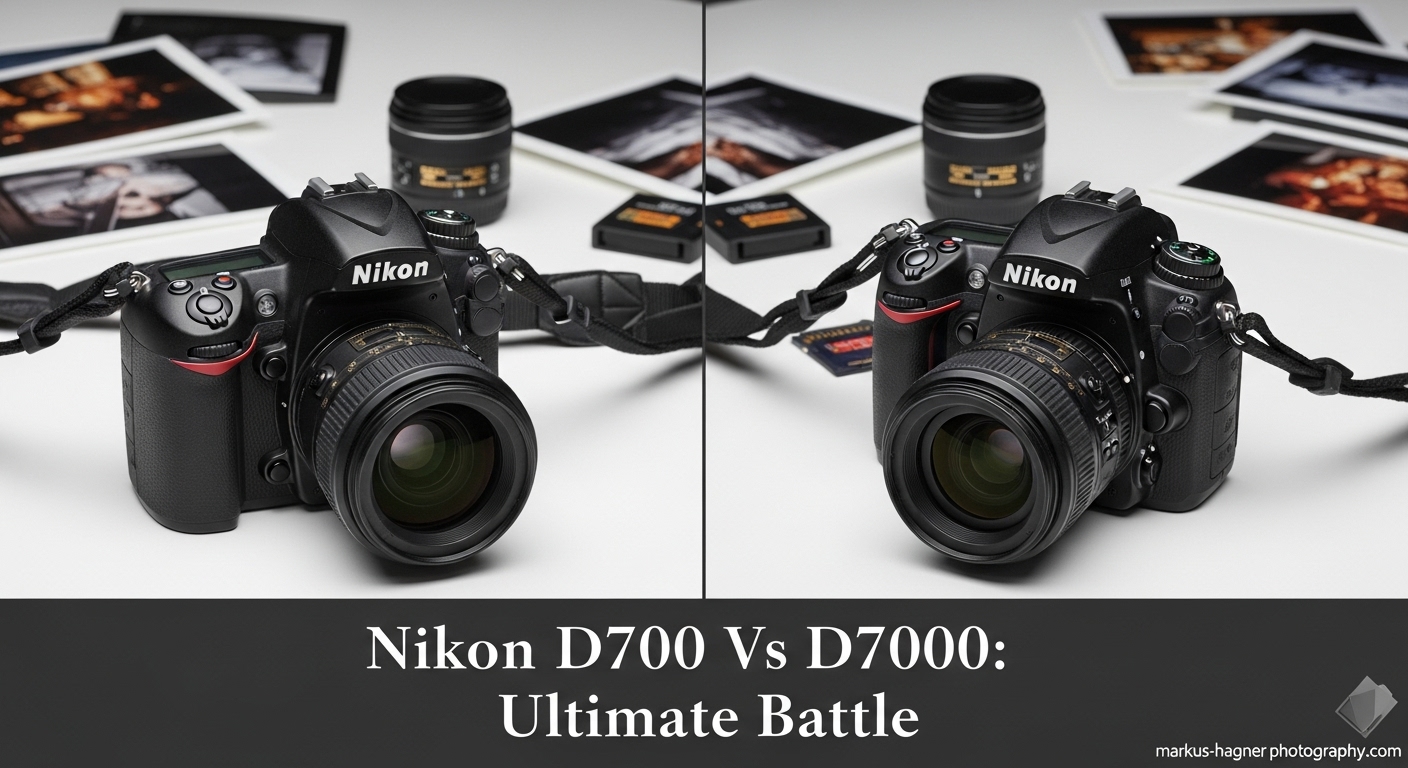
I’ve spent countless hours behind the viewfinder of both the Nikon D700 and D7000, and I’m here to settle the debate once and for all. These two cameras, though separated by just two years in release, represent fundamentally different approaches to photography. The D700 is a full-frame powerhouse that brought professional capabilities to a more affordable price point, while the D7000 packed enthusiast features into a compact APS-C body. In this comprehensive comparison, I’ll share my hands-on experience with both cameras to help you decide which one deserves a place in your camera bag.
Quick Overview: Nikon D700 vs D7000
Before diving deep into the specifics, let me give you a quick snapshot of these two cameras:
The Nikon D700, released in 2008, is a full-frame (FX-format) DSLR that took the photography world by storm. It borrowed many features from the flagship D3 but in a smaller, more affordable body. With its 12.1-megapixel full-frame sensor and exceptional low-light performance, the D700 quickly became a favorite among professionals and serious enthusiasts.
On the other hand, the Nikon D7000, released in 2010, represents Nikon’s upper-tier APS-C (DX-format) offering. It brought many professional features to the crop-sensor market, including a 16.2-megapixel sensor, advanced autofocus system, and robust build quality that exceeded expectations for its class.
Sensor and Image Quality: Full Frame vs APS-C
One of the most significant differences between these cameras lies in their sensors, and I’ve noticed this impacts everything from image quality to lens selection.
Nikon D700: The Full-Frame Advantage
The D700’s 12.1-megapixel full-frame CMOS sensor delivers exceptional image quality, particularly in low-light situations. I’ve been consistently amazed by how clean the images remain even at ISO 3200, and with some careful post-processing, I’ve found ISO 6400 to be usable for many applications.
The full-frame sensor provides several advantages I’ve come to appreciate:
- Better Low-Light Performance: The larger pixels gather more light, resulting in less noise at high ISO settings.
- Shallower Depth of Field: I can achieve that beautiful background blur more easily, even with modest aperture settings.
- Wider Field of View: My wide-angle lenses actually provide the field of view they were designed for, without the crop factor.
I discovered that despite having fewer megapixels than the D7000, the D700 often produces more detailed images in good lighting, thanks to its larger pixels and superior processing.
Nikon D7000: The Resolution King
The D7000’s 16.2-megapixel APS-C CMOS sensor offers more resolution on paper, and in well-lit conditions, I’ve been impressed with the level of detail it can capture. The 1.5x crop factor can be advantageous for telephoto work, effectively extending the reach of my lenses.
What I’ve found with the D7000:
- More Resolution for Cropping: The extra megapixels give me more flexibility to crop images in post-processing.
- Extended Telephoto Reach: My 200mm lens effectively becomes a 300mm, which is great for wildlife and sports photography.
- Smaller File Sizes: The images take up less space on my memory cards and hard drives.
However, I’ve noticed that the D7000’s smaller pixels mean more noise at higher ISO settings. While it’s respectable up to ISO 1600, I generally try to stay below that for critical work.
Build Quality and Ergonomics: Professional vs Enthusiast
When I first picked up both cameras, the difference in build quality was immediately apparent.
Nikon D700: Built Like a Tank
The D700 features a magnesium alloy body with weather sealing that I’ve tested in light rain without any issues. The camera feels substantial in my hands, weighing in at approximately 995g (with battery), which gives me confidence that it can withstand the rigors of professional use.
I’ve particularly appreciated:
- The Deep Grip: It fits my large hands perfectly, allowing for comfortable shooting during long sessions.
- Intuitive Control Layout: The dedicated buttons for key functions mean I rarely need to dive into menus during a shoot.
- Viewfinder Brightness: The full-frame viewfinder is large and bright, making manual focusing a pleasure.
Nikon D7000: Lightweight Yet Sturdy
The D7000, while not as robust as the D700, still features magnesium alloy covers and weather sealing at critical points. At approximately 780g (with battery), it’s significantly lighter, which I’ve found beneficial during long photo walks or when traveling.
What stands out to me about the D7000:
- Compact Size: It’s easier to carry discreetly, which is great for street photography.
- Dual SD Card Slots: A feature I didn’t expect at this price point, providing instant backup or extended storage.
- Improved LCD Screen: The 921,000-dot screen is noticeably sharper than the D700’s 920,000-dot display.
Autofocus Performance: Tracking and Accuracy
Autofocus is crucial for my photography, and both cameras have their strengths in this area.
Nikon D700: Pro-Level AF System
The D700 inherited its Multi-CAM 3500FX autofocus system from Nikon’s flagship D3, featuring 51 focus points (15 cross-type). In my experience, this system is incredibly reliable, especially in low-light conditions.
I’ve found the D700’s autofocus excels at:
- Low-Light Performance: It locks onto subjects reliably even in dimly lit environments.
- Tracking Moving Subjects: The 3D tracking mode works exceptionally well for sports and wildlife photography.
- Accuracy with Fast Lenses: It’s consistently accurate with my wide-aperture primes.
Nikon D7000: Advanced for its Class
The D7000 introduced the Multi-CAM 4800DX autofocus system with 39 focus points (9 cross-type). While not as sophisticated as the D700’s system, I’ve found it to be more than capable for most situations.
What I’ve discovered about the D7000’s autofocus:
- Good in Daylight: It performs admirably in well-lit conditions.
- Face Detection: The live view face detection works surprisingly well for portraits.
- Customizable Settings: I can fine-tune the AF behavior to suit different shooting scenarios.
Continuous Shooting Speed: Capturing the Action
For action photography, burst speed can make the difference between getting the shot or missing it entirely.
Nikon D700: Respectable Speed
The D700 offers 5 frames per second in continuous shooting mode, which I’ve found adequate for most action scenarios. However, when I attach the optional MB-D10 battery grip with EN-EL4a batteries, the speed increases to 8 fps, which puts it in a different league for action photography.
Nikon D7000: Surprisingly Capable
The D7000 matches the D700’s standard 5 fps continuous shooting speed. While it doesn’t have the option to increase this with a battery grip, I’ve found the buffer depth to be generous, allowing for longer bursts before the camera slows down.
Also Read: Nikon Z6 II vs Sony A7 IV
Video Capabilities: A New Frontier
Video was becoming increasingly important in DSLRs during this era, and these two cameras take very different approaches.
Nikon D700: No Video Option
The D700 predates the video-capable DSLR revolution and offers no video recording capabilities. For still photography purists, this isn’t an issue, but I’ve found it limiting in today’s multimedia environment.
Nikon D7000: Entering the Video Arena
The D7000 offers 1080p video recording at 24 fps, which was impressive for its time. I’ve experimented with video on this camera and found the quality to be decent, though not up to modern standards. The manual controls during video recording are limited, which can be frustrating for serious videography work.
Battery Life: Shooting All Day
Battery performance is crucial for my photography, especially during long shoots or when traveling.
Nikon D700: Powerhouse Performance
The D700 uses the EN-EL3e battery, which I’ve found provides approximately 1000 shots per charge. In real-world usage, I can typically shoot for a full day without worrying about battery life.
Nikon D7000: Efficient Energy Use
The D7000 also uses the EN-EL3e battery but is more power-efficient, offering approximately 1050 shots per charge according to CIPA standards. I’ve noticed that the D7000 tends to last slightly longer during my typical shooting sessions.
Lens Compatibility: Expanding Your Options
The lens ecosystem is a crucial consideration for any camera system, and this is where the sensor format makes a significant difference.
Nikon D700: Full-Frame Flexibility
With the D700’s full-frame sensor, I can use both FX (full-frame) and DX (APS-C) lenses. When using DX lenses, the camera automatically crops to a 5.1-megapixel DX mode. I’ve found this flexibility invaluable, as I can use my existing DX lenses while gradually building my FX lens collection.
Nikon D7000: DX-Format Specialization
The D7000 is designed for DX lenses, though it can also use FX lenses with the 1.5x crop factor automatically applied. I’ve discovered that using high-end FX lenses on the D7000 can yield excellent results, often outperforming native DX lenses in terms of sharpness and distortion control.
Real-World Performance: My Experience
Numbers and specifications only tell part of the story. After extensive use of both cameras in various shooting conditions, I’ve developed some clear impressions.
Portrait Photography
For portrait work, I’ve consistently preferred the D700. The full-frame sensor provides that beautiful subject separation and background blur that’s so desirable in portraits. The skin tones rendered by the D700 also seem more natural to my eyes, and the dynamic range allows me to recover highlight and shadow details in post-processing.
Landscape Photography
This is where the comparison becomes more interesting. The D700’s full-frame sensor offers superior dynamic range and low-light performance, which I’ve found beneficial for golden hour and night landscapes. However, the D7000’s extra resolution can be advantageous when I need to make large prints or crop extensively.
Street Photography
For street photography, I’ve found the D7000 to be more suitable. Its smaller size and lighter weight make it less conspicuous, and the flip-out LCD screen (compared to the D700’s fixed screen) allows for creative shooting angles. The silent shooting mode is also useful for capturing candid moments without drawing attention.
Sports and Wildlife Photography
Both cameras perform well in this category, but with different strengths. The D700’s superior autofocus system and low-light performance give it an edge in challenging lighting conditions. However, the D7000’s 1.5x crop factor effectively extends the reach of telephoto lenses, which I’ve found beneficial when photographing distant subjects.
Value in Today’s Market: Is Either Still Relevant?
In 2026, with mirrorless cameras dominating the market, you might wonder if these DSLRs are still worth considering. Based on my experience, both cameras offer excellent value, but for different types of photographers.
Nikon D700: The Budget Full-Frame Option
The D700 can be found on the used market for a fraction of its original price, making it one of the most affordable ways to enter full-frame photography. I’ve recommended it to many aspiring photographers who want the full-frame experience without breaking the bank.
However, it’s important to note that the D700 lacks some modern features we’ve come to expect, such as video recording, Wi-Fi connectivity, and advanced in-camera processing.
Nikon D7000: The Enthusiast Workhorse
The D7000 also represents excellent value on the used market. While it doesn’t offer the full-frame experience, it provides a robust set of features in a compact body. I’ve found it to be an excellent backup camera or primary camera for enthusiasts who prioritize portability.
Who Should Choose Which Camera?
Based on my extensive experience with both cameras, here’s my recommendation for who should choose which:
Choose the Nikon D700 if:
- You want the full-frame experience without spending a fortune
- Low-light performance is a priority for your photography
- You primarily shoot portraits, weddings, or events
- You already own or plan to invest in full-frame lenses
- You don’t need video capabilities
Choose the Nikon D7000 if:
- You want a lightweight camera for travel or street photography
- You need the extra reach of a crop sensor for wildlife or sports
- Video recording is important to you
- You’re on a tighter budget but still want robust features
- You prefer a more compact camera system
Also Read: Leica Mp Vs M6
Pro Tips for Getting the Most from Your Camera
Regardless of which camera you choose, I’ve learned some techniques that can help you maximize its potential:
For Nikon D700 Users:
- Invest in Quality Glass: The sensor is only as good as the lens in front of it. I’ve found that investing in high-quality lenses makes a more significant difference in image quality than upgrading the camera body.
- Master the Autofocus System: Take the time to learn how to customize the autofocus settings for your specific shooting scenarios. I’ve discovered that proper AF configuration can dramatically improve your keeper rate.
- Shoot in RAW: The D700’s RAW files contain incredible amounts of data. I’ve been amazed at how much detail I can recover from seemingly blown highlights or blocked shadows.
- Consider the MB-D10 Grip: If you shoot in portrait orientation frequently or need the extra burst speed, the battery grip is a worthwhile investment.
For Nikon D7000 Users:
- Utilize the Dual Card Slots: Set up the second card as either an overflow or backup. I’ve learned this the hard way after a card failure on an important shoot.
- Explore the U1 and U2 Modes: These custom settings modes allow you to save your preferred configurations for quick access. I have one set up for landscapes and another for portraits.
- Master the Dynamic Lighting Settings: The D7000’s active D-Lighting can help preserve highlight and shadow details in high-contrast scenes. I’ve found it particularly useful for backlit subjects.
- Invest in DX-Specific Lenses: While FX lenses work perfectly, dedicated DX lenses are often smaller, lighter, and less expensive. I’ve built a collection of DX primes that are perfect for travel.
Frequently Asked Questions
Is the Nikon D700 still good in 2026?
Yes, I believe the D700 is still a capable camera in 2026. Its full-frame sensor and excellent low-light performance hold up well against modern cameras in many situations. While it lacks some modern conveniences like Wi-Fi and 4K video, for pure still photography, it delivers excellent results.
Which camera has better image quality, D700 or D7000?
This depends on your priorities. I’ve found that the D700 generally produces cleaner images at high ISO settings and offers better dynamic range. However, the D7000 provides more resolution, which can be beneficial if you need to crop extensively or make large prints.
Can I use modern lenses with these cameras?
Absolutely! Both cameras use Nikon’s F-mount, which is compatible with a vast range of lenses. I’ve successfully used modern AF-P and AF-S lenses on both cameras, though some features like autofocus may be limited with older lenses.
Which camera is better for beginners?
I would recommend the D7000 for beginners. It offers more automated modes, a smaller learning curve, and the added benefit of video recording. The D700, while simpler in some ways, is better suited for photographers who already understand exposure fundamentals.
How do these cameras compare to modern mirrorless options?
While modern mirrorless cameras offer advantages in size, weight, and features like eye-detection autofocus, both the D700 and D7000 still hold their own in terms of image quality. I’ve found that for still photography, the differences are less significant than marketing might suggest, especially when paired with quality lenses.
Conclusion: Making Your Choice
After years of shooting with both the Nikon D700 and D7000, I can tell you that there’s no clear winner—it all depends on your specific needs and preferences as a photographer.
If you prioritize low-light performance, depth of field control, and that classic full-frame look, the D700 remains an excellent choice, especially on the used market. I’ve seen professional photographers produce stunning work with this camera even in 2026.
On the other hand, if you value portability, video capabilities, and the extra reach of a crop sensor, the D7000 is a compelling option. I’ve found it to be a versatile camera that can handle everything from street photography to landscapes with ease.
Ultimately, the best camera is the one that inspires you to get out and shoot. Both the D700 and D7000 are capable tools that can help you realize your creative vision. I hope this comparison has helped you make an informed decision based on your specific needs.
If you found this comparison helpful, be sure to bookmark this page for future reference. Photography technology continues to evolve, and I’ll be updating this article as new information becomes available. Feel free to share your own experiences with these cameras in the comments below—I’d love to hear from you!