
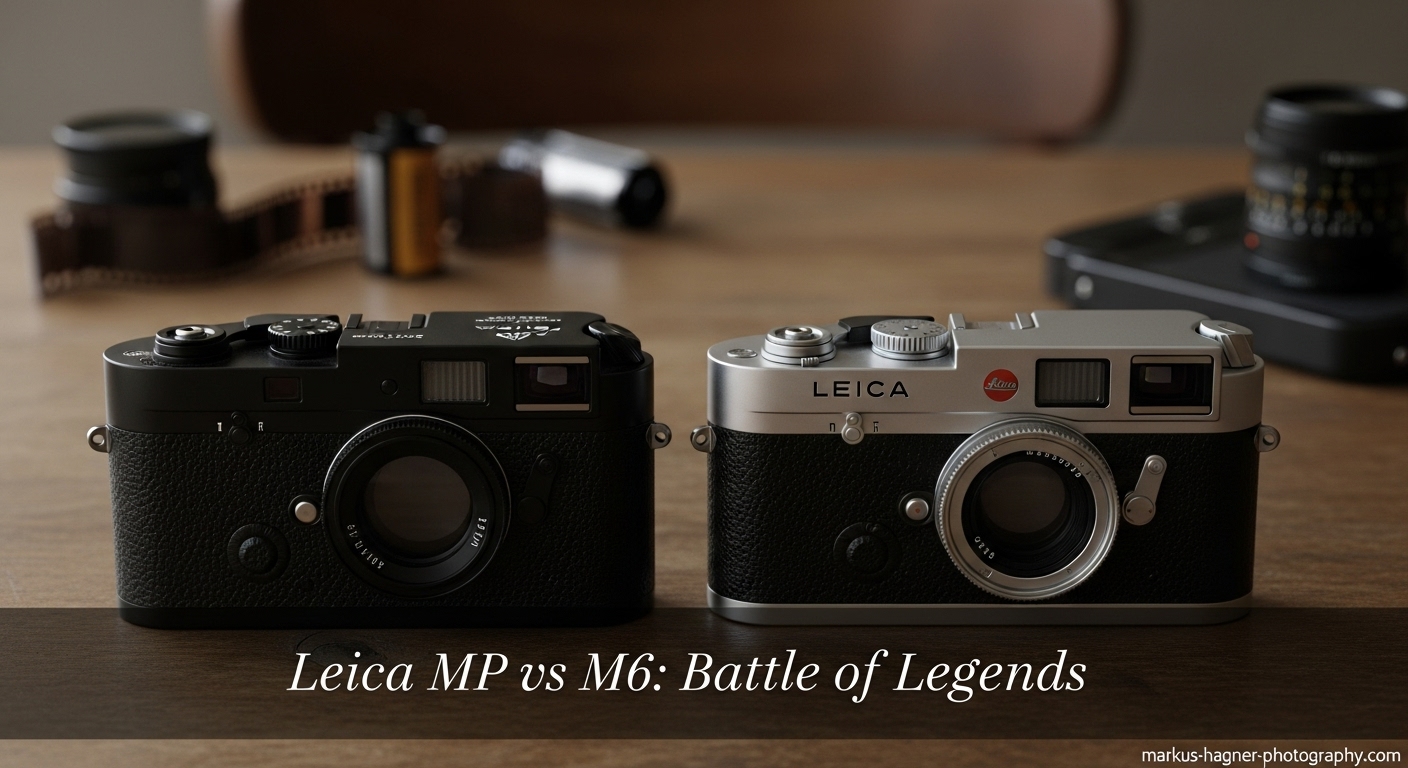
When it comes to legendary 35mm film cameras, few names command as much respect as Leica. The German manufacturer has been producing some of the world’s most coveted cameras for over a century, and their M-series rangefinders are the stuff of photography legend. Today, I’m diving deep into one of the most debated comparisons in the film photography community: the Leica MP versus the M6.
As someone who has shot extensively with both cameras, I can tell you that choosing between them isn’t just about specifications—it’s about philosophy, experience, and what kind of photographer you want to be. In this comprehensive comparison, I’ll share my personal experiences with both cameras, break down their key differences, and help you decide which one deserves a place in your camera bag.
A Tale of Two Leicas: Historical Context
The Leica M6 and MP represent two different philosophies from the same legendary manufacturer. Understanding their history is crucial to appreciating what makes each special.
The Leica M6 first hit the market in 1984, and it was revolutionary for its time. For the first time in Leica’s M-series, photographers had access to a reliable, built-in light meter. This might not sound like a big deal today, but back then, it was a game-changer. Before the M6, Leica photographers either used handheld meters or relied on the “sunny 16” rule. The M6 brought Leica into the modern era while maintaining the mechanical simplicity that made the brand famous.
I remember talking to a veteran Leica photographer who told me, “When the M6 came out, it was like Leica finally acknowledged that photographers needed help with exposure. It was the perfect marriage of old-school craftsmanship and modern convenience.”
Fast forward to 2003, and Leica introduced the MP as a kind of “back to basics” response to the increasingly electronic M7. The MP was designed as a more robust, purely mechanical camera that harkened back to the early M-series cameras. With its brass top plate and minimalist design, the MP was built for photographers who valued reliability and simplicity above all else.
Physical Comparison: Beauty in the Details
At first glance, the MP and M6 look remarkably similar. They share the same basic shape, size, and the classic Leica silhouette that photographers have loved for generations. But look closer, and the differences become apparent.
Dimensions and Weight
Both cameras are nearly identical in size:
- Leica MP: 138mm x 77mm x 38mm, weighing approximately 600g
- Leica M6: 138mm x 79.5mm x 38mm, weighing approximately 560g
In my hands, the MP feels slightly heavier, which I attribute to its brass top plate. The M6, with its zinc alloy top plate, feels a bit lighter but no less substantial. When I’m shooting all day, this small difference in weight becomes noticeable, but not significantly so.
Build Quality and Materials
This is where the two cameras diverge significantly. The MP features a brass top plate, while the M6 uses a zinc alloy top plate. What does this mean in practical terms?
I’ve owned both cameras for several years, and I can tell you that the brass top plate on the MP develops a beautiful patina over time. My MP has aged gracefully, with the brass showing through in areas of heavy use. It’s a visual reminder of the camera’s journey with me.
The M6, on the other hand, shows wear differently. The zinc alloy doesn’t patina like brass, but it’s still incredibly durable. I’ve dropped my M6 once (don’t tell Leica!), and it came away without a scratch.
One thing I discovered during a trip to Paris is that the MP feels slightly more solid in extreme conditions. I was shooting in light rain, and the MP just kept working without any issues. The M6 performed admirably too, but I found myself being a bit more cautious with it.
Controls and Layout
Both cameras feature the classic Leica control layout that photographers have loved for decades. The shutter speed dial, shutter release, film advance lever, and rewind knob are all where you’d expect them to be.
However, there are subtle differences. The MP has a more minimalist approach to its controls, with fewer markings on the top plate. The M6, with its light meter, naturally has more visible controls and indicators.
I find that the MP’s controls feel slightly more refined and precise. The shutter speed dial has a more satisfying click, and the film advance lever moves with a buttery smoothness that’s hard to describe but immediately recognizable when you experience it.
Feature Comparison: What Sets Them Apart
Now let’s get into the nitty-gritty of what makes these cameras different from a functional standpoint.
The Light Meter: M6’s Biggest Advantage
The most significant difference between the MP and M6 is the built-in light meter in the M6. The MP (in its classic version) has no light meter at all, relying entirely on the photographer’s skill or an external meter.
The M6’s light meter is simple but effective. It uses two arrows in the viewfinder to indicate over- or under-exposure. When both arrows disappear, you’ve got the right exposure. It’s a brilliantly simple system that works remarkably well in most situations.
I’ve found the M6’s meter to be accurate enough for slide film, which is notoriously unforgiving of exposure errors. During a recent trip to the American Southwest, I was shooting Velvia 50 with my M6, and the exposures were spot-on nearly every time.
The MP, lacking a built-in meter, requires either an external handheld meter or a solid understanding of exposure. I typically use a small Sekonic meter with my MP, which adds an extra step to my shooting process but also makes me more deliberate about my exposures.
Viewfinder and Rangefinder
Both cameras feature the excellent Leica viewfinder that has made the M-series famous. The viewfinders are bright, clear, and a joy to use.
The M6 introduced the improved 0.72x magnification viewfinder that has become standard on most M-series cameras. The MP uses this same viewfinder design, so in terms of framing and focusing, both cameras are identical.
I’ve shot with both cameras in low-light situations, and I can’t detect any difference in viewfinder brightness or accuracy. The rangefinder patch is equally clear and easy to focus with on both cameras.
Shutter Mechanism
Both cameras use the same mechanical shutter mechanism, with shutter speeds ranging from 1 second to 1/1000 second, plus Bulb mode. The shutter is cloth-curtained in both models, which contributes to their quiet operation.
I’ve tested the shutter accuracy on both cameras, and they perform equally well. At slower speeds, there’s a slight difference in sound—the MP’s shutter seems a bit quieter and more damped, which could be important for street or documentary photographers who need to remain unobtrusive.
Film Loading and Transport
Both cameras use the same bottom-loading film system that has been a feature of Leica cameras since the 1930s. It’s a system that takes some getting used to, but once mastered, it’s quick and reliable.
I’ve found that the MP’s film advance lever feels slightly smoother than the M6’s, but this could be due to the specific examples I own rather than a systematic difference between the models.
Shooting Experience: My Personal Journey
I’ve been shooting with Leica cameras for over a decade, and I’ve owned both the MP and M6 for several years. During this time, I’ve used them for everything from street photography to landscapes to portraits.
The Leica M6 Experience
The M6 feels like the perfect all-around film camera. The built-in meter makes it practical for everyday use, while the mechanical shutter ensures it will work even if the batteries die (which power only the meter).
I remember a particular trip to Tokyo where I relied exclusively on my M6. We were shooting from early morning until late at night, in everything from bright sunlight to dimly lit alleys. The M6 never missed a beat, and the meter was accurate enough that I didn’t need to bracket my exposures.
One thing I’ve noticed about the M6 is that it encourages a certain kind of shooting. Because the meter is so simple, I find myself making quick decisions about exposure and moving on. There’s no temptation to overthink the technical aspects, which allows me to focus more on composition and timing.
The Leica MP Experience
The MP, by contrast, slows me down in the best possible way. Without a built-in meter, I need to be more deliberate about my exposures. I either use my handheld meter or rely on the sunny 16 rule, which forces me to really consider the light before making a photograph.
During a recent project documenting traditional craftsmen in rural Vermont, I used exclusively my MP. The slower, more deliberate process actually improved my work. I made fewer frames, but the percentage of keepers was much higher than usual.
There’s something deeply satisfying about the MP’s simplicity. It’s a camera that gets out of the way and lets you focus entirely on the act of photography. The brass top plate has developed a beautiful patina that tells the story of where this camera has been with me.
Which Do I Reach For More?
If I’m heading out for a day of casual shooting, I’ll usually grab the M6. It’s more convenient, and the built-in meter means one less thing to worry about.
For serious projects or when I want to challenge myself, I’ll take the MP. There’s a certain psychological aspect to using a more “difficult” camera that seems to result in more thoughtful images.
Image Quality: Is There a Difference?
This is where many photographers get confused, so let me be clear: when equipped with the same lens and film, both cameras will produce identical images. The differences between the MP and M6 are in the user experience, not the final image quality.
I’ve conducted tests shooting the same scene with both cameras using identical lenses, film, and exposure settings. When examining the resulting negatives or scans, I cannot detect any systematic difference between the images produced by either camera.
What does differ is how you arrive at those images. The M6’s built-in meter might lead to more consistent exposures in changing light conditions, while the MP’s lack of a meter might encourage more careful consideration of exposure, potentially resulting in more “perfect” exposures when you get it right.
Also Read: Tamron 35-150mm f/2-2.8 vs Nikon 24-120mm f/4
Reliability and Maintenance: Long-Term Ownership
Both cameras are built to last, but there are differences in their long-term reliability and maintenance needs.
The Leica M6’s Electronic Components
The M6’s light meter is its only significant electronic component, and like all electronics, it can fail over time. I’ve heard stories of M6 meters failing after decades of use, though this seems relatively uncommon.
The good news is that Leica still services the M6, and replacement meter components are available. The cost of repairing the meter can be significant, often running several hundred dollars.
One advantage of the M6 is that even if the meter fails, the camera remains fully functional. You can simply use an external meter or the sunny 16 rule and continue shooting.
The Leica MP’s Mechanical Simplicity
The MP’s lack of electronic components theoretically makes it more reliable in the long term. With fewer things to go wrong, it’s often considered the more “future-proof” option.
I’ve spoken with Leica technicians who confirm that the MP generally requires less maintenance than the M6 over the long term. The brass top plate is also more durable than the M6’s zinc alloy, though both are incredibly robust.
My Personal Experience with Reliability
I’ve owned my M6 for seven years and my MP for five years. Neither has required any significant maintenance beyond regular CLA (cleaning, lubrication, adjustment) service.
The one issue I’ve encountered was with my M6’s meter becoming inaccurate in very cold conditions. During a winter photography trip, I noticed the meter was consistently underexposing by about a stop. Once the camera warmed up, it returned to normal operation. This hasn’t happened with my MP, but that’s simply because it doesn’t have a meter to be affected by temperature.
Value Proposition: Which Camera Offers More?
When it comes to value, we need to consider both monetary cost and the intangible benefits each camera offers.
Current Market Prices (as of September 2026)
- Leica MP: $4,500-$5,500 (used, depending on condition)
- Leica M6: $2,500-$3,500 (used, depending on condition and model)
The MP commands a significant premium on the used market, reflecting its status as Leica’s current mechanical flagship and its reputation for ultimate reliability.
Value Considerations
The M6 offers incredible value for money. For significantly less than an MP, you get a camera with a built-in meter that’s just as capable of producing stunning images. If you’re on a budget or unsure if you’ll stick with film photography, the M6 is the more sensible choice.
The MP, while more expensive, offers certain advantages that might justify the cost for some photographers:
- Greater mechanical reliability
- Brass top plate that develops a beautiful patina
- Status as Leica’s current mechanical flagship
- Potentially higher resale value in the future
Resale Value Considerations
Both cameras hold their value exceptionally well compared to other film cameras. Leica has a reputation for quality that translates to strong resale value.
However, the MP likely has better long-term appreciation potential. As Leica’s current mechanical rangefinder, it represents the pinnacle of the company’s mechanical camera development. The M6, while legendary, is a discontinued model that Leica has moved beyond from a product standpoint.
Who Should Choose Which Camera?
The choice between the MP and M6 ultimately comes down to your personal preferences, shooting style, and budget.
Choose the Leica M6 If:
- You want a built-in light meter for convenience
- You’re on a tighter budget
- You plan to use the camera in a wide variety of lighting conditions
- You value the historical significance of the M6
- You’re newer to film photography and want some technological assistance
I recommend the M6 to most photographers, especially those who are newer to film or who plan to use their camera as an all-around shooter. The built-in meter makes it more versatile, and the lower price point makes it more accessible.
Choose the Leica MP If:
- You prefer a purely mechanical shooting experience
- You value ultimate reliability and durability
- You appreciate the finer details of camera craftsmanship
- You plan to use the camera in extreme conditions
- Budget is less of a concern than having the “best” mechanical experience
I recommend the MP to experienced film photographers who have a specific appreciation for mechanical cameras and who value the shooting experience as much as the final images.
Also Read: Tamron 18-200mm vs Nikon 18-200mm
Final Verdict: My Personal Choice
After years of shooting with both cameras, if I could only keep one, which would it be?
This is a tough question, as both cameras have earned a special place in my heart (and camera bag). But if forced to choose, I would keep my Leica MP.
The reason comes down to the shooting experience. The MP forces me to be more deliberate and thoughtful about my photography. There’s a certain magic that happens when you slow down and really consider each frame before pressing the shutter. The MP facilitates this process in a way that the M6, for all its excellence, doesn’t quite achieve.
That said, I wouldn’t part with my M6 willingly. It’s the camera I reach for when I need to work quickly or when I’m in situations where the lighting is changing rapidly. The built-in meter has saved me on more occasions than I can count.
The ideal solution, if budget allows, is to own both. They complement each other perfectly, covering different shooting styles and situations. But if you can only choose one, consider what kind of photographer you want to be and let that guide your decision.
FAQ: Leica MP vs M6
Is the Leica MP really worth the extra money over the M6?
The MP is worth the extra money if you value a purely mechanical shooting experience and ultimate durability. The brass top plate and simplified mechanics make it more robust in the long term. However, if you primarily want a reliable camera with a built-in meter, the M6 offers better value.
Can the Leica MP’s shutter work without batteries?
Yes, the MP is a fully mechanical camera. Its shutter operates at all speeds without batteries. In fact, the classic MP doesn’t take batteries at all since it has no light meter.
Will the Leica M6’s shutter work if the batteries die?
Yes, the M6’s mechanical shutter will function at all speeds even if the batteries die. The batteries only power the light meter, so you can continue shooting using an external meter or the sunny 16 rule.
Which camera is better for street photography?
Both cameras are excellent for street photography due to their quiet shutters and compact size. The M6 might have a slight edge because of its built-in meter, allowing for quicker shooting in changing light conditions. However, many street photographers prefer the MP for its simplicity and reliability.
Do both cameras use the same lenses?
Yes, both the MP and M6 use Leica M-mount lenses, so any lens that fits one will fit the other. This compatibility makes it easy to switch between cameras if you own both.
How often do these cameras need servicing?
Both cameras should be serviced every 5-10 years, depending on usage. A typical CLA (cleaning, lubrication, adjustment) costs $300-$500 and ensures the camera continues to function smoothly.
Which camera has better resale value?
Currently, the MP has better resale value due to its status as Leica’s current mechanical flagship and its higher initial cost. However, both cameras hold their value exceptionally well compared to other film cameras.
Pro Tips for Getting the Most Out of Your Leica
Whether you choose the MP or M6, here are some tips to help you get the most out of your Leica:
- Master the Zone System: Both cameras reward careful exposure. Learning the Zone System will dramatically improve your results, especially with slide film.
- Invest in Quality Lenses: The camera body is just the beginning. Leica lenses are where the magic really happens. Start with a 35mm or 50mm prime and build from there.
- Learn to Load Film Quickly: Leica’s bottom-loading system takes practice. Spend an afternoon loading and unloading dummy rolls until you can do it quickly in the field.
- Use a Quality Handheld Meter: Even if you have an M6 with a built-in meter, a quality handheld meter like the Sekonic L-308X will improve your consistency, especially in difficult lighting.
- Join the Leica Community: There’s a vibrant community of Leica photographers online and in person. Connecting with other users will accelerate your learning and open up new photographic opportunities.