
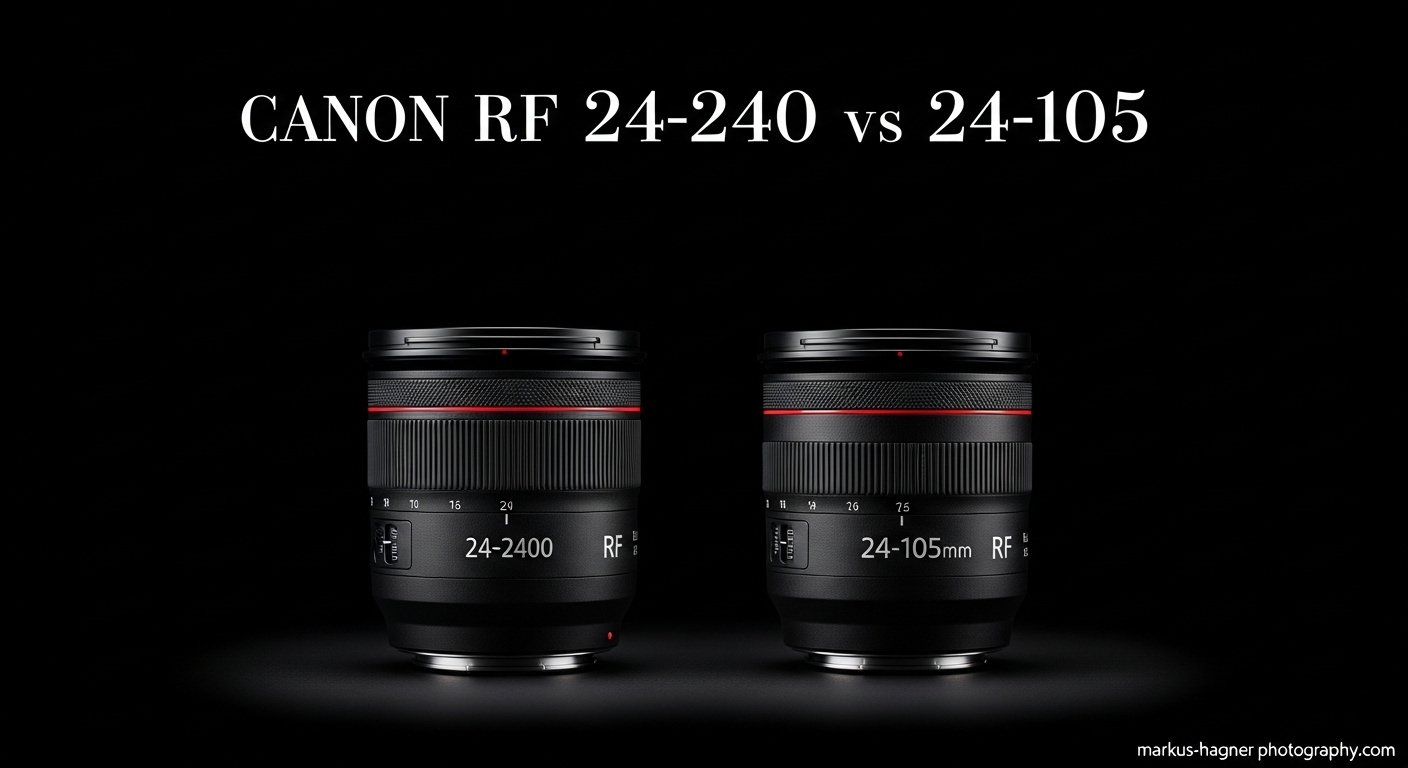
When I first made the switch to Canon’s mirrorless RF system, one of the biggest decisions I faced was choosing between the RF 24-240mm and the RF 24-105mm lenses. Both are versatile zoom lenses that cover a wide focal range, but they serve different purposes and come with distinct advantages and disadvantages. After spending countless hours shooting with both lenses in various conditions, I’m here to share my comprehensive comparison to help you make the right choice for your photography needs.
Overview of the Contenders
Canon RF 24-240mm F4-6.3 IS USM
The Canon RF 24-240mm F4-6.3 IS USM is a superzoom lens designed for photographers who want maximum versatility in a single package. With an impressive 10x zoom range, it covers everything from wide-angle to telephoto, making it an attractive option for travel, events, and everyday shooting.
I remember taking this lens on a trip to the Grand Canyon and being amazed by how I could capture both the vast landscapes at 24mm and distant details at 240mm without changing lenses. This convenience is hard to overstate, especially when you’re traveling light or working in environments where changing lenses isn’t practical.
Canon RF 24-105mm F4L IS USM
The Canon RF 24-105mm F4L IS USM, on the other hand, is part of Canon’s prestigious L-series lineup. It offers a more modest 4.4x zoom range but boasts a constant f/4 aperture throughout the zoom range, superior build quality, and the optical excellence that L-series lenses are known for.
When I shot a wedding with this lens, I appreciated its consistent performance and excellent image quality. The constant f/4 aperture was particularly valuable when the lighting conditions changed throughout the event, allowing me to maintain exposure settings while zooming.
Detailed Specifications Comparison
Let’s break down the key specifications of both lenses to see how they stack up against each other:
| Specification | Canon RF 24-240mm F4-6.3 IS USM | Canon RF 24-105mm F4L IS USM |
|---|---|---|
| Focal Length | 24-240mm | 24-105mm |
| Maximum Aperture | f/4-6.3 | f/4 (constant) |
| Minimum Aperture | f/22-32 | f/22 |
| Lens Construction | 15 elements in 12 groups | 17 elements in 13 groups |
| Diaphragm Blades | 7 | 9 |
| Minimum Focus Distance | 1.64 ft. (0.5m) | 1.32 ft. (0.4m) |
| Maximum Magnification | 0.26x | 0.31x |
| Optical Image Stabilization | Yes (5 stops) | Yes (5 stops) |
| Autofocus | Nano USM | Nano USM |
| Filter Size | 72mm | 77mm |
| Dimensions | 3.1 x 4.8 in. (78.3 x 122.5mm) | 3.5 x 4.4 in. (88.5 x 113.3mm) |
| Weight | 26.6 oz. (750g) | 23.8 oz. (675g) |
| Weather Sealing | Basic | Advanced (L-series) |
Looking at these specifications, we can already see some key differences. The RF 24-240mm offers a much wider focal range but with a variable aperture that gets darker as you zoom in. The RF 24-105mm has a more limited range but maintains a constant f/4 aperture throughout, which is a significant advantage in many shooting situations.
Build Quality and Handling
Canon RF 24-240mm Build Quality
The RF 24-240mm feels solid in the hand, though it’s not as robust as the L-series alternative. It has a plastic exterior with some metal components, and while it feels well-made, it doesn’t have the same premium feel as Canon’s professional lenses.
I found the zoom ring to be smooth but a bit stiff, especially when extending to the full 240mm. The lens extends significantly when zooming, which is typical for superzoom lenses but can affect balance on smaller camera bodies.
The lens includes basic weather sealing, with rubber gaskets at the mount and some of the moving parts. While this offers some protection against dust and moisture, it’s not as comprehensive as the sealing on the L-series lens.
Canon RF 24-105mm Build Quality
As an L-series lens, the RF 24-105mm is built to professional standards. It features a weather-sealed magnesium alloy construction with dust and moisture resistance throughout. The lens feels substantial in the hand, with smooth, well-damped controls that inspire confidence.
I’ve used this lens in light rain and dusty conditions without any issues, and it’s held up beautifully over time. The zoom and focus rings are perfectly sized and positioned, making the lens a joy to handle during long shooting sessions.
While both lenses are relatively heavy, the RF 24-105mm feels better balanced on Canon’s mirrorless bodies, and its more compact dimensions when not in use make it slightly easier to pack in a camera bag.
Image Quality Comparison
Sharpness
When it comes to sharpness, the RF 24-105mm clearly outperforms the RF 24-240mm, especially at the edges and corners of the frame. At 24mm and f/4, the L-series lens delivers excellent sharpness across the frame, with only slight softening in the extreme corners that improves dramatically when stopped down to f/5.6 or f/8.
The RF 24-240mm, while respectably sharp in the center at 24mm and f/4, shows more softness toward the edges. This softness becomes more pronounced as you zoom toward the longer end of the range, particularly at 240mm where the maximum aperture is only f/6.3.
I discovered that stopping down the RF 24-240mm to f/8 or f/11 significantly improves sharpness across the frame, but this means sacrificing light-gathering ability, which can be problematic in low-light situations.
Chromatic Aberration
Chromatic aberration (CA) is well-controlled on both lenses, but the RF 24-105mm performs better, especially in high-contrast situations. The L-series lens shows minimal CA even at wide apertures, with only slight purple fringing in extreme contrast situations.
The RF 24-240mm exhibits more noticeable CA, particularly at the longer end of its zoom range. While modern cameras can correct much of this in post-processing, it’s still something to be aware of if you shoot JPEGs or prefer to minimize post-processing work.
Vignetting
Both lenses show some vignetting at wide apertures, but it’s more pronounced on the RF 24-240mm, especially at 24mm where the corners can be quite dark at f/4. Stopping down to f/5.6 or f/8 reduces this significantly.
The RF 24-105mm shows less vignetting overall, and what is present is more uniform and easier to correct in post-processing. The constant f/4 aperture means vignetting doesn’t change as you zoom, which can be an advantage when maintaining consistent exposure across focal lengths.
Distortion
Wide-angle zoom lenses typically exhibit some distortion, and both of these lenses are no exception. The RF 24-240mm shows more complex distortion patterns, with barrel distortion at the wide end transitioning to pincushion distortion at the telephoto end.
The RF 24-105mm has more predictable distortion, primarily barrel distortion at 24mm that gradually diminishes as you zoom in. Most modern Canon cameras have in-camera correction profiles for both lenses, minimizing this issue in JPEG files.
Autofocus Performance
Both lenses feature Canon’s Nano USM autofocus system, which provides fast, quiet, and accurate focusing. In my experience, both lenses focus quickly and reliably in good lighting conditions.
The RF 24-105mm has a slight edge in low-light situations, likely due to its brighter maximum aperture. I’ve found that it hunts less in dim conditions and locks onto subjects more quickly.
For video work, both lenses offer smooth, silent autofocus that’s suitable for professional use. The Nano USM system is virtually silent during operation, making these lenses excellent choices for video recording where autofocus noise might be picked up by the camera’s microphone.
Low-Light Performance
This is where the differences between these two lenses become most apparent. The RF 24-105mm’s constant f/4 aperture gives it a significant advantage in low-light situations, allowing it to gather twice as much light as the RF 24-240mm at the long end (where the superzoom is at f/6.3).
I’ve shot indoor events with both lenses, and the difference is noticeable. With the RF 24-105mm, I can maintain lower ISO settings and faster shutter speeds, resulting in cleaner images with less noise. The RF 24-240mm often requires higher ISO settings or slower shutter speeds in the same conditions, which can impact image quality.
Both lenses feature 5-stop image stabilization, which helps immensely in low-light situations by allowing you to use slower shutter speeds without introducing camera shake. I’ve found that I can reliably handhold both lenses at shutter speeds as slow as 1/15s at the wide end, though this becomes more challenging as you zoom in.
Use Cases and Photography Styles
Travel Photography
For travel photography, the RF 24-240mm’s versatility is hard to beat. I’ve taken this lens on multiple international trips, and the ability to go from wide-angle landscapes to telephoto details without changing lenses is incredibly convenient.
When I visited Rome last year, I could capture the grandeur of the Colosseum at 24mm and then zoom in to photograph architectural details without moving my feet. This versatility meant I spent more time shooting and less time changing lenses in crowded tourist spots.
That said, the RF 24-105mm is also an excellent travel lens, especially if you prioritize image quality over ultimate versatility. Its smaller size and lighter weight make it less fatiguing to carry all day, and the constant f/4 aperture is valuable when shooting in museums, churches, or other dimly lit locations.
Landscape Photography
For landscape photography, the RF 24-105mm is generally the better choice. Its superior sharpness, especially at the edges of the frame, results in more detailed images. The constant f/4 aperture also allows for easier depth of field control across the zoom range.
I’ve found that the RF 24-240mm can produce excellent landscape results when stopped down to f/8 or f/11, but it doesn’t quite match the micro-contrast and overall clarity of the L-series lens. However, if you need that extra reach for distant elements in your landscapes, the 24-240mm might be worth the compromise.
Portrait Photography
For portrait photography, the RF 24-105mm is clearly the superior option. The constant f/4 aperture provides better subject separation and background blur (bokeh), and the lens produces more pleasing skin tones and finer details.
I’ve shot portraits with both lenses, and the difference is noticeable. The RF 24-105mm renders facial features and hair with more clarity and three-dimensionality, while the RF 24-240mm’s images can look slightly flat by comparison.
The RF 24-240mm can work for environmental portraits where you want to show more of the surroundings, but for traditional portraits where subject separation is important, the L-series lens is the better choice.
Also Read: Canon RF 24-70mm f/2.8 vs RF 28-70mm f/2
Event Photography
Event photography is where both lenses can shine, depending on the specific situation. For weddings and similar events where lighting conditions vary, the RF 24-105mm’s constant aperture is invaluable.
I shot a friend’s wedding with the RF 24-105mm and appreciated how I could maintain consistent exposure settings while zooming from wide shots of the venue to tighter compositions of the couple. The excellent image quality also meant the photos required less post-processing.
For outdoor events or situations where you need maximum versatility without changing lenses, the RF 24-240mm can be a good choice. I’ve used it for outdoor festivals and charity events where the ability to capture both wide scenes and distant details from a single position was advantageous.
Wildlife and Sports Photography
Neither lens is ideal for serious wildlife or sports photography, but the RF 24-240mm’s longer reach gives it an edge for casual use. The 240mm focal length can get you closer to distant subjects, though the slower maximum aperture at the telephoto end means you’ll need good lighting or higher ISO settings.
I’ve used the RF 24-240mm for photographing birds in my backyard and for my kids’ soccer games, and while it’s not a substitute for a dedicated telephoto lens, it’s surprisingly capable in good light.
The RF 24-105mm’s 105mm maximum reach is limiting for wildlife and sports, but the constant f/4 aperture and superior autofocus performance make it better for action photography in good light.
Price and Value Analysis
The Canon RF 24-240mm F4-6.3 IS USM retails for approximately $899, while the Canon RF 24-105mm F4L IS USM commands a higher price of around $1,099. The $200 price difference might seem significant, but it’s important to consider the value each lens offers based on your specific needs.
The RF 24-240mm provides exceptional versatility for its price, essentially replacing multiple lenses in a single package. If you’re the type of photographer who values convenience and hates changing lenses, the superzoom offers excellent value.
The RF 24-105mm, while more expensive, offers professional-grade build quality, superior optics, and a constant aperture. For photographers who prioritize image quality and plan to use the lens professionally, the extra cost is justified by the lens’s performance and durability.
I’ve found that both lenses hold their value reasonably well in the used market, though L-series lenses typically depreciate more slowly due to their professional reputation and build quality.
Also Read: Fujifilm X-T1 vs X-T10
Pros and Cons
Canon RF 24-240mm F4-6.3 IS USM
Pros:
- Incredible 10x zoom range (24-240mm)
- Good value for money
- Compact for its focal range
- 5-stop image stabilization
- Nano USM autofocus system
- Versatile for travel and general photography
Cons:
- Variable aperture (f/4-6.3)
- Less sharp than the L-series alternative
- More pronounced chromatic aberration and distortion
- Extends significantly when zooming
- Basic weather sealing
- Heavier than some might expect
Canon RF 24-105mm F4L IS USM
Pros:
- Constant f/4 aperture throughout zoom range
- Excellent sharpness across the frame
- Superior build quality and weather sealing
- L-series optical performance
- 5-stop image stabilization
- Nano USM autofocus system
- More compact when not in use
Cons:
- Limited zoom range compared to the 24-240mm
- More expensive
- Heavier than some competing standard zooms
- May not be long enough for some applications
Who Should Buy Which Lens?
The RF 24-240mm is Ideal For:
- Travel photographers who want maximum versatility without carrying multiple lenses
- Casual photographers who prioritize convenience over ultimate image quality
- Vloggers and content creators who need a wide focal range in a single lens
- Photographers on a budget who want good performance without breaking the bank
- Beginners who are still exploring different focal lengths and photography styles
The RF 24-105mm is Ideal For:
- Professional photographers who need reliable performance and excellent image quality
- Wedding and event photographers who need a constant aperture and superior low-light performance
- Landscape photographers who value sharpness and optical quality
- Portrait photographers who want pleasing bokeh and excellent subject separation
- Serious enthusiasts who are willing to invest in high-quality glass
Pro Tips for Using These Lenses
Getting the Most from the RF 24-240mm
- Stop down for sharpness: I’ve found that the RF 24-240mm performs best when stopped down to f/8 or f/11, especially at the longer end of the zoom range. This significantly improves sharpness across the frame.
- Use in-camera corrections: Enable lens corrections in your camera’s menu to automatically correct distortion, vignetting, and chromatic aberration. This makes a noticeable difference in image quality, especially at the edges of the frame.
- Stabilize at long focal lengths: When shooting at 240mm, even small movements can cause blur. Use the image stabilization, brace yourself against a solid object, or consider using a monopod for sharper results.
- Be mindful of light: With its variable aperture, the RF 24-240mm loses light as you zoom in. Be prepared to adjust ISO or shutter speed to maintain proper exposure, especially when zooming in dim conditions.
Maximizing the RF 24-105mm
- Leverage the constant aperture: The f/4 constant aperture is one of this lens’s biggest strengths. Use it to maintain consistent exposure when zooming and to achieve better subject separation in portraits.
- Take advantage of weather sealing: Don’t be afraid to use this lens in challenging conditions. The advanced weather sealing means it can handle light rain and dust without issue.
- Pair with a prime for low-light: While the f/4 aperture is good, it’s not ideal for very low-light situations. Consider adding a fast prime lens like the RF 50mm f/1.2 or RF 85mm f/1.2 to your kit for extreme low-light scenarios.
- Use for high-quality video: The RF 24-105mm is an excellent video lens thanks to its constant aperture, smooth autofocus, and minimal focus breathing. It’s a great choice for professional video work.
FAQ: Canon RF 24-240mm vs 24-105
Which lens is better for travel photography?
For travel photography, the RF 24-240mm offers greater versatility with its 10x zoom range, allowing you to capture everything from wide landscapes to distant details without changing lenses. However, the RF 24-105mm is smaller, lighter, and offers better image quality, which might be preferable if you prioritize image quality over ultimate convenience.
Can I use these lenses for professional work?
The RF 24-105mm is definitely suitable for professional work, thanks to its L-series build quality, constant aperture, and excellent image quality. Many professionals use it as their standard zoom for weddings, events, and portrait work. The RF 24-240mm can be used for professional applications where versatility is more important than ultimate image quality, but it’s not typically considered a professional-grade lens.
Do these lenses work with Canon’s teleconverters?
No, neither the RF 24-240mm nor the RF 24-105mm is compatible with Canon’s RF teleconverters. Teleconverters are typically designed to work with select L-series telephoto and macro lenses.
How do these lenses compare to their EF-mount counterparts?
The RF versions of these lenses offer improved autofocus performance, better image stabilization, and more advanced optical designs compared to their EF counterparts. The RF 24-105mm, in particular, is widely regarded as optically superior to the EF version.
Which lens has better bokeh?
The RF 24-105mm produces better bokeh thanks to its constant f/4 aperture and 9-blade diaphragm, which creates more circular out-of-focus highlights. The RF 24-240mm’s variable aperture and 7-blade diaphragm result in less pleasing bokeh, especially at the telephoto end where the aperture is smaller.
Are these lenses good for astrophotography?
Neither lens is ideal for serious astrophotography due to their relatively slow maximum apertures. However, the RF 24-105mm’s constant f/4 aperture and superior sharpness make it the better choice for night sky photography if you’re limited to these two options.
Do I need to buy a filter for these lenses?
Both lenses benefit from the use of protective UV filters to safeguard the front element. The RF 24-240mm uses 72mm filters, while the RF 24-105mm uses 77mm filters. Polarizing and neutral density filters can also be useful with both lenses for landscape and long-exposure photography.
Conclusion: Making the Right Choice
After extensively using both the Canon RF 24-240mm and RF 24-105mm, I can say that both are excellent lenses that serve different purposes. The right choice for you depends on your specific needs, shooting style, and budget.
If you’re a travel photographer, casual shooter, or someone who values convenience above all else, the RF 24-240mm is an excellent choice. Its incredible 10x zoom range means you’ll rarely miss a shot due to focal length limitations, and it offers good performance at a reasonable price.
On the other hand, if you’re a professional photographer, serious enthusiast, or someone who prioritizes image quality and build quality, the RF 24-105mm is the clear winner. Its constant f/4 aperture, superior optics, and L-series build quality make it a lens that can grow with you as your skills develop.
Ultimately, I’ve found that many photographers end up owning both lenses at different points in their journey. The RF 24-240mm is often a great starting point for those new to the RF system, while the RF 24-105mm becomes the logical upgrade as their skills and demands evolve.
Whichever lens you choose, both represent excellent options for Canon’s mirrorless system and will serve you well in capturing your photographic vision.