
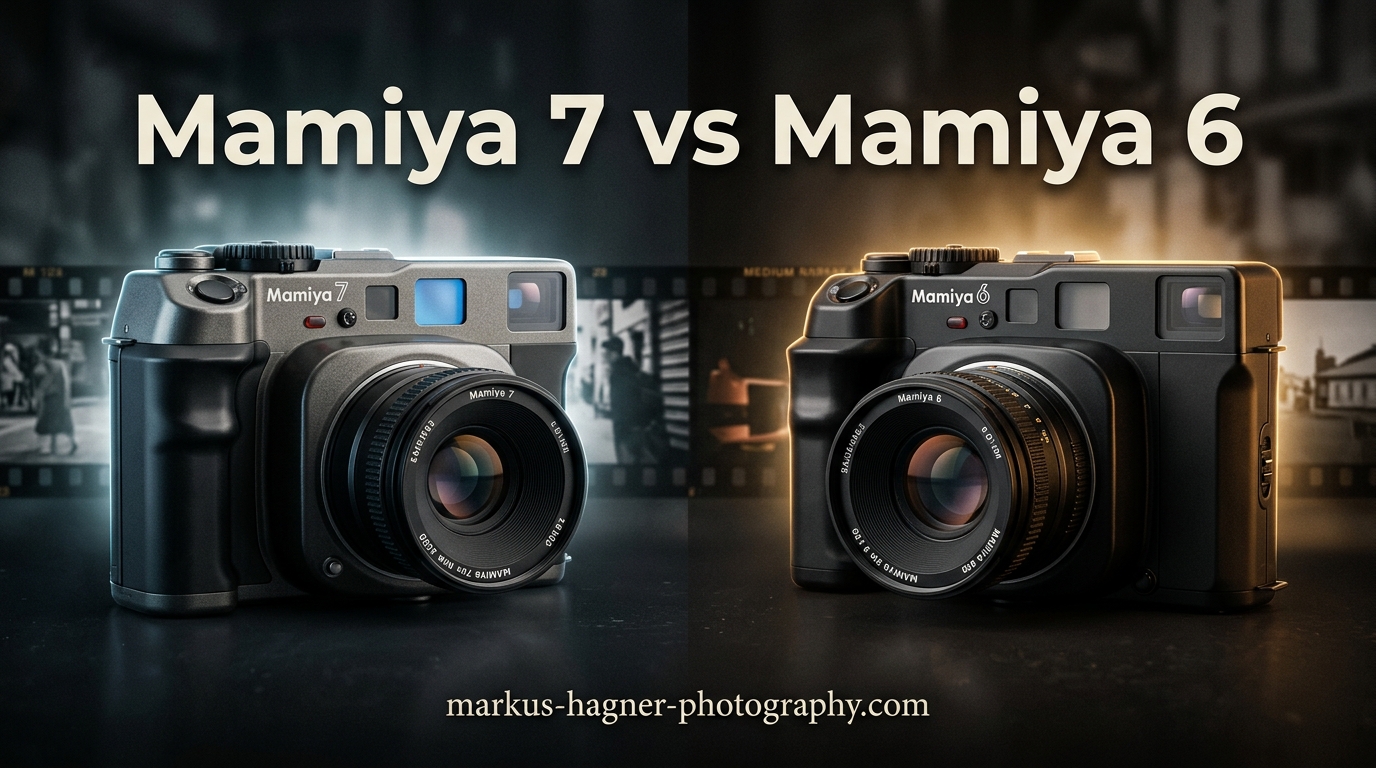
Few cameras have achieved legendary status quite like the Mamiya 6 and Mamiya 7. These medium format rangefinders represent the pinnacle of portable film photography, combining exceptional image quality with travel-friendly designs that still attract photographers decades after their release.
When photographers ask about the Mamiya 7 vs Mamiya 6 comparison, they’re usually trying to decide between two distinct philosophies. The Mamiya 6 offers a compact, collapsible design with square 6×6 format. The Mamiya 7 delivers larger 6×7 negatives with a more extensive lens system.
I’ve spent years shooting with both systems, and the choice between them often comes down to how you work as a photographer. Street and travel photographers tend to gravitate toward the Mamiya 6. Landscape and portrait specialists often prefer the Mamiya 7.
This guide breaks down every aspect of both cameras to help you make the right decision for your photography style.
Mamiya 7 vs Mamiya 6: Quick Comparison
Before diving into the details, here’s a side-by-side look at how these two medium format rangefinders compare on paper.
| Product | Specifications | Action |
|---|---|---|
 Mamiya M645 SLR Camera Body Mamiya M645 SLR Camera Body |
|
Check Latest Price |
 Mamiya RZ 110mm F/2.8 Lens Mamiya RZ 110mm F/2.8 Lens |
|
Check Latest Price |
 Fotodiox Mamiya 7 to Nikon Z Adapter Fotodiox Mamiya 7 to Nikon Z Adapter |
|
Check Latest Price |
 Fotodiox Mamiya 7 to Sony E Adapter Fotodiox Mamiya 7 to Sony E Adapter |
|
Check Latest Price |
 Fotodiox Mamiya 7 to GFX Adapter Fotodiox Mamiya 7 to GFX Adapter |
|
Check Latest Price |
 Fotodiox RB67/RZ67 to Canon Adapter Fotodiox RB67/RZ67 to Canon Adapter |
|
Check Latest Price |
 Fotodiox RB67/RZ67 to Sony E Adapter Fotodiox RB67/RZ67 to Sony E Adapter |
|
Check Latest Price |
Key Differences at a Glance
The most significant difference between these cameras is the format. The Mamiya 6 produces 6×6 cm square images. The Mamiya 7 creates larger 6×7 cm rectangular negatives. This affects composition, print sizes, and how you frame your shots.
Portability is another major factor. The Mamiya 6 features a unique collapsible lens mount that retracts into the body, making it significantly more compact for travel. The Mamiya 7 has a fixed mount but offers more lens options.
Mamiya 6: The Compact Traveler
Pros
- Collapsible lens mount for portability
- Square 6x6 format
- Built-in centre-weighted meter
- Excellent for travel and street
- All lenses use built-in viewfinder
Cons
- Limited to 3 lenses
- Parts becoming scarce
- Averaging meter can be tricky
The Mamiya 6 stands out as one of the most portable medium format cameras ever made. Its collapsible lens mount allows the lens to retract into the body when not in use, reducing bulk dramatically compared to other medium format systems.
I’ve taken this camera on multi-week trips where every ounce matters. The ability to collapse the lens makes it fit easily into a small camera bag while still delivering medium format image quality that rivals much larger systems.
The 6×6 square format has a unique appeal. There’s something liberating about not worrying about orientation. You frame for the square and compose accordingly. Many photographers find this format encourages more deliberate composition.
Format and Image Size
The Mamiya 6 produces 6×6 cm negatives on 120 or 220 film. This gives you 12 shots on a roll of 120 film or 24 on 220. The square format works beautifully for portraits, street photography, and any situation where you want balanced, symmetrical compositions.
Square negatives also simplify printing. You don’t need to rotate the enlarger or worry about cropping for different aspect ratios. Many photographers appreciate this straightforward approach to image making.
The Collapsible Lens Mount Advantage
What makes the Mamiya 6 unique is its collapsible lens mount. Press a button and twist, and the entire lens assembly retracts about an inch into the camera body. This feature alone makes the Mamiya 6 the most portable medium format rangefinder available.
For travel photographers, this matters. The camera becomes small enough to fit in spaces where other medium format cameras simply won’t go. I’ve carried mine in messenger bags, small backpacks, and even large jacket pockets.
Lens System
The Mamiya 6 has three dedicated lenses: 50mm f/4, 75mm f/3.5, and 150mm f/4.5. While limited in number, each lens is exceptionally sharp and well-corrected. All three lenses couple with the built-in viewfinder, so you don’t need external finders.
The 75mm serves as the standard lens, roughly equivalent to a 45mm in 35mm terms. The 50mm gives you a moderate wide angle, while the 150mm handles portraits and distant subjects. For most photographers, these three focal lengths cover the essential bases.
Metering System
The built-in meter uses centre-weighted averaging. It works well for general photography but requires understanding of how averaging meters behave. High contrast scenes may need manual compensation.
Some photographers prefer using a handheld meter for more precise control. The camera’s meter is reliable once you learn its tendencies, but it’s not as sophisticated as modern matrix metering systems.
Mamiya 7: The Landscape Legend
Pros
- Larger 6x7 negative size
- More lens options including ultra-wide
- Built-in spot meter
- Excellent for landscapes and portraits
- Holds value well
Cons
- Cannot collapse like Mamiya 6
- External finders needed for some lenses
- Higher price point
The Mamiya 7 takes everything great about its predecessor and scales it up. The 6×7 format gives you significantly more negative area than 6×6, which translates to higher resolution scans and larger prints with finer grain.
Landscape photographers have embraced the Mamiya 7 for its combination of image quality and portability. You get 6×7 quality in a package that handles like a 35mm camera. This made it a favorite for location work where larger view cameras would be impractical.
The camera feels more substantial in hand compared to the Mamiya 6. Build quality is excellent throughout, with smooth controls and precise rangefinder coupling. It’s a professional tool designed for serious work.
Format Advantages
The 6×7 cm format is often called the “ideal format” because it requires no cropping for 8×10 prints. You get 10 shots on 120 film or 20 on 220. The rectangular aspect ratio works naturally for most compositional styles.
That extra negative size matters for image quality. A 6×7 negative has about 56 square centimeters of image area compared to 36 for 6×6. This 50% increase shows in your prints and scans, especially at larger sizes.
Expanded Lens System
The Mamiya 7 offers six lenses: 43mm f/4.5, 50mm f/4.5, 65mm f/4, 80mm f/4, 150mm f/4.5, and 210mm f/4.5. This gives you more creative options, particularly at the wide end where the 43mm provides an ultra-wide perspective unique to the system.
The 43mm and 50mm lenses require external viewfinders, which adds bulk and cost. However, for landscape photographers who need wide angles, these lenses deliver exceptional results that justify the extra equipment.
Spot Metering Precision
Unlike the Mamiya 6’s averaging meter, the Mamiya 7 features true spot metering. This allows precise exposure measurement of specific tonal values in your scene. For landscape photographers dealing with high contrast, spot metering provides the control needed for perfect exposures.
The spot meter reads approximately a 10-degree area through the viewfinder. You can quickly meter highlights, shadows, and mid-tones to make informed exposure decisions. This precision is particularly valuable for slide film work.
Mamiya 7 vs Mamiya 6: Head-to-Head Comparison
Now let’s examine how these cameras compare across the categories that matter most to working photographers.
Format: 6×6 Square vs 6×7 Rectangular
This is the fundamental difference between the two systems. The Mamiya 6’s square format encourages a different compositional approach. You think in squares, compose for symmetry, and often create more graphic, balanced images.
The Mamiya 7’s rectangular 6×7 format feels more natural for most subjects. Landscapes, portraits, and street scenes often benefit from the wider frame. You also get more image area, which means better image quality at any given print size.
Your preference here should heavily influence your choice. Some photographers love the square format and build their entire visual style around it. Others find it limiting and prefer the flexibility of the rectangular frame.
Portability and Travel
The Mamiya 6 wins decisively on portability. The collapsible lens mount isn’t just a gimmick. It genuinely makes the camera easier to pack and carry. For photographers who travel frequently or shoot on the street, this matters.
Forum discussions consistently highlight this advantage. Users report taking their Mamiya 6 places where they would leave a bulkier camera at home. The best camera is the one you actually use, and the Mamiya 6’s portability encourages use.
The Mamiya 7 isn’t large by medium format standards, but it can’t collapse. It requires more bag space and is more conspicuous when shooting. For dedicated landscape work from a tripod, this matters less. For walk-around photography, it’s a consideration.
Lens Selection
The Mamiya 7 offers twice as many lenses as the Mamiya 6. For photographers who need wide angles, the 43mm and 50mm options open creative possibilities that simply don’t exist on the Mamiya 6.
However, the Mamiya 6 has an advantage: all three lenses work with the built-in viewfinder. No external finders needed. The Mamiya 7 requires external finders for its widest lenses, which means more gear to buy and carry.
Most photographers find the Mamiya 6’s three lenses sufficient for general work. The Mamiya 7’s expanded system benefits specialists who need specific focal lengths.
Metering Systems Compared
The Mamiya 6 uses centre-weighted averaging. The Mamiya 7 uses spot metering. Neither approach is inherently better, but they serve different shooting styles.
Averaging meters work well for balanced scenes where you want the camera to handle exposure automatically. They can struggle with high contrast or backlit subjects.
Spot metering requires more skill but offers precise control. You decide which part of the scene to meter and adjust accordingly. Landscape photographers often prefer this approach.
Build Quality and Ergonomics
Both cameras exhibit excellent build quality. The Mamiya 7 feels slightly more refined, with smoother controls and a more substantial feel. The Mamiya 6 is well-built but lighter.
Ergonomics are subjective. Some photographers prefer the Mamiya 6’s lighter weight and compact size. Others appreciate the Mamiya 7’s solid feel and larger grip area. Both cameras handle well for their intended purposes.
Image Quality
Both systems produce exceptional image quality. The lenses are sharp, contrasty, and well-corrected. You won’t be disappointed with results from either camera.
The Mamiya 7’s larger negative provides a technical advantage for big prints. If you regularly print 16×20 or larger, the extra negative area shows. For smaller prints or web use, the difference becomes less apparent.
Price and Value
The Mamiya 6 generally costs less than the Mamiya 7. This price difference reflects the Mamiya 7’s larger format, more extensive lens system, and stronger demand among landscape photographers.
Value depends on your needs. If the Mamiya 6’s format and lens selection work for you, it represents excellent value. If you need the 6×7 format or wider lenses, the Mamiya 7’s higher price may be justified.
Using Mamiya Lenses on Modern Cameras: Adapters
Many photographers continue using Mamiya lenses on modern digital cameras through adapters. These adapters open up creative possibilities while preserving the unique character of Mamiya glass.
Fotodiox Mamiya 7 to Nikon Z Adapter
Pros
- Enables electronic communication between lens and camera
- All-metal chrome plated brass construction
- Compatible with Mamiya 7 rangefinder lenses
- Fusion technology for automated functions
Cons
- Limited automated functions
- Not Prime eligible
- Requires compatible lenses
This adapter lets you mount Mamiya 7 rangefinder lenses on Nikon Z-mount mirrorless cameras. The built-in FUSION technology enables electronic communication between the lens and camera body.
While automated functions are limited, you gain the ability to use exceptional Mamiya glass on modern digital bodies. The all-metal construction ensures durability and precise fit.
Fotodiox Mamiya 7 to Sony E Adapter
Fotodiox Pro Fusion Adapter Compatible with Select Mamiya 7 Rangefinder Lenses on Sony E Cameras (Limited Auto Functions)
Pros
- Mounts 65mm
- 80mm
- 150mm
- and 210mm Mamiya 7 lenses
- Infinity focus guaranteed
- Built-in FUSION technology
- Aperture control with compatible lenses
- All-metal construction
Cons
- Limited automated functions
- Only compatible with specific Mamiya 7 lenses
- Recently released with limited reviews
For Sony E-mount users, this adapter opens the door to Mamiya 7 optics. It supports the 65mm, 80mm, 150mm, and 210mm lenses with electronic communication for aperture control.
The adapter guarantees infinity focus, so you can use these lenses for landscapes and distant subjects without limitation. Recent release means updated technology and compatibility.
Fotodiox Mamiya 7 to Fujifilm GFX Adapter
Pros
- Works with 50mm
- 80mm
- and 150mm Mamiya 7 lenses
- Infinity focus guaranteed
- FUSION technology for electronic communication
- 2-year manufacturer warranty
- Well-established adapter with user reviews
Cons
- Does not work with 43mm and 65mm lenses
- Some compatibility issues reported
Fujifilm GFX users can adapt Mamiya 7 lenses to their medium format digital bodies. This combination pairs classic Mamiya optics with modern digital capture.
The adapter works with the 50mm, 80mm, and 150mm lenses. Note that the 43mm and 65mm lenses are not compatible with this version. A 4.0 rating from existing users indicates reliable performance.
Mamiya RZ 110mm F/2.8 Lens
Pros
- Fast f/2.8 maximum aperture
- Minimum focusing distance of 20.9 inches
- Six elements in five groups construction
- Equivalent to 53mm in 35mm format
- Professional quality optics
Cons
- Limited availability
- Single unit in stock
- Larger and heavier than rangefinder lenses
The RZ 110mm f/2.8 serves as a normal to short telephoto lens for the Mamiya RZ67 system. Its fast maximum aperture makes it useful for available light work.
This lens offers excellent optical quality with its six-element construction. The 20.9-inch minimum focus distance provides reasonable close-up capability for a medium format lens.
Fotodiox RB67/RZ67 to Canon EOS Adapter
Pros
- Built-in focusing helicoid for all RB67 and RZ67 lenses
- Infinity focus guaranteed
- Solid construction with no looseness
- Highly rated with 2
- 864 positive reviews
- 24-month manufacturer warranty
Cons
- Lose all automated functions
- Manual aperture adjustment required
- Bright blue ring may be visually prominent
This popular adapter lets Canon EOS users mount Mamiya RB67 and RZ67 lenses. The built-in focusing helicoid allows focusing with any lens from these systems.
With nearly 3,000 reviews and a 4.3-star rating, this adapter has proven reliable for thousands of photographers. The premium construction and two-year warranty provide peace of mind.
Users report excellent results adapting Mamiya medium format lenses to Canon bodies. The larger image circle of medium format lenses often provides edge-to-edge sharpness on full-frame sensors.
Fotodiox RB67/RZ67 to Sony E-Mount Adapter
Fotodiox Pro Lens Mount Adapter Compatible with Mamiya RB67 and RZ67 Lenses to Sony E-Mount Cameras
Pros
- Compatible with RB67 and RZ67 lenses on Sony mirrorless
- Infinity focus guaranteed
- Integrated focus control dial
- High-tolerance all-metal construction
- 2-year manufacturer warranty
Cons
- Some quality inconsistency reported
- May have learning curve for controls
- Some users reported internal reflections
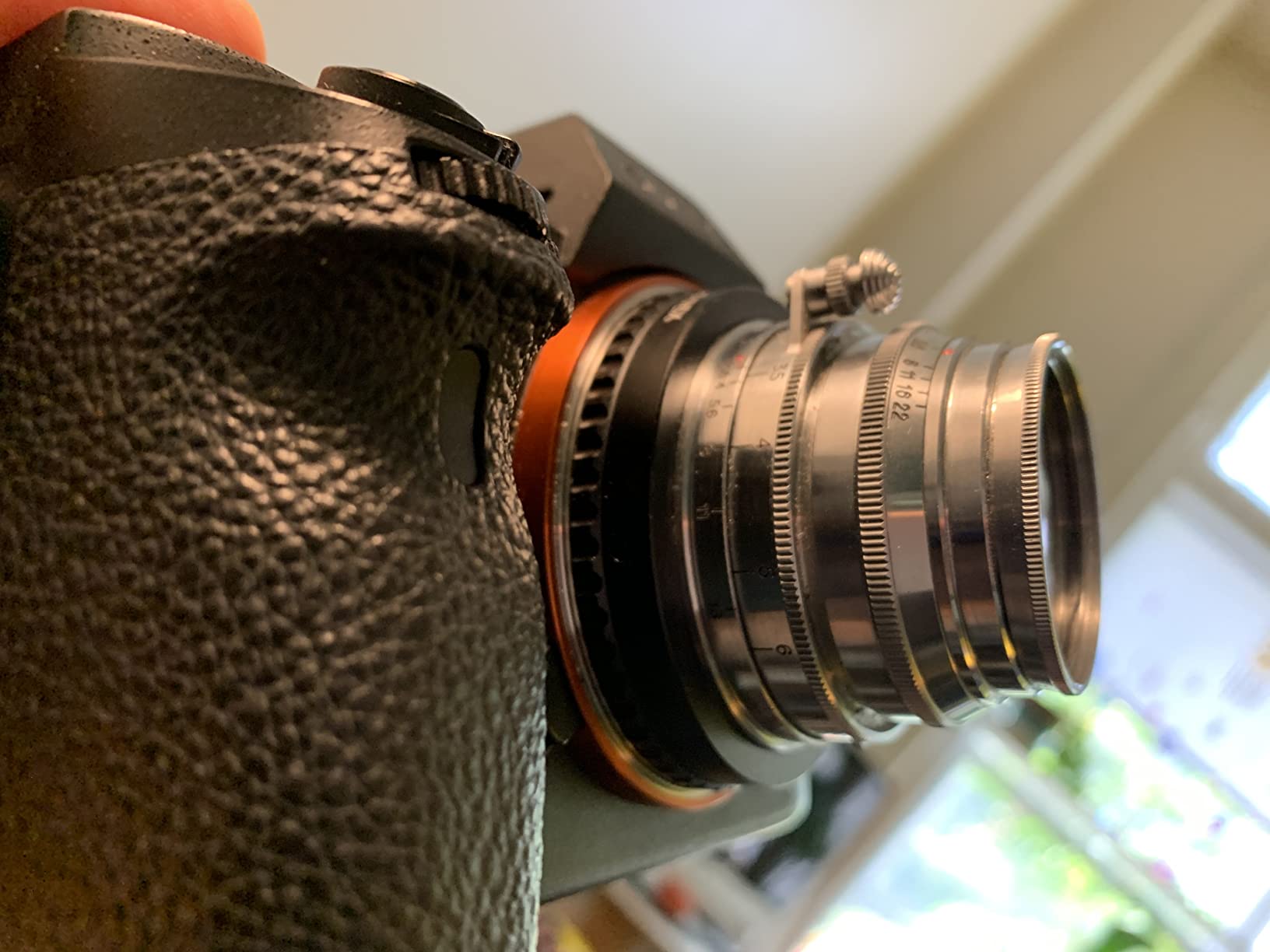
Sony E-mount users can adapt Mamiya RB67 and RZ67 lenses with this adapter. The integrated focus control dial makes focusing smooth and precise.
While rated slightly lower than the Canon version at 3.8 stars, this adapter still provides reliable performance for most users. The all-metal construction ensures durability.
The focus control dial sets this adapter apart from basic mount converters. It provides smooth, controlled focus adjustment for critical work.
Who Should Choose the Mamiya 6?
The Mamiya 6 is ideal for photographers who prioritize portability and prefer the square format. Consider this camera if you fall into these categories.
Travel photographers will appreciate the collapsible design. The camera packs smaller than any other medium format rangefinder, making it perfect for trips where weight and space matter.
Street photographers benefit from the compact size and quiet leaf shutter. The 6×6 format also works well for candid environmental portraits and urban scenes.
Budget-conscious photographers get more value from the Mamiya 6. Lower prices on bodies and lenses make it an accessible entry point into medium format rangefinder photography.
Those who prefer simplified kit will find the three-lens system adequate. No need to chase focal lengths you’ll rarely use.
Who Should Choose the Mamiya 7?
The Mamiya 7 suits photographers who need the larger format and wider lens options. This camera is right for you if these factors apply.
Landscape photographers benefit from the 6×7 format’s resolution advantage and the availability of ultra-wide lenses. The spot meter provides precise exposure control for challenging light.
Portrait photographers often prefer the rectangular format and the longer focal lengths available. The 150mm and 210mm lenses provide flattering compression for portraits.
Photographers who print large will appreciate the extra negative area. For 16×20 prints and larger, the 6×7 format shows its advantages.
Those building a long-term system may prefer the Mamiya 7’s broader lens selection. More focal length options mean more creative possibilities.
Frequently Asked Questions
Which is better Mamiya 6 or 7?
Neither camera is universally better. The Mamiya 6 excels at portability with its collapsible lens mount and offers a unique square 6×6 format. The Mamiya 7 provides a larger 6×7 negative, more lens options including ultra-wides, and spot metering. Choose the Mamiya 6 for travel and street photography. Choose the Mamiya 7 for landscapes and large prints.
Why is Mamiya 7 so expensive?
The Mamiya 7 commands high prices due to strong demand from landscape and portrait photographers, limited supply as a discontinued camera, and its reputation for exceptional image quality. The 6×7 format is prized for large prints, and the lens quality rivals modern options. Prices have increased significantly as film photography has resurged in popularity.
Is the Mamiya 7 worth it?
For serious landscape or portrait photographers, the Mamiya 7 is absolutely worth the investment. The combination of 6×7 image quality, excellent lenses, and portable rangefinder design is unmatched. However, if you don’t need the larger format or wide lens options, the less expensive Mamiya 6 may be a better value for your needs.
Does Mamiya 7 have a built in light meter?
Yes, the Mamiya 7 has a built-in spot meter. It reads approximately a 10-degree area through the viewfinder, allowing precise exposure measurement of specific tonal values in your scene. This is different from the Mamiya 6’s centre-weighted averaging meter and provides more control for challenging lighting situations.
What format is Mamiya 6?
The Mamiya 6 produces 6×6 cm square format images on 120 or 220 film. This gives you 12 exposures on 120 film or 24 on 220 film. The square format is popular for its balanced compositions and eliminates the need to choose between horizontal and vertical orientation when shooting.
Is Mamiya 6 or 7 better for travel?
The Mamiya 6 is better for travel due to its collapsible lens mount that significantly reduces the camera’s bulk. This unique feature makes it the most portable medium format rangefinder available. The Mamiya 7 is not large by medium format standards, but it cannot collapse and requires more bag space. For travel photography, portability usually wins.
Final Verdict: Mamiya 7 vs Mamiya 6
Both cameras represent exceptional achievements in camera design. The Mamiya 7 vs Mamiya 6 comparison doesn’t produce a clear winner because each serves different needs.
Choose the Mamiya 6 if portability is your priority. The collapsible lens mount makes it uniquely suited for travel and street photography. The square format appeals to photographers who think in geometric terms.
Choose the Mamiya 7 if image quality at large print sizes matters most. The 6×7 format and wider lens selection make it the choice for landscape and portrait specialists. The spot metering system provides professional-level exposure control.
Both cameras have proven reliable over decades of use. Parts availability varies, with the Mamiya 7 having better support due to its continued popularity. Either choice will reward you with exceptional image quality and a uniquely enjoyable shooting experience.
My recommendation? If you’re drawn to the square format and value portability above all, get the Mamiya 6. If you need the 6×7 format or want wider lens options, invest in the Mamiya 7. You won’t regret either choice.