
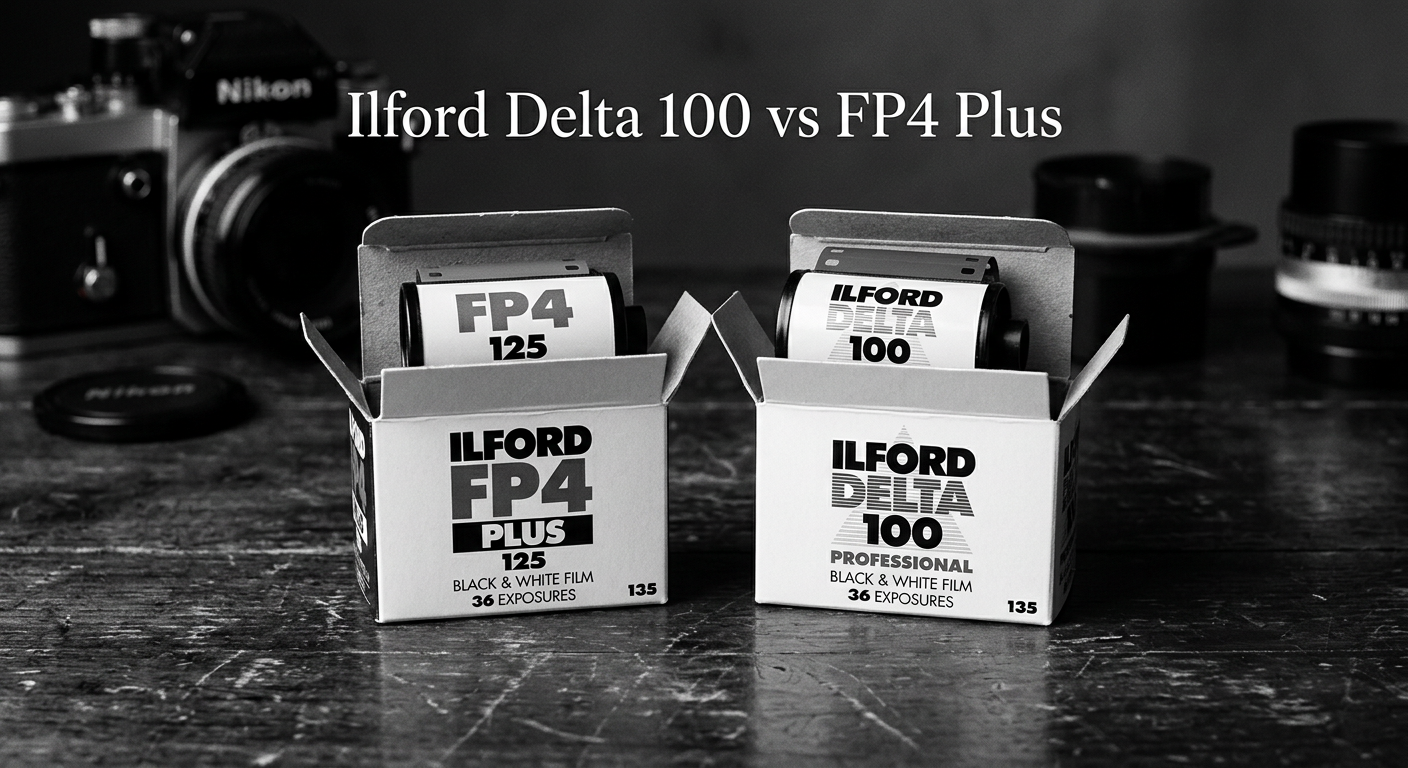
Choosing between Ilford Delta 100 and Ilford FP4 Plus is one of those decisions that shapes how your black and white images will look for years to come. I have shot both films extensively over the past decade, and each has earned a permanent spot in my camera bag for different reasons.
The main difference comes down to this: Delta 100 uses modern tabular grain technology for finer grain and better shadow detail, while FP4 Plus uses conventional grain emulsion for higher contrast and more forgiving development. Neither is universally better; they simply serve different creative visions.
In this head-to-head comparison of Ilford Delta 100 vs Ilford FP4 Plus, I will break down the technical differences, share real-world results from my testing, and help you decide which film deserves your next roll.
Ilford Delta 100 vs Ilford FP4 Plus: Quick Comparison
| Product | Specifications | Action |
|---|---|---|
 Ilford Delta 100 (2 Pack) Ilford Delta 100 (2 Pack) |
|
Check Latest Price |
 Ilford FP4 Plus (3 Pack) Ilford FP4 Plus (3 Pack) |
|
Check Latest Price |
This side-by-side view shows the core distinctions. Delta 100 excels when you need maximum detail in shadows and smoother tonal gradation. FP4 Plus shines when you want punchier contrast and more room for error in exposure and development.
Ilford Delta 100 Professional: Deep Dive Review
Ilford 1780624 Delta 100 Professional Black-and-White Film, ISO 100, 35mm 36-Exposure (2 Pack)
Pros
- Finest grain of any ISO 100 film
- Exceptional shadow detail
- Smooth tonal gradation
- Excellent highlight separation
- Works well with divided developers
Cons
- Less forgiving of exposure errors
- Requires precise development
- Higher cost per roll
Ilford Delta 100 represents the modern approach to black and white film. It uses tabular grain technology, also called T-grain, which arranges silver halide crystals in flat, tablet-like shapes rather than the traditional cubic form. This structure allows for finer grain without sacrificing speed.
When I shoot Delta 100, I notice the difference most in scenes with challenging dynamic range. The film holds onto shadow detail that would block up on other emulsions. A dark forest interior still shows texture in the deepest areas while maintaining bright highlights from sunlit gaps in the canopy.

The characteristic curve of Delta 100 is notably straighter than conventional films. This means the relationship between exposure and density remains linear across a wider range, giving you predictable results and easier scanning. Photographers who digitize their work appreciate how Delta 100 renders smooth gradations without the shoulder compression found in films with S-curves.
For development, I have had excellent results with Ilford DD-X, which brings out the inherent sharpness of the emulsion. HC-110 dilution B produces slightly lower contrast, ideal for scenes with harsh lighting. PMK Pyro developers create beautiful highlight separation and enhanced apparent sharpness through the staining effect.
One consideration: Delta 100 is less tolerant of mistakes. Rate it at box speed (ISO 100) for best results, though I often shoot it at ISO 80 for additional shadow density. Development times are more critical, and overdevelopment shows quickly as blocked highlights.
Best Uses for Ilford Delta 100
Delta 100 excels in situations demanding maximum detail and tonal subtlety. Landscapes with high dynamic range, architectural photography requiring fine detail, and portraits where smooth skin tones matter all benefit from this emulsion.
I particularly recommend Delta 100 for large format work. The fine grain and extended tonal range become even more apparent when shooting 4×5 or 8×10 sheets. The tabular grain technology shows its worth in contact prints and large enlargements.
Ilford FP4 Plus: Deep Dive Review
Pros
- Wide exposure latitude
- Forgiving of development errors
- Classic contrast look
- Excellent for beginners
- Works with any developer
Cons
- Slightly more grain than Delta 100
- Highlights can blow out easily
- S-curve limits highlight separation
Ilford FP4 Plus carries decades of tradition in its emulsion. This conventional grain film uses traditional cubic silver halide crystals, producing a classic black and white look that photographers have trusted since the FP4 name first appeared. Despite its heritage, FP4 Plus remains a current, actively produced film with a loyal following.
The actual ISO rating of FP4 Plus is 125, not 100, though most photographers shoot it at ISO 100-125 successfully. I typically rate it at ISO 100 for slightly denser negatives that scan well and print easily in the darkroom.

What strikes me most about FP4 Plus is its characteristic S-curve. The highlights compress at the upper end of the tonal range, creating a gentle roll-off rather than the linear response of Delta 100. This gives images a classic, somewhat romantic quality that many photographers prefer for certain subjects.
The exposure latitude of FP4 Plus is genuinely impressive. I have seen usable results from shots that were two stops over or under. This makes it an excellent choice for situations where lighting changes rapidly or metering is difficult. Street photographers appreciate this flexibility.

Developer compatibility is nearly universal. D-76, DD-X, HC-110, Rodinal, Pyro developers, and even caffenol all produce good results. I prefer HC-110 dilution E for a balance of sharpness and controlled contrast. The wide latitude in development means timing is less critical than with Delta 100.
The trade-off for this forgiveness is slightly more visible grain and less shadow detail than Delta 100. In 35mm format, the grain difference becomes noticeable in 8×10 or larger prints. For medium and large format, the difference diminishes significantly.
Best Uses for Ilford FP4 Plus
FP4 Plus suits photographers who value consistency and forgiveness. Street photography, documentary work, and any situation with unpredictable lighting benefit from its wide latitude. Beginners learning film photography find it more forgiving of the inevitable early mistakes.
I also recommend FP4 Plus for studio work with controlled lighting. The higher contrast and punchier blacks create dramatic product and portrait images. When you control the light, the reduced shadow detail matters less.
Ilford Delta 100 vs Ilford FP4 Plus: Head-to-Head Comparison
Grain Structure and Sharpness
The grain difference between these films stems directly from their emulsion technology. Delta 100 uses tabular grain, creating flatter silver crystals that pack more efficiently. FP4 Plus uses conventional cubic crystals that produce slightly larger, more visible grain.
In practical terms, Delta 100 shows noticeably finer grain in 35mm format. For medium format (120) or large format (4×5 and larger), both films produce exceptionally smooth results where grain becomes nearly invisible in typical print sizes.
Contrast and Tonality
FP4 Plus produces higher overall contrast with deeper blacks and brighter whites. The S-shaped characteristic curve compresses highlights, creating a classic look many associate with traditional black and white photography. This contrast works well for dramatic images and scenes that benefit from visual punch.
Delta 100 renders with lower inherent contrast but more tonal separation. The straight-line characteristic curve maintains separation in both highlights and shadows. This makes it easier to control contrast through development and printing, giving experienced photographers more creative control.
Shadow Detail and Highlight Handling
Delta 100 clearly wins in shadow detail. The tabular grain structure captures subtle variations in dark areas that would block up on FP4 Plus. For landscape photographers dealing with deep forests or architectural photographers shooting building interiors, this shadow detail matters significantly.
FP4 Plus handles highlights differently. The S-curve compresses bright areas, which can be both a benefit and a limitation. Bright skies roll off gently rather than blocking, but you lose some separation in the brightest values. Delta 100 maintains highlight separation but requires careful development to prevent highlights from becoming too dense.
Exposure Latitude and Forgiveness
FP4 Plus offers substantially more exposure latitude. I have recovered usable images from shots that were significantly over or underexposed. This makes it ideal for situations where metering is difficult or lighting changes rapidly.
Delta 100 requires more precise exposure. While it tolerates minor variations, major exposure errors show clearly in the final image. Photographers who shoot with careful metering and controlled conditions will not find this limiting, but those shooting quickly in changing conditions may prefer FP4 Plus.
Developer Compatibility
Both films work well with standard developers, but their responses differ. FP4 Plus accepts nearly any developer with good results, making it ideal for photographers who experiment with different combinations.
Delta 100 shows more variation with different developers. DD-X and similar fine-grain developers bring out its best qualities. Divided or 2-bath developers work exceptionally well with Delta 100, controlling contrast while maintaining highlight detail. This responsiveness gives advanced photographers more creative control but requires more experimentation.
Push and Pull Processing
Neither film is ideal for pushing, as both are already fine-grained, slow emulsions. However, FP4 Plus handles modest pushes to ISO 200-250 more gracefully. Delta 100 can be pushed but quickly loses the fine-grain advantage that makes it special.
For pulling, both films respond well to reduced development. Pulling Delta 100 to ISO 50 produces exceptionally smooth, low-contrast negatives perfect for bright, high-contrast scenes.
Format Availability
Both films are available in 35mm, 120 medium format, and various sheet film sizes. FP4 Plus has slightly better availability in some regions and formats. Large format photographers will find both readily available in 4×5, with FP4 Plus sometimes easier to find in 8×10.
Price Comparison
FP4 Plus typically costs less per roll than Delta 100. The difference is modest, roughly one to two dollars per roll, but adds up for photographers shooting frequently. For beginners or high-volume shooters, this price difference may influence the decision.
Beginner-Friendliness
FP4 Plus is the clear winner for beginners. Its wide exposure latitude forgives common metering mistakes. Development is more forgiving of timing variations. The classic contrast look produces satisfying results without requiring advanced darkroom technique.
Delta 100 rewards experienced photographers who understand exposure and development. The finer control it offers becomes an advantage only when you know how to use it. Beginners shooting Delta 100 may find themselves frustrated by results that fall short of expectations.
Frequently Asked Questions
What is the difference between FP4 and Delta 100?
Delta 100 uses tabular grain technology for finer grain and better shadow detail, while FP4 Plus uses conventional grain for higher contrast and more exposure latitude. Delta 100 has a straight-line characteristic curve giving linear tonal response, whereas FP4 Plus has an S-curve that compresses highlights for a classic look.
What is Ilford Delta 100 good for?
Ilford Delta 100 excels at landscapes, architecture, and fine art photography where maximum detail and smooth tonal gradation matter. Its fine grain and excellent shadow detail make it ideal for high dynamic range scenes. Large format photographers particularly benefit from its sharpness and tonal range.
What is Ilford FP4 Plus good for?
Ilford FP4 Plus is ideal for street photography, documentary work, and studio photography with controlled lighting. Its wide exposure latitude makes it perfect for unpredictable conditions. The higher contrast and classic look suit portraits and scenes where dramatic tonal separation is desired.
What is the best Ilford film for beginners?
FP4 Plus is generally the best Ilford film for beginners. Its wide exposure latitude forgives common metering mistakes, and development is more forgiving of timing variations. The lower cost and classic look produce satisfying results while building fundamental skills.
Verdict: Which Film Should You Choose?
After comparing Ilford Delta 100 vs Ilford FP4 Plus across every meaningful category, my recommendation depends entirely on your experience level and shooting style.
Choose Ilford Delta 100 if: You are an experienced film photographer who wants maximum shadow detail, finer grain, and more control over tonal reproduction. Landscape, architectural, and fine art photographers who carefully meter and develop their work will appreciate what Delta 100 offers.
Choose Ilford FP4 Plus if: You want a forgiving, versatile film that produces excellent results with minimal fuss. Beginners, street photographers, and anyone shooting in unpredictable conditions will find FP4 Plus more accommodating. The classic contrast look also suits photographers who prefer a traditional black and white aesthetic.
For most photographers starting their journey with black and white film, FP4 Plus provides the better experience. As your skills develop and you crave more control, Delta 100 waits as a rewarding upgrade. Both films are excellent choices from a manufacturer with over a century of black and white expertise.