
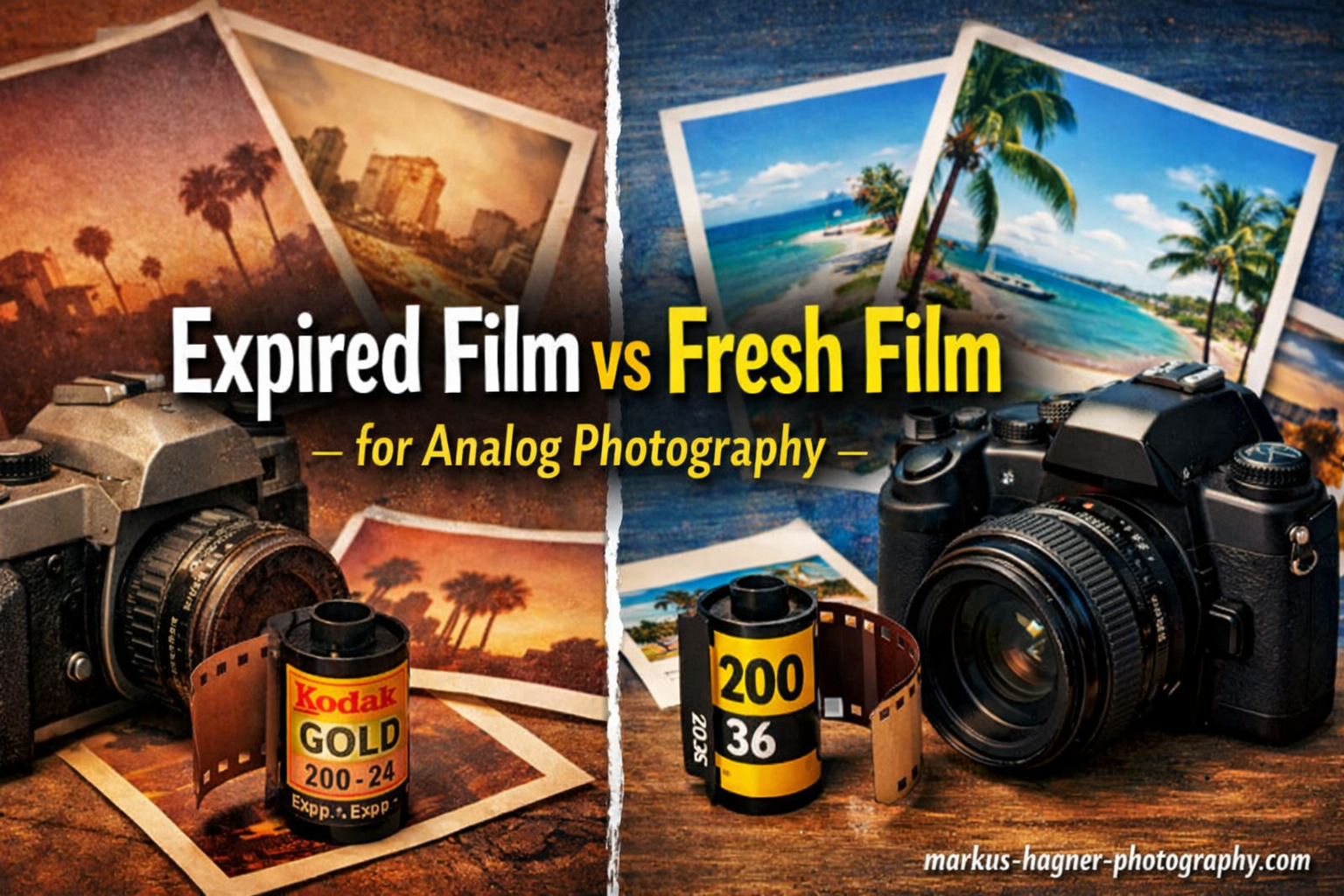
Every film photographer eventually faces this question: should you shoot that dusty roll from the back of your drawer, or is it safer to buy fresh stock? The expired film vs fresh film for analog photography debate has divided the analog community for decades, and for good reason. Both options have distinct advantages depending on your goals, budget, and tolerance for unpredictability.
After shooting hundreds of rolls of both expired and fresh film over the past 15 years, I’ve learned that the answer isn’t black and white. Expired film can produce stunning, one-of-a-kind images with vintage character. Fresh film delivers consistent, reliable results every time. The right choice depends entirely on what you’re trying to achieve.
In this comprehensive comparison, I’ll break down exactly what happens when film expires, how to adjust your exposure for older stock, when each option makes sense, and share real results from my own testing. Whether you’re a curious beginner or an experienced film photographer weighing your options, this guide will help you make informed decisions about your film choices.
Quick Comparison: Expired Film vs Fresh Film
Before diving deep, let’s look at how expired and fresh film stack up against each other across key characteristics. This comparison table highlights the fundamental differences you need to understand.
| Characteristic | Fresh Film | Expired Film |
|---|---|---|
| Light Sensitivity | Matches box speed ISO | Decreases over time (1 stop/decade) |
| Color Accuracy | Consistent, true to life | Color shifts common (purple, magenta) |
| Grain Structure | Fine, predictable | Increased grain, especially in shadows |
| Contrast | Full tonal range | Often reduced, can appear flat |
| Reliability | 99%+ success rate | Highly variable (50-90% depending on storage) |
| Results | Consistent, repeatable | Unpredictable, experimental |
| Cost | Higher upfront cost | Often cheaper, but factor in failure rate |
| Best For | Important events, paid work, learning | Experiments, creative projects, test shots |
| Storage Sensitivity | Still benefits from cool storage | Storage history determines usability |
As you can see, fresh film wins on reliability and consistency, while expired film offers creative unpredictability at a potentially lower cost. But there’s much more nuance to explore, particularly around how film actually degrades and what you can expect from different film types.
Expired Film Deep Dive
Expired film is photographic stock that has passed its manufacturer’s expiration date. This doesn’t mean the film suddenly stops working on that date. Instead, the chemical emulsion begins a gradual degradation process that affects light sensitivity, color reproduction, and overall image quality. Understanding this degradation helps you predict and work with expired film more effectively.
What Happens When Film Expires
Film consists of light-sensitive silver halide crystals suspended in gelatin emulsion, along with color dye layers (in color film). Over time, these components break down through several mechanisms.
The silver halide crystals gradually lose their sensitivity to light. This means a roll rated at ISO 400 might effectively perform closer to ISO 200 or even ISO 100 after several years. The degradation isn’t uniform across all crystals, which contributes to increased grain and reduced sharpness in expired film.
In color film, the three dye layers (cyan, magenta, and yellow) degrade at different rates. This uneven breakdown causes the characteristic color shifts seen in expired film. The magenta layer often degrades fastest, leading to purple or pink color casts. The cyan layer is typically most stable, which is why expired color film can sometimes take on a warm, amber appearance.
Base fog develops as unwanted density accumulates across the entire film. This reduces contrast and can make shadows appear muddy. The effect is more pronounced in higher-speed films because they start with larger silver halide crystals that are more susceptible to degradation.
The Three Possible Outcomes of Expired Film
Based on my experience shooting expired film extensively, I’ve found that results typically fall into three categories. Understanding these helps set realistic expectations.
Outcome 1: Indistinguishable from Fresh Film
Well-stored expired film, particularly black and white stock kept refrigerated or frozen, can produce results virtually identical to fresh film. I’ve shot 15-year-old Kodak Tri-X that was stored in a freezer, and the negatives looked no different from newly purchased rolls. This outcome is most common with black and white film that has been properly stored.
Outcome 2: Interesting Color Shifts and Vintage Character
Moderately expired color film (5-15 years past date) often produces appealing color shifts that many photographers actually seek out. These shifts can include purple skies, warm skin tones, or muted pastel colors. This is where expired film becomes a creative tool rather than a compromise. The results are unpredictable but often beautiful in their own way.
Outcome 3: Washed Out, Grainy, or Blank
Poorly stored expired film, especially color stock kept at room temperature or in hot conditions, can produce severely degraded images or no images at all. I’ve experienced blank rolls after developing 20-year-old color film that was clearly stored in a hot attic. The disappointment is real, but it’s part of the expired film gamble.
Film Type Comparison: How Different Films Age
Not all film ages equally. The three main categories of film degrade at different rates and show different characteristics as they expire.
Black and White Film (Best for Expiration Tolerance)
Black and white film holds up remarkably well over time. Without color dye layers to degrade, the primary concern is reduced light sensitivity. Black and white film also has excellent exposure latitude, meaning it can tolerate overexposure well. If you rate an expired ISO 400 black and white film at ISO 200 or even ISO 100, you’ll likely get usable negatives with minimal penalty.
I regularly shoot black and white film that’s 10-20 years expired with excellent results. The grain might be slightly increased, but the tonal range remains pleasing. Professional-grade black and white films like Kodak Tri-X, Ilford HP5 Plus, and Fuji Neopan seem particularly resilient.
C-41 Color Negative Film (Moderate Tolerance)
Color negative film processed in C-41 chemistry falls in the middle for expiration tolerance. The color dye layers will shift over time, but color negative film has generous exposure latitude that helps compensate for sensitivity loss. Consumer-grade color films like Kodak Gold and Fuji Superia tend to show more dramatic color shifts than professional emulsions.
For expired color negative film, I recommend shooting one stop over for every decade past expiration as a starting point. A 10-year-expired ISO 400 film should be shot at ISO 200. Bracketing your exposures (shooting the same scene at different settings) provides insurance against unpredictable degradation.
E-6 Slide Film (Least Tolerant of Expiration)
E-6 slide film is the most sensitive to expiration. Slide film has very little exposure latitude to begin with, so any sensitivity loss or color shift is immediately visible. Even slight degradation that would go unnoticed in color negative film can render slide film unusable.
I generally avoid expired slide film unless I know its storage history and am prepared for significant color shifts. The risk of blank or severely degraded slides is highest with this film type. That said, some photographers actively seek the extreme color shifts that badly expired slide film can produce.
ISO Adjustment Guidelines for Expired Film
The most practical question when shooting expired film is: what ISO should I actually use? The general rule is one stop slower for every decade past expiration. However, storage conditions significantly affect actual degradation.
Here’s a practical reference table based on my testing and community consensus:
| Years Expired | Refrigerated/Frozen | Room Temperature | Unknown/Hot Storage |
|---|---|---|---|
| 1-5 years | Box speed or -1/3 stop | -1/2 to -1 stop | -1 stop |
| 5-10 years | -1/2 to -1 stop | -1 to -1.5 stops | -2 stops |
| 10-20 years | -1 to -1.5 stops | -2 stops | -2 to -3 stops |
| 20+ years | -2 stops | -2 to -3 stops | Bracket heavily or test |
These are starting points, not guarantees. When in doubt, bracket your exposures across at least two stops. For critical shots, I’ll often expose the same scene at box speed, one stop over, and two stops over to ensure at least one usable frame.
When to Use Expired Film
Expired film shines in specific situations where its unpredictability becomes an advantage rather than a liability.
Experimental and Creative Projects: When you want unique, one-of-a-kind results that can’t be replicated, expired film delivers. The color shifts, increased grain, and vintage character can add mood and atmosphere that would require extensive post-processing to achieve with digital or fresh film.
Personal Photo Walks and Casual Shooting: For days when you’re exploring without pressure, expired film lets you experiment freely. If a roll doesn’t turn out, you’ve lost only the cost of processing, not irreplaceable memories.
Test Shots and Camera Testing: When checking if a newly acquired vintage camera works properly, expired film serves as inexpensive test stock. You’re verifying the camera’s functionality, not creating portfolio images.
Budget-Conscious Practice: If expired film is genuinely cheaper than fresh stock in your area, it can be an economical way to shoot more and improve your skills. Just factor in the higher failure rate when calculating true cost per usable image.
Storage Condition Impact
Storage history is the single biggest factor in how expired film performs. Temperature is the primary enemy of film stability, with humidity playing a secondary role.
Frozen Storage (0°F to 10°F / -18°C to -12°C): Film stored continuously frozen essentially stops degrading. I’ve shot 30-year-old frozen film that performed like it was fresh. The key is continuous storage; film that was frozen for years but then sat at room temperature for months before you acquired it will have degraded.
Refrigerated Storage (35°F to 45°F / 2°C to 7°C): Refrigeration dramatically slows degradation. Film stored refrigerated since purchase can last 10-20 years past expiration with minimal quality loss. This is the sweet spot for most photographers.
Room Temperature Storage (65°F to 75°F / 18°C to 24°C): Film kept at room temperature degrades noticeably faster. Color shifts and sensitivity loss become apparent within 5-10 years of expiration. Still usable, but expect to compensate.
Hot Storage (Above 80°F / 27°C): Heat accelerates degradation exponentially. Film stored in hot cars, attics, or tropical climates without air conditioning can become unusable within just a few years past expiration. Always be cautious with film of unknown provenance.
The challenge with buying expired film is that sellers rarely know or disclose complete storage history. I’ve learned to ask detailed questions and be skeptical of vague answers. Film priced suspiciously cheap often has a storage story that explains the price.
Fresh Film Analysis
Fresh film is stock within its expiration date, purchased from reputable retailers who store it properly. While it may seem less exciting than expired film’s unpredictability, fresh film offers reliability that’s invaluable for many photography situations.
Benefits of Fresh Film
The primary advantage of fresh film is predictability. When you load a fresh roll of Kodak Portra 400, you know exactly what you’re getting: accurate colors, fine grain, and consistent results from frame to frame and roll to roll. This consistency lets you focus on composition and exposure rather than worrying whether the film will cooperate.
Fresh film delivers the manufacturer’s intended aesthetic. Film stocks each have distinct personalities. Portra offers soft pastel tones and forgiving skin tones. Fuji Velvia delivers saturated landscapes with punchy greens and blues. Tri-X provides classic black and white grain structure. When you shoot fresh film, you get the exact look that film is known for, not a degraded approximation.
Technical performance is superior with fresh stock. Sharpness, tonal range, and dynamic range all match specifications. For critical work where image quality matters, fresh film is the only responsible choice.
Reliability and Consistency
I’ve tracked my success rate with fresh versus expired film over years of shooting. Fresh film from reputable sources has a success rate exceeding 99%. Problems are almost always due to camera malfunction, user error, or lab issues, not the film itself.
Expired film success rates vary wildly based on storage. Well-stored black and white film might achieve 90%+ usability. Room-temperature color film of unknown origin might drop to 50-60%. This variability means you’re gambling with every roll of expired film, while fresh film is essentially a sure thing.
Consistency matters for learning. When you’re developing your skills, you want to know that exposure and composition errors are your mistakes, not the film’s inconsistency. Fresh film eliminates one variable from the learning process.
When to Choose Fresh Film
Certain situations absolutely demand fresh film. The consequences of failure with expired film are too high in these scenarios.
Important Events: Weddings, graduations, family reunions, once-in-a-lifetime travel. These moments can’t be reshot. Using expired film for critical events is irresponsible unless you’re explicitly hired for experimental, unpredictable results.
Paid Professional Work: Clients deserve reliable results. Unless a client specifically requests the expired film look, professional work should use fresh stock. Your reputation depends on delivering consistent quality.
Learning Photography: Beginners benefit from consistent results while learning exposure, composition, and camera operation. Expired film’s unpredictability adds confusion when you’re still mastering fundamentals.
Portrait Work: Skin tones are particularly sensitive to the color shifts common in expired film. Fresh color negative film handles skin tones beautifully; expired film can produce unflattering purple or green casts.
Technical or Documentary Work: When accuracy matters more than artistic interpretation, fresh film ensures your images represent reality faithfully.
Fresh Film Storage Recommendations
Even fresh film benefits from proper storage. If you’re buying fresh film to use over time, here’s how to maintain its quality.
Refrigerate film you’ll use within 6-12 months. Freeze film for longer storage. Always let refrigerated or frozen film reach room temperature before opening the canister to prevent condensation from forming on the film surface.
Store film in its original packaging away from strong odors. The gelatin emulsion can absorb chemicals from the environment. Never store film near cleaning supplies, gasoline, or other volatile chemicals.
Use older stock first. Rotate your film inventory so the oldest rolls get used first. This ensures nothing sits around long enough to degrade significantly.
Head-to-Head Comparison
Now let’s compare expired and fresh film across specific categories to help you decide which is right for your needs.
Reliability
Winner: Fresh Film (by a wide margin)
Fresh film wins decisively on reliability. When you load a fresh roll, you can trust that properly exposed images will appear on the developed negatives. Expired film carries inherent risk of blank rolls, severe color shifts, or complete failure. For any situation where you can’t afford to lose images, fresh film is the only sensible choice.
Color Accuracy
Winner: Fresh Film
Fresh film reproduces colors as the manufacturer intended. Expired film, particularly color stock, will show color shifts to varying degrees. Some photographers enjoy these shifts as creative effects, but they’re not accurate. If color fidelity matters for your work, fresh film is essential.
Creative Potential
Winner: Expired Film
For pure creative unpredictability, expired film wins. The unique color shifts, vintage character, and one-of-a-kind results can’t be replicated consistently with fresh stock. Digital post-processing can simulate expired film looks, but there’s something special about the authentic degradation that happens chemically in the emulsion.
Cost
Winner: Depends on availability and failure rate
This category is complicated. Expired film is often cheaper per roll, but the true cost must factor in failure rate. If expired film costs half as much but 30% of your rolls fail, you haven’t saved money. In 2026, the secondary market for expired film has become peculiar, with some expired stocks commanding higher prices than fresh film due to scarcity and nostalgia. Evaluate actual cost per usable image, not just sticker price.
Learning Value
Winner: Fresh Film
Beginners learn faster with consistent results. Fresh film eliminates the variable of film degradation, letting you clearly see the effects of your exposure and composition choices. Expired film adds confusion to the learning process.
Environmental Considerations
Winner: Using existing expired film
From an environmental perspective, shooting expired film that already exists makes use of manufactured materials that would otherwise be discarded. However, actively seeking expired film and having it shipped to you creates additional carbon footprint. The most environmentally conscious approach is to use fresh film efficiently and avoid waste.
Summary Verdict by Category
| Category | Winner |
|---|---|
| Reliability | Fresh Film |
| Color Accuracy | Fresh Film |
| Creative Potential | Expired Film |
| Cost (true cost per image) | Variable – evaluate carefully |
| Learning Value | Fresh Film |
| Environmental Impact | Using existing expired stock |
Practical Recommendations
Based on my extensive experience with both expired and fresh film, here are practical recommendations for different situations.
When to Choose Expired Film
- You’re shooting experimental or artistic projects where unpredictability enhances the concept
- You have well-stored expired film with known provenance (refrigerated or frozen since purchase)
- You’re testing a newly acquired camera and want inexpensive stock
- You enjoy the vintage aesthetic and don’t mind occasional failures
- You’re shooting black and white film that’s 10-20 years expired with good storage
- Budget is tight and you accept the higher risk as a tradeoff
- You’re building a portfolio specifically around the expired film aesthetic
When to Choose Fresh Film
- You’re photographing important events that can’t be reshot
- You’re doing paid professional work for clients
- You’re learning film photography and need consistent results
- You’re shooting portraits where skin tone accuracy matters
- You need specific, repeatable results for technical or documentary work
- The cost difference is minimal and you value reliability
- You’re traveling to locations you may never visit again
Cost Analysis
Understanding true cost requires looking beyond the purchase price. Here’s a framework for evaluating your options.
Calculate your expected usable frames per roll. Fresh film might give you 36 usable frames from a 36-exposure roll. Expired film with unknown storage might give you 20-25 usable frames, with several lost to degradation. Factor in the cost of developing unusable frames.
Consider your time investment. Loading, shooting, and developing a roll that produces no usable images wastes not just money but hours of your time. If your time has value, fresh film’s reliability premium often pays for itself.
In 2026, fresh film prices have increased significantly, making expired film more attractive for budget-conscious photographers. However, secondary market expired film prices have also risen, sometimes exceeding fresh film costs for desirable discontinued emulsions. Do the math for your specific situation.
Where to Buy Each Type
For fresh film, purchase from reputable photography retailers who store inventory properly. B&H Photo, Adorama, and dedicated film retailers like Analogue Wonderland maintain proper storage conditions. Avoid fresh film from general retailers who may not understand film storage requirements.
For expired film, eBay remains the primary marketplace, but approach with caution. Ask sellers specific questions about storage history. Look for sellers who provide detailed information and photographs of the actual item. Be skeptical of vague descriptions like “found in closet” or “estate sale find” without additional context.
Some specialty retailers sell tested expired film with disclosed storage history. These sources cost more but reduce risk. Photography forums and community groups sometimes have members selling well-stored personal stock, which can be more trustworthy than anonymous marketplace sellers.
Development Considerations
Inform your lab that you’re shooting expired film. Some labs adjust development times or techniques for expired stock. Push processing (developing as if the film were rated at a higher ISO) can help compensate for sensitivity loss in expired film.
Black and white film offers the most development flexibility. If you home-process, you can experiment with development times to optimize results from expired stock. Color film requires standardized C-41 or E-6 processing with less room for adjustment.
Some labs charge extra for processing expired film due to the additional handling and potential issues. Ask about their policy before sending expired rolls. A few labs offer “blank roll” vouchers that credit your account if expired film produces no usable images.
Frequently Asked Questions
What happens if I shoot with expired film?
Shooting expired film typically results in reduced light sensitivity, color shifts (often purple or magenta tones), increased grain, and reduced contrast. Well-stored expired film can produce results nearly identical to fresh film, while poorly stored film may yield blank or severely degraded images. The results depend heavily on storage conditions and film type.
Can you trust the ISO of expired film?
You generally cannot trust the box speed ISO of expired film. The general rule is to rate expired film one stop slower for every decade past expiration. A 10-year-expired ISO 400 film should be shot at approximately ISO 200. Bracketing exposures provides insurance against unpredictable sensitivity loss.
Can a 20 year old 35mm film be developed?
Yes, 20-year-old 35mm film can almost always be developed, but results vary greatly depending on storage conditions. Black and white film holds up best and may produce excellent results. Color film will likely show significant color shifts and reduced sensitivity. Inform your lab that you’re processing very old film so they can adjust techniques if needed.
Is expired film better?
Expired film is not technically better than fresh film in terms of image quality, consistency, or reliability. However, expired film can produce unique aesthetic effects that some photographers seek for creative purposes. The color shifts, vintage character, and unpredictability can be artistic assets when that’s the intended look.
What is the 16 rule in film?
The Sunny 16 rule is an exposure guideline stating that on a bright sunny day, proper exposure at f/16 is achieved with a shutter speed equal to the reciprocal of your ISO. At ISO 100, use 1/100 second at f/16. This rule helps estimate exposure without a meter and is particularly useful when shooting expired film where the true ISO may be uncertain.
What does 20 year old expired film look like?
Twenty-year-old expired film typically shows pronounced color shifts (purples, pinks, or warm amber tones), increased grain especially in shadows, reduced contrast, and possible fogging. Black and white film may look nearly normal. Color negative film often displays muted colors and color casts. Some frames may be blank or severely degraded, particularly if storage conditions were poor.
Conclusion
The expired film vs fresh film for analog photography choice ultimately comes down to your priorities as a photographer. Fresh film delivers reliability, consistency, and predictable results. It’s the responsible choice for important events, paid work, and learning photography. Expired film offers creative unpredictability, vintage character, and potentially lower costs, but with the tradeoff of higher failure rates and inconsistent results.
My recommendation for most photographers is to keep both options available. Use fresh film for anything that matters. Experiment with expired film for creative projects, camera testing, and casual shooting. This balanced approach gives you reliability when you need it and creative freedom when you want it.
If you’re new to film photography, start with fresh film exclusively for your first year. Learn the fundamentals with consistent stock before introducing the variables of expired film. Once you understand exposure, composition, and your camera’s behavior, expired film becomes another creative tool rather than a source of confusion.
For experienced photographers, expired film can reignite creative excitement. The unpredictability forces you to let go of perfectionism and embrace happy accidents. Some of my favorite images came from expired film that behaved in ways I never expected.
The film photography community is fortunate to have both options. Fresh film keeps the medium viable and professional. Expired film connects us to photography’s past and offers unique artistic possibilities. Understanding when to use each makes you a more versatile and thoughtful photographer.