
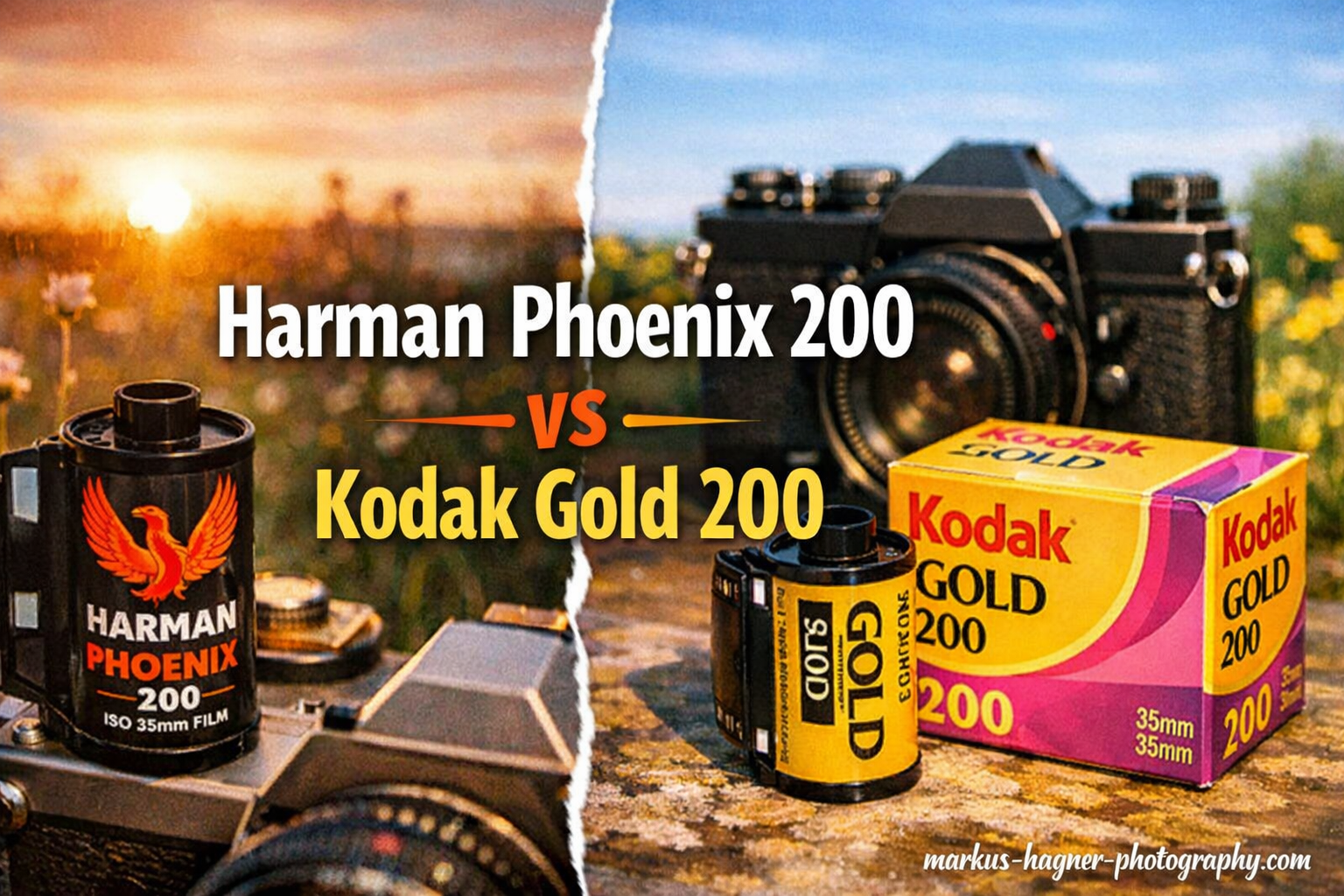
Film photographers have more choices than ever in 2026, and the ISO 200 color negative category has an interesting new contender. Harman Phoenix 200 burst onto the scene as the first color film manufactured entirely in the UK by the legendary Ilford factory. But how does this experimental newcomer stack up against Kodak Gold 200, the established benchmark for warm-toned everyday film?
I have shot both films extensively over the past year, putting them through portrait sessions, street photography walks, and landscape trips. The differences between these two stocks go far beyond their shared ISO 200 rating. Each film has a distinct personality that shines in different situations.
This Harman Phoenix 200 vs Kodak Gold 200 comparison breaks down everything you need to know. I will cover color rendering, grain structure, exposure latitude, scanner compatibility, and real-world performance. By the end, you will know exactly which film belongs in your camera bag.
Quick verdict: Choose Kodak Gold 200 for reliable, consistent results with forgiving exposure. Pick Harman Phoenix 200 when you want an experimental, vintage aesthetic with unique character and do not mind working around its quirks.
Harman Phoenix 200 vs Kodak Gold 200: Quick Comparison
| Product | Specifications | Action |
|---|---|---|
 Phoenix ISO 200 C41 Color Negative Film Phoenix ISO 200 C41 Color Negative Film |
|
Check Latest Price |
 Kodak Gold 200 Film (Pack of 2) Kodak Gold 200 Film (Pack of 2) |
|
Check Latest Price |
The table above shows the basic specifications, but the real story lies in how these films render images. Let me dive deeper into each one.
Harman Phoenix 200 Overview
Pros
- Unique vintage character
- Warm magenta tones
- Great for golden hour
- Experimental aesthetic
- First UK-made color film
Cons
- Needs overexposure
- Grain may be too strong
- Scanner compatibility issues
- Not beginner-friendly
- Inconsistent results
Harman Phoenix 200 represents a milestone in film photography history. Released in late 2023, this is the first color negative film manufactured entirely at the Ilford factory in Mobberley, UK. Harman Technology has produced black and white films for decades under the Ilford brand, but Phoenix marks their entry into color emulsions.
The film positions itself as experimental rather than a direct competitor to established stocks. I found this description accurate. Phoenix delivers punchy contrast, visible grain, and a distinctive color palette that leans warm with noticeable magenta tones. It has character in spades, but that character comes with tradeoffs.
One critical point from my testing: Phoenix does not behave like a true ISO 200 film. Most photographers, including myself, achieve better results rating it between ISO 100 and 160. At box speed, shadows block up and highlights blow out quickly. Overexposing by one to two stops brings out the best in this emulsion.

Color Palette and Character
The color rendering of Phoenix sets it apart from any other film I have used. Warm tones dominate, with a distinct magenta or orange cast that gives images a retro, almost dreamlike quality. Skin tones render with a peachy warmth that some photographers love and others find unnatural.
Halation is visible in backlit scenes, creating a glow around bright light sources. This effect adds to the vintage feel but may frustrate photographers seeking clean, modern results. The halation comes from the relatively thin film base, which also contributes to the scanner compatibility issues I discuss later.
Colors saturate heavily, especially reds and oranges. Blue skies take on a cyan tint, while greens shift toward yellow-green. These are not flaws but characteristics. If you want accurate color reproduction, Phoenix will disappoint. If you want images that look like they were shot decades ago, Phoenix delivers.
Grain and Contrast
The grain structure of Phoenix 200 is its most controversial feature. For an ISO 200 film, the grain is prominent and clearly visible even in well-exposed shots. In underexposed frames, the grain becomes clumpy and distracting. Some photographers embrace this as part of the vintage aesthetic, while others find it limiting.
Contrast runs high across the board. Shadows drop off quickly into darkness, and highlights blow out with little warning. This creates punchy, dramatic images but reduces the dynamic range compared to more modern emulsions. I found shooting in soft, overcast light or during golden hour produced the most pleasing results.

Best Use Cases for Harman Phoenix 200
Through my testing, I identified several scenarios where Phoenix shines:
Golden hour and sunset photography: The warm tones and high contrast complement the natural warmth of low-angle sunlight. Phoenix transforms golden hour into something almost magical.
Artistic and experimental projects: When you want images that stand out from the crowd, Phoenix delivers a look unlike any other currently available film.
Vintage aesthetic seekers: If you want your photos to look like they were shot in the 1970s or 1980s, Phoenix gets you there without any digital manipulation.
Medium format shooting: The larger negative size of 120 format reduces the visibility of grain while retaining the unique color character.
Avoid Phoenix for product photography, corporate headshots, or any situation where color accuracy matters. The film is simply not designed for those applications.
Scanner Compatibility Notes
This is where Phoenix gets tricky. I tested scans from both Noritsu and Frontier scanners, and the difference is dramatic. Noritsu scanners handle the thin film base and unusual color curve much better, producing usable results with minimal correction. Frontier scanners struggle, often outputting extremely contrasty images with blocked shadows and blown highlights.
If your lab uses Frontier scanners, ask if they have experience with Phoenix. Many labs have developed custom profiles for this film, but others still struggle with it. I recommend requesting Noritsu scans or scanning yourself if possible.
Kodak Gold 200 Overview
Pros
- Consistent results
- Forgiving exposure
- Fine grain
- Warm accurate colors
- Universal lab compatibility
Cons
- Only 24 exposures
- Not ideal for low light
- Less character than Phoenix
- Best in bright conditions
Kodak Gold 200 has earned its reputation as one of the most reliable color negative films available. Introduced decades ago and refined over time, Gold 200 delivers exactly what most photographers expect from an ISO 200 color film: warm tones, fine grain, forgiving exposure latitude, and consistent results roll after roll.
I have shot hundreds of rolls of Gold 200 over the years, and it has never let me down. The film works beautifully in point-and-shoot cameras, SLRs, and rangefinders alike. Labs scan it without any special instructions. The results are predictable and professional, even when my technique is less than perfect.
The warm color balance suits portraits, landscapes, and travel photography equally well. Unlike Phoenix, Gold 200 aims for accuracy with a subtle warmth rather than heavy character. Skin tones render naturally, blues stay blue, and greens remain green. This neutrality makes Gold 200 a versatile workhorse.

Color Palette and Character
Kodak Gold 200 produces colors that most people would describe as natural with a pleasant warmth. The legendary Kodak color science is evident in every frame. Reds and yellows have a slight saturation boost, while blues remain clean without the cyan shift seen in Phoenix.
Skin tones are a particular strength. Whether shooting Caucasian, Asian, or African American subjects, Gold 200 renders complexions with accuracy and a subtle golden glow. This makes it my go-to choice for family gatherings, weddings, and portrait sessions where clients expect natural-looking results.
The film does not exhibit the halation effect seen in Phoenix. Highlights roll off smoothly into white, and the film base is substantial enough to prevent light piping. These technical refinements contribute to the clean, modern look that has kept Gold 200 popular for decades.
Grain and Contrast
For an ISO 200 film, Gold 200 exhibits remarkably fine grain. Even in 35mm format, grain is barely visible in well-exposed shots. In medium format, the images are nearly grainless. This clean grain structure allows for significant enlargement without quality loss.
Contrast is moderate, with excellent dynamic range for a consumer-grade film. Shadows retain detail even in high-contrast scenes, and highlights do not blow out until severely overexposed. This exposure latitude is forgiving for beginners and convenient for experienced photographers shooting in variable light.

Best Use Cases for Kodak Gold 200
Gold 200 excels in nearly every category:
Portrait photography: Natural skin tones and moderate contrast make Gold 200 ideal for portraits of all types. The forgiving exposure latitude means you can shoot confidently without bracketing.
Travel and vacation photography: The warm tones complement sunny travel destinations beautifully. The fine grain holds up for landscape shots and detail images alike.
Beginner film photographers: The forgiveness of Gold 200 makes it perfect for learning. Mistakes that would ruin other films are often recoverable with this stock.
Point-and-shoot cameras: The limited exposure controls of most point-and-shoots pair perfectly with Gold 200’s latitude. You can trust the camera’s meter and get great results.
Any situation requiring consistency: When you need reliable results and cannot afford experiments, Gold 200 is the safe choice.
Lab Processing and Scanning
Every professional lab processes and scans Gold 200 daily. The standard C-41 chemistry works perfectly, and all scanners handle the film without issues. Noritsu, Frontier, and Epson flatbeds all produce excellent results. This universal compatibility removes a layer of uncertainty from your workflow.
I have had Gold 200 processed at labs across multiple countries and never received a bad scan. The consistency is remarkable and one of the primary reasons I recommend this film to anyone who wants film photography to be straightforward.
Harman Phoenix 200 vs Kodak Gold 200: Head-to-Head Comparison
Color Rendering: Character vs Accuracy
This is the fundamental difference between these films. Phoenix prioritizes character over accuracy, while Gold 200 delivers accuracy with pleasant warmth. Neither approach is wrong, but they serve different purposes.
Phoenix images have an unmistakable look. The magenta cast, saturated warm tones, and halation create photographs that feel nostalgic and artistic. Colors shift in ways that digital manipulation struggles to replicate. If you want your images to look like they were shot on film, Phoenix announces that fact loudly.
Gold 200 images could pass for well-edited digital photos. The colors are natural enough that viewers might not realize they are looking at film. This subtlety is a strength for professional applications where clients want a clean, modern aesthetic without obvious film characteristics.
Winner: Tie, depending on your goals. Choose Phoenix for maximum character, Gold 200 for accuracy and versatility.
Grain Structure: Vintage vs Clean
The grain difference between these films is substantial. Phoenix shows visible grain even in well-exposed, brightly lit scenes. In lower light or slight underexposure, the grain becomes prominent and textural. This is intentional, part of the vintage aesthetic Harman designed into the emulsion.
Gold 200 exhibits fine, tight grain that is barely noticeable in 35mm and essentially invisible in medium format. Even in challenging light, the grain structure remains pleasing rather than distracting. For large prints or detailed work, this fine grain is a significant advantage.
Some photographers specifically seek out grainy films for their aesthetic effect. If that describes you, Phoenix delivers in spades. For everyone else, Gold 200 offers the cleaner option.
Winner: Kodak Gold 200 for most applications. Harman Phoenix 200 for intentional vintage aesthetic.
Exposure Latitude: Demanding vs Forgiving
Here is where practical shooting differences become obvious. Gold 200 forgives exposure errors by one to two stops in either direction. Rate it at box speed, and you will get usable results. Overexpose by a stop, and it still looks great. Underexpose slightly, and shadow detail remains recoverable.
Phoenix demands more attention. At box speed (ISO 200), I found shadows blocked up and highlights blew out easily. Rating it at ISO 100 to 160 produces better results, but this requires manual intervention. Point-and-shoot cameras with DX coding will default to ISO 200, which is not ideal.
The practical implication: Gold 200 works in any camera with any meter. Phoenix requires cameras with manual ISO setting and a photographer willing to think about exposure carefully.
Winner: Kodak Gold 200 by a significant margin.
Scanner Compatibility: Specific vs Universal
I mentioned this earlier, but it bears repeating in the comparison context. Phoenix 200 produces dramatically different results depending on the scanner used. Noritsu scanners handle it well; Frontier scanners often struggle. Some labs have developed custom profiles, but inconsistency remains an issue.
Gold 200 scans beautifully on every scanner. Noritsu, Frontier, Pakon, Epson flatbed, or dedicated film scanner – the results are consistently excellent. No special profiles or adjustments required. Your lab does not need to know anything about the film to produce great scans.
For photographers who develop at home and scan themselves, this may not matter. But for anyone sending film to a lab, Gold 200 removes a variable from the equation.
Winner: Kodak Gold 200, no contest.
Portrait Performance
Both films can produce lovely portraits, but they render skin tones very differently. Gold 200 gives natural, accurate skin tones with a subtle warmth that flatters most complexions. It handles the full range of skin tones accurately, making it suitable for diverse subjects.
Phoenix renders skin with a warm, peachy quality. Some subjects look great with this treatment; others appear overly orange or sunburned. The high contrast can be unflattering in harsh light, creating dark shadows under eyes and emphasizing skin texture.
For professional portrait work, Gold 200 is the clear choice. For artistic portraits where a stylized look is desired, Phoenix can work beautifully – but expect to spend more time managing exposure and lighting.
Winner: Kodak Gold 200 for professional portrait work.
Landscape and Nature Photography
Gold 200 handles landscapes with natural color reproduction. Greens stay green, blues remain blue, and the moderate contrast preserves detail in both shadows and highlights. The fine grain allows for significant cropping and enlargement.
Phoenix transforms landscapes into something more painterly. The warm tones suit desert scenes, autumn foliage, and golden hour dramatically. The prominent grain adds texture that some photographers find appealing in landscape work. However, the color shifts can make forests look sickly and skies appear unnatural.
For accurate landscape reproduction, Gold 200 wins. For artistic landscape interpretation, Phoenix offers a unique look that some photographers will love.
Winner: Kodak Gold 200 for accuracy, Harman Phoenix 200 for artistic interpretation.
Street Photography
Street photography demands speed, flexibility, and forgiveness. You often have seconds to react to a scene, with no time to adjust exposure or wait for perfect light. Gold 200 handles these conditions beautifully, forgiving exposure errors and delivering consistent results in varied lighting.
Phoenix requires more deliberate shooting. The need to overexpose means you might miss fleeting moments while adjusting settings. The high contrast can create problematic results in high-contrast street scenes with deep shadows and bright highlights.
That said, some street photographers love the gritty, vintage look of Phoenix for urban environments. The grain and contrast can add mood to city scenes in ways that cleaner films cannot.
Winner: Kodak Gold 200 for most street photography situations.
Shooting Recommendations: Which Film Should You Choose?
Choose Harman Phoenix 200 If:
You want to experiment with a unique film that produces images unlike anything else currently available. You embrace grain as an aesthetic element rather than a flaw. You primarily shoot during golden hour, in sunny conditions, or with controlled lighting. You have experience with film exposure and are comfortable rating film differently than box speed. You want to support a new color film emulsion from a historic manufacturer. You shoot medium format where grain is less problematic.
Choose Kodak Gold 200 If:
You want consistent, reliable results roll after roll. You are new to film photography or prefer a straightforward workflow. You shoot portraits where accurate skin tones matter. You use a point-and-shoot camera with DX coding. You send your film to labs and want universal scanner compatibility. You shoot in varied lighting conditions. You need to enlarge prints significantly. You want a film that forgives exposure errors.
Practical Tips for Each Film
For Phoenix 200: Rate it at ISO 100 to 160, not 200. Shoot in soft light or golden hour whenever possible. Request Noritsu scans from your lab, or scan yourself. Embrace the grain and color shifts as character, not flaws. Test a roll before committing to important shoots.
For Gold 200: Shoot at box speed with confidence. Trust your camera’s meter. Expect consistent results in any light. Send to any lab without special instructions. Use it as your everyday film and keep a few rolls in your bag at all times.
Frequently Asked Questions
Is Kodak Gold 200 good quality?
Yes, Kodak Gold 200 is excellent quality for an ISO 200 color negative film. It delivers consistent results with fine grain, accurate colors, and forgiving exposure latitude. With over 1,400 reviews averaging 4.7 stars, photographers praise its reliability and warm tones. It is particularly well-suited for portraits, travel photography, and everyday shooting.
What is HARMAN Phoenix 200?
HARMAN Phoenix 200 is the first color negative film manufactured entirely in the UK by Harman Technology at the Ilford factory in Mobberley. Released in late 2023, it is an experimental ISO 200 C-41 film known for its high contrast, prominent grain, warm magenta color cast, and vintage aesthetic. It represents Harman’s entry into color film after decades of black and white production.
What ISO should I shoot Harman Phoenix at?
Most photographers recommend shooting Harman Phoenix 200 at ISO 100 to 160 rather than the box speed of 200. At box speed, the film tends to produce blocked shadows and blown highlights. Overexposing by one to two stops brings out better shadow detail and reduces the harsh contrast. For point-and-shoot cameras with DX coding, this may require using exposure compensation.
Who makes the Harman Phoenix film?
Harman Phoenix is made by HARMAN Technology Ltd, the company behind Ilford Photo. The film is manufactured entirely at their factory in Mobberley, Cheshire, UK. This marks the first time a color negative film has been produced completely in the UK, as previous UK film manufacturing was limited to black and white emulsions. Harman has produced Ilford black and white films since 1879.
Is Harman Phoenix 200 good for beginners?
Harman Phoenix 200 is not ideal for beginners. Its demanding exposure requirements, scanner compatibility issues, and prominent grain make it challenging for photographers still learning the basics. Beginners should start with more forgiving films like Kodak Gold 200 before experimenting with Phoenix. Once you understand exposure and have consistent technique, Phoenix offers a rewarding creative experience.
Final Verdict: Harman Phoenix 200 vs Kodak Gold 200
After extensive testing, my conclusion is straightforward. Kodak Gold 200 remains the benchmark for ISO 200 color negative film in 2026. Its combination of fine grain, accurate colors, forgiving exposure, and universal lab compatibility makes it the practical choice for most photographers.
Harman Phoenix 200 is not trying to compete with Gold 200 on those terms. It is an experimental film designed for photographers who want character over convenience. If you embrace its quirks and shoot within its limitations, Phoenix produces images with a unique vintage aesthetic that no other current film matches.
My recommendation: Keep Gold 200 as your everyday film. Add Phoenix 200 to your bag for creative projects, golden hour sessions, and times when you want your images to look distinctly analog. Both films deserve a place in a well-rounded film photography practice.