
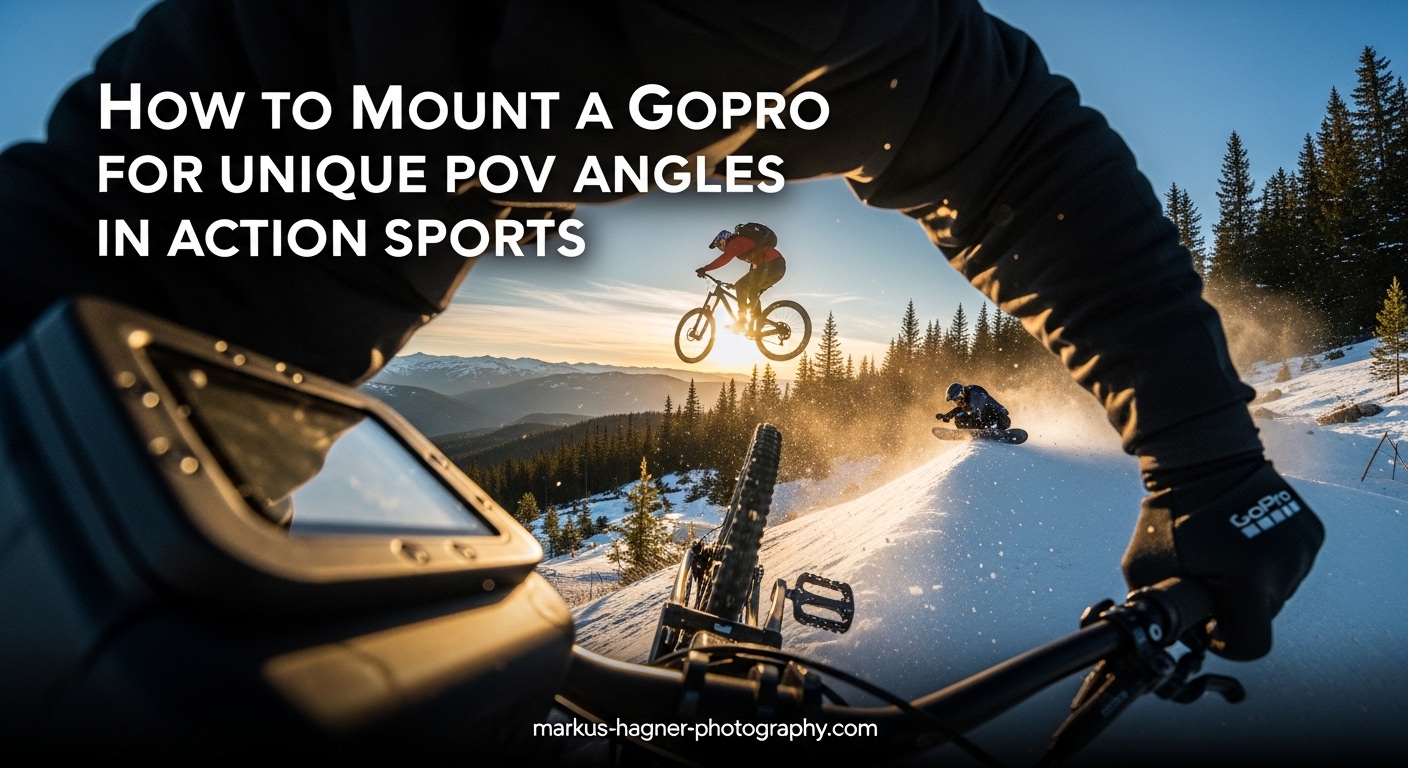
Capturing action sports from your own perspective creates some of the most immersive footage you can shoot. When I started filming my mountain biking adventures, I quickly realized that where you mount your GoPro matters just as much as the camera settings you choose. The right mounting position can make viewers feel like they’re right there with you, while the wrong angle might leave them dizzy or disconnected from the action.
In this guide, I’ll walk you through everything I’ve learned about GoPro POV angles after years of trial and error across multiple sports. You’ll discover which mounts work best for each activity, how to position your camera for maximum impact, and the creative techniques that separate amateur footage from professional-looking POV shots.
Whether you’re skiing down a black diamond, bombing singletrack on your mountain bike, or capturing your morning runs, this guide will help you mount your GoPro for unique, engaging perspectives that tell your story from your point of view.
Understanding POV Filming for Action Sports
Point of view (POV) filming captures footage from your exact perspective, placing viewers directly in the action as if they’re experiencing it themselves. This technique has become essential for action sports content because it creates an immediate, visceral connection between your audience and your experience.
The beauty of POV filming lies in its authenticity. When done right, your footage shows exactly what you see—your hands on the handlebars, your skis carving through powder, or your feet hitting the trail. This first-person perspective makes action sports content more relatable and exciting than traditional third-party filming.
Before diving into specific mounts, consider three key factors: stability, angle, and context. A stable shot keeps viewers engaged rather than motion-sick. The right angle shows enough of the action without cutting off important elements. And context—showing enough of the environment—helps viewers understand where you are and what you’re doing.
Complete Guide to GoPro Mount Types
The mount you choose fundamentally shapes your footage. Each type offers distinct advantages for different situations, and understanding these differences will help you select the right tool for your specific action sport and creative vision.
Body Mounts: Chest and Head Mounts
The chest mount harness (often called the “Chesty”) remains one of the most versatile options for action sports filming. I’ve found it particularly effective because it keeps the camera stable relative to your core, which moves less than your head during intense activity. The resulting footage feels grounded and natural, showing your arms and the terrain ahead without the constant bobbing of head-mounted shots.
For the best chest mount results, I tighten the straps as much as possible—loose straps create shake that no amount of stabilization can fix. Many experienced skiers and mountain bikers actually mount the camera upside down on the chest harness, which naturally angles it slightly upward for a better view of the trail or slope ahead.
Head mounts offer a true eye-level perspective but come with trade-offs. They show exactly what you’re looking at, which can be powerful for moments when you turn your head to take in the scenery. However, every head movement translates directly to camera movement, and I’ve noticed this can make footage feel more chaotic than chest-mounted shots. Head mounts also draw more attention in social situations, which matters if you’re filming in crowded areas or want candid moments.
Helmet Mounts: Top, Side, and Chin Positions
Helmet mounting opens up several positioning options, each with distinct characteristics. The top-of-helmet mount was my first attempt at POV filming, but I quickly learned it often shows too much sky and not enough of the action below. It works well for activities where you’re looking downward frequently, but most action sports benefit from a lower angle.
The side helmet mount provides a slightly off-center perspective that can add visual interest to your footage. It’s particularly effective for activities where you want to capture your peripheral vision or show more of your equipment on one side. However, it can feel less immersive than centered options.
The chin mount has become my go-to recommendation for anyone with a full-face helmet. This position sits at roughly eye level and shows the terrain ahead while including your hands on the bars or your skis in the frame. The mountain biking community widely considers chin mounting “the best way to mount” a GoPro for that sport. It combines the stability of helmet attachment with an angle that feels natural and immersive.
Before mounting anything to your helmet, check your helmet manufacturer’s guidelines and local regulations. Some jurisdictions have restrictions on helmet modifications that could affect safety certifications.
Equipment Mounts: Handlebar, Suction Cup, and Adhesive
Mounting your GoPro directly to equipment creates unique perspectives that body mounts can’t achieve. Handlebar mounts sound ideal for cycling, but here’s what I learned the hard way: they’re often too shaky for mountain biking. Every bump and vibration transfers directly to the camera, creating footage that’s difficult to watch even with stabilization enabled.
For road cycling or smooth surfaces, handlebar mounts work well and provide an interesting low angle. But for mountain biking, I strongly recommend chest or chin mounts instead—they absorb far more vibration and produce smoother footage.
Suction cup mounts excel for water sports and boating applications. They attach securely to smooth surfaces like boat hulls, windscreens, and kayaks. I’ve used them to capture wakeboarding shots from the boat and over-the-water angles that would be impossible with body mounts. Always clean both the mounting surface and the suction cup before attaching, and use the tether as backup security.
Adhesive mounts offer permanent or semi-permanent attachment to helmets, boards, and equipment. Once applied, they’re incredibly secure and low-profile. The trade-off is permanence—removing them requires heat and patience, and they leave residue. I reserve adhesive mounts for equipment I want to film from consistently, like my snowboard or motorcycle fairing.
Sport-Specific Mounting Recommendations
Different sports demand different approaches to POV filming. What works perfectly for skiing might produce mediocre results for mountain biking. Here’s what I’ve learned from filming across multiple disciplines.
Skiing and Snowboarding POV Setup
For skiing and snowboarding, the chest mount emerges as the clear favorite among experienced filmmakers. It captures your skis or board in the frame while showing the slope ahead, creating a balanced composition that tells the complete story. The chest mount also stays more stable than helmet options when you’re carving turns or hitting bumps.
A pro tip I picked up from ski instructors: mount the GoPro upside down on your chest harness. This angles the camera slightly upward, capturing more of the terrain ahead and less of your body. The footage looks more natural, and you can always flip it in post-processing.
Ski pole mounting works beautifully when you want to film others rather than yourself. Mount the camera just below the grip, and you can point it at friends, family, or the scenery around you. Some skiers use a bite mount for quick access—they can grab the camera from their chest pocket, hold it in their mouth for stable shots, and stow it just as quickly.
For snowboarders who prefer helmet mounting, a chin mount on a full-face helmet or a side mount on a regular helmet tends to produce better results than a top mount, which often captures too much sky and not enough of the action below.
Mountain Biking POV Angles
Mountain biking presents unique challenges for POV filming. The constant vibration, rapid changes in terrain, and need to show the trail ahead require careful mount selection and positioning.
If you ride with a full-face helmet, the chin mount is widely considered the gold standard. It positions the camera at roughly eye level, shows your hands on the bars, and captures the trail in a natural perspective. The footage feels immersive without the excessive shake of handlebar mounts or the constant motion of top-of-helmet positions.
For riders without full-face helmets, the chest mount beats head mounts by a significant margin. As one forum user put it, chest mount “beats helmet mount by a long shot” for mountain biking. The key is tightening it as much as possible—any slack translates to shake in your footage.
I strongly advise against handlebar mounts for serious mountain biking. The vibration transfer creates footage that’s uncomfortable to watch, even with HyperSmooth stabilization enabled. Save handlebar mounts for road cycling or bike commuting where surfaces are smoother.
Running and Water Sports Mounting
Running with a GoPro requires balancing stability with discretion. Chest mounts work well but can slide down during extended runs if not tightened properly. I’ve found that cinching the straps as tight as comfortable prevents the gradual slip that ruins footage 20 minutes into a run.
Head mounts for running are more stable than you might expect—your head moves less than you think while running—but they attract attention. If you’re filming in urban areas or want candid interactions with people you pass, the chest mount keeps a lower profile.
Upper arm mounts offer another alternative for runners. They’re less conspicuous than head mounts and less prone to sliding than chest options, though they provide a less immersive angle.
For water sports, think beyond body mounts. Suction cups on boat hulls create dramatic angles impossible to achieve otherwise. The large tube mount works well for railings and ski boat towers. Boom mounts extend over the water for those dramatic wakeboarding shots. Always ensure your GoPro is in a waterproof housing or using its built-in waterproofing for any water activity.
Creative Angles and Unique POV Techniques
Once you’ve mastered basic mounting, you can explore creative techniques that make your footage stand out. These approaches require more planning but yield memorable results.
Multi-Angle Shooting Strategies
The most compelling action sports videos combine multiple angles rather than relying on a single perspective. I typically run two or three cameras simultaneously when I want to create a polished final video. One chest mount captures the continuous action, while a secondary mount—perhaps on equipment or a selfie stick—provides cutaway shots and alternative views.
When I can’t use multiple cameras, I’ll film the same run or route multiple times with different mount positions. This gives me editing options and keeps the final video dynamic. The key is planning your shots before you start filming.
DIY Angle Adjustment Methods
Sometimes the standard mount angle isn’t quite right for your specific situation. Here’s a trick I learned from other filmmakers: placing two fingers between your GoPro and the plastic backing creates approximately a 30-degree angle adjustment. This simple technique lets you fine-tune your shot without buying additional accessories.
For chest mounts, angling the camera slightly upward usually produces better results than the default position. You want to capture the trail, slope, or road ahead, not your chest and legs.
Bite Mounts and Candid Filming
The bite mount offers a unique perspective that’s impossible to achieve with other mounting methods. By holding the GoPro in your mouth, you get a perfectly stable, eye-level shot that moves naturally with your head. I’ve found this particularly useful for skiing, where you can quickly grab the camera, capture a shot, and tuck it back in your pocket.
For candid filming where you want genuine interactions, discrete mounting becomes important. Chest mounts are less conspicuous than head mounts, and you can position the camera to film conversations without making people feel self-conscious. Some content creators use small adhesive mounts on hats or sunglasses for truly unobtrusive filming.
Transition Techniques Between Angles
Professional-looking POV videos flow smoothly between different angles. I plan transitions by thinking about where one shot ends and another begins. A common technique involves matching motion—if I’m panning left at the end of one clip, I start the next clip with similar motion from a different angle. This creates visual continuity that keeps viewers engaged.
Speed ramping—slowing down or speeding up footage at transition points—also helps blend different angles seamlessly. Most video editing software makes this straightforward.
Best Camera Settings for POV Footage In 2026
Your GoPro settings dramatically affect the quality of your POV footage. While HyperSmooth stabilization compensates for many mounting challenges, dialing in the right settings gives you more control over the final result.
Field of View Recommendations
Field of View (FOV) determines how much of the scene your camera captures. For most POV filming, I recommend the Wide or SuperView settings. These expansive fields of view capture the immersive feel of being in the action while providing context about your surroundings.
Linear FOV reduces distortion but captures less of the scene. It works well when you want a more natural look without the fisheye effect, particularly for activities where the extreme wide angle feels distracting.
Narrow FOV zooms in on the center of the frame. I rarely use this for POV filming because it loses the immersive quality that makes first-person footage compelling.
Stabilization Settings
HyperSmooth is your best friend for POV footage. I keep it enabled for nearly all action sports filming. The electronic stabilization compensates for camera movement remarkably well, making previously unusable footage watchable.
For activities with extreme vibration—like mountain biking on rough trails—HyperSmooth High or Boost settings provide maximum stabilization. The trade-off is slight cropping of your footage, but the smoothness gain is worth it.
Frame Rate and Resolution Tips
For action sports, I recommend shooting at 60fps or higher. This gives you smooth motion and the option to slow down footage in editing. At 60fps, you can create half-speed slow motion that highlights particularly exciting moments.
Resolution depends on your needs. 4K provides maximum detail and cropping flexibility, while 1080p saves storage space and processes faster. For most POV content shared on social media, 1080p at 60fps strikes a good balance between quality and practicality.
Tips for Stable, Professional-Looking Footage
Even with the right mount and settings, technique matters. Here are the practices that have improved my POV footage the most.
Tighten your mounts as much as possible. Any movement between your body and the camera creates shake that stabilization struggles to correct. I check my chest mount straps before every session and tighten them until they’re slightly uncomfortable—once I start moving, they loosen to a perfect fit.
Think about your battery life before long sessions. POV filming drains batteries quickly, especially with stabilization enabled. I carry spare batteries and swap them before they’re completely depleted—cold conditions (like skiing) drain batteries faster than warm weather.
Consider safety in your mounting decisions. Never modify a helmet in ways that could compromise its protective capability. If you’re unsure about adhesive placement, consult your helmet manufacturer or stick to strap-based options that don’t require permanent attachment.
Frequently Asked Questions
How to mount a GoPro for POV?
To mount a GoPro for POV footage, choose your mount based on your activity: chest mount for skiing and mountain biking, chin mount (full-face helmet) for biking, or head mount for true eye-level perspective. Tighten all straps securely, angle the camera to capture the action ahead rather than your body, and enable HyperSmooth stabilization. Position the camera so it shows your hands and equipment in the frame for context.
Is GoPro good for sports videography?
Yes, GoPro cameras excel at sports videography. Their compact size, rugged waterproof construction, and advanced stabilization make them ideal for capturing action sports. The wide field of view creates immersive POV footage, and mounting options let you attach them to bodies, helmets, and equipment. GoPro’s HyperSmooth stabilization handles the intense movement of action sports better than most alternatives.
Is having a GoPro on your helmet a violation?
Helmet-mounted cameras may violate safety certifications depending on your helmet manufacturer and local regulations. Some helmet makers void warranties when adhesive mounts are applied, while others approve specific mounting methods. Check your helmet’s documentation before attaching anything. In some jurisdictions, helmet modifications are regulated for motorcycle use. Always prioritize safety over filming capability.
What is the FOV setting on a GoPro?
FOV (Field of View) on a GoPro controls how much of the scene the camera captures. Wide captures the broadest view with slight fisheye distortion, ideal for immersive POV footage. SuperView expands this further, optimized for helmet and body mounts. Linear removes fisheye distortion for a more natural look. Narrow zooms in on the center of the frame. For most action sports POV filming, Wide or SuperView works best.
What’s the best way to film POV?
The best way to film POV is using a chest mount for most action sports, with the camera angled slightly upward to capture the terrain ahead. Enable HyperSmooth stabilization, shoot at 60fps or higher for smooth motion, and use Wide or SuperView FOV for immersion. Tighten mounts securely to minimize shake. For mountain biking with full-face helmets, a chin mount provides the ideal angle. Always consider stability, angle, and context when positioning your camera.
Are GoPro sales declining?
GoPro has faced market challenges as smartphone cameras have improved and the action camera market has matured. However, GoPro remains the dominant brand in dedicated action cameras, particularly for POV filming in action sports where rugged construction, waterproofing, and specialized mounting options matter. The company continues to release new models with improved stabilization and features designed specifically for action sports videography.
What are the coolest things to do with a GoPro?
Creative GoPro uses include: underwater filming while surfing or diving, time-lapse videos of adventures, mounting to pets with specialized harnesses, 360-degree footage with compatible models, night lapses of starry skies, slow-motion capture of jumps and tricks, drone-style shots from extendable poles, and candid POV filming with bite mounts. Multi-angle setups combining different mount positions create dynamic, professional-looking videos of your adventures.
Conclusion
Mastering GoPro POV angles transforms your action sports footage from shaky amateur video into immersive, engaging content that puts viewers directly in the action. By choosing the right mount for your sport, positioning your camera thoughtfully, and dialing in your settings, you’ll capture perspectives that tell your story authentically and compellingly.
Start with a chest mount for most activities—it’s the most versatile and forgiving option for beginners. As you gain experience, experiment with different positions and multi-angle setups to create more dynamic videos. The best POV footage comes from understanding how mounting choices affect your final result and making intentional decisions based on your specific activity and creative goals.