
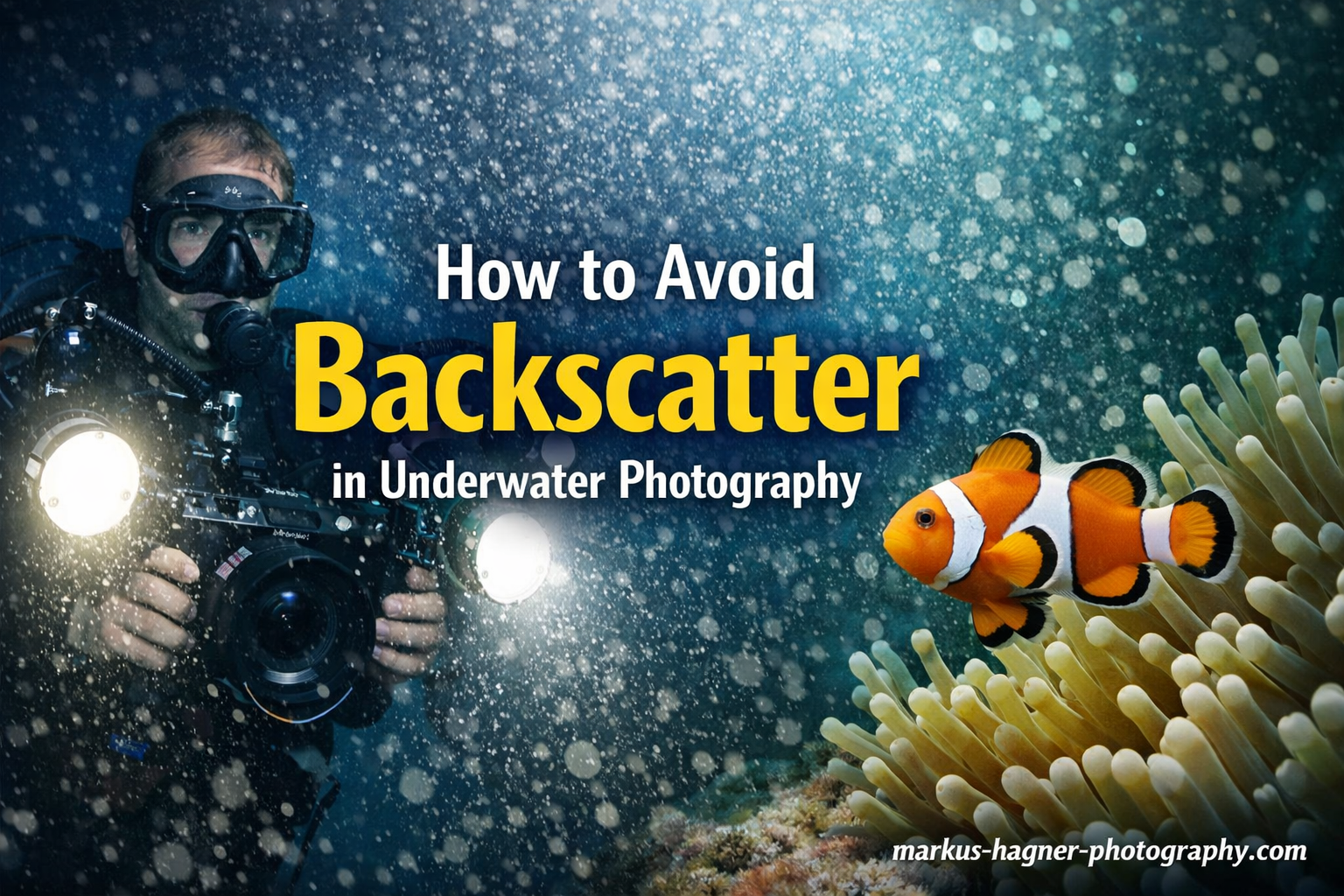
You review your underwater photos after a dive, expecting stunning images of vibrant marine life. Instead, you see white specks scattered across every shot like someone sprinkled salt on your pictures. That is backscatter, and it is the most frustrating problem in underwater photography.
The good news? Backscatter is almost entirely preventable with proper strobe placement. In this guide, I will show you exactly how to position your underwater strobes to eliminate those annoying white spots and capture clean, professional-looking images. Whether you shoot wide angle scenes or tiny macro subjects, these techniques will transform your underwater photography results.
What Is Backscatter in Underwater Photography?
Backscatter refers to the bright white specks, blobs, or spots that appear in underwater photos when light from your strobes reflects off particulate matter suspended in the water column. These particles include plankton, sand, silt, marine snow, and other debris floating between your lens and subject.
Think of it like driving through fog with your high beams on. The light hits the water droplets and bounces straight back at you, creating a wall of white. The same thing happens underwater when your strobe light illuminates particles at the same angle your lens captures them.
Backscatter ruins photos by creating visual noise that distracts from your subject. It can turn a potentially stunning reef scene into a messy collection of bright dots. Even worse, extensive backscatter means hours of tedious post-processing work to clone out each spot individually.
Strobe Positioning Fundamentals
The core principle of backscatter prevention is simple: never let your strobe light illuminate the water column directly in front of your lens. When strobes point straight ahead alongside your housing, they light up every particle between you and your subject. Your lens sees all those illuminated particles as bright spots.
Instead, you need to angle your strobes so the edge of their light beam just barely grazes your subject. This technique lights your subject while keeping the water column between you and your subject dark.
The Above-Centerline Rule
Always keep your strobes positioned above the centerline of your lens. This fundamental rule applies to both wide angle and macro photography. When strobes sit below or at the same level as your lens, they illuminate particles that float up in the water column, creating maximum backscatter.
Positioning strobes above the lens means most particles fall below the light beam, staying dark and invisible in your image.
Arm Length Setup
The standard strobe arm configuration uses two arm segments on each side: a 5-6 inch arm connecting to your housing tray, plus an 8-9 inch arm extending to the strobe. This two-joint system gives you maximum flexibility to position strobes exactly where you need them.
For wide angle work, extend both arms fully to push strobes away from your housing. For macro, you can collapse or extend arms depending on your subject distance and desired lighting effect.
Get Close to Your Subject
Subject distance matters enormously for backscatter control. Every inch of water between your lens and subject contains suspended particles. The more water column your light crosses, the more backscatter you create.
The golden rule of underwater photography applies here: get as close as possible, then get closer still. Minimizing subject distance reduces the amount of water your strobe light must penetrate, directly reducing backscatter potential.
I have found that simply getting 6 inches closer to my subject can eliminate 50% or more of visible backscatter in challenging conditions.
Quick Reference: Strobe Positioning Principles
Here is a comparison of key positioning elements for different shooting scenarios:
| Aspect | Wide Angle | Macro |
|---|---|---|
| Strobe Height | Above centerline | Above centerline |
| Horizontal Position | 9 and 3 o’clock, pulled back | Out to sides or forward |
| Strobe Angle | 45 degrees outward | Angled inward or parallel |
| Arm Extension | Full extension | Variable by subject |
| Light Cone Target | Intersect just in front of subject | Edge grazing subject |
How to Position Strobes for Wide Angle Underwater Photography In 2026?
Wide angle underwater photography presents unique backscatter challenges because you typically shoot through more water column and include larger scenes. Proper strobe placement becomes critical for clean results.
The 9 and 3 O’Clock Position
For standard wide angle shots, position your strobes at approximately the 9 o’clock and 3 o’clock positions relative to your housing. This means one strobe on the left side and one on the right, both above the centerline.
The key is pulling these strobes back behind your housing handles rather than extending them forward. When strobes sit forward of your handles, they illuminate particles directly in front of your lens, maximizing backscatter.
Angled Outward at 45 Degrees
Point your strobes outward at roughly 45-degree angles away from your housing. This positioning creates a light cone that intersects just in front of your subject rather than lighting the water column between you and your subject.
Think of your strobe beams as two flashlight beams that need to meet at your subject. The angle ensures particles closer to your lens remain unlit while your subject receives proper illumination.
Close-Focus Wide Angle Considerations
Close-focus wide angle (CFWA) shots require adjusted strobe positioning. Since your subject is extremely close to your dome port, you need strobes pulled in closer to the housing and angled more steeply outward.
A common mistake with CFWA is keeping strobes in standard wide angle position, which creates a dark center area where your subject sits. Instead, bring strobes forward slightly and increase the outward angle to ensure even coverage across your close subject.
Dome Port Specifics
When shooting with a dome port, your strobes need to illuminate the entire curved field of view. Large dome ports especially require strobes positioned wider and pulled further back to avoid lighting the water directly in front of the dome.
For fisheye lenses behind dome ports, extend your strobes to their maximum width and pull them well behind the handles. The extreme field of view means any forward-positioned strobes will light particles in the edges of your frame.
Macro Strobe Positioning for Clean Images (2026)
Macro underwater photography offers more backscatter control because you typically work with smaller subject distances and narrower fields of view. However, proper strobe positioning still matters enormously.
Side Lighting Technique
The most effective macro technique for backscatter prevention positions strobes out to the sides of your subject rather than directly facing it. This side-lighting approach illuminates your subject while leaving the water column between your lens and subject completely dark.
I position my strobes at approximately 10 o’clock and 2 o’clock for standard macro work, angled so the beam edges just reach my subject.
Angled Inward for Dramatic Effect
For more dramatic macro lighting with deeper shadows, pull your strobes forward and angle them inward toward your subject. This creates a sense of depth and dimension while still avoiding direct illumination of the water column.
The inward angle requires careful adjustment. Too much inward angle lights particles near your lens. The goal is lighting only your subject and the immediate area around it.
Black Background Techniques
Creating clean black backgrounds eliminates backscatter entirely by removing the water column from your composition. Position strobes tight to your housing and use higher strobe power with a fast shutter speed.
Shoot at an upward angle toward open water behind your subject. The strobes light only your subject, while the dark open water provides a clean backdrop with zero backscatter potential.
Using a Snoot for Backscatter Control
A snoot restricts your strobe light to a narrow beam, illuminating only your subject and nothing else in the water column. This tool provides ultimate backscatter control for macro and supermacro photography.
Snoots work especially well in poor visibility conditions where standard strobe positioning still produces visible backscatter. By restricting light to just your subject, you eliminate the possibility of lighting particles in the surrounding water.
Advanced Techniques for Challenging Conditions
Sometimes standard strobe positioning is not enough. Poor visibility, single strobe setups, and special creative effects require adapted techniques.
Single Strobe Underwater Photography
Shooting with one strobe requires different positioning but can produce excellent results with minimal backscatter. Position your single strobe above and slightly to one side of your housing, angled down toward your subject.
This top-down lighting mimics natural sunlight direction and creates a single, manageable light beam. For macro work, position the strobe directly above your subject. For wide angle, offset it to one side at roughly 11 o’clock or 1 o’clock.
Single strobe photography actually produces less backscatter potential than dual strobes because you have fewer light sources to manage. Many experienced photographers prefer the dramatic, directional look of single strobe images.
Shooting in Low Visibility
Low visibility conditions from plankton blooms, surge, or stirred-up sediment demand aggressive backscatter techniques. First, accept that some backscatter may be unavoidable and plan accordingly.
Move your strobes closer to your housing and reduce their power. Counterintuitively, narrower light coverage in poor visibility produces cleaner results than wide beams. Get extremely close to your subject, closer than you would in clear water.
Consider shooting into reef or substrate backgrounds rather than open water. Backscatter shows most obviously against dark, open water backgrounds. Against a busy reef, some backscatter becomes invisible in the texture of the background.
TTL vs Manual Strobe Mode
For backscatter control, manual mode offers advantages over TTL. In manual mode, you set a fixed strobe power and can adjust positioning without the strobe automatically compensating.
TTL mode can inadvertently increase backscatter when your camera meters for a dark subject against open water, causing strobes to fire at full power. This blasts the entire water column with light, maximizing backscatter.
I recommend learning manual strobe control for consistent backscatter management. Once you understand the relationship between power, distance, and positioning, manual mode becomes intuitive.
DIY Light Restriction Methods
You can create backscatter-reducing light modifiers from simple materials. Neoprene sleeves over your strobe edges narrow the beam angle, reducing light spill into the water column.
Some photographers use PVC pipe or cut water bottles as improvised snoots. While not as refined as commercial products, these DIY solutions effectively restrict light to your subject area.
Troubleshooting Common Backscatter Problems
When backscatter still appears despite your best efforts, diagnosing the specific pattern helps identify and fix the problem.
Reading Backscatter Patterns
Even backscatter across your entire image usually means strobes are too far forward or pointing too directly at your subject. Pull strobes back and increase the outward angle.
Backscatter concentrated on one side indicates that strobe is positioned incorrectly. Check each strobe independently and adjust the problematic one.
Backscatter only in the corners typically occurs with wide angle lenses when strobes are not pulled back far enough. Extend arms further behind your handles.
Heavy backscatter despite correct positioning suggests visibility is too poor for your current technique. Move strobes closer, reduce power, or switch to macro subjects.
Pre-Dive Positioning Checklist
Before entering the water, verify your strobe setup:
1. Both strobes positioned above the centerline
2. Arms extended appropriately for your planned shot type
3. Strobes angled outward, not pointing straight ahead
4. All clamps tightened securely
5. Batteries fresh and strobes firing properly
Frequently Asked Questions
What is backscatter in underwater photography?
Backscatter in underwater photography refers to the bright white specks or blobs that appear in photos when light from your strobes reflects off particulate matter suspended in the water. These particles include plankton, sand, silt, and marine snow, appearing as distracting bright spots when illuminated from the same angle as your lens captures them.
What causes backscatter in underwater photos?
Backscatter is caused when your strobe light reflects off particles in the water directly back into your lens. This happens when the angle of illumination is too close to the angle of view. The water column between your lens and subject contains countless microscopic particles, and when strobes are positioned near or parallel to your lens axis, these particles light up and appear as bright spots in your image.
How do you position strobes to avoid backscatter?
To position strobes and avoid backscatter: 1) Keep strobes above the centerline of your lens, 2) Pull strobes back behind your housing handles, 3) Angle strobes outward so the light cones intersect just in front of your subject, 4) Use appropriate arm lengths (5-6 inch housing arm plus 8-9 inch strobe arm), 5) Get as close as possible to your subject to minimize the water column between you.
What is the best strobe position for wide angle underwater photography?
For wide angle underwater photography, position your strobes at approximately 9 and 3 o’clock positions above the housing centerline, pulled back behind the handles, and angled outward at roughly 45 degrees. This creates a light cone that illuminates your subject while minimizing light that hits particles in the water column between your lens and subject.
How do you position strobes for macro underwater photography?
For macro underwater photography, position your strobes out to the sides of your subject rather than directly facing it. This side-lighting approach illuminates your subject while leaving the water column between lens and subject dark. You can also pull strobes forward and angle them inward toward the subject for more dramatic lighting with shadows.
How can I reduce backscatter in low visibility?
To reduce backscatter in low visibility: 1) Get extremely close to your subject, 2) Move strobes closer to the housing and reduce power, 3) Shoot into backgrounds like reef or substrate rather than open water, 4) Consider using a snoot to restrict light to only your subject, 5) Use shallow depth of field to blur out-of-focus particles, 6) Consider macro subjects instead of wide angle in poor conditions.
How far apart should underwater strobes be?
Underwater strobes should be positioned using a two-arm system on each side: a 5-6 inch arm connecting to the housing, plus an 8-9 inch arm connecting to the strobe. This gives maximum flexibility. For wide angle, extend arms fully and position strobes wide apart. For macro, bring them closer depending on your subject distance.
Can you use a single strobe for underwater photography?
Yes, single strobe underwater photography works well and can even produce less backscatter than dual strobes. Position the strobe above and slightly to one side of your housing for a natural top-down lighting effect. For macro, place the strobe directly over the subject. Single strobe creates dramatic, directional lighting that adds depth to your images.
Final Thoughts on Backscatter Prevention
Mastering underwater photography strobe placement takes practice, but the fundamentals remain consistent. Keep your strobes above the centerline, angle them outward so only the beam edge lights your subject, and get as close as possible to minimize water column. Whether you shoot wide angle reef scenes or tiny macro subjects, these principles will dramatically reduce backscatter in your underwater photography.
Remember that water conditions vary tremendously. What works in crystal-clear tropical water may need adjustment in plankton-rich temperate seas. The key is understanding why each positioning technique works, then adapting to your specific conditions. With practice, clean backscatter-free images become your standard result rather than a lucky exception.