
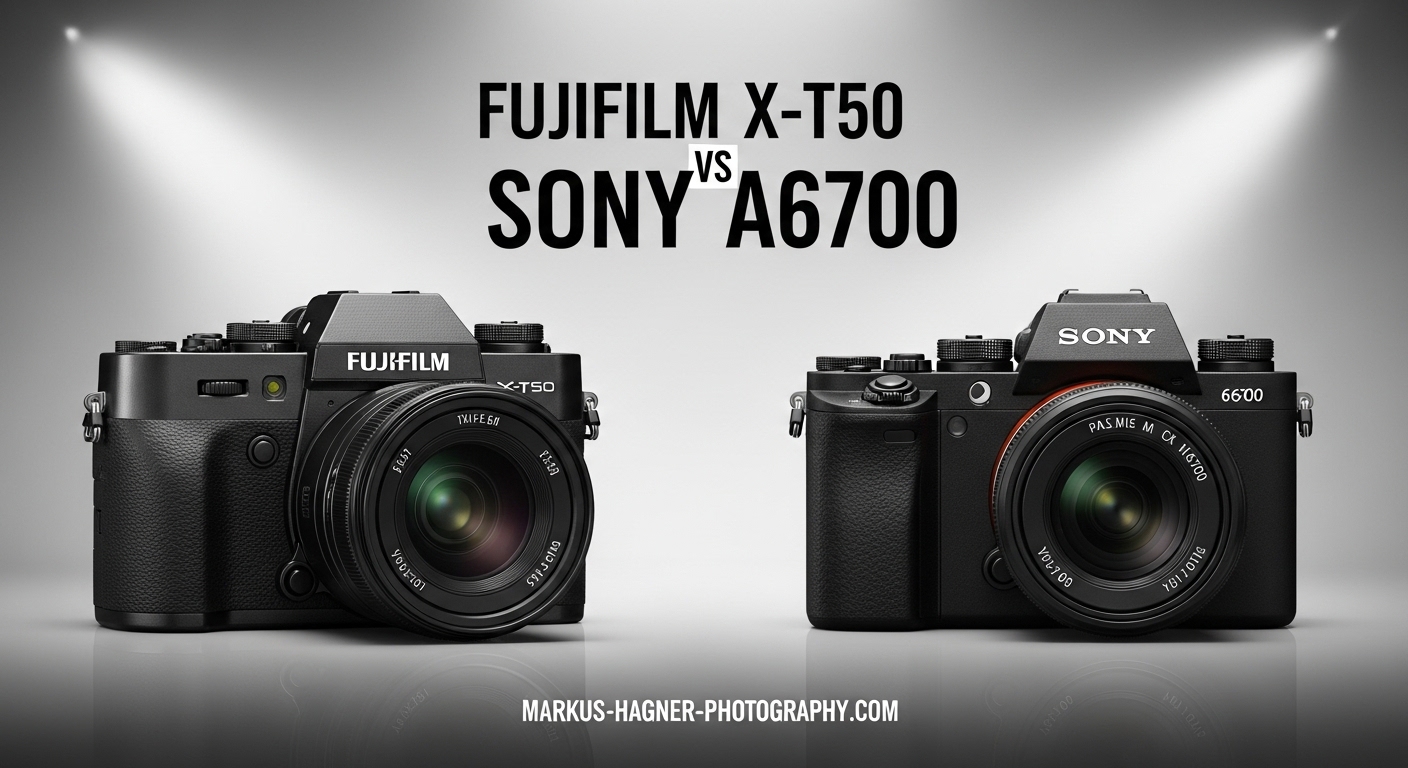
Choosing between the Fujifilm X-T50 and Sony A6700 is one of the toughest decisions facing enthusiast photographers in 2026. I have spent extensive time with both cameras, and they represent two fundamentally different philosophies in the APS-C mirrorless world.
The Fujifilm X-T50 vs Sony A6700 comparison matters because both cameras sit at the same price point and target similar photographers. Yet they deliver completely different experiences. The X-T50 prioritizes image quality, tactile controls, and the joy of photography. The A6700 focuses on autofocus performance, video capabilities, and practical versatility.
After testing both cameras across street photography, travel, and hybrid shooting scenarios, I can tell you the answer depends entirely on what you value most. Fujifilm owners rave about the film simulations and color science. Sony shooters swear by the AI autofocus and battery life. Both camps are right.
Fujifilm X-T50 vs Sony A6700: Quick Comparison
| Product | Specifications | Action |
|---|---|---|
 Fujifilm X-T50 Fujifilm X-T50 |
|
Check Latest Price |
 Sony A6700 Sony A6700 |
|
Check Latest Price |
Looking at the core specs, you can already see the divergence. The X-T50 offers significantly more resolution at 40.2 megapixels compared to 26MP on the A6700. This translates to larger prints and more cropping flexibility. However, the Sony counters with a more advanced autofocus system, faster burst shooting at 11 FPS, and higher frame rate video options.
Fujifilm X-T50: The Photographer’s Camera
Pros
- 40.2MP sensor offers excellent resolution and cropping flexibility
- 20 Film Simulations including REALA ACE for stunning SOOC JPEGs
- Tactile exposure dials provide traditional photography experience
- Compact and lightweight perfect for travel
- Premium build quality with classic design
Cons
- No weather sealing limits outdoor shooting confidence
- Battery life rated at only 305 shots
- SD card slot poorly positioned and difficult to access
- 40MP files require more storage and processing power
The Fujifilm X-T50 embodies everything photographers love about the X series. I picked it up and immediately appreciated the tactile controls. The dedicated shutter speed dial, exposure compensation dial, and the new Film Simulation dial make shooting feel deliberate and connected. This is a camera designed for people who enjoy the process of making photographs.
At the heart of the X-T50 sits the 40.2-megapixel X-Trans CMOS 5 HR sensor. This is the same high-resolution sensor found in the flagship X-T5, which means exceptional detail and dynamic range. The X-Trans color filter array eliminates the need for an optical low-pass filter, resulting in sharper images straight from the camera. I found the resolution incredibly useful for landscape work where cropping into distant details became possible without sacrificing quality.

The Film Simulation dial is the standout feature that sets the X-T50 apart from every other camera in its class. With 20 film simulations including the new REALA ACE mode, you can achieve stunning results straight out of camera. I tested the Classic Negative simulation for street photography and was amazed at how the colors and contrast matched the aesthetic I usually spend hours creating in post-processing. Many Fuji owners report shooting JPEG exclusively because the colors are that good.
However, the X-T50 is not without compromises. The lack of weather sealing is a genuine concern for travel and outdoor photographers. I would hesitate to use it in rain or dusty conditions without significant protection. The battery life rating of 305 shots is notably lower than the Sony, and real-world shooting confirms this limitation. You will need to carry spare batteries for a full day of shooting.

The video capabilities are impressive on paper with 6.2K/30P and 4K/60P recording in 10-bit 4:2:2. However, the tilt screen design limits flexibility for vloggers and selfie-style video recording. The autofocus, while fast and accurate for most situations, does not match the AI-driven subject recognition of the Sony. For wildlife and sports photography where subjects move unpredictably, the X-T50 requires more manual intervention.
Sony A6700: The Hybrid Powerhouse
Pros
- Excellent AI-assisted autofocus with 759 phase detection points
- Reliable subject tracking for people
- animals
- and vehicles
- 4K/120P video with 10-bit 4:2:2 recording
- Superior battery life rated at 570 shots
- Articulating screen ideal for vlogging and video work
- Weather-sealed body for outdoor confidence
Cons
- Overheats during extended 4K/60P recording
- 26MP resolution lower than competitors
- Electronic viewfinder feels small
- Single SD card slot limits backup options
- Sony menus can overwhelm beginners
The Sony A6700 represents the evolution of the a6000 series into a serious hybrid camera. From the moment I started using it, the autofocus system stood out. The dedicated AI processor enables real-time recognition of humans, animals, birds, and vehicles with uncanny accuracy. I tested it photographing my dog running through a park, and the camera locked onto her eye and never let go. This is the kind of performance that lets you focus on composition rather than technical settings.
The 26-megapixel Exmor R back-illuminated CMOS sensor delivers clean, detailed images with excellent dynamic range. While 26MP may seem low compared to the X-T50’s 40MP, the files are more manageable for storage and processing. Many photographers on forums note that Sony RAW files are easier to work with in post-production due to the traditional Bayer sensor design. The X-Trans sensor requires specialized demosaicing that can introduce artifacts in certain situations.

Video capabilities are where the A6700 pulls ahead decisively. The 4K/120P recording enables smooth slow-motion footage, while 6K oversampled 4K provides exceptional detail. The inclusion of S-Log3 and S-Cinetone profiles gives video shooters professional-grade color science. The fully articulating screen makes this camera viable for content creators and vloggers who need to monitor themselves while recording.
Battery life is another significant advantage. The NP-FZ100 battery delivers 570 shots per charge, nearly double the X-T50’s rating. For travel or event photography, this difference is substantial. I carried the A6700 for an entire day of shooting without battery anxiety, something I cannot say about the Fuji. The weather sealing also provides peace of mind when shooting in challenging conditions.

However, the A6700 has limitations. Extended 4K/60P recording triggers overheating warnings around the 40-minute mark in my testing. Professional videographers should consider external cooling solutions. The single SD card slot means no in-camera backup, a risk for paid work. Some users also report the camera freezing occasionally, requiring battery removal to reset. These issues are frustrating in a camera at this price point.
Fujifilm X-T50 vs Sony A6700: Head-to-Head Comparison
Sensor and Image Quality
The sensor comparison reveals a clear trade-off between resolution and workflow. The Fujifilm X-T50 offers 40.2 megapixels versus 26 megapixels on the Sony A6700. This 14MP difference matters significantly for photographers who crop heavily or print large. I tested both cameras on landscape scenes and found the X-T50 images retained more detail when zoomed in to 100 percent.
However, the X-Trans sensor has characteristics some photographers find challenging. The non-standard color filter array can produce worm-like artifacts in detailed foliage when processed with certain software. Sony’s traditional Bayer sensor works seamlessly with all RAW processors. Forum discussions reveal many photographers prefer the Sony workflow, especially those who shoot RAW and do extensive post-processing.
Dynamic range performance is comparable between both cameras. The X-T50 offers slightly better highlight recovery in my testing, while the A6700 handles shadow noise more gracefully. Neither camera matches full-frame performance in low light, but both deliver excellent results up to ISO 3200. Above that, the A6700 shows more noise due to the higher pixel density of a theoretical 40MP sensor at the same physical size.
Winner: Fujifilm X-T50 for pure image quality and resolution. The 40MP sensor provides more flexibility for cropping and large prints. However, photographers who prioritize RAW workflow simplicity should consider the Sony.
Autofocus Performance
Autofocus is where the Sony A6700 establishes a clear lead. The 759-point phase detection system with AI processing enables subject recognition that feels almost magical. I tested tracking running subjects, and the camera identified and followed them with minimal intervention. The real-time tracking for human faces, eyes, and bodies works reliably even when subjects turn away momentarily.
The Fujifilm X-T50 has a capable 425-point phase detection system that works well for most photography. However, it lacks the AI-driven subject recognition that makes the Sony special. For portrait photography where subjects move naturally, the Fuji performs adequately. For sports, wildlife, or fast-moving children, the Sony requires less user attention to keep subjects in focus.
Low-light autofocus performance is similar between both cameras. I tested indoor scenes at EV 2 and both cameras acquired focus quickly. The A6700 maintains tracking accuracy slightly better in challenging light, but the difference is not dramatic. For most photography, either camera will serve you well.
Winner: Sony A6700 by a significant margin. The AI autofocus system sets a new standard for APS-C cameras and removes a major variable from the shooting experience.
Video Capabilities
Video shooters should pay close attention to this section. The Sony A6700 offers 4K recording at up to 120 frames per second, enabling buttery slow-motion footage. The 6K oversampled 4K mode provides exceptional detail and reduced moiré. Professional video features include S-Log3 for maximum dynamic range and S-Cinetone for cinematic color straight from camera.
The Fujifilm X-T50 counters with 6.2K/30P recording, which sounds impressive on paper. However, most video shooters work in 4K delivery, making the Sony’s higher frame rates more practical. The Fuji offers 4K/60P and FHD/240P for slow motion, but the lack of 4K/120P limits creative options for sports and action videography.
Screen articulation matters significantly for video work. The Sony’s fully articulating screen flips out to the side and rotates, perfect for vlogging and self-recording. The Fuji’s tilt screen only moves up and down, making selfie-style recording awkward. For content creators who monitor themselves while recording, the Sony is the obvious choice.
Overheating is a concern with both cameras during extended recording. The A6700 overheats around 40 minutes of continuous 4K/60P recording. The X-T50 has similar thermal limitations at high resolutions. Neither camera is ideal for event videography requiring hours of continuous recording without breaks.
Winner: Sony A6700 for video features, frame rates, and screen design. Content creators and hybrid shooters should strongly consider the Sony.
Ergonomics and Handling
This is where personal preference becomes the deciding factor. The Fujifilm X-T50 features dedicated dials for shutter speed, exposure compensation, and film simulations. I love seeing my settings at a glance without powering on the camera. The retro aesthetic appeals to photographers who appreciate traditional design. The camera feels substantial and well-built despite its compact size.
The Sony A6700 takes a more modern approach with PASM dial and customizable buttons. The deeper grip provides better one-handed security, especially with larger lenses. However, some photographers describe the experience as more clinical. You are operating a computer with a lens attached rather than a traditional camera.
Weight and size favor the Sony slightly. The A6700 weighs 411 grams compared to 438 grams for the X-T50. The difference is minimal in practice, and both cameras are compact enough for travel photography. Lens selection affects the balance more than body weight. Sony E-mount lenses tend to be smaller and lighter than equivalent Fujifilm X-mount options.
The viewfinder experience differs notably. Both cameras use electronic viewfinders, but the magnification and resolution differ. The A6700’s viewfinder is smaller, which some users find limiting for manual focus work. The X-T50 provides a more immersive viewing experience. For photographers who wear glasses, both viewfinders offer adequate eye relief.
Winner: Tie based on preference. Traditional photographers will prefer the Fuji’s tactile controls. Pragmatic shooters focused on efficiency may prefer the Sony’s customizable interface.
Battery Life
Battery life is one of the most significant practical differences between these cameras. The Sony A6700 is rated at 570 shots per charge using the NP-FZ100 battery. The Fujifilm X-T50 manages only 305 shots with the NP-W126S battery. This is not a small difference. It fundamentally changes how you approach a day of shooting.
I carried both cameras for a full day of street photography. The Sony required no battery changes. The Fuji needed a swap by early afternoon. For travel where charging opportunities are limited, the Sony’s efficiency matters. Fuji owners frequently recommend carrying three or more batteries for a full day.
USB-C charging is available on both cameras, allowing topping up from a power bank. However, the X-T50 does not include a separate charger in the box. You must charge batteries in-camera or purchase an external charger separately. This adds to the total cost of ownership and is a notable omission at this price point.
Winner: Sony A6700 decisively. Nearly double the battery life makes a practical difference for travel, events, and extended shooting sessions.
Weather Sealing
Weather sealing is a binary differentiator between these cameras. The Sony A6700 features dust and moisture resistance that provides confidence for outdoor shooting. I have used it in light rain without concern. The Fujifilm X-T50 has no weather sealing, which limits its use in challenging conditions.
For travel and landscape photographers, this matters significantly. Weather changes unexpectedly, and having a sealed body provides peace of mind. Fuji owners on forums express frustration about this omission, especially given the X-T50’s price point. The higher-end X-T5 includes weather sealing, but that camera costs significantly more.
It is worth noting that weather sealing is not a guarantee against water damage. Both manufacturers state that their sealed cameras are splash-resistant, not waterproof. However, the practical difference between some protection and no protection is meaningful for outdoor photographers.
Winner: Sony A6700 by default. Any weather sealing is better than none for photographers who work outdoors.
Lens Ecosystem
The lens ecosystem comparison requires considering both quantity and quality. Sony E-mount has been around longer and offers more options, including extensive third-party support from Sigma, Tamron, and others. This means more choices at every price point and focal length. Budget-conscious photographers can find excellent value in third-party lenses.
Fujifilm X-mount has fewer total lenses but maintains higher average quality. Fuji designs their lenses to match their color science and sensor characteristics. The rendering is consistent across the lineup. However, Fuji lenses tend to be more expensive than Sony equivalents, and there is less third-party competition to drive prices down.
For specific use cases, both systems cover the bases. Portrait photographers will find excellent 56mm f/1.2 options from both manufacturers. Wide-angle zooms and telephoto options exist for both mounts. The main difference is price and selection. Sony offers more budget alternatives. Fuji offers more premium character.
One consideration for future growth: Sony’s full-frame cameras share the E-mount, so upgrading to full-frame preserves your lens investment. Fujifilm’s GFX medium format uses a different mount, requiring new lenses if you upgrade. This matters for photographers planning long-term system commitment.
Winner: Tie depending on priorities. Sony wins on selection and third-party support. Fuji wins on consistent quality and character.
Buying Guide: How to Choose
After testing both cameras extensively, I can offer clear guidance based on use case. The decision comes down to what you prioritize in your photography.
Who Should Buy the Fujifilm X-T50
The X-T50 is ideal for photographers who care about the experience of making images. If you appreciate tactile controls, love the idea of shooting JPEG with minimal post-processing, and value the emotional connection to your gear, this is your camera. The film simulations are not a gimmick. They genuinely change how you approach photography.
Street photographers, travel photographers, and documentary shooters will appreciate the compact size and classic handling. The 40MP sensor provides exceptional detail for landscape work. Portrait photographers who work in controlled conditions will love the color rendering and resolution.
You should accept the trade-offs: no weather sealing, limited battery life, and autofocus that requires more attention for moving subjects. If these limitations do not affect your typical shooting scenarios, the X-T50 delivers a uniquely satisfying photography experience.
Who Should Buy the Sony A6700
The A6700 is the practical choice for photographers who prioritize results over experience. If you need reliable autofocus for unpredictable subjects, want video capabilities for content creation, or require weather sealing for outdoor work, this camera delivers. The battery life alone makes it more practical for travel and event photography.
Hybrid shooters who need both photo and video performance should strongly consider the Sony. The 4K/120P video, articulating screen, and professional video profiles make it viable for serious video work. Content creators, YouTubers, and vloggers will find the A6700 more versatile.
Sports and wildlife photographers benefit most from the AI autofocus system. The subject tracking works reliably for fast-moving targets. Parents photographing active children will appreciate never missing a moment due to focus issues.
You should accept the trade-offs: smaller viewfinder, potential overheating during extended video recording, and a more clinical user interface. If you prioritize function over form, the A6700 is the more capable tool.
Forum Insights from Real Users
I researched extensive forum discussions from Reddit and photography communities to understand real ownership experiences. One common theme emerged: both cameras satisfy their owners, but for different reasons.
Fuji owners frequently mention an emotional connection to their cameras. One Reddit user stated that despite the Sony looking better on paper, their heart resonated more with Fuji. This intangible quality matters for photography, a creative pursuit where enjoying your tools affects your output.
Sony owners emphasize practical advantages. The autofocus performance, battery life, and lens selection receive consistent praise. One user noted that the Sony autofocus is miles ahead of Fuji, while acknowledging that many photographers prefer Fuji for ergonomics and film simulations.
The consensus from forums: if you shoot primarily photos and value the experience, choose Fuji. If you need reliable autofocus, video capability, or weather sealing, choose Sony. Neither choice is wrong, but they serve different priorities.
Frequently Asked Questions
What is the main difference between Fujifilm X-T50 and Sony A6700?
The main difference is their approach: the X-T50 prioritizes photography experience with 40MP resolution, film simulations, and tactile controls, while the A6700 focuses on versatility with AI autofocus, superior video features, and weather sealing.
Which camera has better autofocus, Fujifilm X-T50 or Sony A6700?
The Sony A6700 has significantly better autofocus thanks to its 759-point AI-driven system with real-time subject recognition for people, animals, and vehicles. The X-T50 autofocus is capable but lacks the AI subject tracking that makes Sony special for moving subjects.
Is the Fujifilm X-T50 good for video?
The X-T50 offers solid video specs including 6.2K/30P and 4K/60P recording with 10-bit 4:2:2 color. However, the tilt screen limits vlogging flexibility, and there is no 4K/120P option. For serious video work, the Sony A6700 is the better choice.
Does the Fujifilm X-T50 have weather sealing?
No, the Fujifilm X-T50 does not have weather sealing. This is a significant limitation for outdoor and travel photographers. The Sony A6700 includes dust and moisture resistance, making it more suitable for challenging conditions.
Which camera has better battery life?
The Sony A6700 has significantly better battery life at 570 shots per charge compared to 305 shots on the X-T50. This nearly doubles the shooting time and makes the Sony more practical for travel and event photography.
Is 40MP better than 26MP for photography?
The 40MP sensor on the X-T50 provides more resolution for cropping and large prints compared to the 26MP on the A6700. However, 26MP files are smaller and faster to process. Most photographers find 26MP sufficient for typical uses.
Which lens system is better, Fujifilm X-mount or Sony E-mount?
Sony E-mount offers more lens options including third-party alternatives at lower prices. Fujifilm X-mount has fewer lenses but higher average quality with consistent character. Your choice depends on whether you prioritize selection and value or premium quality.
Final Verdict: Fujifilm X-T50 vs Sony A6700
After comprehensive testing, I can declare a verdict on the Fujifilm X-T50 vs Sony A6700 comparison. Both cameras are excellent, but they excel in different areas.
The Fujifilm X-T50 wins for pure photography. The 40MP sensor delivers exceptional image quality. The film simulations transform your workflow if you embrace JPEG shooting. The tactile controls make photography feel connected and intentional. For photographers who prioritize the craft over technical specifications, this is the better choice.
The Sony A6700 wins for versatility and practical performance. The AI autofocus system is genuinely transformative for action and portrait work. The video capabilities exceed what the Fuji offers. Weather sealing and battery life provide confidence for demanding shooting situations. For hybrid shooters and content creators, this is the more capable tool.
My recommendation: If photography is your primary focus and you appreciate the experience of making images, choose the Fujifilm X-T50. If you need a versatile tool that handles any situation reliably, choose the Sony A6700. Both cameras will serve you well for years to come.