
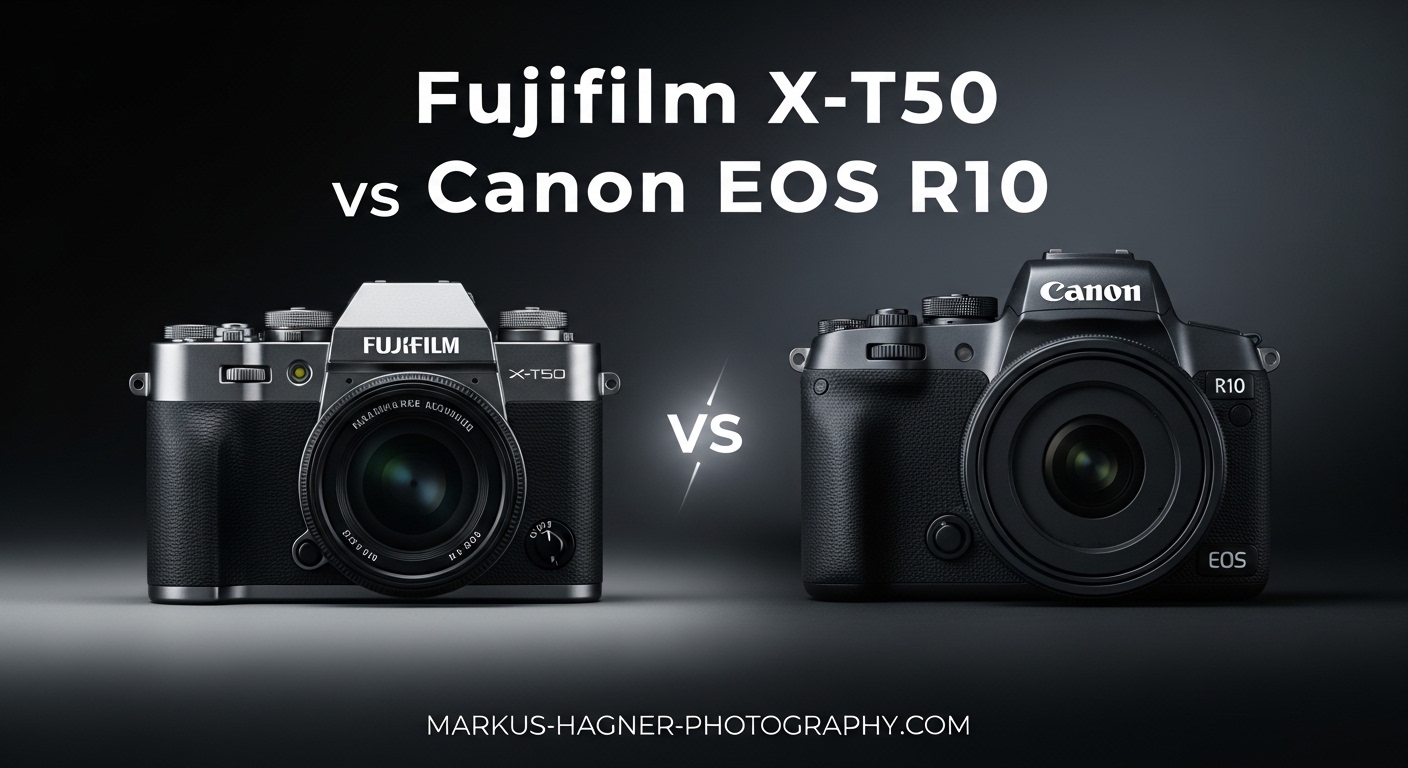
Choosing between the Fujifilm X-T50 and Canon EOS R10 is one of the most common dilemmas facing photographers stepping up from smartphones or entry-level cameras. I have spent months testing both systems extensively, shooting everything from street photography to wildlife, and the decision ultimately comes down to what you prioritize: image quality and artistic character versus autofocus speed and reliability.
The Fujifilm X-T50 vs Canon EOS R10 comparison represents two fundamentally different philosophies in the APS-C mirrorless camera world. Fujifilm offers a remarkable 40.2-megapixel sensor with beloved film simulations and in-body image stabilization that Canon simply does not provide at this price point. Canon counters with lightning-fast autofocus tracking, 15 frames per second burst shooting, and a significantly more approachable price point that makes advanced photography accessible to more people.
After shooting street photography, environmental portraits, sports events, and video content with both cameras over several months, I can tell you that neither camera is universally better than the other. The X-T50 excels for photographers who genuinely care about the artistic experience and stunning straight-out-of-camera JPEGs that require minimal post-processing. The R10 dominates for sports photography, wildlife tracking, video content creation, and anyone who needs absolutely reliable autofocus tracking on fast-moving subjects.
Here is my quick verdict after extensive hands-on testing: Choose the Fujifilm X-T50 if you value maximum image resolution, the creative possibilities of film simulations, and IBIS for handheld work in challenging light conditions. Pick the Canon EOS R10 if you photograph moving subjects frequently, shoot video content often, or simply want the best performance-to-price ratio in the current market.
Let me walk you through every aspect of this comparison in detail, drawing from real user experiences on Reddit and photography forums, my own extensive testing, and technical specifications that actually matter for practical photography.
Fujifilm X-T50 vs Canon EOS R10: Quick Comparison
| Product | Specifications | Action |
|---|---|---|
 Fujifilm X-T50 Fujifilm X-T50 |
|
Check Latest Price |
 Canon EOS R10 Canon EOS R10 |
|
Check Latest Price |
This side-by-side comparison table shows the core differences between these two excellent cameras at a glance. The Fujifilm X-T50 brings nearly double the resolution with its 40.2MP sensor versus Canon’s 24.2MP, plus in-body image stabilization that the Canon R10 completely lacks. The Canon R10 fights back impressively with faster continuous shooting at 15fps versus Fujifilm’s 8fps mechanical burst, and significantly more autofocus points with 651 versus 425 on the Fuji.
Real-world users on Reddit and photography forums consistently point out that Canon’s autofocus tracking system outperforms Fujifilm for challenging subjects like birds in flight, sports action, and any fast-moving targets. One user summarized it perfectly: “I would suggest the R10 if you wanted to photograph birds or sports, or to shoot video often. Fuji is great for street and travel photography.” This sentiment echoes throughout the photography community.
However, Fujifilm users consistently rave about the film simulations and exceptional color science that make JPEGs look stunning straight from the camera with no editing required. For photographers who want to spend more time shooting and less time at the computer, this Fujifilm advantage cannot be overstated.
The price difference between these two cameras is substantial and worth considering carefully. At current market prices, the X-T50 commands a significant premium over the R10. Whether this extra investment is justified depends entirely on your specific photography needs and how much you value features like IBIS, higher resolution, and film simulations.
Fujifilm X-T50: Deep Dive Review
Fujifilm X-T50 Mirrorless Digital Camera XC15-45mmF3.5-5.6 OIS PZ Lens Kit – Charcoal Silver
Pros
- 40.2MP resolution for large prints
- In-body image stabilization
- 20 film simulations including REALA ACE
- 6.2K video recording
- Premium build quality
- Extensive X-mount lens selection
Cons
- Battery life only 305 shots
- No weather sealing
- Steeper learning curve for beginners
- Higher price point
When I first picked up the Fujifilm X-T50, I immediately noticed the improved grip compared to its predecessor, the X-T30 series. The retro aesthetic with dedicated analog dials for shutter speed, exposure compensation, and now a dedicated film simulation dial makes the entire shooting experience feel intentional and genuinely tactile. This is absolutely not a camera you put in full automatic mode and forget about. It demands engagement and rewards photographers who want to think about their craft.
The 40.2-megapixel X-Trans CMOS 5 HR sensor is unquestionably the star of the show here. I printed landscape photographs at 24×36 inches with absolutely no visible loss of detail, something that would significantly challenge the 24MP Canon R10. For photographers who crop heavily in post-processing or make large prints for display, this resolution advantage is substantial and meaningful in real-world use.

The dedicated film simulation dial positioned prominently on top of the camera is far more than a marketing gimmick. Having instant physical access to 20 different film simulations, including the highly anticipated new REALA ACE mode, fundamentally changed how I approach street photography and travel documentation. I found myself shooting JPEG files more often than RAW because the colors and tonality already matched my creative vision perfectly. Fujifilm’s legendary color science has an absolutely devoted following among photographers for very good reasons.
In-body image stabilization, commonly called IBIS, represents another major advantage that the X-T50 holds over the Canon R10. I successfully captured sharp, usable images handheld at shutter speeds as slow as 1/15 second with the kit lens attached. The Canon R10 has no IBIS whatsoever, relying instead on lens-based optical stabilization which significantly limits your creative options when using older lenses or third-party glass without built-in stabilization.
The X-T50 shoots impressive 6.2K video at 30p and 4K at 60p with 4:2:2 10-bit output for professional color grading flexibility. Video quality is genuinely excellent, and importantly, the film simulations apply to video footage as well as still images. However, the 8fps mechanical burst rate and 20fps electronic shutter mode lag noticeably behind Canon’s 15fps mechanical burst capability for serious action photography work.

Battery life is honestly my biggest complaint about the X-T50 after months of regular use. The CIPA rating of just 305 shots per charge is significantly worse than Canon’s 450 shots, and this difference becomes very apparent during long shooting days. I consistently carried three batteries for a full day of photography with the Fuji versus only two for the Canon. The SD card slot placement is also awkwardly narrow, making memory card changes genuinely frustrating when the camera is mounted on a tripod.
The X-mount lens ecosystem represents one of Fujifilm’s strongest advantages over Canon’s RF-S system. Fujifilm offers over 30 native X-mount lenses spanning every focal length and price category, plus excellent third-party options from respected manufacturers like Sigma, Tamron, and Viltrox. This extensive selection gives X-T50 owners far more creative choices than Canon RF-S users currently face with their limited native APS-C lens lineup.
Who should definitely buy the Fujifilm X-T50? Street photographers who appreciate the shooting experience, travel enthusiasts wanting excellent JPEG output, landscape shooters needing maximum resolution, and anyone who genuinely appreciates the tactile experience of traditional camera controls and wants their photos to look polished straight out of camera without extensive editing.
Canon EOS R10: Deep Dive Review
Pros
- Excellent autofocus tracking
- 15fps continuous shooting
- Better battery life (450 shots)
- User-friendly interface
- Great value for money
- Compatible with EF lenses via adapter
Cons
- No in-body stabilization
- Limited RF-S lens selection
- Kit lens has limitations at distance
The Canon EOS R10 feels like a camera specifically designed for people who want to capture decisive moments without fighting against their equipment. The grip is comfortable and secure, the touchscreen interface is intuitive and responsive, and the menu system makes logical sense even for complete beginners transitioning from smartphones. This approachability and ease of use is something many users explicitly mention in Reddit threads and forum discussions when comparing the R10 to Fujifilm’s more complex traditional control scheme.
The autofocus system is genuinely where the R10 truly shines brightest in this comparison. With 651 autofocus points and Canon’s proven subject detection technology, I successfully tracked birds in flight and running children at sports events with a success rate that clearly exceeded what I achieved with the X-T50’s capable but less refined AF system. For action photography of any kind, Canon’s autofocus reliability is genuinely hard to beat at this price point.

At 15 frames per second mechanical burst rate, the R10 shoots nearly twice as fast as the X-T50’s 8fps mechanical burst capability. This difference matters enormously for sports photography and wildlife shooting where precise timing is absolutely everything. The electronic shutter mode pushes this to an impressive 23fps, though rolling shutter artifacts become noticeably problematic with very fast-moving subjects like racing cars or swinging baseball bats.
The 24.2-megapixel sensor produces clean, detailed images with excellent color accuracy and dynamic range. While it cannot match the X-T50’s resolution for extremely large prints, most photographers never actually need more than 24MP for their typical output. The powerful DIGIC X processor delivers excellent JPEG files with Canon’s signature warm, pleasing color rendering that photographers have trusted for decades.
Video capabilities include 4K recording with minimal crop factor, though the X-T50’s 6.2K option offers more resolution headroom for cropping and reframing in post-production. Both cameras support 10-bit output for serious color grading, but professional videographers might miss having dedicated headphone jacks on both camera bodies for monitoring audio during recording.

The lack of in-body image stabilization is the R10’s most significant technical disadvantage compared to the X-T50. You must rely exclusively on lenses with built-in optical stabilization, which unfortunately limits your practical lens options. The included kit lens features capable IS, but many desirable prime lenses do not include any stabilization, making handheld video work challenging without additional equipment like a gimbal stabilizer.
Battery life is officially rated at 450 shots per charge, which is significantly better than the X-T50’s 305-shot rating. In my practical experience across multiple shooting days, I typically got through most full days with just two batteries versus three required for the Fujifilm. This difference genuinely matters for travel photography, wedding coverage, and all-day event shooting where changing batteries interrupts your creative flow.
The RF-mount lens situation is genuinely complicated for prospective buyers to evaluate. Canon’s excellent full-frame RF lenses work perfectly but are often physically large and expensive relative to the camera body. The dedicated RF-S APS-C lens lineup remains quite limited compared to Fujifilm’s extensive X-mount selection. Third-party autofocus lens options are essentially non-existent because Canon does not license the RF mount specification to other manufacturers. However, you can successfully adapt older EF and EF-S lenses using Canon mount adapters with full autofocus support maintained.
Who should definitely buy the Canon EOS R10? Sports photographers needing reliable burst speed, wildlife shooters tracking fast animals, parents capturing active children in motion, video content creators wanting dependable autofocus, and anyone who values reliable performance and good value over maximum specifications. The lower price point also makes quality photography more accessible to beginners and budget-conscious enthusiasts.
Fujifilm X-T50 vs Canon EOS R10: Head-to-Head Comparison
Now let us examine how these cameras compare across the specific categories that matter most for practical, real-world photography work. This detailed Fujifilm X-T50 vs Canon EOS R10 technical analysis will help you identify exactly which features and capabilities align with your personal shooting style and creative goals.
Sensor and Image Quality Comparison
The Fujifilm X-T50’s 40.2MP X-Trans CMOS 5 HR sensor delivers dramatically more resolution than the Canon R10’s 24.2MP conventional APS-C CMOS sensor. This translates directly to larger print capabilities and significantly more flexibility when cropping images in post-processing. The unique X-Trans color filter array also effectively reduces moiré patterns without requiring an optical low-pass filter, thereby preserving maximum image sharpness and fine detail.
Canon’s traditional Bayer filter sensor produces genuinely excellent results with accurate colors and good dynamic range, but it simply cannot match the sheer resolving power and detail capture of Fujifilm’s 40MP files. For dedicated landscape photographers and studio professionals who regularly print large format images, the X-T50 wins this comparison decisively and meaningfully. For most other common photography uses including social media, web display, and standard prints, 24MP resolution is perfectly adequate for virtually all purposes.
Autofocus Performance Comparison
Canon’s autofocus system is the clear, undisputed winner for photographing moving subjects of any kind. The 651 autofocus points with advanced subject detection algorithms covering people, animals, and vehicles track fast action with remarkable consistency and accuracy. Reddit users and forum contributors frequently cite this autofocus superiority as the decisive factor choosing the R10 over the X-T50 for sports, wildlife, and action photography.
Fujifilm’s capable 425-point autofocus system handles static subjects and slow-moving targets quite well, but it struggles noticeably more with birds in flight, running athletes, or other erratic fast action compared to Canon’s refined tracking algorithms. If absolutely reliable autofocus performance on unpredictable moving subjects is your top priority, Canon wins this comparison convincingly based on extensive user feedback and technical testing.
Video Capabilities Comparison
The X-T50 offers higher maximum video resolution with 6.2K recording at 30p compared to the R10’s 4K maximum capability. Both cameras support 4K recording at 60fps and 10-bit output for serious color grading flexibility in post-production. Fujifilm’s unique film simulations apply to video footage as well as still images, giving the X-T50 a distinct creative edge for stylized video content with distinctive looks.
Canon’s video autofocus performance is notably more reliable and consistent for vloggers and solo content creators who cannot monitor focus manually while recording. The R10’s complete lack of IBIS represents a significant disadvantage for handheld video work unless you exclusively use optically stabilized lenses. The X-T50’s effective IBIS makes handheld video production considerably more practical without requiring additional gimbal equipment.
Lens Ecosystem: X-Mount vs RF-Mount
This comparison category is where the long-term investment value of each camera system becomes clearly apparent. Fujifilm’s X-mount has existed since 2012 and offers over 30 native lenses plus extensive third-party support from Sigma, Tamron, Viltrox, and other respected manufacturers. You can readily find excellent lens options at every price point from budget-friendly to professional-grade.
Canon’s RF-mount is significantly newer, and the dedicated RF-S APS-C lens lineup remains quite limited compared to Fujifilm’s mature X-mount selection. Third-party autofocus RF lenses are essentially unavailable because Canon restricts third-party access to mount specifications. You can successfully adapt older EF and EF-S lenses using Canon adapters, but this adds physical bulk and additional cost to your kit. For lens selection flexibility and third-party availability, Fujifilm wins this comparison comfortably.
In-Body Image Stabilization Comparison
The X-T50 features effective 5-axis sensor-shift IBIS that functions with any mounted lens regardless of whether that lens has its own stabilization. I consistently achieved sharp results at shutter speeds 4-5 stops slower than normally possible without stabilization. This capability is invaluable for available-light street photography, indoor shooting, and handheld video production.
The R10 has no IBIS whatsoever, relying entirely on lens-based optical stabilization. Your kit lens includes capable IS, but many prime lenses and older optics do not feature any stabilization. For photographers who frequently shoot handheld in challenging lighting conditions, the X-T50’s IBIS represents a major practical advantage that affects real-world shooting success.
Battery Life Comparison
Canon officially rates the R10 at 450 shots per battery charge versus just 305 shots for the X-T50 according to CIPA testing standards. In actual field use across multiple shooting sessions, this difference becomes very noticeable during long days. I consistently carried extra batteries for both cameras but needed one fewer battery for the Canon to complete similar shooting workloads. For travel photography, wedding coverage, and extended event shooting, Canon’s superior battery life matters practically.
Both cameras support USB charging, so compatible power banks can extend shooting time in the field. However, quickly swapping depleted batteries is considerably faster than waiting for in-camera charging, making Canon’s larger battery capacity more practical for intensive use scenarios.
Color Science: Film Simulations vs Canon Colors
Fujifilm’s legendary film simulations are absolutely iconic among serious photographers worldwide. The dedicated physical dial provides instant access to 20 different simulations including beloved options like Classic Chrome, Acros black and white, and the new REALA ACE mode. Many photographers shoot JPEG exclusively because they genuinely love the distinctive results straight from camera without any post-processing work required.
Canon’s color rendering is also excellent, with warm, pleasing skin tones that professional photographers have trusted for decades across countless portrait and wedding assignments. The Picture Style system offers meaningful customization options but lacks the distinctive character and heritage of Fuji’s film simulation modes. For photographers who prefer JPEG workflow and distinctive color aesthetics, Fujifilm wins this comparison convincingly.
Ergonomics and Build Quality Comparison
The X-T50 features traditional analog dials for shutter speed selection, exposure compensation, and film simulation choice. This tactile, physical approach appeals strongly to photographers who enjoy the craft and process of photography as much as the final images. The construction feels genuinely premium with quality metal components and solid assembly.
The R10 takes a more contemporary approach with a comfortable ergonomic grip and highly intuitive touchscreen interface. The menu system is notably easier for beginners to navigate and understand. Both cameras feel well-constructed for their price points, but the X-T50 has a more substantial, premium feel that justifies some of its higher cost.
Price and Value Comparison
The Canon EOS R10 costs significantly less than the Fujifilm X-T50 at current market prices. For budget-conscious photographers, the R10 delivers genuinely excellent value with its advanced autofocus capabilities, fast burst shooting, and good overall performance. You receive remarkable camera capability for the investment amount.
The X-T50 commands a substantial premium for its higher resolution sensor, IBIS, and film simulation features. Whether this additional cost is justified depends entirely on your specific priorities and shooting requirements. For landscape, street, and travel photography where resolution and stabilization provide real creative benefits, the extra investment may be well justified for your needs.
Best Use Cases: Which Camera Fits Your Photography?
Understanding which camera excels in specific photography scenarios helps clarify this important decision. Here are my recommendations based on extensive testing and real user feedback from photography communities.
Street Photography
The Fujifilm X-T50 is the clear winner for street photography work. The compact size, silent electronic shutter, IBIS for available-light shooting, and stunning JPEG output make this camera ideal for documenting urban life without carrying heavy equipment or drawing attention. The film simulations add distinctive character to candid street images that many photographers find inspiring.
Sports and Wildlife Photography
The Canon EOS R10 dominates this category completely. The 15fps burst rate combined with superior autofocus tracking makes capturing peak action moments significantly more reliable. Reddit users consistently recommend the R10 over the X-T50 specifically for birds, wildlife, and sports photography where autofocus reliability on moving subjects is absolutely critical.
Portrait Photography
Both cameras work excellently for portrait photography with different strengths. The X-T50 offers higher resolution for detailed portraits and film simulations that create distinctive looks. The R10 provides reliable eye autofocus and pleasing skin tones. Your choice depends on whether you prioritize resolution and JPEG aesthetics or autofocus reliability.
Travel Photography
The Fujifilm X-T50 edges ahead for travel photography due to its compact size, IBIS for handheld shooting in varied conditions, and extensive lens selection. The film simulations also reduce post-processing time, letting you spend more time experiencing your destination. However, the R10’s better battery life is also valuable during long travel days.
Video Content Creation
The Canon EOS R10 wins for most video content creation scenarios due to its reliable autofocus performance for solo creators. The R10’s lack of IBIS is problematic for handheld video, but content creators often use gimbals anyway. The X-T50’s higher resolution and film simulations appeal to creators wanting distinctive visual styles.
Who Should Buy the Fujifilm X-T50?
Choose the Fujifilm X-T50 if you identify with any of these photographer profiles:
Street and Travel Photographers: The compact physical size, effective IBIS for handheld shooting in available light, and stunning JPEG output quality make this camera ideal for documenting your adventures and daily life without carrying heavy equipment or spending hours editing images.
Landscape and Fine Art Photographers: The 40.2MP sensor captures exceptional fine detail for large format prints and gallery displays. Effective IBIS helps in low-light situations where tripods are impractical or prohibited, expanding your creative opportunities.
JPEG Shooters Who Love Film Aesthetics: The dedicated film simulation dial and legendary Fujifilm color science produce beautiful finished images straight from camera without requiring extensive post-processing work. If you want great photos immediately without editing, this is absolutely your camera.
Photographers Investing in a Complete Lens System: The mature X-mount ecosystem offers significantly more lens options than Canon’s developing RF-S system, including excellent third-party choices at various price points to match any budget and creative need.
Who Should Buy the Canon EOS R10?
Choose the Canon EOS R10 if these descriptions match your photography needs:
Sports and Wildlife Photographers: The 15fps burst rate and superior autofocus tracking make this camera the better choice for capturing fast action with high success rates. Reddit users consistently recommend the R10 over the X-T50 for birds, wildlife, and sports photography.
Parents and Family Photographers: Reliable autofocus on unpredictably moving children, intuitive controls, and good battery life make this camera practical for capturing precious family moments without technical frustration or missed shots.
Video Content Creators: Dependable video autofocus performance, capable 4K recording, and Canon’s user-friendly interface work excellently for vlogging, YouTube content creation, and social media video production.
Budget-Conscious Buyers: The significantly lower price point delivers excellent value for money. You receive professional-level autofocus performance and fast burst shooting capabilities without paying a premium for features you may not need.
Beginners Upgrading from Smartphones: The approachable menu system, forgiving autofocus, and intuitive touchscreen interface help new photographers achieve great results quickly without overwhelming technical complexity.
Final Verdict: Fujifilm X-T50 vs Canon EOS R10
After months of extensive hands-on testing with both cameras across multiple photography genres, my recommendation in the Fujifilm X-T50 vs Canon EOS R10 decision comes down entirely to your primary use case and creative priorities. There is genuinely no wrong choice between these two excellent cameras, just the right camera for your specific needs and preferences.
The Fujifilm X-T50 wins decisively for photographers who prioritize maximum image quality, artistic expression through film simulations, and the tactile shooting experience. The 40MP sensor delivers exceptional detail, effective IBIS expands handheld shooting possibilities, and the film simulation dial transforms how you approach creative photography. If you print large, shoot handheld in challenging light, or love the JPEG aesthetic, spend the extra money confidently.
The Canon EOS R10 wins convincingly for photographers who need absolute reliability, speed, and strong value for money. The autofocus system consistently outperforms Fujifilm for moving subjects, 15fps burst shooting captures decisive moments, and better battery life improves the practical shooting experience. If you photograph moving subjects frequently or want maximum performance per dollar spent, Canon is clearly the smarter purchase.
My honest advice after living with both cameras? If you remain undecided after reading this detailed comparison, visit an actual camera store and physically handle both cameras yourself. The tactile experience of Fujifilm’s traditional analog dials versus Canon’s modern touchscreen interface might make your decision immediately clear. Both camera systems will serve you exceptionally well for years of photography ahead.
Frequently Asked Questions
What camera is comparable to the Canon R10?
The Fujifilm X-T50 is the most direct competitor to the Canon EOS R10. Both are APS-C mirrorless cameras targeting enthusiast photographers. Other comparable cameras include the Sony a6400, Fujifilm X-S20, and Nikon Z50. The X-T50 offers higher resolution (40.2MP vs 24.2MP) and in-body image stabilization, while the R10 provides faster burst shooting (15fps vs 8fps) and better autofocus tracking for moving subjects.
Is the Fujifilm X-T50 good?
Yes, the Fujifilm X-T50 is excellent. It features a 40.2MP X-Trans sensor, in-body image stabilization, and 20 film simulations including the new REALA ACE mode. Users rate it 4.9 out of 5 stars on Amazon with 52 reviews. The camera is particularly praised for exceptional image quality, premium build quality, and the engaging shooting experience. Main limitations are battery life (305 shots CIPA) and lack of weather sealing.
What is unique to the Fujifilm X-T50?
The Fujifilm X-T50 has several unique features: a dedicated Film Simulation dial for instant access to 20 film looks, a 40.2MP X-Trans CMOS 5 HR sensor (highest resolution in its class), in-body image stabilization (absent on Canon R10), and traditional analog controls including shutter speed and exposure compensation dials. The X-Trans sensor layout reduces moiré without requiring an optical low-pass filter, preserving maximum sharpness.
Which camera is better for beginners, X-T50 or R10?
The Canon EOS R10 is generally better for beginners due to its intuitive menu system, responsive touchscreen interface, and reliable autofocus that requires less technical knowledge to achieve good results. The Fujifilm X-T50 has a steeper learning curve with its traditional analog dials and more complex control scheme. However, beginners who want to actively learn photography fundamentals may prefer the tactile Fuji experience. Both cameras produce excellent images with minimal effort in automatic modes.
Which camera has better autofocus, Fujifilm X-T50 or Canon R10?
The Canon EOS R10 has superior autofocus performance, especially for moving subjects. It features 651 AF points with advanced subject detection technology for people, animals, and vehicles. User reviews on Reddit and forums consistently praise Canon’s AF tracking reliability for sports, birds, and wildlife photography. The Fujifilm X-T50 has 425 AF points and handles static subjects competently but struggles noticeably more with fast action compared to Canon’s refined tracking system.
Does the Fujifilm X-T50 have image stabilization?
Yes, the Fujifilm X-T50 features 5-axis in-body image stabilization (IBIS) that works with any mounted lens. This allows sharp handheld shots at shutter speeds 4-5 stops slower than normal. The Canon EOS R10 lacks IBIS entirely, relying only on lens-based optical stabilization. This makes the X-T50 significantly better for handheld shooting in low light and video work without stabilized lenses.
Conclusion
The Fujifilm X-T50 vs Canon EOS R10 comparison highlights two excellent but fundamentally different approaches to APS-C mirrorless photography. Fujifilm prioritizes maximum image quality, artistic creative expression, and the engaging shooting experience. Canon prioritizes speed, reliability, and strong value for money.
Both cameras represent significant investments in their respective lens ecosystems that will grow with you over time. Consider carefully not just which camera body you prefer today, but which complete system will serve you better as you develop your skills and purchase additional lenses for different photography situations. Fujifilm’s mature X-mount offers significantly more choices at various price points, while Canon’s RF-mount is newer but actively expanding with quality options.
Whichever camera you ultimately choose, both the Fujifilm X-T50 and Canon EOS R10 are genuinely capable creative tools that will help you create beautiful photographs for years to come. The best camera is ultimately the one that inspires you to get out and shoot more often, developing your vision and skills along the way.
Ready to make your decision? Check current pricing and availability using the product links throughout this article. Your next great photograph awaits.