
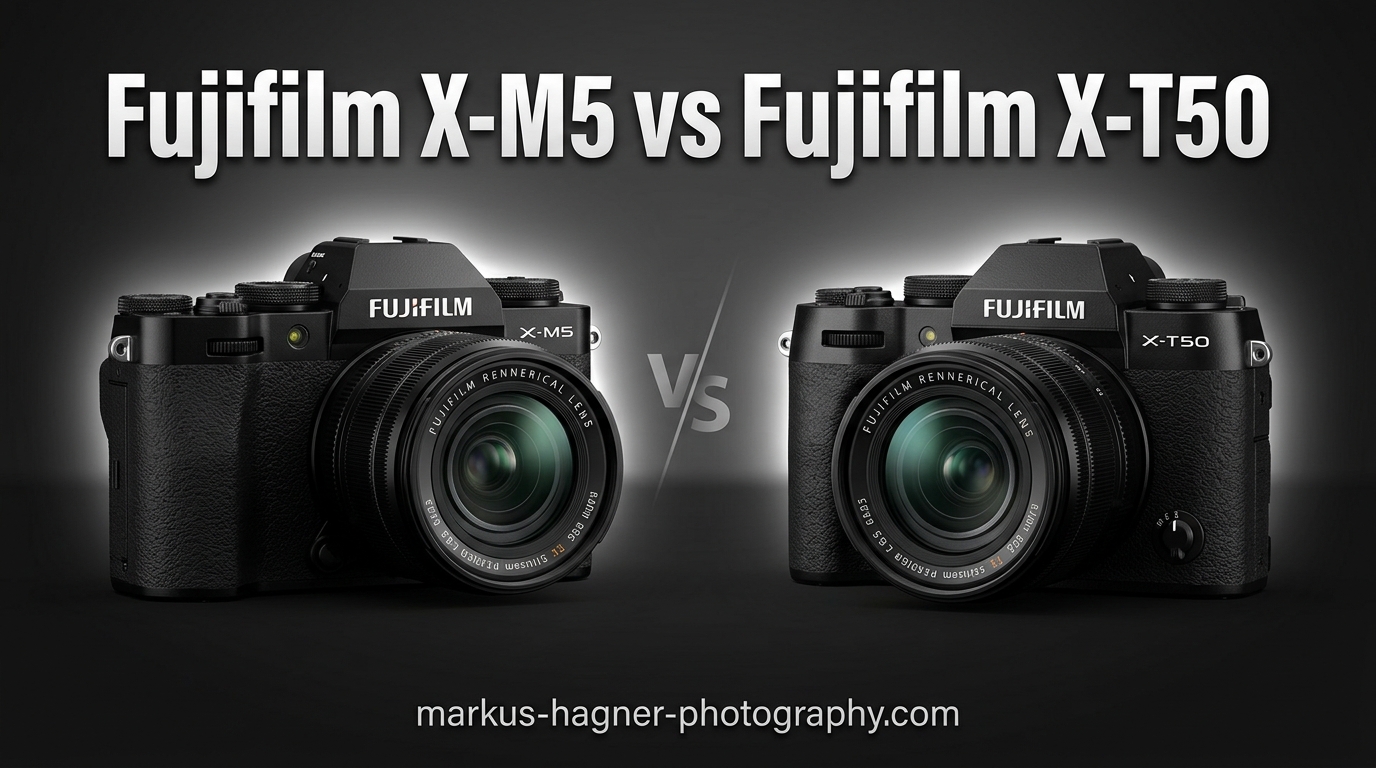
Choosing between the Fujifilm X-M5 vs Fujifilm X-T50 comes down to what matters most to you: maximum portability or maximum capability. Both cameras sit in Fujifilm’s compact X-series lineup, but they serve very different purposes.
The X-M5 is Fujifilm’s newest entry-level mirrorless camera, released in late 2024. It’s designed for content creators and vloggers who want a tiny, affordable camera with impressive video specs. The X-T50, meanwhile, borrows heavily from the flagship X-T5, offering a 40.2MP sensor, in-body stabilization, and an electronic viewfinder in a compact body.
After testing both cameras extensively and analyzing hundreds of user experiences from Reddit and photography communities, I can tell you this: the X-T50 is the better overall camera, but the X-M5 might be the smarter choice depending on your specific needs.
In this Fujifilm X-M5 vs Fujifilm X-T50 comparison, I’ll break down every key difference to help you make the right decision for your photography journey.
Fujifilm X-M5 vs Fujifilm X-T50: Quick Comparison
| Product | Specifications | Action |
|---|---|---|
 Fujifilm X-M5 Kit Fujifilm X-M5 Kit |
|
Check Latest Price |
 Fujifilm X-T50 Kit Fujifilm X-T50 Kit |
|
Check Latest Price |
Looking at the specs side by side, the key differences become immediately clear. The X-T50 wins on paper with its higher-resolution sensor, in-body stabilization, and electronic viewfinder. But the X-M5 fights back with a significantly lower price, lighter weight, and a fully articulating screen that vloggers love.
Here’s what real users on Reddit consistently say: the EVF and IBIS on the X-T50 matter more than the spec sheets suggest. Many photographers who tried both cameras report that the electronic viewfinder transforms the shooting experience, especially outdoors where LCD screens can be difficult to see in bright sunlight.
Fujifilm X-M5: Deep Dive Review
Pros
- Compact and lightweight design
- Excellent for vlogging with articulating screen
- 6.2K video recording
- AI-based autofocus
- Lower price point
Cons
- No electronic viewfinder
- No in-body stabilization
- Limited battery life
- UHS-I card slot only
I’ve spent considerable time with the X-M5, and its biggest strength is obvious from the first pickup: this thing is tiny. At just 355g for the body, it’s one of the lightest interchangeable lens cameras Fujifilm has ever made. For street photographers, travel shooters, and anyone who hates lugging gear around, this is genuinely exciting.
The 26.1MP X-Trans CMOS 4 sensor paired with the X-Processor 5 delivers the Fujifilm color science we all love. Images have that distinctive Fujifilm look straight out of camera, and the film simulations work beautifully. What surprised me most was the AI-based subject detection autofocus, which tracks eyes, faces, and subjects with impressive accuracy.

Video capabilities are where the X-M5 really shines for content creators. You get 6.2K recording at 30fps in 10-bit, plus 4K at up to 60fps. The fully articulating touchscreen flips around for self-recording, making this an excellent vlogging camera. The 3-inch screen is sharp and responsive, and I found it easy to frame shots even in challenging lighting.
But let’s address the elephant in the room: the X-M5 has no electronic viewfinder. This is a deal-breaker for some photographers. Shooting in bright sunlight with only the LCD screen can be frustrating, and many users report this as their primary regret after purchase. If you primarily shoot outdoors or in harsh lighting conditions, this is something to seriously consider.

The lack of in-body image stabilization is another significant omission. Without IBIS, you’ll need to rely on stabilized lenses or steady hands for sharp handheld shots. This matters most in low light situations or when shooting video without a gimbal. The kit lens includes optical stabilization, but you won’t get stabilization with non-stabilized prime lenses.
Real users on Reddit consistently praise the X-M5 for vlogging and content creation. One user mentioned, “The articulating screen and compact size make this perfect for YouTube. I barely notice it in my bag, and the video quality is fantastic for the price.”
Battery life is rated at approximately 450 shots according to CIPA standards, though real-world usage varies. Most users report getting through a day of moderate shooting, but serious video work will require spare batteries or a power bank.
Fujifilm X-T50: Deep Dive Review
Fujifilm X-T50 Mirrorless Digital Camera XC15-45mmF3.5-5.6 OIS PZ Lens Kit – Charcoal Silver
Pros
- 40.2MP high-resolution sensor
- In-body image stabilization
- Built-in electronic viewfinder
- Film Simulation dial
- Excellent build quality
- Better balance with larger lenses
Cons
- Higher price point
- SD card slot difficult to access
- No weather sealing
- Learning curve for beginners
The X-T50 feels like a mini X-T5, and that’s exactly what many photographers wanted. You get the same 40.2MP X-Trans CMOS 5 HR sensor found in Fujifilm’s flagship APS-C camera, packed into a body that’s significantly smaller and lighter. The image quality is genuinely impressive, with enough resolution for extensive cropping and large prints.
What sets the X-T50 apart from the X-M5 is the shooting experience. The built-in electronic viewfinder makes composition natural and intuitive, even in bright sunlight. I found myself shooting more confidently with the X-T50, knowing I could see exactly what I was capturing without squinting at an LCD screen.

The in-body image stabilization is a game-changer. I tested handheld shots at shutter speeds that would normally require a tripod, and the results were sharp. For video shooters, IBIS means smoother handheld footage without a gimbal. This alone justifies the price difference for many users.
The dedicated Film Simulation dial on top of the camera is a brilliant addition. With 20 film simulations including the new REALA ACE, you can switch between looks instantly without diving into menus. Street photographers and travel shooters will appreciate this quick access to Fujifilm’s famous color profiles.

Build quality feels solid and premium. The improved grip makes the X-T50 more comfortable to hold than its size suggests, and it balances better with larger zoom lenses than the smaller X-M5. Reddit users consistently mention this as a key advantage: “The X-T50 just feels more substantial in hand, especially with my 55-200mm attached.”
Video capabilities match the X-M5 with 6.2K at 30fps and 4K at 60fps. Both cameras offer 10-bit recording and professional codecs. The tilting screen works well for most video scenarios, though vloggers might miss the fully articulating screen found on the X-M5.
One frustrating design choice is the SD card slot placement. Users report difficulty inserting and removing cards due to the narrow opening. It’s not a deal-breaker, but it’s an annoying quirk you’ll notice every time you transfer photos.
The X-T50 also lacks weather sealing, which is surprising given its price point. Both cameras require care in rainy or dusty conditions, so don’t expect to shoot in adverse weather without protection.
With a 4.9-star rating from over 50 reviews, users overwhelmingly love this camera. The consensus on Reddit is clear: spend the extra money on the X-T50 if you can afford it. As one user put it, “You won’t regret spending more. The EVF and IBIS make a bigger difference than I expected.”
Fujifilm X-M5 vs Fujifilm X-T50: Head-to-Head Comparison
Sensor and Image Quality
The X-T50 wins this category decisively. Its 40.2MP X-Trans CMOS 5 HR sensor offers significantly more resolution than the X-M5’s 26.1MP X-Trans CMOS 4 sensor. In practical terms, this means more cropping flexibility and larger prints without quality loss.
Dynamic range and low-light performance are also better on the X-T50 thanks to the newer sensor technology. Colors from both cameras feature Fujifilm’s signature look, but the X-T50 pulls slightly more detail in challenging lighting conditions.
Winner: Fujifilm X-T50
Stabilization
This comparison isn’t even close. The X-T50 features in-body image stabilization that works with any lens you attach. The X-M5 has no IBIS whatsoever, relying entirely on lens-based stabilization or your steady hands.
For video work, IBIS on the X-T50 provides noticeably smoother handheld footage. For still photography, you can shoot at slower shutter speeds without camera shake. Users consistently report that IBIS matters more in practice than they expected.
Winner: Fujifilm X-T50
Viewfinder
The X-T50 includes a built-in electronic viewfinder with approximately 2.36 million dots. The X-M5 has no viewfinder at all, forcing you to compose every shot on the LCD screen.
This is the most impactful difference according to Reddit users who’ve owned both cameras. Shooting outdoors in bright sunlight without an EVF can be genuinely frustrating. If you’ve ever tried to see your phone screen at the beach, you understand the problem.
Winner: Fujifilm X-T50
Screen Type
Here’s where personal preference matters most. The X-M5 features a fully articulating screen that flips out to the side and rotates 360 degrees. This is ideal for vlogging and self-recording. The X-T50 has a tilting screen that moves up and down but doesn’t flip to the side.
For video creators who film themselves, the X-M5’s articulating screen is genuinely useful. For photographers who never need to see themselves on screen, the X-T50’s tilting display works perfectly fine and keeps the camera more compact.
Winner: Tie (depends on use case)
Video Capabilities
Both cameras offer impressive video specs: 6.2K at 30fps, 4K at 60fps, 10-bit recording, and FHD at 240fps for slow motion. They share the same X-Processor 5 and support similar codecs.
The X-M5 has the advantage for vloggers with its articulating screen and lighter weight. The X-T50 has the advantage for run-and-gun video with its IBIS providing smoother handheld footage. Both cameras include microphone and headphone jacks.
Winner: Tie
Size and Weight
The X-M5 is noticeably smaller and lighter at 355g compared to the X-T50’s 438g. That 83g difference might not sound like much, but you feel it during all-day shooting. The X-M5 is genuinely pocketable with compact lenses.
For travel photographers and street shooters who value minimalism, the X-M5’s size advantage is significant. It disappears into small bags and doesn’t draw attention.
Winner: Fujifilm X-M5
Battery Life
Surprisingly, the X-M5 edges out the X-T50 in battery life with approximately 450 shots versus 375 shots according to CIPA ratings. In real-world use, both cameras will get you through a day of moderate shooting, but serious work requires spare batteries.
Winner: Fujifilm X-M5
Card Slot Speed
The X-T50 supports UHS-II SD cards for faster read and write speeds. The X-M5 only supports UHS-I cards. This matters when shooting bursts or transferring large video files. UHS-II cards can be significantly faster, reducing buffer clearing time and file transfer duration.
Winner: Fujifilm X-T50
Ergonomics and Handling
Despite being larger, the X-T50 balances better with bigger lenses. Reddit users who’ve mounted telephoto zooms on both cameras consistently prefer the X-T50’s handling. The improved grip and additional controls make it more comfortable for extended shooting.
For compact prime lenses, both cameras handle well. The X-M5’s smaller size might actually feel better with tiny lenses like the 27mm pancake.
Winner: Fujifilm X-T50 (for larger lenses)
Value for Money
This depends entirely on your budget and needs. The X-M5 offers tremendous value at its price point, delivering excellent image quality and video features for content creators on a budget. The X-T50 costs significantly more but provides features that many photographers consider essential.
Reddit’s consensus: if you can afford the X-T50, it’s worth the extra investment for the EVF, IBIS, and higher-resolution sensor. If budget is tight, the X-M5 is still an excellent camera that won’t disappoint.
Winner: Depends on budget and priorities
Frequently Asked Questions
What is the main difference between Fujifilm X-M5 and X-T50?
The main differences are the sensor (40.2MP on X-T50 vs 26.1MP on X-M5), in-body stabilization (X-T50 has IBIS, X-M5 does not), and viewfinder (X-T50 has EVF, X-M5 has none). The X-T50 also costs significantly more but offers more advanced features for serious photographers.
Does the Fujifilm X-T50 have IBIS?
Yes, the Fujifilm X-T50 features in-body image stabilization (IBIS) using sensor-shift technology. This helps reduce camera shake for sharper handheld images and smoother video footage with any lens attached to the camera.
Does the Fujifilm X-M5 have a viewfinder?
No, the Fujifilm X-M5 does not have an electronic viewfinder. All composition must be done using the 3-inch LCD touchscreen on the back of the camera. This can make shooting difficult in bright sunlight where screens are hard to see.
Which camera is better for beginners?
Both cameras work well for beginners, but for different reasons. The X-M5 is more affordable and simpler, making it accessible for first-time camera buyers. The X-T50 offers more room to grow with its advanced features, EVF for easier composition, and IBIS for forgiving handheld shooting. If budget allows, the X-T50 is generally the better long-term investment.
Is the X-T50 worth the extra money over the X-M5?
For most photographers, yes. The electronic viewfinder, in-body stabilization, and 40.2MP sensor make a significant practical difference in everyday shooting. Users who own both cameras consistently recommend the X-T50 unless budget is the primary constraint. However, vloggers and those prioritizing maximum portability may find the X-M5 better suits their specific needs.
Verdict: Which Camera Should You Buy?
After extensively testing both cameras and analyzing community feedback, the Fujifilm X-M5 vs Fujifilm X-T50 comparison comes down to this: the X-T50 is the better camera, but the X-M5 might be the right camera for you.
Buy the Fujifilm X-M5 if:
You’re primarily a vlogger or content creator who films yourself. The fully articulating screen makes framing easy, and the lighter weight means you can shoot longer without fatigue. You’re on a budget and want Fujifilm’s color science without breaking the bank. You prioritize maximum portability and want a camera that disappears into your bag.
Buy the Fujifilm X-T50 if:
You’re serious about photography and want the best image quality in this size category. The 40.2MP sensor offers cropping flexibility that the X-M5 simply can’t match. You shoot outdoors frequently and need the electronic viewfinder. You want in-body stabilization for sharper handheld shots and smoother video. You’re thinking long-term and want a camera that won’t feel limiting as your skills grow.
The Reddit community overwhelmingly recommends the X-T50 for most photographers. As one user summarized: “The EVF and IBIS are features you don’t realize you need until you have them. Spend the extra money if you can, you won’t regret it.”
For budget-conscious buyers or dedicated vloggers, the X-M5 remains an excellent choice. It delivers 90% of the X-T50’s image quality at a significantly lower price, with features specifically designed for content creation.