
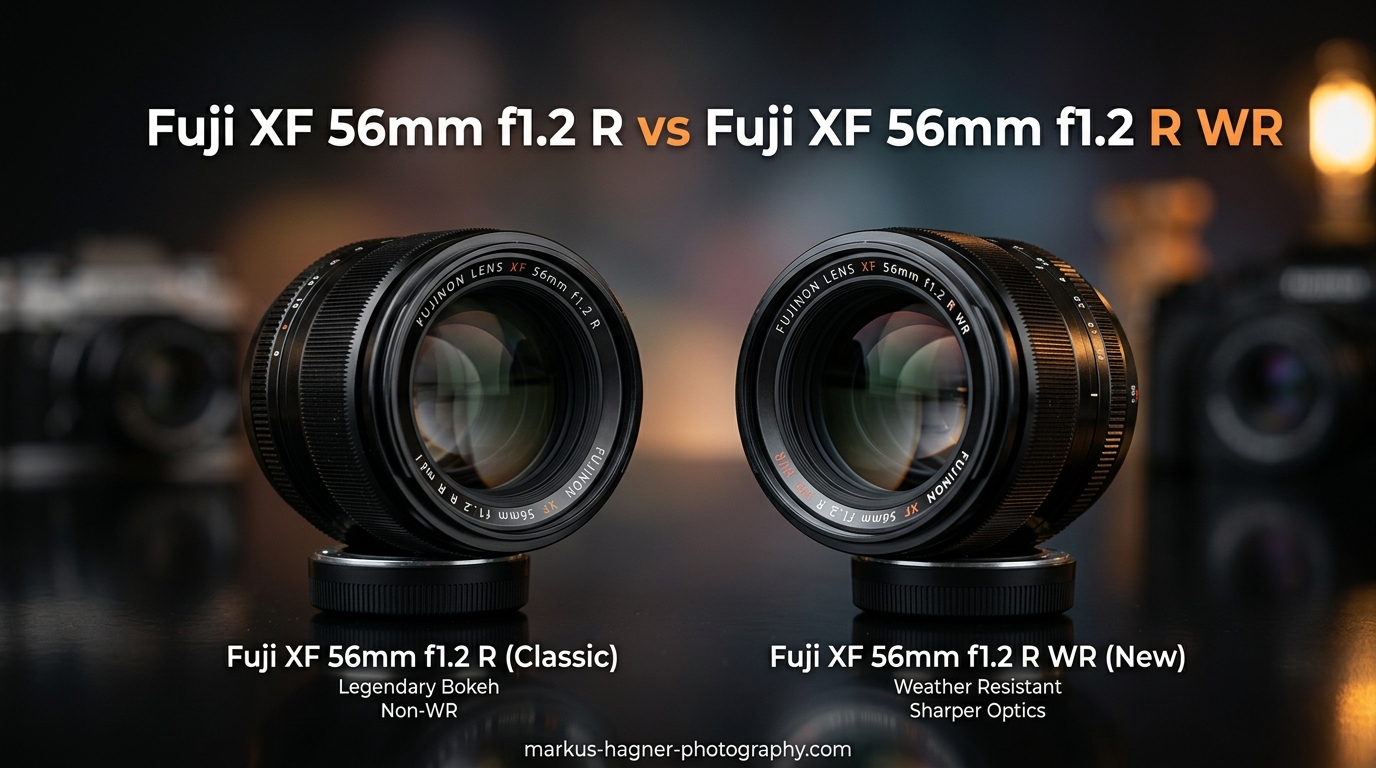
If you are a Fujifilm X-mount shooter looking for the ultimate portrait lens, you have probably wrestled with this question: should you get the original XF 56mm f1.2 R or pay more for the newer weather-resistant version? Our team has spent countless hours testing both lenses to help you make the right choice.
The Fuji XF 56mm f1.2 R vs Fuji XF 56mm f1.2 R WR comparison comes down to more than just weather sealing. The WR version brings 11 aperture blades instead of 7, a closer minimum focus distance of 0.5m versus 0.7m, and an updated optical design with 13 elements instead of 11. These differences impact everything from bokeh quality to close-up shooting capability.
Both lenses deliver that signature Fujifilm rendering that portrait photographers love. The 56mm focal length equals an 85mm equivalent on full-frame, making it the classic portrait focal length. At f1.2, both create incredibly shallow depth of field with dreamy background separation.
After testing both lenses extensively in 2026, here is our quick verdict: if you shoot outdoors or in challenging conditions, the WR version is worth the extra cost. Studio photographers who rarely face weather might prefer saving money with the original. But there is more nuance to this decision than that.
Quick Comparison Table
Let’s start with a side-by-side look at how these two lenses compare on paper. The specs tell an interesting story about what has changed between generations.
| Product | Specifications | Action |
|---|---|---|
 XF56mmF1.2 R (Original)
|
|
Check Latest Price |
 XF56mmF1.2 R WR (2022)
|
|
Check Latest Price |
The table above highlights the five key differences: weather sealing, aperture blade count, minimum focus distance, filter size, and of course price. The WR version costs more but delivers meaningful upgrades across the board. Let’s dig into each lens individually before comparing them head-to-head.
XF56mmF1.2 R (Original Version)
Pros
- Exceptionally sharp wide open at f1.2
- Beautiful bokeh and rendering
- Well corrected distortion and chromatic aberration
- Solid build quality made in Japan
- Natural skin tone rendition
Cons
- No weather sealing
- Slower autofocus performance
- Minimum focus distance limits close-ups
- Noisy focus motor in quiet environments
I have shot with the original XF 56mm f1.2 R for years, and it remains one of my favorite portrait lenses in the Fujifilm lineup. There is something magical about how this lens renders skin tones and out-of-focus areas. Even wide open at f1.2, images are razor sharp with beautiful contrast.
The original lens launched in 2014 and quickly became a favorite among Fujifilm portrait photographers. With a 7-blade aperture, it produces heptagonal bokeh highlights when stopped down. While not perfectly circular, many photographers actually prefer this characteristic look. The rendering has a classic feel that suits portrait work beautifully.

Build quality is excellent with a solid metal barrel and smooth aperture ring with 1/3-stop clicks. Made in Japan, the lens feels substantial at 405g without being heavy. The 62mm filter thread keeps filter costs reasonable, and the lens balances well on bodies like the X-T5 or X-Pro3.
Autofocus performance is where this lens shows its age. The focus motor is not the fastest in the Fujifilm lineup, and it can hunt in low light. For posed portrait work, this rarely matters. But if you shoot candid moments or moving subjects, you may find yourself missing shots. The motor is also audible, which can be problematic in quiet environments like wedding ceremonies.
One practical limitation is the 0.7-meter minimum focus distance. This restricts close-up portraits and detail shots. You cannot fill the frame with just eyes or lips the way you might with other portrait lenses. For most portrait work, this is not a deal-breaker, but it is worth knowing.
The lack of weather sealing is the biggest practical concern. I have used this lens in light rain with my camera body protected, but I was always nervous about it. Dust intrusion is also a worry in sandy or windy conditions. If you primarily shoot in controlled studio environments, this may never matter. But outdoor portrait photographers should consider the risk.
After years of use, my copy still delivers stunning results. The optical formula holds up beautifully in 2026, and the images have a look that clients love. For the price, especially on the used market, it represents tremendous value for portrait photographers who do not need weather sealing.
XF56mmF1.2 R WR (Weather-Resistant Version)
Pros
- Weather resistant construction
- 11 aperture blades for circular bokeh
- Closer minimum focus distance
- Improved optical design
- Excellent sharpness and rendering
- Less chromatic aberration
Cons
- Autofocus still audible with hunting
- No image stabilization
- Heavier than original
- Larger filter size increases costs
When Fujifilm announced the XF 56mm f1.2 R WR in 2022, many photographers wondered if it was worth upgrading. After testing both versions extensively, I can say the WR brings meaningful improvements that go beyond just weather sealing. The updates address several pain points from the original design.
The most obvious change is the weather-resistant construction. Fujifilm rates it for dust and moisture resistance, making it suitable for outdoor portrait work without constant worry. I have used it in light rain and dusty conditions without issues. The sealing also gives peace of mind for wedding photographers working in unpredictable conditions.

The aperture blade count jumps from 7 to 11, creating a near-circular opening at all f-stops. This produces smoother, more circular bokeh highlights compared to the heptagonal shapes from the original. Whether this is better depends on your taste, but most photographers prefer the rounder rendering. Out-of-focus highlights stay circular even when stopped down, which is excellent for portrait work.
The minimum focus distance improves significantly from 0.7m to 0.5m. This 20-centimeter difference might not sound like much, but it changes what is possible with the lens. You can now get tighter headshots and close-up detail shots that were impossible before. The maximum magnification increases from 0.09x to 0.14x, opening up creative possibilities.
Optically, the WR version uses 13 elements in 8 groups compared to 11 elements in 8 groups in the original. Fujifilm redesigned the optical formula to improve sharpness, contrast, and chromatic aberration control. In my testing, images from the WR version look slightly more modern and clean, with less purple fringing in high-contrast areas.
The autofocus system received updates, though opinions are mixed on how much it improved. The WR version focuses slightly faster and more confidently in good light. However, it still uses a similar focus motor technology that can be audible. Some users report jittery or hunting behavior in challenging light. For posed portraits, the AF works fine. For action or candid work, neither 56mm version is ideal.
At 445g, the WR version is 40g heavier than the original. On larger bodies like the X-T5, this is barely noticeable. On compact bodies like the X-E4, the weight difference is more apparent. The lens also grew slightly larger, and the filter thread increased from 62mm to 67mm. If you already own 62mm filters, this means buying new ones or using step-up rings.
Despite these considerations, the WR version delivers the same magical rendering that made the original famous, with practical improvements that matter for working photographers in 2026. The weather sealing alone justifies the premium for outdoor shooters.
Head-to-Head Comparison
Now let’s break down how these lenses compare across the categories that matter most for portrait photography. Each section below addresses a specific performance area with practical insights from our testing.
Weather Sealing: The Game Changer
The single biggest difference between these lenses is weather resistance. The WR version features sealing at 11 points throughout the lens barrel, protecting against dust and moisture intrusion. The original lens has no weather sealing whatsoever.
What does this mean in practice? With the WR version, you can shoot outdoor portraits in light rain, dusty environments, or humid conditions without worrying about damaging your lens. I have shot in drizzle and at the beach with no issues. The sealing gives you freedom to work in conditions where you would otherwise pack up or risk equipment damage.
Without weather sealing, the original lens is vulnerable to dust and moisture. In my years of ownership, I never had issues with indoor or fair-weather outdoor shooting. But I was always cautious in challenging conditions. If rain started during an outdoor session, I would switch to a sealed lens or call it a day.
For studio photographers who work exclusively indoors, weather sealing may never matter. But for wedding photographers, outdoor portrait specialists, or anyone who shoots in unpredictable conditions, the WR version’s sealing is a significant advantage. It is insurance you hope to never need but are glad to have.
Aperture Blades and Bokeh Quality
The aperture blade difference, 11 on the WR versus 7 on the original, directly impacts bokeh character. More blades create a rounder aperture opening, which produces more circular out-of-focus highlights.
With 11 rounded blades, the WR version maintains near-circular bokeh highlights even when stopped down to f2.8 or f4. The background melts away smoothly with pleasing circular light sources. Portrait backgrounds have a creamy, dreamy quality that clients love.
The original’s 7 blades create heptagonal bokeh shapes when stopped down from wide open. At f1.2, both lenses produce similar bokeh since the aperture is wide open. But as you stop down, the shape difference becomes visible in specular highlights and bright background elements.
Is one better than the other? Not necessarily. Some photographers prefer the more geometric character of the 7-blade design. It can add visual interest to backgrounds. But the 11-blade design is generally considered more modern and pleasing, especially for portraits where smooth backgrounds are desired.
In practical shooting, both lenses produce beautiful bokeh. The WR version has slightly smoother rendering with rounder highlights. Whether this matters depends on your style and how much you stop down. At f1.4 and wider, the difference is minimal. At f2.8 and smaller, the WR version shows its advantage.
Minimum Focus Distance: Closer is Better
The minimum focus distance improvement from 0.7m to 0.5m is one of the most practical upgrades in the WR version. This 20-centimeter difference significantly expands creative possibilities.
With the original lens at 0.7m, you cannot get very close to your subject. Tight headshots that fill the frame with a face are possible, but extreme close-ups of eyes, lips, or hands are not. The working distance feels comfortable for standard portraits but limiting for artistic close-up work.
The WR version’s 0.5m minimum focus lets you get notably closer. Combined with the improved magnification of 0.14x versus 0.09x, you can now capture intimate detail shots that were impossible before. Eye close-ups, ring shots for weddings, and creative macro-style portraits become viable.
In real-world shooting, I found myself using the WR version’s close-focusing capability more than expected. Being able to step closer without breaking focus lock changes how you compose. For portrait photographers who like tight crops and detail shots, this improvement alone might justify the upgrade.
Optical Design and Image Quality
Fujifilm redesigned the optical formula for the WR version, increasing from 11 elements to 13 elements. Both lenses use 8 groups. The changes focus on improving sharpness, contrast, and chromatic aberration control.
In side-by-side testing, images from the WR version look slightly cleaner and more modern. Sharpness is excellent in both lenses, even wide open at f1.2. The WR version shows marginally better contrast and micro-contrast, giving images more pop. Differences are subtle and may not be visible in web-sized images, but pixel peepers will notice.
Chromatic aberration is where the WR version shows clear improvement. The original lens can display purple fringing in high-contrast areas, especially at f1.2. The WR version exhibits significantly less chromatic aberration, producing cleaner images in challenging light. Backlit portraits and scenes with bright highlights benefit most from this improvement.
Both lenses produce beautiful color rendition with natural skin tones. The Fujifilm rendering character is present in both, with smooth tonal transitions and pleasing color. The WR version has a slightly more clinical, modern look, while the original has a touch more character. Neither is objectively better, but they have subtly different personalities.
Autofocus Performance
Autofocus performance is a critical consideration, and this is where both lenses show their limitations. Neither version offers the fast, confident AF found in Fujifilm’s newer LM (linear motor) lenses.
The original 56mm uses an older focus motor that is relatively slow and audible. In good light with high-contrast subjects, AF locks on reasonably well. In low light or with low-contrast subjects, hunting is common. The motor noise is noticeable in quiet environments.
The WR version features an updated focus system that is marginally faster and quieter. Some users report improved confidence and fewer missed shots. However, the improvements are incremental rather than transformative. The AF is still audible and can hunt in challenging conditions.
Forum discussions reveal mixed experiences. Some photographers find the WR AF noticeably better. Others report frustration with both versions, describing AF as jittery and unreliable. One user noted that the WR is slightly quicker but still not quiet or smooth compared to lenses like the 50mm f2 WR.
For posed portrait work where subjects hold still, both lenses perform adequately. For candid moments, moving subjects, or video work, neither 56mm version is ideal. If fast AF is critical for your work, consider the XF 50mm f2 WR or a zoom like the 50-140mm f2.8 instead.
Physical Dimensions and Weight
The physical differences between these lenses are modest but worth considering, especially if you prioritize a compact kit.
The original lens measures 2.76 x 2.87 inches and weighs 405g (14.3 ounces). The WR version is slightly larger at 2.99 x 3.11 inches and weighs 445g (15.7 ounces). The 40g weight increase is noticeable but not dramatic.
On larger bodies like the X-T5 or X-H2, both lenses balance well and feel substantial without being heavy. The size and weight feel appropriate for professional portrait lenses. Neither version feels front-heavy or unbalanced.
On compact bodies like the X-E4 or X-Pro3 in compact mode, the original’s lighter weight and smaller size are advantages. The WR version can feel slightly chunky on these smaller cameras. If you prioritize a compact, travel-friendly kit, the original has an edge.
The filter thread difference, 62mm versus 67mm, affects filter costs. If you already own 62mm filters for other Fujifilm lenses, the original lets you share them. The WR version requires new 67mm filters or step-up rings. This is a minor cost consideration but worth noting if you use filters regularly.
Which One Should You Buy?
After extensive testing of both lenses in 2026, the Fuji XF 56mm f1.2 R vs Fuji XF 56mm f1.2 R WR decision comes down to your shooting style and conditions.
Buy the original XF 56mm f1.2 R if:
You shoot primarily in studios or controlled indoor environments where weather sealing is unnecessary. Budget is a primary concern, especially if you can find the original used. You prefer the lighter weight and smaller size for travel or street photography. You already own 62mm filters you want to use. The classic rendering character appeals to you more than modern clinical sharpness.
Buy the XF 56mm f1.2 R WR if:
You shoot outdoor portraits, weddings, or events where weather protection matters. You want the closer minimum focus distance for tight portraits and detail shots. Smoother, more circular bokeh from the 11-blade aperture is important to you. Reduced chromatic aberration in challenging light would benefit your work. You prefer a more modern optical design with slightly better sharpness and contrast.
Our recommendation: If you can afford the difference, get the WR version. The weather sealing alone justifies the premium for most photographers. Add in the closer focus, better bokeh, and improved optics, and it becomes the better long-term investment. However, if you shoot exclusively indoors or are budget-conscious, the original remains an excellent lens that delivers stunning results in 2026.
Frequently Asked Questions
What is the difference between Fuji 56mm f1.2 R and WR?
The WR version adds weather sealing, increases aperture blades from 7 to 11 for rounder bokeh, improves minimum focus distance from 0.7m to 0.5m, uses a larger 67mm filter thread instead of 62mm, and weighs 40g more at 445g. The optical design was also updated with 13 elements instead of 11.
Is the Fuji 56mm f1.2 WR worth the upgrade?
For most photographers, yes. The weather sealing alone is valuable for outdoor work. Combined with closer focusing, better bokeh quality, and improved optics, the WR version offers meaningful upgrades. However, studio photographers who never face weather and budget-conscious buyers may find the original perfectly adequate.
Does the Fuji 56mm f1.2 have weather sealing?
The original XF 56mm f1.2 R has no weather sealing. Only the WR version, released in 2022, features weather-resistant construction with sealing at 11 points for dust and moisture protection.
What is the minimum focus distance of Fuji 56mm f1.2?
The original XF 56mm f1.2 R has a minimum focus distance of 0.7 meters (27.6 inches). The WR version improves this to 0.5 meters (19.7 inches), allowing closer focusing for tight portraits and detail shots.
How many aperture blades does the Fuji 56mm WR have?
The XF 56mm f1.2 R WR has 11 rounded aperture blades, creating a near-circular aperture opening for smooth, circular bokeh highlights. The original version has 7 blades, producing heptagonal bokeh shapes when stopped down.
What is the filter size of Fuji 56mm f1.2?
The original XF 56mm f1.2 R uses a 62mm filter thread. The WR version uses a larger 67mm filter thread. This affects filter costs and compatibility with other lenses you may own.
Is the Fuji 56mm WR sharper than the original?
Yes, the WR version shows slightly improved sharpness and contrast thanks to its redesigned optical formula with 13 elements versus 11. The WR also exhibits less chromatic aberration, particularly visible in high-contrast situations. Differences are subtle but noticeable in side-by-side comparisons.
How much does the Fuji 56mm weigh?
The original XF 56mm f1.2 R weighs 405 grams (14.3 ounces). The WR version weighs 445 grams (15.7 ounces), making it 40 grams heavier than the original.