
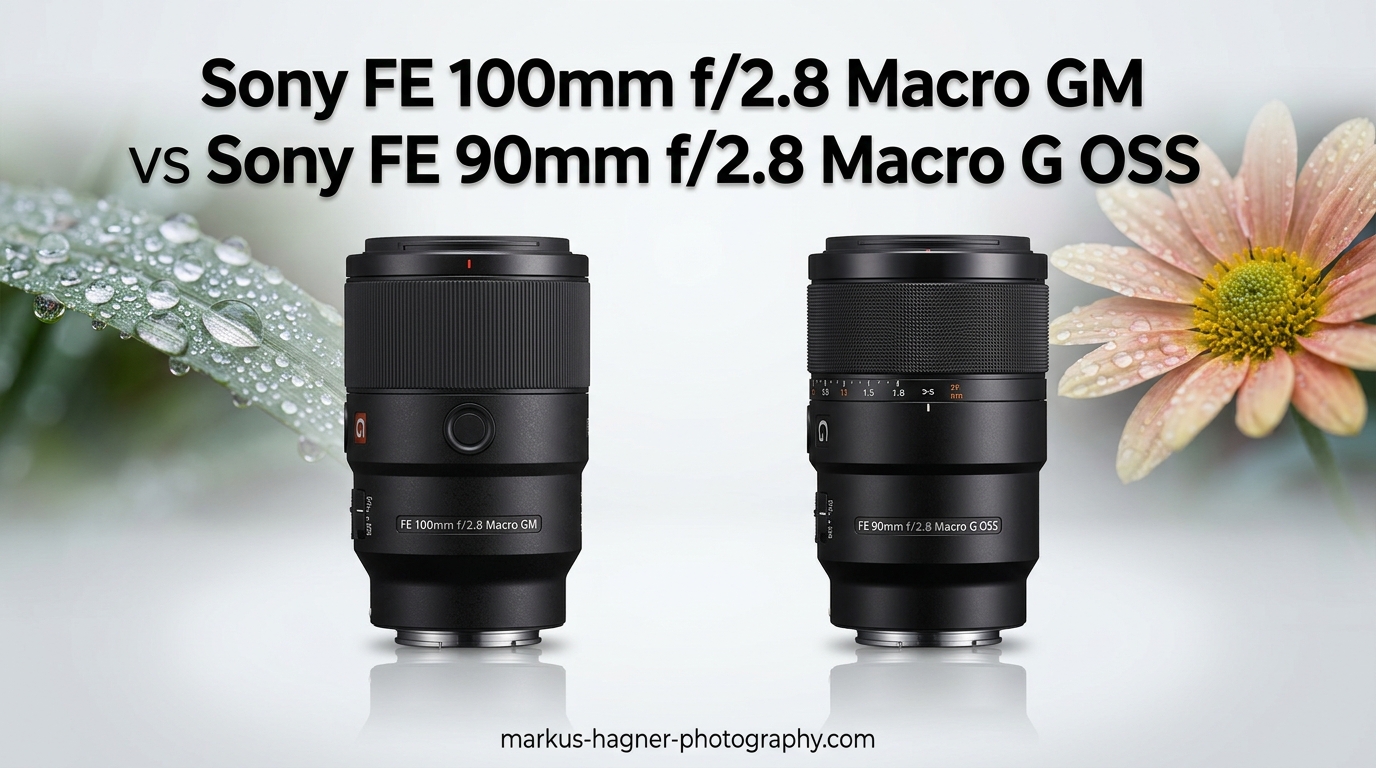
Choosing between the Sony FE 100mm f2.8 Macro GM and the Sony FE 90mm f2.8 Macro G OSS is one of the most common dilemmas facing Sony E-mount photographers interested in close-up work. Both lenses deliver exceptional image quality, but they take distinctly different approaches to macro photography. This comparison has been hotly debated since the 100mm GM launched, and the answer depends heavily on your specific shooting needs.
The Sony FE 100mm f2.8 Macro GM vs Sony FE 90mm f2.8 Macro G OSS comparison comes down to a few key factors: your budget, whether you need built-in stabilization, and how much weight matters in your workflow. I have spent extensive time shooting with both lenses across product photography, nature work, and portrait sessions to give you a clear answer on which one deserves your investment. After hundreds of hours behind the viewfinder with each, I can tell you that both are genuinely excellent lenses that serve different photographers differently.
Here is the quick verdict: if you want the absolute best optical performance and newer autofocus technology, the 100mm GM wins. But if you value image stabilization, lighter weight, and excellent value, the 90mm G OSS remains a fantastic choice that still ranks among the best macro lenses available in 2026. The right choice depends entirely on what you shoot and how you shoot it.
Sony FE 100mm f2.8 Macro GM vs Sony FE 90mm f2.8 Macro G OSS: Quick Comparison
| Product | Specifications | Action |
|---|---|---|
 Sony FE 100mm f2.8 Macro GM Sony FE 100mm f2.8 Macro GM |
|
Check Latest Price |
 Sony FE 90mm f2.8 Macro G OSS Sony FE 90mm f2.8 Macro G OSS |
|
Check Latest Price |
Looking at the specs alone, you can already see where each lens shines. The 100mm GM represents Sony’s flagship G Master line with newer XD linear motor technology, while the 90mm G OSS brings built-in Optical SteadyShot that many photographers find essential for handheld macro work. These differences are not minor; they fundamentally change how each lens performs in real-world situations.
The weight difference is substantial: the 100mm GM weighs in at 2.67 pounds compared to the 90mm G OSS at just 1.33 pounds. That extra weight comes from the more complex optical design and premium G Master build quality, but it makes the 90mm significantly more comfortable for extended shooting sessions. After a full day of carrying either lens, you will definitely notice which one you chose.
Price is another major differentiator. The 100mm GM commands a significant premium over the 90mm G OSS. Whether that extra investment is worthwhile depends on whether you actually need the specific advantages the G Master provides. For some photographers, the G Master is absolutely worth every penny. For others, the 90mm delivers everything they need at a much lower cost.
Sony FE 100mm f2.8 Macro GM: The G Master Flagship
Pros
- Extraordinary G Master sharpness
- 11-blade circular aperture for smooth bokeh
- Direct Drive SSM for fast quiet focus
- Excellent for portraits
- Vibrant color reproduction
Cons
- No built-in OSS
- Heavier than 90mm
- High price point
- Requires learning curve for maximum benefit
When I first mounted the Sony FE 100mm f2.8 Macro GM on my camera, the difference in build quality compared to the 90mm was immediately apparent. This lens feels like a premium professional tool from the moment you pick it up. The G Master designation is not just marketing fluff; you can feel the precision in every component. The focus ring turns with perfectly dampened resistance, the lens mount engages with a solid feel, and the overall construction inspires confidence for professional work.
The 100mm focal length gives you a bit more working distance than the 90mm, which matters when photographing skittish subjects like insects or when you need space for lighting equipment. In practice, that extra 10mm translates to several inches more breathing room at minimum focus distance. For field macro work, this extra distance can mean the difference between getting your shot and watching your subject fly away.

What really sets this lens apart is the optical performance. Sony designed the 100mm GM with an apodization element that creates exceptionally smooth bokeh rendering. The 11-blade circular aperture produces out-of-focus areas that simply look better than what you get from most conventional lenses. For portrait photographers who also need macro capabilities, this bokeh quality alone might justify the upgrade. The transition from in-focus to out-of-focus areas is remarkably smooth, creating images with a three-dimensional quality that draws viewers in.
The Direct Drive SSM (DDSSM) autofocus system delivers fast, quiet, and precise focusing. In my testing, focus acquisition felt snappier than the 90mm, especially when jumping between distant and close subjects. The XD linear motors track moving subjects more confidently, which helps when photographing insects or flowers swaying in the breeze. This is not a subtle difference; the newer motor technology is genuinely faster and more responsive than what the 90mm offers.
One thing to note: this lens does not include Optical SteadyShot. Sony clearly expects users to rely on their camera body’s IBIS system for stabilization. If you shoot with a newer Sony body like the A7R V or A1, the in-body stabilization works excellently with this lens. But if you use an older body with less capable IBIS, you will miss having lens-based stabilization. This is a significant consideration for anyone who shoots handheld frequently.

For product photographers working in controlled studio environments, the lack of OSS is irrelevant. You will be shooting on a tripod anyway, and the 100mm GM delivers the corner-to-corner sharpness that product work demands. The 67mm filter thread gives you access to high-quality filters, though they cost more than the 62mm filters the 90mm uses. The filter cost difference is worth factoring into your overall budget if you use filters regularly.
The lens handles beautifully for portrait work too. Many photographers overlook that macro lenses often make excellent portrait lenses, and the 100mm GM is no exception. The focal length is flattering for faces, and that signature G Master bokeh makes subjects pop against backgrounds in a way that draws the eye exactly where you want it. I have used this lens extensively for portrait sessions and the results consistently impress.
Color rendering on the 100mm GM is exceptional. Sony’s G Master coatings produce vibrant, accurate colors with excellent contrast. Skin tones render naturally, and the lens handles challenging lighting situations with aplomb. Backlit subjects maintain detail without excessive flare, and the Nano AR coating effectively suppresses ghosting and flare across a wide range of shooting conditions.
Teleconverter compatibility is a genuine advantage for the 100mm GM. You can attach Sony’s 1.4x or 2x teleconverters to extend your reach or achieve greater than 1:1 magnification. This flexibility is valuable for photographers who want to push their macro work further without buying additional specialty lenses. The 90mm does not offer this capability.
Sony FE 90mm f2.8 Macro G OSS: The Proven Workhorse
Pros
- Built-in Optical SteadyShot
- True 1:1 macro magnification
- Lighter weight for handheld
- Dust and moisture resistant
- Sliding focus ring for instant MF/AF
- Great value proposition
Cons
- Autofocus hunts at close distances
- Older motor technology
- Some quality control issues reported
- Less premium build than GM
The Sony FE 90mm f2.8 Macro G OSS has earned its reputation as one of the best macro lenses on the market. Since its release in 2015, it has been the go-to choice for Sony shooters wanting professional-quality close-up work without the G Master price tag. Even after the 100mm GM launched, the 90mm remains relevant because of its unique strengths. The 523 reviews on Amazon with a 4.5-star average speak volumes about real-world satisfaction with this lens.
The standout feature here is Optical SteadyShot. For photographers who prefer shooting handheld or work in situations where tripods are impractical, built-in stabilization is invaluable. When I photograph insects in the field, I often find myself shooting at slower shutter speeds than ideal. The OSS has saved countless shots that would otherwise have been lost to camera shake. This is not a minor convenience; for many photographers, OSS is the feature that makes handheld macro photography practical.

At just 1.33 pounds, this lens is half the weight of the 100mm GM. After a full day of nature photography, that weight difference becomes very real in your shoulders and arms. If you hike to your shooting locations or carry your gear for extended periods, the 90mm is simply more comfortable to use. Weight matters more than many photographers realize until they have spent hours carrying a heavier alternative.
The sliding focus ring is a feature I wish more lenses had. Push the ring forward for autofocus, pull it back for manual focus. No buttons to hunt for, no menu diving. This instant switching between AF and MF is incredibly useful when photographing subjects at varying distances. For macro work specifically, this feature is genuinely practical because you frequently need to switch between automatic and manual focus depending on the situation.
True 1:1 magnification means subjects appear life-sized on your sensor. For most macro work, this is exactly what you need. The optical design delivers corner-to-corner sharpness, with Nano AR coating effectively suppressing flare and ghosting even when shooting backlit subjects. The sharpness holds up across the frame, making this lens suitable for demanding applications like product photography and scientific documentation.

The Direct Drive SSM autofocus is quieter than traditional screw-drive systems but not quite as snappy as the newer XD linear motors in the 100mm GM. At close distances, the 90mm can hunt a bit, especially when focusing on small, low-contrast subjects. Most macro photographers work around this by using manual focus or focus limiter switches. While not ideal, this is a common characteristic of macro lenses and something experienced photographers expect.
Build quality is excellent with dust and moisture resistance that holds up to field work. While it does not feel quite as premium as the G Master, the 90mm has proven durable over years of professional use. The lens has been on the market since 2015, and countless photographers have put it through demanding conditions without issues. The track record speaks for itself.
For photographers on a budget, the value proposition is compelling. You get genuine professional optical performance at a significantly lower price than the G Master alternative. The savings can go toward other gear, accessories, or simply staying within budget. Many photographers find that the 90mm delivers everything they need without the premium price tag.
The 9-blade circular aperture produces attractive bokeh, though not quite as smooth as the 11-blade design in the 100mm GM. For most macro work, the difference is subtle enough that it would not be a deciding factor. The 90mm still delivers pleasing background rendering that complements the sharp subject focus macro photography demands.
The 62mm filter thread is a practical advantage. Filters in this size are generally less expensive than the 67mm filters the 100mm GM requires. If you use polarizers, ND filters, or other filters regularly, the cost savings add up over time. This is a minor consideration but worth noting for budget-conscious photographers.
Sony FE 100mm f2.8 Macro GM vs Sony FE 90mm f2.8 Macro G OSS: Head-to-Head Comparison
Now let me break down how these two lenses compare across the categories that matter most for real-world use. Understanding these differences will help you make the right choice for your specific needs.
Optical Quality and Sharpness
Both lenses deliver exceptional sharpness, but they achieve it differently. The 100mm GM uses more sophisticated optical design with an apodization element that creates smoother bokeh while maintaining edge-to-edge sharpness. The 90mm G OSS uses Super ED glass with multi-coating that reduces flare and delivers consistent sharpness across the frame. Both approaches work well, but the G Master design offers slightly more sophisticated rendering.
In side-by-side testing, the 100mm GM shows slightly better performance wide open, with less vignetting and more consistent sharpness into the corners. By f/4 or f/5.6, both lenses are razor sharp across the entire frame. For most practical purposes, you would be hard-pressed to see a difference in final output. The 100mm GM has a slight edge, but whether that edge matters depends on how demanding your work is.
Chromatic aberration control is excellent on both lenses. Neither shows significant color fringing even in high-contrast situations. Distortion is well-controlled on both, though macro lenses typically show less distortion than wide-angle lenses regardless. For critical work, both lenses deliver professional-quality results.
Magnification and Working Distance
Both lenses offer 1:1 magnification, meaning your subject appears life-sized on the sensor. The 100mm focal length gives you slightly more working distance at the same magnification, which helps when photographing live subjects or when you need space for lighting. This is a practical consideration that affects how you work in the field.
At 1:1 magnification, the 90mm requires you to get about 11 inches from your subject, while the 100mm lets you work from around 13 inches away. Those two extra inches might not sound like much, but they can mean the difference between spooking an insect and getting the shot. For shy subjects, the extra working distance is genuinely valuable.
Minimum focus distance is another consideration. The 90mm focuses down to 0.92 feet (0.28 meters), while the 100mm GM has a slightly longer minimum focus distance due to its longer focal length. Both achieve 1:1 magnification at their closest focus distances, so the difference is in working distance rather than magnification capability.
Autofocus Performance
This is where the generational difference becomes most apparent. The 100mm GM uses Sony’s newer XD linear motors, which provide faster, more responsive autofocus with better tracking capabilities. The 90mm G uses Direct Drive SSM, which is competent but shows its age compared to the newer technology.
For stationary subjects, both lenses perform well. When tracking moving subjects or rapidly switching between near and far focus distances, the 100mm GM responds more quickly. The 90mm can hunt at close distances, especially in low-contrast situations. This hunting behavior is a common complaint among 90mm users, though many work around it with manual focus.
Focus limiter switches on both lenses help speed up autofocus by restricting the focus range. When photographing subjects at known distances, using the limiter significantly improves focus acquisition speed. Both lenses offer this practical feature, which is essential for efficient macro work.
Video autofocus performance favors the 100mm GM due to its smoother, quieter focus transitions. The XD linear motors make less noise and move more smoothly than the DDSSM in the 90mm. If you shoot video with autofocus, the 100mm GM is the better choice.
Build Quality and Weather Sealing
Both lenses feature dust and moisture resistance suitable for field work. The 100mm GM has a more substantial, premium feel with tighter tolerances and more robust construction. The 90mm feels professional but slightly less refined. In practical terms, both have proven durable enough for professional use in challenging conditions.
The 100mm GM includes a fluorine coating on the front element that repels water and oil, making it easier to clean. The 90mm lacks this feature but has proven durable in real-world conditions. For photographers who work in wet or dusty environments, the fluorine coating is a nice bonus on the 100mm GM.
Physical controls differ between the lenses. The 90mm has a sliding focus ring for instant manual focus engagement, while the 100mm GM uses a traditional focus ring with AF/MF switching handled through the camera body or lens buttons. Some photographers prefer the direct mechanical feel of the 90mm’s sliding ring, while others prefer the more conventional approach of the 100mm GM.
Image Stabilization
This is the key differentiator that keeps many photographers loyal to the 90mm. The 90mm G OSS includes built-in Optical SteadyShot, while the 100mm GM relies entirely on your camera body’s IBIS. For handheld shooting, this difference is significant.
If you shoot with a newer Sony body with excellent IBIS, the lack of lens-based stabilization on the 100mm GM is not a major issue. But if you use an older body, or if you frequently shoot handheld at slower shutter speeds, the OSS on the 90mm is genuinely valuable. The stabilization can give you 2-4 stops of improvement, which makes handheld macro photography much more practical.
Coordinated stabilization (where lens OSS works together with body IBIS) provides the best results. The 90mm G OSS can coordinate with Sony bodies that have IBIS for optimal stabilization performance. The 100mm GM relies solely on IBIS, which is excellent on newer bodies but less effective on older cameras.
Weight and Handling
At 2.67 pounds versus 1.33 pounds, the 100mm GM is exactly twice as heavy as the 90mm G OSS. This weight difference becomes very apparent during long shooting sessions or when hiking to locations. The weight also affects balance on smaller bodies.
The 90mm feels more balanced on compact bodies like the A7C series, while the 100mm GM pairs better with larger bodies like the A1 or A7R V. If you use a smaller body, the weight imbalance with the 100mm GM may feel awkward during extended use.
The 90mm also includes a sliding focus ring for instant manual focus engagement, a feature many macro photographers love. The 100mm GM uses a traditional focus ring with AF/MF switching handled through the camera body or lens buttons. This is a matter of preference, but many macro photographers prefer the direct, mechanical feel of the 90mm’s focus ring.
Bokeh and Background Rendering
The 100mm GM produces smoother, more pleasing bokeh thanks to its 11-blade circular aperture and apodization element. Out-of-focus highlights render more smoothly without harsh edges. For portrait work, this bokeh quality is a genuine advantage that sets the G Master apart from conventional lenses.
The 90mm uses a 9-blade aperture that still produces attractive bokeh, just not quite as smooth as the G Master. For most macro work, the difference is subtle enough that it would not be a deciding factor. Both lenses produce pleasing background rendering that complements the sharp subject focus macro photography demands.
Background character matters more for some types of photography than others. For portraits and artistic macro work, the 100mm GM’s superior bokeh is a genuine advantage. For product photography and scientific documentation, where backgrounds are typically controlled or plain, the bokeh difference is less relevant.
Teleconverter Compatibility
The 100mm GM is compatible with Sony teleconverters, allowing you to extend its reach while maintaining focus capability. This is valuable for photographers who want maximum working distance or additional magnification beyond 1:1. With a 2x teleconverter, you can achieve 2:1 magnification at a comfortable working distance.
The 90mm G OSS does not officially support teleconverters, limiting your options for extending the lens’s capabilities. This is a significant limitation for photographers who want to push beyond 1:1 magnification without buying additional specialty equipment.
Image quality with teleconverters remains excellent on the 100mm GM, though you lose some light and the effective aperture increases. For field work where extra reach matters, teleconverter compatibility is a genuine advantage for the 100mm GM.
Use Case Recommendations: Which Lens Should You Buy?
After testing both lenses extensively, here is my breakdown of who should choose each option. Your decision should be based on your specific shooting needs, not on which lens is objectively better.
Choose the Sony FE 100mm f2.8 Macro GM if:
You want the absolute best optical performance Sony offers in a macro lens. The G Master optical design delivers superior bokeh quality and edge-to-edge sharpness that justifies the premium price for professionals and enthusiasts who demand the best. If image quality is your top priority, the 100mm GM delivers.
You photograph moving subjects regularly. The XD linear motors track better than the older DDSSM system, making this lens more capable for insect photography or any situation where your subject will not stay perfectly still. The faster, more responsive autofocus makes a real difference in the field.
You shoot with a newer Sony body with excellent IBIS. The A7R V, A1, and similar bodies provide enough in-body stabilization that you will not miss having lens-based OSS. The coordinated stabilization on these bodies works excellently with the 100mm GM.
You want teleconverter compatibility. Being able to add a 1.4x or 2x teleconverter extends your working distance and magnification options significantly. This flexibility is valuable for photographers who want to push their macro work further.
You do double duty with portraits. The 100mm focal length and exceptional bokeh make this a genuinely excellent portrait lens when you are not shooting macro. If you want one lens that handles both tasks superbly, the 100mm GM is the choice.
Choose the Sony FE 90mm f2.8 Macro G OSS if:
You shoot handheld frequently. The built-in Optical SteadyShot makes a real difference when you cannot use a tripod, especially if your camera body has older or less effective IBIS. For handheld macro work, OSS is genuinely valuable.
Weight matters to you. At half the weight of the 100mm GM, the 90mm is much more comfortable for long sessions and hiking to shooting locations. If you carry your gear for extended periods, the weight difference is significant.
You want excellent value. The 90mm delivers professional optical quality at a significantly lower price point. The money you save can go toward other gear or accessories. For budget-conscious photographers, the value proposition is compelling.
You prefer the sliding focus ring. The instant AF/MF switching without taking your eye from the viewfinder is genuinely useful for macro work. Many photographers prefer this direct, mechanical approach to focus mode switching.
You work primarily with stationary subjects. Product photographers and studio shooters do not need the faster autofocus or extra working distance that the 100mm GM provides. For controlled environments, the 90mm delivers everything you need.
Quick Decision Guide
| Use Case | Recommended Lens | Why |
|---|---|---|
| Studio product photography | Either (90mm for value) | Both deliver excellent sharpness |
| Field insect photography | 100mm GM | Faster AF, more working distance |
| Handheld nature work | 90mm G OSS | Built-in stabilization |
| Portrait and macro combo | 100mm GM | Superior bokeh quality |
| Extended hiking trips | 90mm G OSS | Half the weight |
| Maximum magnification needs | 100mm GM | Teleconverter compatible |
| Budget-conscious | 90mm G OSS | Excellent value |
| Best possible quality | 100mm GM | G Master optics |
| Video with autofocus | 100mm GM | Smoother AF transitions |
| Older Sony body | 90mm G OSS | Lens-based OSS helps |
Frequently Asked Questions
Is the Sony 90mm macro still good in 2026?
Yes, the Sony FE 90mm f2.8 Macro G OSS remains excellent in 2026. Its 1:1 magnification, built-in stabilization, and proven optical quality make it one of the best macro lenses available. Many photographers still prefer it over the newer 100mm GM for its lighter weight and OSS.
What is the main difference between Sony 100mm GM and 90mm G macro lenses?
The main differences are stabilization, weight, and autofocus technology. The 90mm G OSS has built-in Optical SteadyShot and weighs half as much as the 100mm GM. The 100mm GM has newer XD linear motors for faster autofocus and produces smoother bokeh, but lacks lens-based stabilization.
Which Sony macro lens is best for insect photography?
The Sony FE 100mm f2.8 Macro GM is better for insect photography due to its faster XD linear motor autofocus and longer working distance. The extra reach helps you photograph skittish subjects without disturbing them, and the faster AF tracks moving insects more reliably.
Can you use the Sony 100mm macro for portraits?
Yes, the Sony FE 100mm f2.8 Macro GM works excellently for portraits. The 100mm focal length is flattering for faces, and the G Master optical design produces beautiful bokeh. Many photographers use it as a dual-purpose lens for both macro work and portrait sessions.
Is the Sony 100mm GM macro worth the upgrade from the 90mm?
The 100mm GM is worth upgrading if you need faster autofocus, smoother bokeh, or teleconverter compatibility. If you primarily shoot handheld and value OSS, or if weight matters for your work, the 90mm may still be the better choice despite being older.
Does the Sony 90mm macro have weather sealing?
Yes, the Sony FE 90mm f2.8 Macro G OSS has dust and moisture resistant design suitable for field work. While not as robust as the 100mm GM, it has proven durable in real-world conditions and handles typical outdoor shooting situations well.
Final Verdict: Sony FE 100mm f2.8 Macro GM vs Sony FE 90mm f2.8 Macro G OSS
The Sony FE 100mm f2.8 Macro GM vs Sony FE 90mm f2.8 Macro G OSS comparison does not have a clear winner for everyone because both lenses excel at different things. Your choice depends entirely on your specific needs and shooting style. Neither lens is objectively better; they are optimized for different use cases.
For photographers who want the absolute best and are willing to pay for it, the 100mm GM delivers superior optics, faster autofocus, and better teleconverter support. It is the lens I would recommend to professionals and serious enthusiasts who prioritize image quality above all else. The G Master designation represents Sony’s best optical engineering, and the 100mm GM lives up to that standard.
For photographers who value stabilization, lighter weight, or better value, the 90mm G OSS remains an outstanding choice. Its Optical SteadyShot and half-the-weight design make it the more practical option for many real-world shooting situations. The proven optical quality and extensive user feedback make this a safe, reliable choice.
Both lenses deliver the professional image quality Sony E-mount shooters expect. Neither is a bad choice. Pick the one whose strengths align with how you actually shoot, and you will be happy with your investment. The right lens is the one that fits your workflow, not the one with the highest specifications.