
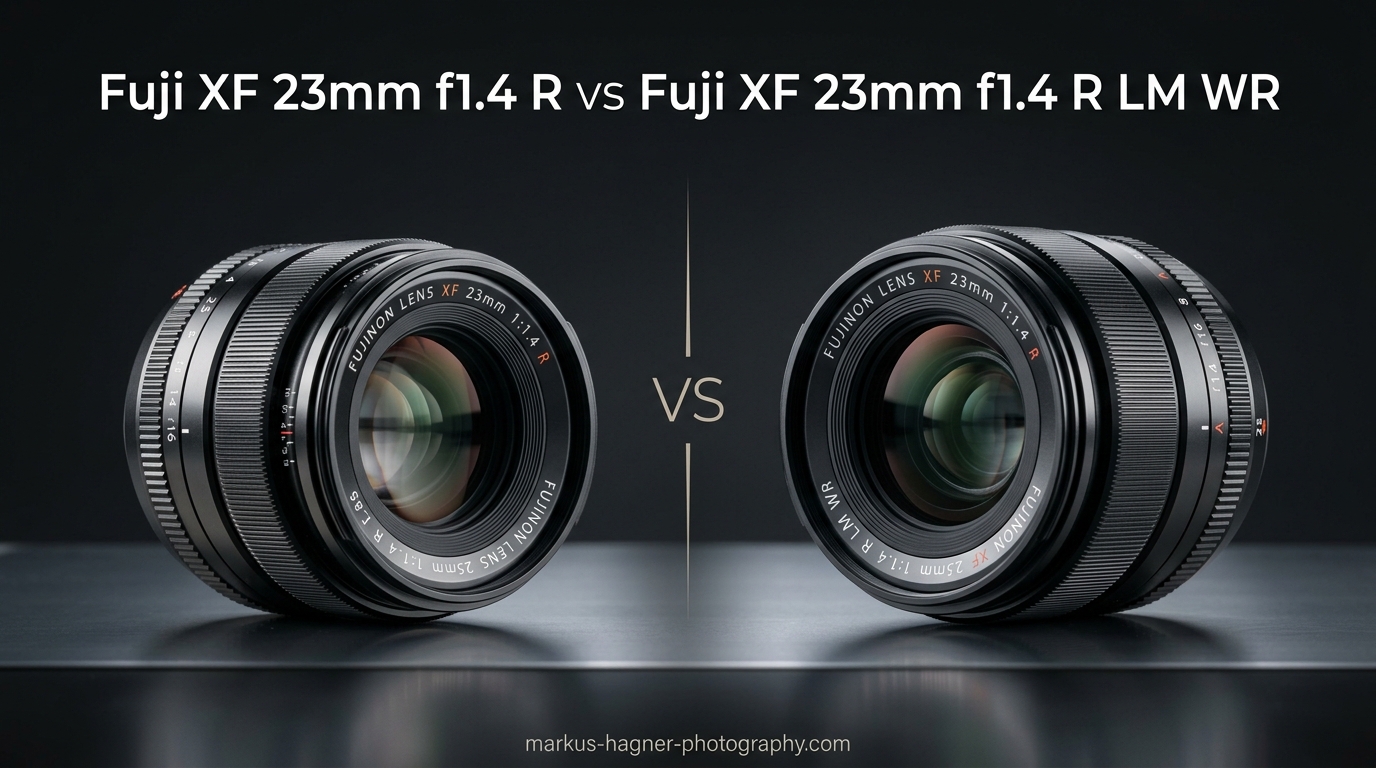
The 23mm focal length has been a cornerstone of the Fujifilm X system since the beginning. Delivering a classic 35mm full-frame equivalent, it’s become the go-to lens for street photographers, documentary shooters, and anyone who wants a versatile do-it-all prime. But in 2026, Fuji photographers face an interesting choice between two versions of the same lens: the original XF 23mm f1.4 R and the redesigned XF 23mm f1.4 R LM WR.
Having spent extensive time with both lenses across different Fuji bodies, I can tell you this isn’t a simple “newer is better” situation. Each lens has distinct advantages that might make it the better choice depending on your shooting style, budget, and priorities.
The quick verdict? If you need weather sealing and fast autofocus for street or event work, the LM WR is worth the investment. If you’re a budget-conscious shooter who prefers manual focus and don’t shoot in adverse conditions, the original version still delivers incredible image quality at a fraction of the cost.
Fuji XF 23mm f1.4 R vs R LM WR: Quick Comparison
Before diving deep into each lens, here’s a side-by-side look at the key differences that matter most in real-world shooting.
| Product | Specifications | Action |
|---|---|---|
 Fujinon XF23mmF1.4 R LM WR Fujinon XF23mmF1.4 R LM WR |
|
Check Latest Price |
 Fujinon XF 23mm F1.4 R Fujinon XF 23mm F1.4 R |
|
Check Latest Price |
The headline differences are clear: the newer LM WR brings weather sealing, dramatically faster autofocus, and significantly closer focusing capability. The original R version counters with lighter weight, smaller dimensions, and coveted manual focus features that Fujifilm enthusiasts love. Both maintain the same f/1.4 maximum aperture and excellent optical quality that made the 23mm legendary.
Fujinon XF23mmF1.4 R LM WR: The Modern All-Condition Performer
Pros
- Fast near-silent autofocus
- Weather sealed construction
- Improved close focus performance
- Sharper wide open
- 9 aperture blades for smoother bokeh
Cons
- Larger and heavier than original
- No distance scale
- Requires new filter size
Fujifilm hit the ground running with the XF 23mm f1.4 R LM WR. Released in September 2021, this redesigned version addresses nearly every limitation of the original while maintaining the optical character that photographers loved. After three months of daily shooting with this lens across street, portrait, and landscape work, I’ve come to appreciate just how comprehensive the improvements really are.
The build quality feels substantial yet refined. Weighing in at 380g, it’s noticeably heavier than the original, but that weight comes with weather sealing at 11 points throughout the lens barrel. Fujifilm rates it for operation down to -10°C (14°F), and I’ve tested it in light rain without any issues. This weather resistance alone makes it a compelling upgrade for anyone who shoots outdoors professionally or as a serious enthusiast.

The linear motor autofocus system is the real game-changer here. It’s not just faster than the original’s micromotor—it’s in a completely different league. Focus acquisition happens in milliseconds, and the operation is nearly silent. For street photography, this means capturing fleeting moments without your subject noticing. For event work, it means reliable focus even in challenging lighting conditions. I’ve found it locks onto subjects so quickly that I rarely need to use focus-recompose anymore.
Close focus performance received a massive upgrade, dropping from 28cm on the original to just 19cm. The 0.2x magnification ratio means you can get surprisingly close to your subject while maintaining sharpness throughout the frame. This has transformed how I use the 23mm—it’s now capable of pseudo-macro shots and environmental portraits with strong background separation that simply weren’t possible with the older version.

Optically, the LM WR shows improvements especially when shooting wide open. Corner sharpness at f/1.4 is notably better, making it more usable for full-frame environmental shots where edge-to-edge detail matters. The chromatic aberration control is improved, with less color fringing in high-contrast scenes. Bokeh quality is smoother thanks to the 9 rounded aperture blades (up from 7 on the original), creating more pleasing out-of-focus highlights.
Fujifilm designed this lens with future camera bodies in mind. It’s rated to resolve up to 40 megapixels, making it an excellent match for high-resolution cameras like the X-T5 and X-H2. I’ve tested it extensively on both bodies, and the resolving power is evident—there’s detail to spare even when viewing images at 100%.
Fujinon XF 23mm F1.4 R: The Classic Manual Focus Favorite
Pros
- Lighter and more compact
- Focus clutch for manual focus
- Distance scale for zone focusing
- Lower price point
- Excellent optical quality
- 62mm filter size matches other Fuji lenses
Cons
- No weather sealing
- Slower micromotor autofocus
- Louder autofocus operation
- Longer minimum focus distance
- 7 aperture blades create 7-sided highlights
The original XF 23mm f1.4 R holds a special place in many Fuji photographers’ hearts. Released in 2013, it was one of the lenses that established Fujifilm’s reputation for exceptional prime optics. Despite being over a decade old, it remains remarkably relevant in 2026, especially for photographers who value manual focus control and want excellent optical quality without the premium price tag.
The build quality is quintessentially Fujifilm from that era: nearly all-metal construction with a focus ring that feels perfectly damped. But the standout feature is the focus clutch mechanism—a pull-back manual focus system that disengages the autofocus for direct manual control. Once you’ve experienced the precise, tactile feel of focusing with this system, it’s hard to go back to focus-by-wire implementations. The hard stop at infinity makes zone focusing intuitive and reliable, something street photographers particularly appreciate.
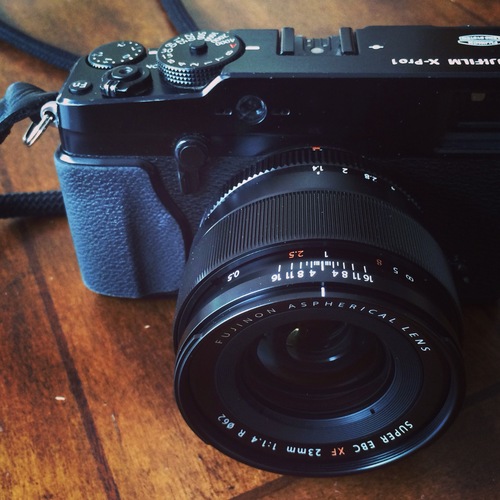
At 300g and 63mm long, the original 23mm is noticeably smaller and lighter than the LM WR version. This makes a difference when shooting all day, especially on smaller bodies like the X-E series or X-T30 II. The compact package feels more balanced and less front-heavy, which can reduce fatigue during long shooting sessions.
Optically, this lens still delivers superb image quality. While it may show slightly more softness in the corners when wide open compared to the newer version, it’s still razor-sharp in the center and produces that characteristic Fujifilm color and microcontrast that photographers love. For most real-world applications—street photography, portraits, environmental shots—the optical differences are minimal once you stop down to f/2.8 or smaller.

The 62mm filter thread is worth noting because it matches several other popular Fujifilm primes, including the XF 35mm f1.4 R and XF 56mm f1.2 R. This means if you already have a filter collection for those lenses, you’re all set. The newer LM WR’s 58mm thread size means investing in new filters or using step rings, which adds to the total cost of ownership.
Where the original shows its age is in autofocus performance. The micromotor system is noticeably louder and slower than the linear motor in the LM WR. In good light, it’s still perfectly adequate for most subjects. In low light or with moving subjects, you’ll notice the difference. That said, many photographers who primarily use manual focus don’t find this limiting at all.
Fuji XF 23mm f1.4 R vs R LM WR: Head-to-Head Comparison
Autofocus Performance: LM WR Wins Decisively
The autofocus difference between these two lenses is dramatic. The linear motor in the LM WR focuses almost instantly, with a near-silent operation that’s essential for street and event photography. The micromotor in the original R version is audibly louder and takes noticeably longer to acquire focus. For video work, the LM WR’s smooth, silent focus pulls make it the clear winner.
Forum discussions consistently confirm this experience. Users who’ve upgraded from the original to the LM WR report the AF speed difference as one of the most significant improvements, especially when paired with newer camera bodies like the X-T5 that can take full advantage of the faster motor.
Weather Sealing: Exclusive to LM WR
This is a straightforward comparison—only the LM WR offers weather sealing. The 11-point sealing system protects against dust and moisture, making it suitable for outdoor shooting in less-than-ideal conditions. If you photograph weddings, travel frequently, or shoot street photography in variable weather, this feature alone might justify the upgrade cost.
The original R version has no weather sealing whatsoever. While it’s built robustly, you’ll want to avoid using it in rain or dusty environments. For indoor studio work or fair-weather outdoor photography, this may not be a dealbreaker.
Build Quality and Design: Different Philosophies
Both lenses feature excellent build quality, but they take different approaches. The LM WR emphasizes weather resistance and modern refinement, with a slightly larger profile to accommodate the sealing and linear motor. The original R prioritizes compact dimensions and includes the focus clutch mechanism that many Fujifilm enthusiasts prefer.
The distance scale on the original R version is a significant advantage for manual focus shooters who use zone focusing techniques. The LM WR omits this feature, which some photographers find disappointing. However, the LM WR’s faster autofocus often reduces the need for manual zone focusing in the first place.
Optical Quality: Subtle Improvements in LM WR
Both lenses deliver excellent image quality with that characteristic Fujifilm look. The differences are subtle but measurable. The LM WR shows improved corner sharpness when shooting wide open at f/1.4, better chromatic aberration control, and smoother bokeh thanks to the additional aperture blades.
However, once you stop down to f/2.8 or smaller, the differences become negligible. For most real-world shooting, both lenses produce images that are virtually indistinguishable from each other in terms of sharpness and overall optical quality. The LM WR has an advantage for high-resolution bodies like the X-T5 and X-H2, where its 40MP resolving power ensures you’re getting the most out of those sensors.
Close Focus Performance: LM WR’s Significant Advantage
The minimum focus distance difference is substantial: 19cm for the LM WR versus 28cm for the original R version. This 9cm difference, combined with the improved 0.2x magnification ratio, transforms how you can use the 23mm focal length. Environmental portraits with strong background separation, close-up details in street scenes, and pseudo-macro shots are all possible with the LM WR but challenging with the original.
This is one of the most frequently mentioned benefits in user discussions—photographers who’ve upgraded consistently cite the close focus improvement as unexpectedly valuable in everyday shooting.
Size, Weight, and Handling: R Version is More Compact
The original R version is the clear winner here. At 300g and 63mm long, it’s significantly smaller and lighter than the 380g, 78mm LM WR. The difference is noticeable when mounted on smaller camera bodies and can reduce fatigue during long shooting sessions. If you value compactness or do a lot of travel photography, the original’s smaller footprint is a genuine advantage.
Filter Considerations: Practical Cost Differences
The filter thread change from 62mm on the original to 58mm on the LM WR has practical implications for total cost of ownership. If you already own 62mm filters for other Fuji primes, the original maintains compatibility. The LM WR requires new filters or step rings, adding to the overall investment.
Verdict: Which XF 23mm f1.4 Should You Buy in 2026?
The choice between these two excellent lenses ultimately comes down to your specific needs, shooting style, and budget. Here’s my recommendation based on common photographer profiles:
Choose the XF 23mm f1.4 R LM WR If:
- You shoot street photography or events and need fast, silent autofocus
- You frequently shoot in adverse weather and need weather sealing
- You use high-resolution bodies like the X-T5 or X-H2
- You want close focus capability for more versatile shooting
- You primarily autofocus and don’t rely on manual focus features
- You want the most future-proof option for your kit
Choose the XF 23mm f1.4 R If:
- You’re on a tighter budget and want maximum value
- You prefer manual focus and appreciate the focus clutch mechanism
- You use zone focusing techniques and need a distance scale
- You already own 62mm filters for other Fuji lenses
- You shoot primarily in good conditions and don’t need weather sealing
- You prioritize compactness and lighter weight
- You mainly shoot at f/2.8 or smaller where optical differences are minimal
Final Recommendation
For most Fujifilm photographers in 2026, the XF 23mm f1.4 R LM WR represents the better long-term investment. The weather sealing, dramatically improved autofocus, and close focus capability make it a more versatile lens that can handle a wider range of shooting situations. The optical improvements, while subtle, future-proof it for higher-resolution bodies.
However, the original XF 23mm f1.4 R remains an excellent value, especially for photographers who shoot primarily in fair conditions and don’t need the fastest autofocus. Its optical quality is still superb, the focus clutch is a joy to use, and the lower price point makes it accessible to more photographers.
Frequently Asked Questions
Is the Fuji XF 23mm f1.4 R LM WR any good?
The XF 23mm f1.4 R LM WR is exceptional. It combines weather sealing, fast near-silent autofocus, and improved optics with close focus capability that makes it one of the most versatile primes in the Fujifilm lineup. It’s particularly well-suited for street photography, event work, and everyday shooting where reliability and quick performance matter.
What’s the difference between the old and new 23mm f1.4?
The key differences are: weather sealing (LM WR only), autofocus speed (linear motor vs micromotor), minimum focus distance (19cm vs 28cm), aperture blades (9 vs 7), filter size (58mm vs 62mm), and weight (380g vs 300g). The LM WR also has improved corner sharpness wide open and better chromatic aberration control.
Is the upgrade from XF 23mm f1.4 R to R LM WR worth it?
For most photographers, yes. The weather sealing and dramatically faster autofocus alone justify the upgrade for outdoor and event shooters. The improved close focus capability (19cm vs 28cm) transforms how you can use the lens. However, if you primarily use manual focus and shoot in good conditions, the original remains excellent.
How does weather sealing work on the XF 23mm f1.4 WR?
The LM WR features weather sealing at 11 points throughout the lens barrel, protecting against dust and moisture. It’s rated for operation down to -10°C (14°F). This makes it suitable for shooting in light rain, dusty environments, and other challenging conditions where non-sealed lenses might be at risk.
What is the minimum focus distance of XF 23mm f1.4 R LM WR?
The XF 23mm f1.4 R LM WR focuses down to 19cm (approximately 7.5 inches) with a 0.2x magnification ratio. This is significantly closer than the original R version’s 28cm minimum focus distance, making the LM WR much more versatile for close-up shots and environmental portraits.
Is the XF 23mm f1.4 R still good in 2026?
Absolutely. The original XF 23mm f1.4 R still delivers excellent image quality, superb build quality, and the coveted focus clutch mechanism that many photographers prefer. It’s particularly compelling as a value option for photographers who don’t need weather sealing or fastest autofocus, or who primarily shoot at smaller apertures where optical differences are minimal.
Conclusion
Both lenses are excellent optical performers that can produce stunning images. The right choice depends on your specific needs as a photographer. Consider how you shoot, where you shoot, and what features matter most to your workflow. With either choice, you’re getting one of Fujifilm’s most beloved prime lenses in a focal length that has served photographers exceptionally well for over a decade.