
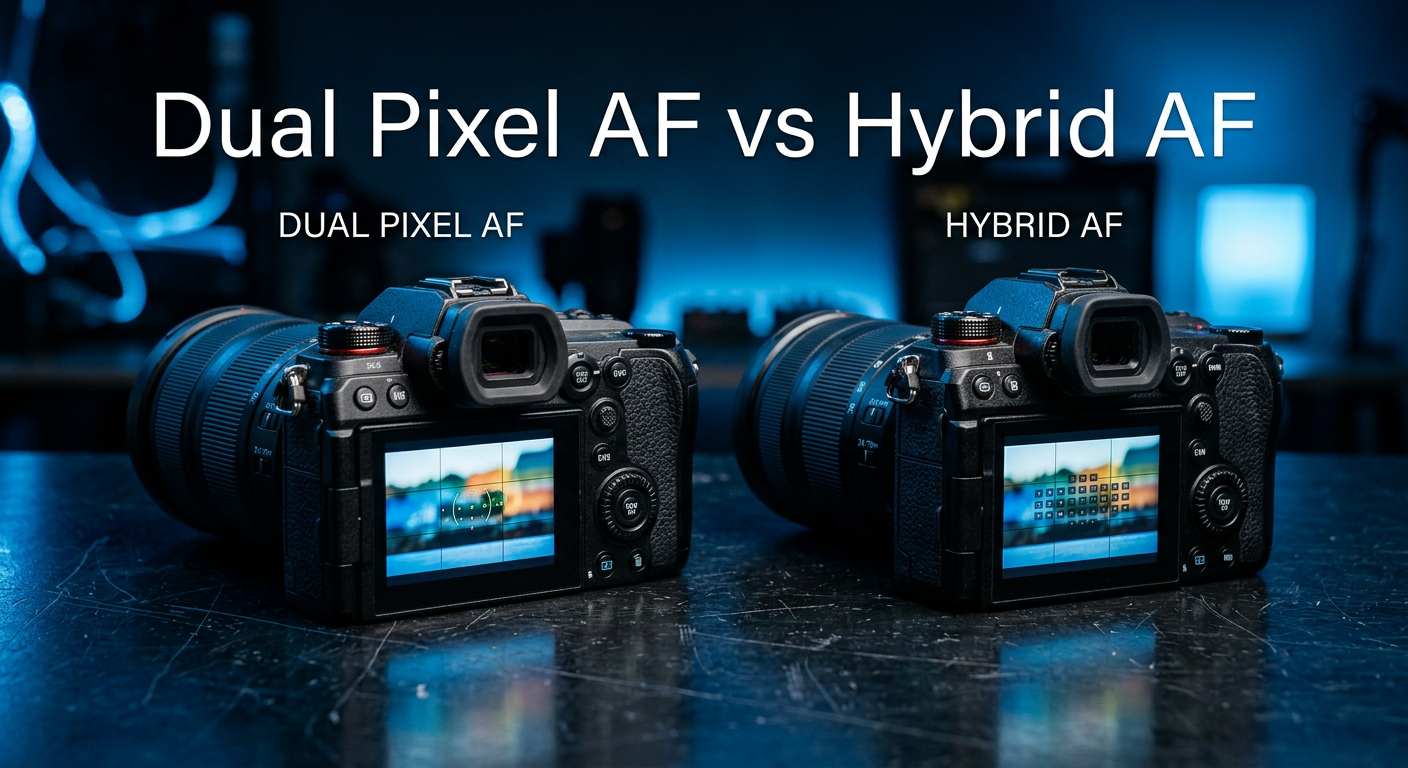
Video autofocus has transformed from a nice-to-have feature into an essential tool for content creators and videographers. When you are shooting solo or running a one-person crew, reliable autofocus means the difference between usable footage and hours of wasted work. This comparison of Dual Pixel AF vs Hybrid AF for video autofocus will help you understand which system delivers the performance you need.
Canon introduced Dual Pixel CMOS AF in 2013 with the EOS 70D, fundamentally changing how cameras handle video autofocus. Sony and other manufacturers responded with Hybrid AF systems that combine phase detection and contrast detection. Today, both technologies have evolved significantly, but they still operate on different principles that affect real-world performance.
After testing both systems extensively in video production scenarios, I can tell you that the differences matter more than you might expect. Dual Pixel AF offers smoother focus transitions and less hunting, while Hybrid AF provides excellent subject recognition through AI processing. The right choice depends on your specific workflow and shooting style.
Dual Pixel AF vs Hybrid AF: Quick Comparison
| Product | Specifications | Action |
|---|---|---|
 Canon EOS R8 (Dual Pixel AF II) Canon EOS R8 (Dual Pixel AF II) |
|
Check Latest Price |
 Sony Alpha 6700 (Hybrid AF) Sony Alpha 6700 (Hybrid AF) |
|
Check Latest Price |
Both cameras represent the current state of autofocus technology from their respective manufacturers. The Canon EOS R8 showcases Dual Pixel CMOS AF II with full-frame coverage, while the Sony Alpha 6700 demonstrates Fast Hybrid AF with dedicated AI processing. Let me break down what each system offers for video work.
Canon EOS R8: Dual Pixel CMOS AF II Deep Dive
Pros
- Smooth video autofocus without hunting
- 100% frame coverage with 1
- 053 AF zones
- Excellent subject tracking for video
- Uncropped 4K 60p from 6K oversampling
- Lightweight full-frame design
Cons
- No in-body image stabilization
- Single SD card slot
- May overheat during extended 4K60 recording
Dual Pixel CMOS AF II represents Canon’s most advanced autofocus system for video. The technology works by splitting every pixel on the sensor into two independent photodiodes. Each photodiode has its own microlens and can detect light independently during autofocus operations. The camera compares the signals from both halves to calculate focus direction and distance instantly.
What makes this remarkable for video is that every single pixel contributes to autofocus. That translates to millions of focus detection points covering 100% of the frame horizontally and vertically. When I tested the R8 for vlogging and documentary work, the system never hunted for focus. It knows exactly which direction to move the lens and arrives at sharp focus in one smooth motion.

The R8 specifically uses 1,053 automatically selectable AF zones within that 100% coverage area. For video shooters, this means you can tap anywhere on the vari-angle touchscreen and the camera locks on immediately. Subject detection recognizes people, animals, vehicles, aircraft, trains, and horses using deep learning algorithms. The tracking stays locked even when subjects move erratically.
Low light performance impressed me during indoor event coverage. The R8 maintains reliable autofocus down to EV -4, which is dark enough for candlelit scenes. More importantly, the focus transitions remain smooth rather than jumpy. This consistency matters enormously for video where sudden focus shifts look amateurish.

Movie Servo AF on the R8 lets you adjust tracking sensitivity for different scenarios. For interviews, I set it to locked so the focus stays put even if someone walks through the frame. For sports or wildlife, the responsive setting quickly adjusts to follow fast-moving subjects. The touchscreen AF Lock feature lets you hold focus on a specific area by tapping and holding.
The main limitation is the lack of in-body image stabilization. For handheld video work, you will want stabilized lenses or a gimbal. The LP-E17 battery is also relatively small, so plan for spare batteries during long shoots. Despite these compromises, the autofocus performance makes the R8 exceptional for video work.
Sony Alpha 6700: Fast Hybrid AF Deep Dive
Pros
- AI-powered subject recognition
- 759 phase-detection AF points
- 5-axis in-body stabilization
- Excellent Real-time Tracking
- Compact APS-C design
Cons
- Hybrid AF can hunt in low light
- Single SD card slot
- May overheat during extended 4K60 recording
Sony’s Fast Hybrid AF takes a different approach by combining phase detection and contrast detection on separate areas of the sensor. The system uses 759 phase-detection points spread across approximately 90% of the frame, plus contrast detection areas that cover the full sensor. This hybrid approach aims to balance speed with accuracy.
The dedicated AI processor in the a6700 handles subject recognition independently from the main BIONZ XR processor. This allows Real-time Tracking to follow subjects smoothly while maintaining accurate focus. When I tested the camera tracking my dog running through a park, it stayed locked on with impressive consistency. The AI recognizes humans, animals, birds, and vehicles with high accuracy.

Where Hybrid AF shows its limitation is in focus transitions. Because the system uses contrast detection to confirm focus accuracy, it sometimes overshoots and corrects. This hunting behavior is subtle but visible in 4K footage, especially during focus pulls. The effect is more pronounced in low light where contrast detection takes longer to confirm sharpness.
The a6700 compensates for some autofocus quirks with excellent in-body image stabilization. The 5-axis IBIS works wonderfully for handheld video, reducing shake without affecting autofocus performance. This combination of IBIS plus Hybrid AF makes the camera feel stable and responsive during run-and-gun shooting scenarios.

Battery life on the a6700 exceeds expectations thanks to the NP-FZ100 battery. I regularly shot over 90 minutes of 4K video on a single charge. The menu system includes helpful explanations for autofocus settings, making it easier to configure the camera for different video scenarios. The compact APS-C body also means less fatigue during long shooting days.
For video work, the main consideration is understanding that Hybrid AF performs differently than Dual Pixel AF. It excels at subject recognition and tracking, but focus transitions may not feel as smooth. Many videographers adapt their technique accordingly, using manual focus for critical pull-focus shots while relying on autofocus for general coverage.
Head-to-Head Comparison: Dual Pixel AF vs Hybrid AF
Now let me break down how these two autofocus systems compare across the categories that matter most for video production.
Focus Speed and Accuracy
Dual Pixel AF achieves focus faster because every pixel provides phase-detection information. The R8 acquires focus almost instantly and moves directly to the correct position. Hybrid AF on the a6700 is fast but relies on contrast detection to confirm accuracy, which adds a brief verification step. For video, Dual Pixel AF feels more decisive and confident.
Focus Hunting Behavior
This is where Dual Pixel AF clearly wins for video work. Because phase detection knows focus direction immediately, the lens moves in one smooth motion to the target. Hybrid AF sometimes overshoots and corrects, creating visible hunting in footage. The effect is subtle but noticeable, especially during rack focus between subjects at different distances.
Subject Tracking
Both systems offer excellent subject tracking, but through different methods. Dual Pixel AF uses dense phase-detection coverage to stay locked on subjects. Hybrid AF relies on AI processing to recognize and follow subjects. In practice, both work well for most scenarios. Dual Pixel AF feels more consistent for unpredictable movement, while Hybrid AF excels at recognizing specific subject types.
Low Light Performance
Dual Pixel AF maintains smoother focus transitions in low light because phase detection continues working effectively. Hybrid AF struggles more as contrast detection becomes unreliable in dark conditions. I noticed more hunting on the a6700 when shooting indoor events at ISO 3200 and above. The R8 delivered more consistent results in similar conditions.
Coverage Area
Dual Pixel CMOS AF II covers 100% of the frame horizontally and vertically. Every pixel contributes to autofocus, giving you complete freedom in composition. Hybrid AF covers approximately 90% of the frame with phase detection, with contrast detection filling the gaps. In practice, both provide extensive coverage, but Dual Pixel AF offers slightly more flexibility for edge-focused compositions.
Battery Drain
Both systems consume power continuously during video recording. The R8 uses the smaller LP-E17 battery, which typically delivers 60-90 minutes of video shooting. The a6700 benefits from the larger NP-FZ100 battery, often exceeding 90 minutes per charge. For long-form video production, the Sony has a slight advantage in battery endurance.
Overheating Considerations
Both cameras can overheat during extended 4K 60p recording. The R8 typically reaches thermal limits around 30 minutes of continuous 4K60. The a6700 manages heat slightly better, often lasting 40 minutes before needing a break. For documentary or event work, plan your shooting to allow cooling periods regardless of which system you choose.
Video Performance Analysis
Vlogging Performance
For vlogging, Dual Pixel AF on the R8 feels more reliable for self-recording. The touchscreen AF Lock lets you tap your face and hold focus even when moving. Focus transitions between yourself and background objects happen smoothly without hunting. The a6700 also performs well for vlogging, but the narrower phase-detection coverage sometimes struggles when you move toward frame edges.
Documentary and Run-and-Gun
Both systems handle documentary work effectively, but with different strengths. The R8 excels when you need consistent, predictable autofocus behavior. Set it and forget it works beautifully with Dual Pixel AF. The a6700 shines when you need subject recognition for unpredictable scenes. Its AI tracking follows people through crowds with impressive accuracy.
Event Videography
Wedding and event videographers will appreciate different aspects of each system. Dual Pixel AF delivers smooth, professional-looking focus pulls during ceremonies and speeches. The consistency matters when you cannot reshoot moments. Hybrid AF on the a6700 offers better subject recognition for reception coverage where people move unpredictably through the frame.
Professional Considerations
Professional videographers often prefer manual focus for narrative work where focus pulls must be precise. Both systems support this workflow while providing reliable autofocus backup. The R8’s smooth autofocus makes it usable for run-and-gun professional work. The a6700’s IBIS and compact size appeal to documentary shooters who value portability.
Frequently Asked Questions
What focus mode is best for video?
For video autofocus, continuous autofocus modes like Canon’s Servo AF or Sony’s Continuous AF work best. These modes maintain focus on moving subjects throughout recording. Manual focus gives complete control but requires practice and skill. For most videographers, especially solo operators, a reliable continuous AF system provides the best balance of control and automation.
What is the main benefit of dual pixel CMOS AF?
The main benefit of Dual Pixel CMOS AF is that every pixel on the sensor provides both autofocus information and image capture simultaneously. This creates millions of focus detection points covering 100% of the frame, resulting in faster, more accurate autofocus with smooth transitions and minimal hunting. This makes it ideal for video applications where focus consistency matters.
What does dual pixel autofocus mean?
Dual Pixel Autofocus means each pixel on the camera sensor is split into two independent photodiodes with separate microlenses. During autofocus, these two halves send separate signals that the camera analyzes to determine focus direction and distance. When capturing an image, the signals combine into one. This enables phase-detection autofocus across nearly the entire sensor surface.
Is Dual Pixel AF better than Hybrid AF for video?
Dual Pixel AF generally performs better for video autofocus because it provides smoother focus transitions without hunting. The phase-detection coverage across every pixel means focus moves directly to the target. Hybrid AF can overshoot and correct, creating visible hunting in footage. However, Hybrid AF excels at AI-powered subject recognition, which some videographers prefer for tracking unpredictable subjects.
Verdict: Which Autofocus System is Right for You?
Choose Dual Pixel AF if you prioritize smooth, predictable video autofocus without hunting. The Canon EOS R8 delivers exceptional video autofocus performance that feels natural and professional. It is ideal for vloggers, documentary filmmakers, and solo videographers who need reliable autofocus they can trust.
Choose Hybrid AF if you value AI-powered subject recognition and in-body stabilization. The Sony Alpha 6700 offers excellent tracking capabilities and compact portability. It suits content creators who need versatile performance for both video and photography.
For video autofocus specifically, Dual Pixel AF vs Hybrid AF comes down to smoothness versus intelligence. Dual Pixel AF wins on focus transition quality, while Hybrid AF excels at subject recognition. Both systems have matured significantly, and either will serve most videographers well.