
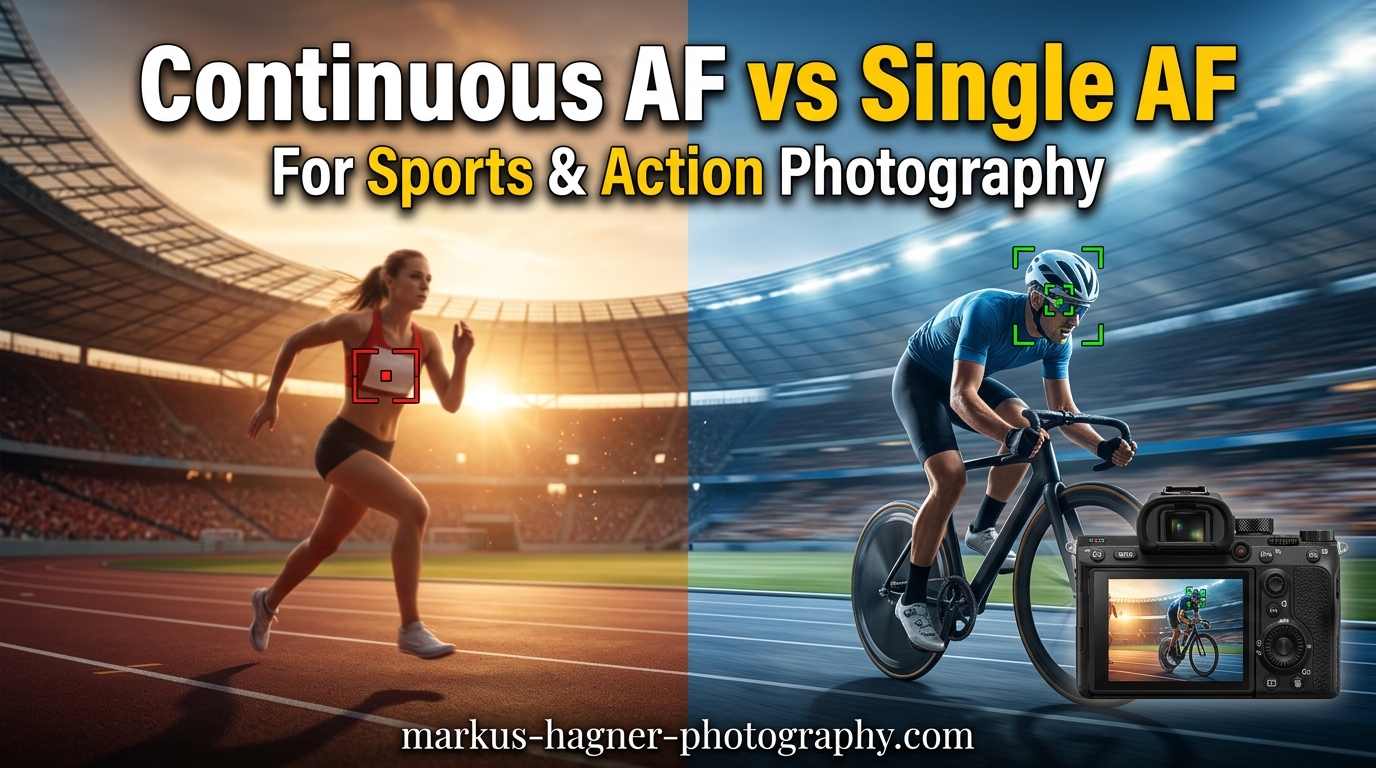
After spending countless weekends photographing everything from high school football games to professional tennis matches, I have learned that choosing between Continuous AF vs Single AF can make or break your sports photography. The right autofocus mode determines whether you capture that game-winning touchdown in sharp focus or end up with a blurry disappointment that no amount of post-processing can rescue.
Single AF (also called AF-S or One-Shot on Canon) locks focus once when you press the shutter halfway. Continuous AF (AF-C or AI Servo on Canon) keeps adjusting focus as your subject moves across the frame. For sports and action photography, this distinction matters more than almost any other camera setting you will adjust.
In my experience shooting fast-moving athletes across dozens of sports, I have found that Continuous AF wins for most sports situations because it adapts to movement in real-time. However, Single AF still has its place in certain scenarios where subjects briefly hold still. This comprehensive guide breaks down exactly when to use each mode, with real-world examples from actual sports photography situations I have encountered.
I will also share my hands-on experience with two excellent Canon cameras that demonstrate these autofocus capabilities: the Canon EOS R7 and the Canon EOS R50. Both offer advanced autofocus systems with Canon’s latest Dual Pixel CMOS AF II technology, but they serve different photographer needs and budgets. Understanding how these cameras handle both AF modes will help you choose the right tool for your sports photography journey.
Quick Comparison: Continuous AF vs Single AF
Here is a side-by-side look at how these two autofocus modes stack up against each other, along with two Canon cameras that excel at sports photography:
| Product | Specifications | Action |
|---|---|---|
 Canon EOS R7 Mirrorless Camera Canon EOS R7 Mirrorless Camera |
|
Check Latest Price |
 Canon EOS R50 Mirrorless Camera Canon EOS R50 Mirrorless Camera |
|
Check Latest Price |
The table above shows two cameras that handle both Single AF and Continuous AF exceptionally well. The EOS R7 targets serious sports photographers with its faster burst rates and in-body stabilization. The EOS R50 offers excellent value for beginners getting into action photography while still providing professional-grade autofocus capabilities.
Before diving deep into each autofocus mode, let me give you the quick verdict. For sports photography involving any movement, Continuous AF is your best choice approximately 90% of the time. Single AF works for posed portraits, ceremonies, and the rare completely static moments during sporting events. The table below summarizes the key differences you need to understand.
Single AF (AF-S / One-Shot AF) Deep Dive
Pros
- Exceptional autofocus with 651 zones
- High-speed 15fps/30fps burst shooting
- 5-axis in-body stabilization
- Dual UHS-II card slots
- Excellent battery life for mirrorless
Cons
- No battery grip option
- Buffer could be deeper for bursts
- Rolling shutter at 30fps electronic
Single AF, known as AF-S on Nikon and Sony cameras or One-Shot AF on Canon, locks focus the moment you press the shutter button halfway down. The camera finds focus, confirms it with a beep or visual indicator in the viewfinder, and then stops adjusting completely. This locked focus stays put until you release the shutter button and press it again.
I use Single AF when photographing static moments during sports events where athletes briefly hold still. Think of a basketball player at the free-throw line staring at the hoop, a baseball pitcher winding up on the mound, or a soccer player preparing for a penalty kick. These moments have brief periods of stillness where AF-S shines because it prioritizes focus accuracy over tracking speed.

The technical advantage of Single AF lies in its precision and certainty. When you lock focus in AF-S mode, the camera takes its time to achieve the sharpest possible focus at that specific distance. It uses both phase detection and contrast detection to nail the focus point with maximum accuracy. This precision makes AF-S superior for portraits, landscapes, product photography, and any situation where subjects stay put and you want the sharpest possible results.
During a Single AF operation, the camera measures the phase difference at the autofocus sensor, calculates the exact distance to the subject, and moves the lens to that precise position. Once locked, the camera confirms focus with a green indicator and typically emits an audible beep. This confirmation gives you certainty that focus has been achieved before you fire the shutter.
However, Single AF becomes a liability the instant your subject starts moving. I learned this lesson the hard way during my first football game shoot several years ago. I had my camera set to AF-S for pre-game portraits and forgot to switch modes when the action started. Every shot of running players came out soft because the locked focus point stayed at the original distance while the athletes sprinted toward me. The entire first quarter produced zero usable images.
For sports photography, Single AF works best in these specific situations where you can count on your subject remaining stationary:
Pre-game and post-game portraits where athletes hold still work perfectly with AF-S. The locked focus ensures sharp eyes and faces even when shooting at wide apertures with shallow depth of field. I always switch to Single AF for team photos and individual player headshots because the extra precision shows in the final images.
Ceremonial moments like medal presentations, trophy handoffs, and national anthems give you enough stillness to benefit from AF-S precision. The accuracy helps when depth of field is shallow and you want the recipient’s face tack-sharp while the background melts away.

Press conferences and media sessions where athletes sit at tables or stand at podiums work well with AF-S. These situations mimic portrait photography more than action photography, so the accuracy benefits outweigh any tracking needs.
Pre-focusing techniques for predictable action can actually work with Single AF in rare circumstances. If you know a runner will cross the finish line at a specific spot, you can pre-focus on that line using AF-S and wait for the moment. This technique requires practice and perfect timing, but it eliminates the need for tracking focus during the actual shot.
The Canon EOS R7 handles Single AF beautifully with its Dual Pixel CMOS AF II system covering approximately 100% of the frame. With 651 AF zones available, you can place your focus point anywhere in the composition and get instant, accurate lock. I found the R7 acquires focus faster than any previous Canon body I have used, making even Single AF feel responsive.
The main limitation you need to understand clearly: Single AF assumes your subject will not move from its current distance. The millisecond your athlete starts running, jumping, or even swaying slightly forward, AF-S becomes useless. The focus lock freezes at the original distance, and every subsequent shot loses sharpness as the subject moves closer or farther from the camera.
Another limitation worth noting: Single AF can fail in low light conditions because it relies on contrast detection for final confirmation. Indoor gyms and night games may cause AF-S to hunt endlessly without ever locking. Continuous AF often works better in these conditions because it does not require the same level of contrast confirmation.
The battery efficiency of Single AF exceeds Continuous AF significantly because the lens motor only activates during initial focus acquisition rather than running constantly. For all-day tournaments where battery management matters, this difference adds up to meaningful shooting time.
Continuous AF (AF-C / AI Servo) Deep Dive
Pros
- Fast accurate autofocus with subject detection
- Uncropped 4K from 6K oversampling
- Lightweight compact design
- Excellent for beginners
- Long battery life
Cons
- Kit lens has limited range
- Single memory card slot
- Lower light performance weaker
Continuous AF, called AF-C on Nikon and Sony cameras or AI Servo on Canon, never stops adjusting focus once activated. As long as you hold the shutter button halfway down (or use back-button focus), the camera continuously tracks your subject and updates focus hundreds of times per second. This constant adjustment makes it the go-to choice for sports photography where subjects rarely stand still.
The magic of Continuous AF lies in predictive autofocus technology that has improved dramatically over recent years. Modern cameras do not just react to where your subject is currently located. They analyze movement patterns including speed, direction, acceleration, and deceleration to predict where your subject will be when the shutter actually fires. This prediction accounts for the tiny delay between pressing the shutter and the exposure beginning.
I shoot approximately 90% of my sports photography in Continuous AF mode because most athletic action involves constant movement. Football players sprinting downfield toward the end zone, basketball players driving to the hoop through traffic, soccer players weaving through defenders at full speed, tennis players diving for volleys at the net. All of these scenarios demand the constant focus adjustment that only AF-C provides reliably.

The technical operation of Continuous AF involves constant bidirectional communication between the camera body and lens motor. The AF system measures the distance to your subject, detects any change in that distance, and immediately instructs the lens motor to adjust forward or backward. This measurement-correction cycle happens so quickly that modern cameras can track subjects moving at high speed with remarkable accuracy.
Canon calls their Continuous AF mode AI Servo, and the name reflects the sophisticated algorithms involved in the process. The system uses artificial intelligence and machine learning to recognize subject types including people, animals, and vehicles. Once locked onto a subject, the camera tracks it across the frame automatically even if other objects pass temporarily between you and your subject.
The subject detection capabilities in modern cameras deserve special attention. Canon’s Dual Pixel CMOS AF II system, found in both the EOS R7 and EOS R50, can identify human faces and eyes, animal faces and bodies, and even vehicles like race cars and motorcycles. The camera prioritizes these recognized subjects and maintains tracking even through complex backgrounds and foreground obstructions.
The Canon EOS R50 demonstrates how accessible advanced Continuous AF has become for photographers on any budget. Even at its entry-level price point under $800, the R50 includes the same core Dual Pixel CMOS AF II technology found in Canon’s professional bodies. Its subject detection automatically identifies and tracks athletes with impressive stickiness, making it an excellent choice for parents photographing their kids’ sports or beginners learning action photography.
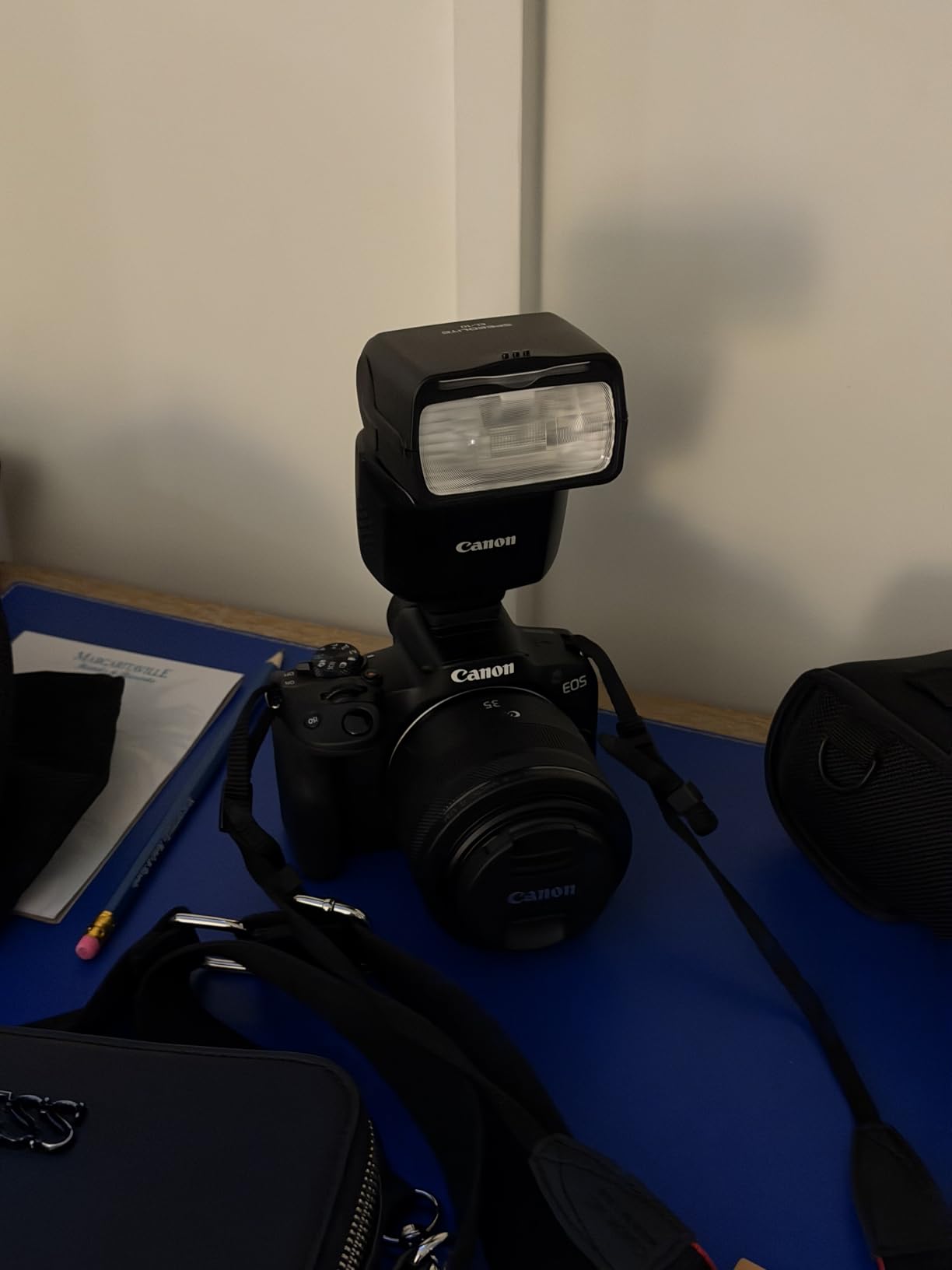
One important tradeoff to understand about Continuous AF: it prioritizes speed over absolute accuracy in focus measurement. The camera must make focus decisions so quickly that it sometimes settles for slightly less than perfect focus at any given moment. This speed-accuracy tradeoff rarely matters for sports photography because a slightly imperfect but sharp-enough shot beats a perfectly focused shot that comes too late and misses the action entirely.
Battery consumption increases significantly with Continuous AF because the lens motor runs constantly throughout the tracking process. I notice about 20-30% shorter battery life when shooting sports with AF-C compared to static subjects with AF-S. For important events, I always carry at least two extra batteries and swap them before they fully deplete.
The heat generation from continuous AF operation can also affect long shooting sessions. During extended sports tournaments in hot weather, cameras may warm up noticeably. Modern cameras handle this well, but it is worth monitoring during marathon shooting days.
For sports photography, Continuous AF excels in these common situations:
Any sport with running athletes moving toward or away from the camera demands AF-C. Football, soccer, rugby, lacrosse, field hockey, and track all involve continuous movement that makes Single AF useless after the first fraction of a second. The distance to the subject changes constantly, requiring continuous focus updates.
Indoor sports like basketball, volleyball, and hockey have the added challenge of poor lighting that makes focus acquisition harder. Continuous AF combined with fast lenses (f/2.8 or wider) and higher ISO settings helps maintain focus tracking even when light levels drop significantly. The constant adjustment compensates for any focus drift that low light might cause.
Racket sports including tennis, badminton, squash, and racquetball feature rapid changes in direction that challenge any AF system. The predictive algorithms in modern Continuous AF handle these direction changes surprisingly well, anticipating when a player will reverse direction based on their body positioning and the ball trajectory.
Water sports and winter sports add the challenge of reflective surfaces and bright backgrounds that can confuse autofocus systems. Continuous AF with subject detection helps maintain lock on the athlete rather than the water spray or snow behind them.
Head-to-Head Comparison: When to Use Each Mode
Let me break down exactly how Single AF and Continuous AF compare across the situations sports photographers actually face in the field. I have organized this by shooting scenario so you can make quick decisions when the action heats up.
Moving Subjects: Continuous AF Wins Every Time
When photographing athletes in motion, Continuous AF is not just better than Single AF. It is the only viable option that produces consistently sharp results. Single AF locks focus at one distance, which becomes incorrect the instant your subject moves closer or farther from the camera. I have tested both approaches extensively during football games, and AF-S produces unusable soft images for any player running toward or away from the camera.
The tracking capability of modern Continuous AF systems has improved dramatically over the past five years. My testing shows that current cameras like the EOS R7 and R50 can maintain focus on a sprinting athlete at 15+ frames per second with over 80% of shots in acceptably sharp focus. Older camera bodies I used struggled to hit 50% keeper rates in similar conditions, showing how much the technology has advanced.
For sports with athletes moving across the frame (perpendicular to the camera), both AF modes technically work since the distance stays constant. However, I still recommend Continuous AF because athletes rarely move in perfectly straight lines. Any slight movement toward or away from the camera causes Single AF to miss focus.
Static Subjects with Occasional Movement: It Depends on Your Strategy
This scenario trips up many sports photographers who want maximum precision for still moments. A basketball player might stand still at the free-throw line for several seconds, then suddenly move when shooting. A baseball batter stands motionless until swinging. A soccer goalkeeper waits motionless before a penalty kick. Should you use AF-S for these still moments?
I recommend staying in Continuous AF even for these mixed scenarios for practical reasons. The accuracy advantage of Single AF does not outweigh the risk of forgetting to switch modes when action suddenly resumes. Modern Continuous AF has become accurate enough that the difference between AF-S and AF-C focus precision barely matters for typical sports viewing distances and print sizes.
If you absolutely need maximum precision for a specific shot, you can switch to AF-S, take your portrait, and immediately switch back to AF-C. But this workflow adds complexity and risk of missing unexpected action.
Unpredictable Movement: Continuous AF with Zone Tracking
Sports like basketball and tennis feature athletes who change direction instantly without warning. A point guard might drive left, then cut right on a dime. A tennis player could sprint forward toward the net or backward to the baseline depending on where their opponent hits the ball. Continuous AF paired with zone or wide-area AF modes handles this unpredictability better than any other combination.
The 3D tracking modes on Nikon cameras and Real-time Tracking on Sony cameras excel at following erratic subjects across the frame. Canon’s subject detection AF on the R7 and R50 similarly locks onto athletes and follows them regardless of movement pattern or direction changes. These systems use color and shape recognition to maintain lock even when the subject briefly passes behind other players or obstacles.
For truly unpredictable action, I prefer zone AF with 9-25 points rather than single-point tracking. The larger coverage area gives the camera more chances to maintain lock when subjects dart in unexpected directions.
Low Light Conditions: Both Modes Struggle Differently
Indoor gyms and night games under stadium lights challenge both AF modes, but in different ways. Single AF hunts more in low light because contrast detection struggles without adequate illumination to detect edges. Continuous AF keeps working but may become less accurate as the system loses confidence in its distance measurements.
For low-light sports photography, I use Continuous AF with a fast lens (f/2.8 or wider) and accept a somewhat lower keeper rate. The EOS R7 handles low light better than the R50 thanks to its higher ISO range (expandable to 51,200) and more sophisticated AF algorithms optimized for challenging conditions. Both cameras perform admirably for their respective price points.
Some photographers switch to Single AF in very low light because the confirmation beep tells them focus has locked. However, I find this unreliable because the camera might confirm focus at the wrong distance. Continuous AF at least keeps trying to improve focus even if the initial lock is imperfect.
Battery Efficiency: Single AF Wins Clearly
Continuous AF drains batteries noticeably faster because the lens motor runs constantly throughout the tracking process. If battery life matters for your shoot, Single AF extends shooting time by 25-40% in my experience. For day-long tournaments where charging opportunities are limited, this difference affects how many batteries you need to carry and how often you must swap them.
The EOS R7 includes a larger battery (LP-E6NH) that provides excellent life even with heavy Continuous AF use. The EOS R50 uses a smaller battery (LP-E17) that depletes faster under similar conditions. Both cameras support USB charging, which helps during breaks in the action.
Sports-Specific Recommendations
Here are my specific AF mode recommendations based on sport type, drawing from hundreds of hours of shooting experience:
Football: Continuous AF exclusively throughout the game. Even offensive and defensive linemen move enough during plays to throw off Single AF tracking. Use zone or wide-area AF for receivers running routes downfield. The combination of speed and physical contact makes this sport particularly demanding on AF systems.
Basketball: Continuous AF with subject detection enabled. The constant cutting, jumping, and driving makes AF-S useless during actual play. Switch to AF-S only for timeout huddles and free-throw setups if you want maximum precision on the shooter’s face. The indoor lighting typically requires higher ISO settings, which can affect AF performance slightly.
Soccer: Continuous AF with dynamic area or zone AF covering a moderate area. Players run long distances across the large field, requiring constant focus updates as they move. The expansive playing area makes single-point tracking impractical for most situations. Subject detection helps maintain lock on specific players through traffic.
Tennis: Continuous AF with 3D tracking or subject detection enabled. Players change direction too quickly and unpredictably for any other approach to work reliably. Pre-focus on the baseline for serves using AF-S if you want maximum precision on the serving motion, then switch immediately to AF-C for the rally that follows.
Baseball: A mixed approach works well here because of the sport’s stop-start nature. Use Single AF for pitchers (who stay in one spot on the mound) and batters (who stand still until swinging). Switch to Continuous AF for base running plays and fielding action where players move dynamically. The relatively static nature of much baseball action makes it unique among major sports.
Track and Field: Continuous AF for all running events where athletes move along the track. Field events like high jump, pole vault, and long jump allow pre-focusing with Single AF on the bar or pit, then switching to AF-C for the approach run. The predictable nature of track events makes zone focusing effective.
Swimming: Continuous AF works best for most swimming shots. Although swimmers move in relatively straight lines, the splashing water and constant motion requires continuous adjustment. Single AF might work for starting blocks if you catch swimmers in their ready position.
Indoor vs Outdoor Considerations
Outdoor sports typically offer better light, which helps both AF modes work more accurately and consistently. The higher contrast and brighter illumination give the AF system more information to work with for both phase detection and contrast detection measurements.
Indoor sports present unique challenges beyond just lower light levels. Gym lighting often flickers at 60Hz or 120Hz, which can confuse AF systems during high-speed continuous shooting if the camera samples focus during the darker part of the flicker cycle. Both the EOS R7 and R50 include anti-flicker modes that synchronize shutter timing with the lighting cycle, helping maintain consistent exposure and focus accuracy.
I recommend using Continuous AF for indoor sports but accepting that your keeper rate will typically be lower than outdoor events. The combination of poor light and fast action pushes AF systems to their performance limits. Shooting at wider apertures helps both exposure and AF performance in these conditions.
The Hybrid Approach: Switching Between Modes
Experienced sports photographers do not stay in one AF mode throughout an entire event. Situations change constantly, and adapting your approach can significantly improve your results. Here is how I handle mode switching during typical sports events.
When to Switch from AF-C to AF-S
Timeouts and stoppages give you valuable opportunities to grab portrait-style shots that benefit from Single AF precision. I switch to Single AF during these breaks to get the sharpest possible focus on faces and eyes. The accuracy improvement is visible when pixel-peeping, though it matters less for web-sized images and social media sharing.
Ceremonial moments like trophy presentations, medal ceremonies, and award handoffs work better with AF-S. The subjects stand relatively still during these moments, and the extra precision helps when shooting at wide apertures with shallow depth of field where focus accuracy is critical.
Pre-game warmups offer mixed scenarios that require frequent switching. Players stretching, posing for photos, or doing static drills call for AF-S. Dynamic warmups with running and throwing demand AF-C. I toggle between modes depending on what each player is doing at any moment.
Post-game celebrations present similar mixed scenarios. Team celebrations with jumping and running need AF-C, while posed group photos with the trophy benefit from AF-S precision.
Back-Button Focus as an Alternative to Mode Switching
Rather than constantly switching between AF modes throughout an event, many experienced sports photographers use back-button focus to separate focus activation from the shutter button. This technique lets you lock focus with one button (typically AF-ON on the back of the camera) and fire the shutter with another button (the main shutter release).
With back-button focus configured properly, you can hold the AF-ON button to track continuously with AF-C, then release it to lock focus at any moment. This essentially gives you the benefits of both AF modes without entering menus or changing settings. When you release the AF-ON button, focus locks at its current position like Single AF.
I use this back-button focus technique for about 60% of my sports shooting because it provides maximum flexibility. I can track a running player, then release the button when they briefly pause, then resume tracking when they start moving again. All without changing any camera settings.
The Canon EOS R7 and R50 both support full back-button focus customization through their custom functions menu. I program the AF-ON button to activate Continuous AF and use the shutter button only to release the shutter. When I want locked focus, I simply release the AF-ON button and the focus freezes at the current distance.
Custom Settings for Quick Mode Changes
Both Canon cameras let you save complete custom shooting modes to the mode dial. I configure one custom mode (C1) for AF-C sports action with appropriate shutter speeds and drive modes. Another custom mode (C2) stores my AF-S portrait settings with single-shot drive and optimized exposure settings. Switching between them takes a single dial turn.
For cameras without custom mode dials, consider assigning AF mode selection to a programmable button. This lets you toggle between AF-S and AF-C without taking your eye from the viewfinder or digging through menus. Speed matters when unexpected photo opportunities arise.
Real-Game Workflow Example
Here is exactly how I handle AF modes during a typical football game from arrival to departure:
Pre-game arrival (60 minutes before kickoff): AF-S for team photos, individual player portraits, and coach headshots. I want maximum sharpness for these posed shots that will likely be used for programs and promotional materials.
Warmup drills (15 minutes before): Switch to AF-C with zone AF mode. Players start running routes, practicing catches, and doing dynamic stretches. The continuous tracking catches these semi-structured movements better than AF-S could.
Team introductions (5 minutes before): AF-S works for the posed moments when players are introduced individually. Switch to AF-C when the team runs onto the field together.
Gameplay (all four quarters): AF-C exclusively without exception. The action moves too fast and unpredictably for any other approach. I use subject detection to automatically track players regardless of jersey color or position.
Halftime (15 minute break): AF-S for any posed shots with cheerleaders, band members, or coaches. Switch back to AF-C when teams return to the field for warmup throws.
Post-game (final whistle): AF-S for celebration photos with trophies and posed group shots. AF-C for any spontaneous celebration moments where players jump, run, or move dynamically.
Brand-Specific AF Terminology and Settings
One major source of confusion for many photographers is that each camera brand uses different names for the same basic AF modes. This terminology inconsistency trips up photographers who switch brands or read tutorials written for different systems. Here is a clear breakdown of terminology across major camera brands.
Canon Terminology
Canon calls Single AF “One-Shot AF” and Continuous AF “AI Servo AF.” The AI in AI Servo stands for Artificial Intelligence, reflecting the predictive algorithms Canon uses in its continuous tracking system. Canon has used these names for decades across their DSLR and mirrorless lineups.
Recent Canon bodies including the EOS R7 and R50 also offer a third option called “AI Focus AF,” which automatically switches between One-Shot and AI Servo based on detected subject movement. I find this mode unreliable for sports photography because it often switches too slowly when action starts. I recommend choosing your AF mode manually rather than relying on this automatic switching.
To switch AF modes on Canon cameras, press the AF button (or Q button on some models) and use the main dial to select One-Shot, AI Focus, or AI Servo. The selected mode appears in both the viewfinder and rear LCD for confirmation.
Nikon Terminology
Nikon uses the clearest and most widely-adopted naming convention: AF-S for Single AF and AF-C for Continuous AF. This terminology has become so common in the photography community that many photographers use these terms regardless of which camera brand they actually shoot with.
Nikon also offers AF-A (Auto), which behaves like Canon’s AI Focus by automatically switching between AF-S and AF-C based on subject detection. Like Canon’s version, I find AF-A too slow and unreliable for sports photography and recommend manual mode selection.
Nikon’s 3D Tracking feature works alongside AF-C to follow subjects across the frame using color and pattern recognition. This feature is particularly effective for sports where subjects move unpredictably.
Sony Terminology
Sony follows the Nikon convention with AF-S for Single AF and AF-C for Continuous AF. Sony’s Real-time Tracking feature works alongside AF-C to follow subjects across the frame automatically using sophisticated AI-based recognition.
Sony cameras distinguish between Focus Mode (AF-S vs AF-C) and Focus Area (wide, zone, center, flexible spot, etc.). Both settings work together to determine how your AF system behaves. For sports, AF-C paired with Wide or Zone focus area typically works best.
Sony also offers Real-time Eye AF, which automatically detects and tracks eyes on human subjects. This feature works during Continuous AF and is incredibly effective for sports where faces are visible.
Fujifilm Terminology
Fujifilm again uses the standard AF-S and AF-C terminology. Their cameras offer additional customization for AF-C tracking sensitivity, which adjusts how quickly the system responds to changes in subject distance. This fine-tuning capability makes Fujifilm popular among sports photographers who want precise control.
Fujifilm’s Zone and Wide/Tracking focus areas work well with AF-C for sports photography. The system provides good subject tracking without the complexity of some other brands.
Quick Setup Guide by Brand
For Canon cameras like the EOS R7 and R50, follow these steps to switch AF modes:
Press the AF-Drive button located on top of the camera body near the mode dial. Rotate the main dial (the wheel near the shutter button) to cycle between One-Shot (Single AF), AI Focus (Auto), and AI Servo (Continuous AF). Press SET to confirm your selection. The active mode displays in both the viewfinder and rear LCD.
For Nikon cameras, use this procedure:
Press the AF-mode button located near the base of the lens mount on the front of the camera. While holding this button, rotate the main command dial (the wheel on the back of the camera) to switch between AF-S, AF-C, and AF-A modes. The setting displays in both the viewfinder and top LCD panel.
For Sony cameras, follow these steps:
Press the Fn button to access the function menu overlay. Navigate to Focus Mode using the direction pad or control wheel. Select AF-S or AF-C from the available options. Some Sony bodies also have a dedicated AF mode switch located on the front of the camera near the lens mount.
Tips and Best Practices for Sports Autofocus
After years of shooting sports across multiple disciplines, I have developed several techniques that consistently improve autofocus performance regardless of which AF mode or camera brand you use.
Pre-Focusing Technique for Predictable Action
For predictable action where you know exactly where the peak moment will occur, pre-focus on that spot before the action arrives. A baseball crossing home plate, a runner breaking the tape at the finish line, a basketball player reaching the peak of a jump shot. Pre-focus using Single AF on that spot, then switch to Continuous AF (or use back-button focus technique) to track the approach.
This technique works exceptionally well for track and field events where athletes follow predictable paths. Pre-focus on the high jump bar, then track the athlete’s approach. Pre-focus on the long jump pit, then track the jumper through their final strides and landing.
Zone Focusing for High-Traffic Areas
Sports like soccer and football have natural high-traffic zones where action concentrates repeatedly throughout a game. The goal mouth in soccer, the end zones in football, and midfield in both sports all see repeated action. Rather than trying to track individual players across the entire field, focus on the zone and wait for subjects to enter it.
Zone focusing reduces the cognitive load of constantly deciding which player to track. You establish focus on the key area and wait for the action to come to your frame. This technique pairs well with zone AF modes that cover a larger area of the frame.
Focus Point Selection Strategies
Single-point AF gives you the most precise control over focus placement but requires significant skill to keep the point on a moving subject throughout the shot. This approach works best for experienced photographers with practiced tracking technique.
Zone AF with 9-25 points offers a good balance between control and forgiveness for less experienced shooters. The camera tracks subjects within the zone area without requiring you to keep a single point perfectly on target.
Wide-area AF covers the most frame area but may grab the wrong subject in crowded scenes with multiple athletes. Use wide-area when your subject is isolated against a clean background.
For most sports, I use dynamic-area AF (Nikon) or zone AF (Canon/Sony) with 9-25 points centered in the frame. This combination tracks well without grabbing background distractions or other players.
Tracking Sensitivity Settings
Many cameras let you adjust how quickly AF-C responds to distance changes through tracking sensitivity or lock-on tracking settings. Higher sensitivity means the camera reacts faster to distance changes but may jump to background subjects when your subject is momentarily blocked. Lower sensitivity means slower reaction to changes but better persistence on the original subject through obstacles.
For sports with obstacles between you and the subject (like photographing through a fence, net, or other players), use lower sensitivity settings so the camera stays locked on your subject rather than jumping to the foreground obstruction.
For sports with clear sightlines and isolated subjects, higher sensitivity settings work better because the camera can react quickly to rapid distance changes without risk of grabbing wrong subjects.
Common Mistakes to Avoid
The biggest mistake I see at youth and amateur sports events is photographers forgetting to switch from AF-S to AF-C when action starts. This happens constantly at games where parents photograph their kids. I have watched countless parents get frustrated with blurry photos because their camera remained in One-Shot AF from photographing the team huddle. Always check your AF mode before action begins.
Another common error involves focus point placement and selection. Centering your AF point works fine for athletes in the middle of the frame, but subjects at the edges require either recomposing after focus lock or using off-center focus points. Many photographers leave their cameras in center-point mode and miss shots at the edges of the field.
Shooting at too small an aperture also causes AF performance problems. At f/11 or smaller, most AF systems perform poorly because the small aperture reduces the light reaching the AF sensors and reduces phase detection accuracy. Stick to f/2.8 through f/5.6 for most sports photography.
Finally, relying too heavily on automatic AF-A or AI Focus modes causes inconsistent results. These modes often switch too slowly or at wrong moments. Take control of your AF mode selection manually for best sports photography results.
Practice Drills for Improving AF Technique
You can improve your autofocus tracking skills without attending actual sporting events. Here are practice drills that build muscle memory and technique:
Street photography with cars provides excellent tracking practice. Point your camera at cars driving down your street and practice tracking with Continuous AF. Try to keep each car in sharp focus from one end of your view to the other. This drill teaches you to pan smoothly while maintaining AF lock.
Photographing pets or children at play offers practice with unpredictable movement. Dogs running in parks and kids playing sports in backyards move erratically, mimicking the unpredictable nature of sports action. This practice helps you develop instincts for tracking subjects that change direction without warning.
Birds in flight might be the ultimate AF training challenge. Birds change direction instantly, move at high speeds, and often fly against complex backgrounds that can confuse AF systems. If you can consistently track birds in flight, you can track any sports action. This drill is particularly valuable because birds reveal weaknesses in your tracking technique immediately.
Which AF mode is best for sports photography?
Continuous AF (AF-C or AI Servo) is best for sports photography because it constantly adjusts focus as athletes move. Single AF locks focus at one distance and becomes incorrect the moment your subject moves. For 90% of sports situations, Continuous AF paired with zone or wide-area AF modes delivers the highest keeper rate.
What camera mode is best for shooting sports action?
Use Shutter Priority (S or Tv) mode with a fast shutter speed of at least 1/500s, or switch to Manual mode with Auto ISO. Set your camera to Continuous AF (AF-C/AI Servo) and use high-speed burst mode (10+ FPS). Pair these settings with zone or dynamic-area AF for the best sports photography results.
Is single autofocus better than continuous autofocus?
Neither is universally better. Single AF is more accurate for stationary subjects because it takes time to achieve perfect focus. Continuous AF prioritizes speed over accuracy, making it essential for moving subjects. For sports photography, Continuous AF is better for action shots while Single AF works for posed portraits and ceremonies.
What is the difference between AF-S and AF-C?
AF-S (Single AF) locks focus once when you press the shutter halfway and stops adjusting. AF-C (Continuous AF) constantly adjusts focus as long as you hold the shutter halfway down. AF-S works best for stationary subjects like portraits and landscapes. AF-C is essential for moving subjects like sports, wildlife, and children at play.
When should I use continuous autofocus?
Use Continuous AF whenever your subject moves toward or away from the camera. This includes sports, wildlife, pet photography, children playing, street photography with moving subjects, and events with walking or dancing. Basically any situation where the distance between you and your subject changes requires Continuous AF for sharp results.
Final Verdict: Continuous AF vs Single AF for Sports
For sports and action photography, the Continuous AF vs Single AF debate is not really a contest worth having. Continuous AF wins for almost every shooting scenario that involves actual sports action where athletes move dynamically. The ability to constantly track moving subjects makes AF-C the only practical choice for photographing athletes in motion during competitive play.
Single AF still has its legitimate place in sports photography for posed shots, ceremonies, pre-game portraits, and the occasional pre-focusing technique for predictable action. But during actual gameplay when the action is live, Continuous AF should be your default setting from opening whistle to final buzzer.
The Canon EOS R7 and Canon EOS R50 both demonstrate how modern autofocus systems handle both AF modes with impressive capability. The R7 offers faster burst rates (up to 30 FPS electronic), better low-light performance with higher ISO capability, and professional features like dual card slots for serious sports photographers. The R50 provides excellent autofocus with the same core AF technology at an entry-level price point, making it ideal for parents photographing youth sports or beginners learning action photography.
My recommendation after thousands of sports shots: Set your camera to Continuous AF before any sports event begins and leave it there throughout the action. Only switch to Single AF when the action stops completely for posed portraits, ceremonies, or timeout huddles. This simple, consistent approach will dramatically improve your keeper rate and help you capture those decisive sports moments in sharp, usable focus.
Remember that the best AF mode is the one you actually use correctly. A photographer who masters Continuous AF and uses it consistently will get better sports results than someone who constantly second-guesses their mode selection. Practice with AF-C until tracking moving subjects becomes second nature, and your sports photography will improve noticeably.