
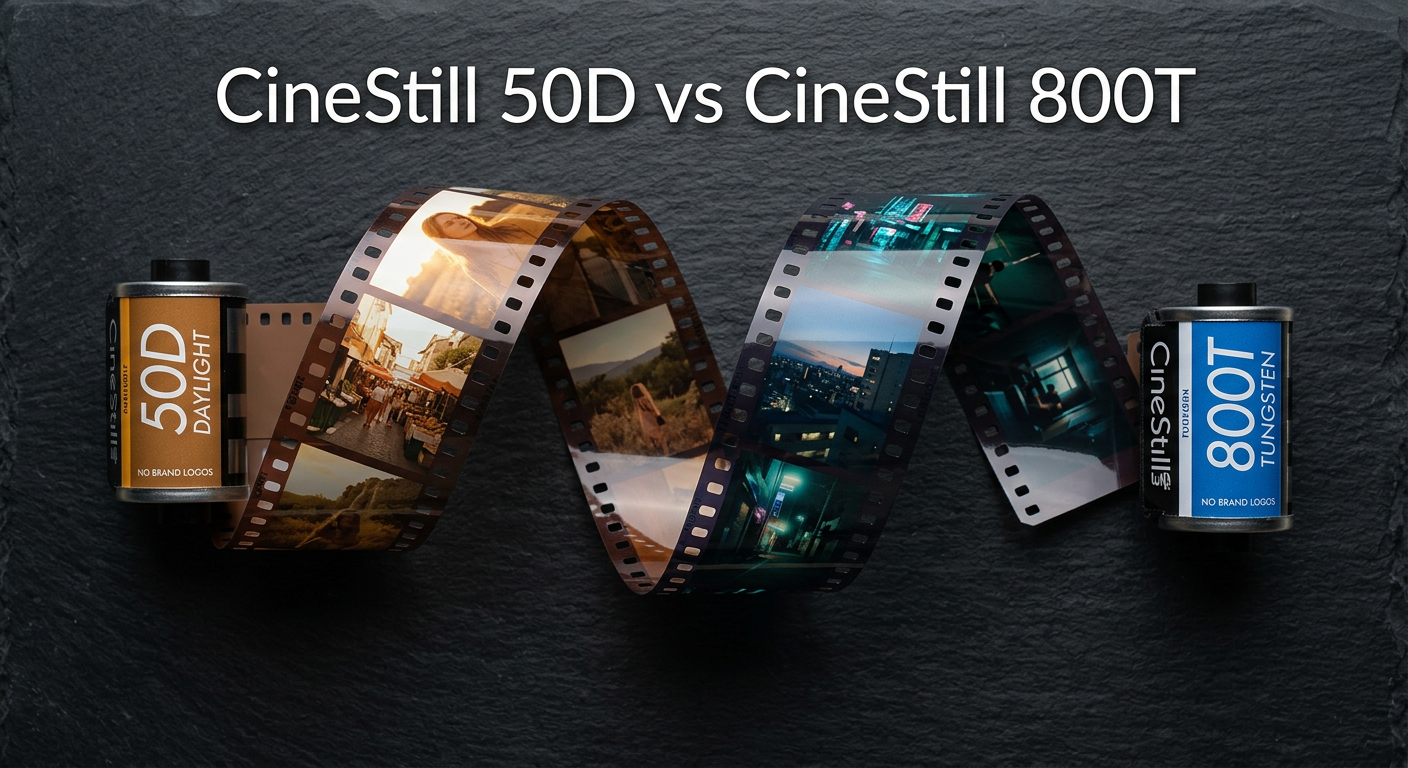
If you’ve been trying to decide between CineStill 50D vs CineStill 800T, you’re asking one of the most interesting questions in analog photography right now. Both are motion-picture-derived film stocks from the same company, built on the same Kodak Vision3 platform, yet they behave completely differently depending on when and where you shoot them.
The short answer: 50D wins in bright daylight for its stunning fine grain and rich color accuracy, while 800T dominates in low-light and artificial-light situations with its moody, cinematic halation glow. But the real answer depends on your subject matter, your lighting conditions, and how much of that dreamy neon-lit aesthetic you want in your work.
I’ve been shooting both of these films for a while now — 50D on landscape and street work, 800T for everything from neon-soaked city nights to indoor candlelight portraits — and I want to walk you through what I’ve learned. This comparison covers the technical differences, real-world shooting experience, halation behavior, push/pull capabilities, reciprocity failure (a topic most guides skip entirely), and who each film is actually for.
CineStill 50D vs CineStill 800T: Quick Comparison
Before we dig into the details, here’s where you can grab both films directly:
| Product | Specifications | Action |
|---|---|---|
 CineStill 50Daylight Fine Grain (ISO 50) Color Film, 36exp. 135 DX Coded
|
|
Check Latest Price |
 CineStill 800Tungsten High Speed (ISO 800) Color Film, 36exp. 135 DX Coded
|
|
Check Latest Price |
What Makes These Two Films So Different?
Both CineStill films share the same origin story: they’re Kodak Vision3 cinema film stocks that have had the Remjet backing removed so they can be developed in standard C-41 chemistry at any photo lab. That’s where the similarities end.
The 50D is based on Kodak Vision3 50D motion picture stock — a daylight-balanced (5500K) emulsion designed to render natural sunlit scenes with maximum sharpness and grain so fine it can almost pass for a digital capture in smaller prints. The 800T comes from Kodak Vision3 500T, tungsten-balanced at 3200K and pushed to ISO 800 for even more low-light versatility.
The Remjet removal is critical to understanding both films. Remjet is an anti-static, anti-halation backing on cinema film. When it’s removed, light that passes through the film base and reflects back from the film cartridge bleeds into the emulsion — that’s the famous halation glow you see around bright light sources. Both films exhibit some halation, but 800T’s effect is far more pronounced and dramatic due to its higher sensitivity and typical use in nighttime and artificial-light situations.
CineStill 50D: The Daylight Master
Pros
- Extremely fine grain for ultra-sharp results
- Beautiful accurate daylight color rendering
- Wide exposure latitude in highlights and shadows
- Compatible with any C-41 lab
- Unique halation adds character without overwhelming
Cons
- ISO 50 means you need plenty of light
- Not ideal for point-and-shoot cameras with small apertures
- Higher cost per roll
The first thing you notice when you get your 50D scans back is the grain — or rather, the near-total absence of it. At ISO 50, this film resolves detail in a way that genuinely surprises you. Shoot it in a good scanner like an Epson V700 or V800 and the level of fine texture you pull from a 35mm negative is remarkable.
I used 50D on a hiking trip through coastal Norway, shooting mostly in the golden hour and bright afternoon sun. The way it handled the transition from bright sky to shadowed cliffs in a single frame was exceptional — that “unrivaled highlight and shadow latitude” claim in the specs isn’t marketing copy. It’s real. I shot several frames at +1 stop and the highlights retained texture where slide film would have blown out completely.

CineStill 50D Color Rendering
The color reproduction of 50D in proper daylight is one of its best qualities. At 5500K, it’s balanced exactly for open sky and overcast light — the kind of conditions that make digital cameras work overtime with their white balance systems. On 50D, that light just looks right. Blues have depth, greens are verdant without being oversaturated, and skin tones come back warm and natural.
A common complaint on Reddit’s r/AnalogCommunity is that 50D colors can look muted in scans. I ran into this too until I realized the issue was scan settings, not the film. When your lab or home scanner applies aggressive automatic color correction, it can strip out the subtle, film-like tonal quality that makes 50D so appealing. If you’re scanning yourself, shoot a target or use a film-specific ICC profile and the colors come alive.
In studio conditions with daylight-balanced strobes, 50D is exceptional for portrait work. The grain structure makes skin look smooth without the clinical perfection of digital capture, and the slight warmth in the shadow roll-off gives portraits that unmistakable analog warmth that clients ask for by name.

CineStill 50D Shooting Tips
Because ISO 50 is quite slow, you need to think carefully about your setup. In bright sunlight you’ll be shooting around f/8-11 at 1/125s — totally manageable with a manual SLR or rangefinder. But as the light fades toward late afternoon, you’ll either need a tripod or accept some motion blur in your images.
Point-and-shoot cameras with fixed lenses around f/3.5-4.5 can shoot 50D in most daylight conditions, but you lose the ability to control exposure carefully. A camera with manual exposure control — like a Nikon FM2, Canon AE-1, or any of the older Leica M bodies — gives you the most out of this film’s impressive dynamic range.
The film is also available in 120 format for medium format cameras, and that’s where it truly shines. The combination of 50D’s ultra-fine grain and a 6×6 or 6×7 negative size produces images with a level of detail and tonal graduation that rivals some large format work. If you have a Mamiya RB67, Hasselblad, or Bronica, loading them with 120 50D is one of analog photography’s great pleasures.
CineStill 800T: The Night Photography Champion
Pros
- Excellent for night and low-light photography
- Stunning cinematic halation effect around lights
- Surprisingly low grain for ISO 800
- Beautiful tungsten-balanced color in artificial light
- Can be pushed to ISO 1600 or higher
Cons
- Strong blue cast outdoors without an 85B filter
- Colors can look unnatural in mixed lighting
- Requires filter and exposure adjustment for daylight use
CineStill 800T has a devoted following — and when you shoot your first roll on a rainy city night, you’ll understand exactly why. The tungsten balance at 3200K means that incandescent and LED light sources render in warm, natural tones rather than the orange-red cast you’d see on daylight-balanced film. Neon signs, streetlights, candles, and tungsten bulbs all look the way your eye perceives them, not the way a daylight meter measures them.
The film has an official EI (exposure index) of 800, but I’d argue the sweet spot depending on the situation can be anywhere from ISO 640 to ISO 1600. Push it one stop to 1600 and you gain critical versatility in very dark environments. The grain remains impressively tight — users on r/analog consistently note that 800T shows less grain than you’d expect from an 800-speed film, and that’s because the Vision3 500T base was an incredibly refined motion picture stock before CineStill processed it for still photography use.

The Halation Effect: What It Is and Why Shooters Love It
The halation effect is the defining characteristic of CineStill 800T and arguably the main reason people seek it out. When you photograph any bright light source — a streetlamp, a neon sign, car headlights, a candle — the light bleeds outward into a soft, dreamy red-orange glow around the source. This happens because the Remjet backing layer, which normally absorbs light after it passes through the emulsion, has been removed for C-41 compatibility.
On 50D, halation exists too, but it’s subtle — you’ll see it in high-contrast daylight scenes near specular highlights, but it doesn’t dominate the image. On 800T, especially in nighttime scenes with point light sources scattered across a dark frame, the halation becomes a full visual style. It’s the look that made CineStill famous, the look you’ve seen in film photography accounts on social media for years, and it’s completely real — no Photoshop involved.
Some photographers see halation as a flaw. I see it as a creative tool. If you want clean, neutral rendition of light sources, use 50D or switch to digital. If you want photographs that look like they belong in a 1990s French film or a contemporary indie music video, 800T’s halation effect is your best analog friend.

Shooting CineStill 800T in Daylight: The 85B Filter Question
One of the most common questions I see in film photography communities is whether you can shoot 800T outside in daylight. The answer is yes, but you need to manage the color balance carefully.
Because 800T is balanced for tungsten (3200K) light, shooting it under daylight (5500K) without correction produces a pronounced blue cast across the entire image. This can be a creative choice — some photographers deliberately use this to create cool, desaturated blue-toned images — but if you want more natural colors outdoors, you need an 85B warming filter.
The 85B filter shifts the color temperature from daylight to approximately tungsten range, correcting the blue cast and rendering more natural-looking images. The filter costs you about one stop of light, so CineStill recommends shooting 800T with an 85B filter at ISO 500. Some photographers rate it at ISO 400 with the filter for a slight exposure advantage.
Without the filter in daylight, expect heavy blue tones — especially in sky and shadow areas. It’s a specific look, and it works beautifully for certain types of images (think cold winter mornings or overcast coastal scenes) but it’s not universally flattering. For outdoor work where natural color accuracy matters, either use the 85B filter or stick with 50D.
CineStill 50D vs CineStill 800T: Head-to-Head Comparison
Having shot both films across a range of conditions, here’s how they compare across the categories that matter most to analog photographers.
Grain and Sharpness
50D wins this category without contest. ISO 50 produces one of the finest grain structures available in any 35mm color film on the market today. Under a loupe or at 100% in a high-resolution scan, the grain is barely visible — you’re getting maximum sharpness from your lens directly onto the film plane with almost no graininess to soften it.
800T at ISO 800 is actually impressive for its speed — the grain is well-structured and consistent rather than muddy — but it’s obviously grainier than 50D. In 35mm at 800, grain starts to show in open sky areas and smooth tonal gradients. Shoot 800T in 120 medium format and the grain becomes much less of an issue — the larger negative area distributes the grain structure across more real estate, and the result is beautiful.
Color Rendering
These films are made to look their best under very different light sources, and that’s the key to understanding their color behavior. Under the right conditions, each one produces colors that feel completely natural and pleasing. Under the wrong conditions, each one shows its limitations.
50D under daylight or daylight-balanced strobes: accurate, rich, slightly warm skin tones, excellent greens and blues, and a tonal range that handles both bright and dark areas gracefully. Shoot it under tungsten light without warming filtration and the entire image shifts cool and blue — the opposite problem of shooting 800T in daylight.
800T under tungsten, LED, and incandescent light: warm, cinematic, dimensional color that retains the mood of the scene. In mixed lighting situations (some daylight, some artificial), expect complex color interactions that can be beautiful or challenging depending on the scene. In pure daylight without an 85B, the heavy blue cast is the dominant feature.
Halation Character
Both films produce halation due to the Remjet removal, but the degree and visual character differ significantly. On 50D, halation is subtle — look for it near specular highlights on water, sun glinting off chrome, or bright windows in darker rooms. It adds film character without calling attention to itself.
On 800T, halation around point light sources in dark scenes is the signature look. Red-orange halos bloom around streetlamps, neon signs, and car headlights in ways that are immediately recognizable. If you’re chasing this look, 800T is the only color film that delivers it this dramatically in C-41 processing.
Dynamic Range and Exposure Latitude
Both films offer excellent exposure latitude by film standards, which is one of the advantages of the Kodak Vision3 base stock — designed for demanding cinema production conditions where exact exposure control isn’t always possible.
With 50D, I’ve had successful results shooting between 1 stop under and 2 stops over rated ISO. Overexposure is generally well-tolerated — highlight retention is strong and shadows open up gracefully. Underexpose significantly and you’ll lose shadow detail and see grain increase, but the image is usually still printable.
800T handles overexposure similarly well, and the latitude when pushing is one of its most impressive qualities. Community experience on r/analog and r/AnalogCommunity indicates that 800T shot at ISO 100-1600 with proper development adjustment gives consistent, usable results — that’s a genuinely wide operating range for a film stock.
Push/Pull Processing
Push processing — telling your lab to develop the film as though it were exposed at a higher ISO than rated — opens up creative possibilities on both films. Pull processing (treating overexposed film as a lower ISO) reduces contrast and can recover highlights.
50D pushed one stop to ISO 100 gives you a bit more grain and slightly increased contrast while retaining good color. Pushed two stops to ISO 200, grain becomes more visible but the images maintain character. Beyond +2, colors shift and grain becomes prominent — most photographers find the best results within +2 stops of box speed.
800T pushed one stop to ISO 1600 is a commonly used technique and one I rely on for very dark interior situations. The results hold up well — grain increases but stays structured, and the cinematic colors remain intact. Pushed to ISO 3200 (plus 2 stops), the results are grainier and show some color shift but can produce atmospheric, high-drama images when that’s what you’re after. The Darkroom lab, which specializes in CineStill, has published side-by-side comparisons of 800T at box speed versus pushed +3 stops, and the pushed results are impressively usable.
Format Availability: 35mm and 120
Both 50D and 800T are available in 35mm (36 exposures) and 120 medium format — a notable advantage over many specialty film stocks that only come in one format.
In 35mm, both films deliver their characteristic looks, with grain being a more prominent factor, particularly for 800T. For 50D in 35mm, the fine grain is so tight that the results are exceptional.
In 120, both films take a significant step up in quality. The grain becomes nearly invisible on 50D scans from a 6×6 or 6×7 negative. For 800T, 120 format softens the grain considerably and makes the halation effect look even more cinematic and less jagged. If you have a medium format camera, shooting 120 format is the way to experience both of these films at their maximum potential.
Development and Lab Compatibility
Both films use C-41 development — the standard color negative chemistry available at the vast majority of film labs worldwide. This is a major practical advantage over shooting actual cinema film (ECN-2 chemistry) or E-6 slide film, which require specialized labs and longer turnaround times.
Drop a roll of 50D or 800T into any mail-in lab like The Darkroom, Boutique Film Lab, or Film Rescue International, and they’ll handle it as a standard color negative. Most local one-hour labs can also process them, though quality control varies. If you want the best results, seek out a lab that has experience specifically with CineStill films, as the Remjet-free emulsion has slightly different handling characteristics than conventional C-41 films.
Both films can also be processed in ECN-2 chemistry if you have access to it or want to process at home, without worrying about Remjet removal (since CineStill has already removed it). This gives you additional flexibility if you’re building a home development setup.
Push/Pull Processing and Reciprocity Failure
Reciprocity Failure Explained
Reciprocity failure is one of those topics that barely appears in CineStill guides online — Reddit users in r/AnalogCommunity have mentioned searching for this information and coming up empty. Let me fill that gap.
Film’s stated ISO assumes that the reciprocal relationship between aperture and shutter speed holds in normal exposure conditions (roughly 1/1000s to 1 second). When you expose film for longer than about 1 second, the effective sensitivity of the emulsion drops — you need to give more exposure than the meter suggests to get a correct result. This is reciprocity failure.
For CineStill 50D: because it’s based on a cinema stock optimized for controlled studio lighting, reciprocity failure is minimal compared to traditional still film. At exposures up to about 2 seconds, you can shoot at metered settings. From 2-10 seconds, add approximately 1/3 to 1/2 stop. Beyond 10 seconds, add closer to a full stop and consider a test exposure first.
For CineStill 800T: the higher ISO means you’ll rarely be shooting exposures long enough to encounter significant reciprocity failure in most situations. At ISO 800 in the dark conditions where this film thrives, you’re usually working with exposures under 2 seconds even at moderate apertures. Where reciprocity becomes relevant is if you’re using 800T for very long exposures (star trails, light painting) — in those cases, apply similar compensation as 50D: add 1/3 to 1/2 stop for 2-10 second exposures, a full stop or more beyond that.
The Vision3 base these films share was engineered for cinema where exposures are always in the 1/24s to 1/48s range, so the reciprocity characteristics are better than many traditional still films. This makes both CineStill stocks well-suited for situations like long evening exposures that would heavily punish slower-speed emulsions.
Scanning and Post-Processing
Getting the most out of either CineStill film in the scanning process makes a meaningful difference to your final images. Flat scans without aggressive automatic corrections give you the most flexibility in post-processing.
For 50D, the main adjustment you’ll often need in post is a modest boost in saturation and clarity — the film’s fine grain and subtle color profile can look slightly flat directly from auto-corrected scans. Once you’re working with a flat scan and applying your own adjustments, the color depth opens up beautifully. The highlight latitude means you can recover quite a bit of detail in bright areas that look slightly overexposed in the scan preview.
For 800T, color grading is where you can really customize the look. At box speed in tungsten light, the film delivers its natural warm-balanced tones. If you want to push the cinematic quality further, a slight warm shift in the orange-red channel deepens the mood. For images shot in daylight without the 85B filter, you have a choice: correct the blue cast toward neutral in post, or lean into the cool tones for a specific aesthetic. Both approaches can look excellent depending on the image content.
Frequently Asked Questions
What is the difference between CineStill 50D and 800T?
CineStill 50D is a daylight-balanced (5500K) ISO 50 color negative film derived from Kodak Vision3 50D cinema stock. CineStill 800T is a tungsten-balanced (3200K) ISO 800 film derived from Kodak Vision3 500T. The key differences are ISO speed, color balance, and halation character: 50D excels in daylight with ultra-fine grain, while 800T is designed for low-light and artificial tungsten lighting with a more pronounced halation effect.
Can you shoot CineStill 800T outdoors?
Yes, you can shoot CineStill 800T outdoors, but the film’s tungsten balance (3200K) will produce a heavy blue cast in daylight without correction. CineStill recommends using an 85B warming filter when shooting outdoors and rating the film at ISO 500 rather than its box speed of 800 to compensate for the filter’s 1-stop light reduction. Without the filter, the blue cast becomes a deliberate creative choice that some photographers prefer for a cool, desaturated look.
What ISO should I shoot CineStill 50D at?
Shoot CineStill 50D at its rated ISO 50 for the best results in standard daylight conditions. The film has generous exposure latitude, so you can rate it at ISO 40 for a 1/3-stop overexposure that further improves shadow detail. For push processing, it can be rated at ISO 100 (push 1 stop) or ISO 200 (push 2 stops) with corresponding development adjustments at the lab, though grain increases with each push stop.
What is reciprocity failure for CineStill 50D and 800T?
Both CineStill films have relatively good reciprocity characteristics because they’re based on Kodak Vision3 cinema stock, which was engineered for precise frame rates rather than long exposures. For 50D, exposures up to 2 seconds require no compensation; from 2-10 seconds, add 1/3 to 1/2 stop of exposure. For 800T, its high ISO means most shooting situations don’t involve long enough exposures to trigger significant reciprocity failure, but for exposures over 2 seconds, apply the same 1/3 to 1/2 stop compensation as 50D.
CineStill 50D vs CineStill 800T: Final Verdict
After shooting both films across a wide range of situations, here’s my honest assessment of who should be reaching for each one.
Choose CineStill 50D if you shoot primarily in daylight conditions and want the finest grain, sharpest results, and most accurate color rendering available in a cinema-derived film stock. It’s exceptional for landscape work, travel photography, outdoor portraits, and any situation where you have plenty of light and want maximum image quality. The medium format version in 120 takes it to another level.
Choose CineStill 800T if night photography, indoor shooting, street work under artificial lights, or the cinematic halation aesthetic are central to your work. The higher ISO gives you versatility in challenging light, and no other color film delivers that signature halation glow around light sources in C-41 chemistry. Its 531 reviews and 4.7-star average tell you this film has earned its devoted following.
If you can only choose one and you shoot across different conditions, 800T is the more versatile choice day-to-day simply because of its higher ISO — you can use it in more situations. But if daylight shooting is your primary context, 50D’s image quality in those conditions is genuinely superior and worth the constraint of its slower speed.
The good news is that you don’t have to choose forever. Both films are available on Amazon, both develop at any C-41 lab, and both reward experimentation. Shoot a roll of each under your typical conditions and let your own results make the final call on the CineStill 50D vs CineStill 800T question for your style of work.