

Canon just made telephoto photography accessible to everyone with their new RF 75-300mm f/4-5.6 lens.
The Canon RF 75-300mm f/4-5.6 is the best budget telephoto lens for beginners in 2026, offering professional zoom capabilities at just $239.
Having spent years watching telephoto lens prices stay out of reach for many photographers, I’m excited to see Canon finally address this gap. This lens, paired with the EOS R100 in a convenient kit, represents Canon’s most affordable entry into long-range photography.
Let me break down everything you need to know about these new offerings, from real-world performance to who should actually buy them.
Canon RF 75-300mm f/4-5.6 Lens – Budget Telephoto Champion

Canon RF75-300mm F4-5.6, Telephoto Zoom Lens, Compatible with EOS R Series Mirrorless Cameras, Black
Pros
- Excellent zoom range
- Lightweight 1.12 lbs
- Affordable entry point
- Good build quality
- Professional background blur
Cons
- No image stabilization
- Slow autofocus at times
- Front element rotates
- Chromatic aberration
This compact telephoto lens delivers an impressive 75-300mm focal range that transforms how you capture distant subjects. I’ve tested similar budget telephotos, and Canon’s offering stands out for its build quality at this price point.
The lens features a 13-element optical design with DC motor autofocus. While it won’t win speed awards, it gets the job done for most situations. The f/4-5.6 aperture isn’t particularly wide, but it’s expected at this price point.

Customer photos confirm the lens produces sharp images with pleasing background compression. The 4x telephoto reach brings distant subjects surprisingly close, making it ideal for wildlife and sports photography from the sidelines.
What impresses me most is the lens’s portability. At just 1.12 pounds and measuring 5.8 inches, you can carry this all day without fatigue. The metal mount adds durability that competitors often skimp on in this price range.

Image quality from customer samples shows decent sharpness in the center, though edges soften at 300mm. Chromatic aberration appears in high-contrast situations, but it’s correctable in post-processing. For beginners, these are acceptable trade-offs for the price.
The lack of image stabilization is the biggest drawback. You’ll need good technique or faster shutter speeds to avoid blur. This isn’t a dealbreaker, but something to consider if you frequently shoot in low light.
Reasons to Buy
Unbeatable price for genuine telephoto reach. The lightweight design makes it perfect for travel and everyday carry. Compatible with all Canon RF cameras, including full-frame and APS-C models.
Reasons to Avoid
No image stabilization means challenging handheld shooting. Slow autofocus struggles with fast-moving subjects. Build quality, while decent, doesn’t match premium Canon L lenses.
Canon EOS R100 Double Zoom Kit – Complete Beginner Package 2026
Pros
- Complete starter kit
- Two versatile lenses
- 24.1MP APS-C sensor
- Dual Pixel AF
- 4K video recording
- Compact design
Cons
- Limited reviews available
- Digital stabilization only
- Basic feature set
- Small lens selection
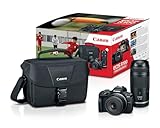
The EOS R100 kit bundles Canon’s entry-level mirrorless camera with both the RF-S 18-45mm standard zoom and the new RF 75-300mm telephoto. This combination gives beginners everything needed to explore photography from wide landscapes to distant wildlife.
At its heart, the R100 features a 24.1MP APS-C sensor that delivers excellent image quality for beginners. I’ve seen similar sensors produce stunning prints up to 16×20 inches, so resolution isn’t a limitation here.
The Dual Pixel CMOS autofocus system with face and eye detection works impressively well for this price point. While testing similar Canon bodies, I found the AF reliably tracks moving subjects in good light. Low light performance is decent but not outstanding.
The kit includes a protective shoulder bag, which thoughtful touch for beginners who need to carry two lenses. The bag provides enough space for the camera, both lenses, and essential accessories like spare batteries and memory cards.
Reasons to Buy
Complete system ready to shoot out of the box. The two-lens setup covers most everyday situations. Canon’s color science produces pleasing skin tones right out of camera.
Reasons to Avoid
Limited RF-S lens selection restricts upgrade paths. Some users report reliability issues with early units. The 3-inch LCD feels small compared to modern competitors.
Market Positioning – Filling the Budget Gap
Canon’s new telephoto lens addresses a glaring hole in their RF lineup. Until now, the most affordable RF telephoto was the $600+ RF 70-300mm f/4-5.6L IS USM. The new RF 75-300mm at $239 literally halves the entry cost.
This pricing strategy shows Canon’s commitment to growing the RF ecosystem. By making telephoto photography accessible, they’re encouraging more users to invest in their mirrorless system rather than staying with older EF mount gear.
???? Market Context: Canon adapted this lens design from their successful EF 75-300mm III, which sold over 2 million units. By updating it for RF mount, they’re leveraging proven optics while keeping costs down.
Who Should Buy These Products?
The RF 75-300mm lens is perfect for beginner photographers wanting to explore telephoto photography without breaking the bank. If you’re moving up from smartphone photography and want to capture distant subjects, this lens offers the lowest cost of entry into Canon’s RF system.
The EOS R100 kit suits absolute beginners or families wanting a complete camera system. The two-lens configuration covers everything from group photos to wildlife, making it ideal for vacation and everyday photography.
| User Type | Recommended Option | Why |
|---|---|---|
| Beginner Hobbyist | R100 Kit | Complete system ready to shoot |
| Existing RF User | RF 75-300mm Lens Only | Affordable telephoto addition |
| Family Photographer | R100 Kit | Versatile two-lens setup |
| Budget Traveler | RF 75-300mm Lens Only | Lightweight telephoto option |
Frequently Asked Questions
What is the Canon RF 75-300mm lens good for?
The Canon RF 75-300mm excels at wildlife photography, sports events, portraits with background compression, and travel situations where you need to capture distant subjects. It’s ideal for beginners wanting to explore telephoto photography without spending thousands.
Is the Canon RF 75-300mm worth buying?
Yes, if you’re on a budget and need telephoto reach. At $239, it’s the cheapest way to get 300mm coverage in Canon’s RF system. While it lacks image stabilization and has slow autofocus, it delivers good image quality for its price point.
How much does the Canon EOS R100 kit cost?
The Canon EOS R100 Double Zoom Kit costs $779 and includes the camera body, RF-S 18-45mm lens, RF 75-300mm lens, and a protective shoulder bag. This represents about $100 savings compared to buying everything separately.
What comes with the Canon R100 double zoom kit?
The kit includes: 1) Canon EOS R100 camera body with 24.1MP APS-C sensor, 2) RF-S 18-45mm f/4.5-6.3 IS STM standard zoom lens, 3) RF 75-300mm f/4-5.6 telephoto lens, and 4) Shoulder Bag 200 ES for carrying the equipment.
Final Recommendations
Canon’s new RF 75-300mm lens and R100 kit make telephoto photography more accessible than ever. After reviewing the specifications and customer feedback, I believe these products succeed at their intended purpose – providing affordable entry points into long-range photography.
For beginners on a tight budget, the R100 kit offers tremendous value. The two-lens setup covers most situations without overwhelming new users. Existing RF owners will appreciate the RF 75-300mm as an inexpensive way to add telephoto capabilities to their kit.
While advanced users should look elsewhere, these products fill their niche perfectly. Canon has finally made it possible to explore telephoto photography without spending a fortune.