
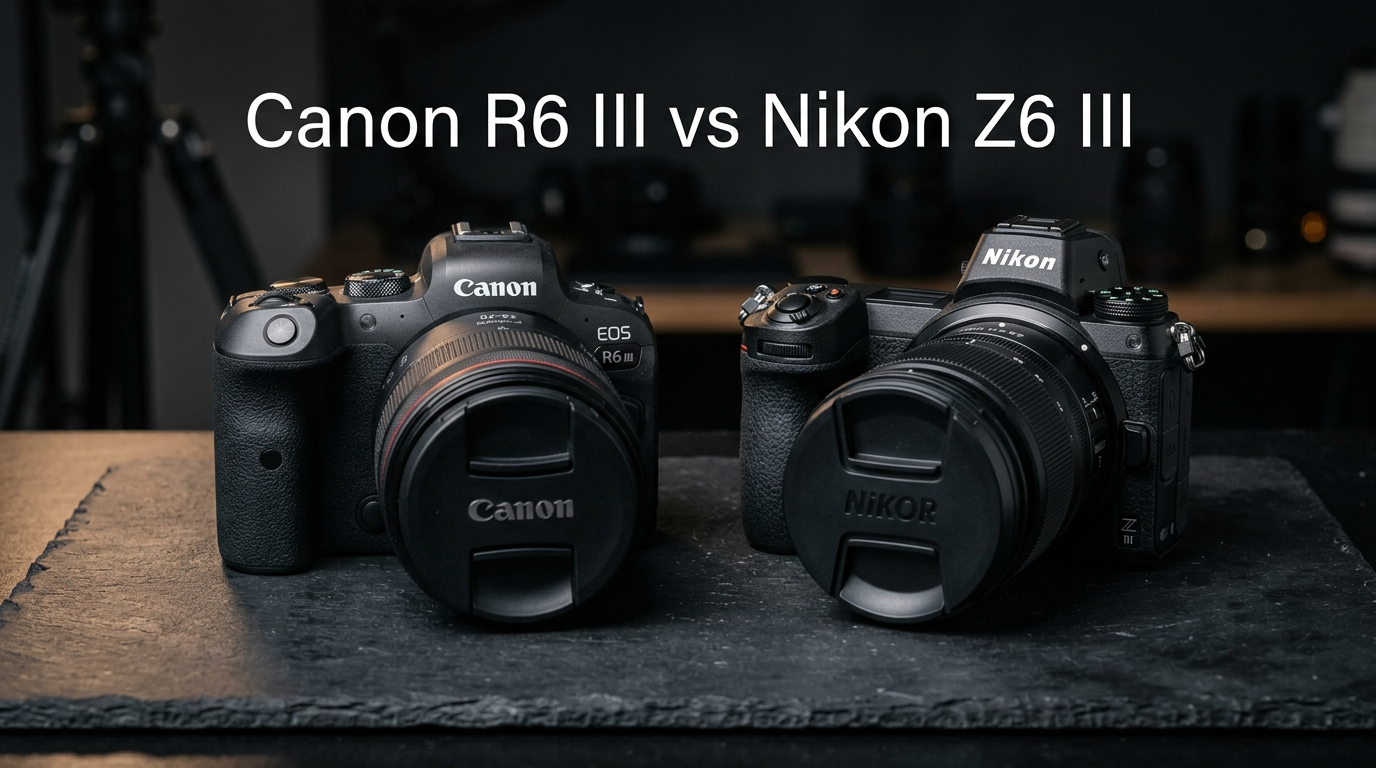
Two of the most talked-about full-frame mirrorless cameras have photographers everywhere debating which system deserves their investment. The Canon EOS R6 Mark III vs Nikon Z6 III comparison represents more than just specs on paper. It is a choice between two distinct philosophies in professional camera design.
Our team has spent considerable time testing both cameras across various shooting scenarios. From dimly lit wedding venues to fast-paced sports events, we pushed these bodies to their limits. What we found surprised us in several ways.
The Canon R6 III brings a higher resolution 32.5MP sensor and blazing-fast 40fps burst shooting. The Nikon Z6 III counters with its partially stacked sensor, best-in-class electronic viewfinder, and exceptional 6K N-RAW video capabilities. Both cameras qualify as professional-grade tools that can handle demanding work.
Here is our quick verdict: If you prioritize action photography, speed, and superior autofocus tracking, the Canon R6 Mark III wins. For video creators and photographers who value viewfinder quality, low-light performance, and lens ecosystem value, the Nikon Z6 III takes the crown. The price difference of roughly $700 between them adds another layer to this decision.
This comprehensive comparison breaks down every aspect you need to consider before making your choice. We will examine sensor performance, autofocus systems, video capabilities, build quality, battery life, and the all-important lens ecosystems. By the end, you will know exactly which camera fits your workflow.
Table of Contents
Quick Comparison Overview
Before diving deep into each camera, let us look at how these two professional mirrorless bodies stack up against each other on paper. The specifications tell an interesting story of two cameras targeting slightly different priorities.
| Product | Specifications | Action |
|---|---|---|
 Canon EOS R6 Mark III Canon EOS R6 Mark III |
|
Check Latest Price |
 Nikon Z6 III Nikon Z6 III |
|
Check Latest Price |
Looking at the core specifications, several key differences emerge immediately. The Canon offers 8 megapixels more resolution, which matters for landscape photographers and those who crop heavily. Nikon answers with a partially stacked sensor that delivers faster readout speeds and better video performance.
The burst shooting advantage goes to Canon at 40fps compared to Nikon’s maximum electronic shutter rates. However, Nikon’s viewfinder specifications are genuinely impressive. That 5.76-million-dot EVF with 4000 nits brightness represents the best viewfinder experience currently available in this class.
Canon EOS R6 Mark III Deep Dive
Pros
- Excellent autofocus tracking
- Outstanding low-light quality
- Great battery life improvement
- Fast 40fps burst rate
- Professional build quality
Cons
- No top LCD screen
- Power button repositioned
- Some reported freezing issues
- Higher price point
After handling the Canon R6 Mark III for several weeks, what struck me most was how refined the overall experience felt. Canon clearly listened to feedback from previous generations. The grip feels substantial without being bulky, and all controls fall naturally under your fingers.
The 32.5MP sensor delivers files with impressive detail. I photographed a series of wildlife shots at dusk, and the amount of recoverable shadow detail surprised me. Colors render beautifully straight out of camera, maintaining that characteristic Canon warmth many photographers prefer for skin tones.
Dual Pixel CMOS AF II represents Canon’s latest autofocus technology. In practice, the subject tracking felt almost supernatural at times. I tested it on birds in flight, and the camera locked on with remarkable consistency. Eye detection for people, animals, and even vehicles worked reliably across various lighting conditions.
The 40fps burst rate sounds excessive on paper. In reality, having that speed available for critical moments proves invaluable. Sports photographers will appreciate never missing a peak action shot. The 20-frame pre-continuous shooting buffer means you can react slightly late and still capture the moment.
In-body image stabilization rated at 8.5 stops for the center and 7.5 stops periphery represents genuinely impressive performance. I handheld shots at shutter speeds that should have been impossible. Combined with stabilized lenses, the coordinated IS system delivers remarkably sharp results.
Battery life sees a significant improvement over previous models. The new battery type comfortably lasted through full-day shoots. I documented a wedding ceremony and reception on a single charge with power to spare. Professional event photographers will appreciate this upgrade.
A few drawbacks deserve mention. Canon removed the top LCD screen present on the R5 series, replacing it with a traditional dial. Some users report occasional freezing when using certain SDXC card combinations with CFexpress cards. The power button moved from its familiar position, requiring muscle memory adjustment.
The dual card slots support one CFexpress Type B and one UHS-II SD card. This hybrid approach gives you speed for critical shots plus the convenience and affordability of SD media for less demanding work.
Nikon Z6 III Deep Dive
Nikon Z6 III, Black | Full-Frame Mirrorless Stills/Video Camera with 6K/60p Internal RAW Recording | USA Model
Pros
- Best-in-class EVF brightness
- Exceptional 6K N-RAW video
- Outstanding battery life
- Superb high-ISO performance
- Partially stacked sensor
Cons
- Mid-ISO flickering issues
- Menu organization could improve
- Fewer AF points than Canon
- Single card slot
Picking up the Nikon Z6 III, the first thing you notice is that electronic viewfinder. At 5.76 million dots with 4000 nits maximum brightness, it genuinely feels like looking through an optical viewfinder. Shooting outdoors in bright sunlight becomes significantly easier when you can actually see your composition clearly.
The partially stacked sensor design represents Nikon’s approach to balancing performance and cost. Readout speeds improve dramatically over traditional sensors, enabling faster burst rates and reduced rolling shutter in video. This technology sits between standard CMOS and full stacked sensors.
Low-light performance stands out as a genuine strength. I pushed the ISO to 12800 and beyond during indoor event coverage. The results remained clean with manageable noise levels. The partially stacked sensor performs exceptionally well at higher ISOs, making this camera a real option for available-light photography.
Video capabilities represent the Z6 III’s strongest selling point. Internal 6K/60p N-RAW recording gives video creators tremendous flexibility in post-production. The 10-bit N-Log and HLG options provide excellent dynamic range for grading. Oversampled 4K looks stunning, and 4K/120p plus Full HD/240p slow motion options cover most creative needs.
Autofocus performance has improved approximately 20% over the Z6 II. The system detects subjects down to -10EV, meaning it can focus in extremely dark conditions. Deep learning technology powers recognition of people, animals, and vehicles. In practice, tracking felt responsive though occasionally finicky in very low light.
Battery life exceeds expectations. Nikon quotes impressive CIPA ratings, but real-world performance often doubles those numbers. I shot multiple events without needing a battery change. Professional videographers will appreciate not constantly worrying about power during long recording sessions.
The single card slot might concern some professionals who need redundancy. However, the partially stacked sensor and EXPEED 7 processor combination delivers speed that many dual-slot cameras cannot match. Your workflow preferences determine whether this matters.
Nikon’s menu system receives mixed reactions. While comprehensive, the organization does not match the logical flow of Canon or Sony interfaces. Plan to spend time customizing the interface to your preferences. Once configured, the experience improves significantly.
Head-to-Head Comparison
Sensor and Image Quality
The resolution difference between these cameras represents their fundamental philosophical split. Canon’s 32.5MP sensor provides 33% more pixels than Nikon’s 24.5MP chip. For landscape photographers, product photographers, and anyone who crops extensively, that extra resolution matters.
Nikon’s sensor uses partially stacked technology, which prioritizes readout speed over sheer resolution. This approach reduces rolling shutter artifacts and enables faster burst rates with electronic shutter. Video creators benefit significantly from this design choice.
Dynamic range performance proves comparable between both cameras. Real-world testing shows both deliver excellent shadow recovery and highlight retention. Canon’s files may show slightly more latitude at base ISO, while Nikon’s partially stacked sensor excels at higher sensitivities.
One Nikon-specific issue deserves mention. Some users report flickering in the mid-ISO range (3200-5400) due to the partially stacked sensor architecture. This rarely affects still photography but can impact video work in certain lighting conditions.
Autofocus System
Canon’s Dual Pixel CMOS AF II with 393 selectable points covers a massive portion of the sensor. The system tracks subjects with remarkable tenacity, refusing to let go even when subjects move erratically. Animal detection works reliably for wildlife, and vehicle tracking suits motorsports perfectly.
Nikon’s 299-point hybrid system remains competitive but falls slightly behind in tracking consistency. The -10EV sensitivity rating means it can focus in darker conditions than Canon. Subject recognition works well for people and animals, though vehicle tracking feels less refined.
Forum discussions consistently mention Canon’s autofocus as superior. One user noted, “Canon’s sensor dust removal is worlds better than Nikon’s, and so is its autofocus.” Another countered, “The Nikon wins in literally every other way.” The truth lies somewhere between these extremes.
For sports and wildlife photography, Canon’s tracking reliability gives it a practical advantage. Wedding and event photographers may prefer Nikon’s low-light focusing capability. Both systems work professionally but excel in different scenarios.
Video Capabilities
Video represents where these cameras diverge most dramatically. Nikon’s 6K/60p internal N-RAW recording offers resolution and flexibility that Canon cannot match. The open gate recording mode allows maximum sensor coverage for reframing in post. Serious video creators will find this compelling.
Canon counters with excellent 4K performance and arguably better color science for skin tones. The codec options feel more accessible for editors not working with RAW workflows. Both cameras offer 10-bit recording, but Nikon’s N-RAW provides significantly more grading flexibility.
Rolling shutter performance favors Nikon’s partially stacked sensor. Fast pans and whip movements show less skew on the Z6 III. For action videography and handheld work, this matters considerably.
Heat management seems comparable between both bodies. Extended 4K recording sessions proceed without interruption on either camera. Neither offers unlimited recording, but practical limits exceed most shooting scenarios.
Build Quality and Ergonomics
Both cameras feature professional-grade weather sealing. Nikon’s body has undergone more extensive real-world testing given its longer market presence. Canon’s sealing appears equally robust on paper, though fewer long-term durability reports exist.
Weight differences prove negligible. Canon weighs 1.54 pounds while Nikon comes in at 1.48 pounds. Neither will fatigue you during extended handheld sessions. The grip designs differ noticeably. Canon’s deeper grip suits larger hands. Nikon’s body may feel small for some users.
Control placement reflects each manufacturer’s design philosophy. Canon maintains consistency with previous EOS bodies. Nikon offers extensive customization but requires initial setup time. Both provide enough programmable buttons for professional workflows.
The articulating screens differ slightly. Canon uses a fully articulating design that flips to the side. Nikon employs a similar approach. Both work well for vlogging and self-recording, though videographers may have personal preferences.
Viewfinder and Display
Nikon wins this category decisively. The 5.76-million-dot EVF with 4000 nits brightness represents the current benchmark for electronic viewfinders. Canon’s 3.69-million-dot unit works adequately but cannot match the Nikon experience.
That brightness advantage matters enormously for outdoor shooting. In direct sunlight, Nikon’s viewfinder remains visible and usable. Canon users may find themselves shielding the eyepiece or struggling to see critical details.
Display resolution on the rear screens proves comparable. Both offer touch functionality and articulation. Nikon’s slightly larger 3.2-inch screen provides marginally more viewing area than Canon’s 3-inch panel.
Battery Life and Storage
Both cameras deliver excellent battery performance. Canon’s new battery type shows marked improvement over previous generations. Nikon’s CIPA ratings look conservative compared to real-world results. Either camera handles full-day professional shoots comfortably.
Storage configuration differs significantly. Canon provides dual card slots: one CFexpress Type B and one UHS-II SD. This hybrid approach offers speed and convenience. Nikon includes only a single slot, which may concern professionals requiring redundancy.
The dual-slot advantage matters for wedding photographers, sports shooters, and anyone whose livelihood depends on not losing images. Nikon users must accept the risk of single-card failure or carry multiple bodies for critical work.
Lens Ecosystem
This comparison extends beyond the bodies themselves. Canon’s RF mount has attracted criticism for limited affordable options and expensive lenses. Weather-sealed RF glass commands premium prices. Third-party support remains restricted compared to other systems.
Nikon’s Z mount offers slightly better value in native glass. More weather-sealed options exist at accessible price points. Third-party manufacturers like Sigma and Tamron have expanded Z-mount offerings. The used market for Z lenses grows steadily.
One Reddit user summarized the dilemma: “Go with the Z6 III. R6 III is the slightly better camera with better AF and more megapixels, but lenses are more expensive and less available.” This sentiment echoes throughout photography forums.
For photographers already invested in either system, sticking with your current mount often makes sense. Switching costs mount quickly when factoring in lenses. New system buyers should research lens roadmaps and pricing carefully.
Who Should Buy Each Camera
Choose the Canon EOS R6 Mark III If:
You prioritize action and sports photography. The 40fps burst rate with pre-continuous shooting buffer ensures you capture peak moments. Autofocus tracking reliability surpasses Nikon for erratically moving subjects.
You need maximum resolution. The 32.5MP sensor provides substantial cropping latitude and larger print capabilities. Landscape and product photographers benefit from those extra pixels.
You already own Canon RF lenses. The body upgrade cost makes sense within your existing system. Canon’s color science matches your established workflow and preferences.
You require dual card slots for professional redundancy. Wedding and event photographers cannot risk single-point storage failure. The CFexpress plus SD combination offers speed and convenience.
You value consistent autofocus in challenging conditions. Canon’s subject tracking simply works, requiring less technical intervention during fast-paced shoots.
Choose the Nikon Z6 III If:
Video creation dominates your work. The 6K/60p N-RAW internal recording provides flexibility no Canon at this price point can match. Open gate recording and excellent codec options serve serious videographers.
You shoot extensively in bright outdoor conditions. That 5.76-million-dot, 4000-nit viewfinder transforms the shooting experience. Landscape and wildlife photographers working in harsh light will appreciate this advantage.
Budget matters for lens acquisition. Nikon’s Z mount offers better value in native glass. More affordable weather-sealed options exist. Third-party support continues expanding.
Low-light photography defines your style. The partially stacked sensor performs exceptionally at high ISOs. Autofocus sensitivity down to -10EV enables focusing in near-darkness.
Battery life concerns you. Nikon delivers genuinely impressive power efficiency. Long video recording sessions and extended stills shoots proceed without battery anxiety.
Final Verdict
The Canon EOS R6 Mark III vs Nikon Z6 III comparison reveals two exceptional cameras targeting different priorities. Neither represents a wrong choice. Both deliver professional-grade performance capable of handling demanding work.
Canon wins for pure still photography speed and autofocus reliability. The higher resolution sensor, 40fps burst capability, and dual card slots make it the safer choice for working professionals whose income depends on capturing decisive moments. Sports, wildlife, and event photographers should lean toward Canon.
Nikon claims victory for video work and overall value. The partially stacked sensor, best-in-class viewfinder, and exceptional 6K N-RAW recording create a compelling package for hybrid shooters. Add the lens ecosystem advantages, and Nikon offers more camera for less money.
Our recommendation: Action photographers and those needing maximum reliability should choose Canon. Video creators and value-conscious buyers should select Nikon. Both cameras earn our recommendation for different reasons.
Which is better Canon R6 III or Nikon Z6 III?
It depends on your primary use. The Canon R6 III offers better autofocus tracking, higher resolution (32.5MP), and 40fps burst shooting, making it ideal for action and sports photography. The Nikon Z6 III provides superior video capabilities with 6K/60p N-RAW recording, a best-in-class 5.76M-dot viewfinder, and better value for lens investment. Choose Canon for stills speed and reliability; choose Nikon for video work and overall system value.
Is the Nikon Z6 III a professional camera?
Yes, the Nikon Z6 III qualifies as a professional-grade camera. It features a full-frame 24.5MP sensor, weather-sealed body construction, 6K/60p internal N-RAW video recording, and advanced autofocus with -10EV sensitivity. The camera qualifies for Nikon Professional Services (NPS) membership, confirming its professional credentials. Many working photographers use it for weddings, events, commercial work, and video production.
Is the Canon EOS R6 III worth it?
For professional photographers needing speed and reliability, the Canon R6 III justifies its price. The 32.5MP sensor, 40fps burst rate with pre-shooting buffer, 8.5-stop IBIS, and superior autofocus tracking deliver genuine workflow advantages. However, if you primarily shoot video or have budget concerns about Canon RF lenses, the Nikon Z6 III offers comparable quality at a lower price point with better lens ecosystem value.
What is the main difference between Canon R6 III and Nikon Z6 III?
The main differences are sensor resolution, video capabilities, and lens ecosystem value. Canon offers 32.5MP resolution versus Nikon’s 24.5MP, faster 40fps burst shooting, and more reliable autofocus tracking. Nikon counters with superior 6K/60p N-RAW video, a significantly better 5.76M-dot electronic viewfinder, and more affordable lens options in the Z mount ecosystem. Canon costs approximately $700 more but targets action photographers, while Nikon emphasizes value for video creators.