
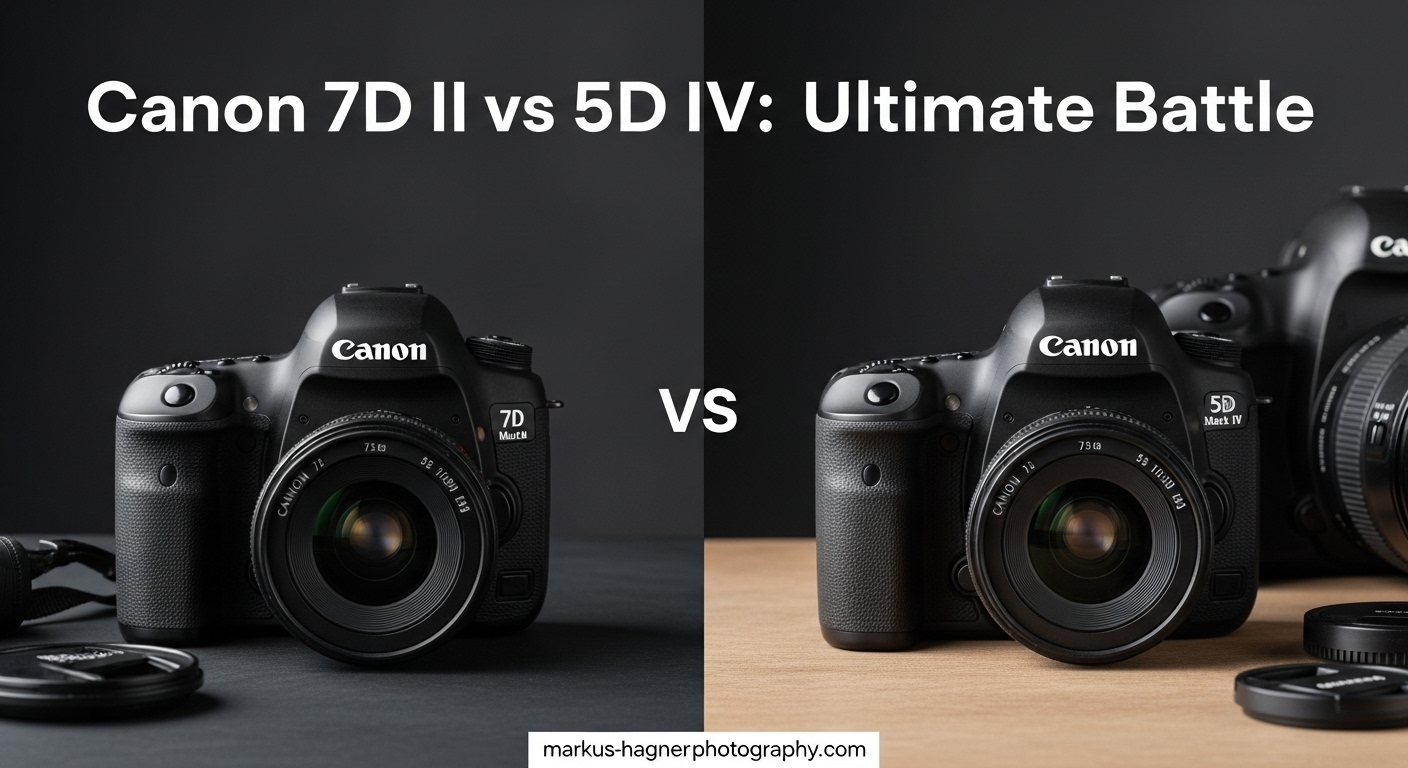
When it comes to choosing between the Canon 7D Mark II and the 5D Mark IV, photographers face a classic dilemma: crop-sensor speed versus full-frame versatility. As someone who’s shot extensively with both cameras, I can tell you that this isn’t a simple “which is better” question—it’s about which camera is better for YOU. In this comprehensive comparison, I’ll break down every aspect of these two popular Canon DSLRs to help you make an informed decision.
A Brief Introduction to Both Cameras
Before diving into the nitty-gritty details, let’s get acquainted with these two Canon powerhouses.
Canon 7D Mark II: The Crop-Sensor Champion
The Canon 7D Mark II, released in 2014, is Canon’s flagship APS-C crop-sensor DSLR. It’s built for speed and durability, targeting sports, wildlife, and action photographers who need a responsive camera that can keep up with fast-moving subjects. I remember when I first got my hands on the 7D Mark II—I was immediately impressed by its rugged feel and lightning-fast performance.
What sets the 7D Mark II apart is its focus on speed and precision. It’s not about having the largest sensor or the highest resolution; it’s about capturing the moment with accuracy and reliability. For photographers who prioritize performance over sensor size, the 7D Mark II has been a go-to choice for years.
Canon 5D Mark IV: The Full-Frame All-Rounder
The Canon 5D Mark IV, released in 2016, represents the fourth generation of Canon’s legendary 5D series. It’s a full-frame DSLR designed to be a versatile workhorse for professional photographers across various genres. When I upgraded to the 5D Mark IV, I was blown away by its image quality and the creative possibilities that the full-frame sensor unlocked.
The 5D series has a storied history in the photography world, with the original 5D Mark II revolutionizing digital photography. The Mark IV continues this legacy, offering a balance of resolution, low-light performance, and advanced features that make it suitable for everything from portraits to landscapes to weddings.
Head-to-Head Comparison
Now, let’s get down to business and compare these two cameras across several key factors.
Sensor and Image Quality
Canon 7D Mark II:
- 20.2 megapixel APS-C CMOS sensor (1.6x crop factor)
- Dual DIGIC 6 image processors
- ISO range: 100-16,000 (expandable to 51,200)
Canon 5D Mark IV:
- 30.4 megapixel full-frame CMOS sensor
- DIGIC 6+ image processor
- ISO range: 100-32,000 (expandable to 102,400)
The most significant difference between these two cameras is their sensor size. The 5D Mark IV’s full-frame sensor is approximately 2.6 times larger than the 7D Mark II’s APS-C sensor. This size difference has several implications:
Low-Light Performance: The larger pixels on the 5D Mark IV’s sensor can gather more light, resulting in better low-light performance. I’ve shot both cameras in dimly lit venues, and the 5D Mark IV consistently produces cleaner images with less noise at high ISOs. At ISO 6400, the 5D Mark IV maintains impressive detail and color accuracy, while the 7D Mark II shows more noticeable noise.
Depth of Field: The full-frame sensor of the 5D Mark IV provides shallower depth of field at equivalent apertures and focal lengths. This makes it easier to achieve that pleasing background separation that portrait photographers love. When I shoot portraits with the 5D Mark IV, I can create beautiful bokeh even at moderate apertures like f/4.
Resolution and Detail: With 30.4 megapixels versus 20.2, the 5D Mark IV captures more detail and allows for more aggressive cropping while maintaining image quality. This extra resolution is particularly beneficial for landscape and commercial photographers who need to produce large prints.
Crop Factor Advantage: The 7D Mark II’s 1.6x crop factor can be an advantage for wildlife and sports photographers. It effectively extends the reach of telephoto lenses, making distant subjects appear larger. A 200mm lens on the 7D Mark II provides the same field of view as a 320mm lens on the 5D Mark IV. I’ve found this crop factor invaluable when photographing birds and other distant wildlife.
Autofocus System
Canon 7D Mark II:
- 65-point all cross-type AF system
- Dual Pixel CMOS AF for live view and video
- AF sensitivity down to EV -3
- High-density reticular AF with customizable AF cases
Canon 5D Mark IV:
- 61-point AF system (41 cross-type, 5 dual cross-type)
- Dual Pixel CMOS AF with improved performance
- AF sensitivity down to EV -3
- AF area selection modes similar to 7D Mark II
Both cameras feature advanced autofocus systems, but there are some key differences:
AF Point Coverage: The 7D Mark II’s 65-point AF system covers a larger percentage of the frame (approximately 80% horizontally and vertically) compared to the 5D Mark IV’s 61-point system (about 70% horizontally and 50% vertically). This wider coverage can be advantageous when tracking moving subjects that occupy a significant portion of the frame.
AF Point Type: The 7D Mark II has 65 cross-type AF points, which are more sensitive and accurate than standard vertical or horizontal points. The 5D Mark IV has 41 cross-type points and 5 dual cross-type points (even more sensitive). While the 7D Mark II has more cross-type points overall, the 5D Mark IV’s dual cross-type points are exceptionally precise.
Real-World Performance: In my experience, both cameras offer excellent autofocus performance, but they excel in different scenarios. The 7D Mark II feels slightly snappier and more confident when tracking fast-moving subjects, making it ideal for sports and wildlife photography. The 5D Mark IV, while slightly slower in continuous tracking, offers more precision and reliability in low-light situations.
Customization: Both cameras offer extensive AF customization options, including adjustable tracking sensitivity, acceleration/deceleration tracking, and AF point auto switching. These features allow you to fine-tune the AF behavior to match your shooting style and subject matter.
Continuous Shooting Speed
Canon 7D Mark II:
- 10 frames per second (fps)
- Buffer capacity: Up to 31 RAW images or 1090 JPEG images
Canon 5D Mark IV:
- 7 frames per second (fps)
- Buffer capacity: Up to 21 RAW images or infinite JPEG images
The 7D Mark II is clearly the winner when it comes to speed, with its 10 fps continuous shooting rate compared to the 5D Mark IV’s 7 fps. This difference might not seem significant on paper, but in practice, it can be crucial when capturing decisive moments in sports or wildlife photography.
I’ve shot everything from football games to bird flight with both cameras, and the 7D Mark II’s higher frame rate has given me more options to choose from when selecting the perfect moment. The extra three frames per second can make the difference between capturing the peak action and missing it entirely.
However, the 5D Mark IV’s larger file sizes mean its buffer fills up faster when shooting RAW. While Canon claims “infinite” JPEG shooting, in reality, the camera will eventually slow down as the buffer fills. For extended bursts, the 7D Mark II has the advantage.
Build Quality and Ergonomics
Canon 7D Mark II:
- Magnesium alloy body
- Weather sealing (76 gaskets and seals)
- Dimensions: 148.6 × 112.4 × 78.2 mm
- Weight: 910g (body only)
Canon 5D Mark IV:
- Magnesium alloy body
- Weather sealing (enhanced over previous models)
- Dimensions: 150.7 × 116.4 × 75.9 mm
- Weight: 800g (body only)
Both cameras feature robust magnesium alloy construction and comprehensive weather sealing, making them suitable for professional use in challenging conditions. However, there are some differences worth noting:
Size and Weight: The 5D Mark IV is slightly larger but lighter than the 7D Mark II. While the difference might not seem significant, it can be noticeable during long shooting sessions. I’ve found the 5D Mark IV to be slightly more comfortable for handheld shooting over extended periods, while the 7D Mark II feels more compact and balanced with larger telephoto lenses.
Ergonomics: Both cameras feature excellent ergonomics with well-placed controls and comfortable grips. The 7D Mark II has a slightly deeper grip, which can be more comfortable for photographers with larger hands. The 5D Mark IV’s controls feel slightly more refined, with a smoother shutter button and more responsive dial resistance.
Durability: In my experience, both cameras have held up exceptionally well in various shooting conditions, from dusty deserts to humid rainforests. The 7D Mark II feels slightly more rugged, with its additional weather sealing points giving me more confidence when shooting in adverse conditions.
Viewfinder and LCD
Canon 7D Mark II:
- Pentaprism viewfinder with 100% coverage
- 1.0x magnification (with 50mm lens at infinity)
- 3.0-inch Clear View II LCD monitor (1,040,000 dots)
- Fixed touchscreen
Canon 5D Mark IV:
- Pentaprism viewfinder with 100% coverage
- 0.71x magnification (with 50mm lens at infinity)
- 3.2-inch Clear View II LCD monitor (1,620,000 dots)
- Touchscreen with touch and drag AF capability
Viewfinder Experience: The 5D Mark IV’s full-frame viewfinder provides a larger, brighter view compared to the 7D Mark II’s APS-C viewfinder. This difference is particularly noticeable when using wide-angle lenses, where the full-frame viewfinder gives a more immersive experience. However, the 7D Mark II’s viewfinder is still excellent and provides 100% coverage for accurate composition.
LCD Quality: The 5D Mark IV features a larger, higher-resolution LCD screen with more touch functionality. The touchscreen is particularly useful for selecting focus points in live view and navigating menus. I’ve found the 5D Mark IV’s touchscreen to be responsive and intuitive, while the 7D Mark II’s fixed touchscreen feels more limited in comparison.
Video Capabilities
Canon 7D Mark II:
- 1080p Full HD video up to 60fps
- MPEG-4 AVC/H.264 compression
- Manual exposure control in video mode
- No headphone jack or clean HDMI output
Canon 5D Mark IV:
- 4K video at 30fps (1.74x crop)
- 1080p Full HD video up to 60fps
- MP4 and MOV compression options
- Built-in headphone and microphone jacks
- Clean HDMI output
The 5D Mark IV is significantly more capable as a video camera, offering 4K recording and professional audio controls. While the 7D Mark II can produce high-quality 1080p footage, it lacks the advanced video features that make the 5D Mark IV a versatile hybrid camera.
4K Performance: The 5D Mark IV’s 4K video is impressive, with good detail and dynamic range. However, it’s worth noting that the 4K mode uses a 1.74x crop factor, which effectively turns a 50mm lens into an 87mm equivalent. This crop can be limiting for wide-angle videography but beneficial for telephoto work.
Full HD Performance: Both cameras produce excellent 1080p footage, but the 5D Mark IV has the edge with its improved Dual Pixel CMOS AF, which provides smoother, more reliable autofocus during video recording. The addition of a headphone jack on the 5D Mark IV also allows for accurate audio monitoring, which is crucial for professional video work.
Battery Life
Canon 7D Mark II:
- LP-E6N rechargeable lithium-ion battery
- Approximately 670 shots per charge (CIPA standard)
- Compatible with optional battery grip
Canon 5D Mark IV:
- LP-E6N rechargeable lithium-ion battery
- Approximately 900 shots per charge (CIPA standard)
- Compatible with optional battery grip
The 5D Mark IV offers significantly better battery life, with approximately 900 shots per charge compared to the 7D Mark II’s 670 shots. This difference can be crucial for event photographers who need to shoot for extended periods without changing batteries.
In my experience, both cameras exceed their CIPA ratings in real-world use, but the 5D Mark IV definitely has the advantage for all-day shooting. Both cameras are compatible with the same LP-E6N batteries and optional battery grips, which is convenient for photographers who own multiple Canon DSLRs.
Connectivity and Features
Canon 7D Mark II:
- Built-in GPS
- No built-in Wi-Fi or NFC
- USB 3.0 port
- Optional W-E1 Wi-Fi adapter
Canon 5D Mark IV:
- Built-in GPS
- Built-in Wi-Fi and NFC
- USB 3.0 port
- Bluetooth connectivity
- Built-in intervalometer
The 5D Mark IV offers significantly more connectivity options, including built-in Wi-Fi, NFC, and Bluetooth. These features make it easier to transfer images to mobile devices, control the camera remotely, and connect to various accessories. The built-in intervalometer is also a welcome addition for time-lapse photographers.
While the 7D Mark II has built-in GPS, it lacks wireless connectivity without the optional W-E1 adapter, which takes up the SD card slot. I’ve found the 5D Mark IV’s wireless capabilities to be incredibly useful for on-the-go image sharing and remote camera control.
Real-World Performance in Different Photography Genres
To give you a better idea of how these cameras perform in practice, let’s look at their suitability for different types of photography:
Sports and Action Photography
Canon 7D Mark II: The 7D Mark II excels in sports and action photography thanks to its fast continuous shooting speed (10 fps), advanced 65-point AF system, and 1.6x crop factor. The crop factor effectively extends the reach of telephoto lenses, making it easier to fill the frame with distant subjects. I’ve shot everything from football games to motorsports with the 7D Mark II, and its performance has been consistently impressive.
Canon 5D Mark IV: While the 5D Mark IV is no slouch in action photography, its slower continuous shooting speed (7 fps) and lack of crop factor put it at a disadvantage compared to the 7D Mark II. However, its superior low-light performance and higher resolution can be beneficial for indoor sports or situations where you need to crop extensively.
Winner: Canon 7D Mark II
Wildlife Photography
Canon 7D Mark II: For wildlife photography, the 7D Mark II’s crop factor is a significant advantage, effectively giving you more reach with telephoto lenses. Combined with its fast AF system and continuous shooting speed, it’s an excellent choice for capturing birds and other wildlife. I’ve used the 7D Mark II extensively for bird photography, and the extra reach has made a noticeable difference in my images.
Canon 5D Mark IV: The 5D Mark IV’s full-frame sensor provides better image quality, especially in low-light conditions, which can be crucial for wildlife photography at dawn or dusk. The higher resolution also allows for more aggressive cropping while maintaining image quality. However, you’ll need longer (and more expensive) lenses to achieve the same framing as the 7D Mark II.
Winner: Canon 7D Mark II (for reach), Canon 5D Mark IV (for image quality)
Also Read: EF-M 18-150mm vs 55-200mm
Portrait Photography
Canon 7D Mark II: While the 7D Mark II can certainly be used for portrait photography, its crop sensor makes it more challenging to achieve the shallow depth of field that many portrait photographers desire. You’ll need faster lenses or shoot from closer distances to achieve similar background blur as a full-frame camera.
Canon 5D Mark IV: The 5D Mark IV is an excellent portrait camera, thanks to its full-frame sensor, which makes it easier to achieve pleasing background separation. The higher resolution also captures more detail in skin tones and clothing, which is important for professional portrait work. I’ve shot numerous portrait sessions with the 5D Mark IV, and the image quality has consistently impressed me and my clients.
Winner: Canon 5D Mark IV
Landscape Photography
Canon 7D Mark II: The 7D Mark II can produce beautiful landscape images, but its crop sensor means you’ll need wider lenses to achieve the same field of view as a full-frame camera. The dynamic range is good but not quite on par with the 5D Mark IV.
Canon 5D Mark IV: With its full-frame sensor, higher resolution, and excellent dynamic range, the 5D Mark IV is an outstanding landscape camera. The larger sensor captures more detail in shadows and highlights, making it easier to recover information in post-processing. I’ve found that landscape images shot with the 5D Mark IV have a certain depth and clarity that’s hard to match with a crop sensor.
Winner: Canon 5D Mark IV
Wedding and Event Photography
Canon 7D Mark II: The 7D Mark II’s speed and reliability make it a viable option for wedding and event photography, especially as a second camera. Its fast AF system performs well in low-light conditions, and the build quality ensures it can withstand the demands of a long wedding day.
Canon 5D Mark IV: The 5D Mark IV is arguably one of the best wedding cameras available, offering an excellent balance of resolution, low-light performance, and reliability. The full-frame sensor provides beautiful image quality for both portraits and candid shots, while the advanced AF system ensures you won’t miss important moments. I’ve shot numerous weddings with the 5D Mark IV, and it has never let me down.
Winner: Canon 5D Mark IV
Price and Value Analysis
Canon 7D Mark II: As of September, the Canon 7D Mark II is priced at approximately $1,499 (body only). While it’s been on the market for several years, it still offers excellent value for photographers who need speed and durability without the cost of a full-frame system.
Canon 5D Mark IV: The Canon 5D Mark IV is priced at approximately $2,499 (body only), making it significantly more expensive than the 7D Mark II. However, considering its advanced features and full-frame sensor, many photographers find the additional cost justified.
Value Considerations: When evaluating the price difference, it’s important to consider the total system cost. Full-frame lenses are typically larger, heavier, and more expensive than their APS-C counterparts. If you’re building a system from scratch, the price difference between the two cameras will be amplified by the cost of lenses.
However, the 5D Mark IV’s higher resolution and better image quality can potentially save money on lenses, as you can crop more aggressively or use less expensive lenses while still achieving excellent results.
Who Should Buy Which Camera?
Based on my extensive experience with both cameras, here’s my recommendation for who should choose each:
Choose the Canon 7D Mark II If:
- You primarily shoot sports, wildlife, or action photography
- You need the fastest possible continuous shooting speed
- You want to maximize the reach of your telephoto lenses
- You’re on a tighter budget but still want professional-grade performance
- You prefer a smaller, lighter camera body
- You already own APS-C lenses and want to continue using them
Choose the Canon 5D Mark IV If:
- You shoot portraits, weddings, or landscapes
- You prioritize image quality and low-light performance
- You want the creative flexibility of a full-frame sensor
- You need a versatile camera that excels in various situations
- You shoot video and want 4K capability
- You’re willing to invest in a more expensive system for better image quality
Also Read: Olympus OM1 vs OM2
Personal Experiences with Both Cameras
Over the years, I’ve used both the Canon 7D Mark II and 5D Mark IV extensively in various shooting scenarios. Here are some of my personal observations:
I discovered the 7D Mark II’s true potential during a wildlife photography trip to Alaska. I was photographing bald eagles in flight, and the camera’s 10 fps continuous shooting speed and advanced AF system allowed me to capture incredible action sequences that would have been impossible with a slower camera. The 1.6x crop factor also gave me extra reach with my 400mm lens, allowing me to fill the frame with distant subjects.
When I first switched to the 5D Mark IV, I was immediately impressed by its image quality. During a portrait session, I was able to achieve beautiful background separation even with a relatively modest 85mm f/1.8 lens. The full-frame sensor provided a level of detail and dynamic range that I hadn’t experienced with crop-sensor cameras.
One of my most memorable experiences was shooting a wedding where I used both cameras as a two-body setup. I had the 7D Mark II with a 70-200mm lens for ceremony shots and the 5D Mark IV with a 35mm lens for reception images. This combination gave me the best of both worlds: the speed and reach of the 7D Mark II for distant shots and the image quality and low-light performance of the 5D Mark IV for intimate moments.
Pro Tips for Both Cameras
Whether you choose the 7D Mark II, 5D Mark IV, or a combination of both, here are some pro tips to help you get the most out of your camera:
For Canon 7D Mark II Users:
- Master the AF system: Take the time to learn and customize the AF cases for your specific shooting scenarios. The 7D Mark II’s AF system is incredibly capable when properly configured.
- Invest in quality glass: The 7D Mark II deserves high-quality lenses to take full advantage of its resolution and AF capabilities. Consider Canon’s L-series lenses or high-quality third-party options.
- Use the crop factor to your advantage: For wildlife and sports photography, the 1.6x crop factor is a benefit, not a limitation. Embrace it and choose lenses accordingly.
- Customize your controls: The 7D Mark II offers extensive customization options. Set up the camera to match your shooting style for maximum efficiency.
- Consider a battery grip: For extended shooting sessions, especially in vertical orientation, a battery grip can significantly improve comfort and battery life.
For Canon 5D Mark IV Users:
- Leverage the full-frame sensor: Experiment with shallow depth of field and wide-angle perspectives to take full advantage of the full-frame sensor.
- Master Dual Pixel RAW: The 5D Mark IV’s Dual Pixel RAW feature allows you to adjust focus point, bokeh, and even reduce ghosting in post-processing. It’s a powerful tool when used correctly.
- Utilize the touchscreen: The 5D Mark IV’s touchscreen is not just for menu navigation. Use it for quick focus point selection and touch-and-drag AF operation.
- Customize your picture styles: While RAW capture gives you maximum flexibility, customizing your in-camera picture styles can provide better previews and more accurate JPEGs.
- Explore 4K video: Even if you’re primarily a still photographer, experiment with the 5D Mark IV’s 4K video capabilities. You might discover new creative possibilities.
FAQ
Is the Canon 5D Mark IV worth the extra money over the 7D Mark II?
Whether the 5D Mark IV is worth the extra money depends on your specific needs. If you prioritize image quality, low-light performance, and a full-frame sensor, then yes, the 5D Mark IV is worth the additional cost. However, if you primarily shoot sports or wildlife and need speed and reach, the 7D Mark II offers better value for those specific purposes.
Can I use EF-S lenses on the 5D Mark IV?
No, the 5D Mark IV is a full-frame camera and cannot use EF-S lenses, which are designed specifically for APS-C crop-sensor cameras. However, you can use EF lenses on both the 5D Mark IV and the 7D Mark II.
Which camera is better for video?
The Canon 5D Mark IV is significantly better for video due to its 4K recording capability, built-in headphone jack, and improved Dual Pixel CMOS AF. While the 7D Mark II can produce high-quality 1080p video, it lacks the advanced video features of the 5D Mark IV.
Is the 7D Mark II still a good camera in 2026?
Yes, the Canon 7D Mark II is still a capable camera in 2026, especially for sports and wildlife photography. While it’s been on the market for several years, its speed, durability, and advanced AF system remain competitive. However, if you prioritize image quality and low-light performance, newer full-frame options like the 5D Mark IV might be more suitable.
Which camera has better low-light performance?
The Canon 5D Mark IV has significantly better low-light performance due to its full-frame sensor, which has larger pixels that can gather more light. The 5D Mark IV produces cleaner images with less noise at high ISO settings compared to the 7D Mark II.
Can I use the same batteries and accessories for both cameras?
Yes, both the Canon 7D Mark II and 5D Mark IV use the same LP-E6N batteries and are compatible with the same battery grips. This compatibility is convenient if you own both cameras or plan to upgrade from one to the other.
Which camera is better for a beginner?
For beginners, the Canon 7D Mark II might be overwhelming due to its complex autofocus system and numerous customization options. The 5D Mark IV, while more expensive, offers a more straightforward user experience while still providing room to grow as your skills develop. However, if you’re specifically interested in sports or wildlife photography, the 7D Mark II’s capabilities might be worth the learning curve.
Conclusion
After extensively using both the Canon 7D Mark II and 5D Mark IV in various scenarios, I can tell you that there’s no clear winner in this comparison—both cameras excel in different areas and are designed to meet different needs.
The Canon 7D Mark II is a specialized tool for photographers who prioritize speed, reach, and durability. It’s an excellent choice for sports, wildlife, and action photographers who need a camera that can keep up with fast-moving subjects. Its 1.6x crop factor is a significant advantage for telephoto work, and its 10 fps continuous shooting speed is still impressive even by today’s standards.
The Canon 5D Mark IV, on the other hand, is a versatile all-rounder that excels in almost any situation. Its full-frame sensor provides superior image quality, especially in low-light conditions, and its higher resolution allows for more flexibility in post-processing. It’s an excellent choice for portrait, wedding, and landscape photographers who demand the best possible image quality.
Ultimately, the best choice depends on your specific needs, shooting style, and budget. Many professional photographers, myself included, find that owning both cameras gives them the best of both worlds—speed and reach when needed, and image quality and versatility when that’s the priority.
Before making your decision, I recommend trying both cameras if possible. Rent them for a weekend and shoot with them in your typical scenarios. This hands-on experience will give you a much better sense of which camera feels right for you.
Remember, the best camera is the one that helps you achieve your creative vision. Whether that’s the Canon 7D Mark II, the 5D Mark IV, or a combination of both, the most important thing is to get out there and start creating!
If you found this comparison helpful, make sure to bookmark this page for future reference. I update it regularly with new information and real-world experiences as I continue to use both cameras. And don’t forget to check out my other articles on camera techniques and equipment reviews to help you make the most of whichever camera you choose.