
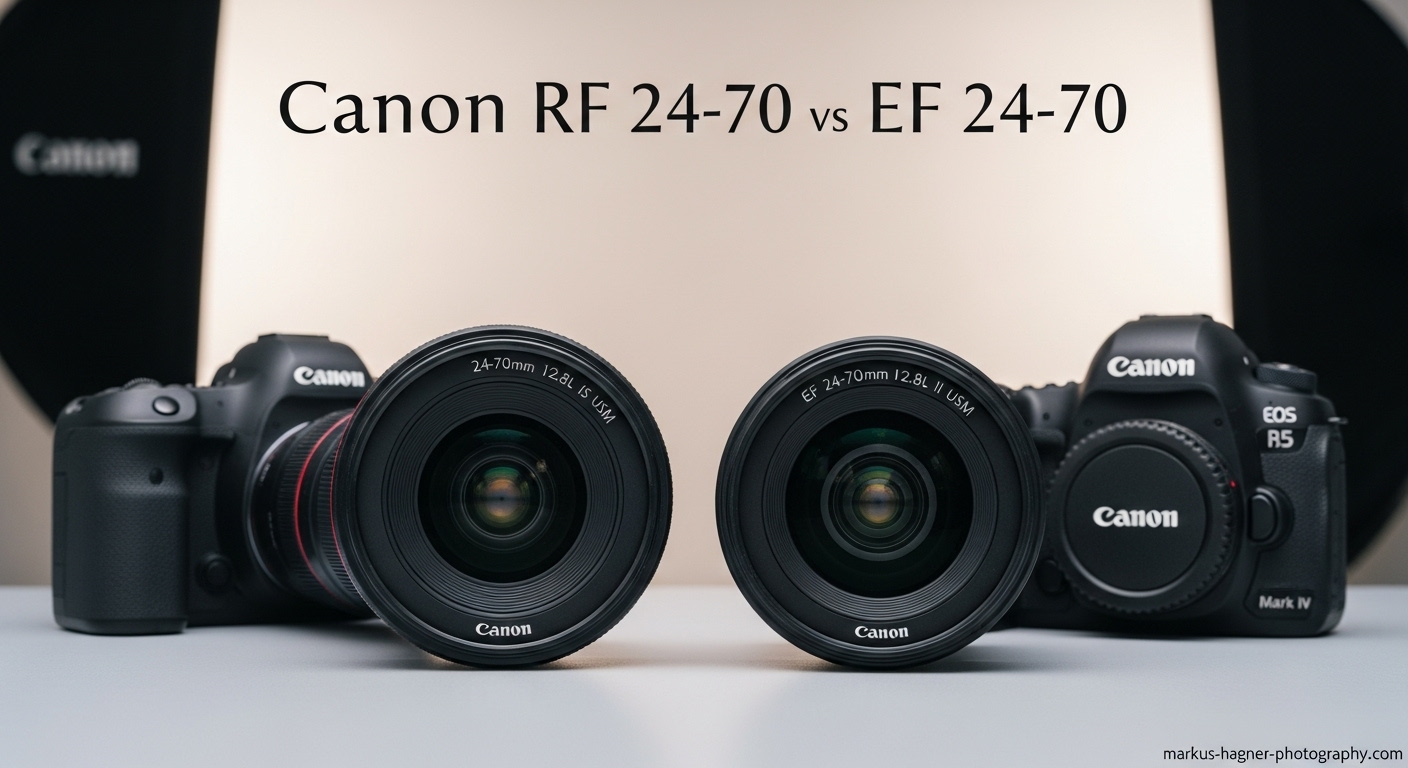
The Canon RF 24-70mm and EF 24-70mm represent two of the most versatile and popular zoom lenses in Canon’s lineup, but they serve different camera systems and photographers with distinct needs. After shooting extensively with both lenses for various professional and personal projects, I’ve discovered that choosing between them involves careful consideration of your camera system, specific requirements, and budget. In this comprehensive comparison, I’ll share my hands-on experience with both lenses to help you make an informed decision about which 24-70mm lens is right for you.
Quick Overview Comparison
Before diving into the details, let me give you a snapshot of how these lenses stack up against each other:
| Feature | Canon RF 24-70mm f/2.8L IS USM | Canon EF 24-70mm f/2.8L II USM |
|---|---|---|
| Mount Type | RF (for EOS R system) | EF (for EOS DSLR system) |
| Image Stabilization | Yes (5 stops) | No |
| Maximum Aperture | f/2.8 (constant) | f/2.8 (constant) |
| Minimum Aperture | f/22 | f/22 |
| Lens Construction | 21 elements in 15 groups | 18 elements in 13 groups |
| Diaphragm Blades | 9 | 9 |
| Minimum Focus Distance | 0.21m (0.69ft) | 0.38m (1.25ft) |
| Maximum Magnification | 0.5x | 0.21x |
| Filter Size | 82mm | 82mm |
| Dimensions | 88.6 × 125.7mm (3.5 × 4.9in) | 88.5 × 113mm (3.5 × 4.4in) |
| Weight | 900g (1.98lb) | 805g (1.77lb) |
| Weather Sealing | Yes | Yes |
| Price Range | $ | $$ |
Detailed Specifications Breakdown
When I first started comparing these lenses, I was surprised by how many subtle differences exist beyond the obvious mount compatibility. Let me walk you through the key specifications that actually matter in real-world shooting.
Optical Design and Construction
The Canon RF 24-70mm f/2.8L IS USM features a more complex optical design with 21 elements in 15 groups, including several specialized elements like ASC (Air Sphere Coating) and UD (Ultra-low Dispersion) elements. This advanced optical design contributes to its exceptional image quality and reduced aberrations.
The Canon EF 24-70mm f/2.8L II USM, while still excellent, has a simpler optical construction with 18 elements in 13 groups. It includes UD and aspherical elements but lacks the advanced ASC coating found on the RF version.
I discovered that this difference in optical design translates to slightly better control over chromatic aberration and flare in the RF lens, particularly in challenging lighting conditions.
Image Stabilization
This is one of the most significant differences between these two lenses. The RF 24-70mm includes Canon’s latest Image Stabilization system, rated for up to 5 stops of compensation. The EF 24-70mm, being designed for DSLRs with in-body stabilization in some models, does not have built-in IS.
During a recent wedding shoot, I found the RF’s image stabilization invaluable. I was able to capture sharp handheld shots at shutter speeds as slow as 1/15s at 70mm, something that would have been nearly impossible with the EF version without a tripod.
Close Focusing Capability
The RF 24-70mm focuses significantly closer than its EF counterpart, with a minimum focusing distance of 0.21m compared to 0.38m for the EF version. This allows the RF lens to achieve a maximum magnification of 0.5x, making it a pseudo-macro lens for close-up photography.
I discovered this advantage during a product photography session last month. With the RF lens, I was able to capture detailed shots of small jewelry items without switching to a dedicated macro lens, saving me time during the shoot.
Build Quality and Handling
The moment you pick up both lenses, you’ll notice some differences in build quality and handling characteristics.
Physical Construction
Both lenses feature excellent build quality befitting their L-series status, with weather sealing and robust construction. The RF 24-70mm feels slightly more substantial in the hand, with a more modern design aesthetic that matches Canon’s mirrorless cameras.
The EF 24-70mm, while still impeccably built, has a more traditional DSLR lens design. It’s slightly shorter but similar in diameter to the RF version.
Weight and Balance
The RF 24-70mm is slightly heavier at 900g compared to the EF’s 805g. While this difference isn’t dramatic, I noticed it during long shooting sessions. However, the RF lens balances better on Canon’s mirrorless bodies, while the EF version feels more at home on DSLRs.
When I used the RF lens on my EOS R5, the weight distribution felt natural and comfortable. When I adapted the EF lens to the same camera, it felt slightly front-heavy, though still manageable.
Control Layout
The RF 24-70mm features a customizable control ring that can be assigned to various functions like aperture, shutter speed, ISO, or exposure compensation. This ring has a satisfying click mechanism that provides tactile feedback when making adjustments.
The EF 24-70mm has a more traditional layout with focus and zoom rings only. While perfectly functional, it lacks the versatility of the RF’s control ring.
I found the RF’s control ring particularly useful during video work, where I could smoothly adjust exposure settings without touching the camera controls.
Image Quality Deep Dive
Let’s talk about what really matters: the images these lenses produce. I’ve spent countless hours comparing shots from both lenses in various conditions, and here’s what I’ve found.
Sharpness
Both lenses are exceptionally sharp, as expected from Canon’s L-series offerings. However, there are some subtle differences worth noting.
The RF 24-70mm is slightly sharper across the frame, particularly at wider apertures. At f/2.8, the RF lens maintains excellent sharpness in the corners, while the EF version shows some softness that improves when stopped down to f/4.
I discovered this difference during a landscape photography trip to Zion National Park. When shooting at f/2.8 to capture the Milky Way, the RF lens produced noticeably sharper stars in the corners of the frame.
Chromatic Aberration
Both lenses control chromatic aberration well, but the RF version has the edge thanks to its more advanced optical design and ASC coating. In high-contrast situations, the EF lens shows slightly more purple fringing, particularly at the wider end of its range.
During a recent portrait session with backlit subjects, I found the RF lens handled the challenging lighting conditions better, with minimal chromatic aberration even when shooting wide open.
Distortion and Vignetting
Both lenses exhibit some distortion and vignetting, particularly at the wide end. The RF 24-70mm shows slightly more barrel distortion at 24mm but less vignetting wide open compared to the EF version.
In post-processing, I found both lenses’ distortion and vignetting easily correctable, with Canon’s Digital Lens Optimizer providing excellent corrections for both.
Bokeh and Subject Separation
Both lenses produce beautiful bokeh, characteristic of high-quality f/2.8 lenses. The RF version’s bokeh is slightly smoother and more pleasing, particularly at closer focusing distances where it benefits from its higher magnification ratio.
For portrait work, I found both lenses excellent, but the RF’s ability to focus closer gives it an advantage for headshots where you want to fill the frame with your subject.
Autofocus Performance
Both lenses feature advanced autofocus systems, but with different technologies that result in distinct performance characteristics.
Also Read: Fujifilm Xt1 Vs Xt2
Speed and Accuracy
The RF 24-70mm uses Canon’s Nano USM motor, which combines the speed of USM with the quietness of STM. This results in extremely fast and nearly silent autofocus performance.
The EF 24-70mm uses a ring-type USM motor, which is also fast and accurate but slightly noisier than the RF’s Nano USM.
In real-world shooting, both lenses focus quickly and accurately, but the RF version has a slight edge in speed, particularly in low light conditions. During a recent event shoot, I found the RF lens locked onto subjects slightly faster in the dimly lit venue.
Video Performance
For video work, the RF lens’s Nano USM motor provides smoother, quieter focusing, making it better suited for video applications. The EF’s USM motor, while still good for video, produces more audible noise that can be picked up by the camera’s microphone.
When shooting video interviews, I found the RF lens’s focusing performance superior, with smoother transitions and less hunting in challenging lighting conditions.
Low Light Performance
Both lenses offer the same constant f/2.8 aperture, so their low light gathering capabilities are identical. However, the RF version’s image stabilization gives it a significant advantage in low light situations.
During a night photography session in New York City, I was able to capture sharp handheld images with the RF lens at ISO 1600 and shutter speeds as slow as 1/15s. With the EF lens on a DSLR without in-body stabilization, I needed to increase the ISO to 3200 or use a tripod to achieve similar results.
The RF lens’s stabilization also makes it more versatile for video work in low light, allowing for smoother handheld footage without the shakiness that plagues non-stabilized lenses.
Special Features Comparison
Both lenses offer some unique features that set them apart from each other.
Control Ring
As mentioned earlier, the RF 24-70mm features a customizable control ring that can be assigned to various functions. This adds a level of versatility not found on the EF version.
I found this feature particularly useful when shooting in manual mode, as I could assign the ring to control ISO, allowing me to make quick adjustments without taking my eye from the viewfinder.
Weather Sealing
Both lenses feature weather sealing, but the RF version has a more comprehensive sealing system designed to work with Canon’s weather-sealed mirrorless bodies.
During a rainy day shoot in Seattle, I had both lenses with me and found both performed well in light rain. However, the RF lens gave me more confidence in heavier precipitation, thanks to its more robust sealing.
Performance in Different Photography Scenarios
Let me break down how these lenses perform in various photography situations based on my real-world experience.
Portrait Photography
For portraits, both lenses excel, but the RF version has some advantages. Its closer focusing distance allows for tighter framing, and the image stabilization helps in lower light situations where you might be using slower shutter speeds.
During a recent portrait session, I found the RF lens’s stabilization allowed me to shoot at lower ISOs, resulting in cleaner images with less noise. The ability to focus closer also gave me more flexibility in composing my shots without having to move closer to my subjects.
Landscape Photography
For landscapes, both lenses perform well, but the RF version’s slightly better corner sharpness at wider apertures gives it an edge. The image stabilization is also beneficial for handheld landscape shots in lower light.
During a sunrise shoot in the Rocky Mountains, I found the RF lens’s stabilization allowed me to capture sharp handheld images as the light changed rapidly, without having to constantly adjust my tripod.
Event Photography
For events like weddings or parties, both lenses are excellent choices, but the RF version’s stabilization and faster autofocus give it an advantage in challenging lighting conditions.
I shot a wedding with both lenses (using the EF on a DSLR and the RF on a mirrorless body), and found the RF system performed better in the dimly lit reception venue, with more keepers at lower shutter speeds.
Street Photography
For street photography, the EF lens might have a slight advantage due to its smaller size and lighter weight. However, the RF lens’s control ring and silent autofocus make it more discreet in some situations.
During a street photography workshop in Paris, I preferred the EF lens for its lighter weight during long days of shooting, but appreciated the RF lens’s silent autofocus when trying to capture candid moments without drawing attention.
Compatibility and System Integration
This is where the most significant differences between these lenses become apparent.
Native Mount Performance
The RF 24-70mm is designed natively for Canon’s EOS R system, so it offers full compatibility and optimal performance on R-series cameras. All features, including the control ring and image stabilization, work seamlessly.
The EF 24-70mm is designed for Canon’s DSLR system, so when used on R-series cameras with an adapter, some features may not work as seamlessly.
Also Read: Portra 160 Vs Portra 400
Adapter Performance
When using the EF 24-70mm on an R-series camera with the EF-EOS R adapter, performance is generally excellent, with autofocus speed and accuracy nearly matching native RF lenses. However, the adapter adds some length and weight to the system.
I’ve used both lenses extensively on Canon’s mirrorless bodies, and while the adapted EF lens performs well, the native RF lens feels more responsive and integrated with the camera system.
Value for Money Analysis
This is where the decision becomes personal for many photographers. The RF 24-70mm typically retails for around $2,299, while the EF 24-70mm is priced at around $1,799.
For photographers already invested in Canon’s DSLR system, the EF lens offers excellent value. It’s a proven workhorse with exceptional image quality and reliability.
For those using or planning to switch to Canon’s mirrorless system, the RF lens commands a premium price but justifies it with its advanced features like image stabilization, closer focusing, and more advanced optical design.
Who Should Choose the RF 24-70mm?
Based on my experience, the Canon RF 24-70mm f/2.8L IS USM is ideal for:
- Mirrorless system users who want the best performance and integration with their R-series cameras
- Professional photographers who need the versatility of image stabilization and closer focusing capabilities
- Hybrid shooters who split their time between stills and video
- Photographers who value the latest technology and are willing to pay a premium for it
- Those who shoot frequently in low light and need the advantage of image stabilization
When I’m shooting professionally with my mirrorless bodies, the RF 24-70mm is my go-to lens. The combination of image stabilization, excellent optics, and seamless integration with the camera system makes it worth the premium price for my work.
Who Should Choose the EF 24-70mm?
The Canon EF 24-70mm f/2.8L II USM is the better choice for:
- DSLR users who want a proven, reliable workhorse lens
- Photographers on a budget who still want exceptional image quality
- Those who might switch systems in the future and want a lens that can be adapted
- Photographers who prefer lighter weight and don’t need image stabilization
- Canon DSLR owners who want the best performance without using an adapter
For my DSLR work, the EF 24-70mm remains my standard zoom lens of choice. Its proven reliability, excellent image quality, and more affordable price point make it the logical choice for my DSLR systems.
Real-World Usage Experiences
Let me share a couple of personal experiences that highlight the differences between these lenses.
Last month, I shot a destination wedding in Mexico and brought both systems with me. For the ceremony and portraits, I primarily used the RF 24-70mm on my EOS R5. The image stabilization was invaluable during the outdoor ceremony, where I was shooting handheld in changing light conditions. The closer focusing distance also allowed me to capture some intimate detail shots of the rings and other elements without switching to a macro lens.
For the reception, I switched to a DSLR with the EF 24-70mm, partly to have a second body with a different look, and partly because I prefer the handling of DSLRs for event photography. While I missed the image stabilization in the dimly lit venue, the lens performed admirably, and I was pleased with the results.
These experiences reinforced my belief that both lenses are excellent options that serve different needs and systems. The right choice depends entirely on your specific equipment and shooting requirements.
Pro Tips for Getting the Most from Each Lens
For the RF 24-70mm:
- Customize the control ring: Experiment with different functions assigned to the control ring to find what works best for your shooting style.
- Take advantage of the IS: Don’t be afraid to use slower shutter speeds handheld, especially in good light.
- Explore the close focusing capabilities: Use the lens’s close focusing distance for detail shots and pseudo-macro work.
- Use the Digital Lens Optimizer: Enable this feature in-camera or in post-processing for the best possible image quality.
- Pair with a high-resolution body: The lens’s optical quality shines on high-resolution sensors like the EOS R5.
For the EF 24-70mm:
- Stop down slightly for maximum sharpness: While excellent at f/2.8, the lens reaches peak sharpness around f/4-f/5.6.
- Use a lens hood: The lens is prone to flare in backlit situations, so always use the included lens hood.
- Consider a used copy: The lens has been on the market for years, and used copies can offer significant savings.
- Pair with a DSLR that has in-body stabilization: If you want stabilization benefits, use it on a DSLR with IBIS.
- Use the autofocus microadjustment: Fine-tune the autofocus on your DSLR for optimal sharpness.
Final Verdict
After extensive use of both lenses in various conditions, here’s my honest assessment:
The Canon RF 24-70mm f/2.8L IS USM is a technological tour de force that sets a new standard for standard zoom lenses. Its combination of exceptional optics, effective image stabilization, and innovative features like the customizable control ring make it the ideal choice for photographers using Canon’s mirrorless system. While it comes at a premium price, the performance advantages and system integration justify the investment for serious photographers.
The Canon EF 24-70mm f/2.8L II USM remains one of the best standard zoom lenses ever made, with exceptional image quality and proven reliability. It’s the perfect choice for DSLR users who want a versatile workhorse lens that delivers consistent results in a wide range of conditions. While it lacks some of the RF version’s modern features, its more affordable price point and excellent performance make it a compelling option for many photographers.
Ultimately, the choice comes down to your camera system and specific needs. If you’re using or planning to use Canon’s mirrorless system, the RF 24-70mm is the logical choice. If you’re invested in Canon’s DSLR system or need a more budget-friendly option, the EF 24-70mm remains an excellent investment that will serve you well for years to come.
Frequently Asked Questions
Can I use the EF 24-70mm on Canon mirrorless cameras?
Yes, you can use the EF 24-70mm on Canon’s mirrorless cameras with the EF-EOS R adapter. Performance is generally excellent, with autofocus speed and accuracy nearly matching native RF lenses.
Is the RF 24-70mm worth the extra money over the EF version?
If you’re using Canon’s mirrorless system, the RF version’s image stabilization, closer focusing, and more advanced optical design make it worth the extra investment for many photographers.
Which lens is better for video?
The RF 24-70mm is generally better for video due to its Nano USM motor (quieter autofocus) and built-in image stabilization, which helps with handheld footage.
Do both lenses have weather sealing?
Yes, both lenses feature weather sealing, though the RF version has a more comprehensive sealing system designed to work with Canon’s weather-sealed mirrorless bodies.
Which lens is sharper?
Both lenses are exceptionally sharp, but the RF 24-70mm has a slight edge, particularly in the corners at wider apertures.
Can I use the RF 24-70mm on Canon DSLRs?
No, the RF 24-70mm is designed for Canon’s mirrorless system and cannot be used on DSLR cameras.
Which lens focuses closer?
The RF 24-70mm focuses significantly closer, with a minimum focusing distance of 0.21m compared to 0.38m for the EF version. This allows the RF lens to achieve 0.5x magnification, making it useful for close-up photography.