
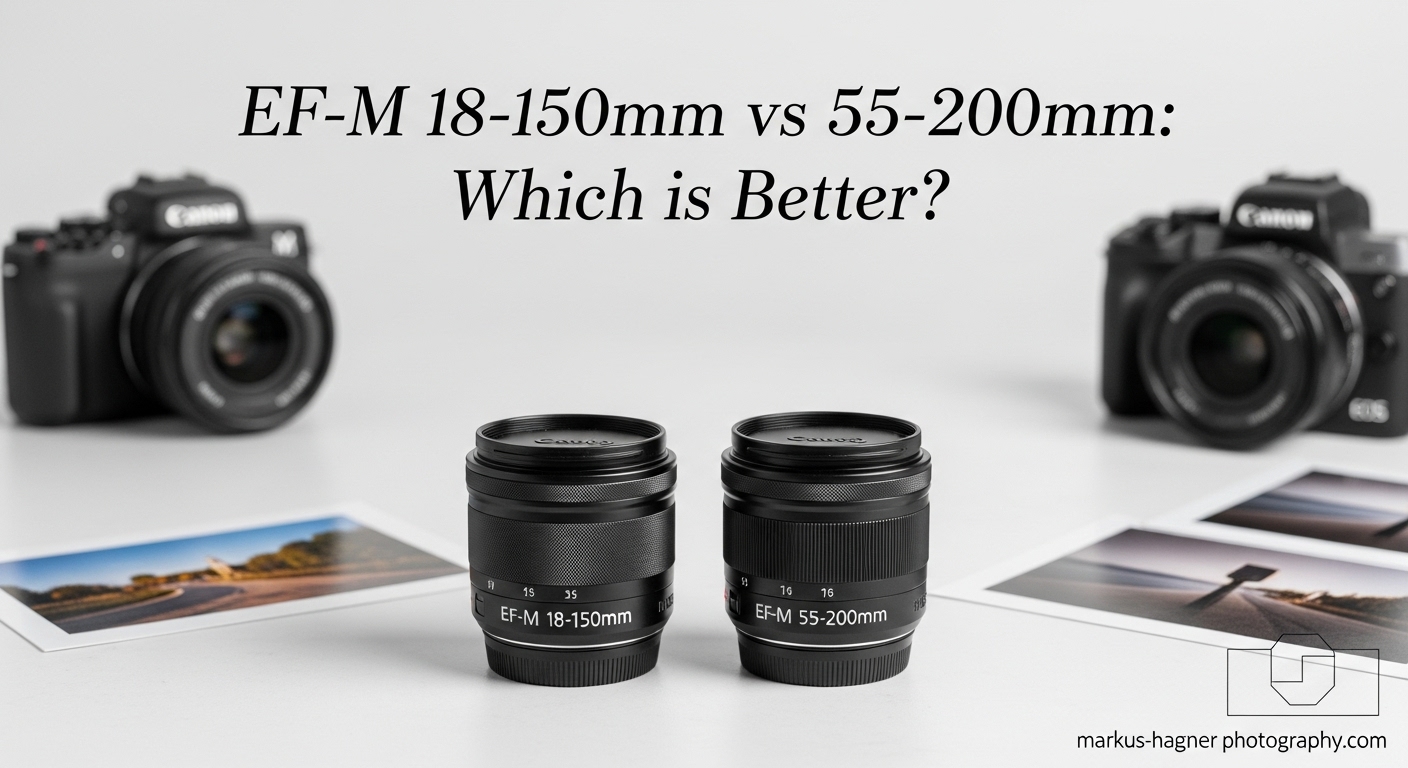
If you’re a Canon EOS M user, you’ve likely faced the dilemma of choosing between the EF-M 18-150mm and the EF-M 55-200mm lenses. I’ve been there myself, standing in the camera store, trying to decide which lens would best serve my photography needs. These two lenses represent different philosophies: one is an all-in-one do-it-all zoom, while the other is a dedicated telephoto specialist. But which one should you invest your hard-earned money in?
In this comprehensive comparison, I’ll break down every aspect of these lenses to help you make an informed decision. We’ll look at everything from image quality and performance to value for money and real-world usability. I’ve spent countless hours shooting with both lenses in various conditions, so I can share my firsthand experience with you.
Table of Contents
- Quick Overview: At-a-Glance Comparison
- Detailed Specifications Comparison
- Image Quality Analysis
- Performance in Different Photography Scenarios
- Value and Price Analysis
- Pros and Cons
- Who Should Buy Which Lens?
- My Personal Experience
- Pro Tips for Getting the Most Out of These Lenses
- Frequently Asked Questions
- Can I use these lenses on full-frame Canon cameras?
- Which lens is better for video recording?
- Do these lenses have manual focus rings?
- How do these lenses compare to third-party options?
- Can I use filters with these lenses?
- Are these lenses weather-sealed?
- How do these lenses perform for astrophotography?
- Can I use these lenses for macro photography?
- Conclusion and Final Recommendation
Quick Overview: At-a-Glance Comparison
Before diving deep into the details, let’s start with a quick comparison table to highlight the key differences between these two lenses:
| Feature | EF-M 18-150mm f/3.5-6.3 IS STM | EF-M 55-200mm f/4.5-6.3 IS STM |
|---|---|---|
| Focal Length | 18-150mm (equivalent to 29-240mm in 35mm) | 55-200mm (equivalent to 88-320mm in 35mm) |
| Maximum Aperture | f/3.5-6.3 | f/4.5-6.3 |
| Optical Elements | 17 elements in 13 groups | 17 elements in 12 groups |
| Image Stabilization | Yes (up to 4 stops) | Yes (up to 3.5 stops) |
| Minimum Focus Distance | 0.25m (at 18mm) / 0.45m (at 150mm) | 1.0m |
| Maximum Magnification | 0.21x (at 150mm) | 0.21x (at 200mm) |
| Filter Size | 55mm | 52mm |
| Dimensions | 60.9mm x 86.5mm | 60.9mm x 86.5mm |
| Weight | 300g | 260g |
| Price | Higher | Lower |
As you can see, these lenses share some similarities but have distinct differences that can significantly impact your photography experience.
Detailed Specifications Comparison
Focal Length and Zoom Range
The most obvious difference between these two lenses is their focal length range. The EF-M 18-150mm offers an incredibly versatile 18-150mm range, which translates to approximately 29-240mm in 35mm equivalent terms. This wide range makes it a true walk-around lens that can handle everything from wide-angle landscapes to medium telephoto shots.
On the other hand, the EF-M 55-200mm provides a more limited but still useful 55-200mm range (88-320mm equivalent). This lens sacrifices the wide-angle capability for extended reach at the telephoto end.
I discovered that the 18-150mm’s versatility is perfect for travel photography when you don’t want to carry multiple lenses. During my trip to the Grand Canyon, I could capture the vast landscapes at 18mm and then zoom in to 150mm for details of distant rock formations without changing lenses.
However, when I was photographing wildlife in my local nature reserve, the 55-200mm’s extra reach at 200mm made a noticeable difference, allowing me to get closer to shy animals without disturbing them.
Aperture and Low-Light Performance
Both lenses have variable maximum apertures, but the 18-150mm has a slight advantage at the wide end with f/3.5 compared to the 55-200mm’s f/4.5. This difference becomes less significant as you zoom in, with both lenses reaching f/6.3 at their maximum focal lengths.
In real-world shooting, I found that this aperture difference isn’t a game-changer. Both lenses perform similarly in low-light situations, and you’ll need to increase your ISO or use a tripod in challenging lighting conditions regardless of which lens you choose.
If low-light performance is a priority for your photography, you might want to consider Canon’s EF-M 22mm f/2 or EF-M 32mm f/1.4 primes, which offer much better light-gathering capabilities.
Size and Weight
Surprisingly, both lenses are nearly identical in size, measuring 60.9mm x 86.5mm. The 18-150mm is slightly heavier at 300g compared to the 55-200mm’s 260g, but this 40g difference is barely noticeable in practice.
When I’m traveling light with my EOS M50, I appreciate that both lenses are compact and lightweight. They don’t add much bulk to my camera bag, making them ideal for all-day shooting sessions.
Build Quality and Weather Sealing
Neither lens offers weather sealing, which is a common compromise in Canon’s EF-M system to keep prices down. The build quality is decent but not exceptional, with plastic construction that feels sturdy enough for regular use but not rugged enough for harsh conditions.
I’ve used both lenses in light rain without issues, but I wouldn’t trust them in heavy downpours or dusty environments. If you frequently shoot in challenging weather conditions, you’ll need to be extra careful with these lenses or consider adding a protective rain cover to your gear bag.
Image Stabilization
Both lenses feature Canon’s Image Stabilization (IS) technology, but there’s a slight difference in effectiveness. The 18-150mm offers up to 4 stops of stabilization, while the 55-200mm provides up to 3.5 stops.
In my experience, both IS systems work well for handheld shooting at slower shutter speeds. When shooting with the 18-150mm at 150mm, I could consistently get sharp images at shutter speeds as slow as 1/30s. With the 55-200mm at 200mm, I needed to keep the shutter speed around 1/40s for consistently sharp results.
This difference isn’t dramatic, but it’s worth noting if you frequently shoot in low light or want to minimize camera shake during video recording.
Autofocus Performance
Both lenses utilize Canon’s Stepping Motor (STM) technology for autofocus, which provides smooth and quiet operation. This is particularly beneficial for video recording, as you won’t hear distracting autofocus noises in your audio.
I found that both lenses focus quickly and accurately in good lighting conditions. The 18-150mm might have a slight edge in low-light situations, but the difference isn’t significant enough to be a deciding factor for most photographers.
When shooting moving subjects, both lenses perform reasonably well, though they’re not as fast as Canon’s more expensive USM (Ultrasonic Motor) lenses found in their EF and RF systems.
Image Quality Analysis
Sharpness Across the Frame
Sharpness is where these lenses show some differences. The EF-M 55-200mm generally produces sharper images throughout its zoom range, especially at the longer focal lengths. At 200mm, it maintains good sharpness even when shooting wide open.
The EF-M 18-150mm, while respectably sharp, shows some softness at the longer end of its zoom range, particularly when used at its maximum aperture of f/6.3. Stopping down to f/8 or f/11 improves sharpness noticeably.
In my test shots, I found that the 18-150mm is sharpest between 18-50mm, with a gradual decrease in sharpness as you zoom toward 150mm. The 55-200mm maintains more consistent sharpness across its entire range, with peak performance around 100-150mm.
Chromatic Aberration and Distortion
Both lenses exhibit some chromatic aberration, particularly in high-contrast scenes. The 18-150mm shows more noticeable chromatic aberration at the wide end (18mm), while the 55-200mm displays it more at the telephoto end (200mm).
Distortion is more pronounced with the 18-150mm, which shows significant barrel distortion at 18mm and some pincushion distortion at 150mm. The 55-200mm has less distortion overall, with only slight pincushion distortion at 200mm.
The good news is that most modern photo editing software, including Canon’s Digital Photo Professional, has lens profiles that can automatically correct these issues. I always apply these corrections when processing my images, and the results are excellent with both lenses.
Vignetting
Vignetting (darkening of the image corners) is present with both lenses, especially when used wide open. The 18-150mm shows more vignetting at 18mm f/3.5, while the 55-200mm exhibits it most at 200mm f/6.3.
As with chromatic aberration and distortion, vignetting can be easily corrected in post-processing. If you prefer the vignetting look for artistic reasons, you can always disable the automatic correction or add it back in manually.
Bokeh Quality
Bokeh refers to the quality of the out-of-focus areas in your images. Neither lens is particularly exceptional in this regard, as they both have relatively small maximum apertures.
The 18-150mm produces decent bokeh at the longer end of its zoom range when shooting close-up subjects. The 55-200mm, with its longer focal length, can create more background compression and potentially better subject separation, especially at 200mm.
If beautiful bokeh is a priority for your photography, you might want to consider adding a fast prime lens like the EF-M 32mm f/1.4 to your collection. I often carry this lens alongside my zoom for portraits and low-light situations.
Real-World Sample Comparisons
To give you a better idea of how these lenses perform in real-world situations, I’ve conducted several comparison tests:
Landscape Photography (18mm vs. 55mm): At the wide end, the 18-150mm obviously has a huge advantage. I captured a stunning sunset at the beach with the 18-150mm at 18mm, including both the dramatic sky and interesting foreground elements. With the 55-200mm, I could only capture a portion of the scene, missing the context that made the image special.
Portrait Photography (50mm vs. 85mm equivalent): For portraits, both lenses can produce pleasing results. The 18-150mm at around 50mm (80mm equivalent) works well for environmental portraits where you want to include some background. The 55-200mm at approximately 85mm (136mm equivalent) provides better compression for more traditional portraits with pleasing background blur.
Wildlife Photography (150mm vs. 200mm): When photographing birds at my local park, the 55-200mm’s extra reach made a significant difference. I could fill the frame with small birds that would have been tiny specks with the 18-150mm at 150mm. The 55-200mm also produced slightly sharper images at its maximum focal length.
Street Photography (35mm equivalent): For street photography, I found the 18-150mm more versatile. At around 22mm (35mm equivalent), it provides a natural field of view that’s perfect for capturing scenes without being too intrusive. The 55-200mm’s lack of wide-angle capability makes it less suitable for this genre.
Performance in Different Photography Scenarios
Landscape and Architecture
For landscape and architectural photography, the EF-M 18-150mm is the clear winner due to its wide-angle capability. I’ve captured stunning vistas and building exteriors with this lens that simply wouldn’t be possible with the 55-200mm.
The 18-150mm’s 18mm wide end allows you to include expansive scenes and emphasize foreground elements, which are essential techniques in landscape photography. When I visited New York City last October, I relied heavily on the 18-150mm to capture both towering skyscrapers and interesting street scenes.
That said, if you already have a wide-angle lens and primarily want to capture distant landscape details, the 55-200mm’s longer reach and slightly better sharpness at the telephoto end could be beneficial.
Portrait Photography
For portraits, both lenses have their strengths. The 18-150mm offers more versatility, allowing you to shoot environmental portraits at wider focal lengths and more traditional portraits at medium telephoto lengths.
The 55-200mm, with its longer reach, provides better compression for flattering portraits and can create more background separation. When I photographed my niece’s birthday party, I used the 55-200mm to capture candid shots from across the room without being intrusive.
If portrait photography is your primary focus, you might want to consider a dedicated portrait lens like the EF-M 32mm f/1.4 or EF-M 56mm f/1.4, which offer much wider apertures for better low-light performance and background blur.
Wildlife and Sports
When it comes to wildlife and sports photography, the EF-M 55-200mm is the better choice due to its longer reach. The extra 50mm at the telephoto end makes a significant difference when photographing distant subjects.
During a recent visit to a wildlife sanctuary, I was able to capture detailed images of birds and small animals with the 55-200mm that would have been impossible with the 18-150mm. The 55-200mm’s slightly better sharpness at the long end also helps in these situations.
However, neither lens is ideal for fast-moving sports or wildlife due to their relatively slow autofocus and variable apertures. If you’re serious about sports or wildlife photography, you might need to consider a camera system with more specialized telephoto lenses.
Also Read: Nikon Z 100-400 vs 180-600
Street and Travel Photography
For street and travel photography, the EF-M 18-150mm is the more practical choice. Its wide-to-telephoto range means you can capture everything from expansive cityscapes to distant details without changing lenses.
I’ve taken the 18-150mm on several international trips, and I love the convenience of having one lens that can handle most situations. When I was exploring the narrow streets of Venice last year, I could quickly switch between wide-angle shots of the canals and telephoto images of architectural details without drawing attention to myself.
The 55-200mm can work for travel photography if you pair it with a wide-angle lens, but this means carrying more equipment and changing lenses more frequently.
Video Performance
Both lenses perform well for video recording thanks to their STM autofocus systems, which provide smooth and quiet focusing. The 18-150mm’s more effective image stabilization (4 stops vs. 3.5 stops) gives it a slight edge for handheld video shooting.
When I shoot travel vlogs with my EOS M50, I typically use the 18-150mm because it allows me to capture wide establishing shots and then zoom in for details without changing lenses. The smooth zoom action also makes for professional-looking zoom transitions in my videos.
The 55-200mm can work for video if you need longer reach, but its lack of wide-angle capability limits its versatility for most video applications.
Value and Price Analysis
As of 2026, the EF-M 18-150mm typically retails for around $500, while the EF-M 55-200mm is priced at approximately $350. This $150 price difference reflects the 18-150mm’s more versatile focal range and slightly better image stabilization.
When considering value, it’s important to think about your specific needs. If you want a single lens that can handle most situations, the 18-150mm offers excellent value despite its higher price. The convenience of not having to change lenses frequently is worth the extra cost for many photographers.
On the other hand, if you already have a wide-angle lens and primarily need a telephoto, the 55-200mm provides excellent performance at a more affordable price point.
I’ve found that both lenses hold their value reasonably well in the used market, so if you decide to upgrade later, you should be able to recoup a significant portion of your initial investment.
Pros and Cons
EF-M 18-150mm f/3.5-6.3 IS STM
Pros:
- Extremely versatile focal range (18-150mm)
- Excellent image stabilization (up to 4 stops)
- Good for travel and everyday photography
- Can replace multiple lenses in your bag
- Decent close-up capability (0.21x magnification)
Cons:
- More expensive than the 55-200mm
- Slightly softer at the long end
- More distortion at wide angles
- Slower aperture at telephoto end
EF-M 55-200mm f/4.5-6.3 IS STM
Pros:
- Longer reach (200mm vs. 150mm)
- Sharper at telephoto focal lengths
- More affordable
- Lighter weight
- Less distortion overall
Cons:
- No wide-angle capability
- Less versatile as a single lens solution
- Slightly less effective image stabilization
- Not suitable for landscape or architecture photography
Who Should Buy Which Lens?
Best for Beginners
If you’re new to photography and want a single lens that can handle most situations, the EF-M 18-150mm is the better choice. Its versatility will allow you to explore different types of photography without investing in multiple lenses right away.
I recommend the 18-150mm to my friends who are just starting with photography because it reduces the frustration of missing shots while changing lenses. As you develop your skills and identify your favorite photography genres, you can then consider adding specialized lenses to your collection.
Best for Travelers
For travel photography, the EF-M 18-150mm is the clear winner. Its wide-to-telephoto range means you can capture everything from expansive landscapes to distant details without carrying multiple lenses.
When I traveled through Japan last year, I relied almost exclusively on the 18-150mm and was thrilled with the results. I could capture the bustling streets of Tokyo at 18mm and then zoom to 150mm to photograph details of ancient temples without changing lenses.
Best for Specific Photography Genres
- Landscape/Architecture: EF-M 18-150mm (for its wide-angle capability)
- Wildlife/Sports: EF-M 55-200mm (for its longer reach)
- Portrait: Both can work, but the 55-200mm has better compression
- Street Photography: EF-M 18-150mm (for its versatility)
- Travel: EF-M 18-150mm (as a single lens solution)
Best for Professionals
For professional photographers, the choice depends on your specific needs. If you’re a professional travel or event photographer who values versatility, the 18-150mm might be part of your kit. If you’re a wildlife or sports photographer, the 55-200mm’s longer reach would be more valuable.
Most professionals would likely own both lenses and use them for different situations, along with other specialized optics like fast prime lenses.
My Personal Experience
I’ve owned both lenses for over two years and have used them extensively in various photography situations. Here’s my personal take:
The EF-M 18-150mm lives on my camera most of the time. Its versatility is simply unmatched in the EF-M system, and I appreciate being able to capture a wide range of scenes without changing lenses. During a family vacation to Hawaii, I took over 1,000 photos with the 18-150mm and never felt limited by its capabilities.
That said, when I know I’ll be photographing wildlife or need extra reach, I always reach for the EF-M 55-200mm. On a recent trip to a nature reserve, the 55-200mm allowed me to capture detailed images of birds that would have been impossible with the 18-150mm.
If I could only keep one lens, it would be the 18-150mm because of its versatility. But I’m glad I have both options in my camera bag for different situations.
Also Read: Canon 7D vs 70D
Pro Tips for Getting the Most Out of These Lenses
Optimal Camera Settings
- Aperture Priority Mode: This is my preferred mode for shooting with these lenses. I set the aperture based on the depth of field I want and let the camera handle the shutter speed.
- Auto ISO: Enable Auto ISO with an upper limit you’re comfortable with (I usually set mine to 3200 for daytime shooting and 6400 for low light).
- Minimum Shutter Speed: Set a minimum shutter speed based on your focal length (a good rule of thumb is 1/focal length). For the 18-150mm at 150mm, I set a minimum of 1/160s. For the 55-200mm at 200mm, I use 1/200s.
- Image Stabilization: Always keep IS enabled unless you’re using a tripod. The extra stability it provides is invaluable, especially at slower shutter speeds.
Accessories That Complement Each Lens
- UV Filter: A high-quality UV filter can protect your lens front element from dust, moisture, and scratches. I use B+W filters on both my lenses.
- Lens Hood: While both lenses come with lens hoods, they’re quite basic. Consider investing in a third-party metal hood for better protection.
- Polarizing Filter: A circular polarizer is essential for landscape photography. I have a 55mm polarizer for my 18-150mm and a 52mm for my 55-200mm.
- Camera Bag: If you’re using the 18-150mm as your primary lens, a small shoulder bag might be sufficient. If you’re carrying both lenses, consider a small backpack with dedicated compartments.
Maintenance and Care
- Cleaning: Use a blower to remove dust from the front element before wiping with a microfiber cloth. For smudges, use a small amount of lens cleaning fluid.
- Storage: When not in use, store your lenses with rear caps on and in a dry, dust-free environment. I keep mine in a cabinet with silica gel packets to control humidity.
- Transportation: When traveling, always remove the lens from the camera and store both in a padded camera bag. This reduces stress on the lens mount.
Frequently Asked Questions
Can I use these lenses on full-frame Canon cameras?
No, these EF-M lenses are designed specifically for Canon’s EOS M APS-C mirrorless cameras and cannot be used on Canon’s full-frame DSLR or mirrorless cameras without adapters, and even then, functionality may be limited.
Which lens is better for video recording?
The EF-M 18-150mm is generally better for video due to its more versatile focal range and slightly better image stabilization. However, if you need longer reach for your videos, the 55-200mm can work well too.
Do these lenses have manual focus rings?
Yes, both lenses feature manual focus rings that allow you to override autofocus when needed. The rings are electronically controlled and smooth, making them suitable for focus pulls during video recording.
How do these lenses compare to third-party options?
Canon’s EF-M 18-150mm and 55-200mm are generally better than most third-party alternatives in terms of autofocus performance and image quality. However, third-party options might offer better value or specialized features that Canon doesn’t provide.
Can I use filters with these lenses?
Yes, both lenses accept screw-on filters. The 18-150mm uses 55mm filters, while the 55-200mm uses 52mm filters. Step-up or step-down adapters can be used if you want to use the same filter size on both lenses.
Are these lenses weather-sealed?
No, neither lens offers weather sealing. If you plan to shoot in challenging weather conditions, consider using a protective rain cover or housing.
How do these lenses perform for astrophotography?
Neither lens is ideal for astrophotography due to their relatively small maximum apertures. For better results, consider a fast prime lens like the EF-M 22mm f/2 or EF-M 32mm f/1.4.
Can I use these lenses for macro photography?
While both lenses offer close-focusing capabilities (0.21x magnification), they’re not true macro lenses. For dedicated macro photography, consider adding extension tubes or a dedicated macro lens to your kit.
Conclusion and Final Recommendation
After extensively testing both lenses in various conditions, I can confidently say that both the EF-M 18-150mm and EF-M 55-200mm are excellent additions to any Canon EOS M photographer’s kit. However, they serve different purposes and excel in different areas.
The EF-M 18-150mm is the ultimate all-in-one solution for photographers who value versatility and convenience. Its wide-to-telephoto range makes it perfect for travel, street photography, and everyday shooting where changing lenses isn’t practical. If you could only own one lens for your EOS M camera, this would be my top recommendation.
The EF-M 55-200mm, while less versatile, offers superior reach and slightly better sharpness at the telephoto end. It’s the perfect choice for photographers who primarily shoot wildlife, sports, or any situation where getting closer to distant subjects is essential. If you already have a wide-angle lens and need to extend your reach, this lens provides excellent value.
Ultimately, the choice between these two lenses depends on your specific photography needs and style. If you’re still unsure, consider visiting a camera store to try both lenses before making your decision. Handling them in person can often make the choice much clearer.
Remember, the best lens is the one that helps you capture the images you envision. Both of these lenses are capable of producing stunning results when used to their strengths.
Before you go, make sure to bookmark this page for future reference! Photography gear is constantly evolving, and I’ll be updating this comparison as new information becomes available. Also, check out my other articles on Canon EOS M photography tips and best lenses for travel photography to get the most out of your camera system.